ANTHROPOCENE
INTERACTING WITH THE ENVIRONMENT
BY
ANIKET MUKHERJEE
(IMTH 9TH SEMESTER)
Paul Crutzen (2000)
Naming the Anthropocene
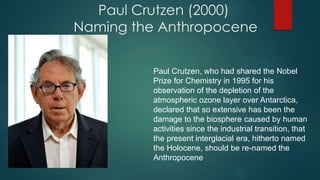
Paul Crutzen, who had shared the Nobel
Prize for Chemistry in 1995 for his
observation of the depletion of the
atmospheric ozone layer over Antarctica,
declared that so extensive has been the
damage to the biosphere caused by human
activities since the industrial transition, that
the present interglacial era, hitherto named
the Holocene, should be re-named the
Anthropocene
DEFINING THE ANTHROPOCENE
A period marked by a regime change in the activity of
industrial societies which began at the turn of the nineteenth
century and which has caused global disruptions in the Earth
System on a scale unprecedented in human history: climate
change, biodiversity loss, pollution of the sea, land and air,
resources depletion, land cover degradation, radical
transformation of the biosphere and the geosphere. These
phenomena call for a paradigm shift in the way we frame our
worldviews, and the methods we practice in our inhabitation of
the planet.
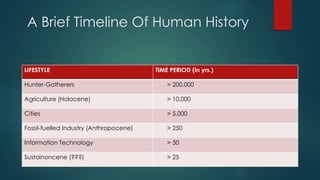
A Brief Timeline Of Human History
LIFESTYLE TIME PERIOD (in yrs.)
Hunter-Gatherers > 200,000
Agriculture (Holocene) > 10,000
Cities > 5,000
Fossil-fuelled Industry (Anthropocene) > 250
Information Technology > 50
Sustainoncene (???) > 25
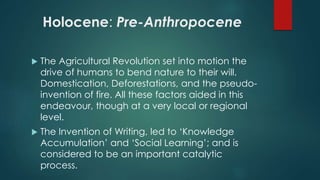
Holocene: Pre-Anthropocene
 The Agricultural Revolution set into motion the
drive of humans to bend nature to their will.
Domestication, Deforestations, and the pseudo-
invention of fire. All these factors aided in this
endeavour, though at a very local or regional
level.
 The Invention of Writing, led to ‘Knowledge
Accumulation’ and ‘Social Learning’; and is
considered to be an important catalytic
process.
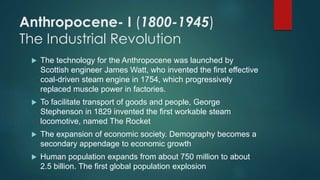
Anthropocene- I (1800-1945)
The Industrial Revolution
 The technology for the Anthropocene was launched by
Scottish engineer James Watt, who invented the first effective
coal-driven steam engine in 1754, which progressively
replaced muscle power in factories.
 To facilitate transport of goods and people, George
Stephenson in 1829 invented the first workable steam
locomotive, named The Rocket
 The expansion of economic society. Demography becomes a
secondary appendage to economic growth
 Human population expands from about 750 million to about
2.5 billion. The first global population explosion
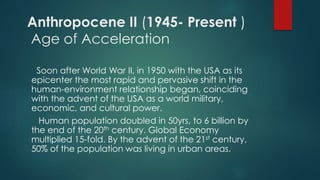
Anthropocene II (1945- Present )
Age of Acceleration
Soon after World War II, in 1950 with the USA as its
epicenter the most rapid and pervasive shift in the
human-environment relationship began, coinciding
with the advent of the USA as a world military,
economic, and cultural power.
Human population doubled in 50yrs, to 6 billion by
the end of the 20th century. Global Economy
multiplied 15-fold. By the advent of the 21st century,
50% of the population was living in urban areas.
Anthropocene III ( Present - Near
Future)
Sustainocene
 We are currently standing at a sort of crossroads.
 The one species that emerged from nature, to
becoming virtual masters of it.
 We have come a long way, from cowering on hearing
rumbling thunder and flashing lightning; to discussing
ways on harnessing nature to fulfil our energy needs, on
a global-scale.
 We have become a geo-physical force, battling the
forces of nature to establish our mastery over them.
Continued…….
 Human-induced change raises disturbing questions
about the future of Earth and the environmental services
that support human civilization.
 “The Earth is rapidly moving into a less biologically
diverse, less forested, much warmer, and probably
wetter and stormier state.”
 According to a growing section of environmentalists, it is
high time the current environmental model of ‘only
protection and preservation’ is overhauled by more
comprehensive ‘management model’
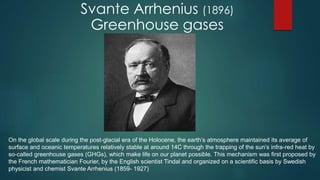
On the global scale during the post-glacial era of the Holocene, the earth’s atmosphere maintained its average of
surface and oceanic temperatures relatively stable at around 14C through the trapping of the sun’s infra-red heat by
so-called greenhouse gases (GHGs), which make life on our planet possible. This mechanism was first proposed by
the French mathematician Fourier, by the English scientist Tindal and organized on a scientific basis by Swedish
physicist and chemist Svante Arrhenius (1859- 1927)
Svante Arrhenius (1896)
Greenhouse gases
Characteristics of The
Anthropocene
 Huge prevalent nutrition gap.
 Excessive sugar intake….. Leading to obesity… and other
related disorders
 Homo sedentarius
 Species extinction, Ocean Acidification, Global Pollution
and Warming, Ozone Layer Depletion, Peak Fish and
Peak Oil.
 Continued Deforestation
 Neglecting both the potential in renewable energy
sources and sustainable housing and agricultural
practices
Impacts on Human Health
 Advantages:
1) Decreased maternal deaths. Double life expectancy.
2) Generally improved material living standards and improvements
in public health and medical care
 Disadvantages:
1) Epidemics, Emerging and Re-emerging infectious diseases,
Antibiotic resistance
2) Increasing cases of chronic alcohol and drug abuse
3) Perceived social and mental disorders, Emergence of new
cancer types
Impacts on Global Health
 Extreme weather events; Polar Vortexes;
Hyperthermia; Habitat Loss
 Emergence of both vector-borne and
water-borne diseases. Antibiotic
resistance.
 Economic collapse; The Great Recession;
Resource Wars.
Olduvai Theory of
Industrialisation
The rush for oil
extraction and fossil
fuel usage, starting
with James Watts’
invention of the
steam engine, and
plunges when the
oil reserves drop to
37%. This prediction
is the most extreme
one, but not
altogether
impossible.
Peak Oil
c. 1930 c. 2025
Pre-Industrial Phase [c. 3,000,000 BC to 1765]
A = Tool making begins (c. 3,000,000 BC)
B = Fire use begins (c. 1,000,000 BC)
C = Neolithic Agricultural Revolution (c. 8,000 BC)
D = Watt's steam engine, 1765
Interval D-E is a transition period.
Current Scenario in Brief
 Research is ongoing, particularly on
“interdisciplinary work on human-environment
systems”
 The emergence of The Internet as “a global self-
organizing information system”
 Democratic political systems and the
emergence of sustainable civil societies.
 The spread of free and open societies.
Road to The Future
 There are three ways by which the problems that
have arisen in the Anthropocene, can be
tackled:
1) Business-as-usual
2) Mitigation
3) Geo-engineering
A fourth option still under consideration is Social
Ecology and the concept of Re-inhabitation.
‘Business-As-Usual’ Scenario
 This model makes certain assumptions like:
 Human-driven changes do not disrupt global
economy and societies.
 The ‘market-oriented’ economic system can
adapt quickly to the rapidly changing
conditions
 Resources are still plentiful enough to mitigate
the damage already done, without significantly
making any changes.
Potential Risks
The long-term momentum built into the Earth
System means that:
By the time humans realize that a business-as-usual
approach may not work;
The world will be committed to further decades or
even centuries of environmental change.
Collapse of modern, globalized society under
uncontrollable environmental change is the one highly
likely outcome.
Mitigation Scenario
Improved technology and social
organization
Wiser use of resources
Control of human and animal
population
Conservation and restoration of the
environment
Continued…..
 Mitigation is currently the preferred option, as it does not
require a drastic overhaul of the entire global economic
system, but the one crucial factor in this particular scenario is
‘ENERGY’
 In addition to the many opportunities for energy
conservation, numerous technologies, from solar thermal and
photovoltaic through nuclear fission and fusion to wind power
and biofuels from forests and crops, are available now or are
under development to replace fossil fuels.
 Another factor which is stressed upon is dematerialisation. To
do more with less.
Geo-engineering Scenario
 The main objective of this scenario is the
sequestering of Carbon dioxide in underground
reservoirs, and the controlled release of aerosols
into the stratosphere to reflect the sun’s rays.
 But this scenario carries the huge risk of
‘unintended consequences’. The ethical
debates that are raging at the moment
mentions that the cures just might be worse than
the disease.
Sustainocene- Hoping for the
future
From 19th century of ancient, dirty, non-renewable
solar CAPITAL
To 21st century of clean renewable solar CURRENCY:
 Local: Building design and operation (insulation,
solar hot water, photovoltaics), biofuels
 Central: Solar Thermal Electricity (STE): covering
0.5% of deserts with mirrors focused on turbines
would meet all electricity needs.
Also geothermal; wind; waves; tides
Continued……
 Transport: From road to rail, from air to wind-assisted
ships; hybrid cars; biofuels from algae and crop
wastes, not from food crops or palm oil from cleared
forests; Solar or wind - generated H2 in fuel cells
 Agriculture: Cease land clearing; move to organic
agriculture for better water retention, less pesticides,
herbicides; local food production to reduce transport
costs
 Health: Equity of resources; healthy nutrition; more
use of muscle power; adaptation to inevitable global
warming.
Anthropocene v/s Sustainocene
(The Five "Ps")
POPULATION
POVERTY
POLLUTION
PROFIT
PREPARATION FOR WARFARE
(The Four "Es")
ENLIGHTENMENT
ECOLOGY
EDUCATION
ETHICS
The ABC of Enlightenment
Awe
Beauty
Caritas
CONCLUSION
I conclude by stating that at this point of time,
we are at a tipping point, it does not matter
what the next epoch is named. Rather what
we do in this epoch that will decide where
our world would go from here-on. Will we fulfil
the direst of scientific predictions or will we be
finally be at peace with the evolving planet,
that is our only home, is a question that still
remains to be answered.
THANK YOU
We have to save this
planet - It's the only one
with chocolate!

The Anthropocene

  • 1.
    ANTHROPOCENE INTERACTING WITH THEENVIRONMENT BY ANIKET MUKHERJEE (IMTH 9TH SEMESTER)
  • 2.
    Paul Crutzen (2000) Namingthe Anthropocene Paul Crutzen, who had shared the Nobel Prize for Chemistry in 1995 for his observation of the depletion of the atmospheric ozone layer over Antarctica, declared that so extensive has been the damage to the biosphere caused by human activities since the industrial transition, that the present interglacial era, hitherto named the Holocene, should be re-named the Anthropocene
  • 3.
    DEFINING THE ANTHROPOCENE Aperiod marked by a regime change in the activity of industrial societies which began at the turn of the nineteenth century and which has caused global disruptions in the Earth System on a scale unprecedented in human history: climate change, biodiversity loss, pollution of the sea, land and air, resources depletion, land cover degradation, radical transformation of the biosphere and the geosphere. These phenomena call for a paradigm shift in the way we frame our worldviews, and the methods we practice in our inhabitation of the planet.
  • 4.
    A Brief TimelineOf Human History LIFESTYLE TIME PERIOD (in yrs.) Hunter-Gatherers > 200,000 Agriculture (Holocene) > 10,000 Cities > 5,000 Fossil-fuelled Industry (Anthropocene) > 250 Information Technology > 50 Sustainoncene (???) > 25
  • 5.
    Holocene: Pre-Anthropocene  TheAgricultural Revolution set into motion the drive of humans to bend nature to their will. Domestication, Deforestations, and the pseudo- invention of fire. All these factors aided in this endeavour, though at a very local or regional level.  The Invention of Writing, led to ‘Knowledge Accumulation’ and ‘Social Learning’; and is considered to be an important catalytic process.
  • 6.
    Anthropocene- I (1800-1945) TheIndustrial Revolution  The technology for the Anthropocene was launched by Scottish engineer James Watt, who invented the first effective coal-driven steam engine in 1754, which progressively replaced muscle power in factories.  To facilitate transport of goods and people, George Stephenson in 1829 invented the first workable steam locomotive, named The Rocket  The expansion of economic society. Demography becomes a secondary appendage to economic growth  Human population expands from about 750 million to about 2.5 billion. The first global population explosion
  • 7.
    Anthropocene II (1945-Present ) Age of Acceleration Soon after World War II, in 1950 with the USA as its epicenter the most rapid and pervasive shift in the human-environment relationship began, coinciding with the advent of the USA as a world military, economic, and cultural power. Human population doubled in 50yrs, to 6 billion by the end of the 20th century. Global Economy multiplied 15-fold. By the advent of the 21st century, 50% of the population was living in urban areas.
  • 8.
    Anthropocene III (Present - Near Future) Sustainocene  We are currently standing at a sort of crossroads.  The one species that emerged from nature, to becoming virtual masters of it.  We have come a long way, from cowering on hearing rumbling thunder and flashing lightning; to discussing ways on harnessing nature to fulfil our energy needs, on a global-scale.  We have become a geo-physical force, battling the forces of nature to establish our mastery over them.
  • 9.
    Continued…….  Human-induced changeraises disturbing questions about the future of Earth and the environmental services that support human civilization.  “The Earth is rapidly moving into a less biologically diverse, less forested, much warmer, and probably wetter and stormier state.”  According to a growing section of environmentalists, it is high time the current environmental model of ‘only protection and preservation’ is overhauled by more comprehensive ‘management model’
  • 10.
    On the globalscale during the post-glacial era of the Holocene, the earth’s atmosphere maintained its average of surface and oceanic temperatures relatively stable at around 14C through the trapping of the sun’s infra-red heat by so-called greenhouse gases (GHGs), which make life on our planet possible. This mechanism was first proposed by the French mathematician Fourier, by the English scientist Tindal and organized on a scientific basis by Swedish physicist and chemist Svante Arrhenius (1859- 1927) Svante Arrhenius (1896) Greenhouse gases
  • 11.
    Characteristics of The Anthropocene Huge prevalent nutrition gap.  Excessive sugar intake….. Leading to obesity… and other related disorders  Homo sedentarius  Species extinction, Ocean Acidification, Global Pollution and Warming, Ozone Layer Depletion, Peak Fish and Peak Oil.  Continued Deforestation  Neglecting both the potential in renewable energy sources and sustainable housing and agricultural practices
  • 12.
    Impacts on HumanHealth  Advantages: 1) Decreased maternal deaths. Double life expectancy. 2) Generally improved material living standards and improvements in public health and medical care  Disadvantages: 1) Epidemics, Emerging and Re-emerging infectious diseases, Antibiotic resistance 2) Increasing cases of chronic alcohol and drug abuse 3) Perceived social and mental disorders, Emergence of new cancer types
  • 13.
    Impacts on GlobalHealth  Extreme weather events; Polar Vortexes; Hyperthermia; Habitat Loss  Emergence of both vector-borne and water-borne diseases. Antibiotic resistance.  Economic collapse; The Great Recession; Resource Wars.
  • 14.
    Olduvai Theory of Industrialisation Therush for oil extraction and fossil fuel usage, starting with James Watts’ invention of the steam engine, and plunges when the oil reserves drop to 37%. This prediction is the most extreme one, but not altogether impossible. Peak Oil c. 1930 c. 2025 Pre-Industrial Phase [c. 3,000,000 BC to 1765] A = Tool making begins (c. 3,000,000 BC) B = Fire use begins (c. 1,000,000 BC) C = Neolithic Agricultural Revolution (c. 8,000 BC) D = Watt's steam engine, 1765 Interval D-E is a transition period.
  • 15.
    Current Scenario inBrief  Research is ongoing, particularly on “interdisciplinary work on human-environment systems”  The emergence of The Internet as “a global self- organizing information system”  Democratic political systems and the emergence of sustainable civil societies.  The spread of free and open societies.
  • 16.
    Road to TheFuture  There are three ways by which the problems that have arisen in the Anthropocene, can be tackled: 1) Business-as-usual 2) Mitigation 3) Geo-engineering A fourth option still under consideration is Social Ecology and the concept of Re-inhabitation.
  • 17.
    ‘Business-As-Usual’ Scenario  Thismodel makes certain assumptions like:  Human-driven changes do not disrupt global economy and societies.  The ‘market-oriented’ economic system can adapt quickly to the rapidly changing conditions  Resources are still plentiful enough to mitigate the damage already done, without significantly making any changes.
  • 18.
    Potential Risks The long-termmomentum built into the Earth System means that: By the time humans realize that a business-as-usual approach may not work; The world will be committed to further decades or even centuries of environmental change. Collapse of modern, globalized society under uncontrollable environmental change is the one highly likely outcome.
  • 19.
    Mitigation Scenario Improved technologyand social organization Wiser use of resources Control of human and animal population Conservation and restoration of the environment
  • 20.
    Continued…..  Mitigation iscurrently the preferred option, as it does not require a drastic overhaul of the entire global economic system, but the one crucial factor in this particular scenario is ‘ENERGY’  In addition to the many opportunities for energy conservation, numerous technologies, from solar thermal and photovoltaic through nuclear fission and fusion to wind power and biofuels from forests and crops, are available now or are under development to replace fossil fuels.  Another factor which is stressed upon is dematerialisation. To do more with less.
  • 21.
    Geo-engineering Scenario  Themain objective of this scenario is the sequestering of Carbon dioxide in underground reservoirs, and the controlled release of aerosols into the stratosphere to reflect the sun’s rays.  But this scenario carries the huge risk of ‘unintended consequences’. The ethical debates that are raging at the moment mentions that the cures just might be worse than the disease.
  • 22.
    Sustainocene- Hoping forthe future From 19th century of ancient, dirty, non-renewable solar CAPITAL To 21st century of clean renewable solar CURRENCY:  Local: Building design and operation (insulation, solar hot water, photovoltaics), biofuels  Central: Solar Thermal Electricity (STE): covering 0.5% of deserts with mirrors focused on turbines would meet all electricity needs. Also geothermal; wind; waves; tides
  • 23.
    Continued……  Transport: Fromroad to rail, from air to wind-assisted ships; hybrid cars; biofuels from algae and crop wastes, not from food crops or palm oil from cleared forests; Solar or wind - generated H2 in fuel cells  Agriculture: Cease land clearing; move to organic agriculture for better water retention, less pesticides, herbicides; local food production to reduce transport costs  Health: Equity of resources; healthy nutrition; more use of muscle power; adaptation to inevitable global warming.
  • 24.
    Anthropocene v/s Sustainocene (TheFive "Ps") POPULATION POVERTY POLLUTION PROFIT PREPARATION FOR WARFARE (The Four "Es") ENLIGHTENMENT ECOLOGY EDUCATION ETHICS
  • 25.
    The ABC ofEnlightenment Awe Beauty Caritas
  • 26.
    CONCLUSION I conclude bystating that at this point of time, we are at a tipping point, it does not matter what the next epoch is named. Rather what we do in this epoch that will decide where our world would go from here-on. Will we fulfil the direst of scientific predictions or will we be finally be at peace with the evolving planet, that is our only home, is a question that still remains to be answered.
  • 27.
    THANK YOU We haveto save this planet - It's the only one with chocolate!