Dr. Andrew Wallace PhD
Climate change / global warming The evidence for The reasons why What can we do about it? Fixing the facade Building a sustainable society
Scientist and engineer Electrical and Electronic engineering Robotics and Applied AI Society Where are we going? Can we do this a better way? Network of European Technocrats
 
 
The North  West Passage
 
Linked to rising CO2 Human activity “ most of the observed increase in globally averaged temperatures since the mid-20th century is very likely due to the observed increase in anthropogenic greenhouse gas concentrations” IPCC
It’s a natural process, the Earth is warming up anyway. The Earth cooled in the early 20 th  cent leading to “global cooling” in the 1970s. Accuracy of the data Urban areas NASA’s corrections Suns activity Other planets are warming up as well Dust clouds Pluto undergoing the most changes Ulysses star dust storm
Global warming / climate change is a reality Most likely human caused The way we do things causes the warming Might have another cause Human activity contributing to a natural event We have to live with the change!
Extreme weather Droughts, heaver rain, more erosion, worse storms Sea level rising Local cooling thermohaline circulation Political / social problems Wars, people movement
Most efforts assume we have caused global warming They centre around reducing C02 Keeping things running as they are!
Kyoto Protocol Energy conservation Alternative energy sources Taxation New technologies
Kyoto Protocol 1990 - 2004 EU down 5% US up 16% China up 47% India up 55% Only Sweden and UK on target ECONOMIC GROWTH
Energy conservation Energy saving devices A compact fluorescent lamp can save 2000 times their own weight in greenhouse gases Fuel economy targets Since the 1970s SUVs  Change in work practice Teleworking Economic growth
Alternative energy sources Wind Solar Nuclear There is a gloomy forecast too on renewable energy - that the [UK] government will fail to meet its targets in both 2010 and 2015. [BBC New 23 August 2007]
Bio-fuels Road transport in the UK consumes 37.6m tonnes of petroleum products a year. The most productive oil crop that can be grown in this country is rape. The average yield is 3-3.5 tonnes per hectare. One tonne of rapeseed produces 415kg of biodiesel. So every hectare of arable land could provide 1.45 tonnes of transport fuel. To run our cars and buses and lorries on biodiesel, in other words, would require 25.9m hectares. There are 5.7m in the UK. Even the EU's more modest target of 20% by 2020 would consume almost all our cropland. [George Monbiot, Guardian, 22 Nov 2004] Economic Growth
Taxation Reduce those activities that produce the most CO2 Increase those activities that produce least CO2 Economic growth
New technologies Gratzel solar cells Thin film solar cells Hydrogen fuel More on the way ... Better to work with what we know?
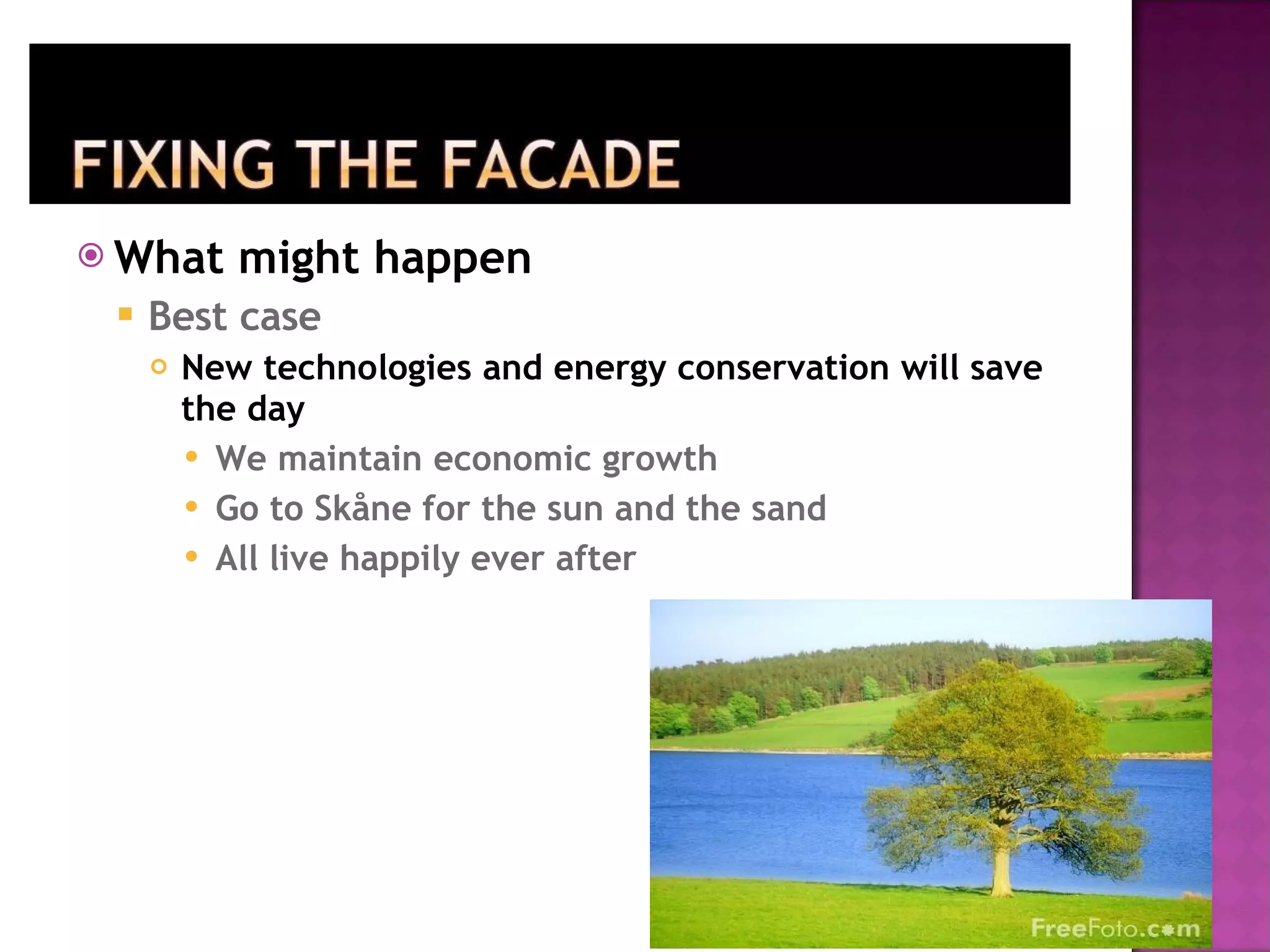
What might happen Best case New technologies and energy conservation will save the day We maintain economic growth Go to Skåne for the sun and the sand All live happily ever after
What might happen Worse case With hardship and mass migrations will come epidemics, which are likely to kill millions. By 2100, [Dr. James] Lovelock believes, the Earth's population will be culled from today's 6.6 billion to as few as 500 million [“The Prophet of Climate Change: James Lovelock”. Jeff Goodell 17 Oct 2007]
Rapid environmental change is all around us. The most obvious example is climate change ... But that is not the only threat. Many other clouds are on the horizon, including water shortages, degraded land and the loss of biodiversity. This assault on the global environment risks undermining the many advances human society has made in recent decades. It is undercutting our fight against poverty. It could even come to jeopardize international peace and security. [Geo-4. Ban Ki-Moon, Secretary-General UN]
Climate change is a reality It is unlikely that in our current mode of operation we will be able to avoid the consequences of climate change We need to reform what we do and the way we do it Minimise our impact on the environment Live with the changes that will most likely occur Reduce, reuse, recycle
What about an alternative? This is not to suggest, however, that Lovelock believes we should just party while the world burns. Quite the opposite. "We need bold action," Lovelock insists. "We have a tremendous amount to do." In his view, we have two choices: We can return to a more primitive lifestyle and live in equilibrium with the planet as hunter-gatherers, or we can sequester ourselves in a very sophisticated, high-tech civilization. [“The Prophet of Climate Change: James Lovelock”. Jeff Goodell 17 Oct 2007]
What do we want to do? Highest standard of living for the longest time possible? Economic growth Remove money from the equation
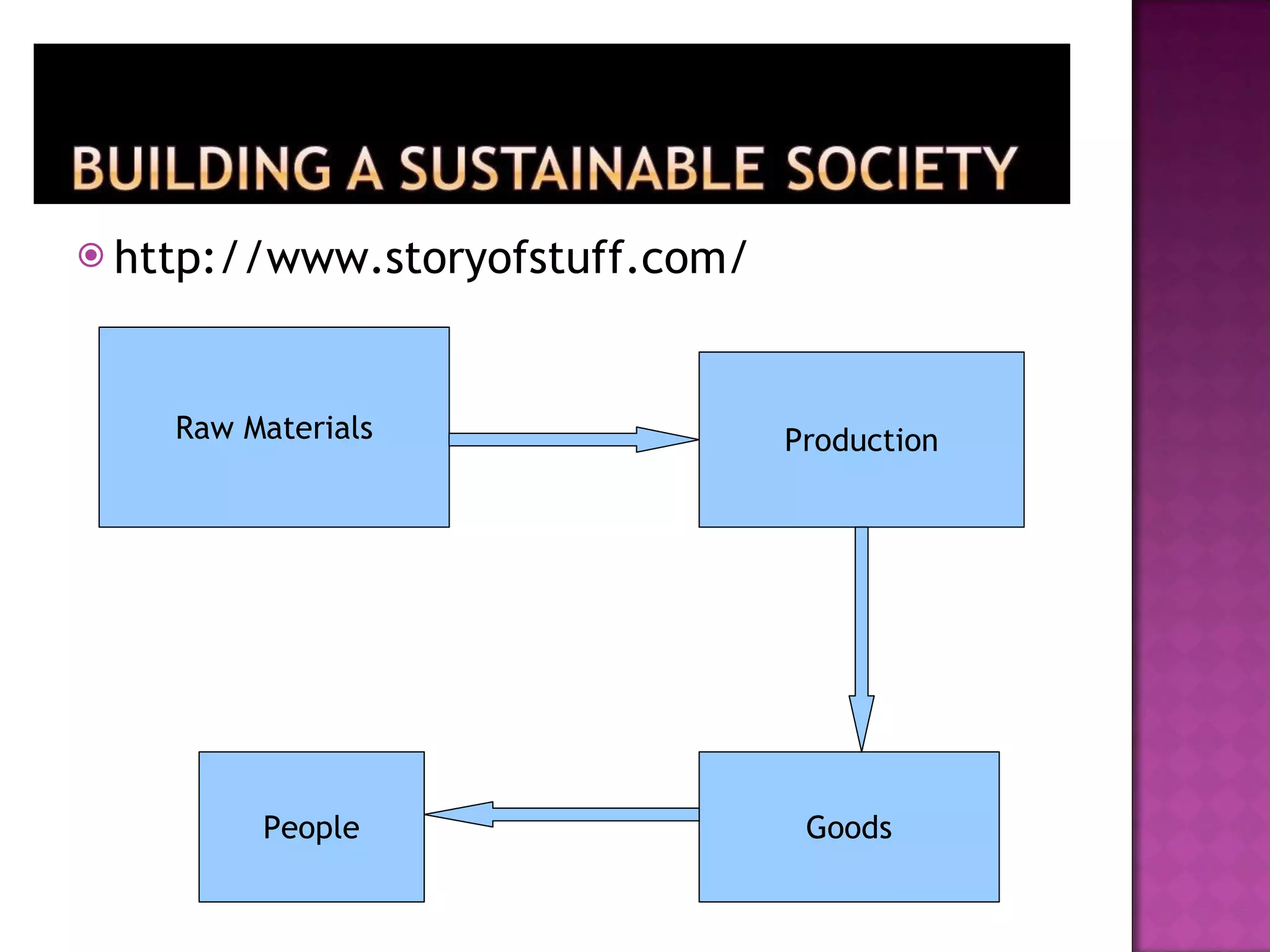
Lets step back a bit: Appliance of science to society Rational, experimental Raw materials Production Goods People Perfection! Better!!!! Resource allocation Problem
http://www.storyofstuff.com/ Production Raw Materials Goods People
Other problems Pollution Population Resource depletion
Controlling production Money Debt Made up Does not reflex what is actually going on Physics Closer to reality Energy Materials
Controlling production Energy Credits Production takes energy Divide production capacity in terms of energy among the people People then decide what gets produced through allocating energy to production Can't save. Can't transfer
Controlling production For what point? Removal of money Remove the profit motive Remove the need for economic growth
How Society Complex integration between people and technology Technology side People side
Technology side No money – Energy credits Common usage  – managed by teams of experts Reduce production 25% of today's Localise production Reduce working hours 16 hours week Reduce amount of work 25 - 45 LESS IMPACT ON THE ENVIRONMENT!
Keyword: BALANACE Balance production with demand Balance technology with ecology Balance environment with society
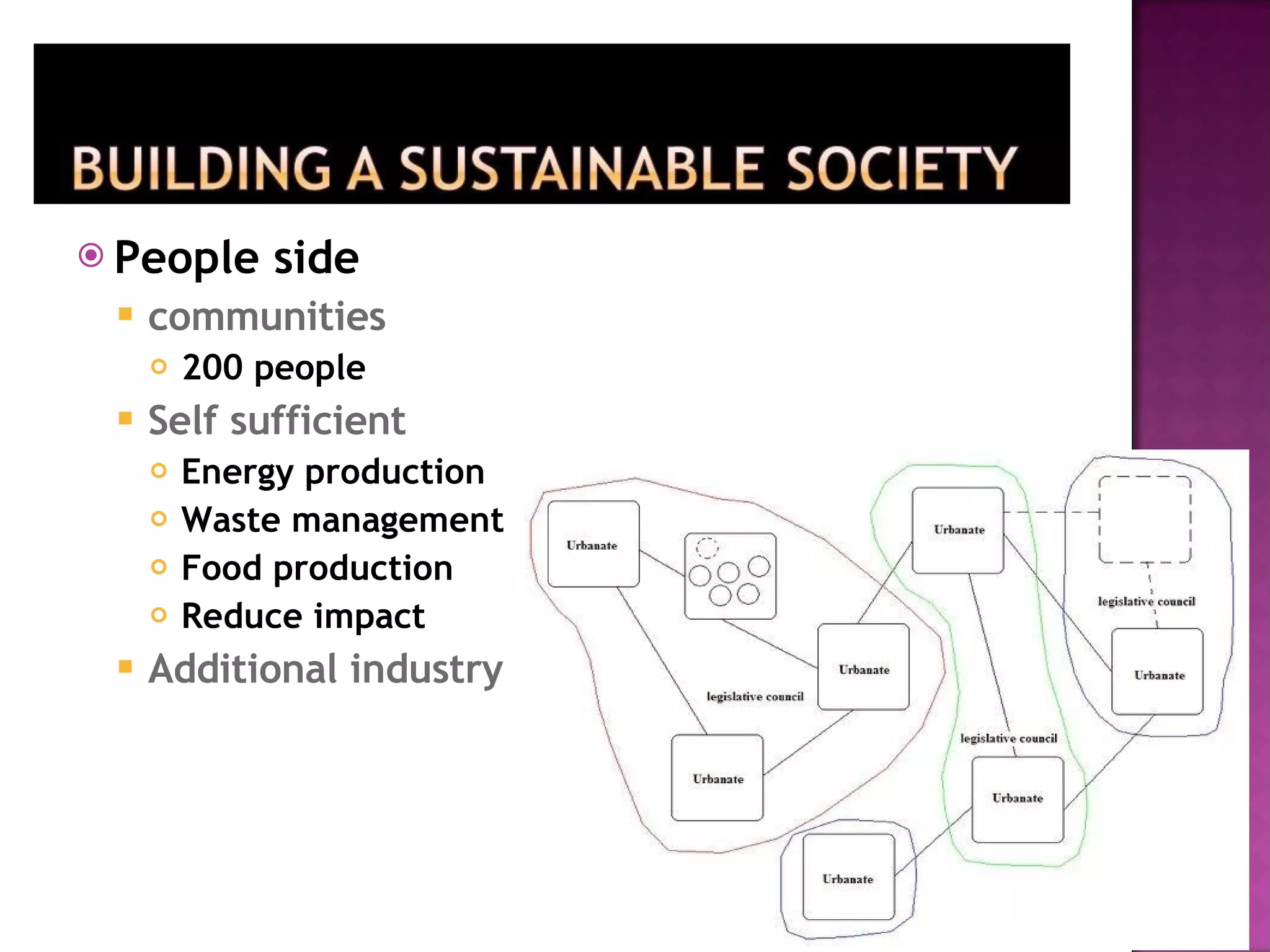
People side No countries Climate does not stop at national boundaries Network of communities Common culture Common languages 10 000 people blocks made of communities of up to 200 people
People side communities 200 people Self sufficient Energy production Waste management Food production Reduce impact Additional industry
Will it work? Far too Utopian! Need to test it Simulations Experimental communities In the end, we get the type of society we deserve!
http://en.technocracynet.eu http://www.technocracy.tk/
“ We can't solve problems by using the same kind of thinking we used when we created them.” [Prof. Albert Einstein]

Climate Reform2

  • 1.
  • 2.
    Climate change /global warming The evidence for The reasons why What can we do about it? Fixing the facade Building a sustainable society
  • 3.
    Scientist and engineerElectrical and Electronic engineering Robotics and Applied AI Society Where are we going? Can we do this a better way? Network of European Technocrats
  • 4.
  • 5.
  • 6.
    The North West Passage
  • 7.
  • 8.
    Linked to risingCO2 Human activity “ most of the observed increase in globally averaged temperatures since the mid-20th century is very likely due to the observed increase in anthropogenic greenhouse gas concentrations” IPCC
  • 9.
    It’s a naturalprocess, the Earth is warming up anyway. The Earth cooled in the early 20 th cent leading to “global cooling” in the 1970s. Accuracy of the data Urban areas NASA’s corrections Suns activity Other planets are warming up as well Dust clouds Pluto undergoing the most changes Ulysses star dust storm
  • 10.
    Global warming /climate change is a reality Most likely human caused The way we do things causes the warming Might have another cause Human activity contributing to a natural event We have to live with the change!
  • 11.
    Extreme weather Droughts,heaver rain, more erosion, worse storms Sea level rising Local cooling thermohaline circulation Political / social problems Wars, people movement
  • 12.
    Most efforts assumewe have caused global warming They centre around reducing C02 Keeping things running as they are!
  • 13.
    Kyoto Protocol Energyconservation Alternative energy sources Taxation New technologies
  • 14.
    Kyoto Protocol 1990- 2004 EU down 5% US up 16% China up 47% India up 55% Only Sweden and UK on target ECONOMIC GROWTH
  • 15.
    Energy conservation Energysaving devices A compact fluorescent lamp can save 2000 times their own weight in greenhouse gases Fuel economy targets Since the 1970s SUVs Change in work practice Teleworking Economic growth
  • 16.
    Alternative energy sourcesWind Solar Nuclear There is a gloomy forecast too on renewable energy - that the [UK] government will fail to meet its targets in both 2010 and 2015. [BBC New 23 August 2007]
  • 17.
    Bio-fuels Road transportin the UK consumes 37.6m tonnes of petroleum products a year. The most productive oil crop that can be grown in this country is rape. The average yield is 3-3.5 tonnes per hectare. One tonne of rapeseed produces 415kg of biodiesel. So every hectare of arable land could provide 1.45 tonnes of transport fuel. To run our cars and buses and lorries on biodiesel, in other words, would require 25.9m hectares. There are 5.7m in the UK. Even the EU's more modest target of 20% by 2020 would consume almost all our cropland. [George Monbiot, Guardian, 22 Nov 2004] Economic Growth
  • 18.
    Taxation Reduce thoseactivities that produce the most CO2 Increase those activities that produce least CO2 Economic growth
  • 19.
    New technologies Gratzelsolar cells Thin film solar cells Hydrogen fuel More on the way ... Better to work with what we know?
  • 20.
    What might happenBest case New technologies and energy conservation will save the day We maintain economic growth Go to Skåne for the sun and the sand All live happily ever after
  • 21.
    What might happenWorse case With hardship and mass migrations will come epidemics, which are likely to kill millions. By 2100, [Dr. James] Lovelock believes, the Earth's population will be culled from today's 6.6 billion to as few as 500 million [“The Prophet of Climate Change: James Lovelock”. Jeff Goodell 17 Oct 2007]
  • 22.
    Rapid environmental changeis all around us. The most obvious example is climate change ... But that is not the only threat. Many other clouds are on the horizon, including water shortages, degraded land and the loss of biodiversity. This assault on the global environment risks undermining the many advances human society has made in recent decades. It is undercutting our fight against poverty. It could even come to jeopardize international peace and security. [Geo-4. Ban Ki-Moon, Secretary-General UN]
  • 23.
    Climate change isa reality It is unlikely that in our current mode of operation we will be able to avoid the consequences of climate change We need to reform what we do and the way we do it Minimise our impact on the environment Live with the changes that will most likely occur Reduce, reuse, recycle
  • 24.
    What about analternative? This is not to suggest, however, that Lovelock believes we should just party while the world burns. Quite the opposite. "We need bold action," Lovelock insists. "We have a tremendous amount to do." In his view, we have two choices: We can return to a more primitive lifestyle and live in equilibrium with the planet as hunter-gatherers, or we can sequester ourselves in a very sophisticated, high-tech civilization. [“The Prophet of Climate Change: James Lovelock”. Jeff Goodell 17 Oct 2007]
  • 25.
    What do wewant to do? Highest standard of living for the longest time possible? Economic growth Remove money from the equation
  • 26.
    Lets step backa bit: Appliance of science to society Rational, experimental Raw materials Production Goods People Perfection! Better!!!! Resource allocation Problem
  • 27.
  • 28.
    Other problems PollutionPopulation Resource depletion
  • 29.
    Controlling production MoneyDebt Made up Does not reflex what is actually going on Physics Closer to reality Energy Materials
  • 30.
    Controlling production EnergyCredits Production takes energy Divide production capacity in terms of energy among the people People then decide what gets produced through allocating energy to production Can't save. Can't transfer
  • 31.
    Controlling production Forwhat point? Removal of money Remove the profit motive Remove the need for economic growth
  • 32.
    How Society Complexintegration between people and technology Technology side People side
  • 33.
    Technology side Nomoney – Energy credits Common usage – managed by teams of experts Reduce production 25% of today's Localise production Reduce working hours 16 hours week Reduce amount of work 25 - 45 LESS IMPACT ON THE ENVIRONMENT!
  • 34.
    Keyword: BALANACE Balanceproduction with demand Balance technology with ecology Balance environment with society
  • 35.
    People side Nocountries Climate does not stop at national boundaries Network of communities Common culture Common languages 10 000 people blocks made of communities of up to 200 people
  • 36.
    People side communities200 people Self sufficient Energy production Waste management Food production Reduce impact Additional industry
  • 37.
    Will it work?Far too Utopian! Need to test it Simulations Experimental communities In the end, we get the type of society we deserve!
  • 38.
  • 39.
    “ We can'tsolve problems by using the same kind of thinking we used when we created them.” [Prof. Albert Einstein]