The Anthropocene:
Global Change and the Earth System
Will Steffen
Emeritus Professor, Australian National University
Senior Fellow, Stockholm Resilience Centre
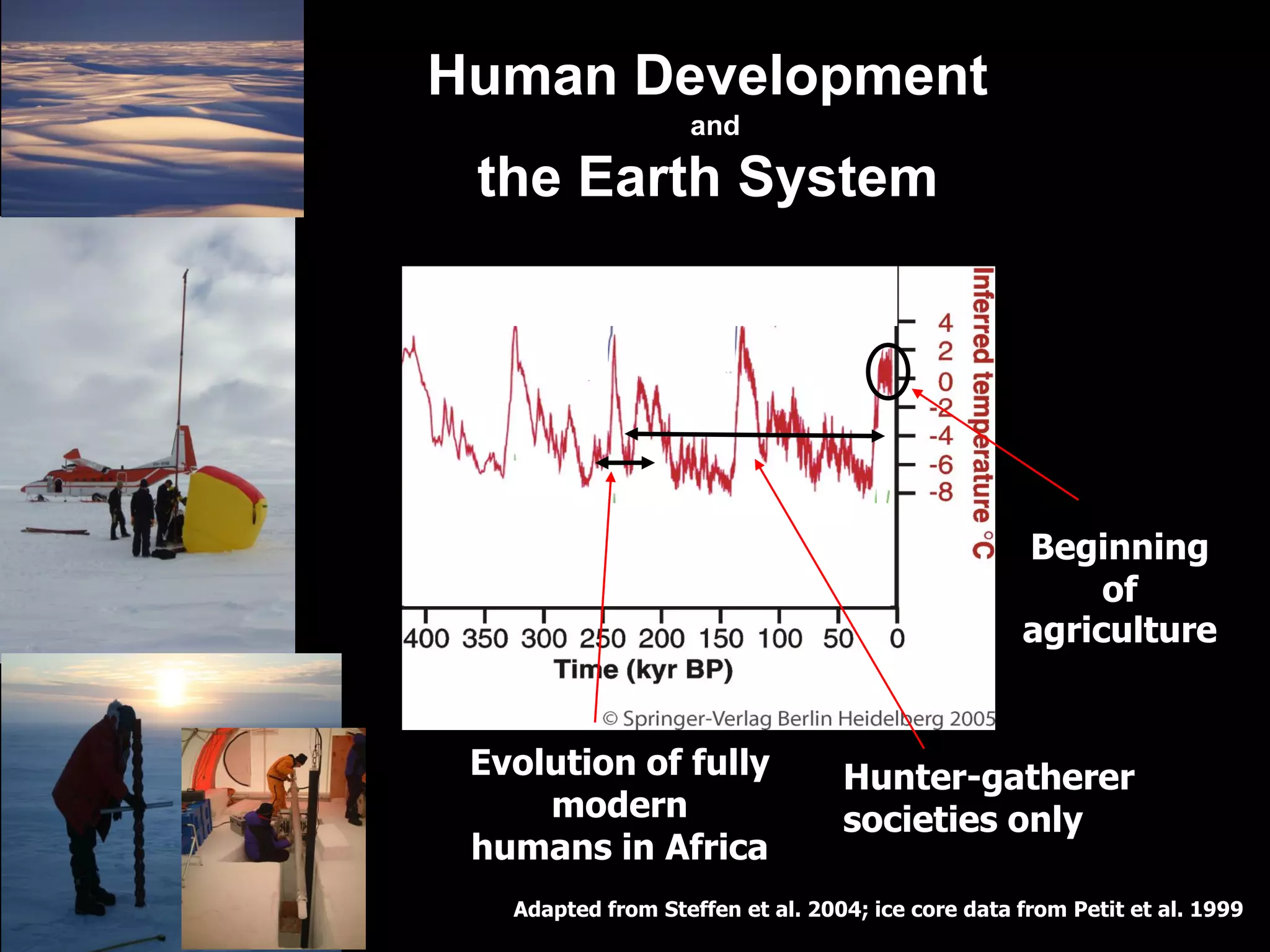
Hunter-gatherer
societies only
Beginning
of
agriculture
Adapted from Steffen et al. 2004; ice core data from Petit et al. 1999
Evolution of fully
modern
humans in Africa
Human Development
and
the Earth System
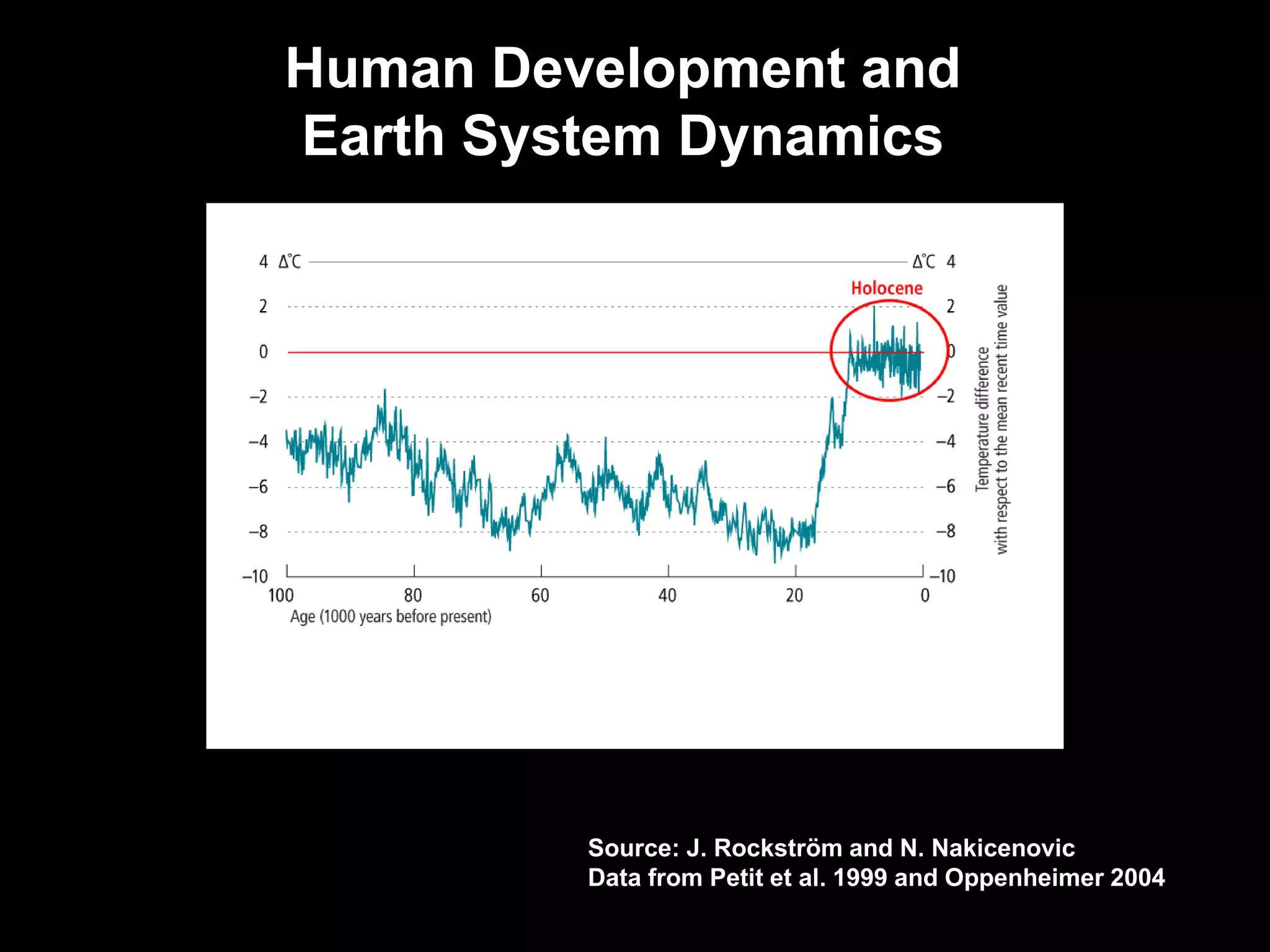
Human Development and
Earth System Dynamics
Source: Data from Petit et al. 1999, labeled as in Young and Steffen 2009.
Source: J. Rockström and N. Nakicenovic
Data from Petit et al. 1999 and Oppenheimer 2004
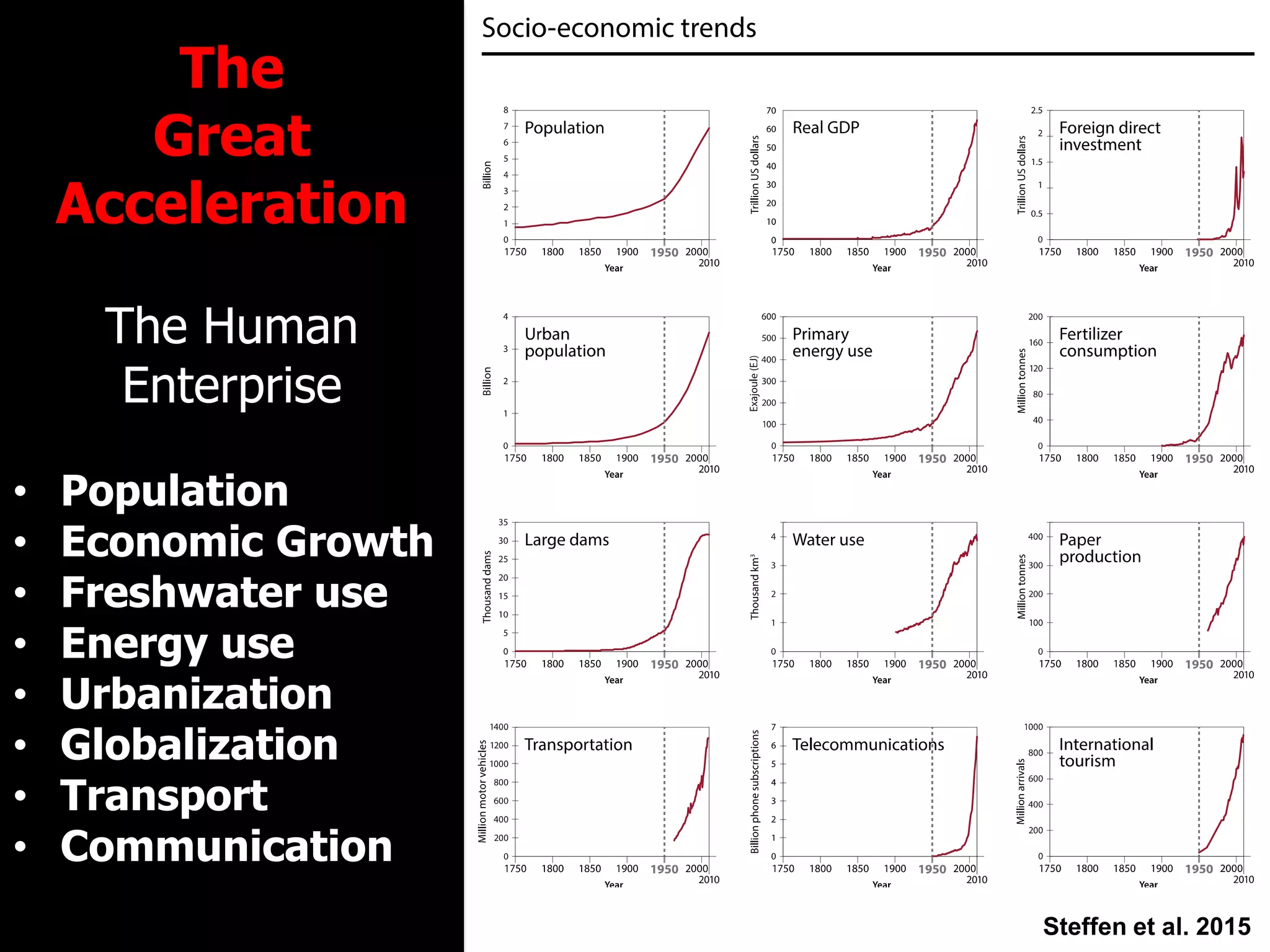
The
Great
Acceleration
The Human
Enterprise
• Population
• Economic Growth
• Freshwater use
• Energy use
• Urbanization
• Globalization
• Transport
• Communication
Steffen et al. 2015
• Greenhouse gases
• Ozone depletion
• Climate
• Marine ecosystems
• Coastal zone
• Nitrogen cycle
• Tropical forests
• Land systems
• Biosphere integrity
Global Impact
Steffen et al. 2015
The
Great
Acceleration
I = P x A x T
Visualising the Great Acceleration
I - impact
P - population
A - affluence
T - technology
Holdren and Ehrlich 1974; National Geographic 2011
IGBP Newsletter 41: May 2000
Climate Change
NASA 2018
Global Average Temperature Anomaly, 1880-2017
Baseline is 1951-1980
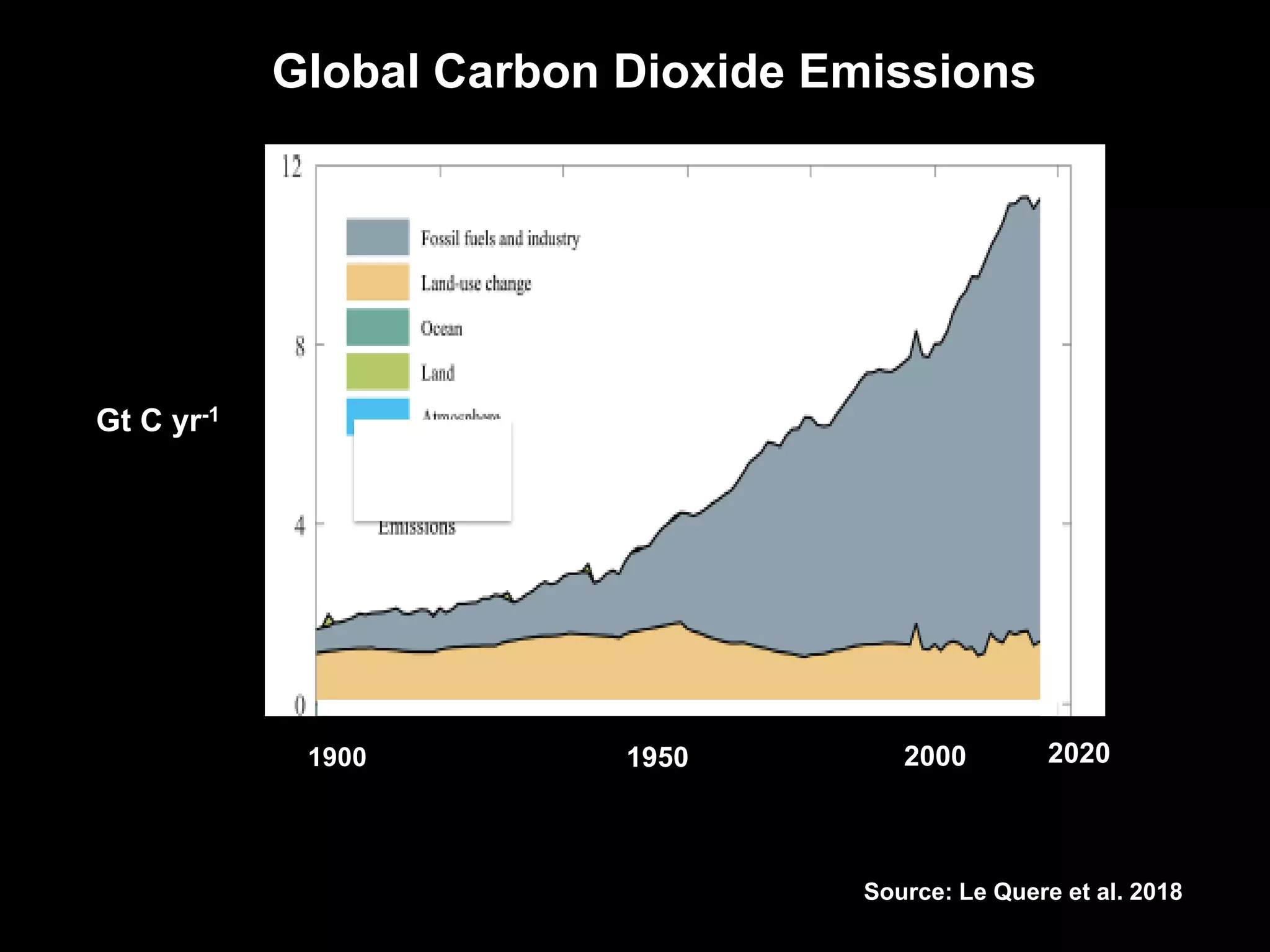
Source: Le Quere et al. 2018
Global Carbon Dioxide Emissions
Gt C yr-1
19501900 2000 2020
This is What Climate Change Looks Like
Hughes et al. 2019; Climate Council of Australia
Koala
Murray Cod, Darling River
Baby Spectacled Flying Foxes
Carnoby’s Black Cockatoo
Ringtail Possums
Koala
Climate Change as a Threat Multiplier
IPCC AR5 WG1 Report 2013
The patterns of where and when we can
produce food will be massively disrupted
in a +2oC world. Millions of humans will be
affected. Starvation, migration, conflict are
the likely outcomes.
The Syrian Crisis
• Iraqi refugees
• Weak government
• Worst drought in recorded history -
A million flood into cities
The Security Risk:
Human Transformation of
the Biosphere
Intergovernmental Science-Policy Platform on Biodiversity and Ecosystem Services, 2019
Nature’s Dangerous Decline
Nature is declining globally at rates unprecedented
In human history
Around 1 million animal and plant species are now
threatenedwith extinction, many within decades.
The web of life on Earth is getting smaller
and increasingly frayed.
Terrestrial vertebrate biomass
Domesticated animals
ca 65%
Humans
ca 32%
Vertebrate
wildlife
< 3%
Smil 2002
Stratigraphic Definition of the Anthropocene
Have humans changed the Earth System such that
geological deposits forming now and in the recent
past include a fingerprint distinct from that of the
Holocene Epoch?
If so, when has the change become recognizable
worldwide?
Source: C.N. Waters et al., Science, 2016, (synthesis paper by the
Anthropocene Working Group)
Formalization of the Anthropocene:
Current Status
Should the Anthropocene be formalised in the Geological Time
Scale?
Should the base of the Anthropocene (start date) be placed
around the mid-20th century?.
AWG Newsletteer, May 2019
Jan Zalasiewicz, Convenor
Anthropocene Working Group (AWG)
University of Leicester, UK
‘YES’ won the formal vote by 29 to 4
Waters et al. 2016
The climate system, the biosphere…
What about humans and our systems?
It is not correct to consider “mankind” or “humankind” in general
The fossil fuel-driven, consumption oriented, globalised economy
was not created by humankind in general.
“Intra-species inequalities are part ….of the current ecological
crisis and cannot be ignored in attempts to understand it.
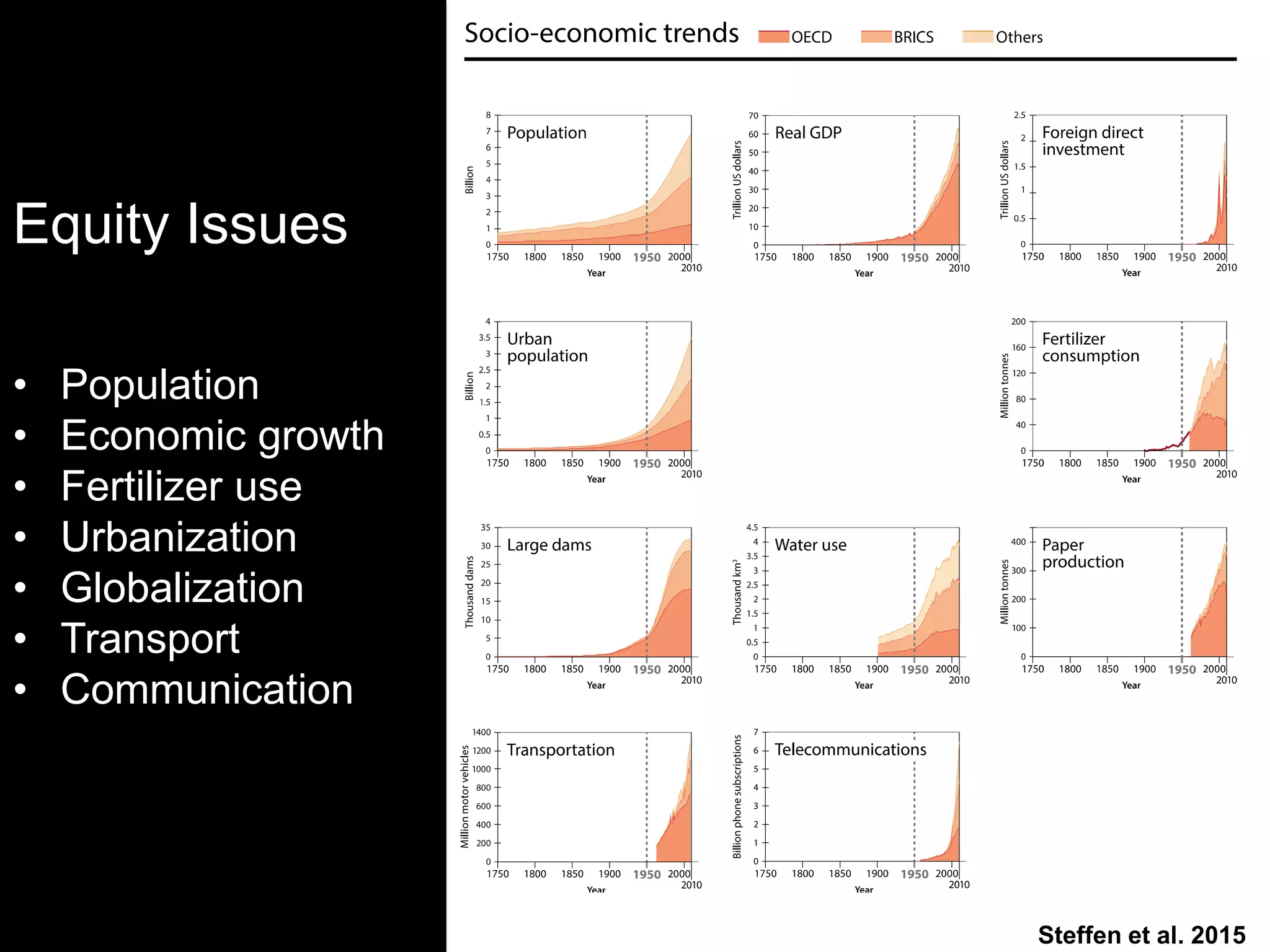
Equity Issues
• Population
• Economic growth
• Fertilizer use
• Urbanization
• Globalization
• Transport
• Communication
Steffen et al. 2015
Evolution of Income Equality
Source: S. van der Leeuw
Europe and JapanEnglish-speaking
countries
Pickett and Wilkinson 2015
System Incompatibilities?
Photo: W.
Steffen
Photo: W. Steffen
Springer-Verlag
Photo: O.Henriksson/Azote
…the Earth System
Our planet is a single system…
Climate Change
NASA 2018
Global Average Temperature Anomaly, 1880-2017
Baseline is 1951-1980
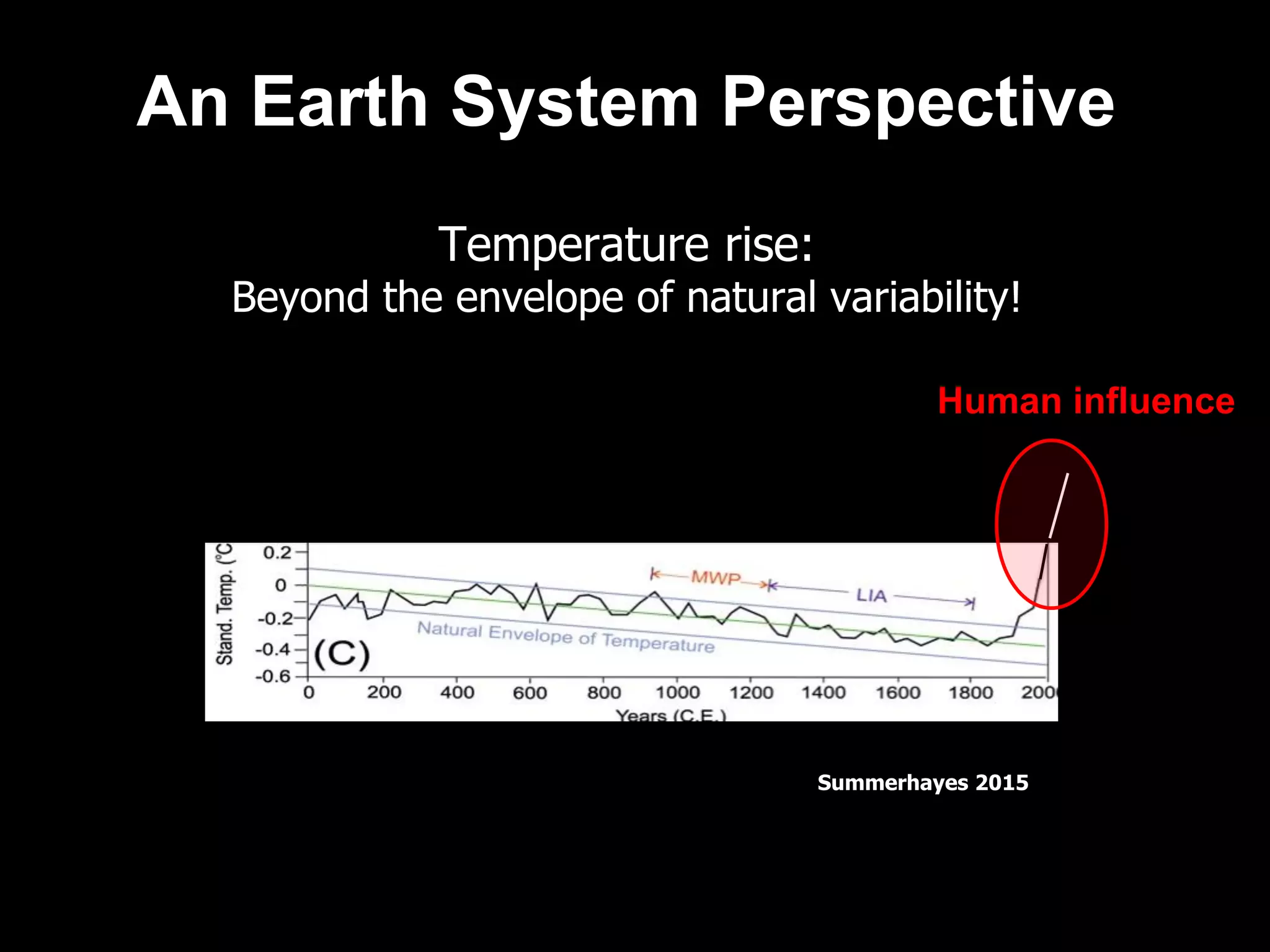
Temperature rise:
Beyond the envelope of natural variability!
Summerhayes 2015
Human influence
An Earth System Perspective
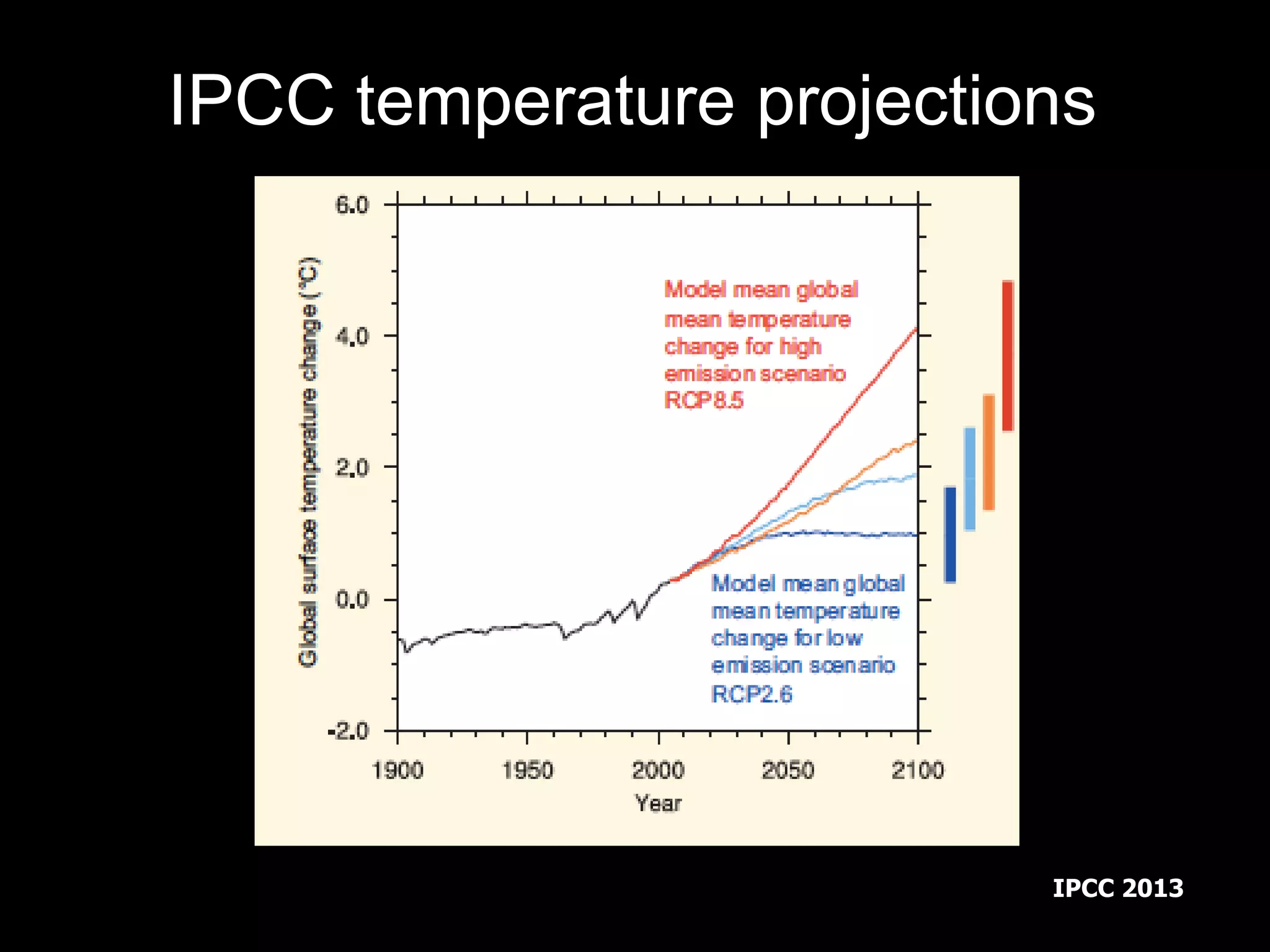
Implications of accelerating climate change
IPCC temperature projections
IPCC 2013
2
4
3
5
6
1
0
GlobalTemperature
(°C)
IPCC Projections
2100 AD
Earth System moves to a new
state? Severe challenge to
contemporary civilisation.
Possible collapse?
Summerhayes 2015
Committed
Tipping Points?
Tipping Elements in the Earth System
Huber, Lenton, and Schellnhuber, in Richardson et al. 2011
Over 10 years of C storage
lost in 2005, 2010 and
2015/2016 droughts
50 to 250 Gt C lost by 2100
from thawing permafrost
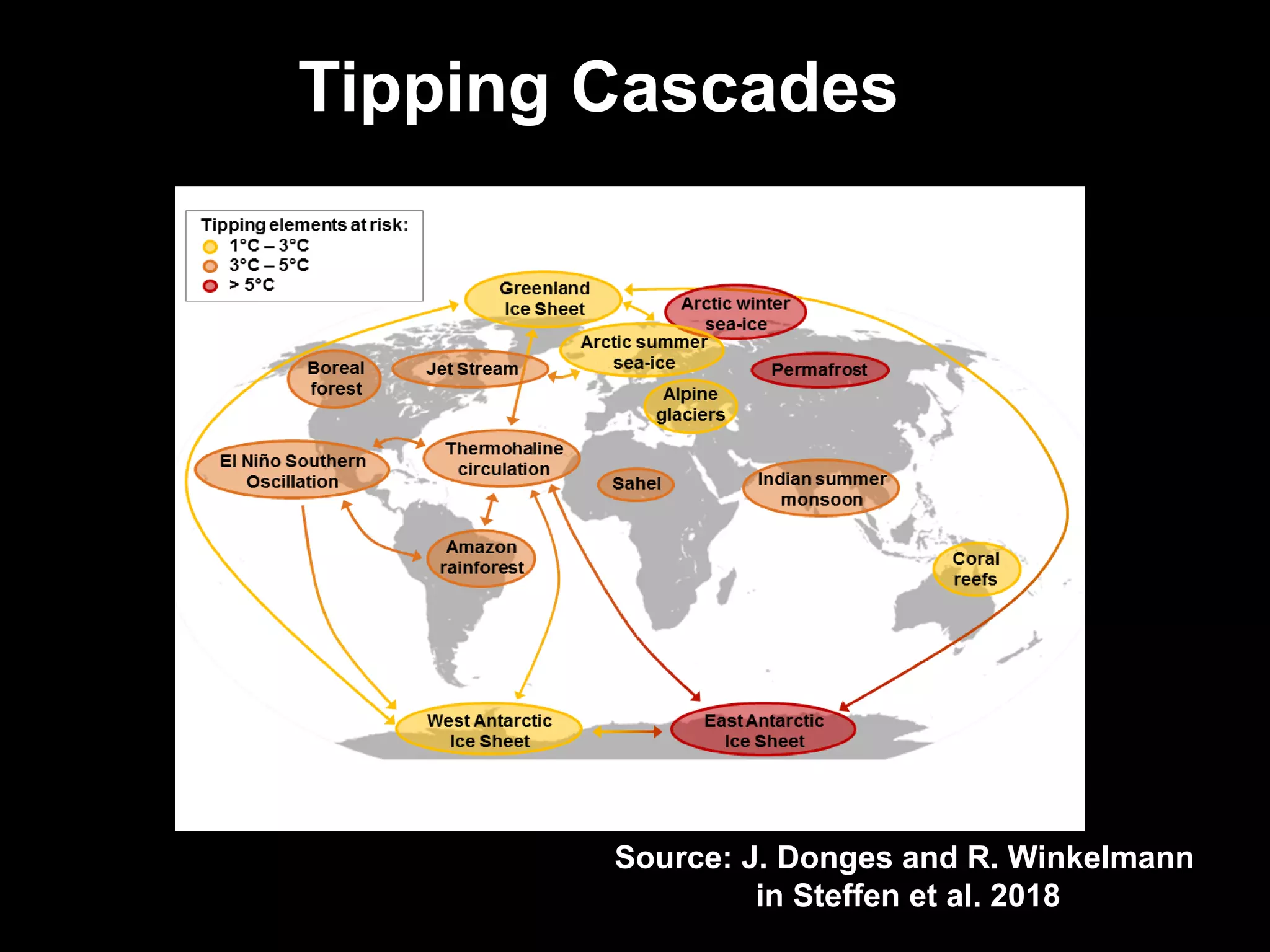
Tipping Cascades
Source: J. Donges and R. Winkelmann
in Steffen et al. 2018
Earth System Trajectories
Steffen et al. 2018
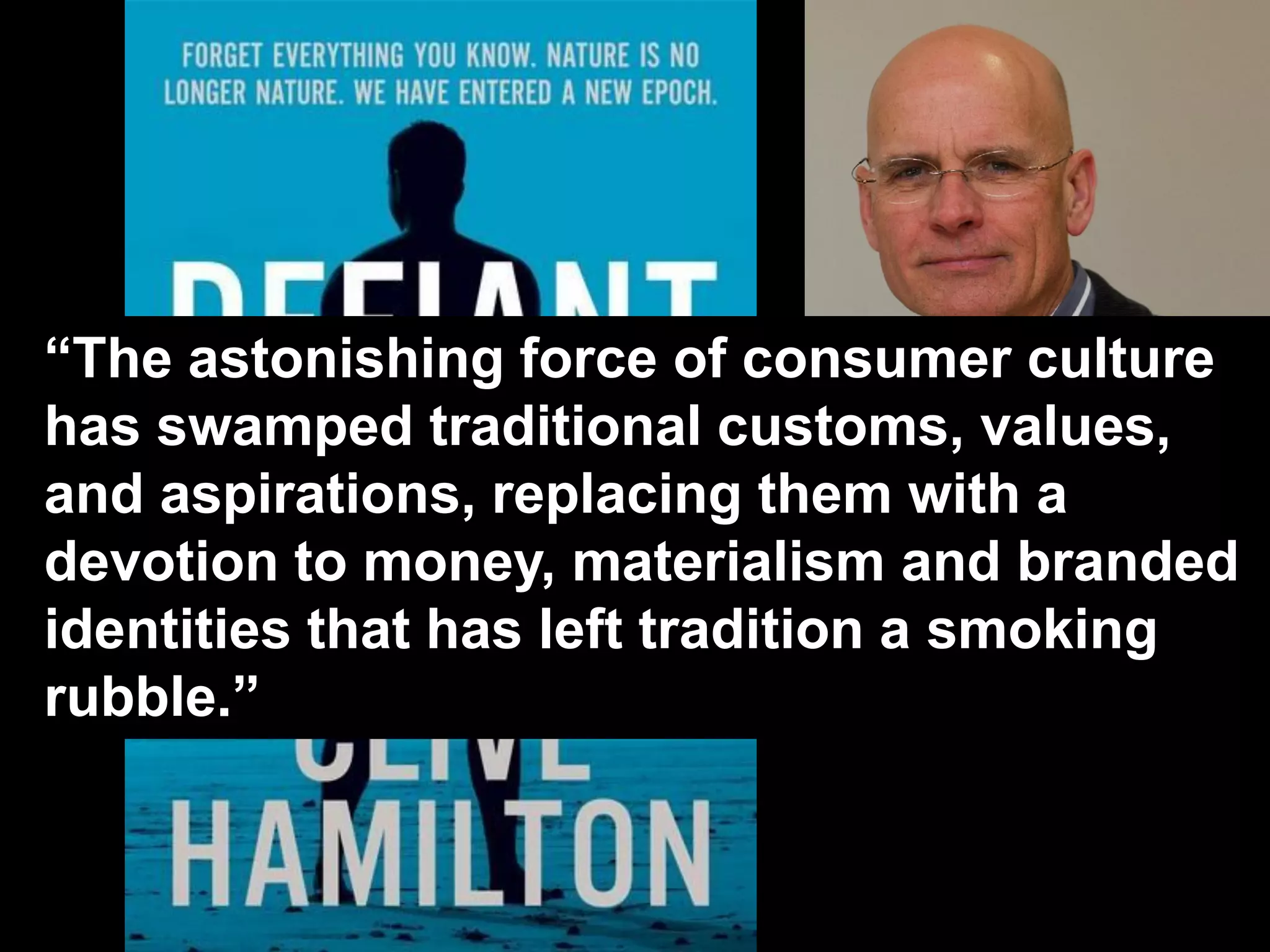
“The astonishing force of consumer culture
has swamped traditional customs, values,
and aspirations, replacing them with a
devotion to money, materialism and branded
identities that has left tradition a smoking
rubble.”
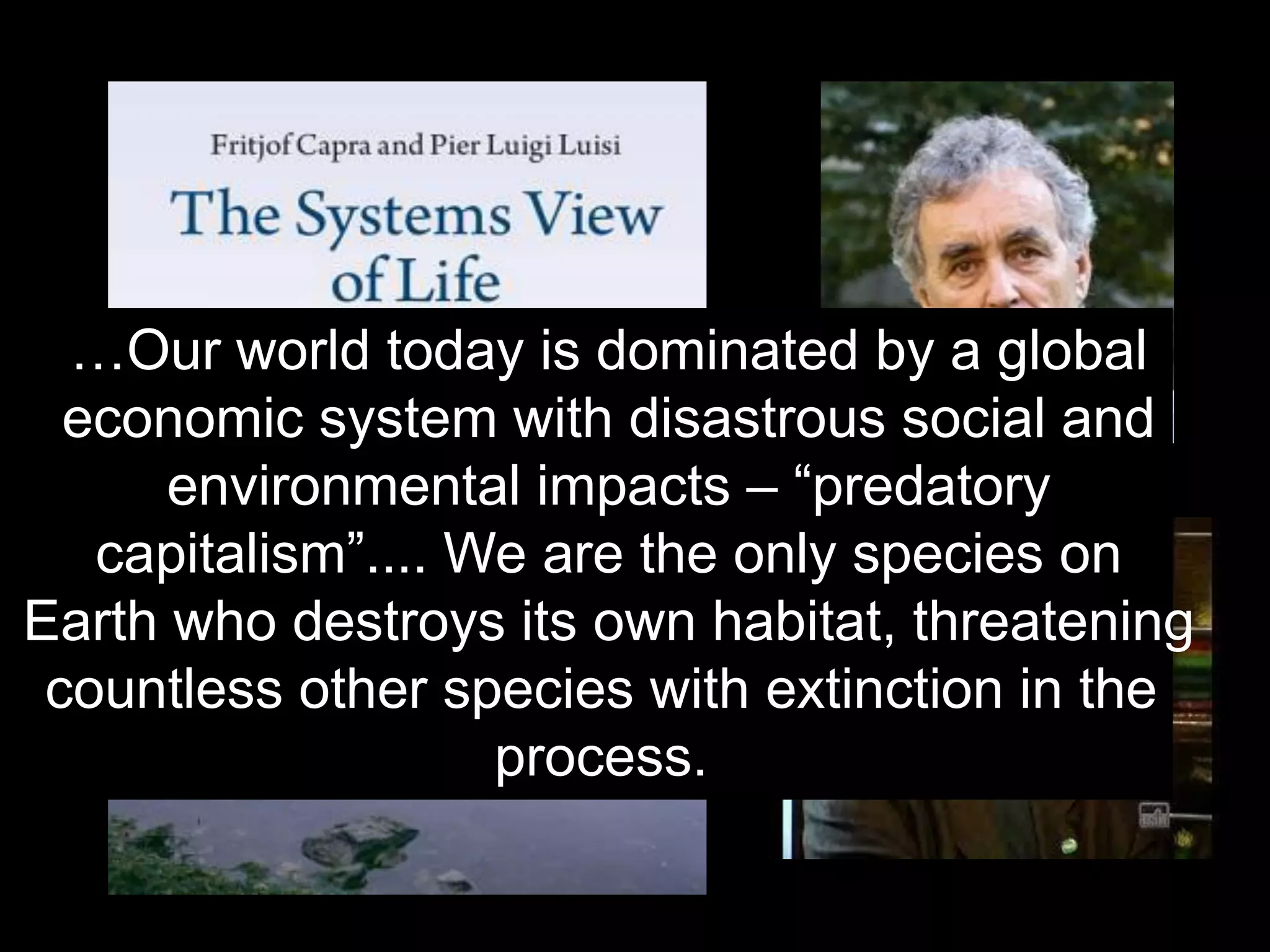
…Our world today is dominated by a global
economic system with disastrous social and
environmental impacts – “predatory
capitalism”.... We are the only species on
Earth who destroys its own habitat, threatening
countless other species with extinction in the
process.
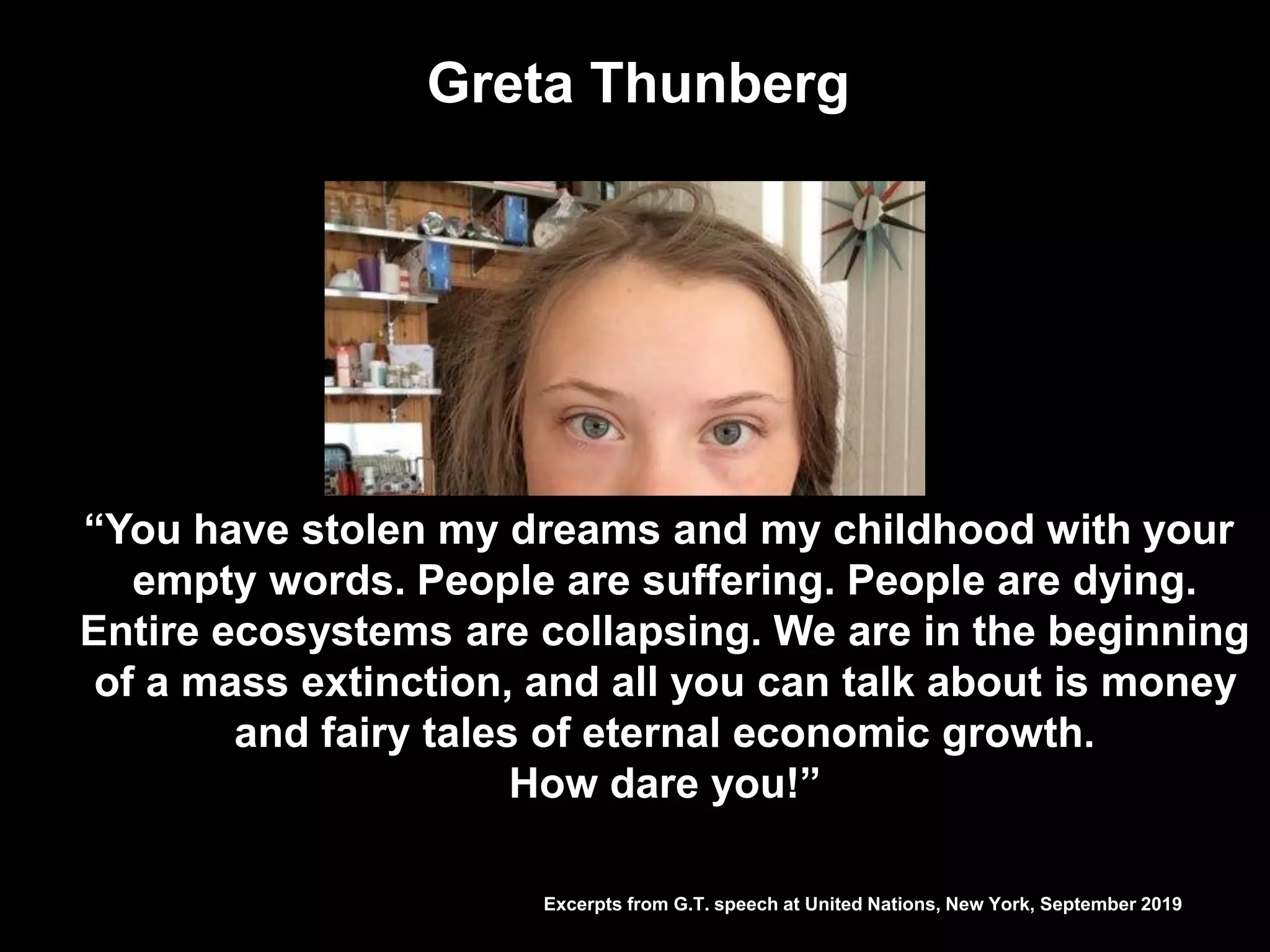
Greta Thunberg
Excerpts from G.T. speech at United Nations, New York, September 2019
“You have stolen my dreams and my childhood with your
empty words. People are suffering. People are dying.
Entire ecosystems are collapsing. We are in the beginning
of a mass extinction, and all you can talk about is money
and fairy tales of eternal economic growth.
How dare you!”
The ‘Doughnut’: a safe and just space for
humanity
Kate Raworth
Oxford University
An Economy for the 21st Century
• Systems thinking: dynamic complexity
• Equity: distributive by design
• Biosphere: regenerative by design
Prof Dipash Chakrabarty
University of Chicago
Homo-centric v. Zoe-centric
(human-centric v. life-centric)
Contemporary society is based on a homo-centric
approach, but the Anthropocene demands a
zoe-centric approach.
“epochal consciousness” v. “departmental thinking”
Tanner Lectures in Human Values, Yale University, 2015
Prof Carl Folke
Stockholm Resilience Centre
and
Beijer Institute of Ecological Economics
On humanity’s challenge in the 21st century:
“Reconnect to the biosphere”
We're only here for a short amount of time to do what we've
been put here to do, which is to look after the country.
We're only a tool in the cycle of things. …(we) go out into
the world and help keep the balance of nature. It's a big
cycle of living with the land, and then eventually going back
to it....
An Elder, Noongar People. From: 'Elders:
Wisdom from Australia's Indigenous Leaders’
The Anthropocene: Global Change and the Earth System

The Anthropocene: Global Change and the Earth System

  • 1.
    The Anthropocene: Global Changeand the Earth System Will Steffen Emeritus Professor, Australian National University Senior Fellow, Stockholm Resilience Centre
  • 2.
    Hunter-gatherer societies only Beginning of agriculture Adapted fromSteffen et al. 2004; ice core data from Petit et al. 1999 Evolution of fully modern humans in Africa Human Development and the Earth System
  • 3.
    Human Development and EarthSystem Dynamics Source: Data from Petit et al. 1999, labeled as in Young and Steffen 2009. Source: J. Rockström and N. Nakicenovic Data from Petit et al. 1999 and Oppenheimer 2004
  • 4.
    The Great Acceleration The Human Enterprise • Population •Economic Growth • Freshwater use • Energy use • Urbanization • Globalization • Transport • Communication Steffen et al. 2015
  • 5.
    • Greenhouse gases •Ozone depletion • Climate • Marine ecosystems • Coastal zone • Nitrogen cycle • Tropical forests • Land systems • Biosphere integrity Global Impact Steffen et al. 2015 The Great Acceleration
  • 6.
    I = Px A x T Visualising the Great Acceleration I - impact P - population A - affluence T - technology Holdren and Ehrlich 1974; National Geographic 2011
  • 7.
  • 8.
    Climate Change NASA 2018 GlobalAverage Temperature Anomaly, 1880-2017 Baseline is 1951-1980
  • 9.
    Source: Le Quereet al. 2018 Global Carbon Dioxide Emissions Gt C yr-1 19501900 2000 2020
  • 10.
    This is WhatClimate Change Looks Like Hughes et al. 2019; Climate Council of Australia Koala Murray Cod, Darling River Baby Spectacled Flying Foxes Carnoby’s Black Cockatoo Ringtail Possums Koala
  • 11.
    Climate Change asa Threat Multiplier IPCC AR5 WG1 Report 2013 The patterns of where and when we can produce food will be massively disrupted in a +2oC world. Millions of humans will be affected. Starvation, migration, conflict are the likely outcomes. The Syrian Crisis • Iraqi refugees • Weak government • Worst drought in recorded history - A million flood into cities The Security Risk:
  • 12.
  • 13.
    Intergovernmental Science-Policy Platformon Biodiversity and Ecosystem Services, 2019 Nature’s Dangerous Decline Nature is declining globally at rates unprecedented In human history Around 1 million animal and plant species are now threatenedwith extinction, many within decades. The web of life on Earth is getting smaller and increasingly frayed.
  • 14.
    Terrestrial vertebrate biomass Domesticatedanimals ca 65% Humans ca 32% Vertebrate wildlife < 3% Smil 2002
  • 15.
    Stratigraphic Definition ofthe Anthropocene Have humans changed the Earth System such that geological deposits forming now and in the recent past include a fingerprint distinct from that of the Holocene Epoch? If so, when has the change become recognizable worldwide? Source: C.N. Waters et al., Science, 2016, (synthesis paper by the Anthropocene Working Group)
  • 16.
    Formalization of theAnthropocene: Current Status Should the Anthropocene be formalised in the Geological Time Scale? Should the base of the Anthropocene (start date) be placed around the mid-20th century?. AWG Newsletteer, May 2019 Jan Zalasiewicz, Convenor Anthropocene Working Group (AWG) University of Leicester, UK ‘YES’ won the formal vote by 29 to 4 Waters et al. 2016
  • 17.
    The climate system,the biosphere… What about humans and our systems?
  • 18.
    It is notcorrect to consider “mankind” or “humankind” in general The fossil fuel-driven, consumption oriented, globalised economy was not created by humankind in general. “Intra-species inequalities are part ….of the current ecological crisis and cannot be ignored in attempts to understand it.
  • 19.
    Equity Issues • Population •Economic growth • Fertilizer use • Urbanization • Globalization • Transport • Communication Steffen et al. 2015
  • 21.
    Evolution of IncomeEquality Source: S. van der Leeuw Europe and JapanEnglish-speaking countries
  • 22.
  • 23.
  • 26.
  • 27.
    …the Earth System Ourplanet is a single system…
  • 28.
    Climate Change NASA 2018 GlobalAverage Temperature Anomaly, 1880-2017 Baseline is 1951-1980
  • 29.
    Temperature rise: Beyond theenvelope of natural variability! Summerhayes 2015 Human influence An Earth System Perspective
  • 30.
    Implications of acceleratingclimate change IPCC temperature projections IPCC 2013
  • 31.
    2 4 3 5 6 1 0 GlobalTemperature (°C) IPCC Projections 2100 AD EarthSystem moves to a new state? Severe challenge to contemporary civilisation. Possible collapse? Summerhayes 2015 Committed Tipping Points?
  • 32.
    Tipping Elements inthe Earth System Huber, Lenton, and Schellnhuber, in Richardson et al. 2011 Over 10 years of C storage lost in 2005, 2010 and 2015/2016 droughts 50 to 250 Gt C lost by 2100 from thawing permafrost
  • 33.
    Tipping Cascades Source: J.Donges and R. Winkelmann in Steffen et al. 2018
  • 34.
  • 35.
    “The astonishing forceof consumer culture has swamped traditional customs, values, and aspirations, replacing them with a devotion to money, materialism and branded identities that has left tradition a smoking rubble.”
  • 36.
    …Our world todayis dominated by a global economic system with disastrous social and environmental impacts – “predatory capitalism”.... We are the only species on Earth who destroys its own habitat, threatening countless other species with extinction in the process.
  • 37.
    Greta Thunberg Excerpts fromG.T. speech at United Nations, New York, September 2019 “You have stolen my dreams and my childhood with your empty words. People are suffering. People are dying. Entire ecosystems are collapsing. We are in the beginning of a mass extinction, and all you can talk about is money and fairy tales of eternal economic growth. How dare you!”
  • 38.
    The ‘Doughnut’: asafe and just space for humanity Kate Raworth Oxford University An Economy for the 21st Century • Systems thinking: dynamic complexity • Equity: distributive by design • Biosphere: regenerative by design
  • 39.
    Prof Dipash Chakrabarty Universityof Chicago Homo-centric v. Zoe-centric (human-centric v. life-centric) Contemporary society is based on a homo-centric approach, but the Anthropocene demands a zoe-centric approach. “epochal consciousness” v. “departmental thinking” Tanner Lectures in Human Values, Yale University, 2015
  • 40.
    Prof Carl Folke StockholmResilience Centre and Beijer Institute of Ecological Economics On humanity’s challenge in the 21st century: “Reconnect to the biosphere”
  • 41.
    We're only herefor a short amount of time to do what we've been put here to do, which is to look after the country. We're only a tool in the cycle of things. …(we) go out into the world and help keep the balance of nature. It's a big cycle of living with the land, and then eventually going back to it.... An Elder, Noongar People. From: 'Elders: Wisdom from Australia's Indigenous Leaders’