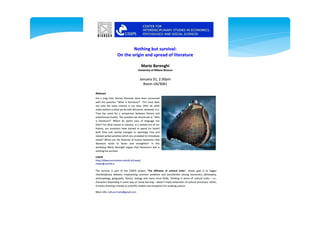
Proposal for an “Anthropocene”
Research Program, and its
relationship with the “Cultural
Evolution” program
Emanuele Serrelli
University of Milano-Bicocca
CISEPS assembly, October 26, 2016
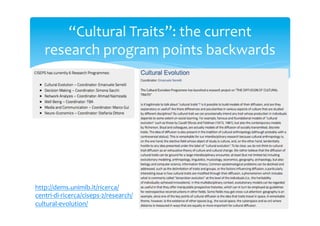
“Cultural Traits”: the current
research program points backwards
http://dems.unimib.it/ricerca/centri
-di-ricerca/ciseps-
2/research/cultural-evolution/
 Anthropocene as a good candidate to REPROPOSE
the successful template of the project “The Diffusion
of Cultural Traits” (2011-2016)
The idea
1. A “hot topic” in the scientific literature (debated, criticized, defended…)
2. A topic that, once reinterpreted, can become a key to interdisciplinarity
3. A specific but non-constraining definition of the topic: it can be
recognized across disciplines, but it is open to revision and even rejection
4. Strong engagement of UNIMIB colleagues: a lot of scouting and
diplomatic work
5. Concrete job: a series of 10-15 seminars within the regular series of
CISEPS, to become chapters or articles in the final publication; a few
events that mix art and culture, and that can be open to colleagues and
to the general public (preferably with institutional collaborations)
6. Intense network communication: mailing lists
7. A concrete outcome: a high-level edited publication (book or special
issue)
The template
“The Diffusion of Cultural Traits”
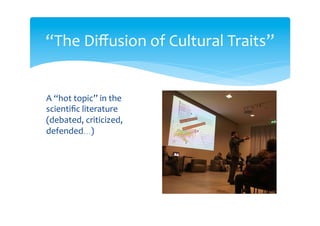
A “hot topic” in the
scientific literature
(debated, criticized,
defended…)
“The Diffusion of Cultural Traits”
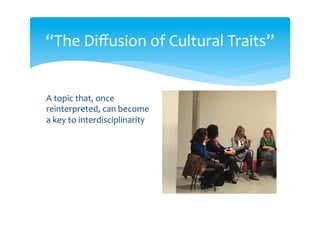
A topic that, once
reinterpreted, can become
a key to interdisciplinarity
“The Diffusion of Cultural Traits”
A specific but non-
constraining definition of
the topic: it can be
recognized across
disciplines, but it is open to
revision and even rejection
Some assumptions:
 “...by cultural trait we can provisionally
intend any trait whose production in
individuals depends to some extent on
social learning”
 “...we do not think to cultural trait
diffusion as an exhaustive theory of
culture and cultural change”
 thinking in terms of cultural traits can
trigger discourses in different disciplines
and communication, highlighting
common issues and valuing diversity
 “...evolutionary models can be regarded
as useful in that they offer manipulable
prospective histories, which can in turn be
employed as guidelines for restrospective
reconstructions in other fields”
“The Diffusion of Cultural Traits”
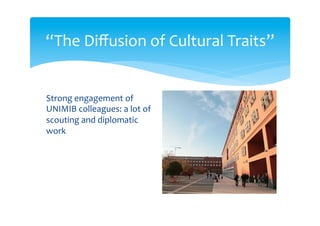
Strong engagement of
UNIMIB colleagues: a lot of
scouting and diplomatic
work
“The Diffusion of Cultural Traits”
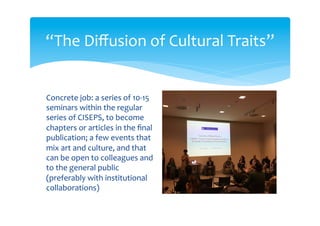
Concrete job: a series of 10-15
seminars within the regular
series of CISEPS, to become
chapters or articles in the final
publication; a few events that
mix art and culture, and that
can be open to colleagues and
to the general public
(preferably with institutional
collaborations)
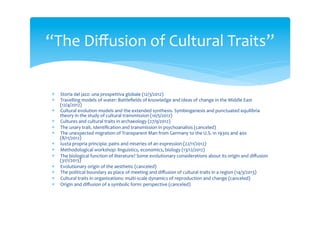
 Storia del jazz: una prospettiva globale (12/3/2012)
 Travelling models of water: Battlefields of knowledge and ideas of change in the Middle East
(12/4/2012)
 Cultural evolution models and the extended synthesis. Symbiogenesis and punctuated equilibria
theory in the study of cultural transmission (10/5/2012)
 Cultures and cultural traits in archaeology (27/9/2012)
 The unary trait. Identification and transmission in psychoanalisis (canceled)
 The unexpected migration of Transparent Man from Germany to the U.S. in 1930s and 40s
(8/11/2012)
 Iuxta propria principia: pains and miseries of an expression (22/11/2012)
 Methodological workshop: linguistics, economics, biology (13/12/2012)
 The biological function of literature? Some evolutionary considerations about its origin and diffusion
(31/1/2013)
 Evolutionary origin of the aesthetic (canceled)
 The political boundary as place of meeting and diffusion of cultural traits in a region (14/3/2013)
 Cultural traits in organizations: multi-scale dynamics of reproduction and change (canceled)
 Origin and diffusion of a symbolic form: perspective (canceled)
“The Diffusion of Cultural Traits”
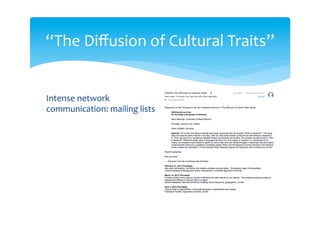
Intense network
communication: mailing
lists
“The Diffusion of Cultural Traits”
A concrete outcome: a high-
level edited publication
(book or special issue)
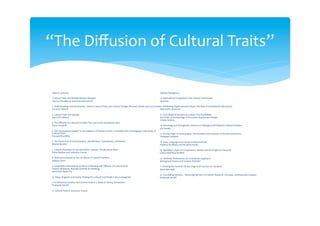
Table of contents
1 Cultural Traits and MultidisciplinaryDialogue
Fabrizio Panebianco and Emanuele Serrelli
2 Understanding Cultural Diversity. Culture, Cultural Traits and Cultural Changes Between Global and Local
Scales
Vincenzo Matera
3 Cultural Traits and Identity
Ugo E.M. Fabietti
4 The Diffusion of a Museum Exhibit: The Case of the Transparent Man
Elena Canadelli
5 The ‘Incompetent Subject’ in the Kingdom of Technical Terms. A Possible Role of Pedagogy in the Study of
Cultural Traits
Rossana Brambilla
6 The Unary Trait of Psychoanalysis. Identification,Transmission, Generation
Matteo Bonazzi
7 Cultural Diversities Across and Within Cultures: The Bicultural Mind
Olivia Realdon and Valentino Zurloni
8 Birth and Evolution of Jazz as Effects of Cultural Transfers
Stefano Zenni
9 Geographical Boundaries as Places of Meeting and Diffusion of Cultural Traits
Stefano Malatesta, Marcella Schmidt di Friedberg,
and Enrico Squarcina
10 Maps, Diagrams and Charts: Making the Cultural Trait Visible Fulvio Carmagnola
11 Evolutionary Genetics and Cultural Traits in a ‘Body of Theory’ Perspective
Emanuele Serrelli
12 Cultural Traits in Economic Theory
Fabrizio Panebianco
13 International Cooperation and Cultural Transmission
Isa Gama
14 Rethinking Organizational Culture: The Role of Generational Subcultures
Alessandra Lazazzara
15 From Material Remains to Culture: The Possibilities
and Limits of Archaeology in Reconstructing Ancient People
Viviana Ardesia
16 Homology and Phylogenetic Inference in Biological and Material Cultural Evolution
Ilya Tëmkin
17 On the Origin of Technologies: The Invention and Evolution of the Bow-and-Arrow
Giuseppe Carignani
18 Trees, Languages and Genes: A Historical Path
Federica Da Milano and Nicoletta Puddu
19 Signaling in Style: On Cooperation, Identity and the Origins of Visual Art
Larissa Mendoza-Straffon
20 Aesthetic Preferences: An Evolutionary Approach
Mariagrazia Portera and Lorenzo Bartalesi
21 Nothing But Survival: On the Origin and Function of Literature
Mario Barenghi
22 Concluding Remarks – Removing Barriers in Scientific Research: Concepts, Synthesis and Catalysis
Emanuele Serrelli
“The Diffusion of Cultural Traits”
A specific but non-constraining definition of the topic: it can be recognized
across disciplines, but it is open to revision and even rejection
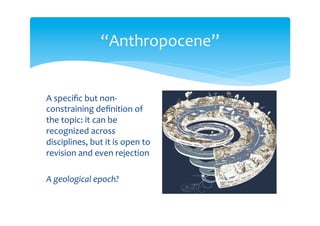
 The Anthropocene defines Earth's most recent geologic time period as being
human-influenced, or anthropogenic, based on overwhelming global evidence
that atmospheric, geologic, hydrologic, biospheric and other earth system
processes are now altered by humans.
 The word combines the root "anthropo", meaning "human" with the root "-
cene", the standard suffix for "epoch" in geologic time.
 The Anthropocene is distinguished as a new period either after or within the
Holocene, the current epoch, which began approximately 10,000 years ago
(about 8000 BC) with the end of the last glacial period.
 Source: The Encyclopedia of Earth, cit. in www.anthropocene.info
“Anthropocene”
“Anthropocene”
A specific but non-
constraining definition of
the topic: it can be
recognized across
disciplines, but it is open to
revision and even rejection
A geological epoch?
“Anthropocene”
A specific but non-
constraining definition of
the topic: it can be
recognized across
disciplines, but it is open to
revision and even rejection
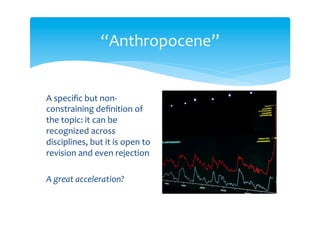
A great acceleration?
“Anthropocene”
A specific but non-
constraining definition of
the topic: it can be
recognized across
disciplines, but it is open to
revision and even rejection
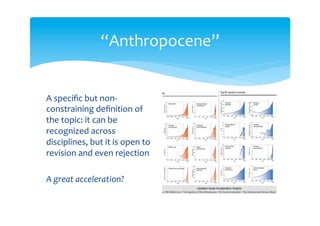
A great acceleration?
“Anthropocene”
A specific but non-constraining
definition of the topic: it can
be recognized across
disciplines, but it is open to
revision and even rejection
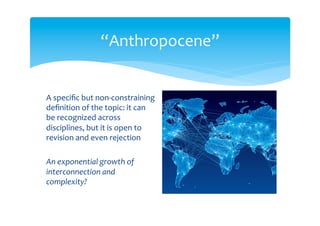
An exponential growth of
interconnection and
complexity?
“Anthropocene”
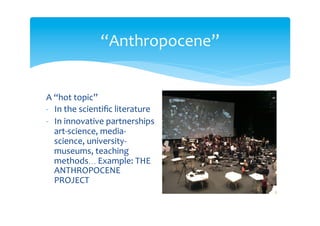
A “hot topic”
- In the scientific literature
- In innovative partnerships
art-science, media-
science, university-
museums, teaching
methods… Example: THE
ANTHROPOCENE
PROJECT
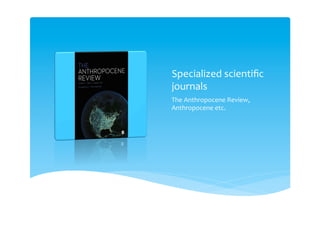
Specialized scientific
journals
The Anthropocene Review,
Anthropocene etc.
In the news
The Economist
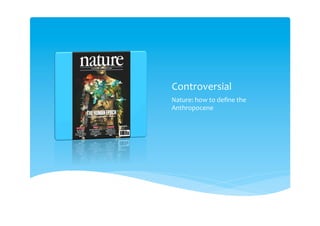
Controversial
Nature: how to define the
Anthropocene
On the web
www.anthropocene.info
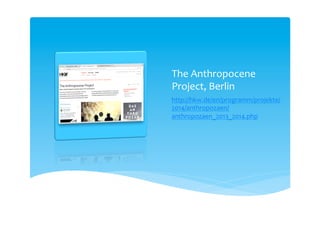
The Anthropocene
Project, Berlin
http://hkw.de/en/programm/projekte/
2014/anthropozaen/anthropozaen_20
13_2014.php
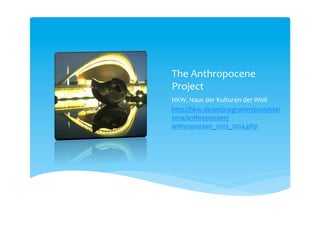
The Anthropocene
Project
HKW, Haus der Kulturen der Welt
http://hkw.de/en/programm/projekte/
2014/anthropozaen/anthropozaen_20
13_2014.php
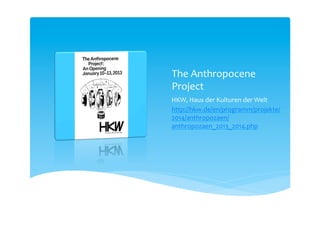
The Anthropocene
Project
HKW, Haus der Kulturen der Welt
http://hkw.de/en/programm/projekte/
2014/anthropozaen/anthropozaen_20
13_2014.php
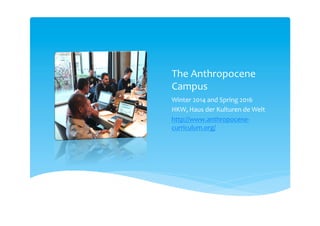
The Anthropocene
Campus
Winter 2014 and Spring 2016
HKW, Haus der Kulturen de Welt
http://www.anthropocene-
curriculum.org/
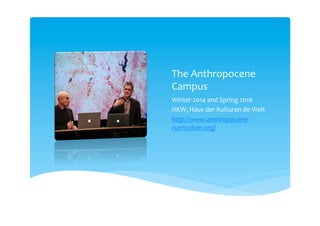
The Anthropocene
Campus
Winter 2014 and Spring 2016
HKW, Haus der Kulturen de Welt
http://www.anthropocene-
curriculum.org/
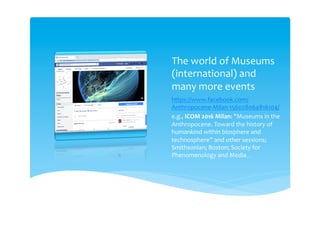
The world of Museums
(international) and
many more events
https://www.facebook.com/Anthropoc
ene-Milan-156028064816104/
e.g., ICOM 2016 Milan: "Museums in the
Anthropocene. Toward the history of
humankind within biosphere and
technosphere” and other sessions;
Smithsonian; Boston; Society for
Phenomenology and Media…
 2016 by the end of the year: webpage with updated
abstract and schedule of the first activities
 January 2017: inaugural lecture on Anthropocene Project,
with Elena Bougleux and a leader from Berlin
 Feb-May 2017: seminars
 Sep-Dec 2017: seminars, field trip, another public event
 Jan-March 2018: seminars and publication proposal
 May 2018: finalization of publication proposal, start of
editorial process
 2018 by the end of the year: publication and final event
Tentative schedule

Ciseps Anthropocene Proposal

  • 1.
    Proposal for an“Anthropocene” Research Program, and its relationship with the “Cultural Evolution” program Emanuele Serrelli University of Milano-Bicocca CISEPS assembly, October 26, 2016
  • 2.
    “Cultural Traits”: thecurrent research program points backwards http://dems.unimib.it/ricerca/centri -di-ricerca/ciseps- 2/research/cultural-evolution/
  • 3.
     Anthropocene asa good candidate to REPROPOSE the successful template of the project “The Diffusion of Cultural Traits” (2011-2016) The idea
  • 4.
    1. A “hottopic” in the scientific literature (debated, criticized, defended…) 2. A topic that, once reinterpreted, can become a key to interdisciplinarity 3. A specific but non-constraining definition of the topic: it can be recognized across disciplines, but it is open to revision and even rejection 4. Strong engagement of UNIMIB colleagues: a lot of scouting and diplomatic work 5. Concrete job: a series of 10-15 seminars within the regular series of CISEPS, to become chapters or articles in the final publication; a few events that mix art and culture, and that can be open to colleagues and to the general public (preferably with institutional collaborations) 6. Intense network communication: mailing lists 7. A concrete outcome: a high-level edited publication (book or special issue) The template
  • 5.
    “The Diffusion ofCultural Traits” A “hot topic” in the scientific literature (debated, criticized, defended…)
  • 6.
    “The Diffusion ofCultural Traits” A topic that, once reinterpreted, can become a key to interdisciplinarity
  • 7.
    “The Diffusion ofCultural Traits” A specific but non- constraining definition of the topic: it can be recognized across disciplines, but it is open to revision and even rejection Some assumptions:  “...by cultural trait we can provisionally intend any trait whose production in individuals depends to some extent on social learning”  “...we do not think to cultural trait diffusion as an exhaustive theory of culture and cultural change”  thinking in terms of cultural traits can trigger discourses in different disciplines and communication, highlighting common issues and valuing diversity  “...evolutionary models can be regarded as useful in that they offer manipulable prospective histories, which can in turn be employed as guidelines for restrospective reconstructions in other fields”
  • 8.
    “The Diffusion ofCultural Traits” Strong engagement of UNIMIB colleagues: a lot of scouting and diplomatic work
  • 9.
    “The Diffusion ofCultural Traits” Concrete job: a series of 10-15 seminars within the regular series of CISEPS, to become chapters or articles in the final publication; a few events that mix art and culture, and that can be open to colleagues and to the general public (preferably with institutional collaborations)
  • 10.
     Storia deljazz: una prospettiva globale (12/3/2012)  Travelling models of water: Battlefields of knowledge and ideas of change in the Middle East (12/4/2012)  Cultural evolution models and the extended synthesis. Symbiogenesis and punctuated equilibria theory in the study of cultural transmission (10/5/2012)  Cultures and cultural traits in archaeology (27/9/2012)  The unary trait. Identification and transmission in psychoanalisis (canceled)  The unexpected migration of Transparent Man from Germany to the U.S. in 1930s and 40s (8/11/2012)  Iuxta propria principia: pains and miseries of an expression (22/11/2012)  Methodological workshop: linguistics, economics, biology (13/12/2012)  The biological function of literature? Some evolutionary considerations about its origin and diffusion (31/1/2013)  Evolutionary origin of the aesthetic (canceled)  The political boundary as place of meeting and diffusion of cultural traits in a region (14/3/2013)  Cultural traits in organizations: multi-scale dynamics of reproduction and change (canceled)  Origin and diffusion of a symbolic form: perspective (canceled) “The Diffusion of Cultural Traits”
  • 11.
    “The Diffusion ofCultural Traits” Intense network communication: mailing lists
  • 13.
    “The Diffusion ofCultural Traits” A concrete outcome: a high- level edited publication (book or special issue)
  • 14.
    Table of contents 1Cultural Traits and MultidisciplinaryDialogue Fabrizio Panebianco and Emanuele Serrelli 2 Understanding Cultural Diversity. Culture, Cultural Traits and Cultural Changes Between Global and Local Scales Vincenzo Matera 3 Cultural Traits and Identity Ugo E.M. Fabietti 4 The Diffusion of a Museum Exhibit: The Case of the Transparent Man Elena Canadelli 5 The ‘Incompetent Subject’ in the Kingdom of Technical Terms. A Possible Role of Pedagogy in the Study of Cultural Traits Rossana Brambilla 6 The Unary Trait of Psychoanalysis. Identification,Transmission, Generation Matteo Bonazzi 7 Cultural Diversities Across and Within Cultures: The Bicultural Mind Olivia Realdon and Valentino Zurloni 8 Birth and Evolution of Jazz as Effects of Cultural Transfers Stefano Zenni 9 Geographical Boundaries as Places of Meeting and Diffusion of Cultural Traits Stefano Malatesta, Marcella Schmidt di Friedberg, and Enrico Squarcina 10 Maps, Diagrams and Charts: Making the Cultural Trait Visible Fulvio Carmagnola 11 Evolutionary Genetics and Cultural Traits in a ‘Body of Theory’ Perspective Emanuele Serrelli 12 Cultural Traits in Economic Theory Fabrizio Panebianco 13 International Cooperation and Cultural Transmission Isa Gama 14 Rethinking Organizational Culture: The Role of Generational Subcultures Alessandra Lazazzara 15 From Material Remains to Culture: The Possibilities and Limits of Archaeology in Reconstructing Ancient People Viviana Ardesia 16 Homology and Phylogenetic Inference in Biological and Material Cultural Evolution Ilya Tëmkin 17 On the Origin of Technologies: The Invention and Evolution of the Bow-and-Arrow Giuseppe Carignani 18 Trees, Languages and Genes: A Historical Path Federica Da Milano and Nicoletta Puddu 19 Signaling in Style: On Cooperation, Identity and the Origins of Visual Art Larissa Mendoza-Straffon 20 Aesthetic Preferences: An Evolutionary Approach Mariagrazia Portera and Lorenzo Bartalesi 21 Nothing But Survival: On the Origin and Function of Literature Mario Barenghi 22 Concluding Remarks – Removing Barriers in Scientific Research: Concepts, Synthesis and Catalysis Emanuele Serrelli “The Diffusion of Cultural Traits”
  • 15.
    A specific butnon-constraining definition of the topic: it can be recognized across disciplines, but it is open to revision and even rejection  The Anthropocene defines Earth's most recent geologic time period as being human-influenced, or anthropogenic, based on overwhelming global evidence that atmospheric, geologic, hydrologic, biospheric and other earth system processes are now altered by humans.  The word combines the root "anthropo", meaning "human" with the root "- cene", the standard suffix for "epoch" in geologic time.  The Anthropocene is distinguished as a new period either after or within the Holocene, the current epoch, which began approximately 10,000 years ago (about 8000 BC) with the end of the last glacial period.  Source: The Encyclopedia of Earth, cit. in www.anthropocene.info “Anthropocene”
  • 16.
    “Anthropocene” A specific butnon- constraining definition of the topic: it can be recognized across disciplines, but it is open to revision and even rejection A geological epoch?
  • 17.
    “Anthropocene” A specific butnon- constraining definition of the topic: it can be recognized across disciplines, but it is open to revision and even rejection A great acceleration?
  • 18.
    “Anthropocene” A specific butnon- constraining definition of the topic: it can be recognized across disciplines, but it is open to revision and even rejection A great acceleration?
  • 19.
    “Anthropocene” A specific butnon-constraining definition of the topic: it can be recognized across disciplines, but it is open to revision and even rejection An exponential growth of interconnection and complexity?
  • 21.
    “Anthropocene” A “hot topic” -In the scientific literature - In innovative partnerships art-science, media- science, university- museums, teaching methods… Example: THE ANTHROPOCENE PROJECT
  • 22.
  • 23.
    In the news TheEconomist
  • 24.
    Controversial Nature: how todefine the Anthropocene
  • 25.
  • 26.
  • 27.
    The Anthropocene Project HKW, Hausder Kulturen der Welt http://hkw.de/en/programm/projekte/ 2014/anthropozaen/anthropozaen_20 13_2014.php
  • 28.
    The Anthropocene Project HKW, Hausder Kulturen der Welt http://hkw.de/en/programm/projekte/ 2014/anthropozaen/anthropozaen_20 13_2014.php
  • 29.
    The Anthropocene Campus Winter 2014and Spring 2016 HKW, Haus der Kulturen de Welt http://www.anthropocene- curriculum.org/
  • 30.
    The Anthropocene Campus Winter 2014and Spring 2016 HKW, Haus der Kulturen de Welt http://www.anthropocene- curriculum.org/
  • 31.
    The world ofMuseums (international) and many more events https://www.facebook.com/Anthropoc ene-Milan-156028064816104/ e.g., ICOM 2016 Milan: "Museums in the Anthropocene. Toward the history of humankind within biosphere and technosphere” and other sessions; Smithsonian; Boston; Society for Phenomenology and Media…
  • 32.
     2016 bythe end of the year: webpage with updated abstract and schedule of the first activities  January 2017: inaugural lecture on Anthropocene Project, with Elena Bougleux and a leader from Berlin  Feb-May 2017: seminars  Sep-Dec 2017: seminars, field trip, another public event  Jan-March 2018: seminars and publication proposal  May 2018: finalization of publication proposal, start of editorial process  2018 by the end of the year: publication and final event Tentative schedule