The Communication
Revolution.
BY: ANINDITA AICH & TRISHA SARKAR
THE TRADITIONAL MEDIA
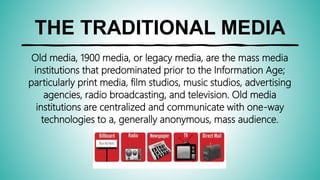
Old media, 1900 media, or legacy media, are the mass media
institutions that predominated prior to the Information Age;
particularly print media, film studios, music studios, advertising
agencies, radio broadcasting, and television. Old media
institutions are centralized and communicate with one-way
technologies to a, generally anonymous, mass audience.
The Traditional Media’s journey.
THE PRINT MEDIA :
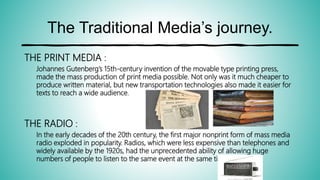
Johannes Gutenberg’s 15th-century invention of the movable type printing press,
made the mass production of print media possible. Not only was it much cheaper to
produce written material, but new transportation technologies also made it easier for
texts to reach a wide audience.
THE RADIO :
In the early decades of the 20th century, the first major nonprint form of mass media
radio exploded in popularity. Radios, which were less expensive than telephones and
widely available by the 1920s, had the unprecedented ability of allowing huge
numbers of people to listen to the same event at the same time.
PIGEON :
It is the use of homing pigeons to carry messages. Pigeons were effective as
messengers due to their natural homing abilities. The pigeons were
transported to a destination in cages, where the would be attached with the
messages.
MAIL :
Mail or post is a system for transporting letters and other tangible objects,
written documents typically enclosed in envelopes and also small packages
and delivered to destinations around the world.
VIDEO RECORDERS :
Until the advent of digital video recorders in the late 1990s, it was
impossible to pause and rewind a live television broadcast.
CABLE TELEVISION :
The media world faced drastic changes once again in the 1980s and
1990s with the spread of cable television. During the early decades of
television, viewers had a limited number of channels to choose from—
one reason for the charges of homogeneity.
THE NEW MEDIA
New media are forms of media that are computational and rely
on computers for redistribution. Some examples of new media
are computer animations, computer games, human-computer
interfaces, interactive computer installations, websites, and
virtual worlds, Blogs, Email, Social media networks, Music and
television streaming services, Virtual and augmented reality.
The New Media’s journey.
• Until the 1980s media relied primarily upon print and analog broadcast models, such as
those of television and radio. The last twenty-five years have seen the rapid transformation
into media which are predicated upon the use of digital technologies, such as the Internet
and video games. However, these examples are only a small representation of new media.
• The use of digital computers has transformed the remaining 'old' media, as suggested by
the advent of digital television and online publications. Even traditional media forms such as
the printing press have been transformed through the application of technologies such as
image manipulation software like Adobe Photoshop and desktop publishing tools.
THE WEB :
Most of the time spent in the Internet nowadays is mediated through the World Wide
Web (WWW) experience produced by current browsers. Tim Berners-Lee, a British
scientist, invented the World Wide Web (WWW) in 1989, while working at CERN. The
Web was originally conceived and developed to meet the demand for automated
information-sharing between scientists in universities and institutes around the world.
BLOGS :
The modern blog evolved from the online diary where people would keep a running
account of the events in their personal lives. Most such writers called themselves
diarists, journalists, or journalers. Justin Hall, who began personal blogging in 1994
while a student at Swarthmore College, is generally recognized as one of the earlier
bloggers, as is Jerry Pournelle.
SOCIAL MEDIA :
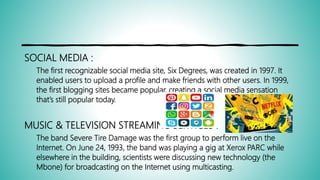
The first recognizable social media site, Six Degrees, was created in 1997. It
enabled users to upload a profile and make friends with other users. In 1999,
the first blogging sites became popular, creating a social media sensation
that’s still popular today.
MUSIC & TELEVISION STREAMING SERVICES :
The band Severe Tire Damage was the first group to perform live on the
Internet. On June 24, 1993, the band was playing a gig at Xerox PARC while
elsewhere in the building, scientists were discussing new technology (the
Mbone) for broadcasting on the Internet using multicasting.
Difference between old & new media.
CONCLUSION !
Transitions from one technology to another have greatly
affected the media industry, although it is difficult to say
whether technology caused a cultural shift or resulted from it.
The ability to make technology small and affordable enough to
fit into the home is an important aspect of the popularization of
new technologies.

The communication revolution

  • 1.
  • 2.
    THE TRADITIONAL MEDIA Oldmedia, 1900 media, or legacy media, are the mass media institutions that predominated prior to the Information Age; particularly print media, film studios, music studios, advertising agencies, radio broadcasting, and television. Old media institutions are centralized and communicate with one-way technologies to a, generally anonymous, mass audience.
  • 3.
    The Traditional Media’sjourney. THE PRINT MEDIA : Johannes Gutenberg’s 15th-century invention of the movable type printing press, made the mass production of print media possible. Not only was it much cheaper to produce written material, but new transportation technologies also made it easier for texts to reach a wide audience. THE RADIO : In the early decades of the 20th century, the first major nonprint form of mass media radio exploded in popularity. Radios, which were less expensive than telephones and widely available by the 1920s, had the unprecedented ability of allowing huge numbers of people to listen to the same event at the same time.
  • 4.
    PIGEON : It isthe use of homing pigeons to carry messages. Pigeons were effective as messengers due to their natural homing abilities. The pigeons were transported to a destination in cages, where the would be attached with the messages. MAIL : Mail or post is a system for transporting letters and other tangible objects, written documents typically enclosed in envelopes and also small packages and delivered to destinations around the world.
  • 5.
    VIDEO RECORDERS : Untilthe advent of digital video recorders in the late 1990s, it was impossible to pause and rewind a live television broadcast. CABLE TELEVISION : The media world faced drastic changes once again in the 1980s and 1990s with the spread of cable television. During the early decades of television, viewers had a limited number of channels to choose from— one reason for the charges of homogeneity.
  • 6.
    THE NEW MEDIA Newmedia are forms of media that are computational and rely on computers for redistribution. Some examples of new media are computer animations, computer games, human-computer interfaces, interactive computer installations, websites, and virtual worlds, Blogs, Email, Social media networks, Music and television streaming services, Virtual and augmented reality.
  • 7.
    The New Media’sjourney. • Until the 1980s media relied primarily upon print and analog broadcast models, such as those of television and radio. The last twenty-five years have seen the rapid transformation into media which are predicated upon the use of digital technologies, such as the Internet and video games. However, these examples are only a small representation of new media. • The use of digital computers has transformed the remaining 'old' media, as suggested by the advent of digital television and online publications. Even traditional media forms such as the printing press have been transformed through the application of technologies such as image manipulation software like Adobe Photoshop and desktop publishing tools.
  • 8.
    THE WEB : Mostof the time spent in the Internet nowadays is mediated through the World Wide Web (WWW) experience produced by current browsers. Tim Berners-Lee, a British scientist, invented the World Wide Web (WWW) in 1989, while working at CERN. The Web was originally conceived and developed to meet the demand for automated information-sharing between scientists in universities and institutes around the world. BLOGS : The modern blog evolved from the online diary where people would keep a running account of the events in their personal lives. Most such writers called themselves diarists, journalists, or journalers. Justin Hall, who began personal blogging in 1994 while a student at Swarthmore College, is generally recognized as one of the earlier bloggers, as is Jerry Pournelle.
  • 9.
    SOCIAL MEDIA : Thefirst recognizable social media site, Six Degrees, was created in 1997. It enabled users to upload a profile and make friends with other users. In 1999, the first blogging sites became popular, creating a social media sensation that’s still popular today. MUSIC & TELEVISION STREAMING SERVICES : The band Severe Tire Damage was the first group to perform live on the Internet. On June 24, 1993, the band was playing a gig at Xerox PARC while elsewhere in the building, scientists were discussing new technology (the Mbone) for broadcasting on the Internet using multicasting.
  • 10.
  • 11.
    CONCLUSION ! Transitions fromone technology to another have greatly affected the media industry, although it is difficult to say whether technology caused a cultural shift or resulted from it. The ability to make technology small and affordable enough to fit into the home is an important aspect of the popularization of new technologies.