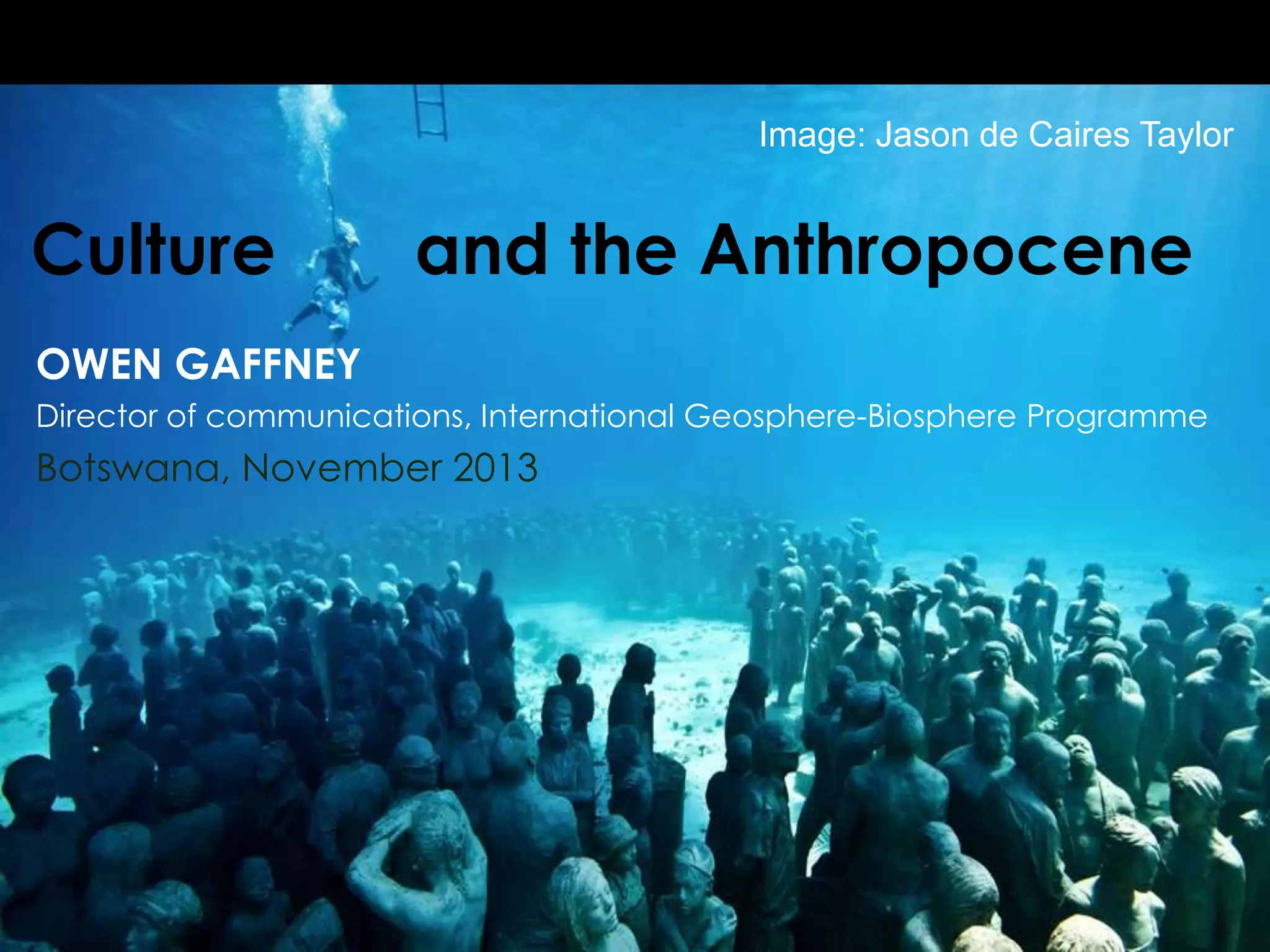
Image: Jason de Caires Taylor

Culture

and the Anthropocene

OWEN GAFFNEY
Director of communications, International Geosphere-Biosphere Programme

Botswana, November 2013
Image: Jason de Caires Taylor

What is the Anthropocene?
Why is it important?
Oxford dictionary definition
relating to or denoting the current geological
age, viewed as the period during which human
activity has been been the dominant influence
on climate and the environment.

Image: Felix Pharand Deschenes
Ice Age ends

Population (billion)

7
6
5

4

Holocene

3
2

1
200,000

70,000 40,000
50,000

12,000 9000 6000
11,000

200

Time (years before present)
Population

US Bureau of the Census (2000) International database
IGBP synthesis: Global Change and the Earth System, Steffen et al 2004
Total real GDP

Nordhaus (1997) The economics of new goods. University of Chicago Press
IGBP synthesis: Global Change and the Earth System, Steffen et al 2004
Foreign direct investment

World Bank (2002) data and statistics
IGBP synthesis: Global Change and the Earth System, Steffen et al 2004
Damming of rivers

World Commission on Dams (2000)
IGBP synthesis: Global Change and the Earth System, Steffen et al 2004
Water use

Shiklomanov (1990) Global Water Resources
IGBP synthesis: Global Change and the Earth System, Steffen et al 2004
Fertiliser consumption

International Fertilizer Industry Association (2002)
IGBP synthesis: Global Change and the Earth System, Steffen et al 2004
Urban population

The State of the World’s Cities (2001)
IGBP synthesis: Global Change and the Earth System, Steffen et al 2004
Paper consumption

Pulp and paper international (1993)
IGBP synthesis: Global Change and the Earth System, Steffen et al 2004
Motor vehicles

Global environmental outlook (2000)
IGBP synthesis: Global Change and the Earth System, Steffen et al 2004
Telephones

Canning (2001) A database of world infrastructure stocks, 1950-95 World Bank
IGBP synthesis: Global Change and the Earth System, Steffen et al 2004
International tourism

World Tourism Organization (2001) Tourism industry trends
IGBP synthesis: Global Change and the Earth System, Steffen et al 2004
Fisheries exploitation

Percentage of global fisheries either fully exploited, overfished or collapsed. Source:
FAOSTAT (2002) Statistical databases
IGBP synthesis: Global Change and the Earth System, Steffen et al 2004
Shrimp farm production

IAnnual shrimp production as a proxy for coastal zone alteration. Sources: WRI (2003)
A guide to world resources, 2002-2004
IGBP synthesis: Global Change and the Earth System, Steffen et al 2004
Domesticated land

Amount of land converted to pasture and cropland. Source: Klein Goldewijk and Battjes (1997)
National Institute for Public Health and the Environment (RIVM). Bilthoven, Netherlands
IGBP synthesis: Global Change and the Earth System, Steffen et al 2004
Atmospheric CO2 concentration

Etheridge et al. Geophys Res 101: 4115-4128
IGBP synthesis: Global Change and the Earth System, Steffen et al 2004
Atmospheric N2O concentration

Machida et al Geophys Res Lett 22:2921-2925
IGBP synthesis: Global Change and the Earth System, Steffen et al 2004
Atmospheric CH4 concentration

Blunier et al J Geophy Res 20: 2219-2222
IGBP synthesis: Global Change and the Earth System, Steffen et al 2004
Northern hemisphere average surface
temperature

Mann et al Geophys Res Lett 26(6): 759-762
IGBP synthesis: Global Change and the Earth System, Steffen et al 2004
Ozone depletion

percentage total column ozone loss over Antarctica, using the average annual total
column ozone, 330, as a base. Image: J.D. Shanklin, British Antarctic Survey
IGBP synthesis: Global Change and the Earth System, Steffen et al 2004
Tropical rainforest and woodland loss

Loss of tropical rainforest and woodland, as estimated for tropical Africa, Latin America and South and
Southeast Asia. Sources: Richards (1990) In: The Earth as transformed by human action, Cambridge
University Press IGBP synthesis: Global Change and the Earth System, Steffen et al 2004
Natural climatic disasters

Decadal frequency of great floods (one-in-100-year events) after 1860 for basins larger than 200 000 km2 with
observations that span at least 30 years. Source: Milly et al. (2002) Nature 415:514-517 IGBP synthesis:
Global Change and the Earth System, Steffen et al 2004
Coastal zone nitrogen flux

Model-calculated partitioning of the human-induced nitrogen perturbation fluxes in the global coastal
margin for the period since 1850. Source: Mackenzie et al. (2002) Chem. Geology 190:13-32
IGBP synthesis: Global Change and the Earth System, Steffen et al 2004
Biodiversity loss

Mathematically calculated rate of extinction. Source: Wilson (1992) The diversity of life, the Penguin Press.
IGBP synthesis: Global Change and the Earth System, Steffen et al 2004
Great acceleration

IGBP synthesis: Global Change and the Earth System, Steffen et al 2004
Water

Credit: Adam Nieman

Atmosphere
Credit: IGBP/Globaia Owen Gaffney, Felix Pharand Deschenes
Image: Radhika Gupta

Credit: Radhika Gupta
Image: Radhika Gupta

Credit: Radhika Gupta
1992: New York Times journalist Andrew Revkin

“We are entering an age that might
someday be referred to as, say, the
Anthrocene [sic]. After all, it is a
geological age of our own making.”
Global Warming: Understanding the
forecast
1989: U.S writer and activist Bill McKibben
publishes the End of Nature
1980s: U.S. biologist Eugene Stoermer’s (1934-2012)
lectures mention the Anthropocene
NASA Earth rise
Vladimir Verdansky (1863-1945)
GeosphereBiosphere Noösphere

Life is a geological force
Just as the emergence of life
fundamentally transformed the
geosphere, the emergence of
human cognition fundamentally
transforms the biosphere.

Image: Memorial Office Museum of
Academician VI Verdansky
Moscow.

Vernadsky and Teilhard de Chardin
used the term “noösphere” – the world
of thought – to mark the growing role
of human brain-power in shaping its
own future and environment.
George Perkins Marsh (1801-1882)
Man and Nature (1864)
The Earth as Modified by
Human Action: Man and
Nature. (1874)

George P. Marsh, photographed by Mathew B. Brady between
1855 and 1865. Brady-Handy Collection (Library of Congress).
[call number: BH8201-4981; reproduction number: LC-BH82014981 DLC (b&w film copy neg.)
Antonio Stoppani (1824-1891)
Corso di geologia
(1873)
„Anthropozoic era‟
…Defined by a “new telluric
force, which in power and
universality may be compared
to the greater forces of earth.”

Image: Paleontologica Lombarda
Who decides?
But the rest of the world is
not waiting…
Society in the Anthropocene conference, June 2013, Bristol.
Image: Philippa Bayley
Andrew Barry, University of Oxford
“The idea of the Anthropocene
…represents a remarkable
intervention by the geosciences into
the field of politics...an attempt by
the geosciences to move aboveground.”

2012 © Owen Gaffney
“The concept of the

ANTHROPOCENE
heralds a profound
shift in PERCEPTION
of our place in the
WORLD.”
Nobel Laureate Elinor Ostrom
(1933-2012)
Planet Under Pressure

Photo credit: Chris Meyer
Image: Jason de Caires Taylor
Image: David Thomas Smith
Could the Anthropocene mark a cultural paradigm shift?
Thank you!
OWEN GAFFNEY
Director of communications
International Geosphere-Biosphere Programme
Botswana November 2013

Owen.gaffney@igbp.kva.se
Twitter:
@owengaffney
@igbpcomms
www.igbp.net

Anthropocene and culture dec 2013 web

  • 1.
    Image: Jason deCaires Taylor Culture and the Anthropocene OWEN GAFFNEY Director of communications, International Geosphere-Biosphere Programme Botswana, November 2013
  • 2.
    Image: Jason deCaires Taylor What is the Anthropocene? Why is it important?
  • 3.
    Oxford dictionary definition relatingto or denoting the current geological age, viewed as the period during which human activity has been been the dominant influence on climate and the environment. Image: Felix Pharand Deschenes
  • 4.
    Ice Age ends Population(billion) 7 6 5 4 Holocene 3 2 1 200,000 70,000 40,000 50,000 12,000 9000 6000 11,000 200 Time (years before present)
  • 5.
    Population US Bureau ofthe Census (2000) International database IGBP synthesis: Global Change and the Earth System, Steffen et al 2004
  • 6.
    Total real GDP Nordhaus(1997) The economics of new goods. University of Chicago Press IGBP synthesis: Global Change and the Earth System, Steffen et al 2004
  • 7.
    Foreign direct investment WorldBank (2002) data and statistics IGBP synthesis: Global Change and the Earth System, Steffen et al 2004
  • 8.
    Damming of rivers WorldCommission on Dams (2000) IGBP synthesis: Global Change and the Earth System, Steffen et al 2004
  • 9.
    Water use Shiklomanov (1990)Global Water Resources IGBP synthesis: Global Change and the Earth System, Steffen et al 2004
  • 10.
    Fertiliser consumption International FertilizerIndustry Association (2002) IGBP synthesis: Global Change and the Earth System, Steffen et al 2004
  • 11.
    Urban population The Stateof the World’s Cities (2001) IGBP synthesis: Global Change and the Earth System, Steffen et al 2004
  • 12.
    Paper consumption Pulp andpaper international (1993) IGBP synthesis: Global Change and the Earth System, Steffen et al 2004
  • 13.
    Motor vehicles Global environmentaloutlook (2000) IGBP synthesis: Global Change and the Earth System, Steffen et al 2004
  • 14.
    Telephones Canning (2001) Adatabase of world infrastructure stocks, 1950-95 World Bank IGBP synthesis: Global Change and the Earth System, Steffen et al 2004
  • 15.
    International tourism World TourismOrganization (2001) Tourism industry trends IGBP synthesis: Global Change and the Earth System, Steffen et al 2004
  • 16.
    Fisheries exploitation Percentage ofglobal fisheries either fully exploited, overfished or collapsed. Source: FAOSTAT (2002) Statistical databases IGBP synthesis: Global Change and the Earth System, Steffen et al 2004
  • 17.
    Shrimp farm production IAnnualshrimp production as a proxy for coastal zone alteration. Sources: WRI (2003) A guide to world resources, 2002-2004 IGBP synthesis: Global Change and the Earth System, Steffen et al 2004
  • 18.
    Domesticated land Amount ofland converted to pasture and cropland. Source: Klein Goldewijk and Battjes (1997) National Institute for Public Health and the Environment (RIVM). Bilthoven, Netherlands IGBP synthesis: Global Change and the Earth System, Steffen et al 2004
  • 19.
    Atmospheric CO2 concentration Etheridgeet al. Geophys Res 101: 4115-4128 IGBP synthesis: Global Change and the Earth System, Steffen et al 2004
  • 20.
    Atmospheric N2O concentration Machidaet al Geophys Res Lett 22:2921-2925 IGBP synthesis: Global Change and the Earth System, Steffen et al 2004
  • 21.
    Atmospheric CH4 concentration Blunieret al J Geophy Res 20: 2219-2222 IGBP synthesis: Global Change and the Earth System, Steffen et al 2004
  • 22.
    Northern hemisphere averagesurface temperature Mann et al Geophys Res Lett 26(6): 759-762 IGBP synthesis: Global Change and the Earth System, Steffen et al 2004
  • 23.
    Ozone depletion percentage totalcolumn ozone loss over Antarctica, using the average annual total column ozone, 330, as a base. Image: J.D. Shanklin, British Antarctic Survey IGBP synthesis: Global Change and the Earth System, Steffen et al 2004
  • 24.
    Tropical rainforest andwoodland loss Loss of tropical rainforest and woodland, as estimated for tropical Africa, Latin America and South and Southeast Asia. Sources: Richards (1990) In: The Earth as transformed by human action, Cambridge University Press IGBP synthesis: Global Change and the Earth System, Steffen et al 2004
  • 25.
    Natural climatic disasters Decadalfrequency of great floods (one-in-100-year events) after 1860 for basins larger than 200 000 km2 with observations that span at least 30 years. Source: Milly et al. (2002) Nature 415:514-517 IGBP synthesis: Global Change and the Earth System, Steffen et al 2004
  • 26.
    Coastal zone nitrogenflux Model-calculated partitioning of the human-induced nitrogen perturbation fluxes in the global coastal margin for the period since 1850. Source: Mackenzie et al. (2002) Chem. Geology 190:13-32 IGBP synthesis: Global Change and the Earth System, Steffen et al 2004
  • 27.
    Biodiversity loss Mathematically calculatedrate of extinction. Source: Wilson (1992) The diversity of life, the Penguin Press. IGBP synthesis: Global Change and the Earth System, Steffen et al 2004
  • 28.
    Great acceleration IGBP synthesis:Global Change and the Earth System, Steffen et al 2004
  • 29.
  • 30.
    Credit: IGBP/Globaia OwenGaffney, Felix Pharand Deschenes
  • 31.
  • 32.
  • 33.
  • 34.
  • 35.
  • 36.
  • 37.
    1992: New YorkTimes journalist Andrew Revkin “We are entering an age that might someday be referred to as, say, the Anthrocene [sic]. After all, it is a geological age of our own making.” Global Warming: Understanding the forecast
  • 38.
    1989: U.S writerand activist Bill McKibben publishes the End of Nature
  • 39.
    1980s: U.S. biologistEugene Stoermer’s (1934-2012) lectures mention the Anthropocene
  • 40.
  • 41.
    Vladimir Verdansky (1863-1945) GeosphereBiosphereNoösphere Life is a geological force Just as the emergence of life fundamentally transformed the geosphere, the emergence of human cognition fundamentally transforms the biosphere. Image: Memorial Office Museum of Academician VI Verdansky Moscow. Vernadsky and Teilhard de Chardin used the term “noösphere” – the world of thought – to mark the growing role of human brain-power in shaping its own future and environment.
  • 42.
    George Perkins Marsh(1801-1882) Man and Nature (1864) The Earth as Modified by Human Action: Man and Nature. (1874) George P. Marsh, photographed by Mathew B. Brady between 1855 and 1865. Brady-Handy Collection (Library of Congress). [call number: BH8201-4981; reproduction number: LC-BH82014981 DLC (b&w film copy neg.)
  • 43.
    Antonio Stoppani (1824-1891) Corsodi geologia (1873) „Anthropozoic era‟ …Defined by a “new telluric force, which in power and universality may be compared to the greater forces of earth.” Image: Paleontologica Lombarda
  • 44.
  • 45.
    But the restof the world is not waiting…
  • 46.
    Society in theAnthropocene conference, June 2013, Bristol. Image: Philippa Bayley
  • 47.
    Andrew Barry, Universityof Oxford “The idea of the Anthropocene …represents a remarkable intervention by the geosciences into the field of politics...an attempt by the geosciences to move aboveground.” 2012 © Owen Gaffney
  • 48.
    “The concept ofthe ANTHROPOCENE heralds a profound shift in PERCEPTION of our place in the WORLD.” Nobel Laureate Elinor Ostrom (1933-2012) Planet Under Pressure Photo credit: Chris Meyer
  • 54.
    Image: Jason deCaires Taylor
  • 55.
    Image: Jason deCaires Taylor
  • 56.
  • 57.
    Could the Anthropocenemark a cultural paradigm shift?
  • 58.
    Thank you! OWEN GAFFNEY Directorof communications International Geosphere-Biosphere Programme Botswana November 2013 Owen.gaffney@igbp.kva.se Twitter: @owengaffney @igbpcomms www.igbp.net

Editor's Notes

  • #6 This great acceleration really started in the 50s
  • #20 The biophysical responses of the Earth System show many of the same features as the Great Acceleration in the human enterprise.The hockeystick pattern applies all key indicators that form the basis for human well being and environmental health.
  • #29 A single human lifetime
  • #30 AdamNieman
  • #41 Earth rise. 1968 Nasa astronaut William Anders. Apollo missions and Russian spaceflights provide humanity with new perspective. Rachel Carson’s Silent Spring warns of environmental damage. Club of Rome and Limits to Growth create a new narrative for humanity1972 Stockholm Summit puts global environment and human action on the political landscape.
  • #45 Decision may be made in 2016.Stratigraphy commission websitehttp://www.quaternary.stratigraphy.org.uk/workinggroups/anthropocene/The 'Anthropocene' is not a formally defined geological unit within the Geological Time Scale. A proposal to formalise the 'Anthropocene' is being developed by the 'Anthropocene' Working Group for consideration by the International Commission on Stratigraphy, with a current target date of 2016. Care should be taken to distinguish the concept of an 'Anthropocene' from the previously used term Anthropogene (cf. below**).The 'Anthropocene' is currently being considered by the Working Group as a potential geological epoch, i.e. at the same hierarchical level as the Pleistocene and Holocene epochs, with the implication that it is within the Quaternary Period, but that the Holocene has terminated. It might, alternatively, also be considered at a lower (Age) hierarchical level; that would imply it is a subdivision of the ongoing Holocene Epoch.Broadly, to be accepted as a formal term the 'Anthropocene' needs to be (a) scientifically justified (i.e. the 'geological signal' currently being produced in strata now forming must be sufficiently large, clear and distinctive) and (b) useful as a formal term to the scientific community. In terms of (b), the currently informal term 'Anthropocene' has already proven to be very useful to the global change research community and thus will continue to be used, but it remains to be determined whether formalisation within the Geological Time Scale would make it more useful or broaden its usefulness to other scientific communities, such as the geological community.The beginning of the 'Anthropocene' is most generally considered to be at c. 1800 CE, around the beginning of the Industrial Revolution in Europe (Crutzen's original suggestion); other potential candidates for time boundaries have been suggested, at both earlier dates (within or even before the Holocene) or later (e.g. at the start of the nuclear age). A formal 'Anthropocene' might be defined either with reference to a particular point within a stratal section, that is, a Global Stratigraphic Section and Point (GSSP), colloquially known as a 'golden spike; or, by a designated time boundary (a Global Standard Stratigraphic Age).The 'Anthropocene' has emerged as a popular scientific term used by scientists, the scientifically engaged public and the media to designate the period of Earth's history during which humans have a decisive influence on the state, dynamics and future of the Earth system. It is widely agreed that the Earth is currently in this state.
  • #46 3 new journals launched with Anthropocene in the title in the last 12 months
  • #48 New challenge for international politics to include/manage earth system processes. A new responsibility forcing us to question whether we have the right institutions to do this.
  • #49 Our international organizations were not set up to deal with the challenges we have today. We have a new responsibility at a global scale. The biggest challenge we face is to find a way to manage the global commons. Towards the end of her career ElinorOstrom increasingly discussed the challenge. She died after a short battle with cancer earlier this year, just a week before the Rio+20 summit, the largest gathering in UN history – 188 heads of state and ministers, 50,000 people. If we are to manage the global commons our world view needs to change. Our world view extends from our self to our family, community, city and nation. Increasingly it extends to the global.
  • #50 Have we affected the Earth’s biogeochemical cycles to such an extent we can now say we have entered a new geological epoch? Paul Crutzen (Nobel laureate and former vice chair of the International Geosphere-Biosphere Programme) argued in Nature in 2002 that we have entered the Anthropocene.In June 2011 the Economist ran it as the cover story following a groundbreaking conference at the London Geological Society in May 2011. This marked the beginning of Anthropocene fever. The media loved the concept.
  • #58 There are many scientific paradigm shifts that are only of interest to a small scientific community. Occasionally a paradigm shift occurs in science that has major repercussions In society. They cause us to reevaluate ourselves and our place in the world. In the past their impact has even been seen as heretical. Copernicus and Darwin were major scientific and cultural milestones for us as a species and society. Will the Anthropocene create such a cultural paradigm shift, or is it just a buzz word that will die out like post-modernism or post industrialism
  • #59 Thank Jerry and MichaelExcite WMO about the potential of data viz, show lots of examplesExplore the value of data viz for Earth system scienceTalk about some examples of good practice and exemplary examples (and show that it is not a panacea)Discuss the role of data viz and policyTalk about WMO and data viz opportunitiesMy backgroundNo equations. No computational fluid dynamics