Instructional Material Evaluation
and Development
BOBBY P.S. DHILLON
CONTENTS
Overview of Instructional Materials
Evaluation of Instructional Materials
Development of Instructional Materials
Tools and Techniques for Evaluation and
Development
PART 1
Overview of Instructional Materials
DEFINITION AND PURPOSE
• Educational Role: Instructional materials serve as tools to guide learners in
acquiring knowledge, skills, and competencies systematically.
• Purpose–driven design: They aim to align with curriculum objectives,
facilitate concept understanding, and provide learning pathways.
• Engagement enhancement: Design to spark interest and sustain learners’
attention, promoting active participation in the education process.
Types of Instructional Materials
Print resources: Books, worksheets, and modules offer foundational
and structured learning materials across various subjects.
Digital tools: Educational apps, e-books, and online platforms allow
interactive and accessible learning tailored to diverse needs.
Multimedia: Videos, animations, and presentations create dynamic
learning experiences through visual and auditory engagement.
Hands-on materials: Models, manipulative, and experiments foster
practical understanding, especially in STEM and hands-on learning
contexts.
Importance of Instructional Materials
1. Learning Outcomes:
High-quality instructional materials enhance understanding, retention, and
application of knowledge.
2. Skill Development: They encourage creativity, critical thinking, and
problem-solving within both academic and real-world contexts.
3. Accessibility: Properly designed materials accommodate diverse
learning styles, ensuring inclusivity for students with varying needs.
4. Teacher Support: Materials act as valuable aids in planning and
delivering effective lessons, reducing workload and improving focus.
PART 2
EVALUATION OF
INSTRUCTIONAL MATERIALS
General Appearance and
Organization
Layout Clarity: Materials should have a clear,
visually appealing layout to enhance readability and
understanding.
Consistency: Uniform formats, such as headers, front
types, and spacing, improve navigation and reduce
cognitive load.
Logical Arrangement: Information should be
organized sequentially and structured to follow a
coherent flow, adding comprehension.
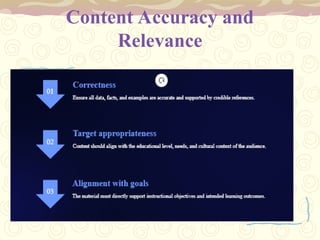
Content Accuracy and
Relevance
ENGANGEMENT AND
INTERACTIVITY
• Learner Focus: Include questions,
activities, or prompts that encourage
critical thinking and active participation
• Visual Enhancement: Use
graphics, charts, or multimedia
elements to capture attention and
emphasize key concepts
• Flexibility: Interactive
features, such as adaptive
pathways or self-paced modules,
cater to diverse learning
preferences.
PART 3
Development of Instructional Materials
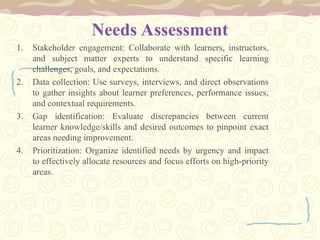
Needs Assessment
1. Stakeholder engagement: Collaborate with learners, instructors,
and subject matter experts to understand specific learning
challenges, goals, and expectations.
2. Data collection: Use surveys, interviews, and direct observations
to gather insights about learner preferences, performance issues,
and contextual requirements.
3. Gap identification: Evaluate discrepancies between current
learner knowledge/skills and desired outcomes to pinpoint exact
areas needing improvement.
4. Prioritization: Organize identified needs by urgency and impact
to effectively allocate resources and focus efforts on high-priority
areas.
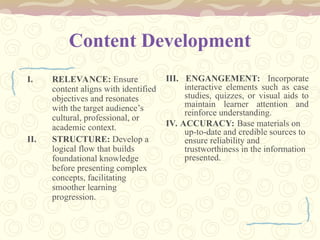
Content Development
I. RELEVANCE: Ensure
content aligns with identified
objectives and resonates
with the target audience’s
cultural, professional, or
academic context.
II. STRUCTURE: Develop a
logical flow that builds
foundational knowledge
before presenting complex
concepts, facilitating
smoother learning
progression.
III. ENGANGEMENT: Incorporate
interactive elements such as case
studies, quizzes, or visual aids to
maintain learner attention and
reinforce understanding.
IV. ACCURACY: Base materials on
up-to-date and credible sources to
ensure reliability and
trustworthiness in the information
presented.
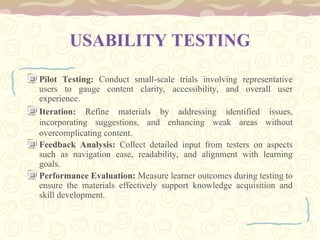
USABILITY TESTING
Pilot Testing: Conduct small-scale trials involving representative
users to gauge content clarity, accessibility, and overall user
experience.
Iteration: Refine materials by addressing identified issues,
incorporating suggestions, and enhancing weak areas without
overcomplicating content.
Feedback Analysis: Collect detailed input from testers on aspects
such as navigation ease, readability, and alignment with learning
goals.
Performance Evaluation: Measure learner outcomes during testing to
ensure the materials effectively support knowledge acquisition and
skill development.
Tools and Techniques for
Evaluation and Development
PART 4
EVALUATION RUBRICS AND
TOOLS
Ensuring alignment: Verify content alignment with
learning objectives and intended outcomes.
Accessibility Check: Evaluate materials for
inclusivity and compliance with accessibility
standards.
Feedback Collection: Leverage survey tools, or
analytic platforms for collecting user insights.
Iterative Design: Employ user-centered design
methods to refine materials based on feedback.
EVALUATION RUBRICS
AND TOOLS
Technology Integration: Utilize modern tools such as AI, AR, or VR
to enhance learning experience.
Scalability Focus: Ensure resources can be adapted for use across
varying audience sizes or contexts.
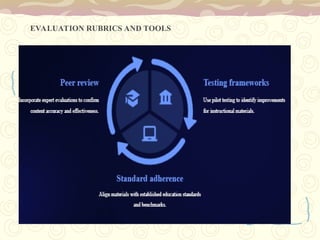
EVALUATION RUBRICS AND TOOLS
INSTRUCTIONAL DESIGN
MODELS
ADDIE
Analyze, design, develop, implement, and evaluate instructional materials
effectively.
SAM
Focus on rapid development through iterative design and prototyping
processes.
Gagné’s Nine Events
Structure instructional strategies with sequential components like gaining
attention and eliciting performance.
ASSIGNMENT
1. Find out some other resources regarding Instructional Material
Evaluation and Development. Summarize them with your own
sentences or understanding.
2. Describe instructional design model with some examples.

Interactional Material Evaluation and Development.ppt

  • 1.
    Instructional Material Evaluation andDevelopment BOBBY P.S. DHILLON
  • 2.
    CONTENTS Overview of InstructionalMaterials Evaluation of Instructional Materials Development of Instructional Materials Tools and Techniques for Evaluation and Development
  • 3.
    PART 1 Overview ofInstructional Materials
  • 4.
    DEFINITION AND PURPOSE •Educational Role: Instructional materials serve as tools to guide learners in acquiring knowledge, skills, and competencies systematically. • Purpose–driven design: They aim to align with curriculum objectives, facilitate concept understanding, and provide learning pathways. • Engagement enhancement: Design to spark interest and sustain learners’ attention, promoting active participation in the education process.
  • 5.
    Types of InstructionalMaterials Print resources: Books, worksheets, and modules offer foundational and structured learning materials across various subjects. Digital tools: Educational apps, e-books, and online platforms allow interactive and accessible learning tailored to diverse needs. Multimedia: Videos, animations, and presentations create dynamic learning experiences through visual and auditory engagement. Hands-on materials: Models, manipulative, and experiments foster practical understanding, especially in STEM and hands-on learning contexts.
  • 6.
    Importance of InstructionalMaterials 1. Learning Outcomes: High-quality instructional materials enhance understanding, retention, and application of knowledge. 2. Skill Development: They encourage creativity, critical thinking, and problem-solving within both academic and real-world contexts. 3. Accessibility: Properly designed materials accommodate diverse learning styles, ensuring inclusivity for students with varying needs. 4. Teacher Support: Materials act as valuable aids in planning and delivering effective lessons, reducing workload and improving focus.
  • 7.
  • 8.
    General Appearance and Organization LayoutClarity: Materials should have a clear, visually appealing layout to enhance readability and understanding. Consistency: Uniform formats, such as headers, front types, and spacing, improve navigation and reduce cognitive load. Logical Arrangement: Information should be organized sequentially and structured to follow a coherent flow, adding comprehension.
  • 9.
  • 10.
    ENGANGEMENT AND INTERACTIVITY • LearnerFocus: Include questions, activities, or prompts that encourage critical thinking and active participation • Visual Enhancement: Use graphics, charts, or multimedia elements to capture attention and emphasize key concepts • Flexibility: Interactive features, such as adaptive pathways or self-paced modules, cater to diverse learning preferences.
  • 11.
    PART 3 Development ofInstructional Materials
  • 12.
    Needs Assessment 1. Stakeholderengagement: Collaborate with learners, instructors, and subject matter experts to understand specific learning challenges, goals, and expectations. 2. Data collection: Use surveys, interviews, and direct observations to gather insights about learner preferences, performance issues, and contextual requirements. 3. Gap identification: Evaluate discrepancies between current learner knowledge/skills and desired outcomes to pinpoint exact areas needing improvement. 4. Prioritization: Organize identified needs by urgency and impact to effectively allocate resources and focus efforts on high-priority areas.
  • 13.
    Content Development I. RELEVANCE:Ensure content aligns with identified objectives and resonates with the target audience’s cultural, professional, or academic context. II. STRUCTURE: Develop a logical flow that builds foundational knowledge before presenting complex concepts, facilitating smoother learning progression. III. ENGANGEMENT: Incorporate interactive elements such as case studies, quizzes, or visual aids to maintain learner attention and reinforce understanding. IV. ACCURACY: Base materials on up-to-date and credible sources to ensure reliability and trustworthiness in the information presented.
  • 14.
    USABILITY TESTING Pilot Testing:Conduct small-scale trials involving representative users to gauge content clarity, accessibility, and overall user experience. Iteration: Refine materials by addressing identified issues, incorporating suggestions, and enhancing weak areas without overcomplicating content. Feedback Analysis: Collect detailed input from testers on aspects such as navigation ease, readability, and alignment with learning goals. Performance Evaluation: Measure learner outcomes during testing to ensure the materials effectively support knowledge acquisition and skill development.
  • 15.
    Tools and Techniquesfor Evaluation and Development PART 4
  • 16.
    EVALUATION RUBRICS AND TOOLS Ensuringalignment: Verify content alignment with learning objectives and intended outcomes. Accessibility Check: Evaluate materials for inclusivity and compliance with accessibility standards. Feedback Collection: Leverage survey tools, or analytic platforms for collecting user insights. Iterative Design: Employ user-centered design methods to refine materials based on feedback.
  • 17.
    EVALUATION RUBRICS AND TOOLS TechnologyIntegration: Utilize modern tools such as AI, AR, or VR to enhance learning experience. Scalability Focus: Ensure resources can be adapted for use across varying audience sizes or contexts.
  • 18.
  • 19.
    INSTRUCTIONAL DESIGN MODELS ADDIE Analyze, design,develop, implement, and evaluate instructional materials effectively. SAM Focus on rapid development through iterative design and prototyping processes. Gagné’s Nine Events Structure instructional strategies with sequential components like gaining attention and eliciting performance.
  • 21.
    ASSIGNMENT 1. Find outsome other resources regarding Instructional Material Evaluation and Development. Summarize them with your own sentences or understanding. 2. Describe instructional design model with some examples.