P.Y. 6.2., Pulmonary Surfactant
by
Dr. Pandian M
Assistant Professor
Dept. of Physiology
SLO’s:
•Principle of alveolar surface tension
•Law of Laplace.
•Source of surfactant.
•Composition.
•Mechanism of action.
•Functions of surfactant.
•Factors affecting pulmonary surfactant.
•Clinical significance.
Introduction
1. Lung produce one Physiological active
substance called Surfactant
2. It is lipoptn complex made up of Phospholipids,
ptns, other lipds.
3. The major phospholipids associated with
surfactant is Dipalmityol Phosphatidyl
choline.
•One portion of each
phospholipid molecule is
hydrophilic (head) &
dissolves in water lining
the alveoli.
•Lipid hydrophobic (tail)
portion of the molecule is
oriented towards the air.
•This causes spreading of surfactant molecules
over the surface of fluid lining the alveoli.
•Apoprotiens & Calcium are responsible for
uniform & quick spreading of surfactant
molecules over the surface.
•In there absence DPPC spreads so slowly that it
cannot function effectively.
•Surface tension with normal alveolar fluid
lining without surfactant is about
50dynes/cm2 & with surfactant it varies
between 5 to 30dynes/cm2 depending upon
the concentration of surfactant.
•Surfactant molecules move apart as alveoli enlarge
during inspiration & surface tension ↑.
•Whereas surface tension ↓ when the surfactant
molecules move closer together during expiration.
•Some of the protein-lipid complexes in surfactant
are taken up by endocytosis in type II alveolar cells
& recycled.
Principle of alveolar surface tension
•When water forms interface with air, water
molecules on the surface of the water have strong
attraction for one another.
•As a result water surface is always attempting to
contract.
•Same principle applies for holding rainsdrops
together in air.
•On the inner surface of the alveoli there is thin film
of fluid lining.
•So there is interface of air & fluid.
•This causes the fluid surface to contract which forces
the air out of the alveoli through the bronchioles & it
results into collapse of alveoli.
•This elastic contractile force of the entire lung is
called as surface tension elastic force.
•Surface tension ↑ the tendency of the lungs to
deflate.
•So an ↑ Transmural pressure is necessary to
counteract the effects of surface tension.
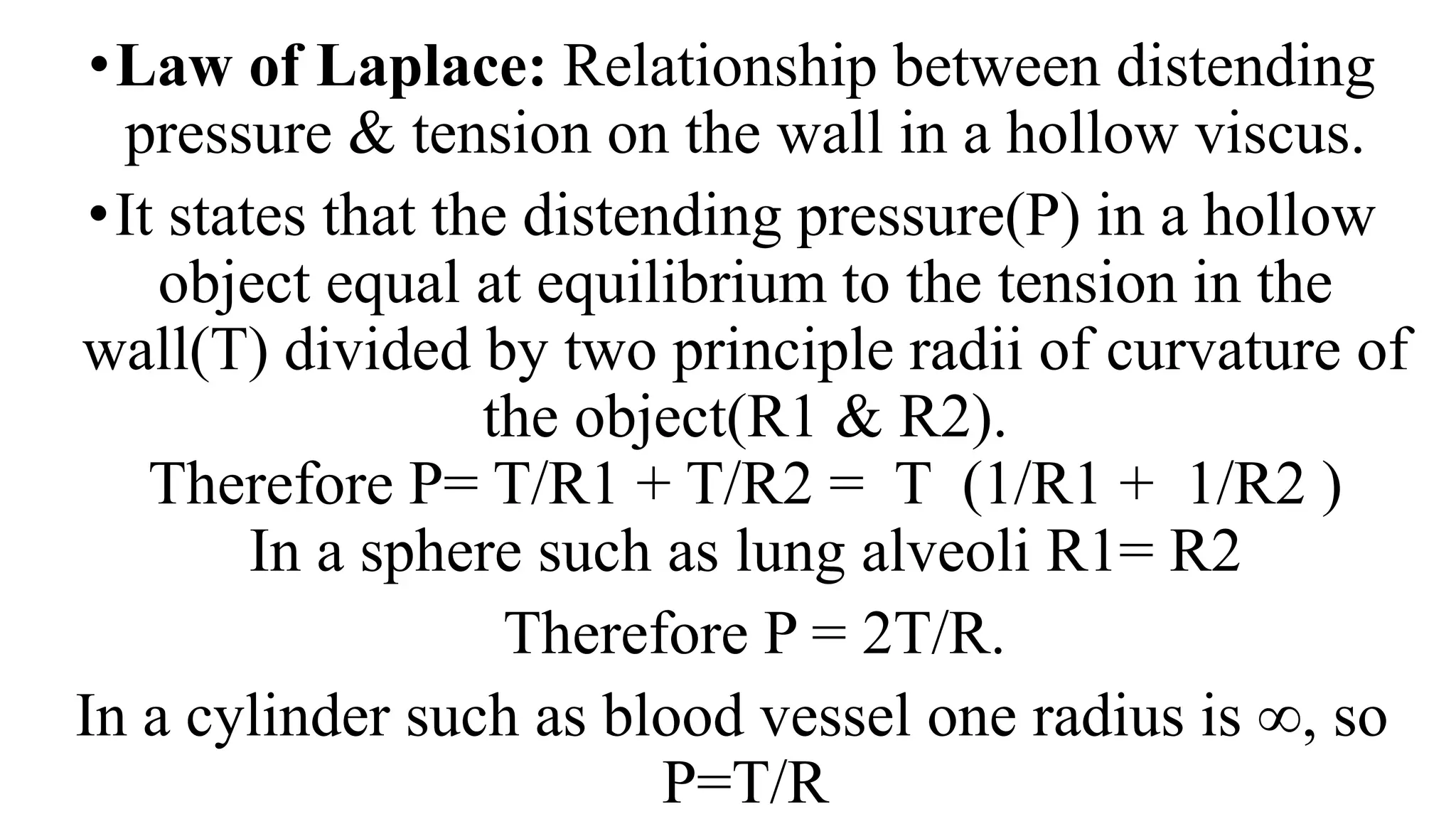
•Law of Laplace: Relationship between distending
pressure & tension on the wall in a hollow viscus.
•It states that the distending pressure(P) in a hollow
object equal at equilibrium to the tension in the
wall(T) divided by two principle radii of curvature of
the object(R1 & R2).
Therefore P= T/R1 + T/R2 = T (1/R1 + 1/R2 )
In a sphere such as lung alveoli R1= R2
Therefore P = 2T/R.
In a cylinder such as blood vessel one radius is ∞, so
P=T/R
Animation: Respiratory System: Pulmonary Ventilation
Law of Laplace
•Alveolar surface tension can be demonstrated
experimentally by recording the compliance
of an isolated lung of an animal by first
distending it with air & then with saline.
•Filling the lungs with saline theoretically
eliminates the force of surface tension.
•So has far greater compliance than air filled
lung having water air interface.
Pulmonary surfactant:
•Source:
1. Secreted by Type II alveolar epithelial
cells(granular pneumocytes),
2. which constitutes about 10% of surface area of
alveoli.
3. It is stored in the cells in the lamellar bodies.
4. Lamellar bodies are membrane bound organelles
containing whorls of phospholipids.
5. These bodies are secreted into alveolar
lumen by exocytosis.
6. From these tubes of lipids called
Tubular myelin formed which further
forms phospholipids.
7. Tubular myelin then lines the fluid
lining on the inner surface of the alveoli.
•Composition : Complex mixture of several
phospholipids,proteins & ions.
•Phospolipids:
-Dipalmitoyl phosphatidyl choline 62% (DPPC)
-Phosphatidyl glycerol 5%
-Other phospholipids 10%
-Neutral lipids 13%
-Proteins 8%
-Carbohydrates 2%
•Proteins: SP-A, SP-B, SP-C, SP-D.
•SP-A & SP-D & are hydrophilic proteins. Act,
as opsonins & promote phagocytosis of bac. By
alveolar macrophages.
•SP-A & SP-D are involved in innate immunity
in the conducting airway as well as in the
alveoli.
•SP-C gene defect leads to familial interstitial
disease.
•SP-B & SP-C are strongly hydrophobic
proteins & facilitate spread of surfactant as
surface form of mononuclear phospholipid
film outer the alveolar fluid.
Blood Supply
•Pulmonary circulation is low pressure system.
•The mean hydrostatic pressure is 6 to 8 mmHg
•Respectively in systemic and glomerular
capillaries its 32 to 60mmHg.
•Low hydrostatic pressure & surfactant keeps the
alveoli dry.
•Functions of pulmonary surfactant:
a)Reduces the tendency of alveoli to collapse.
During expiration the size of alveolus ↓,so the surface
tension force↑ & produces +ve pressure inside the
alveoli.
Pressure generated by = 2 x Surface tension
radius
• If this pressure overcomes the distending
pressure, the alveoli will collapse.
• But here the surfactant molecules come much
closer to each other & adjust or ↓ the surface
tension, so the alveoli do not collapse.
• So when there is reduction of radius , there is
reduction of surface tension by surfactant.
• Hence distending force is not overcomed by the
surface tension force.
b)When air passages leading from the alveoli are
blocked, the surface tension causing collapse of alveoli
create +ve pressure in the alveoli which pushes the air
out.
This pressure = 2 x Surface tension
radius of alveoli
-Here surfactant reduces the amount of +ve pressure
developed by surface tension & thus prevents collapse
of the alveoli.
-Hence with low distending pressure also the alveoli
remain expanded & are not collapsed.
2)Reduces work of breathing:
•According to Laplace’s law due to reduction in surface
tension, the mean radius is increased.
•This reduces the transmural pressure required for
expanding the alveoli.
•As alveoli are easily expanded, so work of breathing is
reduced.
•The low surface tension facilitates the reopening of
collapsed airway & alveoli.
3)Surfactant helps to prevent pulmonary oedema by
reducing surface tension.
•Surface tension is retracting force in the alveoli.
•It is about 20mm of Hg which draws out fluid from
the blood capillaries into the alveoli (transudation
of fluid) producing pulmonary odema.
•Surfactant lowers the surface tension thus prevents
pulmonary oedema & keeps the alveoli dry.
4) Alveolar stabilization:
•Surfactant causes stability of alveoli i.e it maintains
almost uniform size of alveoli.
•Due to pulmonary surfactant pulling pressure in the
alveoli is reduced from 18cm of H2O to 4cm of H2O.
•In the presence of surfactant the surface tension
developed is inversely proportionate to the
concentration of surfactant per unit area.
•In the smaller alveolus the surfactant molecules form
a thick layer , while in a larger alveolus the surfactant
molecules are scattered on the larger surface.
•Thus in smaller alveolus the tendency to develop more
pressure due to smaller radius will be neutralized due to more
concentration of surfactant per unit area, & reverse will occur
in larger alveolus.
• In this way there will not be much pressure gradient between
the two alveoli, helping to maintain the size of the alveolar
sac constant.
• Other factors are interdependence & fibrous tissue.
•Interdependence: Alveoli are tethered together by their
adjoining & stabilize the alveoli.
• Fibrous tissue act as additional splints & stabilize the alveoli.
Factors affecting pulmonary surfactant:
a. Factors which ↓ the pulmonary surfactant:
1)Long term inhalation of 100% O2
2)Occlusion of main bronchus
3)Occlusion of one pulmonary artery
4)Cigarette smoking &
5)Cutting both the vagi
b. Factors which ↑ the pulmonary
surfactant:
1)Thyroid hormones ↑ the secretion of
pulmonary surfactant by ↑ size &
number of inclusion bodies in type II
alveolar cells.
2)Glucocorticoids ↑ the maturation of
pulmonary surfactant.
Surfactant Productions is stimulated by
1. Vagus :- It stimulate the type II cells &
↑se the Production of surfactant
•Results of Vagotomy ↓se the production
of ???.
•It’s leads to development of Pulmonary
edema.
2. Thyroid Hormone :-
•It stimulate Production of Surfactant in
normal healthy People.
•In Hypothyroidism Pt’s it ↓ses.
•Glucocorticoids hormones:- Matured
Surfactant produced.
•During pregnancy this hormone level
increases which causes ↑se the production of
Surfactant.
•Even insulin & growth hormones ↑se the
production of Surfactant.
Inhibition effect of Surfactant
•Hypoxia – it inhibit the
production of
Surfactant, interruption
of pulmonary circulation
or bronchus and also
due to deficiency of the
Surfactant produces a
patchy atelectasis.
•Clinical significance:
1)Respiratory distress syndrome: (RDS) of
newborn or premature babies (Hyaline
membrane disease).
Occurs in newborn or premature babies due to
inadequate formation or lack of maturity of
surfactant.
This results into ↑ alveolar surface tension. So, it
is extremely difficult to expand the lungs.
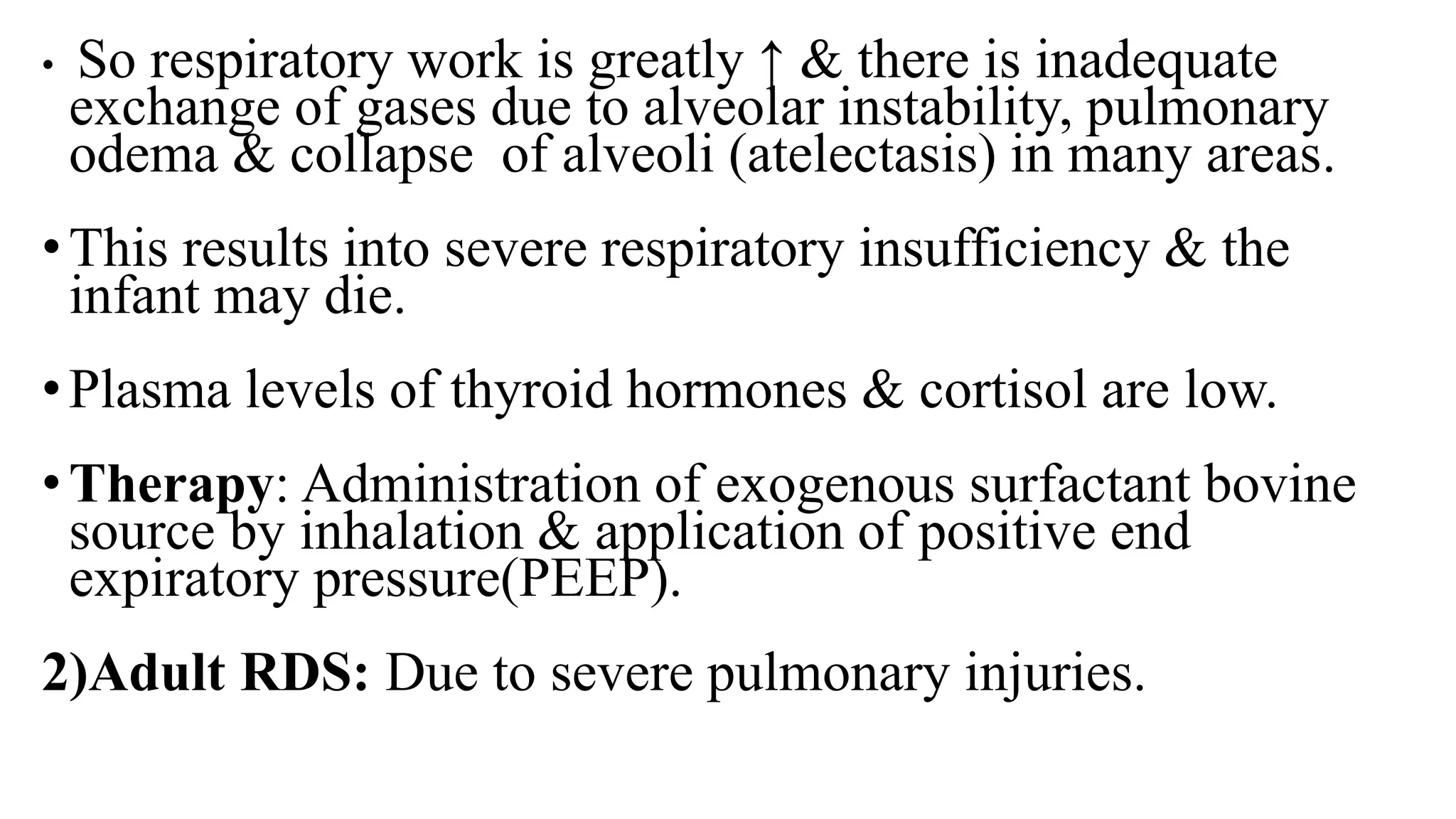
• So respiratory work is greatly ↑ & there is inadequate
exchange of gases due to alveolar instability, pulmonary
odema & collapse of alveoli (atelectasis) in many areas.
•This results into severe respiratory insufficiency & the
infant may die.
•Plasma levels of thyroid hormones & cortisol are low.
•Therapy: Administration of exogenous surfactant bovine
source by inhalation & application of positive end
expiratory pressure(PEEP).
2)Adult RDS: Due to severe pulmonary injuries.
References
• Text book of Medical Physiology 14th edition
Guyton & Hall
• Ganong's Review of Medical Physiology, 26 edition.
• Human Physiology
• Vander
• Text book of Medical Physiology
• Indukurana
• Hutchinson Clinical Methods
THANK YOU . . .

Pulmonary Surfactant for MBBS .pptx

  • 1.
    P.Y. 6.2., PulmonarySurfactant by Dr. Pandian M Assistant Professor Dept. of Physiology
  • 2.
    SLO’s: •Principle of alveolarsurface tension •Law of Laplace. •Source of surfactant. •Composition. •Mechanism of action. •Functions of surfactant. •Factors affecting pulmonary surfactant. •Clinical significance.
  • 3.
    Introduction 1. Lung produceone Physiological active substance called Surfactant 2. It is lipoptn complex made up of Phospholipids, ptns, other lipds. 3. The major phospholipids associated with surfactant is Dipalmityol Phosphatidyl choline.
  • 4.
    •One portion ofeach phospholipid molecule is hydrophilic (head) & dissolves in water lining the alveoli. •Lipid hydrophobic (tail) portion of the molecule is oriented towards the air.
  • 5.
    •This causes spreadingof surfactant molecules over the surface of fluid lining the alveoli. •Apoprotiens & Calcium are responsible for uniform & quick spreading of surfactant molecules over the surface. •In there absence DPPC spreads so slowly that it cannot function effectively.
  • 6.
    •Surface tension withnormal alveolar fluid lining without surfactant is about 50dynes/cm2 & with surfactant it varies between 5 to 30dynes/cm2 depending upon the concentration of surfactant.
  • 7.
    •Surfactant molecules moveapart as alveoli enlarge during inspiration & surface tension ↑. •Whereas surface tension ↓ when the surfactant molecules move closer together during expiration. •Some of the protein-lipid complexes in surfactant are taken up by endocytosis in type II alveolar cells & recycled.
  • 9.
    Principle of alveolarsurface tension •When water forms interface with air, water molecules on the surface of the water have strong attraction for one another. •As a result water surface is always attempting to contract. •Same principle applies for holding rainsdrops together in air. •On the inner surface of the alveoli there is thin film of fluid lining. •So there is interface of air & fluid.
  • 10.
    •This causes thefluid surface to contract which forces the air out of the alveoli through the bronchioles & it results into collapse of alveoli. •This elastic contractile force of the entire lung is called as surface tension elastic force. •Surface tension ↑ the tendency of the lungs to deflate. •So an ↑ Transmural pressure is necessary to counteract the effects of surface tension.
  • 12.
    •Law of Laplace:Relationship between distending pressure & tension on the wall in a hollow viscus. •It states that the distending pressure(P) in a hollow object equal at equilibrium to the tension in the wall(T) divided by two principle radii of curvature of the object(R1 & R2). Therefore P= T/R1 + T/R2 = T (1/R1 + 1/R2 ) In a sphere such as lung alveoli R1= R2 Therefore P = 2T/R. In a cylinder such as blood vessel one radius is ∞, so P=T/R
  • 13.
    Animation: Respiratory System:Pulmonary Ventilation Law of Laplace
  • 14.
    •Alveolar surface tensioncan be demonstrated experimentally by recording the compliance of an isolated lung of an animal by first distending it with air & then with saline. •Filling the lungs with saline theoretically eliminates the force of surface tension. •So has far greater compliance than air filled lung having water air interface.
  • 16.
    Pulmonary surfactant: •Source: 1. Secretedby Type II alveolar epithelial cells(granular pneumocytes), 2. which constitutes about 10% of surface area of alveoli. 3. It is stored in the cells in the lamellar bodies. 4. Lamellar bodies are membrane bound organelles containing whorls of phospholipids.
  • 17.
    5. These bodiesare secreted into alveolar lumen by exocytosis. 6. From these tubes of lipids called Tubular myelin formed which further forms phospholipids. 7. Tubular myelin then lines the fluid lining on the inner surface of the alveoli.
  • 19.
    •Composition : Complexmixture of several phospholipids,proteins & ions. •Phospolipids: -Dipalmitoyl phosphatidyl choline 62% (DPPC) -Phosphatidyl glycerol 5% -Other phospholipids 10% -Neutral lipids 13% -Proteins 8% -Carbohydrates 2%
  • 20.
    •Proteins: SP-A, SP-B,SP-C, SP-D. •SP-A & SP-D & are hydrophilic proteins. Act, as opsonins & promote phagocytosis of bac. By alveolar macrophages. •SP-A & SP-D are involved in innate immunity in the conducting airway as well as in the alveoli.
  • 21.
    •SP-C gene defectleads to familial interstitial disease. •SP-B & SP-C are strongly hydrophobic proteins & facilitate spread of surfactant as surface form of mononuclear phospholipid film outer the alveolar fluid.
  • 22.
    Blood Supply •Pulmonary circulationis low pressure system. •The mean hydrostatic pressure is 6 to 8 mmHg •Respectively in systemic and glomerular capillaries its 32 to 60mmHg. •Low hydrostatic pressure & surfactant keeps the alveoli dry.
  • 23.
    •Functions of pulmonarysurfactant: a)Reduces the tendency of alveoli to collapse. During expiration the size of alveolus ↓,so the surface tension force↑ & produces +ve pressure inside the alveoli. Pressure generated by = 2 x Surface tension radius
  • 24.
    • If thispressure overcomes the distending pressure, the alveoli will collapse. • But here the surfactant molecules come much closer to each other & adjust or ↓ the surface tension, so the alveoli do not collapse. • So when there is reduction of radius , there is reduction of surface tension by surfactant. • Hence distending force is not overcomed by the surface tension force.
  • 25.
    b)When air passagesleading from the alveoli are blocked, the surface tension causing collapse of alveoli create +ve pressure in the alveoli which pushes the air out. This pressure = 2 x Surface tension radius of alveoli -Here surfactant reduces the amount of +ve pressure developed by surface tension & thus prevents collapse of the alveoli. -Hence with low distending pressure also the alveoli remain expanded & are not collapsed.
  • 29.
    2)Reduces work ofbreathing: •According to Laplace’s law due to reduction in surface tension, the mean radius is increased. •This reduces the transmural pressure required for expanding the alveoli. •As alveoli are easily expanded, so work of breathing is reduced. •The low surface tension facilitates the reopening of collapsed airway & alveoli.
  • 30.
    3)Surfactant helps toprevent pulmonary oedema by reducing surface tension. •Surface tension is retracting force in the alveoli. •It is about 20mm of Hg which draws out fluid from the blood capillaries into the alveoli (transudation of fluid) producing pulmonary odema. •Surfactant lowers the surface tension thus prevents pulmonary oedema & keeps the alveoli dry.
  • 31.
    4) Alveolar stabilization: •Surfactantcauses stability of alveoli i.e it maintains almost uniform size of alveoli. •Due to pulmonary surfactant pulling pressure in the alveoli is reduced from 18cm of H2O to 4cm of H2O. •In the presence of surfactant the surface tension developed is inversely proportionate to the concentration of surfactant per unit area. •In the smaller alveolus the surfactant molecules form a thick layer , while in a larger alveolus the surfactant molecules are scattered on the larger surface.
  • 32.
    •Thus in smalleralveolus the tendency to develop more pressure due to smaller radius will be neutralized due to more concentration of surfactant per unit area, & reverse will occur in larger alveolus. • In this way there will not be much pressure gradient between the two alveoli, helping to maintain the size of the alveolar sac constant. • Other factors are interdependence & fibrous tissue. •Interdependence: Alveoli are tethered together by their adjoining & stabilize the alveoli. • Fibrous tissue act as additional splints & stabilize the alveoli.
  • 33.
    Factors affecting pulmonarysurfactant: a. Factors which ↓ the pulmonary surfactant: 1)Long term inhalation of 100% O2 2)Occlusion of main bronchus 3)Occlusion of one pulmonary artery 4)Cigarette smoking & 5)Cutting both the vagi
  • 34.
    b. Factors which↑ the pulmonary surfactant: 1)Thyroid hormones ↑ the secretion of pulmonary surfactant by ↑ size & number of inclusion bodies in type II alveolar cells. 2)Glucocorticoids ↑ the maturation of pulmonary surfactant.
  • 35.
    Surfactant Productions isstimulated by 1. Vagus :- It stimulate the type II cells & ↑se the Production of surfactant •Results of Vagotomy ↓se the production of ???. •It’s leads to development of Pulmonary edema.
  • 36.
    2. Thyroid Hormone:- •It stimulate Production of Surfactant in normal healthy People. •In Hypothyroidism Pt’s it ↓ses.
  • 37.
    •Glucocorticoids hormones:- Matured Surfactantproduced. •During pregnancy this hormone level increases which causes ↑se the production of Surfactant. •Even insulin & growth hormones ↑se the production of Surfactant.
  • 38.
    Inhibition effect ofSurfactant •Hypoxia – it inhibit the production of Surfactant, interruption of pulmonary circulation or bronchus and also due to deficiency of the Surfactant produces a patchy atelectasis.
  • 39.
    •Clinical significance: 1)Respiratory distresssyndrome: (RDS) of newborn or premature babies (Hyaline membrane disease). Occurs in newborn or premature babies due to inadequate formation or lack of maturity of surfactant. This results into ↑ alveolar surface tension. So, it is extremely difficult to expand the lungs.
  • 40.
    • So respiratorywork is greatly ↑ & there is inadequate exchange of gases due to alveolar instability, pulmonary odema & collapse of alveoli (atelectasis) in many areas. •This results into severe respiratory insufficiency & the infant may die. •Plasma levels of thyroid hormones & cortisol are low. •Therapy: Administration of exogenous surfactant bovine source by inhalation & application of positive end expiratory pressure(PEEP). 2)Adult RDS: Due to severe pulmonary injuries.
  • 41.
    References • Text bookof Medical Physiology 14th edition Guyton & Hall • Ganong's Review of Medical Physiology, 26 edition. • Human Physiology • Vander • Text book of Medical Physiology • Indukurana • Hutchinson Clinical Methods
  • 42.

Editor's Notes

  • #6 Dipalmityol Phosphatidyl choline.
  • #7 Such hydrophobic surface exposed to air has 1/12 to 1/2 the surface tension of pure water depending on concentrations & orientations of surfactant molecules on the surface. ????????????????????
  • #19 TM – tubular myelin CB – Composite body LB – Lamellar bodies
  • #37 ?? Surfactant