Understanding Text Features Headings Titles Photographs Illustrations Captions
What is a feature? The word  feature  is used in many different contexts, or situations A  feature  is an important part of something
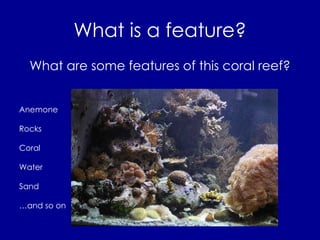
What is a feature? What are some features of this coral reef? Anemone Rocks Coral Water Sand … and so on
What is a feature? What are your  facial features ? eyes, nose, mouth, chin, cheeks…
What is a feature? What are the  features  of your playground?
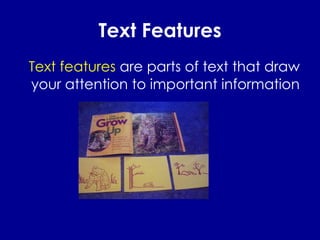
Text Features Text features  are parts of text that draw your attention to important information
Looking at text features You will need an assortment of nonfiction books or magazines for the rest of this presentation
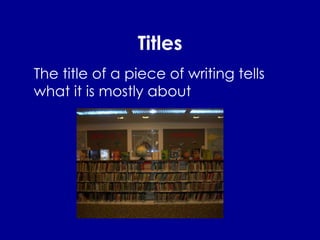
Titles The title of a piece of writing tells what it is mostly about
Titles Look at the books you have. Notice: -How are the titles written? What kind of font do they use? -Are the titles long or short? -Are there subtitles?
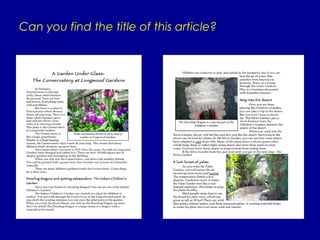
Can you find the title of this article?
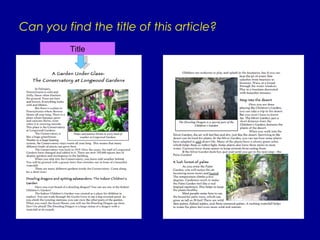
Can you find the title of this article? Title
Headings Headings introduce topics in text. They are often written in bold print, large print, or colorful text.
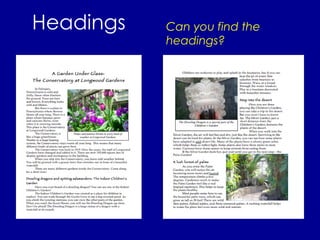
Headings Can you find the headings?
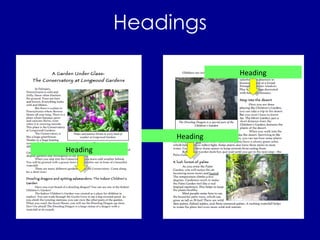
Headings Heading Heading Heading
Headings Look through the books that you have. Can you find headings that are: - In bold print? -Only one word? -Questions? -Phrases?
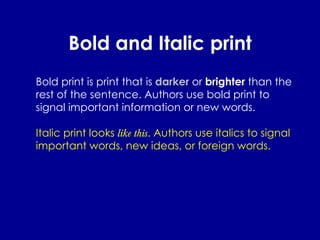
Bold and Italic print Bold print is print that is  darker  or  brighter  than the rest of the sentence. Authors use bold print to signal important information or new words. Italic print looks  like this . Authors use italics to signal important words, new ideas, or foreign words.
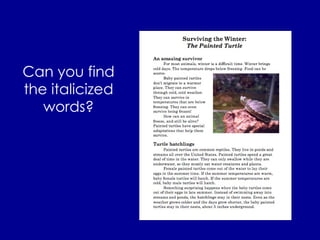
Can you find the italicized words?
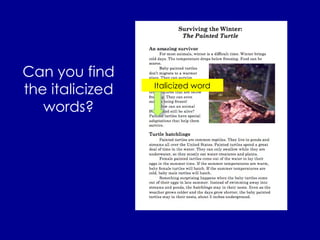
Can you find the italicized words? Italicized word
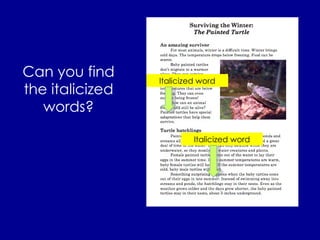
Can you find the italicized words? Italicized word Italicized word
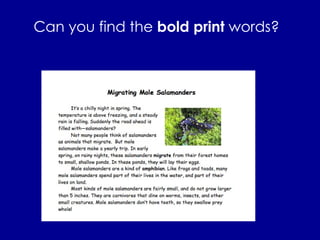
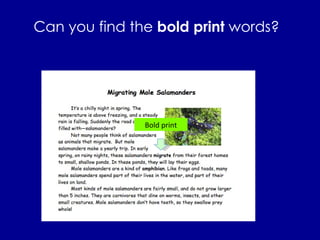
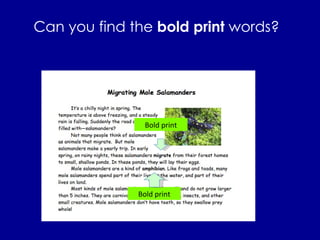
Can you find the  bold print  words?
Can you find the  bold print  words? Bold print
Can you find the  bold print  words? Bold print Bold print
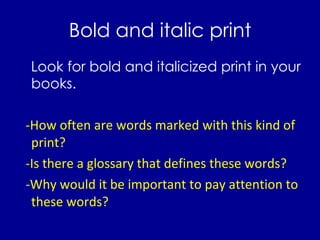
Bold and italic print Look for bold and italicized print in your books. -How often are words marked with this kind of print? -Is there a glossary that defines these words? -Why would it be important to pay attention to these words?
Illustrations and Photographs Illustrations  are drawings. They are created by an artist. Illustrations can be very basic, or they can be very detailed. Photographs  are taken by a photographer. They show real objects in real settings.
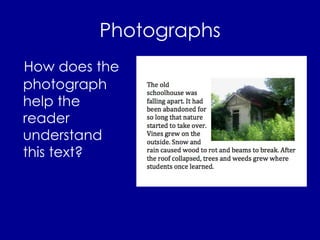
Photographs How does the photograph help the reader understand this text?
Photographs Look for photographs in your books. Think about: - Why did the writer include this photo? -How does this help the reader to understand key ideas? -What can you learn from looking at the photo? -Does the text make sense without the picture?
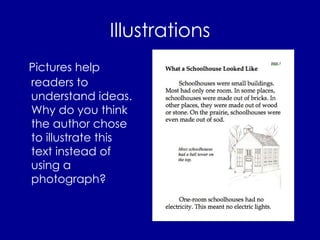
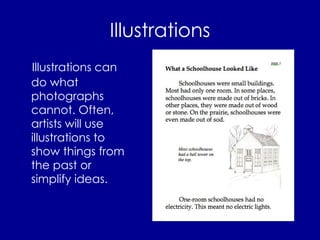
Illustrations Pictures help readers to understand ideas. Why do you think the author chose to illustrate this text instead of using a photograph?
Illustrations Illustrations can do what photographs cannot. Often, artists will use illustrations to show things from the past or simplify ideas.
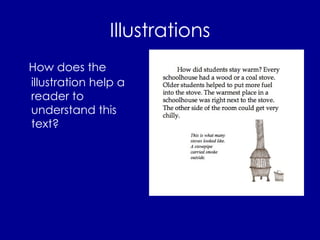
Illustrations How does the illustration help a reader to understand this text?
Illustrations Look for illustrations in your books. Think about: -Why did the author use an illustration instead of a photograph? -Is the style of the illustration appealing? -What can you learn from the illustration?
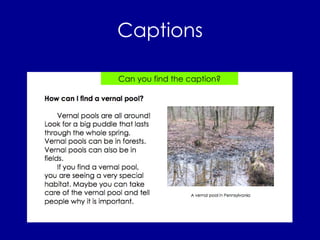
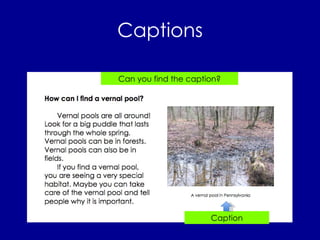
Captions Captions are found underneath illustrations or photographs. They explain what’s in the picture.
Captions Can you find the caption?
Captions Can you find the caption? Caption
Captions Look over the books that you have.  -What captions can you find?  -How do the captions help you to understand the pictures? -How are the captions written in different ways?
Other text features What other text features can you think of?
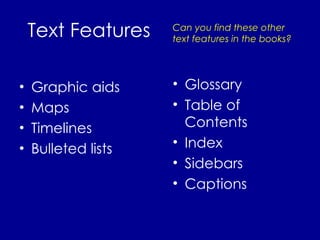
Text Features Graphic aids Maps Timelines Bulleted lists Glossary Table of Contents Index Sidebars Captions Can you find these other text features in the books?
Text Features What have you learned about text features? What do you still wonder about text features?

Text features

  • 1.
    Understanding Text FeaturesHeadings Titles Photographs Illustrations Captions
  • 2.
    What is afeature? The word feature is used in many different contexts, or situations A feature is an important part of something
  • 3.
    What is afeature? What are some features of this coral reef? Anemone Rocks Coral Water Sand … and so on
  • 4.
    What is afeature? What are your facial features ? eyes, nose, mouth, chin, cheeks…
  • 5.
    What is afeature? What are the features of your playground?
  • 6.
    Text Features Textfeatures are parts of text that draw your attention to important information
  • 7.
    Looking at textfeatures You will need an assortment of nonfiction books or magazines for the rest of this presentation
  • 8.
    Titles The titleof a piece of writing tells what it is mostly about
  • 9.
    Titles Look atthe books you have. Notice: -How are the titles written? What kind of font do they use? -Are the titles long or short? -Are there subtitles?
  • 10.
    Can you findthe title of this article?
  • 11.
    Can you findthe title of this article? Title
  • 12.
    Headings Headings introducetopics in text. They are often written in bold print, large print, or colorful text.
  • 13.
    Headings Can youfind the headings?
  • 14.
  • 15.
    Headings Look throughthe books that you have. Can you find headings that are: - In bold print? -Only one word? -Questions? -Phrases?
  • 16.
    Bold and Italicprint Bold print is print that is darker or brighter than the rest of the sentence. Authors use bold print to signal important information or new words. Italic print looks like this . Authors use italics to signal important words, new ideas, or foreign words.
  • 17.
    Can you findthe italicized words?
  • 18.
    Can you findthe italicized words? Italicized word
  • 19.
    Can you findthe italicized words? Italicized word Italicized word
  • 20.
    Can you findthe bold print words?
  • 21.
    Can you findthe bold print words? Bold print
  • 22.
    Can you findthe bold print words? Bold print Bold print
  • 23.
    Bold and italicprint Look for bold and italicized print in your books. -How often are words marked with this kind of print? -Is there a glossary that defines these words? -Why would it be important to pay attention to these words?
  • 24.
    Illustrations and PhotographsIllustrations are drawings. They are created by an artist. Illustrations can be very basic, or they can be very detailed. Photographs are taken by a photographer. They show real objects in real settings.
  • 25.
    Photographs How doesthe photograph help the reader understand this text?
  • 26.
    Photographs Look forphotographs in your books. Think about: - Why did the writer include this photo? -How does this help the reader to understand key ideas? -What can you learn from looking at the photo? -Does the text make sense without the picture?
  • 27.
    Illustrations Pictures helpreaders to understand ideas. Why do you think the author chose to illustrate this text instead of using a photograph?
  • 28.
    Illustrations Illustrations cando what photographs cannot. Often, artists will use illustrations to show things from the past or simplify ideas.
  • 29.
    Illustrations How doesthe illustration help a reader to understand this text?
  • 30.
    Illustrations Look forillustrations in your books. Think about: -Why did the author use an illustration instead of a photograph? -Is the style of the illustration appealing? -What can you learn from the illustration?
  • 31.
    Captions Captions arefound underneath illustrations or photographs. They explain what’s in the picture.
  • 32.
    Captions Can youfind the caption?
  • 33.
    Captions Can youfind the caption? Caption
  • 34.
    Captions Look overthe books that you have. -What captions can you find? -How do the captions help you to understand the pictures? -How are the captions written in different ways?
  • 35.
    Other text featuresWhat other text features can you think of?
  • 36.
    Text Features Graphicaids Maps Timelines Bulleted lists Glossary Table of Contents Index Sidebars Captions Can you find these other text features in the books?
  • 37.
    Text Features Whathave you learned about text features? What do you still wonder about text features?

Editor's Notes