Heterogeneous Persistence
A guide for the modern DBA
Marcos Albe
Jervin Real
Ryan Lowe
Liz Van Dijk
Introduction
Hello everyone
Introduction
MySQL everyone?
Introduction
Memcached?
Agenda
● Introduction
● Why a single DBMS is not enough
● What makes a DBMS
● Different flavors of DMBS
● Top picks
Why one DBMS is not enough
"If you feel things are not efficient in your code, is likely that you are suffering of
poor data structures choice/design" ~ Anonymous
Why one DBMS is not enough
● Different data structures
● Different access patterns
● Different consistency and durability requirements.
● Different scaling needs
● Different budgets
● Theoretical fundamentalism
Why one DBMS is not enough
A more concrete example
OLAP -vs- OLTP
OLAP -vs- OLTP
PROs CONs
● No SPOF
● Workload optimized services
● Easier to scale*
● Additional complexity
● Operational needs (additional
staffing)
● Cost ($$$)*
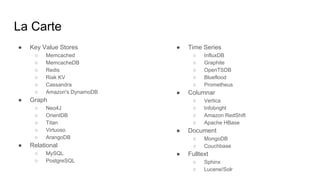
La Carte
● Key Value Stores
○ Memcached
○ MemcacheDB
○ Redis
○ Riak KV
○ Cassandra
○ Amazon's DynamoDB
● Graph
○ Neo4J
○ OrientDB
○ Titan
○ Virtuoso
○ ArangoDB
● Relational
○ MySQL
○ PostgreSQL
● Time Series
○ InfluxDB
○ Graphite
○ OpenTSDB
○ Blueflood
○ Prometheus
● Columnar
○ Vertica
○ Infobright
○ Amazon RedShift
○ Apache HBase
● Document
○ MongoDB
○ Couchbase
● Fulltext
○ Sphinx
○ Lucene/Solr
What makes a DB?
General Criteria
● Specialty
● Cost
● API/Interfaces
● Scalability
● CAP
● ACID
● Secondary Features
What makes a DBMS: General
● Licensing
● Language support
● OS support
● Community & workforce
● Tools ecosystem
● Data Architecture
○ Logical data model
○ Physical data model
● Standards adherence (where defined)
● Atomicity
● Consistency
● Isolation
● Durability
● Referential integrity
● Transactions
● Locking
● Crash recovery
● Unicode support
What makes a DBMS: Fundamental Features
● Interface / connectors / protocols
● Sequences / auto-incrementals / atomic counters
● Conditional entry updates
● MapReduce
● Compression
● In-memory
● Availability
● Concurrency handling
● Scalability
● Embeddable
● Backups
What makes a DBMS: Fundamental Features cont.
● CRUD
● Union
● Intersect
● JOIN (inner, outer)
● Inner selects
● Merge joins
● Common Table Expressions
● Windowing Functions
● Parallel Query
● Subqueries
● Aggregation
● Derived tables
What makes a DBMS: querying capabilities
● Cursors
● Triggers
● Stored procedures
● Functions
● Views
● Materialized views
● Virtual columns
● UDF
● XML/JSON/YAML support
What makes a DBMS: programmatic capabilities
● Database (tables size sum)
● Number of Tables
● Tables individual size
● Variable length column size
● Row width
● Row columns count
● Row count
● Column name
● Blob size
● Char
● Numeric
● Date (min / max)
What makes a DBMS: sizing limits
● B-Tree
● Full text indexing
● Hash
● Bitmap
● Expression
● Partials
● Reverse
● GiST
● GIS indexing
● Composite keys
● Graph support
What makes a DBMS: indexing
● Replication
● Failover
● Clustering
● CAP choice
What makes a DBMS: high availability
Partitioning
● Range
● Hash
● Range+hash
● List
● Expression
● Sub-partitioning
Sharding
● By key
● By table
What makes a DBMS: scalability
● Integer
● Floating point
● Decimal
● String
● Binary
● Date/time
● Boolean
● Binary
● Set
● Enumeration
● Blob
● Clob
● JSON/XML/YAML (as native types)
What makes a DBMS: supported data types
● Authentication methods
● Access Control Lists
● Pluggable Authentication Modules support
● Encryption at-rest
● Encryption over the wire
● User proxy
What makes a DBMS: security features
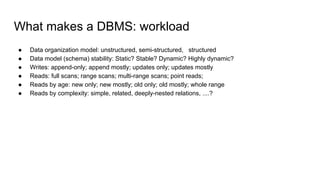
● Data organization model: unstructured, semi-structured, structured
● Data model (schema) stability: Static? Stable? Dynamic? Highly dynamic?
● Writes: append-only; append mostly; updates only; updates mostly
● Reads: full scans; range scans; multi-range scans; point reads;
● Reads by age: new only; new mostly; old only; old mostly; whole range
● Reads by complexity: simple, related, deeply-nested relations, ....?
What makes a DBMS: workload
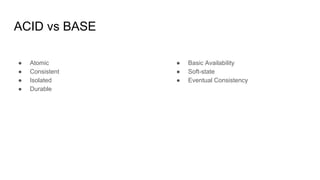
ACID vs BASE
● Atomic
● Consistent
● Isolated
● Durable
● Basic Availability
● Soft-state
● Eventual Consistency
CAP Theorem
● Consistency
● Availability
● Partitioning
Relational Databases
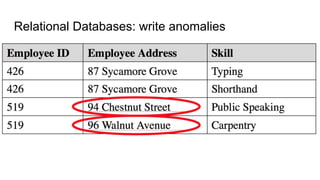
Relational Databases: write anomalies
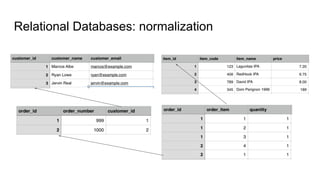
Relational Databases: normalization
Relational Databases: query language
results = new Array();
table = open(‘mydata’);
while (row = table.fetch()) {
if (row.x > 100) {
results.push(row);
}
}
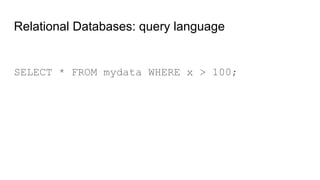
Relational Databases: query language
SELECT * FROM mydata WHERE x > 100;
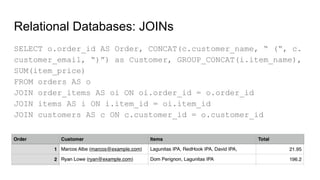
Relational Databases: JOINs
SELECT o.order_id AS Order, CONCAT(c.customer_name, “ (“, c.
customer_email, “)”) as Customer, GROUP_CONCAT(i.item_name),
SUM(item_price)
FROM orders AS o
JOIN order_items AS oi ON oi.order_id = o.order_id
JOIN items AS i ON i.item_id = oi.item_id
JOIN customers AS c ON c.customer_id = o.customer_id
Relational Databases: good use cases
● Highly-structured data with complex querying needs
● Projects that need very high data durability and guarantees of database-level
consistency and integrity
● Simple projects with limited data growth and limited amount of entities
● Projects that require PCI/DSS, HIPPA or similar security requirements
● Analysis of portions of larger BigData stores
● Projects where duplicated data volumes would be a problem
Relational Databases: bad use cases
● Unstructured data
● Deep Hierarchies / Nested -> XML
● Deep recursion:
● Ever-growing datasets; Projects that are basically logging data
● Projects recording time-series
● Reporting on massive datasets
Relational Databases: bad use cases
● Projects supporting extreme concurrency
● Projects supporting massive data intake
● Queues
● Cache storage
PROs CONs
● Very mature
● Abundant workforce
● ACID guarantees
● Referential integrity
● Highly expressive query language
● Ubiquitous
● Rigid schema
● Difficult to scale horizontally
● Expensive writes
● JOIN bombs
Relational Databases: MySQL
● Well known / mature / extensive documentation
● GPLv2 + commercial license for OEMs, ISVs and VARs
● Client libraries for about every programming language
● Many different engines
● SQL/ACID impose scalability limits
● Asynchronous / Semi-synchronous / Virtually synchronous replication
● Can be AP or CP depending on replication model
Relational Databases: MySQL
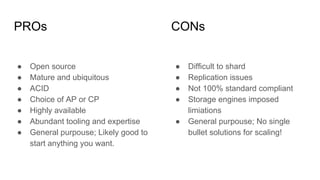
PROs CONs
● Open source
● Mature and ubiquitous
● ACID
● Choice of AP or CP
● Highly available
● Abundant tooling and expertise
● General purpouse; Likely good to
start anything you want.
● Difficult to shard
● Replication issues
● Not 100% standard compliant
● Storage engines imposed
limiations
● General purpouse; No single
bullet solutions for scaling!
Relational Databases: PostgreSQL
● Mature / adequate documentation
● PostgreSQL License (similar to BSD/MIT)
● Client libraries for about every programming language
● Highly Standards Compliant
● SQL/ACID impose scalability limits
● Asynchronous / Semi-synchronous
● Virtually synchronous replication via 3rd party
● Can be AP or CP depending on replication model`
Relational Databases: PostgreSQL
PROs CONs
● Open source
● Mature and stable
● ACID
● Lots of advanced features
● Vacuum
● Difficult to shard
● Operations feel like an
afterthought
● Less forgiving
● Vacuum
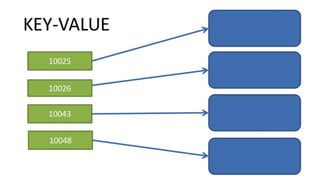
K/V Stores
CRUD
● CREATE
● READ
● UPDATE
● DELETE
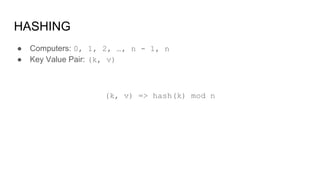
HASHING
● Computers: 0, 1, 2, …, n - 1, n
● Key Value Pair: (k, v)
(k, v) => hash(k) mod n
THUNDERING HERD
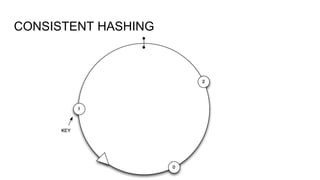
CONSISTENT HASHING
CONSISTENT HASHING
K/V Stores - Good Use Cases
● Lots of data
● Object cache in front of RDBMS
● High concurrency
● Massive small-data intake
● Simple data access patterns
K/V Stores - Good Use Cases
● Lots of data
○ Usually easily horizontally scalable
● Object cache in front of RDBMS
● High concurrency
● Massive small-data intake
● Simple data access patterns
K/V Stores - Good Use Cases
● Lots of data
● Object cache in front of RDBMS
○ Memcached, anyone?
● High concurrency
● Massive small-data intake
● Simple data access patterns
K/V Stores - Good Use Cases
● Lots of data
● Object cache in front of RDBMS
● High concurrency
○ Very simple locking model
● Massive small-data intake
● Simple data access patterns
K/V Stores - Good Use Cases
● Lots of data
● Object cache in front of RDBMS
● High concurrency
● Massive small-data intake
● Simple data access patterns
K/V Stores - Good Use Cases
● Lots of data
● Object cache in front of RDBMS
● High concurrency
● Massive small-data intake
● Simple data access patterns
○ CRUD on PK access
K/V Stores - Bad Use Cases
● Durability and consistency*
● Complex data access patterns
● Non-PK access*
● Operations*
K/V Stores - Bad Use Cases
● Durability and consistency*
● Complex data access patterns
● Non-PK access*
● Operations*
K/V Stores - Bad Use Cases
● Durability and consistency*
● Complex data access patterns*
● Non-PK access*
● Operations*
K/V Stores - Bad Use Cases
● Durability and consistency*
● Complex data access patterns
● Non-PK access*
● Operations*
K/V Stores - Bad Use Cases
● Durability and consistency*
● Complex data access patterns
● Non-PK access*
● Operations*
○ Complex systems fail in complex ways
SIMPLE FAILURE
COMPLICATED FAILURE
EXAMPLE K/V STORES
● Memcached
● MemcacheDB
● Redis*
● Riak KV
● Cassandra*
● Amazon DynamoDB*
EXAMPLE K/V STORES
● Memcached
● MemcacheDB
● Redis*
● Riak KV
● Cassandra*
● Amazon DynamoDB*
EXAMPLE K/V STORES
● Memcached
● MemcacheDB
● Redis*
● Riak KV
● Cassandra*
● Amazon DynamoDB*
EXAMPLE K/V STORES
● Memcached
● MemcacheDB
● Redis*
● Riak KV
● Cassandra*
● Amazon DynamoDB*
EXAMPLE K/V STORES
● Memcached
● MemcacheDB
● Redis*
● Riak KV
● Cassandra*
● Amazon DynamoDB*
EXAMPLE K/V STORES
● Memcached
● MemcacheDB
● Redis*
● Riak KV
● Cassandra*
● Amazon DynamoDB*
EXAMPLE K/V STORES
● Memcached
● MemcacheDB
● Redis*
● Riak KV
● Cassandra*
● Amazon DynamoDB*
PROs CONs
● Highly scalable
● Simple access patterns
● Operational complexities
● Limited access patterns
Key Value Stores - Questions?
Columnar Databases
Columnar Data Layout
● Row-oriented ● Column-oriented
001:10,Smith,Joe,40000;
002:12,Jones,Mary,50000;
003:11,Johnson,Cathy,44000;
004:22,Jones,Bob,55000;
...
10:001,12:002,11:003,22:004;
Smith:001,Jones:002,Johnson:003,Jones:004;
Joe:001,Mary:002,Cathy:003,Bob:004;
40000:001,50000:002,44000:003,55000:004;
...
Columnar Data Layout
● Row-oriented Read Approach
What we want to read
Read Operation
Memory Page
1 2
3
4
10 Smith Bob 40000
12 Jones Mary 50000
11 Johnson Cathy 44000
Columnar Data Layout
● Column-oriented Read Approach
What we want to read
Read Operation
Memory Page
1 2
3
4
10 12 11 22
Smith Jones Johnson
Joe Mary Cathy Bob
Columnar Databases - Considerations
● Buffering and compression can help to reduce the impact of writes, but
they should still be avoided when possible
○ Usually, an ETL process should be put in place to prepare data for analysis in a column-based
format
● Covering Indexes in row-based stores could provide similar benefits, but only
up to a point → index maintenance work can become too expensive
● Column-based stores are self-indexing and more disk-space efficient
● SQL can be used for most column-based stores
Columnar Databases - Considerations
● Buffering and compression can help to reduce the impact of writes, but they
should still be avoided when possible
○ Usually, an ETL process should be put in place to prepare data for analysis in a column-based
format
● Covering Indexes in row-based stores could provide similar benefits,
but only up to a point → index maintenance work can become too
expensive
● Column-based stores are self-indexing and more disk-space efficient
● SQL can be used for most column-based stores
Columnar Databases - Considerations
● Buffering and compression can help to reduce the impact of writes, but they
should still be avoided when possible
○ Usually, an ETL process should be put in place to prepare data for analysis in a column-based
format
● Covering Indexes in row-based stores could provide similar benefits, but only
up to a point → index maintenance work can become too expensive
● Column-based stores are self-indexing and more disk-space efficient
● SQL can be used for most column-based stores
Columnar Databases - Considerations
● Buffering and compression can help to reduce the impact of writes, but they
should still be avoided when possible
○ Usually, an ETL process should be put in place to prepare data for analysis in a column-based
format
● Covering Indexes in row-based stores could provide similar benefits, but only
up to a point → index maintenance work can become too expensive
● Column-based stores are self-indexing and more disk-space efficient
● SQL can be used for most column-based stores
● Suitable for read-mostly or read-intensive, large data repositories
● Good for full table / large range reads.
● Good for unstructured problems where “good” indexes are hard to forecast
● Good for re-creatable datasets
● Good for structured data
Columnar Database - Good use cases
● Suitable for read-mostly or read-intensive, large data repositories
● Good for full table / large range reads.
● Good for unstructured problems where “good” indexes are hard to forecast
● Good for re-creatable datasets
● Good for structured data
Columnar Database - Good use cases
● Suitable for read-mostly or read-intensive, large data repositories
● Good for full table / large range reads.
● Good for unstructured problems where “good” indexes are hard to forecast
● Good for re-creatable datasets
● Good for structured data
Columnar Database - Good use cases
● Suitable for read-mostly or read-intensive, large data repositories
● Good for full table / large range reads.
● Good for unstructured problems where “good” indexes are hard to forecast
● Good for re-creatable datasets
● Good for structured data
Columnar Database - Good use cases
● Suitable for read-mostly or read-intensive, large data repositories
● Good for full table / large range reads.
● Good for unstructured problems where “good” indexes are hard to forecast
● Good for re-creatable datasets
● Good for structured data
Columnar Database - Good use cases
● Not good for “SELECT *” queries or queries fetching most of the columns
● Not good for writes
● Not good for mixed read/write
● Bad for unstructured data
Columnar Database - Bad use cases
● Not good for “SELECT *” queries or queries fetching most of the columns
● Not good for writes
● Not good for mixed read/write
● Bad for unstructured data
Columnar Database - Bad use cases
● Not good for “SELECT *” queries or queries fetching most of the columns
● Not good for writes
● Not good for mixed read/write
● Bad for unstructured data
Columnar Database - Bad use cases
● Not good for “SELECT *” queries or queries fetching most of the columns
● Not good for writes
● Not good for mixed read/write
● Bad for unstructured data
Columnar Database - Bad use cases
Columnar Database - Examples
● InfoBright (ICE)
● Vertica
● Amazon Redshift
● Apache HBase
Columnar Database - Examples
● InfoBright (ICE)
● Vertica
● Amazon Redshift
● Apache HBase
Columnar Database - Examples
● InfoBright (ICE)
● Vertica
● Amazon Redshift
● Apache HBase
Columnar Database - Examples
● InfoBright (ICE)
● Vertica
● Amazon Redshift
● Apache HBase
○ https://www.percona.com/live/data-performance-conference-
2016/sessions/solr-how-index-10-billion-phrases-mysql-and-hbase
Columnar - Questions?
Graph Databases
Graph Databases - Good Use Cases
● Highly Connected Data
● Millions or Billions of Records
● Re-Creatable Data Set
● Structured Data
Graph Databases - Good Use Cases
● Highly Connected Data
○ Network & IT Operations, Recommendations, Fraud Detection, Social Networking, Identity &
Access Management, Geo Routing, Insurance Risk Analysis, Counter Terrorism
● Millions or Billions of Records
● Re-Creatable Data Set
● Structured Data
Graph Databases - Good Use Cases
● Highly Connected Data
● Millions or Billions of Records
○ Relational databases can also solve this problem at a smaller scale
● Re-Creatable Data Set
● Structured Data
Graph Databases - Good Use Cases
● Highly Connected Data
● Millions or Billions of Records
● Re-Creatable Data Set
○ Keep as much as possible outside of the critical path
● Structured Data
Graph Databases - Good Use Cases
● Highly Connected Data
● Millions or Billions of Records
● Re-Creatable Data Set
● Structured Data
○ You cannot graph a relationship unless you can define it
Graph Databases - Bad Use Cases
● Unstructured Data
● Non-Connected Data
● Highly Concurrent RW Workloads
● Anything in the Critical OLTP Path*
● Ever-Growing Data Set
Graph Databases - Bad Use Cases
● Unstructured Data
○ You cannot graph a relationship if you cannot define it
● Non-Connected Data
● Highly Concurrent Workloads
● Anything in the Critical OLTP Path*
● Ever-Growing Data Set
Graph Databases - Bad Use Cases
● Unstructured Data
● Non-Connected Data
○ Graphiness is important here
● Highly Concurrent Workloads
● Anything in the Critical OLTP Path*
● Ever-Growing Data Set
Graph Databases - Bad Use Cases
● Unstructured Data
● Non-Connected Data
● Highly Concurrent RW Workloads
○ Performance breaks down
● Anything in the Critical OLTP Path*
● Ever-Growing Data Set
Graph Databases - Bad Use Cases
● Unstructured Data
● Non-Connected Data
● Highly Concurrent Workloads
● Anything in the Critical OLTP Path*
○ I'm not only talking about writes here
● Ever-Growing Data Set
Graph Databases - Bad Use Cases
● Unstructured Data
● Non-Connected Data
● Highly Concurrent RW Workloads
● Anything in the Critical OLTP Path*
● Ever-Growing Data Set
Example Graph Databases
● Neo4j
● OrientDB
● Titan
● Virtuoso
● ArangoDB
Example Graph Databases
● Neo4j
● OrientDB
● Titan
● Virtuoso
● ArangoDB
Example Graph Databases
● Neo4j
● OrientDB
● Titan
● Virtuoso
● ArangoDB
Example Graph Databases
● Neo4j
● OrientDB
● Titan
● Virtuoso
● ArangoDB
Example Graph Databases
● Neo4j
● OrientDB
● Titan
● Virtuoso
● ArangoDB
Example Graph Databases
● Neo4j
● OrientDB
● Titan
● Virtuoso
● ArangoDB
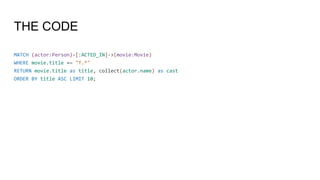
THE CODE
PROs CONs
● Solves a very specific (and hard) data
problem
● Learning curve not bad for developer
usage
● Data analysts’ dream
● Very little operational expertise for hire
● Little community and virtually no tooling for
administration and operations.
● Big mismatch in paradigm vs RDBMS;
Hard to switch for DBAs.
● Hard/Expensive to scale horizontally
● Writes are computationally expensive
Graph Databases - Questions?
Time Series
ID: {timestamp, value}
db1-threads: {1460928171, 6}
Time Series - Good Use Cases
● Uh … Time Series Data
● Write-mostly (95%+) - Sequential Appends
● Rare updates, rarer still to the distant past
● Deletes occur at the opposite end (the beginning)
● Data does not fit in memory
Time Series - Good Use Cases
● Uh … Time Series Data
● Write-mostly (95%+) - Sequential Appends
● Rare updates, rarer still to the distant past
● Deletes occur at the opposite end (the beginning)
● Data does not fit in memory
Time Series - Good Use Cases
● Uh … Time Series Data
● Write-mostly (95%+) - Sequential Appends
● Rare updates, rarer still to the distant past
● Deletes occur at the opposite end (the beginning)
● Data does not fit in memory
Time Series - Good Use Cases
● Uh … Time Series Data
● Write-mostly (95%+) - Sequential Appends
● Rare updates, rarer still to the distant past
● Deletes occur at the opposite end (the beginning)
● Data does not fit in memory
Time Series - Good Use Cases
● Uh … Time Series Data
● Write-mostly (95%+) - Sequential Appends
● Rare updates, rarer still to the distant past
● Deletes occur at the opposite end (the beginning)
● Data does not fit in memory
Time Series - Good Use Cases
● Uh … Time Series Data
● Write-mostly (95%+) - Sequential Appends
● Rare updates, rarer still to the distant past
● Deletes occur at the opposite end (the beginning)
● Data does not fit in memory
Time Series - Bad Use Cases
● Uh … Not Time Series Data
● Small data
Example Time Series Databases
● InfluxDB
● Graphite
● OpenTSDB
● Blueflood
● Prometheus
Example Time Series Databases
● InfluxDB
● Graphite
● OpenTSDB
● Blueflood
● Prometheus
Example Time Series Databases
● InfluxDB
● Graphite
● OpenTSDB
● Blueflood
● Prometheus
Example Time Series Databases
● InfluxDB
● Graphite
● OpenTSDB
● Blueflood
● Prometheus
Example Time Series Databases
● InfluxDB
● Graphite
● OpenTSDB
● Blueflood
● Prometheus
Example Time Series Databases
● InfluxDB
● Graphite
● OpenTSDB
● Blueflood
● Prometheus
PROs CONs
● Solves a very specific (big) data problem
● Well-defined and finite data access
patterns
● Terrible query semantics
Time Series - Questions?
Document Stores
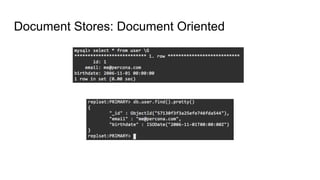
Document Stores: Document Oriented
Document Stores: Flexible Schema
ShardShardShard
Document Stores: Scalable by Design
Primary Primary Primary
Replica Replica Replica
InstanceInstanceInstance
Document Stores: Scalable By Design
Shard Shard Shard
Replica Replica Replica
Document Stores
Document Stores: MongoDB
● Sharding and replication for dummies!
● Pluggable storage engines for distinct workloads.
● Excellent compression options with PerconaFT, RocksDB, WiredTiger
● On disk encryption (Enterprise Advanced)
● In-memory storage engine (Beta)
● Connectors for all major programming languages
● Sharding and replica aware connectors
● Geospatial functions
● Aggregation framework
● .. a lot more except being transactional
Document Stores: MongoDB
● Sharding and replication for dummies!
● Pluggable storage engines for distinct workloads.
● Excellent compression options with PerconaFT, RocksDB, WiredTiger
● On disk encryption (Enterprise Advanced)
● In-memory storage engine (Beta)
● Connectors for all major programming languages
● Sharding and replica aware connectors
● Geospatial functions
● Aggregation framework
● .. a lot more except being transactional
Document Stores: MongoDB
● Sharding and replication for dummies!
● Pluggable storage engines for distinct workloads.
○ Different locking behaviors
● Excellent compression options with PerconaFT, RocksDB, WiredTiger
● On disk encryption (Enterprise Advanced)
● In-memory storage engine (Beta)
● Connectors for all major programming languages
● Sharding and replica aware connectors
● Geospatial functions
● Aggregation framework
● .. a lot more except being transactional
Document Stores: MongoDB
● Sharding and replication for dummies!
● Pluggable storage engines for distinct workloads.
● Excellent compression options with PerconaFT, RocksDB, WiredTiger
● On disk encryption (Enterprise Advanced)
● In-memory storage engine (Beta)
● Connectors for all major programming languages
● Sharding and replica aware connectors
● Geospatial functions
● Aggregation framework
● .. a lot more except being transactional
Document Stores: MongoDB
● Sharding and replication for dummies!
● Pluggable storage engines for distinct workloads.
● Excellent compression options with PerconaFT, RocksDB, WiredTiger
● On disk encryption (Enterprise Advanced)
● In-memory storage engine (Beta)
● Connectors for all major programming languages
● Sharding and replica aware connectors
● Geospatial functions
● Aggregation framework
● .. a lot more except being transactional
Document Stores: MongoDB
● Sharding and replication for dummies!
● Pluggable storage engines for distinct workloads.
● Excellent compression options with PerconaFT, RocksDB, WiredTiger
● On disk encryption (Enterprise Advanced)
● In-memory storage engine (Beta)
● Connectors for all major programming languages
● Sharding and replica aware connectors
● Geospatial functions
● Aggregation framework
● .. a lot more except being transactional
Document Stores: MongoDB
● Sharding and replication for dummies!
● Pluggable storage engines for distinct workloads.
● Excellent compression options with PerconaFT, RocksDB, WiredTiger
● On disk encryption (Enterprise Advanced)
● In-memory storage engine (Beta)
● Connectors for all major programming languages
● Sharding and replica aware connectors
● Geospatial functions
● Aggregation framework
● .. a lot more except being transactional
Document Stores: MongoDB
● Sharding and replication for dummies!
● Pluggable storage engines for distinct workloads.
● Excellent compression options with PerconaFT, RocksDB, WiredTiger
● On disk encryption (Enterprise Advanced)
● In-memory storage engine (Beta)
● Connectors for all major programming languages
● Sharding and replica aware connectors
● Geospatial functions
● Aggregation framework
● .. a lot more except being transactional
Document Stores: MongoDB
● Sharding and replication for dummies!
● Pluggable storage engines for distinct workloads.
● Excellent compression options with PerconaFT, RocksDB, WiredTiger
● On disk encryption (Enterprise Advanced)
● In-memory storage engine (Beta)
● Connectors for all major programming languages
● Sharding and replica aware connectors
● Geospatial functions
● Aggregation framework
● .. a lot more except being transactional
Document Stores: MongoDB
● Sharding and replication for dummies!
● Pluggable storage engines for distinct workloads.
● Excellent compression options with PerconaFT, RocksDB, WiredTiger
● On disk encryption (Enterprise Advanced)
● In-memory storage engine (Beta)
● Connectors for all major programming languages
● Sharding and replica aware connectors
● Geospatial functions
● Aggregation framework
● .. a lot more except being transactional
Document Stores: MongoDB
● Sharding and replication for dummies!
● Pluggable storage engines for distinct workloads.
● Excellent compression options with PerconaFT, RocksDB, WiredTiger
● On disk encryption (Enterprise Advanced)
● In-memory storage engine (Beta)
● Connectors for all major programming languages
● Sharding and replica aware connectors
● Geospatial functions
● Aggregation framework
● .. a lot more except being transactional
● Catalogs
● Analytics/BI (BI Connector on 3.2)
● Time series
Document Stores: MongoDB > Use Cases
● Catalogs
● Analytics/BI (BI Connector on 3.2)
● Time series
Document Stores: MongoDB > Use Cases
● Catalogs
● Analytics/BI (BI Connector on 3.2)
● Time series
Document Stores: MongoDB > Use Cases
Document Stores: Couchbase
● MongoDB - more or less
● Global Secondary Indexes is exciting which produces localized secondary
indexes for low latency queries (Multi Dimensional Scaling)
● Drop in replacement for Memcache
Document Stores: Couchbase
● MongoDB - more or less
● Global Secondary Indexes is exciting which produces localized
secondary indexes for low latency queries (Multi Dimensional Scaling)
● Drop in replacement for Memcache
Document Stores: Couchbase
● MongoDB - more or less
● Global Secondary Indexes is exciting which produces localized secondary
indexes for low latency queries (Multi Dimensional Scaling)
● Drop in replacement for Memcache
Document Stores: Couchbase > Use Cases
● Internet of Things (direct or indirect receiver/pipeline)
● Mobile data persistence via Couchbase Mobile i.e. field devices with unstable
connections and local/close priximity ingestion points
● Distributed K/V store
Document Stores: Couchbase > Use Cases
● Internet of Things (direct or indirect receiver/pipeline)
● Mobile data persistence via Couchbase Mobile i.e. field devices with
unstable connections and local/close priximity ingestion points
● Distributed K/V store
Document Stores: Couchbase > Use Cases
● Internet of Things (direct or indirect receiver/pipeline)
● Mobile data persistence via Couchbase Mobile i.e. field devices with unstable
connections and local/close priximity ingestion points
● Distributed K/V store
Document Store: Questions?
Fulltext Search
Fulltext Search: Inverted Index
Fulltext Search: Search in a Box
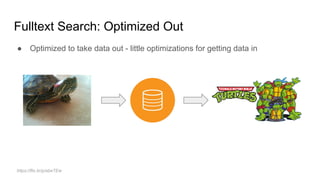
Fulltext Search: Optimized Out
● Optimized to take data out - little optimizations for getting data in
https://flic.kr/p/abeTEw
Fulltext Search: Structured/Non-Structured Data
Fulltext Search
Fulltext Search: Elasticsearch
● Lucene based
● RESTful interface - JSON in, JSON out
● Flexible schema
● Automatic sharding and replication (NDB like)
● Reasonable defaults
● Extension model
● Written in Java, JVM limitation applies i.e. GC
● ELK - Elasticsearch+Logstash+Kibana
Fulltext Search: Elasticsearch
● Lucene based
● RESTful interface - JSON in, JSON out
● Flexible schema
● Automatic sharding and replication (NDB like)
● Reasonable defaults
● Extension model
● Written in Java, JVM limitation applies i.e. GC
● ELK - Elasticsearch+Logstash+Kibana
Fulltext Search: Elasticsearch
● Lucene based
● RESTful interface - JSON in, JSON out
● Flexible schema
● Automatic sharding and replication (NDB like)
● Reasonable defaults
● Extension model
● Written in Java, JVM limitation applies i.e. GC
● ELK - Elasticsearch+Logstash+Kibana
Fulltext Search: Elasticsearch
● Lucene based
● RESTful interface - JSON in, JSON out
● Flexible schema
● Automatic sharding and replication (NDB like)
● Reasonable defaults
● Extension model
● Written in Java, JVM limitation applies i.e. GC
● ELK - Elasticsearch+Logstash+Kibana
Fulltext Search: Elasticsearch
● Lucene based
● RESTful interface - JSON in, JSON out
● Flexible schema
● Automatic sharding and replication (NDB like)
● Reasonable defaults
● Extension model
● Written in Java, JVM limitation applies i.e. GC
● ELK - Elasticsearch+Logstash+Kibana
Fulltext Search: Elasticsearch
● Lucene based
● RESTful interface - JSON in, JSON out
● Flexible schema
● Automatic sharding and replication (NDB like)
● Reasonable defaults
● Extension model
● Written in Java, JVM limitation applies i.e. GC
● ELK - Elasticsearch+Logstash+Kibana
Fulltext Search: Elasticsearch
● Lucene based
● RESTful interface - JSON in, JSON out
● Flexible schema
● Automatic sharding and replication (NDB like)
● Reasonable defaults
● Extension model
● Written in Java, JVM limitation applies i.e. GC
● ELK - Elasticsearch+Logstash+Kibana
Fulltext Search: Elasticsearch
● Lucene based
● RESTful interface - JSON in, JSON out
● Flexible schema
● Automatic sharding and replication (NDB like)
● Reasonable defaults
● Extension model
● Written in Java, JVM limitation applies i.e. GC
● ELK - Elasticsearch+Logstash+Kibana
Fulltext Search: Elasticsearch > Use Cases
● Logs Analysis - ELK Stack i.e. Netflix
● Full Text search i.e. Github, Wikipedia, StackExchange, etc
● https://www.elastic.co/use-cases
Fulltext Search: Elasticsearch > Use Cases
● Logs Analysis - ELK Stack i.e. Netflix
● Full Text search i.e. Github, Wikipedia, StackExchange, etc
● https://www.elastic.co/use-cases
Fulltext Search: Elasticsearch > Use Cases
● Logs Analysis - ELK Stack i.e. Netflix
● Full Text search i.e. Github, Wikipedia, StackExchange, etc
● https://www.elastic.co/use-cases
○ Sentiment analysis
○ Personalized experience
○ etc
● Lucene based
● Quite cryptic query interface - Innovator’s Dilemma
● Support for SQL based query on 6.1
● Structured schema, data types needs to be predefined
● Written in Java, JVM limitation applies i.e. GC
● Near realtime indexing - DIH,
● Rich document handling - PDF, doc[x]
● SolrCloud support for sharding and replication
Fulltext Search: Solr
● Lucene based
● Quite cryptic query interface - Innovator’s Dilemma
● Support for SQL based query on 6.1
● Structured schema, data types needs to be predefined
● Written in Java, JVM limitation applies i.e. GC
● Near realtime indexing - DIH,
● Rich document handling - PDF, doc[x]
● SolrCloud support for sharding and replication
Fulltext Search: Solr
● Lucene based
● Quite cryptic query interface - Innovator’s Dilemma
● Support for SQL based query on 6.1
● Structured schema, data types needs to be predefined
● Written in Java, JVM limitation applies i.e. GC
● Near realtime indexing - DIH,
● Rich document handling - PDF, doc[x]
● SolrCloud support for sharding and replication
Fulltext Search: Solr
● Lucene based
● Quite cryptic query interface - Innovator’s Dilemma
● Support for SQL based query on 6.1
● Structured schema, data types needs to be predefined
● Written in Java, JVM limitation applies i.e. GC
● Near realtime indexing - DIH,
● Rich document handling - PDF, doc[x]
● SolrCloud support for sharding and replication
Fulltext Search: Solr
● Lucene based
● Quite cryptic query interface - Innovator’s Dilemma
● Support for SQL based query on 6.1
● Structured schema, data types needs to be predefined
● Written in Java, JVM limitation applies i.e. GC
● Near realtime indexing - DIH,
● Rich document handling - PDF, doc[x]
● SolrCloud support for sharding and replication
Fulltext Search: Solr
● Lucene based
● Quite cryptic query interface - Innovator’s Dilemma
● Support for SQL based query on 6.1
● Structured schema, data types needs to be predefined
● Written in Java, JVM limitation applies i.e. GC
● Near real-time indexing - DIH,
● Rich document handling - PDF, doc[x]
● SolrCloud support for sharding and replication
Fulltext Search: Solr
● Lucene based
● Quite cryptic query interface - Innovator’s Dilemma
● Support for SQL based query on 6.1
● Structured schema, data types needs to be predefined
● Written in Java, JVM limitation applies i.e. GC
● Near realtime indexing - DIH,
● Rich document handling - PDF, doc[x]
● SolrCloud support for sharding and replication
Fulltext Search: Solr
● Lucene based
● Quite cryptic query interface - Innovator’s Dilemma
● Support for SQL based query on 6.1
● Structured schema, data types needs to be predefined
● Written in Java, JVM limitation applies i.e. GC
● Near realtime indexing - DIH,
● Rich document handling - PDF, doc[x]
● SolrCloud support for sharding and replication
Fulltext Search: Solr
● Search and Relevancy
○ https://www.percona.com/live/data-performance-conference-2016/sessions/solr-how-index-10-
billion-phrases-mysql-and-hbase
● Recommendation Engine
● Spatial Search
Fulltext Search: Solr > Use Cases
● Search and Relevancy
● Recommendation Engine
● Spatial Search
Fulltext Search: Solr > Use Cases
● Search and Relevancy
● Recommendation Engine
● Spatial Search
Fulltext Search: Solr > Use Cases
● Structured data
● MySQL protocol - SphinxQL
● Durable indexes via binary logs
● Realtime indexes via MySQL queries
● Distributed index for scaling
● No native support for replication i.e. via rsync
● Very good documentation
● Fastest full indexing/reindexing [?]
Fulltext Search: Sphinx Search
● Structured data
● MySQL protocol - SphinxQL
● Durable indexes via binary logs
● Realtime indexes via MySQL queries
● Distributed index for scaling
● No native support for replication i.e. via rsync
● Very good documentation
● Fastest full indexing/reindexing [?]
Fulltext Search: Sphinx Search
● Structured data
● MySQL protocol - SphinxQL
● Durable indexes via binary logs
● Realtime indexes via MySQL queries
● Distributed index for scaling
● No native support for replication i.e. via rsync
● Very good documentation
● Fastest full indexing/reindexing [?]
Fulltext Search: Sphinx Search
● Structured data
● MySQL protocol - SphinxQL
● Durable indexes via binary logs
● Realtime indexes via MySQL queries
● Distributed index for scaling
● No native support for replication i.e. via rsync
● Very good documentation
● Fastest full indexing/reindexing [?]
Fulltext Search: Sphinx Search
● Structured data
● MySQL protocol - SphinxQL
● Durable indexes via binary logs
● Realtime indexes via MySQL queries
● Distributed index for scaling
● No native support for replication i.e. via rsync
● Very good documentation
● Fastest full indexing/reindexing [?]
Fulltext Search: Sphinx Search
● Structured data
● MySQL protocol - SphinxQL
● Durable indexes via binary logs
● Realtime indexes via MySQL queries
● Distributed index for scaling
● No native support for replication i.e. via rsync
● Very good documentation
● Fastest full indexing/reindexing [?]
Fulltext Search: Sphinx Search
● Structured data
● MySQL protocol - SphinxQL
● Durable indexes via binary logs
● Realtime indexes via MySQL queries
● Distributed index for scaling
● No native support for replication i.e. via rsync
● Very good documentation
● Fastest full indexing/reindexing [?]
Fulltext Search: Sphinx Search
● Structured data
● MySQL protocol - SphinxQL
● Durable indexes via binary logs
● Realtime indexes via MySQL queries
● Distributed index for scaling
● No native support for replication i.e. via rsync
● Very good documentation
● Fastest full indexing/reindexing
Fulltext Search: Sphinx Search
● Real time full text + basic geo functions
● Above with with dependency or to simplify access with SphinxQL or even
Sphinx storage engine for MySQL
Fulltext Search: Sphinx Search > Use Cases
● Real time full text + basic geo functions
● Above with with dependency or to simplify access with SphinxQL or
even Sphinx storage engine for MySQL
Fulltext Search: Sphinx Search > Use Cases
Search - Questions?
Docker Is Your Friend
Relational
● https://github.com/docker-library/mysql
● https://github.com/docker-library/postgres
Key Value
● https://github.com/docker-library/memcached
● https://github.com/docker-library/redis
● https://github.com/docker-library/cassandra
● https://github.com/hectcastro/docker-riak (https://docs.docker.
com/engine/examples/running_riak_service/)
Docker Is Your Friend
Graph
● https://github.com/neo4j/docker-neo4j
● https://github.com/orientechnologies/orientdb-docker
● https://github.com/arangodb/arangodb-docker
● https://github.com/tenforce/docker-virtuoso (non official)
● https://hub.docker.com/r/itzg/titandb/~/dockerfile/ (non official)
● https://github.com/phani1kumar/docker-titan (non official)
Full Text
● https://github.com/docker-solr/docker-solr/
● https://github.com/stefobark/sphinxdocker
Docker Is Your Friend
Time series
● https://github.com/tutumcloud/influxdb (non official)
● https://hub.docker.com/r/sitespeedio/graphite/ (non official)
● https://github.com/rackerlabs/blueflood/tree/master/demo/docker
● https://hub.docker.com/r/petergrace/opentsdb-docker/ (non-official)
● https://hub.docker.com/r/opower/opentsdb/ (non-official)
● https://prometheus.io/docs/introduction/install/#using-docker
● https://github.com/prometheus/prometheus/blob/master/Dockerfile
● Both via http://opentsdb.net/docs/build/html/resources.html
Docker Is Your Friend
Document
● https://github.com/docker-library/mongo/
● https://hub.docker.com/r/couchbase/server/~/dockerfile/
Columnar
● http://www.infobright.org/index.php/download/download-pentaho-ice-integrated-virtual-machine/
● https://github.com/meatcar/docker-infobright/blob/master/Dockerfile
● https://github.com/vertica/docker-vertica
Heterogenous Persistence

Heterogenous Persistence

  • 1.
    Heterogeneous Persistence A guidefor the modern DBA Marcos Albe Jervin Real Ryan Lowe Liz Van Dijk
  • 2.
  • 3.
  • 4.
  • 5.
    Agenda ● Introduction ● Whya single DBMS is not enough ● What makes a DBMS ● Different flavors of DMBS ● Top picks
  • 6.
    Why one DBMSis not enough "If you feel things are not efficient in your code, is likely that you are suffering of poor data structures choice/design" ~ Anonymous
  • 7.
    Why one DBMSis not enough ● Different data structures ● Different access patterns ● Different consistency and durability requirements. ● Different scaling needs ● Different budgets ● Theoretical fundamentalism
  • 8.
    Why one DBMSis not enough A more concrete example OLAP -vs- OLTP
  • 9.
  • 10.
    PROs CONs ● NoSPOF ● Workload optimized services ● Easier to scale* ● Additional complexity ● Operational needs (additional staffing) ● Cost ($$$)*
  • 11.
    La Carte ● KeyValue Stores ○ Memcached ○ MemcacheDB ○ Redis ○ Riak KV ○ Cassandra ○ Amazon's DynamoDB ● Graph ○ Neo4J ○ OrientDB ○ Titan ○ Virtuoso ○ ArangoDB ● Relational ○ MySQL ○ PostgreSQL ● Time Series ○ InfluxDB ○ Graphite ○ OpenTSDB ○ Blueflood ○ Prometheus ● Columnar ○ Vertica ○ Infobright ○ Amazon RedShift ○ Apache HBase ● Document ○ MongoDB ○ Couchbase ● Fulltext ○ Sphinx ○ Lucene/Solr
  • 12.
  • 13.
    General Criteria ● Specialty ●Cost ● API/Interfaces ● Scalability ● CAP ● ACID ● Secondary Features
  • 14.
    What makes aDBMS: General ● Licensing ● Language support ● OS support ● Community & workforce ● Tools ecosystem
  • 15.
    ● Data Architecture ○Logical data model ○ Physical data model ● Standards adherence (where defined) ● Atomicity ● Consistency ● Isolation ● Durability ● Referential integrity ● Transactions ● Locking ● Crash recovery ● Unicode support What makes a DBMS: Fundamental Features
  • 16.
    ● Interface /connectors / protocols ● Sequences / auto-incrementals / atomic counters ● Conditional entry updates ● MapReduce ● Compression ● In-memory ● Availability ● Concurrency handling ● Scalability ● Embeddable ● Backups What makes a DBMS: Fundamental Features cont.
  • 17.
    ● CRUD ● Union ●Intersect ● JOIN (inner, outer) ● Inner selects ● Merge joins ● Common Table Expressions ● Windowing Functions ● Parallel Query ● Subqueries ● Aggregation ● Derived tables What makes a DBMS: querying capabilities
  • 18.
    ● Cursors ● Triggers ●Stored procedures ● Functions ● Views ● Materialized views ● Virtual columns ● UDF ● XML/JSON/YAML support What makes a DBMS: programmatic capabilities
  • 19.
    ● Database (tablessize sum) ● Number of Tables ● Tables individual size ● Variable length column size ● Row width ● Row columns count ● Row count ● Column name ● Blob size ● Char ● Numeric ● Date (min / max) What makes a DBMS: sizing limits
  • 20.
    ● B-Tree ● Fulltext indexing ● Hash ● Bitmap ● Expression ● Partials ● Reverse ● GiST ● GIS indexing ● Composite keys ● Graph support What makes a DBMS: indexing
  • 21.
    ● Replication ● Failover ●Clustering ● CAP choice What makes a DBMS: high availability
  • 22.
    Partitioning ● Range ● Hash ●Range+hash ● List ● Expression ● Sub-partitioning Sharding ● By key ● By table What makes a DBMS: scalability
  • 23.
    ● Integer ● Floatingpoint ● Decimal ● String ● Binary ● Date/time ● Boolean ● Binary ● Set ● Enumeration ● Blob ● Clob ● JSON/XML/YAML (as native types) What makes a DBMS: supported data types
  • 24.
    ● Authentication methods ●Access Control Lists ● Pluggable Authentication Modules support ● Encryption at-rest ● Encryption over the wire ● User proxy What makes a DBMS: security features
  • 25.
    ● Data organizationmodel: unstructured, semi-structured, structured ● Data model (schema) stability: Static? Stable? Dynamic? Highly dynamic? ● Writes: append-only; append mostly; updates only; updates mostly ● Reads: full scans; range scans; multi-range scans; point reads; ● Reads by age: new only; new mostly; old only; old mostly; whole range ● Reads by complexity: simple, related, deeply-nested relations, ....? What makes a DBMS: workload
  • 26.
    ACID vs BASE ●Atomic ● Consistent ● Isolated ● Durable ● Basic Availability ● Soft-state ● Eventual Consistency
  • 27.
    CAP Theorem ● Consistency ●Availability ● Partitioning
  • 28.
  • 29.
  • 30.
  • 31.
  • 32.
  • 33.
  • 34.
    Relational Databases: querylanguage results = new Array(); table = open(‘mydata’); while (row = table.fetch()) { if (row.x > 100) { results.push(row); } }
  • 35.
    Relational Databases: querylanguage SELECT * FROM mydata WHERE x > 100;
  • 36.
    Relational Databases: JOINs SELECTo.order_id AS Order, CONCAT(c.customer_name, “ (“, c. customer_email, “)”) as Customer, GROUP_CONCAT(i.item_name), SUM(item_price) FROM orders AS o JOIN order_items AS oi ON oi.order_id = o.order_id JOIN items AS i ON i.item_id = oi.item_id JOIN customers AS c ON c.customer_id = o.customer_id
  • 37.
    Relational Databases: gooduse cases ● Highly-structured data with complex querying needs ● Projects that need very high data durability and guarantees of database-level consistency and integrity ● Simple projects with limited data growth and limited amount of entities ● Projects that require PCI/DSS, HIPPA or similar security requirements ● Analysis of portions of larger BigData stores ● Projects where duplicated data volumes would be a problem
  • 38.
    Relational Databases: baduse cases ● Unstructured data ● Deep Hierarchies / Nested -> XML ● Deep recursion: ● Ever-growing datasets; Projects that are basically logging data ● Projects recording time-series ● Reporting on massive datasets
  • 39.
    Relational Databases: baduse cases ● Projects supporting extreme concurrency ● Projects supporting massive data intake ● Queues ● Cache storage
  • 40.
    PROs CONs ● Verymature ● Abundant workforce ● ACID guarantees ● Referential integrity ● Highly expressive query language ● Ubiquitous ● Rigid schema ● Difficult to scale horizontally ● Expensive writes ● JOIN bombs
  • 41.
  • 42.
    ● Well known/ mature / extensive documentation ● GPLv2 + commercial license for OEMs, ISVs and VARs ● Client libraries for about every programming language ● Many different engines ● SQL/ACID impose scalability limits ● Asynchronous / Semi-synchronous / Virtually synchronous replication ● Can be AP or CP depending on replication model Relational Databases: MySQL
  • 43.
    PROs CONs ● Opensource ● Mature and ubiquitous ● ACID ● Choice of AP or CP ● Highly available ● Abundant tooling and expertise ● General purpouse; Likely good to start anything you want. ● Difficult to shard ● Replication issues ● Not 100% standard compliant ● Storage engines imposed limiations ● General purpouse; No single bullet solutions for scaling!
  • 44.
  • 45.
    ● Mature /adequate documentation ● PostgreSQL License (similar to BSD/MIT) ● Client libraries for about every programming language ● Highly Standards Compliant ● SQL/ACID impose scalability limits ● Asynchronous / Semi-synchronous ● Virtually synchronous replication via 3rd party ● Can be AP or CP depending on replication model` Relational Databases: PostgreSQL
  • 46.
    PROs CONs ● Opensource ● Mature and stable ● ACID ● Lots of advanced features ● Vacuum ● Difficult to shard ● Operations feel like an afterthought ● Less forgiving ● Vacuum
  • 47.
  • 49.
  • 50.
    HASHING ● Computers: 0,1, 2, …, n - 1, n ● Key Value Pair: (k, v) (k, v) => hash(k) mod n
  • 54.
  • 55.
  • 56.
  • 57.
    K/V Stores -Good Use Cases ● Lots of data ● Object cache in front of RDBMS ● High concurrency ● Massive small-data intake ● Simple data access patterns
  • 58.
    K/V Stores -Good Use Cases ● Lots of data ○ Usually easily horizontally scalable ● Object cache in front of RDBMS ● High concurrency ● Massive small-data intake ● Simple data access patterns
  • 59.
    K/V Stores -Good Use Cases ● Lots of data ● Object cache in front of RDBMS ○ Memcached, anyone? ● High concurrency ● Massive small-data intake ● Simple data access patterns
  • 60.
    K/V Stores -Good Use Cases ● Lots of data ● Object cache in front of RDBMS ● High concurrency ○ Very simple locking model ● Massive small-data intake ● Simple data access patterns
  • 61.
    K/V Stores -Good Use Cases ● Lots of data ● Object cache in front of RDBMS ● High concurrency ● Massive small-data intake ● Simple data access patterns
  • 62.
    K/V Stores -Good Use Cases ● Lots of data ● Object cache in front of RDBMS ● High concurrency ● Massive small-data intake ● Simple data access patterns ○ CRUD on PK access
  • 63.
    K/V Stores -Bad Use Cases ● Durability and consistency* ● Complex data access patterns ● Non-PK access* ● Operations*
  • 64.
    K/V Stores -Bad Use Cases ● Durability and consistency* ● Complex data access patterns ● Non-PK access* ● Operations*
  • 65.
    K/V Stores -Bad Use Cases ● Durability and consistency* ● Complex data access patterns* ● Non-PK access* ● Operations*
  • 66.
    K/V Stores -Bad Use Cases ● Durability and consistency* ● Complex data access patterns ● Non-PK access* ● Operations*
  • 67.
    K/V Stores -Bad Use Cases ● Durability and consistency* ● Complex data access patterns ● Non-PK access* ● Operations* ○ Complex systems fail in complex ways
  • 68.
  • 69.
  • 70.
    EXAMPLE K/V STORES ●Memcached ● MemcacheDB ● Redis* ● Riak KV ● Cassandra* ● Amazon DynamoDB*
  • 71.
    EXAMPLE K/V STORES ●Memcached ● MemcacheDB ● Redis* ● Riak KV ● Cassandra* ● Amazon DynamoDB*
  • 72.
    EXAMPLE K/V STORES ●Memcached ● MemcacheDB ● Redis* ● Riak KV ● Cassandra* ● Amazon DynamoDB*
  • 73.
    EXAMPLE K/V STORES ●Memcached ● MemcacheDB ● Redis* ● Riak KV ● Cassandra* ● Amazon DynamoDB*
  • 74.
    EXAMPLE K/V STORES ●Memcached ● MemcacheDB ● Redis* ● Riak KV ● Cassandra* ● Amazon DynamoDB*
  • 75.
    EXAMPLE K/V STORES ●Memcached ● MemcacheDB ● Redis* ● Riak KV ● Cassandra* ● Amazon DynamoDB*
  • 76.
    EXAMPLE K/V STORES ●Memcached ● MemcacheDB ● Redis* ● Riak KV ● Cassandra* ● Amazon DynamoDB*
  • 77.
    PROs CONs ● Highlyscalable ● Simple access patterns ● Operational complexities ● Limited access patterns
  • 78.
    Key Value Stores- Questions?
  • 79.
  • 80.
    Columnar Data Layout ●Row-oriented ● Column-oriented 001:10,Smith,Joe,40000; 002:12,Jones,Mary,50000; 003:11,Johnson,Cathy,44000; 004:22,Jones,Bob,55000; ... 10:001,12:002,11:003,22:004; Smith:001,Jones:002,Johnson:003,Jones:004; Joe:001,Mary:002,Cathy:003,Bob:004; 40000:001,50000:002,44000:003,55000:004; ...
  • 81.
    Columnar Data Layout ●Row-oriented Read Approach What we want to read Read Operation Memory Page 1 2 3 4 10 Smith Bob 40000 12 Jones Mary 50000 11 Johnson Cathy 44000
  • 82.
    Columnar Data Layout ●Column-oriented Read Approach What we want to read Read Operation Memory Page 1 2 3 4 10 12 11 22 Smith Jones Johnson Joe Mary Cathy Bob
  • 83.
    Columnar Databases -Considerations ● Buffering and compression can help to reduce the impact of writes, but they should still be avoided when possible ○ Usually, an ETL process should be put in place to prepare data for analysis in a column-based format ● Covering Indexes in row-based stores could provide similar benefits, but only up to a point → index maintenance work can become too expensive ● Column-based stores are self-indexing and more disk-space efficient ● SQL can be used for most column-based stores
  • 84.
    Columnar Databases -Considerations ● Buffering and compression can help to reduce the impact of writes, but they should still be avoided when possible ○ Usually, an ETL process should be put in place to prepare data for analysis in a column-based format ● Covering Indexes in row-based stores could provide similar benefits, but only up to a point → index maintenance work can become too expensive ● Column-based stores are self-indexing and more disk-space efficient ● SQL can be used for most column-based stores
  • 85.
    Columnar Databases -Considerations ● Buffering and compression can help to reduce the impact of writes, but they should still be avoided when possible ○ Usually, an ETL process should be put in place to prepare data for analysis in a column-based format ● Covering Indexes in row-based stores could provide similar benefits, but only up to a point → index maintenance work can become too expensive ● Column-based stores are self-indexing and more disk-space efficient ● SQL can be used for most column-based stores
  • 86.
    Columnar Databases -Considerations ● Buffering and compression can help to reduce the impact of writes, but they should still be avoided when possible ○ Usually, an ETL process should be put in place to prepare data for analysis in a column-based format ● Covering Indexes in row-based stores could provide similar benefits, but only up to a point → index maintenance work can become too expensive ● Column-based stores are self-indexing and more disk-space efficient ● SQL can be used for most column-based stores
  • 87.
    ● Suitable forread-mostly or read-intensive, large data repositories ● Good for full table / large range reads. ● Good for unstructured problems where “good” indexes are hard to forecast ● Good for re-creatable datasets ● Good for structured data Columnar Database - Good use cases
  • 88.
    ● Suitable forread-mostly or read-intensive, large data repositories ● Good for full table / large range reads. ● Good for unstructured problems where “good” indexes are hard to forecast ● Good for re-creatable datasets ● Good for structured data Columnar Database - Good use cases
  • 89.
    ● Suitable forread-mostly or read-intensive, large data repositories ● Good for full table / large range reads. ● Good for unstructured problems where “good” indexes are hard to forecast ● Good for re-creatable datasets ● Good for structured data Columnar Database - Good use cases
  • 90.
    ● Suitable forread-mostly or read-intensive, large data repositories ● Good for full table / large range reads. ● Good for unstructured problems where “good” indexes are hard to forecast ● Good for re-creatable datasets ● Good for structured data Columnar Database - Good use cases
  • 91.
    ● Suitable forread-mostly or read-intensive, large data repositories ● Good for full table / large range reads. ● Good for unstructured problems where “good” indexes are hard to forecast ● Good for re-creatable datasets ● Good for structured data Columnar Database - Good use cases
  • 92.
    ● Not goodfor “SELECT *” queries or queries fetching most of the columns ● Not good for writes ● Not good for mixed read/write ● Bad for unstructured data Columnar Database - Bad use cases
  • 93.
    ● Not goodfor “SELECT *” queries or queries fetching most of the columns ● Not good for writes ● Not good for mixed read/write ● Bad for unstructured data Columnar Database - Bad use cases
  • 94.
    ● Not goodfor “SELECT *” queries or queries fetching most of the columns ● Not good for writes ● Not good for mixed read/write ● Bad for unstructured data Columnar Database - Bad use cases
  • 95.
    ● Not goodfor “SELECT *” queries or queries fetching most of the columns ● Not good for writes ● Not good for mixed read/write ● Bad for unstructured data Columnar Database - Bad use cases
  • 96.
    Columnar Database -Examples ● InfoBright (ICE) ● Vertica ● Amazon Redshift ● Apache HBase
  • 97.
    Columnar Database -Examples ● InfoBright (ICE) ● Vertica ● Amazon Redshift ● Apache HBase
  • 98.
    Columnar Database -Examples ● InfoBright (ICE) ● Vertica ● Amazon Redshift ● Apache HBase
  • 99.
    Columnar Database -Examples ● InfoBright (ICE) ● Vertica ● Amazon Redshift ● Apache HBase ○ https://www.percona.com/live/data-performance-conference- 2016/sessions/solr-how-index-10-billion-phrases-mysql-and-hbase
  • 100.
  • 101.
  • 103.
    Graph Databases -Good Use Cases ● Highly Connected Data ● Millions or Billions of Records ● Re-Creatable Data Set ● Structured Data
  • 104.
    Graph Databases -Good Use Cases ● Highly Connected Data ○ Network & IT Operations, Recommendations, Fraud Detection, Social Networking, Identity & Access Management, Geo Routing, Insurance Risk Analysis, Counter Terrorism ● Millions or Billions of Records ● Re-Creatable Data Set ● Structured Data
  • 106.
    Graph Databases -Good Use Cases ● Highly Connected Data ● Millions or Billions of Records ○ Relational databases can also solve this problem at a smaller scale ● Re-Creatable Data Set ● Structured Data
  • 107.
    Graph Databases -Good Use Cases ● Highly Connected Data ● Millions or Billions of Records ● Re-Creatable Data Set ○ Keep as much as possible outside of the critical path ● Structured Data
  • 108.
    Graph Databases -Good Use Cases ● Highly Connected Data ● Millions or Billions of Records ● Re-Creatable Data Set ● Structured Data ○ You cannot graph a relationship unless you can define it
  • 109.
    Graph Databases -Bad Use Cases ● Unstructured Data ● Non-Connected Data ● Highly Concurrent RW Workloads ● Anything in the Critical OLTP Path* ● Ever-Growing Data Set
  • 110.
    Graph Databases -Bad Use Cases ● Unstructured Data ○ You cannot graph a relationship if you cannot define it ● Non-Connected Data ● Highly Concurrent Workloads ● Anything in the Critical OLTP Path* ● Ever-Growing Data Set
  • 111.
    Graph Databases -Bad Use Cases ● Unstructured Data ● Non-Connected Data ○ Graphiness is important here ● Highly Concurrent Workloads ● Anything in the Critical OLTP Path* ● Ever-Growing Data Set
  • 112.
    Graph Databases -Bad Use Cases ● Unstructured Data ● Non-Connected Data ● Highly Concurrent RW Workloads ○ Performance breaks down ● Anything in the Critical OLTP Path* ● Ever-Growing Data Set
  • 113.
    Graph Databases -Bad Use Cases ● Unstructured Data ● Non-Connected Data ● Highly Concurrent Workloads ● Anything in the Critical OLTP Path* ○ I'm not only talking about writes here ● Ever-Growing Data Set
  • 114.
    Graph Databases -Bad Use Cases ● Unstructured Data ● Non-Connected Data ● Highly Concurrent RW Workloads ● Anything in the Critical OLTP Path* ● Ever-Growing Data Set
  • 115.
    Example Graph Databases ●Neo4j ● OrientDB ● Titan ● Virtuoso ● ArangoDB
  • 116.
    Example Graph Databases ●Neo4j ● OrientDB ● Titan ● Virtuoso ● ArangoDB
  • 117.
    Example Graph Databases ●Neo4j ● OrientDB ● Titan ● Virtuoso ● ArangoDB
  • 118.
    Example Graph Databases ●Neo4j ● OrientDB ● Titan ● Virtuoso ● ArangoDB
  • 119.
    Example Graph Databases ●Neo4j ● OrientDB ● Titan ● Virtuoso ● ArangoDB
  • 120.
    Example Graph Databases ●Neo4j ● OrientDB ● Titan ● Virtuoso ● ArangoDB
  • 122.
  • 123.
    PROs CONs ● Solvesa very specific (and hard) data problem ● Learning curve not bad for developer usage ● Data analysts’ dream ● Very little operational expertise for hire ● Little community and virtually no tooling for administration and operations. ● Big mismatch in paradigm vs RDBMS; Hard to switch for DBAs. ● Hard/Expensive to scale horizontally ● Writes are computationally expensive
  • 124.
  • 125.
  • 126.
  • 127.
    Time Series -Good Use Cases ● Uh … Time Series Data ● Write-mostly (95%+) - Sequential Appends ● Rare updates, rarer still to the distant past ● Deletes occur at the opposite end (the beginning) ● Data does not fit in memory
  • 128.
    Time Series -Good Use Cases ● Uh … Time Series Data ● Write-mostly (95%+) - Sequential Appends ● Rare updates, rarer still to the distant past ● Deletes occur at the opposite end (the beginning) ● Data does not fit in memory
  • 129.
    Time Series -Good Use Cases ● Uh … Time Series Data ● Write-mostly (95%+) - Sequential Appends ● Rare updates, rarer still to the distant past ● Deletes occur at the opposite end (the beginning) ● Data does not fit in memory
  • 130.
    Time Series -Good Use Cases ● Uh … Time Series Data ● Write-mostly (95%+) - Sequential Appends ● Rare updates, rarer still to the distant past ● Deletes occur at the opposite end (the beginning) ● Data does not fit in memory
  • 131.
    Time Series -Good Use Cases ● Uh … Time Series Data ● Write-mostly (95%+) - Sequential Appends ● Rare updates, rarer still to the distant past ● Deletes occur at the opposite end (the beginning) ● Data does not fit in memory
  • 132.
    Time Series -Good Use Cases ● Uh … Time Series Data ● Write-mostly (95%+) - Sequential Appends ● Rare updates, rarer still to the distant past ● Deletes occur at the opposite end (the beginning) ● Data does not fit in memory
  • 133.
    Time Series -Bad Use Cases ● Uh … Not Time Series Data ● Small data
  • 134.
    Example Time SeriesDatabases ● InfluxDB ● Graphite ● OpenTSDB ● Blueflood ● Prometheus
  • 135.
    Example Time SeriesDatabases ● InfluxDB ● Graphite ● OpenTSDB ● Blueflood ● Prometheus
  • 137.
    Example Time SeriesDatabases ● InfluxDB ● Graphite ● OpenTSDB ● Blueflood ● Prometheus
  • 138.
    Example Time SeriesDatabases ● InfluxDB ● Graphite ● OpenTSDB ● Blueflood ● Prometheus
  • 139.
    Example Time SeriesDatabases ● InfluxDB ● Graphite ● OpenTSDB ● Blueflood ● Prometheus
  • 140.
    Example Time SeriesDatabases ● InfluxDB ● Graphite ● OpenTSDB ● Blueflood ● Prometheus
  • 141.
    PROs CONs ● Solvesa very specific (big) data problem ● Well-defined and finite data access patterns ● Terrible query semantics
  • 142.
    Time Series -Questions?
  • 143.
  • 144.
  • 145.
  • 146.
  • 147.
  • 148.
  • 149.
  • 150.
  • 151.
    ShardShardShard Document Stores: Scalableby Design Primary Primary Primary Replica Replica Replica Replica Replica Replica
  • 152.
    InstanceInstanceInstance Document Stores: ScalableBy Design Shard Shard Shard Replica Replica Replica Replica Replica Replica
  • 153.
  • 154.
  • 155.
    Document Stores: MongoDB ●Sharding and replication for dummies! ● Pluggable storage engines for distinct workloads. ● Excellent compression options with PerconaFT, RocksDB, WiredTiger ● On disk encryption (Enterprise Advanced) ● In-memory storage engine (Beta) ● Connectors for all major programming languages ● Sharding and replica aware connectors ● Geospatial functions ● Aggregation framework ● .. a lot more except being transactional
  • 156.
    Document Stores: MongoDB ●Sharding and replication for dummies! ● Pluggable storage engines for distinct workloads. ● Excellent compression options with PerconaFT, RocksDB, WiredTiger ● On disk encryption (Enterprise Advanced) ● In-memory storage engine (Beta) ● Connectors for all major programming languages ● Sharding and replica aware connectors ● Geospatial functions ● Aggregation framework ● .. a lot more except being transactional
  • 157.
    Document Stores: MongoDB ●Sharding and replication for dummies! ● Pluggable storage engines for distinct workloads. ○ Different locking behaviors ● Excellent compression options with PerconaFT, RocksDB, WiredTiger ● On disk encryption (Enterprise Advanced) ● In-memory storage engine (Beta) ● Connectors for all major programming languages ● Sharding and replica aware connectors ● Geospatial functions ● Aggregation framework ● .. a lot more except being transactional
  • 158.
    Document Stores: MongoDB ●Sharding and replication for dummies! ● Pluggable storage engines for distinct workloads. ● Excellent compression options with PerconaFT, RocksDB, WiredTiger ● On disk encryption (Enterprise Advanced) ● In-memory storage engine (Beta) ● Connectors for all major programming languages ● Sharding and replica aware connectors ● Geospatial functions ● Aggregation framework ● .. a lot more except being transactional
  • 159.
    Document Stores: MongoDB ●Sharding and replication for dummies! ● Pluggable storage engines for distinct workloads. ● Excellent compression options with PerconaFT, RocksDB, WiredTiger ● On disk encryption (Enterprise Advanced) ● In-memory storage engine (Beta) ● Connectors for all major programming languages ● Sharding and replica aware connectors ● Geospatial functions ● Aggregation framework ● .. a lot more except being transactional
  • 160.
    Document Stores: MongoDB ●Sharding and replication for dummies! ● Pluggable storage engines for distinct workloads. ● Excellent compression options with PerconaFT, RocksDB, WiredTiger ● On disk encryption (Enterprise Advanced) ● In-memory storage engine (Beta) ● Connectors for all major programming languages ● Sharding and replica aware connectors ● Geospatial functions ● Aggregation framework ● .. a lot more except being transactional
  • 161.
    Document Stores: MongoDB ●Sharding and replication for dummies! ● Pluggable storage engines for distinct workloads. ● Excellent compression options with PerconaFT, RocksDB, WiredTiger ● On disk encryption (Enterprise Advanced) ● In-memory storage engine (Beta) ● Connectors for all major programming languages ● Sharding and replica aware connectors ● Geospatial functions ● Aggregation framework ● .. a lot more except being transactional
  • 162.
    Document Stores: MongoDB ●Sharding and replication for dummies! ● Pluggable storage engines for distinct workloads. ● Excellent compression options with PerconaFT, RocksDB, WiredTiger ● On disk encryption (Enterprise Advanced) ● In-memory storage engine (Beta) ● Connectors for all major programming languages ● Sharding and replica aware connectors ● Geospatial functions ● Aggregation framework ● .. a lot more except being transactional
  • 163.
    Document Stores: MongoDB ●Sharding and replication for dummies! ● Pluggable storage engines for distinct workloads. ● Excellent compression options with PerconaFT, RocksDB, WiredTiger ● On disk encryption (Enterprise Advanced) ● In-memory storage engine (Beta) ● Connectors for all major programming languages ● Sharding and replica aware connectors ● Geospatial functions ● Aggregation framework ● .. a lot more except being transactional
  • 164.
    Document Stores: MongoDB ●Sharding and replication for dummies! ● Pluggable storage engines for distinct workloads. ● Excellent compression options with PerconaFT, RocksDB, WiredTiger ● On disk encryption (Enterprise Advanced) ● In-memory storage engine (Beta) ● Connectors for all major programming languages ● Sharding and replica aware connectors ● Geospatial functions ● Aggregation framework ● .. a lot more except being transactional
  • 165.
    Document Stores: MongoDB ●Sharding and replication for dummies! ● Pluggable storage engines for distinct workloads. ● Excellent compression options with PerconaFT, RocksDB, WiredTiger ● On disk encryption (Enterprise Advanced) ● In-memory storage engine (Beta) ● Connectors for all major programming languages ● Sharding and replica aware connectors ● Geospatial functions ● Aggregation framework ● .. a lot more except being transactional
  • 166.
    ● Catalogs ● Analytics/BI(BI Connector on 3.2) ● Time series Document Stores: MongoDB > Use Cases
  • 167.
    ● Catalogs ● Analytics/BI(BI Connector on 3.2) ● Time series Document Stores: MongoDB > Use Cases
  • 168.
    ● Catalogs ● Analytics/BI(BI Connector on 3.2) ● Time series Document Stores: MongoDB > Use Cases
  • 169.
  • 170.
    Document Stores: Couchbase ●MongoDB - more or less ● Global Secondary Indexes is exciting which produces localized secondary indexes for low latency queries (Multi Dimensional Scaling) ● Drop in replacement for Memcache
  • 171.
    Document Stores: Couchbase ●MongoDB - more or less ● Global Secondary Indexes is exciting which produces localized secondary indexes for low latency queries (Multi Dimensional Scaling) ● Drop in replacement for Memcache
  • 172.
    Document Stores: Couchbase ●MongoDB - more or less ● Global Secondary Indexes is exciting which produces localized secondary indexes for low latency queries (Multi Dimensional Scaling) ● Drop in replacement for Memcache
  • 173.
    Document Stores: Couchbase> Use Cases ● Internet of Things (direct or indirect receiver/pipeline) ● Mobile data persistence via Couchbase Mobile i.e. field devices with unstable connections and local/close priximity ingestion points ● Distributed K/V store
  • 174.
    Document Stores: Couchbase> Use Cases ● Internet of Things (direct or indirect receiver/pipeline) ● Mobile data persistence via Couchbase Mobile i.e. field devices with unstable connections and local/close priximity ingestion points ● Distributed K/V store
  • 175.
    Document Stores: Couchbase> Use Cases ● Internet of Things (direct or indirect receiver/pipeline) ● Mobile data persistence via Couchbase Mobile i.e. field devices with unstable connections and local/close priximity ingestion points ● Distributed K/V store
  • 176.
  • 177.
  • 178.
  • 179.
  • 180.
    Fulltext Search: OptimizedOut ● Optimized to take data out - little optimizations for getting data in https://flic.kr/p/abeTEw
  • 181.
  • 182.
  • 183.
    Fulltext Search: Elasticsearch ●Lucene based ● RESTful interface - JSON in, JSON out ● Flexible schema ● Automatic sharding and replication (NDB like) ● Reasonable defaults ● Extension model ● Written in Java, JVM limitation applies i.e. GC ● ELK - Elasticsearch+Logstash+Kibana
  • 184.
    Fulltext Search: Elasticsearch ●Lucene based ● RESTful interface - JSON in, JSON out ● Flexible schema ● Automatic sharding and replication (NDB like) ● Reasonable defaults ● Extension model ● Written in Java, JVM limitation applies i.e. GC ● ELK - Elasticsearch+Logstash+Kibana
  • 185.
    Fulltext Search: Elasticsearch ●Lucene based ● RESTful interface - JSON in, JSON out ● Flexible schema ● Automatic sharding and replication (NDB like) ● Reasonable defaults ● Extension model ● Written in Java, JVM limitation applies i.e. GC ● ELK - Elasticsearch+Logstash+Kibana
  • 186.
    Fulltext Search: Elasticsearch ●Lucene based ● RESTful interface - JSON in, JSON out ● Flexible schema ● Automatic sharding and replication (NDB like) ● Reasonable defaults ● Extension model ● Written in Java, JVM limitation applies i.e. GC ● ELK - Elasticsearch+Logstash+Kibana
  • 187.
    Fulltext Search: Elasticsearch ●Lucene based ● RESTful interface - JSON in, JSON out ● Flexible schema ● Automatic sharding and replication (NDB like) ● Reasonable defaults ● Extension model ● Written in Java, JVM limitation applies i.e. GC ● ELK - Elasticsearch+Logstash+Kibana
  • 188.
    Fulltext Search: Elasticsearch ●Lucene based ● RESTful interface - JSON in, JSON out ● Flexible schema ● Automatic sharding and replication (NDB like) ● Reasonable defaults ● Extension model ● Written in Java, JVM limitation applies i.e. GC ● ELK - Elasticsearch+Logstash+Kibana
  • 189.
    Fulltext Search: Elasticsearch ●Lucene based ● RESTful interface - JSON in, JSON out ● Flexible schema ● Automatic sharding and replication (NDB like) ● Reasonable defaults ● Extension model ● Written in Java, JVM limitation applies i.e. GC ● ELK - Elasticsearch+Logstash+Kibana
  • 190.
    Fulltext Search: Elasticsearch ●Lucene based ● RESTful interface - JSON in, JSON out ● Flexible schema ● Automatic sharding and replication (NDB like) ● Reasonable defaults ● Extension model ● Written in Java, JVM limitation applies i.e. GC ● ELK - Elasticsearch+Logstash+Kibana
  • 191.
    Fulltext Search: Elasticsearch> Use Cases ● Logs Analysis - ELK Stack i.e. Netflix ● Full Text search i.e. Github, Wikipedia, StackExchange, etc ● https://www.elastic.co/use-cases
  • 192.
    Fulltext Search: Elasticsearch> Use Cases ● Logs Analysis - ELK Stack i.e. Netflix ● Full Text search i.e. Github, Wikipedia, StackExchange, etc ● https://www.elastic.co/use-cases
  • 193.
    Fulltext Search: Elasticsearch> Use Cases ● Logs Analysis - ELK Stack i.e. Netflix ● Full Text search i.e. Github, Wikipedia, StackExchange, etc ● https://www.elastic.co/use-cases ○ Sentiment analysis ○ Personalized experience ○ etc
  • 194.
    ● Lucene based ●Quite cryptic query interface - Innovator’s Dilemma ● Support for SQL based query on 6.1 ● Structured schema, data types needs to be predefined ● Written in Java, JVM limitation applies i.e. GC ● Near realtime indexing - DIH, ● Rich document handling - PDF, doc[x] ● SolrCloud support for sharding and replication Fulltext Search: Solr
  • 195.
    ● Lucene based ●Quite cryptic query interface - Innovator’s Dilemma ● Support for SQL based query on 6.1 ● Structured schema, data types needs to be predefined ● Written in Java, JVM limitation applies i.e. GC ● Near realtime indexing - DIH, ● Rich document handling - PDF, doc[x] ● SolrCloud support for sharding and replication Fulltext Search: Solr
  • 196.
    ● Lucene based ●Quite cryptic query interface - Innovator’s Dilemma ● Support for SQL based query on 6.1 ● Structured schema, data types needs to be predefined ● Written in Java, JVM limitation applies i.e. GC ● Near realtime indexing - DIH, ● Rich document handling - PDF, doc[x] ● SolrCloud support for sharding and replication Fulltext Search: Solr
  • 197.
    ● Lucene based ●Quite cryptic query interface - Innovator’s Dilemma ● Support for SQL based query on 6.1 ● Structured schema, data types needs to be predefined ● Written in Java, JVM limitation applies i.e. GC ● Near realtime indexing - DIH, ● Rich document handling - PDF, doc[x] ● SolrCloud support for sharding and replication Fulltext Search: Solr
  • 198.
    ● Lucene based ●Quite cryptic query interface - Innovator’s Dilemma ● Support for SQL based query on 6.1 ● Structured schema, data types needs to be predefined ● Written in Java, JVM limitation applies i.e. GC ● Near realtime indexing - DIH, ● Rich document handling - PDF, doc[x] ● SolrCloud support for sharding and replication Fulltext Search: Solr
  • 199.
    ● Lucene based ●Quite cryptic query interface - Innovator’s Dilemma ● Support for SQL based query on 6.1 ● Structured schema, data types needs to be predefined ● Written in Java, JVM limitation applies i.e. GC ● Near real-time indexing - DIH, ● Rich document handling - PDF, doc[x] ● SolrCloud support for sharding and replication Fulltext Search: Solr
  • 200.
    ● Lucene based ●Quite cryptic query interface - Innovator’s Dilemma ● Support for SQL based query on 6.1 ● Structured schema, data types needs to be predefined ● Written in Java, JVM limitation applies i.e. GC ● Near realtime indexing - DIH, ● Rich document handling - PDF, doc[x] ● SolrCloud support for sharding and replication Fulltext Search: Solr
  • 201.
    ● Lucene based ●Quite cryptic query interface - Innovator’s Dilemma ● Support for SQL based query on 6.1 ● Structured schema, data types needs to be predefined ● Written in Java, JVM limitation applies i.e. GC ● Near realtime indexing - DIH, ● Rich document handling - PDF, doc[x] ● SolrCloud support for sharding and replication Fulltext Search: Solr
  • 202.
    ● Search andRelevancy ○ https://www.percona.com/live/data-performance-conference-2016/sessions/solr-how-index-10- billion-phrases-mysql-and-hbase ● Recommendation Engine ● Spatial Search Fulltext Search: Solr > Use Cases
  • 203.
    ● Search andRelevancy ● Recommendation Engine ● Spatial Search Fulltext Search: Solr > Use Cases
  • 204.
    ● Search andRelevancy ● Recommendation Engine ● Spatial Search Fulltext Search: Solr > Use Cases
  • 205.
    ● Structured data ●MySQL protocol - SphinxQL ● Durable indexes via binary logs ● Realtime indexes via MySQL queries ● Distributed index for scaling ● No native support for replication i.e. via rsync ● Very good documentation ● Fastest full indexing/reindexing [?] Fulltext Search: Sphinx Search
  • 206.
    ● Structured data ●MySQL protocol - SphinxQL ● Durable indexes via binary logs ● Realtime indexes via MySQL queries ● Distributed index for scaling ● No native support for replication i.e. via rsync ● Very good documentation ● Fastest full indexing/reindexing [?] Fulltext Search: Sphinx Search
  • 207.
    ● Structured data ●MySQL protocol - SphinxQL ● Durable indexes via binary logs ● Realtime indexes via MySQL queries ● Distributed index for scaling ● No native support for replication i.e. via rsync ● Very good documentation ● Fastest full indexing/reindexing [?] Fulltext Search: Sphinx Search
  • 208.
    ● Structured data ●MySQL protocol - SphinxQL ● Durable indexes via binary logs ● Realtime indexes via MySQL queries ● Distributed index for scaling ● No native support for replication i.e. via rsync ● Very good documentation ● Fastest full indexing/reindexing [?] Fulltext Search: Sphinx Search
  • 209.
    ● Structured data ●MySQL protocol - SphinxQL ● Durable indexes via binary logs ● Realtime indexes via MySQL queries ● Distributed index for scaling ● No native support for replication i.e. via rsync ● Very good documentation ● Fastest full indexing/reindexing [?] Fulltext Search: Sphinx Search
  • 210.
    ● Structured data ●MySQL protocol - SphinxQL ● Durable indexes via binary logs ● Realtime indexes via MySQL queries ● Distributed index for scaling ● No native support for replication i.e. via rsync ● Very good documentation ● Fastest full indexing/reindexing [?] Fulltext Search: Sphinx Search
  • 211.
    ● Structured data ●MySQL protocol - SphinxQL ● Durable indexes via binary logs ● Realtime indexes via MySQL queries ● Distributed index for scaling ● No native support for replication i.e. via rsync ● Very good documentation ● Fastest full indexing/reindexing [?] Fulltext Search: Sphinx Search
  • 212.
    ● Structured data ●MySQL protocol - SphinxQL ● Durable indexes via binary logs ● Realtime indexes via MySQL queries ● Distributed index for scaling ● No native support for replication i.e. via rsync ● Very good documentation ● Fastest full indexing/reindexing Fulltext Search: Sphinx Search
  • 213.
    ● Real timefull text + basic geo functions ● Above with with dependency or to simplify access with SphinxQL or even Sphinx storage engine for MySQL Fulltext Search: Sphinx Search > Use Cases
  • 214.
    ● Real timefull text + basic geo functions ● Above with with dependency or to simplify access with SphinxQL or even Sphinx storage engine for MySQL Fulltext Search: Sphinx Search > Use Cases
  • 215.
  • 216.
  • 217.
    Relational ● https://github.com/docker-library/mysql ● https://github.com/docker-library/postgres KeyValue ● https://github.com/docker-library/memcached ● https://github.com/docker-library/redis ● https://github.com/docker-library/cassandra ● https://github.com/hectcastro/docker-riak (https://docs.docker. com/engine/examples/running_riak_service/) Docker Is Your Friend
  • 218.
    Graph ● https://github.com/neo4j/docker-neo4j ● https://github.com/orientechnologies/orientdb-docker ●https://github.com/arangodb/arangodb-docker ● https://github.com/tenforce/docker-virtuoso (non official) ● https://hub.docker.com/r/itzg/titandb/~/dockerfile/ (non official) ● https://github.com/phani1kumar/docker-titan (non official) Full Text ● https://github.com/docker-solr/docker-solr/ ● https://github.com/stefobark/sphinxdocker Docker Is Your Friend
  • 219.
    Docker Is YourFriend Time series ● https://github.com/tutumcloud/influxdb (non official) ● https://hub.docker.com/r/sitespeedio/graphite/ (non official) ● https://github.com/rackerlabs/blueflood/tree/master/demo/docker ● https://hub.docker.com/r/petergrace/opentsdb-docker/ (non-official) ● https://hub.docker.com/r/opower/opentsdb/ (non-official) ● https://prometheus.io/docs/introduction/install/#using-docker ● https://github.com/prometheus/prometheus/blob/master/Dockerfile ● Both via http://opentsdb.net/docs/build/html/resources.html
  • 220.
    Docker Is YourFriend Document ● https://github.com/docker-library/mongo/ ● https://hub.docker.com/r/couchbase/server/~/dockerfile/ Columnar ● http://www.infobright.org/index.php/download/download-pentaho-ice-integrated-virtual-machine/ ● https://github.com/meatcar/docker-infobright/blob/master/Dockerfile ● https://github.com/vertica/docker-vertica