EXPLANATORY               HANDBOOK

                          ON

 INDIAN STANDARD CODE OF PRACTICE FOR
DESIGN LOADS (OTHER THAN EARTHQUAKE)
      FOR BUILDINGS AND STRUCTURES
                  PART 3 WIND LOADS
                [IS 875 (PART 3): 1987]


                        0 BIS 2001

       BUREAU     OF   IN DIAN       STANDARDS
       MANAK BHAVAN, 9 BAHADUR SHAH ZAFAR MARG
                   NEW DELHI 110002
SP 64 (S & T) :2001


FIRST PUBLISHED          DECEMBER        2001


Q BUREAU OF INDIAN STANDARDS


ISBN 81-7061 -053-4


PRICE : W 650.00


Typeset by Paragon Enterprises, New Delhi 110002

Printed in India
at Viba Press Pvt. Ltd., 122, DSIDC Shed, Okhla Industrial Area Phase-I, New Delhi- I 1002O
Published by
Bureau of Indian Standards, New Delhi 110002
Composition   of the Special Committee for Implementation   of Science and
                               Technology Projects (SCIP)


                                      Chairman
                          PADAMSHRI DR H. C. VISVESVARAYA
                                   Vice-chancellor
                                University of Roorkee
                                       Roorkee

          Members                                            Representing
DR T. V. S. R. APPA RAO                     Structural Engineering Research Centre (CSIR),
                                               Chennai
DIRECTOR                                    Central Building Research Institute, Roorkee
SHRI V. RAO AIYAGERI                        Department     of    Science   & Technology,
                                               New Delhi
ADDITIONAL DIRECTOR GENERAL (S&P)           Central Public Works Department, New Delhi
   CHIEF ENGINEER (DESIGNS) (Alternate)
SHRI S. K. DATTA                            Metallurgical   and Engineering Consultants
                                               (India) Ltd, Ranchi
SHRI l?. D. MAYEE                           Planning Commission, New Delhi
   SHRI UMESH KALRA (Altenzate)

                                   Member-Secretaries
                              SHRIMATI NEETA SHARMA
                              Deputy Director (S&T), BIS

                              SHRIMATI RACHNA SEHGAL
                            Deputy Director (Civ Engg), BIS
As in the Original Standard, this Page is Intentionally Left Blank
FOREWORD

Users of various civil engineering codes have been feeling the need for explanatory handbooks and other
compilations based on Indian Standards. The need has been further emphasized in view of the publication of
the National Building Code of India in 1970 (which has since been revised in 1983) and its implementation.
The Expert Group set up in 1972 by the Department of Science and Technology, Government of India carried
out in-depth studies in various areas of civil engineering and construction practices. During the preparation of
the Fifth Five-Year Plan in 1975, the Group was assigned the task of producing a Science and Technology Plan
for research, development and extension work in the sectors of housing and construction technology. One of
the items of this plan was the formulation of design handbooks, explanatory handbooks and design aids based
on the National Building Code and various Indian Standards and other activities in the promotion of the National
Building Code. The Expert Group gave high priority to this item and on the recommendation of the Department
of Science and Technology, the Planning Commission approved the following two projects which were assigned
to the Bureau of Indian Standards (erstwhile Indian Standards Institution) :
      a) Development programme on code implementation for building and civil engineering construction, and
     b) Typification for industrial buildings.

A Special Committee for Implementation of Science and Technology Projects (SCIP) consisting of experts
connected with different aspects was set up in 1974 to advise the BIS Directorate General in identifying
the handbooks and for guiding the development of the work. Under the first project, the Committee has
identified several subjects for preparing explanatory handbooks/compilations covering appropriate Indian
Standards/Codes/Specifications which include the following :

*Handbooks Published
      1. Design Aids for Reinforced Concrete to IS 456:1976 (SP 16: 1980)
      2. Handbook on Masonry Design and Construction (first revision) (SP 20: 1991)
      3. Summaries of Indian Standards for Building Materials (SP 21: 1983)
     4. Explanatory Handbook on Codes of Earthquake Engineering (IS 1893:1975 and IS 4326: 1976)
        (SP 22: 1982)
      5. Handbook on Concrete Mixes (SP 23: 1982)
      6. Explanatory Handbook on Indian Standard Code of Practice for Plain and Reinforced Concrete (IS 456:
         1978) (SP 24: 1983)
      7. Handbook on Causes and Prevention of Cracks in Buildings (SP 25: 1984)
      8. Handbook on Functional Requirements of Industrial Buildings (Lighting and Ventilation) (SP 32:
         1986)
      9. Handbook on Timber Engineering (SP 33: 1986)
    10. Hankbook on Concrete Reinforcement and Detailing (SP 34: 1987)
     Il. Handbook on Water Supply and Drainage with Special Emphasis on Plumbing (SP 35: 1987)
    12. Handbook on Typified Designs for Structures with Steel Roof Trusses (with and without Cranes) (based
        on IS Codes) (SP 38: 1987)
    13. Handbook on Structures with Steel Portal Frames (without Cranes) (SP 40: 1987)


* Hmdbooks publishedare available for sale from BIs Headquarters, and from all Branches and Regional, Offices of BIS.

                                                        (v)
14. Handbook on Functional Requirements of Buildings (Other than Industrial Buildings) (SP 41: 1987)
     15. Handbook on structures with Reinforced Concrete Portal Frames (without Cranes) (SP 43: 1987)
     16. Handbook on Structures with Steel Lattice Portal Frames (without Cranes) (SP 47: 1987)
     17. Handbook on Building Construction Practices (Other than Electrical Services) (SP 62: 1997)
     18. Handbook on Construction Safety Practices (SP 70: 2001)

This Handbook has been written with a view to provide detailed background information on the provision of
Indian Standard on Code of Practice for Design Loads (Other than Earthquake) for Buildings and Structures :
Part 3 Wind Loads [1S875 (Part 3): 1987] and also the use of standard for arriving at the wind loads on buildings
and structures while evaluating their structural safety. The Handbook will serve as a guide for all those engaged
in the structural design of wind sensitive buildlngs and structures due to their shape, slenderness, flexibility, size
and lightness.

It maybe noted that the Handbook does not form part of any Indian Standard on the subject and does not have
the status of an Indian Standard. Wherever, if there is any dispute about the interpretation or opinion expressed
in this Handbook, the provisions of the codes only shall apply; the provisions of this Hankbook should be
considered as only supplementary and informative.

The Handbook is based on the first draft prepared by Shri S.K. Agarwal, Head, Wind Engineering, SERC,
Ghaziabad. The draft Handbook was circulated for review to STUP Consultants Ltd, Mumbai; National Council
for Cement and Building Materials, New Delhi; Central Public Works Department, New Delhi; Indian Institute
of Technology, Chennai; Indian Institute of Technology, KanpuG Structural Engineering Research Centre,
Chennai; M.N. Dastur & Co Ltd, Kolkata; Meteorological Office, Pune; Indian Institute of Science, Bangalore;
University of Roorkee, Roorkee; Tandon Consultants Pvt Ltd, New Delhi; Central Electricity Authority, New
Delhi; Indian Institute of Technolo~y, Kharagpuq Indian Institute of Technology, New Delhi; Engineers India
Ltd, New Delhi; N.T.P.C., Noida; Ministry of Railways (RDSO), Lucknow; Department of Space, Bangalore;
Nuclear Power Corporation, Mumbai; Moti Lal Nehru Regional Engineering College, Allahabad; VaJcilMehta
Seth, Ahmedabad; Anna University, Chennai; UNITECH, New Delhi; Consulting Engineering Services (I) Pvt
Ltd, New Delhi; Tata Consulting Engineers, Mumbai; Housing &Urban Development Corporation, New Delhi;
National Institute of Construction Management and Research, Mumbai; Howe India (Pvt) Ltd, New Delhi; Army
Headquarters, New Delhi; Institution of Engineers, New Delhi; Gammons India Ltd, Mumbai; Central Building
Research Institute, Roorkee; Department of Science & Technology, New Delhi; Metallurgical& Engineering
Consultants (India) Ltd, Ranchi; Planning Commission, New Delhi; and views expressed by them were taken
into consideration while finalizing the Handbook.


                                                        (vi)
Contents
Clause                                                                            Page
O   INTRODUCTION                                                    ...     ...     1
    0.1   Background                                                ...     ...     1
    0.2   Nature of Wind                                            ...     ...     1
    0.3   Shortfalls of the1964 Code                                ...     ...    5
1   SCOPE                                                           ...     ...    8
2   TERMINOLOGY                                                     ...     ...    8
    2.1   Angle of Attack                                           ...     ...    8
    2.2   Breadth                                                   ...     ...    8
    2.3   Depth                                                     ...     ...    8
    2.4   Developed Height                                          ...     ...    8
    2.5   Effective Frontal Area                                    ...     ...    8
    2.6   Element Surface Area                                      ...     ..     8
    2.7   Force and Moment Coefficients                             ...     ...    9
    2.8   Ground Roughnes                                           ...     ...    9
    2.9   Gradient Height                                           ...     ...    9
    2.10 Pressure Coefficient                                       ...     ...    9
    2.11 Suction                                                    ...     ...    10
    2.12 Solidity Ratio’@’                                          .,.     ...    10
    2.13 Fetch Length                                               ...     ...    11
    2.14 Terrain Category                                           ...     ...    11
    2.15 Velocity Profile                                           ...     ...    11
    2.16 Topography                                                 ...     .,.    11
3   WINDSPEEDANDPRESSURE                                            ...     ...    11
    3.1   Basic Wind Speed                                          ...     ...    11
    3.2   Design Wind Speed                                         ...     ...    13
    3.3   Risk Coefficient                                          ...     ...    13
    3.4   Terrain, Height and Structure Size (k2Factor)             ...     ...    14
    3.5   Fetch and Developed Height Relationship                   ...     ...    14
    3.6   Topography (ks)                                           ...     ...    17
    3.7   Design Wind Pressure                                      ...     ...    17
4   WINDPRESSURE     ANDFORCES   ONBUILDINGS/STRUCTURES             ...     ..     18
    4.1   General                                                   ...     ...    18
    4.2   Pressure Coefficients                                     ...     ...    18
    4.3   Force Coefficients                                        ...     ...    19
5   DYNAMIC   EFFECTS                                               ... ,   ...    20
6   GUSTFACTOR     (Go ORGUSTEFFECTIVENESS      FACTOR  (GEF,) METHOD..     20
7   WINDTUNNEL      MODELSTUDIES                                    ...     ...    21
8   APPLICATIONFCODAL
                  O          PROVISIONS                             ...     ...    22
9   ASSESSMENT FWINDLOADS
                 O                ONBUILDINGS NDSTRUCTURES ...
                                                 A                          ...    29
    LIST OF SOLVED EXAMPLES ON
    Rectangular Clad Buildings                                      ...     ...    29
    Free Roof                                                       ...     ...    81
    Miscellaneous Structures (Force Coefficient Method)             ...     ...    91
    Miscellaneous Structures (Gust Factor Method)                   ...     ...    108


                                                 (vii)
SP 64 (S & T) :2001

O INTRODUCTION                                                  which approached or crossed the Indian coasts during
                                                                1890 to 1960, together with the wind data available
0.1 Background
                                                                from about 10-12 continuously recording Dynes Pres-
A large number of structures that are being constructed         sure Anemograph (DPA) stations which existed at that
at present tend to be wind-sensitive because of their           time, to get an overall picture for the country. However
shapes, slenderness, flexibility, size and lightness.           3-cup anemometer readings were not much used in the
Added to these are the use of a variety of materials            preparation of wind maps because much of such data
which are stressed to much higher percentage of their           were synoptic.
ultimate strength than in earlier days because of better
                                                                The height of DPA instruments varied from 10 m to
assurance of the quality of materials. In the social
                                                                30 m at different places. Therefore only one extreme
environment that is developing world over, the ancient
                                                                value of wind was given up to 30 m height from ground
philosophy of accepting continuing disasters due to
                                                                level without any variation in-between. Further, l/10th
wind as ordained by ‘fate’ and Gods is giving place to
                                                                power law had been adopted regardless of terrain
demands for economical wind resistant designs. These
                                                                conditions, for indicating variation of wind speed with
factors have demanded a more realistic, if not, precise
                                                                height from 30 m to 150 m, for which there was no
definition of wind loading. Updating of some
                                                                supportive evidence. The code gave two wind pressure
International Codes of practice, notably the British,
                                                                maps (one giving winds of shorter duration <5 minutes
Australian, Canadian, American and French has been
                                                                and another excludlng winds of shorter duration) and
effected fairly frequently over the last two decades and
                                                                there was no clear guidance for using either or both of
the present versions incorporate most of the advances
                                                                them.
made in understanding the wind characteristics and its
effect on structures. The new discoveries are such that         With the publication of the recent revised wind code,
it is clear that mere issue of amendments to the earlier        IS 875 (Part 3) : 1987, an attempt has been made to
wind Code IS 875 : 1964 will not be justifiable. The            remove these deficiencies and provide to the Indian
recently issued wind code ‘Code of practice for design          structural engineer adequate guidelines for arriving at
loads (other than earthquake) for buildings and                 more rational wind loading for design purposes.
structures’ IS 875 (Part 3): 1987 differs in many ways
from the previous Code first issued in 1964 and                 0.2 Nature of Wind
attempts not only to rectify the shortfalls of the 1964
                                                                0.2.1 Wind means the motion of air in the atmosphere.
code but incorporates recent knowledge of wind
                                                                The response of structures to wind depends on the
effects on structures. The height up to which velocities
                                                                characteristics of the wind. From the point of view of
are given has now been raised to 500 m and the
                                                                assessing wind load, it is convenient to divide the wind
loadings on as many of the commonly encountered
                                                                into two categories: ‘Rotating and Non-rotating’
buildings and structures, for which there are no other
                                                                winds. Rotating winds are caused by tropical cyclones
Indian Standards, have been included. Although not
                                                                and tornadoes. The wind speeds caused by these may
explicitly stated, the code recognizes the fact that most
                                                                exceed 200 kti. The duration of such winds at any
of the high winds in India occur due to short duration
                                                                Ioeation varies from 2 to 5 minutes in the case of
rotating winds like tropical cyclones along the Coasts
                                                                tornadoes and thunderstorms and about 3 to 4 days in
or Tornadoes elsewhere, and nearly rectilinear winds
                                                                case of tropical cyclones. Non-rotating winds are
of short duration like thunderstorms at many places. In
                                                                caused by differential pressures and thus move in
this respect, the high wind loading conditions in India
                                                                preferred direction. These are also called ‘Pressure
are different from those of temperate zone countries
                                                                System’ winds and when they persist for distances like
like Europe and Canada. Much of the random response
                                                                50-100 km, are termed as ‘Fully developed pressure
theories, which have been adopted in EuropanA-J.S. or
                                                                system winds’. The intensity of such winds is usual]y
Australian Codes are based on these ‘fully developed
                                                                given in Beaufort Scale as in Table 1 (other scales for
pressure winds’ or ‘pressure wind’ conditions and
                                                                particular types of winds like cyclones have also been
strictly cannot be applied in most parts of India. But
                                                                proposed). Thunderstorms are rectilinear winds of
their judicious use, in the absence of proper theories
                                                                high speed lasting only a few minutes and start as a
applicable to cyclones, tornadoes and thunderstorms
                                                                strong vertical downdraft, from clouds which spread
will give adequate safety margins and this is what the
                                                                laterally on reaching the ground. They last for 2 to
present 1S 875 (Part 3) :1987 attempts to do.
                                                                5 minutes and wind speed can exceed 200 km/h.
In India, success in satisfactory codification of wind
loading on structures has remained elusive so far. In           0.2.2 Gradient Winak
most cases, codification has followed, not preceded
                                                                Winds are primarily caused by the differences in
structural failures or distress. The wind maps given in
                                                                temperature over the earth’s surface because the
the 1964 version of the code had been prepared mainl y
                                                                intensity of the sun’s radiation received at different
on the basis of extreme value wind data from storms

                                                            1
SP 64 (S & T) :2001

latitudes varies, and land areas heat and cool quicker            0.2.3.1 Logarithmic profile
than the sea. Ocean currents also affect the temperature
distribution by transporting heat from one part of earth          The logarithmic profile of the variation of mean wind
to another. The differences in temperature give rise to           speed with height is given by
the gradients of pressure which set the air in motion.                V~F    = Ilk. lo& zI@                              ...(1)
Near the earth’s surface, the motion is opposed, and
the wind speed reduced, by the surface friction. At the
surface, the wind speed reduces to zero and then begins                     design wind velocity at height z,
to increase with height, and at some height, known as                       von Karman’s constant with a numerical
the gradient height, the motion may be considered to                        value of 0.4,
be free of the earth’s frictional influence and will attain                 height above ground
its ‘gradient velocity’. This velocity depends on the                       is the surface roughness parameter,
pressure variation at that height in the plane parallel to                  the friction velocity defined as ~,
the earth’s surface. The gradient height increases with                     the skin friction force on the wall, and
the roughness of the terrain on the earth’s surface and
is taken to vary from about 300 m for flat ground to                        the density of air.
about 550 m for very rough terrain, in the Indian and             0.2.3.2 Power luw
a few other national codes. Although, the gradient
height is confused in many codes to be the same as the            Another representation for the mean wind speed
edge of the earth’s (planetary) boundary layer, the two           profile is the simple power law expression:
heights are not identical. True gradient height lies well
above the edge of the earth’s boundary layer height.                  VziVR (?,kR)
                                                                           =    a                                        ...(2)
The Indian Code has adopted a carefully written                   where
definition to imply this difference.                               VR = the speed at a reference height ZR, usually
                                                                        taken as the standard meteorological height
0.2.3 Variation of Mean Wind Speed with Height
                                                                        of 10 m, and
At the earth’s surface the wind speed is zero and, in              a = a constant for a particular site and terrain.
conditions of neutral stability, there is a continuous            0.2.4 Nature of Wind Flow Past Bodies
increase of mean wind speed from the ground to the
gradient height. A number of laws for defining this               0.2.4.1 The nature of flow of a fluid past a body
wind speed profile have been suggested, the most                  resting on a surface depends on the conditions of the
widely used of which is the logarithmic profile. The              surface, the shape of the body, its height, velocity of
empirical power law profile is also used in many codes.           fluid flow and many other factors. The flow may be


                                    Table 1 Beaufort Scale for Wmd Speeda
                                                (Clause 0.2.1)

 Beaufort       Description                   speed                  Deacrtptionf Wind Effects
                                                                               o
    No.         of Wind                        ds
   o            Calm                           < r3.4                No noticeablewind
    1           Lightairs                     0.4-1.5                Barelynoticeablewind
    2           Lightbreeze                    1.6-3.3               Whrdfelt on face
    3           Gentlebreeze                  3.4-5.4                Windextendstightflag,hair is distuti, clothingflaps
    4           Moderatebreeze                5.5-7.9                Windraisesdust,dry soil,loosepaper,hair disarranged
    5           Freshbreeze                   8.0-10.7               Forceof windfelt on body, driftingsnow becomesair borne;
                                                                        timitof agreeablewindon land
    6           Srrongbreeze                  10.8-13.8              Umbrellasused with difficulty;hair blown straigh~dlftlculty
                                                                        in watking steadily;windnoiseon ears unpleaaan~begin-
                                                                        ningof blizzards (snowflowsin air)
    7           Moderategale                 13.9-17.1               Inconvenience whenwatking
                                                                                    felt
    8           Freshgale                    17.2-20.7               progressinwalkingdiffIculcmaintainingbalancein gustsvery
                                                                        difficult
    9           Stronggale                   20.8-24.4               Peopleblownoverby gusts
   10           Wholegale                    24.5-28.5               smalltreesuprooted
   11           Storm                        28.6-34.0               Widespread&mage
   12           Hurricane                     >34.0                  Failureof illdesigned, structures,likelampposts,GI sheetsto
                                                                        majorfailures


                                                              2
SP 64 (S & T) :2001

what is called ‘streamlined’ or ‘laminar’ flow or what pressures acting on the body surfaces in contact with
is called ‘turbulent’ or ‘unsteady flow of random ‘it, and this reduction of pressure on the body’s leeward
nature’. A streamline is defined as a line drawn through side accounts for a large proportion of the drag force.
a moving fluid such that the velocity vector is Pressure forces act normal to the surface, and
tangential to it. The streamlines coincide with the paths integrating the components of pressure forces over the
of the particles in steady laminar fluid motion but not whole surface of the body in-line and perpendicular to
when the fluid motion is turbulent. In turbulent fluid the fluid direction results in alongwind (or drag) and
motion, the velocity and direction of the particles of acrosswind (or lift) forces. These are additional to the
small masses of fluid fluctuate in time, mostly in a skin-friction drag, which is caused by the viscosity of
random and chaotic manner. In uniform flow each the fluid and acts tangentially to the surface. The drag
streamline has the same constant velocity, but in flows resulting from the pressure distribution is referred to
of viscous fluids near a solid boundary, the velocity at as the pressure drag, and is kept to a minimum in
the boundary is reduced to zero by the effects of shapes used in aircraft wings called aerofoil sections,
viscosity. Thus the velocity along the streamlines which are designed to avoid flow separation.
increases with distance of the streamline from the solid
boundary until a final unretarded velocity is attained. Except for surfaces with pronounced protuberances
The region of retarded fluid, which is indicated by the that may fix the positions where the flow separates, the
broken lines in Fig. 1 is referred to as the boundary positions of transition from laminar to turbulent flow
layer. The flow over the surface within the boundary and of flow separation from the surface are dependent
layer may be laminar at an upstream position but on the Reynolds number (Re) of the flow,
transition to turbulent flow may take place at some
                                                               R== pvl~ = WV                                  ...(3)
position as the flow proceeds downstream along the
surface. This transition takes place over a distance where
along the flow direction. If the flow is subject to an
adverse gradient, that is a pressure gradient opposing p and v are, respectively, the dynamic and kinematic
it (such as may be induced by flow over a concave viscosities of the fluid and 1 is a typical length.
surface, or other circumstance in which it is forced or
allowed to expand), its velocity throughout the The Reynolds number is a measure of the ratio of the
boundary layer is further retarded and at some position inertia forces (that is, force due to acceleration of fluid
along the surface may be reduced to zero slightly particles) to viscous forces in a fluid.
above the surface. Then the opposing pressure will
drive the fluid in opposite direction (reversed flow). 0.2.5 Flow Patterns
The boundary layer flow becomes detached from the 0.2.5.1 Around circular cylinders
surface and large eddies are formed and are discharged
into the region behind the body called the wake. These We will first consider flow pasta structure of circular
eddies are usually discharged either randomly or at cross-section, since this shape is used in many tall and
fairly regular intervals, dependtng on the vebcity of even short structures. The flow patterns around a
the fluid and the dimensions and shape of the body. circular cylinder are sketched in Fig. 2, and show the
The energy carried downstream by these eddies marked influence of Reynolds number (Q. In the
reduces the pressure in the wake and hence the subcritical flow regime Fig. 2(a) the boundary layer


                                              +   v+


                                             la
               FIG. 1 GROWTH
                           OFABOUNDARY
                                     LAYERINA FAVORABLEPRESSURE
                                                              GRADIENT


                                                         3
5P 64 (S & T) :2001

remains laminar up to the points of separation, which                  width of the wake and an increase in cd. The periodic
occur at about 80° from the stagnation point P.                        vortex shedding in this regime is both weak and
Vortices are formed regularly and alternately from                     random. The increase in cd continues until Re = 3 X 10⁶
each side of the cylinder and are shed into the wake.                  and the position of the separation point stabilizes at
The width of the wake, and hence the value of the drag                 about 109°. In :his transcritical (sometimes, perhaps
coefficient Cd, is greatest in the subcritical flow                    more correctly, referred to as hypercritical) regime
regime. When the surface is smooth, at about a                         Fig. 2(d) the value of cd decreases slowly with increase
R, = 2 x 10⁵, the laminar boundary layer becomes                       of Reand the wake contains peak energy at frequencies
turbulent at a forward position on the cylinder surface.               higher than in the subcritical regime vortex shedding
The separation point shifts more or less suddenly to an                frequency. The flow patterns of Fig. 2 are for
angle of about 120° to 130°. In this critical regime                   stationary smooth-surface cylinders in a smooth
Fig. 2(b) cd falls rapidly as the Reynolds number                      approach flow; they are modified by surface
increases to 5 x 10⁵when its lowest value is reached.                  roughness, by turbulence of the incident wind, and by
Thereafter, increase of Re brings the flow into the                    motion of the cylinder and height to diameter ratio of
supercritical regime Fig. 2(c) with an increase in the                 the cylinder.


                                                                                                                         1
                                              -a) -> J
                              I
                                       Ts
                                                                                                           -m

                                                                                                                         1WAKE


                     G$-
                       c’
                              ie
                =


                    9 sW”
                         --
                              ,.‘. e


                              INla!
                                       Ts                                      ———
                                                                                ——_
                                                                                 __
                                                                                  fbl
                                                                                                                     }
                                                                                                                         WAKE


                      = 50”IN
                      . 6& IN
                                                                                                                     1
                      .7UW
                                                                                                                         WAKE

                                                                                                                     1


                                                                                            . . .- .--..--.”


                                            *6 J
                                                                       . . . . ..----.”-
                                                            ., . ..-
                                                       1s                                                  -—..
                                                                        --a
                                                                                                                 3       WAKE
                                            ~“      ~ ‘U/


                                                                               ldl
                                                                                      ... . .. . ...            ..   J
                    LB        = Laminar Boundaty Layer
                    T=          Transition from Laminar to Turbulent Boundaty Layer
                    TA        = Re-attachment of Turbulent Boundary Layer
                    LS, TS    = Separation of Laminar and Turbulent Boundaries Respectively
                    TB        = Turbulent Boundaty Layer
                    NOTE —         Broken line indicates boundary of separated flow.

   (a) Subcritical, 300 c R, <2 x 10⁵, Q= 1.2 a= 0.2; (b) Critical,2 x 105 c R. c 5 x 105,1.2> Cj >0.3,
       0.2< S, c 0.5; (c) Super-critical, 5 x 10b < Re c 3 x 10⁶, 0.5s ~s 0.7, S = 0.5; (d) Transcritical
      (Hypercritical), R, >3 x 1C6,Q = 0.7, S = 0.27, R,= V&.1,where dis the diameter of the cylinder

       FIG. 2 SKETCHES FTWO-DIMENSIONAL
                     O               AIRFLOWPATTERNS ROUND CIRCULAR
                                                   A     A        CYLINDER


                                                                   4
SP 64 (S & T) :2001

0.2.5.2 Around other bluff bodies                              equivalent static load. Static wind effect primarily
                                                               causes elastic bending and twisting of structure. The
 A body is said to be a bluff body if the ratio of its
                                                               dynamic effects of wind are either periodic forces such
 dimension parallel to the flow to its dimension
                                                               as due to Vortex Shedding, Flutter, Galloping and
perpendicular to the flow does not differ by more than
                                                               Ovalling or non-periodic such as turbulent bufetting
about 6 and whose drag coefficient based on the
                                                               (see Table 2).
smaller dimension exceeds about 0.1. Circular
cylinder, square and rectangular prisms, etc, are              0.3 Shortfalls of the 1%4 Code
examples. As an example, the flow patterns around a
                                                               0.3.1 The Code, which was published more than 35
 long square-section prism are sketched in Fig. 3. The
                                                               years ago has provided reasonably good guidance to
patterns, and hence the values of the drag coefficient         structural engineers for the design of most of the
Cdcan be considered independent of R, if R, is > about
                                                               simple structures. In most cases, its provisions have
 104because the positions of the points of separation of
                                                               been safe, if not conservative.
the flow from the body are fixed by the sharp corners.
They are, however, influenced by the turbulence of the         A look at some of the recent International Codes
approaching stream, the effect of which may be to              however, clearly indicates the significant advances
cause the flow which has become detached at a                  made in wind engineering in the last few years. Not
windward comer (A) to reattach to the side, until              only is there an improved knowledge of the charac-
finally separated at the leeward comer. Thus in                teristics of wind, but there have been new trends,
turbulent flows the width of the wake is reduced               innovations and requirements of structural design,
compared to that in smooth flow, with a corresponding          which demand a more accurate definition of wind
reduction in the value of Cd.                                  forces. Viewed from this background, the shortfalls of
                                                               IS 875:1964 must be understood in today’s context.
                                                               In the revision of the Code, an attempt has been made
                                                               to overcome the obvious shortfalls and update the


        {.-
         , —-
                                                               information to present-day knowledge of wind


    <u -.——
         -
         —----
                                                               engineering. A serious attempt has been made to
                                                               ensure that the new phenomenon introduced or/and
                                                               discussed in the 1987 revision are free from am-
                                                               biguities and not significantly beyond the existing
                                                               knowledge base in the country. Some of the more
                                                               important shortfalls that had surfaced over the years of


          --
           _______
          f---
          .-.
       .-77-’
               A.
                    .... .


                                              c
                                                               the Code of 1964, which provided the main impetus to
                                                               the revision of the 1964 Code are briefly summarized
                                                               below:

                                                               0.3.2 Wind Zoning

                                                         Of interest to structural designers are wind pressures
                                                         of short averaging time and gusts with averaging time
                                                         of say 3 to 15 seconds. The wind map zoning in the
                                            —-—__
                       Ibl                                1964 Code represented the state of knowledge of the
                                                         wind climate and measurements taken earlier over
   (a) Smooth Incident Flow, Cd= 2.2; (b) Turbulent      some 30 years. Several studies have since been
               Incident Flow, Cd= 1.6                    published based on increasingly available data. It was
 FIG.3 SKETCHES FAIRFLOW
                    O            PATTERNS    AROUND abundantly clear that the earlier wind zoning either
 PRISMS  OFSQUARE    SECTION  WITHSHARPCORNERS over-estimated or under-estimated the occurrence of
                                                         extreme wind speeds in different parts of the country.
0.2.5.3 Over buildings                                   Thus the revision of wind map zoning was long
                                                         overdue.
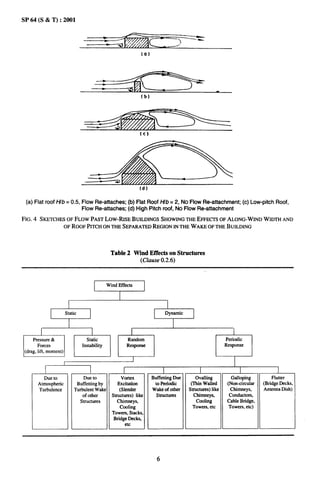
Figure 4 shows sketches of typical flow patterns
around buildings, most of which can be classed as bluff 0.3.3 Risk Level
bodies.
                                                         In the 1964 Code, no indication was available about
0.2.6 Wind Effects on Structures                         the return period. Experiences all over the world, by
Wind effects on structures can be classified as ‘Static’ and large, has favoured designing normal structures
and ‘Dynamic’. Strictly speaking, wind effects are for a life and return period of 50 years as these criteria,
only dynamic in nature but in most of the codes these seem to yield safe and economical loads for normal
dynamic effects are expressed in terms of an structures. For wind-sensitive structures and for


                                                           5
SP64(S&T):2001


                                                         (0)


                                    —*-—


                                                         (b)


                                                         (d)


 (a) Flat roof H/b = 0.5, Flow Re-attaches;         (b) Flat Roof Mb = 2, No Flow Re-attachment;        (c) Low-pitch Roof,
                          Flow Re-attaches;         (d) High Pitch roof, No Flow Re-attachment

FIG. 4 SKETCHESOF FLOW PAST LOW-RISE BUILDINGS SHOWINGTHEEFFE~S OFALONG-WIND
                                                                           WIDTHAND
              OF ROOF PITCH ON THE SEPARATEDREGIONINTHEWAKEOFTHEBUILDING


                                           Table 2 Wind Effects on Structures
                                                         (Clause 0.2.6)


                                I     WindEffects          I


                                                               1                           I        I
                                                     I
                                                     1
                                                                                                    I

         1                  !                   I                      I                                               I
                         Dueto                  vortex         Buffeting Due      Ovalling         Gatloping         Flutter


                                                                               T
        Dueto
      Atmospheric     Buffeting by            Excitation        to Periodic     (Tldn Walled     (Non-circular   (BridgeDecks,
      Turbulence     TurbulentWala             (Slender        Wakeof other    Structures)like     Chimneys,     AntennaDkh)
                        of other           Structures)like      structures       Chimneys,        Conductors,
                       structures            Chimneys,                            Cooling        CableBridge,
                                               Cooling                           Towers,etc       Towers,etc)
                                           Towers,Stacks,
                                           BridgeDecks,
                                                  etc


                                                                   6
SP 64 (S & T) :2001

structures with post-disaster functions, the return            height may not be affected significantly by the low
period is often increased to 100 years. As a matter of         value of the power index, the 1964 Code would yield
fact, for structures of exceptional importance the             pressures which are under-estimates in the upper
return period could logically be even higher to reduce         regions of tall structures where more precise values are
the risk levels still further. These issues are further        needed. The Code did not indicate variations with
discussed in 3.3.                                              terrain roughness, and was silent about wind pressures
                                                               above 150 m from ground. With tall structures already
0.3.4 Wind Velocity Measurement                                reaching heights of 300 m in the country and still taller
The wind instruments used by meteorologists are                structures on the drawing board, the short falls of
                                                               IS 875 : 1964 became particularly evident for tall
generally calibrated in terms of wind velocity at
standard atmospheric conditions of 15 ‘C and 760 mm            structures.
mercury pressure and measure the wind velocity with            0.3.6 Dynamic Analysis
an averaging time of about 3 seconds . The wind                For tall, long span and slender structures a ‘dynamic
pressure is evaluated by the equation p = K@, where            analysis’ of the structure is essential. Wind gusts
K is a constant. The Code of 1964 gives wind pressure          cause fluctuating forces on the structure which induce
and these were arrived at from the velocities by using         large dynamic motions, including oscillations. The
a value of K which is higher by 25 percent as compared         severity of the dynamic motions and/or wind-induced
to other International Codes.                                  oscillations depends on the natural frequency of
0.3.5 Wind Variation with Height and Terrain                   vibration and the damping of the structure. The
                                                               motions are induced in both ‘along-wind’ direction as
The variation of wind velocity with height and                 well as ‘across-wind’ direction. The ‘along-wind’
character     of surrounding terrain has important             response of the structure is accounted for by a
implications in structural design. The 1964 Code               magnification factor (often called the ‘gust factor’ )
specified constant pressure up to a height of 30 m and         applied to the static or direct forces. The ‘across-wind’
thereafter, a variation corresponding to the following         response requires a separate dynamic analysis. The
equation was given:                                            1964 Code did not give any guidance on these aspects
      Pz = P30 (zj30)a                            ...(4)       of structural design of tall structures.

where                                                          0.3.7 Size of Structure
 Pyj = basic wind pressure which is constant up to             The 1964 Code did not indicate any correlation
          height of 30 m;                                      between the structure size and wind loading. The
 z=       height in m above ground of point under              magnitude of the load imparted on a structure by a gust
          consideration; and                                   depends, to a significant extent, on the size of the
 a=       power index, with a value of 0.2.                    structure. The reason is that the spatial extent of a gust
                                                               of wind in any directions, having the same velocity as
Whenever such power laws are used, the generally               that specified in the Code is small-being about 25 m to
accepted norm in International Codes is to take a              150 m at any instant of time. Thus, a large structure
constant velocity up to 10 m height and thereafter a           will not experience the highest wind specified at all
variation given by the following equation to obtain the        points on it at the same instant and hence the average
velocity profile:                                              total load on the structure will be less than the value
      Vz = v~~(Z/lo)a                             ...(5)       obtained by assuming the highest specified wind over
                                                               its entire extent. Allowance for this needs to be made,
where                                                          although locally the load will be that due to the highest
 V,() = velocity at 10 m above ground;                         wind.
 z    = height in m of point above ground under
                                                               0.3.8 Shape of Structure
        consideration; and
 a=     power law index whose value varies from                Structures can be of many shapes, particularly when
        0.07 to 0.35 depending upon the terrain and            we combine the whole gamut of possibilities in
        averaging time; larger indices correspond to           concrete and structural steel. The ‘direct or static’ wind
        increasing roughness of terrain and larger             force on a structure is given by the equation F = SAP,
        averaging times.                                       where S is the shape facto~ A is the projected area in
                                                               the plane perpendicular to the wind direction; and P is
In recent times, the logarithmic law is being used more        the wind pressure. The 1964 Code gave values of the
often, mainly due to its better theoretical backing.           shape factor for the basic shapes (circular, octagon and
Considering that the power law index of IS 875:1964            square), but this information needed to be extended to
was applicable to pressures, the corresponding index           other shapes for various wind directions. For steel
for velocity would be 0.1. While structures of low             structures of different plan shapes, shielding

                                                           7
SP 64 (S & T) :2001

configurations and solidlty ratios, no guidance was            2 TERMINOLOGY
avai Iable. Therefore it became essential for the
                                                               2.1 Angle of Attack [3.1.1]
designer to either consult other International Codes or
take advice from specialists.                                  Angle between the direction of wind and the reference
                                                               axis is known as the angle of attack. As shown in
0.3.9 Pressure Coefficients                                    Fig. 5(a), angle %’ is angle of attack, between the
                                                               direction of wind and reference axis (horizontal line).
All over the world, the unsatisfactory performance of
relatively light weight low rise buildings such as the         2.2 Breadth [3.1.2]
thatched houses in rural India or houses with sheet            Horizontal dimension of the building measured normal
roofing, led to updating of pressure coefficients              to the direction of wind, is termed as the breadth of the
(internal and external) for various configurations of          structure. As shown in Fig. 5(b), breadth =AB for wind
buildings, wall openings and wind directions.                  along the longitudinal reference axis and BK for wind
Additionally, a need was felt to define higher local           perpendicular to it. For other wind directions, such as
external negative coefficients at certain locations to         at angle ’0’, it is the maximum width seen along the
cater to concentrations near edges of walls and roofs,         wind such as the projection of AB’ on a plane
where the failures are primarily initiated. It is              perpendicular to the direction of wind. In Fig. 5(b),
recognized that considerable research is still needed in       this is AE.
this area.
                                                               2.3 Depth [3.1.3]
1 SCOPE                                                        Horizontal dimension of the building measured in the
                                                               direction of wind is the depth of the building. As shown
The aim of this Handbook is to provide detailed                in Fig. 5(b), depth = AA’for wind along the reference
background information on the provisions of IS 875             axis and BA for wind perpendicular to the reference
(Part 3) : 1987 and the use of the standard for                axis. For other wind directions, such as at angle ‘f3’,it
estimating wind loads on structures. The emphasis has          is the maximum length from the first point on the body
been on the identification of source material used,            which meets the wind to the point where a line from
philosophical ideas behind the changes in 1987 edition         this point along-wind meets a boundary of the body
and guidance to the use of the standard. Clauses 0.1           such as BD.
and O.2 of this Handbook contains background
                                                               2.4 Developed Height [3.1.4]
information, philosophical ideas, nature of wind and
wind effects on structures. Clause 0.3 brings out the          The velocity increases up to certain height from the
shortfalls of the earlier standard (IS 875: 1964),             ground when wind passes from one terrain category
vis-a-vis wind zoning, risk level, wind velocity and its       to another terrain category. After covering a certain
variation with height, dynamic analysis, effect of             distance in the new terrain, the velocity profile does
structure size and shape. Clause 2 explains the various        not change any more and is said to be fully developed.
terminology used in the standard. Clause 3 discusses           Before becoming fully developed, the velocity profile
the main features of the revised Code like new wind            will have a mixed character of the fully developed
zoning map, estimation of design wind speed, concept           profiles of the upstream and downstream terrains. In
of return period, effects of terrain roughness and             this intermediate region, the height up to which the
structure     size, local topography,          correct         velocity profile changes in the new terrain is known as
velocity-pressure relationship. In Clause 4 wind               the Developed Height. [Table 3] gives the vahtes of the
pressure and forces on buildings/structures          are       Developed Height as a function of the distance for the
discussed in light of pressure coefficient method.             four terrain categories. Methodology for estimation of
Details of force coefficient method are given in 4.3           the developed height and for using the same has been
while dynamic effects like along-wind               and        illustrated in the solved Examples given in 3.5.
across-wind responses are explained in 5 and 6.                2.5 Effective Frontal Area [3.1.5]
Requirements of wind tunnel studies are detailed in 7.
Clause 8 conducts the user to the various provisions of        As given in Fig. 5(a) for angle of attack ’6’ = O,
the standard with the help of flow diagrams. Clause 9          effective frontal area is ABCD, which is the projected
contains the methodology for the estimation of wind            area of the structure normal to the direction of the
loads on low rise buildings, with the help of examples.        wind. For ‘til’not equal to zero, the frontal area is
                                                               ACEF.
Clause 9.3 is devoted to the estimation of dynamic
effects of wind using gust factor method and contains          2.6 Element Surface Area [3.1.6]
typical solved examples of structures.                         In Fig. 5(a), for angle of attack ‘f3’= Oat height z, area
    NOTE—AllClauses,FiguresandTablesin SquareBracketsin        PQRS represents the element surface area of height
   the HandbookRefer to Clause Numbers,FigureNumbersand        Az. In the element surface area pressure/force
   TableNumbersof IS 875(Part3): 1987,respectively             coefficients are to be taken constant.

                                                           8
SP 64 (S & T) :2001

2.7 Force and Moment Coefficients [3.1.7]                       2.9 Gradient Height [3.1.9]
When a structure is immersed in flowing fluid like air,         When wind moves over large distances in a particular
a force is exerted on it which depends on the nature of         terrain, the velocity becomes constant above a certain
flow, type of structure and is expressed in terms of            height. The height above which the velocity is found
non-dimensional coefficient. This non-dimensional               to be constant and is not influenced by surface friction
coefficient is termed as force-coefficient.                     is called the Gradient Height. Implicitly, the Code
There can be components of force in the directions              identifies the gradient height as the height of the
other than the direction of wind. The force component           planetary boundary Iayev the wording of the definition
along the direction of wind is called drag force (now-          is obviously very carefully done, since the
a-days, more frequently as along-wind force) and the            meteorologists’ identify the gradient height as one at
force components in the other normal directions are             which there is a balance of Coriolis and pressure
termed as lift force (or across-wind force) and side            forces. The meteorologists’ definition of gradient
force (or transverse force). Likewise, the moment               height puts it well above the edge of the atmospheric
coefficient tending to bend the structure in the direc-         boundary layer. Thus the definition of gradient height
tion of wind is called the over turning moment, the             used in the Code is not the same as the gradient height
coefficient tending to twist it about a vertical axis as        as understood by the meteorologists.
torque and the coefficient in the transverse direction as       2.10 Pressure Coefficient [3.1.9]
‘sideways’ moment coefficient.
2.8 Ground Roughness [3.1.8]                                    The pressure exerted by wind at a point on the structure
                                                                wil I be different from the pressure of wind far
The obstructions like trees, buildings, structures, etc,        upstream of the structure, called ‘free stream static
on ground are termed as ground roughness. The ground            pressure’. The ratio of the difference of the pressure
roughness tends to retard the flow near ground because          at a point on the structure and static p~ssum of the
of momentum transfer between layers of wind. The                incident wind to the design wind pressure is termed as
velocity profile of wind is dependent on the ground             Pressure Coefficient.
roughness. Although the nature of ground roughness
on the surface of the earth varies from flat and very           The concept of pressure coefficient is similar to that of
smooth to very rough as in the city centres with tall           force coefficient. The pressure coefficient at a point
buildings, it has been found convenient and adequate            multiplied by design wind pressure yields the pressure
to categorize them into four fairly distinct categories.        at that point.
                                                                               J

                                              /’7


                                                #


                        e  e“

                      WIND DIRECWM
                             (e)
                                     AXIS
                                            RENCE


                                                                            (b)
                         VJINDIN PLAN                                  BUILDINGPLAN
                                       FIG. 5 WIND EFFECTSON A BUILDING


                                                            9
SP 64 (S & T) :2001

The pressure coefficient may vary with height or           2.12 Solidity Ratio ‘$’ [3.1.9]
width. The pressure acting towards the surface of          In general, solidity ratio is the ratio of the sum of all
structure is to be taken as positive and pressure acting   the areas’ of each element of a framed structure
away from the surface of structure is to be taken as       normal to the wind to the area of the boundary
negative.                                                  enclosing the structure. Care must, however, be taken
2.11 Suction [3.1.9]                                       in applying “this definition. In a plane frame, the
                                                           boundary area is to be taken as that of the main frame
Atsomepoints on anybody, pressure may fall below           only and the areas of appurtenances which are within
atmospheric pressure and is called ‘suction’. Suction      the boundary [as AntennaAl, or ladderLl, in Fig. 6(a)]
is the pressure acting away from the surface of            treated as part of the element of the frame. However,
structure; negative pressure is the same as suction        the area of the antenna or an appurtenance outside the
pressure.                                                  boundary such as the AntennaA2 or lightening arrester


                                                 6(a) Plane Frame


                                        0’                 c’


                                                                             (ii)
                                  (i)
                                                 6(b) Space Frame
                                 FIG.6 SOLmITY
                                             RATIO PLANE SPACE
                                                 —     AND   FRAME

                                                           10
SP 64 (S & T) :2001

L~ in Fig. 6(a) should not be taken into account either      Terrain category 1 (TC- 1) applies to exposed open
as part of the enclosed boundary or that of the frame        terrain with few or no obstructions and in which the
in computing the solidity ratio. The loads on such           average height of objects surroundings the structure is
appurtenances outside the enclosed boundary must be          less than 1.5 m. Category 2 (TC-2) refers to open
separately estimated and added to the load on the frame      terrain with well scattered obstructions having heights
at the appropriate point. In Fig. 6(a), the area enclosed    generally between 1.5 to 10 m while Category 3 (TC-3)
by ABCD k the boundary area and the area of shaded           applies to terrain with numerous closely spaced
elements to be considered for estimating the solidity        obstructions having size of buildings/structures up to
ratio is indicated. Similar principles apply in the case     10 m in height with or without a few isolated tall
of space frames. In case of cross bracings, the              structures. Terrain Category 4 (TC-4) means terrain
projected area as seen from windward face shall be           with numerous large high closely spaced obstructions.
taken and added to other areas (shown shaded) to             However, when fetch lengths are small, the velocity
arrive at the total solidity ratio. If there are             profile is not fully developed and suitable velocity
appurtenances within the enclosed volume (ABCD               profile with changes in terrain categories be
 A’B’C’D’) [see Fig. 6(b)(i)], then their area should be     considered [5.3.2.4].
projected on the nearest windward frame for
estimating the frame solidity ratio Fig. 6(b)(ii). The       2.15 Velocity profile [3.1.9]
solidity ratio of each frame should be found and             The variation of wind speed with height is called the
appropriate shielding factor applied.                        Velocity Profile. The velocity profile is dependent on
2.13 Fetch Length [3.1.9]                                    the terrain category, zonal velocity and the fetch
                                                             length. Figure 8 shows the velocity profile in the four
The distance over which wind has moved in a                  terrain categories.
particular terrain category before approaching the
                                                             2.16 Topography [3.1.9]
structure is known as the Fetch Length. The velocity
profile of wind changes continuously over the fetch          Geographical       features such as mountains, hills,
length before stabilizing at the variation given in          escarpments,       etc, of an area is known as the
[Table 2]. The distance required for a stab]: profile to     Topography of      the area in which the structure is built
be formed is given in [Table 3]. Distance AB in Fig. 7       and this affects   the wind speed on and downstream of
is the fetch length.                                         these features.
2.14 Terrain Category [3.1.9]                                3 WIND SPEED AND PRESSURE [5]
Buildings, vegetation, walls, trees and waves at sea         3.1 Basic Wind Speed [5.2]
contribute to the surface roughness and thus influence
the local characteristics to which a structtue may be        In 1960, there existed about 10-12 continuously
exposed. The average ground roughness of large areas         recording DPA stations in the country compared to
is termed as Terrain Category. Based on the average          about 50 or so such stations at present. The instruments
height of the ground roughness four representative           continuously record wind speed on Y-axis with time
terrain categories having fully developed velocity           on X-axis and in addition, record the direction of wind
profiles are suggested [5.3.2] from the equivalent of a      speed. Most of these stations are located on the coastal
calm sea to inner city area dominated by tall buildings.     belt.


                                                                 H
                                                                                   MODIFIEO VELOCITY
                                                                                   PROFILE DUE TO
                                                                                   CHANGE OF
                                                                                   ROUGHNESS


                         H
                                                                                  h:
                                                                                        MEAN GROUND
                                                                                           LEvEL

                 APPROACHING VELOCITY
                       PROFILE
                                             ‘I?==4’(b,
                         (a)


                               FIG. 7 EFFECTOFCHANGE INTERRAIN
                                                             CATEGORIES


                                                            11
SP 64 (S & T) :2001

The revised wind map is based mainly on the data from        Cyclonic Storms — Cyclonic storms on east and west
the anemograph records of 47 DPA stations for periods        coasts are more intense over the sea than on the land.
from 1948 to 1983. All these wind data have been             West coast storms are less intense except in Northern
published in India Meteorological Department publi-          Sourashtra compared to east coast storms. Reports of
cations, ‘Indian Weather Review, Annual Summary              failures of structures at Sriharikota, Gujarat coast,
Part-A’ published annually from 1948 onwards. The            Paradeep and other places have been taken into ac-
basic approach followed for preparing the wind map           count for evolving the reference speed in these regions.
is by extracting wind velocities, since analysis of stmc-    Storm speeds begin to decrease once they cross the
tures in many cases depends on wind speed directly           coast and are normally taken to be effective up to a
and also much of the available data on effects of terrain    distance of about 60 km inland after striking the coast.
is in terms of wind speed. The use of wind speeds for        However, in Bengal coast its effect has been observed
statistical analysis is also in line with the internatio-    up to 110 km inland. A region along the sea coast
nallyaccepted practice. The peak values of annual            extending up to a distance of 60 km (and 110 km along
maximum wind speeds (wind gustiness) for each of the         Bengal coast) from the nearest coast line has been
47 stations formed the data for statistical analysis to      identified separately from the main land for wind
obtain the extreme wind speeds. In the statistical           zoning. In addition, it has also been decided to give the
analysis of all the annual peaks at each of the above 47     number of cyclones that have struck different sections
stations in India, IMD used Fisher-Tippet Type-I             of east and west coasts in the basic wind map for more
(Gumbal) distribution. Before analyzing, recorded            sophisticated design load estimation.
values were reduced to values at 10 m height above
ground for the normalized terrain Category 2. Since              Dust Storms — Dust storms associated with high local
the data for analyses came from DPA which has an             wind speeds which are short lived and are particularly
averaging time of about 3 seconds, analysis gives gust       intense over Rajasthan plains have been considered.
velocity values averaged over 3 seconds. These values        Also Norwesters or Kal Baisaki winds over North
for 50 year return period and 50 year structure life have    Eastern plains during summer months have been ac-
been given in [Fig. 1] for terrain Category 2. In addi-      counted for. It has been suggested that the influence of
tion to the use of data available from 47 DPA stations       wind speed off the coast up to a distance of about
up to 1983, the following effects have been suitably         200 km maybe taken as 1.15 times the value on the
incorporated in the preparation of the basic wind            nearest coast in the absence of definite wind data [5.5]
velocity map:                                                as in Australia. The occurrence of a tornado is possible
                                                             in virtually any part of India. They are particularly
Orography — Orography has been considered in the             more severe in Northern parts of India. The recorded
zoning of wind velocity map since it was observed that       number of these tornadoes is too small to assign any
continuous hills and mountains spread over a large           frequency. The devastation caused by a tornado is due
area affect wind speed, for example regions demar-           to exceptionally high winds about its periphery and the
cated by Vindhya mountains. The data spread seems            sudden reduction in atmospheric pressure at its centre
to match the orography of the country.                       resulting in a huge outward pressure on the elements
                                                             of the structure. The regional basic wind speeds do not
Palghat Gap — Extreme winds observed during mon-             include any allowance for tornadoes directly. It is not
soon season over the southern peninsula due to the           the usual practice to allow for the effect of tornadoes
funneling effect of Palghat gap (reported wind speeds        unless special requirements are called for as in the case
being up to 160 km/h) has been considered.                   of important structures such as satellite communica-

                     500
                           t               I                      ++%%


                               OPENSEA       OPENTERRAIN FOREST
                                                              StJWRRS CITY CENTFES

                      FIG. 8 VELOCITY
                                    PROFILE
                                          OVERDIFFERENTTERRAINCATEGORIES


                                                            12
SP64(S&T)       :2001

tion towers. The wind speed can now be obtained up           level’, on the other hand means the probability that a
to 500 m height above the ground surface. Design wind        given wind speed will be exceeded in a certain number
speed up to 10 m height from mean ground level is            of successive years which is usually the life of the
taken to be constant. Although not stated in the Code,       structure. The coefficient kl is identified in the Code
turbulence level above 500 m is unlikely to be more          for return periods of 5,25,50 and 100 years alongwith
than 6 percent. Basic wind speed map of India has been       recommendations regarding ‘mean probable design
presented in the Code. The reference wind speed all          life of structures’ of various types [Table 1]. For
over the country has been found to fall into six ranges      general buildings and structures of permanent nature,
of basic wind speeds, varying from 33 m/s to 55 nds          the return periods have been recommended to be 50
for a 50 year return period and a probability of ex-         years and a life of 50 years for the structure. For all
ceedence level of 63 percent. The indicated wind speed       temporary structures including temporary boundary
characteristics are in line with other International         walls, it is recommended that a life of 5 years be
Codes, namely short duration gusts averaged over a           assumed and the appropriate multiplier kl as given in
time interval of about 3 seconds applicable to 10 m          [Table 1] be used. The normal value of risk level
height in ‘open’ terrain. The Code recognizes that           recommended is 0.63 for structures whose life
there is not enough meteorological data to draw              expectancy is equal to the return period. The factor kl
isotachs (lines joining places of equal velocity) on the     has been used to assess the effect of different risk
wind map of India as seems to be the practice in some        levels.
other International Codes.
                                                             At first sight, a risk level of 0.63, which is the prob-
The revised map, when compared to that of the earlier        ability that the design wind speed is exceeded once in
Code shows that in general, in the following areas of        the life of say N years of the structure under the
the country, the wind velocity was previously under-         condition that the probability of the exceedence of the
estimated:                                                   design wind in any one year is l/N, seems rather high.
   — Nollh : North-eastern part of Jammu and                 However experience in many parts of the world has
     Kashmir                                                 shown that this amount of risk can be taken for normal
   — West: Coastal areas of Kutch in Gujarat                 structures. Although not given in the Code, the risk
   — East: Tripura and Mizoram                               level can be found from the formula

The wind map indicates updated supplementary infor-                  r=l–(1–l/T)~                                  ...(7)
mation (1877 to 1982) relating to the total number of
                                                                 where
cyclonic storms. Occasionally, a user comes across a
                                                                  N = desired life of the structure in years,
situation where the wind speed at a location on the
                                                                  T = return period in years, and
boundary between two zones has to be obtained. If
                                                                  r    = risk level.
local wind data is not available, it is recommended that
the higher speed of the adjacent zones be used for           The designer or owner must decide the amount of risk,
design.                                                      he is prepared to take. Let us take one example.
3.2 Design Wind Speed [5.3]                                  Example. Only 10% risk acceptable,           life 30
The design wind speed is dependent on the                    years,   in zone    with wind speed of 39 rids,
geographical basic wind speed, return period, height         Categoq 2, size of structure 30 m. To find the design
above ground, structure size and local topography. The       wind speed.
format of the equation of design wind speed adopted              From Eqn (7), we get
in the new Code is as follows:
                                                                  UT = 1-( l-r)l’N
       Vz = Vb k, kz k~                            ...(6)             = 3.5x 10⁻³
where                                                        That is, this is the acceptable probability that the
  V.    = design wind speed at height z in mls,              regional wind speed of 39 rmlswill be exceeded in any
  Vh = basic wind speed of the wind zone,                    one year during the 30 year life of the structure for the
 k,  = risk coefficient,                                     accepted risk. Using the above values of risk level, life
 kz  = terrain, height and structure size factor, and        of structure and the quantities A and B corresponding
 k~  = local topography factor.                              to 39 m/s wind speed in [Table 1], one obtains
3.3 Risk Coefficient [5.3.1]                                 kl = 1.165.
There is sometimes confusion as to the meaning of                Hence, the regional basic wind speed to be used for
return period and risk level. Return period (Tin years)          this structure should be 1.165 x 39 = 45.44 rids. Use
is the reciprocal of the probability that a given wind           of Eqn. (7) is necessary if the return period T only is
speed will be exceeded at least once in any one year.            known from analysis of wind data and risk level has to
The word, ‘period’ sometimes causes confusion. ‘Risk             be assessed.

                                                            13
SP 64 (S & T) :2001

3.4 Terrain, Height and Structure Size (kz factor)           to a height of 35 m at a distance of 0.5 km from B2.
[5.3.2]                                                      Hence one takes the multiplier of TC-3 [Class C of
The coefficient k2 has been indicated at different           Table 2] up to a height of 35 m (by interpolation).
heights in a convenient tabular form [Table 2] which         Above this height, the multipliers of TC-1 are to be
identifies four terrain categories (1, 2,3 or 4) and three   used. At a height of 35 m, the multiplier corresponding
classes (that is, sizes) of structures (A, B or C). The k2   to TC-3 is to be used when computing the design load
factors are valid only up to the height at which they are    on the tower, although the multipliers of both TC- 1 and
specified. For example, the factor 1.17 in TC-2, class       TC-3 are shown at this height in this sketch. The final
A structure applies only up to 50 m height. As stated        design multipliers are shown in Table 3.
in [Note 2 of Table 2], values between 1.12 and 1.17
                                                             Table 3 Multipliers for a Structure in TC-3 with
may be linearly interpolated between heights of 40 m
                                                                             Upstream TC-1
and 50 m or a constant value of 1.17 (the higher one)
                                                                               @ample 1)
may be used between 40 m and 50 m. The coefficient
k2 has different values [Table 33] when dealing with
wind speeds averaged over 1 hour, which are required          Height (m)     Multipliers as per     Multipliers as per
                                                                              [5.3.2.4(b)(i)]        [AppendixB]
for evaluating dynamic effects according to certain
                                                                  10               0.99                    0.82
theories.
                                                                  15                1.03                   0.87
3.5 Fetch and Developed Height Relationship
                                                                  20                1.06                   0.91
[5.3.2.4]
                                                                  30                1.09                   0.96
The revised Code had added the concept of fetch
                                                                  35                1.10                   1.04
length and developed height for considering the effect
of change of terrain category. In the following                   50                1.14                   1.14
examples the methodology for considering this effect              55                1.15                   1.15
is explained with the help of illustrations.
                                                                NOTE- It is observedthat the applicationof [5.3.2.4(b)(i)]
Example 1. A framed tower structure inside a big                leadsto higheror conservativeload.
town at a distance of 0.5 km from the edge of the town;
the terrain outside the town isJat open, the structures      Example 2. A chimney of height 150 m in open
inside the town are closely spaced and of heights up to      country at a distance of 10 km from clusters of scat-
10 m. Height of the tower 55 m. Tofind the design wind       teredsmall villages all round with houses of height less
speeds.                                                      than 10 m. Tofind the wind speed multiplier profile.

Solution: Here, one can take the terrain outside the         Solution: Since the terrain up to a distance of 10.0 km
town as of category 1 (TC- 1) and the terrain inside the     from the chimney is open, one may assume that the
town to be of category 3 (TC-3). This problem is a case      terrain is of category 1 up to 10 km from the chimney.
of wind moving from a lower terrain catego~ to a             In view of the location of clusters of small villages
higher terrain category. Figure 9 gives a sketch of the      beyond 10 km, one can consider the approaching
configuration.                                               profile to chimney to be TC-2 from beyond 10.0 km
                                                             and TC- 1 for a distance of 10 km from the chimney.
In the above sketch,AA is the edge of TC-1profile (say,
                                                             Figure 10 gives the sketch of the configuration. It may
where the factor as per [Table 2] is 1.35), B1B2is the
                                                             be observed that in this problem, the wind flows from
approach terrain of TC- 1 and B2B3is the town centre
                                                             a higher terrain category to a lower terrain category. In
terrain of TC-3 [5.3.2.1(c)]. The tower is located at C,
                                                             Fig. 10,AA is the edge of the TC-2 profile (say the line
a distance of 0.5 km from the beginning of the town at
                                                             of multiplier 1.35), B1B2is the approach terrain TC-2
B2. In order to apply [5.3.2.3], one proceeds as follows:
                                                             and B2B3 the TC- 1 in which the chimney is located.
At C draw the profile of multipliers as per [Table 2,        The chimney is located at C, which is located at a
Class C] (since the height of the structure is more than     distance of 10 km from the beginning of TC- 1, namely
50 m), corresponding to both the terrain categories 1        B2. To obtain the appropriate multipliers, one can
and 3. Thus CDH corresponds to TC- 1 and CEFG to             proceed as follows:
TC-3. [5.3.2.4] allows one to use two options. As per
[5.3.2.4 (b) (i)], one can use the multipliers of the             i) Assume that TC- 1multiplier applies for the
lowest terrain category, which in this case is TC-1, that            entire height, as per [5.3.2.4 (b) (i)]
is, CDHG. The second possibility is to use the proce-            ii) Use the procedure of [Appendix B] as follows
dure of [Appendix B]. To use the procedure of                To use the procedure of [Appendix B], draw the varia-
[Appendix B], one first notes the height up to which         tion of the multipliers of TC-2 and TC-1 at C with
the TC-3 profile has penetrated in the vertical direction    height. These are mpectively CEFG and CDH. From
in the terrain in which the structure is located. In this    ~able 31of the Code,it is observed that the profile of
case, [Table 3] indicates that TC-3 has penetrated up        TC-1 penetrates up to a height of 80 m, in a distance
SP64(S&T):2001

of 10 km. Thus one takes the TC- 1 multipliers of Class          Table 4 Multipliers for a Structure in TC-1 with
C (since the maximum chimney dimension exceeds 50                                Upstream TC-2
m) up to a height of 80 m. This multiplier has an                                       (Example 2)
interpolated value of 1.17 at a height of 80 m. Above
this height, one has to take the multipliers as per TC-2,        Height (m)       Multipliersas per       Mukiptieras per
Class C. But the multiplier as per TC-2, Class C has a                             [5.3.2.4(b) (i)]        [AppendixB]
value of 1.17 only at a height of 100 m as per [Table                10                 0.99                     0.99
2]. The recommendation of [Appendix B] is to take the                15                 1.03                     1.03
same value of the multiplier as per the terrain of                                                               1.06
                                                                     20                 1.06
location (that is TC-1) up to the height of the upstream
                                                                     30                 1.09                     1.09
higher terrain category at which the same multiplier is
found as per [Table 2] of the Code. In this case, the        I       50       I         1.14          I          1.14       I
recommendation implies that the multiplier 1.17 at 80        I       80       I         1,17          I          1.17       I
m height of TC- 1 must be continued up to a height of               100                 1.20                     1.17
 100 m, above which only the TC-2 multipliers of Class              150                 1.24                     1.21
C are to be used. Table 4 gives the final recommended
multipliers.                                                       NOTE Asobservedearlier[5.3.2.4(b)(i)]giveshigherloads
                                                                           —
                                                                   but is simplerto apply.


       A—         .           .—               .
                                                                                        -+-—–A

                      —.


                                                       v


                                                   +


                                           /


                                       /
                                   +


      TC1
                                                                                                            B3


                                               —.—     Tc   .1

                                               ~       TC-3
                                               —       DESIGN PROFILE
            FIG.9 DETERMINATION
                              OFVELOCITYPROFILE
                                              NEARA CHANGE
                                                         INTERRAINCATEGORY
                                (LESSROUGHTOMOREROUGH)

                                                            15
SP64(S&T)       :2001

                      A             .—        .          .—          .—       -—.                 .—    A


                           —..

                                                                          tii’7,xiii#
                                                                               /
                                         ..                                 /’
                                   ./
                    TC2                       Tcl
               BI            IB2                               Ic                                  83


                                                  ~—          TC-1 PROPILE
                                                  --—-        TC-2 PROPILE
                                                              DEStGNPWFtLE


            FIG. 10 DETERMINATION
                                OFVELOCITY
                                         PROFILE
                                               NEARCHANGE
                                                        INTERRAINCATEGORY
                                 (MOREROUGHTOLESSROUGH)

Example 3. A TV tower of height 300 m located in the                 b) B1B2 is the approach terrain TC-2, B2B3is the
 centre of a city with tall buildings (greater than 50 m                first intermediate terrain TC- 1, B3B4 is the
 in height) up to a height of 3 km from it, closely built               second intermediate terrain TC-3 and B4B5is
 houses of up to 10 m height from 3 km to 10 km and                     the final terrain TC-4 in which the TV tower is
jlat terrain beyond for 15 km at which sea coast is                     located.
 encountered. Wind is from the sea. To find the wind                 c) From Vable 3], it may be easily determined
 speed multipliers.                                                     that the edge of the TC- 1 profile starting at B2
                                                                        meets the TV tower at “Clat a height of 100 m,
Solution: This k a problem in which wind passes                         the edge of TC-3 profile starting at B3meets the
through four terrains before reaching the structure of                  TV tower C2at a height of 250 m and the edge
interest. At high winds, the sea can be taken as                        of the TC-4 profile starting at B4meets the TV
equivalent to TC-2 due to the large waves that are                      tower at C3 at a height of 220 m and the edge
generated. In this problem, TC-2 is followed by TC-1                    of the upstream TC-2 profile is at a height of
for 15 km and this is followed bf TC-3 for 10 km with                   490 m,
a final terrain category 4 for 3 km. The configuration               d) All the four category profiles (of class C since
is sketched in Fig. 11 where the multiplier profiles of                 the maximum dimension of the structure is
TC- 1 to TC-4 are shown at the location of the TV                       more than 50 m) have been drawn with origin
tower. As before, one can choose the simpler method                     at C, the base of the TV tower.
of [5.3.2.4 (b) (i)] and use the multipliers of TC- 1 for            e) Proceeding as before, one finds that TC-4
the entire height. To use the alternate method given in                 swamps TC-1 and is effective up to a height of
 [Appendix B], one draws first the developing profiles                  220 m, from C to D. At D, one”encounters TC-3
from the beginning of each terrain [Table 3].                           beginning at 1$ up to a height of 250 m. Thus
     a) AA is the edge of TC-2 (say the line of multi-                  the profile shifts from D to Eon TC-3 profile
        plier 1.35).                                                    at a height of 220 m and moves along the TC-3
                                                                        profile from E to F, which is at a height of


                                                              16
sP64(s&T):2001

  A—     Jui?-             — .——         ——                   —    .—          ——           —_      _                                   -A
                                                                                                                                  H


                                                                                                                                   IT


       TC-2                   lc-t
                              Skm             1   b3                7 km              B,~    3km     “
                 ,                            7                                        1


                     —         DESIGN   PROFILE               ‘A—           TC-1 PRCFHE          —x—     TC-3 PROFILE
                                                              —o—           TC-2 PROFILE
                                                                      Tc-b PROFILE               ----—
                         FIG. 11 DETERMINATION
                                             OFDESIGNPROFILEINVOLVING ORETHANONE
                                                                    M
                                          CHANGEINTERRAINCATEGORY
         250 m. Above F, the unpenetrated profile is the                           3.7 Design Whd Pressure [5.4]
         far upstream TC-2 profile and this applies for
         the rest of the height of the TV tower. Table 5                           One of the important modifications in the Code relates
         gives the final multipliers.                                              to the veloeity-pressure relationship. In the earlier
                                                                                   version of the Code, the pressure was over-estimated
 Table 5 Multipliers for a Structure in TC-4 with                                  by about 25 percent for a given wind velocity. The
         Upstream TC-3, TC-1 and TC-2                                              correct equation given now reads as follows:
                            (Example 3)                                                pz = 0.6 VZ2                                   ...(8)
                                                                                   where
   Height (m)            Multipliers as per            Multipliers as per
                          [5.3.2.4(b)(i)]               [AppendixB]                 Pz = design wind pressure at height z in N/m2, and
                                                                                    VZ = design wind speed at height z in mh.
 10                            0.99                    0.67
 15                            1.03                    0.67                        Strictly speaking, the coefficient 0.6 is only the most
 20                            1.06                    0.83                        probable average for the atmospheric conditions
 30                            1.09                    0.83                        prevailing in India during the whole year. A value of
 50                            1.14                    1.05                        0.6125 would be more appropriate in temperate zones
                                                                                   above latitude of about 33°. The wind effects in terms
 100                           1.20                    1.10
                                                                                   of static loading on the structure are determined from
 150                           1.24                    1.10                        design pressures as indicated in 4. A comparison of
 200                           1.26                    1.13                        wind pressures as per new and 1964 Code is given in
 220(intetpulated)             1.27                    1.19 (TC-3 vatue)           the following example.
 250                           1.28                    1.26 (lW2   value)
                                                                                   Example. Estimation      of design wind pressure for a
 300                           1.30                    1.31(TC-2value)
                                                                                   building as per 1S 875:1964 and IS 875 (Part 3): 1987.

3.6 Topography (kJ [5.3.3]                                                            Given:
The coefficient k~ allows for undulations in the local                                A buildingof length35.0q width 15.0m, height15.0m
terrain in the form of hills, valleys, cliffs, escarpments                            Life of structure 25 years
and caters to both upwind and downwind                                                Termin category 3
slopes. Methods for evaluation of k3 are given in                                     Location: Delhi
[Appendix C] of the Code.

                                                                              17
SP 64 (S & T) :2001

   Topography: Almost flat                                                  Table 6 Design Wind Pressure
                                                                                        (Example     )
Solution:
                                                                Location
Previous code [1S875: 1964], [Fig. 1A] gives pz=150                           (Yeara)
kgf/m2.                                                                        “e           “’rain   m
                                                                                                         1987        1964
Present code [1S 875 (Part 3) : 1987] :
                                                                                25      I
                                                                                               3     I    831.37I
Design wind speed VZ = Vb.kl.kz.ks                              Delhi                                                1470.00
                                                                                50             3         1026.39
 Vb = 47.0 m/s [Fig. 1]                                                         50             2         1271.91
                                                                Calcutta        25             3          940.89     1962.00
kl = 0.90 [Table 1, N = 25 years]
                                                                Roorkee         25             2          741.84     1471.50
Since greatest horizontal dimension of 35 m is between                          25             3          744.91
20 m and 50 m                                                   Bombay                                                981.00
                                                                                50             2         1115.60
k2 = 0.88 [Table 2, Class B] at 10.0 m height                   Madraa          25             3          940.89     1962.00
k~ = 1.00                                                       Bangalore       25             3          447.09      981.00
                                                                Darbhanga       25             2         1380.73     1471.50
Hence Vlo = 47.0 x 0.90x 0.88x 1.0= 37.22 nds
                                                                  — The building/structure taken as a whole;
Design pressure at 10 m height        = 0.6 V;
                                                                  — Individual structural elements such as roofs
                                     = 831.37 N/m2                  and walls; and
                                     = 84.83 kgf/m2
                  (g= 9.80 m/s2 in most parts of India)           — Individual cladding units such as sheeting and
                                                                    glazing including their fixtures.
Let the life of the structure be increased to 50 years
                                                  The wind loading is given in terms of pressure coeffi-
[kl=l .0, Table 1], then
                                                  cients CP and force coefficients Cf and can be deter-
plo = 0.6 [47.0x 1.0x 0.88x 1.0]2 = 1026.39 N/m2  mined as follows:
                                  = 104.73 kgf/m2      F= CfAep~                              ...(9) [6.3]
If the structure is located in a terrain category 2,                F= (Cw _ Cpi) A Pd                         ...(10) [6.2.1]

  then the value of k2 = 0.98 and                             where
                     Pll) = 0.6 [(47.0)(1.00)(0.98)(1.00)]2            F=     wind load;
                          = 1272.91 N/m2= 129.89 kgf/m2
                                                                      Cf = force coefficient;
  Let us now consider a situation where the same struc-               A. = effective frontal area obstructing wind,
  ture is situated at Madras, Calcutta, Roorkee, Bombay,                      which is identified for each structure;
  Bangalore and Darbhanga. The design wind pressure
                                                                      pd = design wind pressure;
  will be as given in Table 6, for different possible terrain
  conditions. From Table 6, it is observed that the design      Cpe* Cpi = external and internal pressure coeffi-
  wind pressure is strongly affected by the consideration                     cients; and
  of the expected life of the structure and terrain                   A=      surface area of structural elements.
  category. It is observed that the earlier Code generally
  over estimated the wind load in city centres. One can 4.2 Pressure Coeftlcients [6.2]
  also work out that the earlier Code generally underes-
, timated the design wind load, if either the expected life Pressure coefficients are applicable to structural
  or ‘return period’ is large (for example, seethe case for elements like walls and roofs as well as to the design
  Bombay in Table 6). This is particularly true for of cladding. The calculation process implies the
  regions where the design pressures, according to the algebraic addition of Cw and C~i to obtain the final
  1964 Code are low.                                          wind loading by the use of Eqn. (10). The Code
                                                              indicates both these coefficients separately for a wide
  4 WIND PRESSURE AND FORCES ON                               variety of situations generally encountered in practice.
  BUILDINGS/STRUCTURES [6]
                                                              4.2.1 External Pressure Coefficient CF [6.2.21
  4.1 General
                                                               External pressure coefficient depends on wind direc-
The Code stipulates requirements for calculation of
                                                               tion, structure configuration in plan, its height versus
wind loading from three different points of viewf

                                                          18
sP64(s&T):2001

width ratio and, characteristics of roof and its shape.       4.2.2.1 Internal pressures [6.2.3]
[Tables 4 to 22] are devoted exclusively to the deter-
                                                              The internal pressures given in [6.2.3] have been
mination of CPVFor the specific design considerations
                                                              deliberately specified slightly higher (negatively) than
relating to cladding, local coefficients have been
                                                              the codes of temperate countries to reflect the fact that
separately shown delineating the areas at the edges of
                                                              as a tropical country, the size of windows/doors are
walls and roofs where high concentration of negative
                                                              larger in India and the normal tendency is to keep them
pressure is often found to exist.
                                                              open as much as possible.
4.2.1.1 External pressures
                                                              4.3 Force Coefficients [6.3]
It deals with a large number of cases of gross force
                                                              Force coefficients applicable to the buildinghmcture
coefficients and pressures. Should pmssums in
                                                              as a whole as well as to structural frameworks which
[Table 4] be applied at each level in the case of a tall
                                                              are temporarily or permanently unclad are also given
building, with velocity variation as in [Table 2]. The
                                                              in [6]. For evaluating force coeftlcients for the clad
answer, is that the Code implies that the calculation
                                                              buildinghtmcture as a whole, the Code gives guidance
should be carried out for each level as if the air load at
                                                              for a variety of plan shapes and height to breadth ratios
that level is independent of that at an adjacent (or lower
                                                              [Table 23]. It also indicates extra forces occurring due
or higher) level. It is puzzling to note a positive pres-
                                                              to ‘frictional drag’ on the walls and roofs of clad
sure coefficient of 1.25 in [6.2.2.T, when one knows
                                                              buildings [6.3.1]. The diameter D to be considered for
that it cannot exceed +1 .0. The reason is that since the
                                                              rough surface when applying [6S.2.2] is the value
pressure coefficients on the small overhanging posi-
                                                              excluding the height of the roughness, that is excluding
tions are not given but are known to be more strongly
                                                              the height of flutings or similar ‘regular’ roughnesses
negative on top than the negative pressures on the non-
                                                              or excluding average height of random roughness like
overhanging portions, these numbers are expected to
                                                              sand particles. This definition of D is valid only if
compensate for the projected lower pressures on the
                                                              D/E >100 (where Eis the average height of the surface
top of overhanging portion. Although not stated in the
                                                              roughness). For still larger roughnesses, specialists
Code, it is desirable to take the same values in [6.2.2.T
                                                              advice should be sought.
on the vertical walls above and below the overhanging
portion, over a height equal to half the projecting           Force coefficients on unclad buildingshtructures,
length of the overhang; if no other guideline is avail-       frameworks and their individual members, are com-
able.                                                         prehensively covered in [6.3.3.3 to 6.3.3.6]. The
                                                              frameworks included are those that are single (that is
4.2.2 Internal Pressure Coefficient CPi[6.2.3]
                                                              isolated), multiple or in the form of lattice towers. The
Internal pressure coefficients are largely dependent on       effects of ‘shielding’ in parallel multiple frames and
the percentage of openings in the walls and their             the effect of different solidity ratios have been incor-
location with reference to wind direction. The Code           porated along with global force coefficients for lattice
indicates C~i for a range of values with a possible           towers Uables 28 to 32]. Force coetllcients for in-
maximum (that is positive pressure) and a possible            dividual members of various structural shapes and
minimum (that is negative pressure) with the provision        wires/cables have been separately indicated [Tables 26
that both the extreme values would have to be                 and 27].
examined to evaluate critical loading on the concerned        4.3.1 Individual Members [633.2]
member. Three cases have been specifically indicated
for arriving at C~i:                                          The force coefficient of rectangular members given in
                                                              [Fig. 4] reflect the recent discovery that the aspect ratio
   —    openings up to 5 percent of wall area,                of the nxtangle affects the total force coefficient and
   —                                                          peaks at an aspect ratio of about 2/3. Slight discrepan-
        openings from 5 percent to 20 percent of wall
                                                              cies will be observed between the gross value in
        area, and
                                                              [Fig. 4] and the summed up values in [Table 4], for
   —    openings larger than 20 percent of wall area          smaller height to width ratios and the value for the
        (including buildings with one side open).             square in [Table 26]. Such seeming contradictions will
                                                              be observed in several international codes also and
The last case is of particular interest in determining        reflect, mainly the continuation of values taken from
wind loading for structures such as aircraft hangers          earlier codes. The last case in Pable 4], has reconciled
which have wide full height openable doors forming            the value in [Fig. 4] and that in the last sketch of
one side of the enclosure [Fig. 3].                           [Table 4], hlw26.


                                                             19
SP64(S&T):2001

In the other cases it is recommended that the negative         specialist advice when wind induced oscillations of the
pressure behind the body be further reduced to bring           structure reach significant proportions. [Clause 7.1]
the total force to the value in [Fig. 4]. For example let      gives guidelines for the assessment of dynamic effects
us consider the case 1/2 c hAvS 312,312< Uw c 4 and            of wind. It is to be noted that the Strouhal number for
8 = 0° in [Table 4 (item 4)] with a = 2, b = 8 and h           non-circular bodies [7.2] is usually slightly less than
= 3. The total force in the direction of wind with             that for circular bodies.
pressure coefficient of +0.7 on faceA and -0.3 on face         6 GUST FACTOR (GF) OR GUST
B is 1.0. ‘a’ in [Fig. 4] is ‘w’ of [Table 4], ‘b’ in [Fig.    EFFECTIVENESS FACTOR (GEF) METHOD [8]
4] is ’1’of [Table 4] and ‘h’ has the same meaning in
both. Hence                                                    6.1 One doubt that may arise during a comparative
                                                               study of [Table 33] to find hourly mean wind speed,
hJw = Ida = [h/b. blaJ                                         and peak gust multiplier from nable 2] is the absence
Therefore,                                                     of the class of structure that is its size in [Table 33].
                                                               However, further study will show that the variable $
hlb = hlw. alb
                                                               takes into account the building size [8.3 and Fig. 8].
llw = bla
                                                               The Code says that the use of random response method
For hlw = 3/2 and llw = 4 of [Table 4] we have to look         for across wind response of structures of non-circular
up Wb = 3/8, db = 0.25 in [Fig. 4B] which gives Cf =           cross-sections have not matured and hence are not
1.18, while adding the pressures on faces A and B in           given in the Code. Some users may find small dif-
[Table 4] yields Cf = 1.0. The recommendation is not           ferences in the graph for E [Fig. 11] and those in some
to change the pressure on the front face A (they are           other codes. Because of the local short period intense
usually more reliable and in any case cannot exceed            nature of wind in most parts of our country, the calcu-
1.0), but decrease the pressure on the back face from          lated gust factors as per the Indian Code will be found
-0.3 to -0.48. The pressures on the sides as well as at        to be generally slightly higher than in other codes
the corners need not be changed.                               which are based on the turbulence characteristics of
                                                               the ‘steady’ fully developed pressure system wind.
4.3.2 Force Coefficient       for   Framed    Structures
[6.3.3.3 and 6.3.3.4]                                          6.2 A1ong-Wind Loads [8.3]
The force coefficients for framed structures given in          The use of gust factor approach has been permitted by
[6.3.3.3] and [6.3.3.4] reflect the result of data which       the Code for the evaluation of along-wind load.
became available around 1980. A few designers have
                                                               The calculations involved for the estimation of along-
encountered a condition (in unusual structures), where         wind load have been reduced to a simple equation
they found that the sum of the total force on more than        given below:
three frames was more than that on a solid body of the
same outer geometry. This is correct and has to be                       FZ=Cf. AepZ~ G                       ...(11) [8.3]
applied as such if all the frames are finally mounted on
                                                               where
a single large structure. In some cases, the designers             F,     = along-wind static loading at height z, applied
have found it more economical to have a fully clad
                                                                            on effective frontal area Ae of strip under
structure with an internal braced framework.                                 consideration,
5 DYNAMIC EFFECTS [7]                                              Pz’    = design pressure at height z corresponding to
The Code incorporates a new section relating to                             hourly wind speed, and
dynamic effects, recognizing the advent of a large                 G      = gust factor.
number of tall, flexible and slender structures in the         One of the important departures for along-wind
country’s sky-line. Structures which require investiga-        dynamic effects as compared to static effects is to
tion under this section of the Code are the following:         approach the problem of design pressure evaluation
   — those with height to minimum lateral dimen-               from the route of hourly wind instead of short duration
       sion ratio of more than 5.0.                            gusts as one is required to do for application up to [6].
   — structures with a first mode natural frequency            [Table 33] indicates the revised factors k2 which have
       of less than 1.0 Hz.                                    to be applied to the basic wind speed (short duration
                                                               gusts) of [Fig. 1] for arriving at the hourly mean wind
Guidelines are given in the Code for the approximate           speed and consequently the corresponding design
determination of natural frequency of multistoreyed            pressures, pz’.
buildings and the designer is cautioned regarding cer-
tain structural responses such as cross-wind motions,              The gust factor G, which depends on natural frequen-
interferences of upwind obstructions, galloping, flutter           cy, size and damping of the structure and on the wind
and ovalling. The Code encourages use of wind tunnel               characteristics  can be evaluated directly from
model testing, analytical tools and reference to                   parametem obtained from graphs given in [Fig. 8 to 11].

                                                              20
SP64(S8ZT):2001

6.2.1 Computation        of Wind Load by Gust Factor          tion can be attempted. It recommends use of wind
Method                                                        tunnel model studies and specialist advice in cases
Step 1. Hourly Mean Wind (V;): Hourly mean wind
                                                              where significant across-wind loads are anticipated.
speed is maximum wind speeds averaged over one                7 WIND TUNNEL MODEL STUDIES [1 and 7]
hour.                                                         The Code recommends that model studies in wind tun-
      VZ’= V~.kl .kz’.k~                           ...(12)    nels lx resorted to under several conditions. These are:
                                                                   i) for structures of unconventional shapes, un-
where                                                                 usual locations and abnormal environmental
v~ = Regional basic windspeed[Fig. 1],                                conditions, not covered in the Code [1.1.3,
k,      = Probability factor [5.3.1],                                 Note 1];
kz’     = Terrain and height factor [Table 33], and               ii) certain wind induced dynamic response
or k2                                                                 problems [7.1, Notes 2 and 9]; and
k~      = Topography factor [5.3.3].                             iii) buildings or shapes for which more accurate
Step 2. Design Wind Pressure (p;) [6.2.1]                             data or conflation of existing data is required.

      p;=   0.6 (V~)2                              ...(13)    Unlike in some foreign codes, no guidelines have been
                                                              prescribed for properly carrying out such studies or
Step 3. Along-wind      Load [8.3]
                                                              limitation of model studies including those due to
      F== @ie.p:.G                                 ...(14)    Reynolds number etc. The mason appears to be that
                                                              there are very few suitable wind tunnels in our country.
where
                                                              However, since the existing ones are being improved
FZ      = along-wind load on structure at any height G
                                                              and four to five new wind tunnels are likely to come
Cf = force coefficient                                        up in the next 3 to 5 years, it is in order to discuss this.
A.      = effective frontal area;
Pz’     = design wind pressure;                               It is now well recognized that wind load on a structure
G=          the Gust Factor = (peak load/mean load); and      (static or dynamic) depends on:
            is given by
                                                                      i) Variations of mean velocity Uo,with height;
      G=l+gf.      r{[B(l+@)2+        SE@]         ...(15)           ii) Variation of the intensity of turbulence
                                                                         with hei ht, the intensity being defined as
where
~f = peak factor defined as the ratio of the ex-                        *
                                                                                            where u’, v’ and w’ are the
        pected peak value to the root mean value of a
        fluctuating load;                                                departure of the velocity at any time along x,y
r     = roughness factor;                                                and z axes, respectively, from Vo, and
        gf. r is given by [Fig. 8]                                  iii) the ‘scale’ of turbulence, which is a measure of
B=      background factor [Fig. 9];                                      the size of coherent blobs of flow, usually
SEl~ = measure of the resonant component of the                          swirls of various sizes, called ‘eddies’.
        fluctuating wind load;
s = size reduction factor [Fig. 10];                          The above is not an exhaustive list, but is generally
E=      measure of available energy in the wind               adequate for consideration. Creation of the mean
        stream at the natural frequency of the struc-         velocity distribution in a wind tunnel is a relatively
        ture [Fig. 11];                                       simple task and about half a dozen methods are avail-
        damping coefficient of the structure                  able for doing it. However, care has to be exercised
6=
        [Table 34]; and                                       with regard to the simulation of (ii) and (iii). Some-
                           g~. r.ti                           times, it is stated that the intensity of distribution of
                   (+=          ~                             turbulence and scale must be the same as values scaled
                                                              down from that in the atmosphere. This maybe accept-
            and is to be accounted only for buildings less
                                                              able for sharp edged bodies whose properties do not
            than 75 m high in terrain category 4 and for
                                                              depend on the Reynolds number. But the force coeffi-
            buildings less than 25 m high in terrain
                                                              cients on rounded surface bodies depend strongly on
            category 3, and is to be taken as zero in all
                                                              Reynolds number and while the spectra must be simu-
            other cases.
                                                              lated, the intensities may have to be different, to ensure
6.3 Across-Wind Loads                                         that force coefficients are not measured in the force
The Code points out that the method of evaluating             bucket (see data for R, between 4 x 10⁵ and 2 x 10⁶ in
across-wind and other components of structural                [Fig. 5] which shows the ‘buck~t’).
response to wind loading are fairly complex and have              The above discussions lead to the following general
not as yet reached a stage where successful codifica-             guidelines for wind tunnel model studies.

                                                             21
SP 64 (S & T) :2001

    i) The variation of the mean velocity with height        8 APPLICATION OF CODAL PROVISIONS
       has to be modelled, to within 2.0 percent to
                                                             8.1 Provisions   of IS 875:     1987 can be broadly
       3.0 percent.
                                                             classified as:
   ii) The longitudinal component of turbulence in-
       tensity, particularly, has to be modelled suitab-         a) Computation of design wind speed based on
       ly to ensure that the non-dimensional spectral               wind zone, terrain category, topography and
       energy n.S.(n)/ cr. has the same variation with              wind direction.
       respect to n. L.#VZ as in the atmosphere, espe-           b) Computation of design wind pressure.
       cially around the natural frequency (or fre-              c) Computation of wind load using pressure
       quencies) of the structure.                                  co-efficients.
  iii) The model dimension along the wind should                 d) Computation of wind load using force coeffi-
       not exceed three times the longitudinal scale of             cients.
       turbulence. This requirement helps in fulfilling          e) Computation of along-wind force using gust
       (ii) to some extent.                                         factor method.
  iv) All scaling laws used to extrapolate model
                                                             8.2 For easy understanding, the above steps of com-
       results to full scale, incorporate established
                                                             putation are detailed in the form of flow charts in
       Reynolds number effect correlations and such
                                                             Fig. 12 to 15. Reference to clauses, tables and charts
       corrections as may seem necessary should be
                                                             of IS 875 (Part 3): 1987 has also been incorporated in
       applied. It is worth stating that the instrumenta-
                                                             these flow diagrams. Further explanation of the above
       tion chain used must have adequate response
                                                             points is given alongwith the solved examples.
       characteristics.


                                                            22
SP 64 (S & T) :2001


                       &

              MEAN PROBABLE       LIFE


                       q

   I   FIND Vb FOR PARTICULAR  ZONE
       [REFER FIG.1 OR APPENDIX Al


 REFER [CIAUSE 5.3.2,3] FOR EFFECTS OF
- CHANGE IN TERPINN CATEGORY DUE TO
 FETCH   & DEVELOPED       HEIGHT
                                                      1
                       q


               -Yesl   +


                                              No          1
                       Yes


         I
             CALCULATE K3 AS PER
                 [APPENDIX C]
                                         I
         I                               J
                                                  A
                       i                          w


                             No
                       i


                                                  I
                 CALCULATE


                       *
               VZ= Vb, KI, K2, K3

         CALCULATE GESIGN WIND
               PRESSURE
   Pd = 0.6 VZ2 AT DIFFERENT        HEIGHTS


FIG. 12 FLOWDIAGRAM
                   o STOP


                  FORCALCULATING
                               DESIGNWINDPRESSURE

                                             23
SP 64 (S & T) :2001


                    I        CALCULATE WIND PRESSURE
                                    Pd = 0.6 VZ2                I
                 TO READ COEFFICIENT OF PRESSURE CP & TO CALCULATE
                    WIND LOAD    NORMAL TO A SURFACE FOLLOW
                                  STEPS BELWJ


                                    (fj +.+
                                                                                         Yes


   ‘ REFER CIAUSE 16.2.33 & u
   “ ITABLE 71::O~~OSLWE        &FREE
   . ~/Q3LE 8]: FC4?FREE STANDIW
                DOUBLE SLOPED R~FS
   * ~ABLE 9] ; FOR PITCHED FREE ROOF
               &a=30”                                   1622S6TA~
   * ~ABLE 101: FOR PITCHED FREE ROOF               FOR Cm IF CYLINDER WITH AXIS
                &a. 3& WITN EFFECT OF
                                                       a) NORMAL TO GROUND
               TRAIN OR STORED MATERIAL                b) PARALLELTO GROUNO
   q ~ABLE 11]: FOR PITCHED FREE ROOFS                                                                    U!l
                                                       c) ~ > Io,ooo                                      fiStNEO
                 &a=lO”
                                                    FOR CX = 0.S    IF MD ~ 0.3
   “   ~ABLE21:
           1     FOR PITCHED FREE ROOFS                    = 0.5    IF MD< 0.3
                                                                                         ROOFS & ROOFS WITH
                                                                                         A SKYLIGHT
                 & u = IO” WITH EFFECT OF          Nets: h Is tiw heiiht 84a uerlical
                TRAIN OR STORED MATERIAL           cylinderor bngth of a horizontal
   ‘ ~ABLE 13]: FOR TROUGHED FREE ROOFS            cylinder,If there is a fmeSowof         REFER CIAUSF
                                                   air aroundbdh ends, h b to be         19J2.116TASLF2  11
                 aci= lo”
                                                   taken aa halftha lengthfor mmpu-      FOR A TYPICAL GRAND
   ‘   ~A13LE 14]: FOR TROW3HE0 FREE ROOFS
                                                   tlngthe rallo of MD.                   STAND PROOF
                   & a = 1~ WITH EFFECT OF
                   TRAIN OR STOREO MATERLAL
                                                 “Km##mwu                               ‘~
                                                    FOR Cm C+ ROOFS & SOITOMS OF             FOR UPPER SURFACE OF
                                                    CYUNORICAL ELEVATED                      ROUND SILOS & TANKS
                                                    STRUCTURES


           FIG. 13 FLOWDIAGRAM(2)TOREADCPVALUESOFBUILDING/STRUCTURES
                                                                  (Continued)


                                                           24
SP 64 (S & T) :2001


                                              r  6
                                                              A
                                                                                      !YzER
                                                                                  .    MUSE [6.2.2.6
                                                                                      & TABLE 16
                                                                                      FOR C- F9R
                                                      IS IT            No             PITCHEDROOFS
                                                  SINGLE SPAN                         OF MULTISPAN
                                                                                      BUILDINGS WITH
                                                                                      h NOT GREATER
                                                                                      THAN W’

                                                                                      REFER


                                          ‘“s47“
                                                                                      Q&&E 16.2.2.6
                                                                                           E 171
                                                                                      FOR Cm FOR
                                                                                      SAWTOOTl+ED
                                                                                      ROOFS OF
                                                                                      MULTISPAN
                             I                                                        BUILDINGS WITH


        ,i            &&yes,?
                                 No                       i       No


  REFFR Cl A USE                                         Is                           REFER CLAUSE
                                                 AREA OF OPENING
[6.2.2.1 & TABLE 4]                                                         Yes         u
                                               BETWEEN 5“h & 20% OF
    FOR Cm OF                                      WALL AREA                          FOR C@= A().2
RECTANGULAR   CUD
     BUILDING
                                          QU
                                                              No
                                      h
                                      q
                                           REFERCIAUSE f6.2.3.2]
                                           AREA OF OPENING>20% OF
                                           WALL AREA
                                           C*= ko.7

                                      q
                                           REFER IFIG.3] FOR BUILDING
                                           WITH ONE SIDE OPEN
                                           DEPENDING UPON B/L RATIO


             REFER CLAUSE r6,2.2.2 & TABLE Q

             FOR Cp OF PITCHED ROOFS OF
             RECTANGULAR CIAD BUILDINGS

             REFER CLAUSE f6.2.2,~

             FOR OVERHANG ROOFS

             REFFR CLAUSE 16.2.2.3 & TABLE 6]

             FOR MONOSLOPE ROOFS OF
             RECTANGULAR CIAD BUILDINGS

             REFER CLAUSE [6.2 2.5 & TABLE 15]

             FOR C= OF CURVED ROOFS


             FIG. 13 now DIAGRAM(2) TOREADCPVwum OFBUILDINGS/STRUCTURES


                                                     25
SP 64 (S & T) :2001


                                      oEslaI%&%f%suRE
                                            W*2
                                              P*=   o

                                                              q


                                                    J
                                   TO READF-   COEFFICIENT
                                                         OF
                                    mLowwmRucll#lE   ~
                                          TNE8E STEP6

                                                              &


                                            tTA BUHDINQ


                                      +                           ‘=


                      +
                FOR OTHER
                 BUK.OINGSw

                OBTAIN ~VNUE
                            CLAo
               UNIFORM SECTleM

                FROM fTABLE23]
                                       1
                                                & FlG4q
                                            FORqVALUE
                                          cORmEsmNOINc
                                          Toatl mM21
                                                          m       F*
                                                          CORRESPONUNG
                                                          TOmbORNb *1


                 FIG, 14 FLOWDIAGRAM TOREADFORCECOEFFICIENT
                                    (3)                   (Continued)
                                                                       qvALuE


                                                                                c)
                                                                                B


                                                    26
SP 64 (S & T) :2001


                                                       0  B


                           Yes


A
                No


      1=   [T            Yes    REFtR ITABLE23] i

                                                                          REFER CLAUSE


+
DEPENDlt4G ON
                                                                         L
                                                                         [6.3.3.4, TABLE29
                                                                           & FIG. 7] FOR ~

                                                                                              f        RLA T71CE

                                                                                             RFFER ITABLE ~
DIAMETER (D),
DESIGN WIND                                                                                  FOR SQUARE OR
SPEED (Vd) &                        Yss                                                      EQUIU4TEIUL
SURFACE                                                                                      TRIANGuLARBASE
                                                                                             WITH FIAT SIDEO
ROUGHNESS
                                                                                             MEMBERs
                                                                                             fZEFER
                                                                                                 ma
                                                                                             FOR SQUARE SAsE
                                                                                             WITH ROUNDED
                                                                                             MEMBERs
                     r
                                k         -1                       I

                                                               I
                                                                                             TRIANGULARBASE
                                                                   No                        WITH ROUNOED
                                                                                             MEMBERS


                                                    FOR COMPUTING C,
                                                    FOR FRAMES HAVINGA
                                                    COMBINATIONOF CIRCULAR
                                                    AND FLATSIDED MEMBERS
                                                    USING INTERACTION
                                                    RELATIONSHIP


                               FIG. 14 FLOWDIAGRAM TOREADFORCECOEFFICIENT
                                                 (3)


                                                              27
SP 64 (S & T) :2001


                            (        GUST FACTOR METHOD                ~


                      I
                          CALCULATE HOURLYMEAN SPEED (VZ~  AT
                             HEIGHT z AND TERRAIN CATEGORY
                                    VZ ‘Vb, KI,K2, K3


                          CALCULATE DESIGN WIND PRESSURE AT

                      I
                      I
                          HEIGHT Z DUE TO HOURLY MEAN WIND
                                        SPEED
                                     Pz = 0.6.(VZ’)2
                                                            I

                                                                           I
                                 READ m.r & L(h) FROM (FIG.8)
                                DEPENDINGON THE HEIGHTOF
                                 BUILDING/STRUCTUREAND
                                    TERRAIN CATEGORY


                                READ”BACKGROUND FACTOR B
                                        lFROM FIG.9]
                                 DEPENOINGON CZ.hlL(h) & ~
                                  Where, A = Cy,b/Cz.h
                                         Cy= 10, Cz= 2:
                                b IS BREADTH OF STRUCTURE
                                  NORMAL TO WIND STREAM
                                & h IS HEIGHT OF STRUCTURE

                                                *
                           I    READ   SIZEREDUCTION       FACTORS
                                                                       1
                           I             OM IFIG. 10]
                                 FOR THE VALUE OF REDUCED
                                FREQUENCY Fo = Cz . fo,h/v’h & k
                                                                       I


                           I       Where f. IS THE NATURAL
                                FREQUENCY OF THE STRUCTURE


                                                !L


                                  I                            ‘1
                                       READ GUST EN R Y
                                     FACTOR E FROM FI .11
                                        FOR THE VALUE OF
                                                    ‘:
                                         F(I= CZ fr).~”h
                                  I                                I


                      I
                      COMPUTE GUST FACTOR G ( = peak load/
                       Mean load) USING THE EXPRESSION


                      I    G=l+gr.      r[B(l+@)2+S.

                      Where ~ IS THE DAMPING COEFFICIENT
                                                           E/p]%


                          =0.010 FOR WELOED STEEL STRUCTURE
                          =0.020 FOR BOLTED TEEL STRUCTURE
                                =0.016 FOR REINFORCEDSTRUCTURE


                                           o STOP


                      FIG. 15 FLOW DIAGRAM
                                         FORGUSTFACTOR

                                                 28
SP64(S&T)       :2001

9 ASSESSMENT OF WIND LOADS ON BUILDINGS AND STRUCTURES

9.1 Pressure Coefficient Method

9.1.1 Stepwise computation of wind load using Peak Gust Method is as under

Step 1. Design Wind Speed (VZ) [5.3]
     Vz = V~.kl.k2.k~

where
     Vb = basic wind speed,
     Vz = design wind speed,
 k,     = probability factor or risk coefficient [Table 1],
 kz     = terrain, height and structure size factor [Table 2], and
 k~     = topography factor [5.3.3].

Step 2. Design Wind Pressure (pZ) [5.4]

 P.     =    1/2p VZ2

where
 P      = the density of air and its value is 1.2 kg/m3.

Step 3. Wind Load Calculation       [6.2.1]

The wind load on individual structural elements such as roofs, walls, individual cladding units and their fittings
is calculated by accounting the pressure difference between opposite faces of these elements or units and is
given by:
 F=          (CP - cPi) A.pd

where
 F=          wind load,
 Cpe = external pressure coefficient,
 Cpi = internal pressure coefficient [6.2S.1],
 A=          surface area of structural element or cladding, and
 P(j = design wind pressure.
Values of CPeand C~ifor different types of roofs, walls of different types of buildings are given in [Tables 4 to
22].
Step 4. Estimation of Frictional Drag (F’) [63.1]

Depending upon the d/h or d/b ratio of rectangular clad buildings additional drag force given by Eqn. 16 or 17
is added to the force given by [6.2].
if     hSb    F= C~(d–4h)      b.pd+C~(d–4h)      2h.pd                                                    ...(16)

       h > b F = C; (d – 4b) b.p~ + C; (d – 4b) 2h.p~                                                      ...(17)

Values of C~ are given in [6.3.1] for different surfaces.

9.1.2 Solved Examples of Rectangular Clad Buildings

Example 1. A rectangular clad building having pitched roof and located in a farm (Fig. 16) [Tables 4 and 5].

         Given:

        Physical Parameters:


                                                           29
SP 64 (S & T) :2001

      Height (k)                       3.5 m
      Width (w)                        10.0 m (excluding the overhangs)
      Length (1)                       18.0 m
      Roof angle (a)                   5°
      Overhang                         0.5 m
      Openings on sides           :    10 percent of wall area
      External surface of walls   :    Smooth
      Flat ground


                                                                  3k m
                                        ~                        -J_
                                                  18m
                                       FRONT     ELEVATION


                     FIG. 16 A RKTANGULAR
                                        CLADBUILDING
                                                   wrrH PITCHED
                                                              RGGF

Wind Data

      Wind zone :                     3(Basicwindspeed =47m/s)
      Terrain category :              1 [5.3.2.1]
      Class of structure :            A [5.3.2.2]
Design Wind Speed (VIO)

 VZ = V~.kl.k2.k~
 V~ = 47 nds [5.2, Appendix A]
 kl = 0.90 (Farm Building) [5.3.1, Table 1]
 kz = 1.05 [5.3.2.2, Table 2]
 k~ = 1.00 [5.3.3.1], for site upwind slope less than 3°

Hence
 v 10 = 47x0.9x     1.05X 1.0= 44.42mls

Design Wind Pressure at 10 m height (plJ

 P, = 0.6 VZ2 [5.4]
 plo = 0.6 (44.42)2= 1183.88 N/m2


                                                    30
SP 64 (S & T) :2001

Wind Load Calculation

 F     = (cPe - CPi)A.p~ [6.2.1, Tables 4 and 5]

Internal Pressure Coetllcients (CPi)

Since openings are given as 5-20 percent of the wall areas, the value of C~i = M1.5[623 and 6.2.3.2]

The sign will depend on the direction of flow of air relative to the side of openings.

External Pressure Coefficients on Roof (CJ

The CPefor various sectors of the roof excluding the overhangs, are given in Fig. 16(a) and Table 7 as per
[Table 5]. For Ww= 3.5/10 = 0.35, which is <0.5.

                                 Table 7 Overall External Pressure Coeffkient
                                                      WindIncidencePressureChsfftdent
                            Portionof Roof
                                                         @                     w
                                  E                     -0.9                   -0.8
                                  F                     -0.9                   -0.4
                                  G                     -0.4                   -0.8
                                  H                     -0.4                   -0.4


Pressure Coefficients for Overhang [6.2.2.71

External pressure coefficients are recommended as equivalent to nearby local pressure coefficients


                                                        1
                 -1.4, corner of width y = 1.5 m
Thus CPe=
                [ –1 .2, other than comer
However, for wind ward side of overhang the equivalent CPi(underside of roof surface) is +1.25 while on
lee-ward side of overhang the CPiis equal to the Cw of adjoining wall.

Design Pressure Coeffkients on Roof (External)

CP(net) = CP – C@, are calculated for cladding (local pressure coeftlcients are given separately). The CP
calculations are summarized as follows:

If CPi= +0.5;
     When 0 = OO;
     CP(for region E and F)= -0.9-     (0.5)= -1.4
     CP(for region G and H)= -0.4-      (0.5)= -0.9
     When 9 = 90°;
     CP(for E and G) = -0.8- (0.5)= -1.3
     CP(for F and H) = -0.4- (0.5)= -0.9

If CPi= -0.5;
     When 9 = OO;
     CP(for E and F)= –0.9 – (-0.5) = -0.4
     CP(for G and H)= 4,4- (-0.5)= +0.1
     When f3= 90°;
     CP(for E and G)= -0.8 – (-0.5) = -0.3
     CP(for F and H) = -0.4- (-0.5)= +0.1

The CPvalues for various sectors of roof are given in Fig. 16(b).


                                                         31
SP 64 (S & T) :2001

The wind may come from either direction and opening may be on any side, hence the highest CPvalue for all
zones of cladding is considered as –1.4 outward and+ 0.1 inward. Design will have to be checked for both these
pressures.

Design Pressure Coefficients on Roof (Local)

CP, local is negative everywhere. Depending on wind direction C~ican be +ve or –ve. Positive value of C~iwill
increase CP(net), which is to be considered for calculation of wind loads. The values of local CPare summarized
in Fig. 16(c).

Design Pressure Coeftlcients on Walls [6.2.2.1 and Table 4]

In this case h/w= 0.35 and VW= 1.8
   — For these values of h/w and l/w [Table 4], the value of CP as per Codal provisions are given in
     Fig. 16(d).

Value of CPiis the same as before = t 0.5

The CPcalculations are summarized below:

If CPi= +0.5;
   When 6 = OO;
   CP(for Wall A) = 0.7 – (0.5) = 0.2
   CP(for Wall B) = –0.25 - (0.5) = -0.75
   CP(for Wall C) = –0.6 – (0.5) = –1.1
   CP(for Wall D) = -0.6- (0.5)= -1.1
   When 0 = 90°;
   CP(for Wall A) = -0.5- (0.5) = -1.0
   CP(for Wall B) = -0.5 – (0.5) = –1.0
   CP(for Wall C) = 0.7- (0.5) = +0.2
   CP(for Wall D) = -0.1 – (0.5) = -0.6

If Cpi = ‘0.5;
   When 8 = O“;
   CP(for Wall A) = 0.7- (-0.5)      = 1.2
   CP(for Wall B) = –0.25 - (-0.5)   = +0.25
   CP(for Wall C) = –0.6 – (–0.5)    = -0.1
   CP(for Wall D) = –0.6 – (4.5)     = -0.1
   When O= 90°;
   CP(for Wall A) = –0.5 – (-0.5) = 0.0
   CP(for Wall B) = -0.5 – (–0.5) = 0.0
   CP(for Wall C) = +0.7 – (-0.5) = +1,2
   CP(for Wall D) = -0.1- (-0.5)= +0.4

The above CP values for walls are based on wind directions of (3= 0° and 0 = 90°. But with change of angle of
attack of wind, position of A–B and C–D get interchanged. Hence, maximum CPvalues for walls A or B = + 1.2
(and -1.0) and for walls C or D = +1.2 (and -1.1) are to be considered for the design of walls.

The comers of walls experience more force for which local <P is specified as under CP(Comer) = -1.0 -(+0.5)
= –1.5 or -0.5. Hence, the four comers of the building for width of 0.25w that is 2.50 m are to be designed for
CP=-1.5


                                                      32
SP 64 (S & T) :2001

Computation of Frictional Drag [6.3 and 6.3.1]

For rectangular clad buildings when &h or &b >4 and h < b frictional drag force F’ (acting in the direction of
wind, for (3=90° and 270°) is given by

F’= c; (d - 4h) b.pd + c; (d-4h) 2 h.pd
    (drag on roof)      (drag on walls)

Here, d=l=18m;      b=w=lOm;       h=3.5 m

C;= 0.01 (since external surface of walls is smooth)

Frictional Drag on Roof

      = 0.01 (18 – 4 X 3.5)10 X 1 183.88= 473.55 N

Frictional Drag on Walls

       =0.01 (18–4x3.5)      2x3.5 X 1 183.88= 331.50N

Total Frictional Drag = 805.05 N

The frictional drag on various structural components is to be distributed such that the first l/3rd windward
portion (6 m) should be able to resist half of frictional drag alongwith other loads and rest 2/3rd lee-ward
portion (12 m) should be able to resist other half of frictional drag, on roof as well as on walls separately.

Final design pressure coefficient for cladding, fmtures etc, are given in Fig. 16 (e-g) and force calculations
are as follows:
Forces for regions other than local regions (for cladding and fixtures) considering higher value of CP from
Fig. 16(e). Negative values mean that the roof or wall is being pushed outwards or upwards.
Force per unit area for roof when CP= –1.4
    = -1.4x 1.0x 1183.88 = –1 657.43 N/m2

Force per unit area for longitudinal walls when CP= + 1.2

    = 1.2x 1.0x 1 183.88= 1420.66 N/m2

Force per unit area for cross walls when CP= + 1.2= 1420.66 N/m2

Forces for local regions (for cladding and fixtures) are given in Fig. 16(f).

Forces for design of main frames etc.

For the design of main frames various load cases are given in Fig. 16(g). The values given inside the frame are
to be used for calculating lateral force transferred from the side walls C or D. The frictional drag is to be taken
appropriately alongwith these forces.
COMMENTS
     (i) Each component located in a region is to be designed for the forces acting on it.
    (ii) The fasteners on cladding may be concentrated in the region of high wind pressure as shown in
        Fig. 16(h).


                                                        33
SP 64 (S & T) :2001


                                         1.5m


                                                    I
                                                                                                 -OVER HANG
                                                ;


                     WIND INCIDENCE             :
                      ANGLE 0°                  I
                                                I

                                                ;

                                                ;


                                     l“5m
                                           t
                                  -1’4


                                                                    PLAN

                                                             16(a)      ~~ for Roof


                                                                                       PLAN                      P1.N
                                                                                      LocAL Cp             c,   ON OVERMAMG


                                                                                          16(c)     ~ (Local) for Roof
              PLAN                                        PLAN


       -1.L
                                                -04


        E,F           G,H                           G,H          E,F
                              A
          ELEVATION                                     ELEVATION
      Max. CP(8=O”)                             Max        Cp(e=1800)
              (cP;;)+ 0.5)                                (Cpi. t03)
                                                            (b]

                             16(b)       ~ for Roof

                   FIG. 16 A RECTANGULAR
                                       CLADBUILDING
                                                  WITHPITCHEDROOF(Continued)


                                                                        34
SP 64 (S & T) :2001

                                                                                                                              WALL


                                                                                                                 m
         LOCAL                                        W!NO(O.9(F’)
      cpe.-lo
                   C(-06)                                   c +0.7)         -1.0

                                          Cp..f.o{
                                                                                       25   m
                                                                                   1                                                          1
                                                                                                                 t                            r
A (+07)                              B(-025)                                                                                                  I
                                                                                                                 I
                                                                                                                 1                            I
                                I@m                                                                                                           I
WINO                                             2                    ~
                                                                                                                 ;
(0=0’)                                                                &                                                       Uo OF
                                                                                                                 I                            :
                                                z                     m                                          I
                                                                                                                 1                            :
                                                                                                                 I
                                                                                                                 I -1.4,40.1      -1.L,40.J   :
 03                             1
          &         ;:*                               D(-O.l)
                                                                                                                 I                            I
                                                                                                                                              I
                                                     PLAN               SIDE
                   PLAN                                               ELEVATION
                                                                                                                 :       (- 165 7.43]         :
                                                                                                                 I
                                                                                                                 I                            I
                                                                                                                 1                            I
                                                                                                                                              I
                                                                                                                 I
                                                                                                                                              I
                                                                                                                 t                            I
                                                                                                                 I                            t
                                                                                                                                              t
                                                                                                             c
           FRONT    ELEvATION
                                                                                                WALL                                              WALL
                                                                                                       -f~
                                                                                                                          +1.2,-1$1
                                                                                                                          (+1420.66)
                             16(d)      ~~ for Walls                                                   L*
                                                                                                                              WALL
                                                                                                             I                                I


                                                                                                         16 (e)          ~ (Design) for Cladding


                                                                                                                     -f
                                                                                                                     1
                                                                                                                     25


                                                                                                                          1


                                                                                                                     L


                                                                      ~                W*
                                                          FIGURES IN BRACKET INDICATE THE DESIGN
                                                          PRESSURE        IN NII112


                                                     16 (f)      ~ (Design-Local) for Cladding


                            FIG. 16 A REmANGULAR
                                               CLADBUILDING
                                                          WITHPITCHEDROOF(Continued)


                                                                                       35
SP 64 (S & T) :2001


              CASE(i 18=@, Cpi= +05                                    CASE (Ii) 0=0’,            Cpi = -05


                                                                                         .


                                                                                  F
          CASE      [“iii) e=gr)~c pi=    +().5                       CASE    (IV)     9-900,         Cpi=-o        5

                                                                                      :l:ls       J             $118 39)


                                                                                  m
                                                                                                               +0.1


      (-1183.00)
               -            F               H       -     (-1163439
                                                                 )                                              H
          -1.0 ‘                                        - -1.0               00                                            00
               —

            cASE(V)       f3=90°,    Cpi=+tJ.5                         CASE(vi)        e= d’,         Cpi=     -0.5


        CASE (vii) AT ENDS                                        CASE ( Viii)       Af ErWS
                   e=oe, cpi=+o.s                                                    e s9cf’, cpi = -05


                                                                                              E                  G
            FIGURES IN BRACKET           INDICATE   THE          (.1!93-.:,:) -                                            --- f-1183.8B)
            DESIGN P~ESSURE IN N/m2                                                                                           - -1.0
                                                                              -             -0.6, +0.2                      .
                                                                                          G710-33~236 .78)

                                                                      CASE   ( ix)    AT EtIOS
                                                                                      f3=900, Cpi=             +05


                                16(g)     ~ and Design Forces for Various Load Cases

                   FIG. 16 A REaANGULARCLADBUILDING
                                                  WITHPITCHEDROOF(Connnued)


                                                                 36
SP 64 (S & T) :2001

                                                             1

                   —                                                                             —
                           +++++*+                     ++                 +       +     +    +
                           +++++++                      ++                +       +     +    +
                           +++++++                      ++                ++++
                           +++++++                      ++                +       +++
                           +++++++                      +         +       +       +     ++
                                                                                                 ?
                           +++++-++                     ++                +       +     +    +
                       {
                           +++++++                      +         +       +       ++         +

                           +++++++                      +         +       +       +     +    +

                           +++++++                      ++                +       +     +    +
                                                                                                 —


                       16(h)       Non-Uniform   Distribution of Fasteners for Local Regions

                       FIG. 16 A RECTANGULAR
                                           CLADBUILDING
                                                      WITHPITCHEDROOF

Example 2. A rectangular clad building with monoslope roof with overhangs (Fig. 17), [Table 6].


                                                         -. .-
                                1- —-.      — —.-—                    -z L..-_


                           ii
                           o


                    FIG. 17 A RECTANGULAR
                                        CLADBUILDING
                                                   WITHMONOSLOPE OOF
                                                               R

      Given:

      Physical Parameters:
      Height (h)        :          4.0 m
      Width (w)         :          8.0 m
      Length (1)        :          16.0 m
      Roof angle (~) :             20°


                                                             37
SP 64 (S & T) :2001

      Overhang           :    0.5 m
      Openings           :    Longer side of the building is open
External surface of wall : Smooth
Ground is almost flat
Life 25 years
Return period 25 years

Wind Data

Wind zone: 2 (Basic wind speed 39 m/s)
Terrain category :2 [5.3.2.1]
Class of structure: A [5.3.2.2]

Design Wind Speed (VJ

V,= VWkl.kz.kJ
V~ = 39 mh [5.2, Appendix A]
kl = 0.92 [5.3.1]
k2 = 1.00 [5.3.2.2, Table 2]
k~ = 1.00 [5.3.3.1]
Hence, VIO= 39 x 0.92 x 1.0x 1.0= 35.88 nds

Design Wind Pressure (pZ)

pZ = 0.6 VZ2
PIO=0.6x (35.88)2= 772.42 N/m2

Wind Load Calculation
F= (CP – CPi)A.p~ (6.2.1, Table 6]

Internal Pressure Coefficients (CPJ [6.2.3.2 and Fig. 3]
Since one side of the building is open, and B/L or W/L <1, C~iare as follows from [Fig. 3].
         +0.8          for   (3= 0°


        [1
         -0.175        for   e =45”
C~i =    +.5           for   e = 90”
         -0.5          for   e = 135”
         -0.4          for   e = 180°
Values of Etfor 45° and 135° are obtained by interpolation.
External Pressure Hlcienta              on Roof (Cpe)
The Cw for various sectors of the roof and different wind direction angles [6.2.2.3 and Table 6] are given in Fig.
17(a) and Table 8.

                                Table 8 External Pressure Coefficient on Roof (Cw)
                                             Overall CP for a = 20°

                   0                                         H                                 L
                  o“                        -0.8                             -0.5
                  45°                       -1.0                             -0.6
                  90°                       -0.9 for4 m fromwindward         -0.9 for 4 m fromwindward
                                            -0.5 for theremainingportion     -0.5 for the remainingportion
                  135°                      -0.5                             -1.0
                  18(T                      -0.2                             -1.0

Pressure Coefficients for Overhang [6.2.2.7]
Pressure coefilcients on top side of overhang (equivalent C~ are recommended as nearby local external
coefficients. However, for windward side of overhang the equivalent CPi(under side of roof surface) are

                                                             38
SP 64 (S & T) :2001

recommended as 0.75 (for overhanging slope upward) and 1.25 (for overhanging slope downward) [6.2.2.7].
On lee-ward side of overhang, the CPiisequal to the Cwof adjoining wall. The net maximum pressure coefficients
are given below and shown in Fig. 17(b).

                                                  Adjacent to Regions

       I           HI            I           He            I            L            I           LI            I

       I   -1.8-0.75=-2.55       I   -2.0-1.25=-3.25           -2.0-1.25=-3.25      I   -1.8- 1.25=-3.05      I


 It is to be noted that these values are the maximum coeficientsfor    which the roof in thatportion shall be designed,
 regardless of the direction of wind. It is assumed that the under pressure on the side overhangs He and Le will
 experience an upward force of 1.25, as also the overhang beyond L1 and ~, for some wind direction (for wind
from 180° in the latter case). Also that regions HzandLzare         absent in the present example. Since the extent of
 region (Hl + .HJ is equal to W, the width of the structure is W = lJ2.

Design Pressure Coefficients on Roof

CP(net)= Cp. – Cpi,k calculated for different direction of wind as given below :

For 0 = OO;
CP(region H) = –0.8 – (0.8) = –1.6
CP (region J!,)= -0.5- (0.8)= -1.3

For 0 = 45°;
CP(H)= -1.0- (0.8)= –1.8
CP (L)= -0.6 – (0.8) = –1.4

For Cl= 90°;
CP(windward 4 m) = -0.9- (-0.5) = –0.4
CP(rest of the portion)= -0.5 – (-0.5) = 0.0

Fore = 135°;
Cp (H)= -0.5 – (–0.4) = -0.1
Cp(L)= -1.0 – (-0.4) = -0.6

For(3 = 180°;
Cp(H)= -0.2- (–0.4) = +0.2
Cp (L)= -1.0- (-0.4)= -0.6

It is clear from the above calculations that CPfor region H is –1.8 @ = 45°) and +0.2@=          180°) and for region
L is -1.4 @ = 450).

Local Design Pressure Coefflcienta on Roof

The net pressure coefficients on the edges of the roof and overhangs are shown in Fig. 17(b),

Pressure Coeftlcients on Walls [6.2.2.1 and Table 4]

Since one of the walls is open, some care has to be exercised in assessing the internal and external pressure on
walls. The internal pressures are to be taken from [Fig. 3], for the case B/L< 1.0. The external pressures for the
solid walls as well as the pressures in the local region at the comers are to be taken from the appropriate cases
of [Table 4]. The external pressures for the case hlw = 1/2 and Uw= 2.0 are shown in Fig. 17(c). Taking the
internal pressure from [Fig. 3], the net pressure on the wall is given in Fig. 17(d). Design must be checked for
all the wind loadings conditions (positive and negative) and for each wind direction. CPfor comers of wall are
given in Fig. 17(e).

Since &h or db is not greater than 4, the building will not experience frictional drag.


                                                           39
SP 64 (S & T) :2001

                                                                                   e=90°                  &b21n
                                                                              i

                                    – 0.9


                                                                   w                                      1-.
         WHEN   0#90°                                               WHEN 13=90°                                LOCAL Cpe
       ( REFER TABLE 2-1)


                                                                   17 (a)     ~        for Rcmf


                “m :T-3”2
                  - .
                   ;..
                 i-s---iv
                                                                                                          l--     4.05


               -2.6
                        :                                              -2.6
                                                                                                  ‘--     ~

                       lzzzzzK
                                        ..!.

                                                       .       .
                                                                                  -2.55                           -3.05
                                                   .           .


                                                                                                          “.
                            :
                                                       .   .

                                               .           .
                            ;.
                                               ,.

                            .
                                           “.:

                 2,8                                                              -3.25
                                                                                          H                       -3.25

                       ~
                                                                                              L-=--l
                            LOCAL CP ON ROOF                                                  Cp ON OVERHANG

                                                           17 (b)       ~ (Local) for Roof

              FIG. 17 A RECTANGULAR
                                  CLADBUILDING
                                             WITHMONOSLOPE OOF(Conlinued)
                                                         R


                                                                                  40
SP64(S&T):2001

                         -0.6
                       c       <


                 //
                       +0.8
                 LOCALREOIONS
                  (CLADDING)
                                          B -0.25                                  B   -0.5
    ~    (oA~N)
                                                         —(W:N)


          [
                           D       y                                  D
                        -0.6                                           -0.1
                      Cpe (e=d’)                                   Cpe ( e =90°)


                        -0.6


          1
          I
        (O$EN)
                                            +0.7

                                                                                              -!.0


                        -0.6                                  u

                 Cpe(Q=180°)                                       LOCAL Cpe


                                           17 (c)   %* for Walls


FIG. 17 A RECTANGULAR
                    CLADBUILDING
                               WITHMONOSLOPE OOF(Continued)
                                           R


                                                    41
SP 64 (S & T) :2001

                         -1.4                                     +1.2
                           c


                                      e .1-05               A                   B   0.0


                            D                                          D
                         -1.4                                        +0.4
                       CP (e=o”)                                CP    (e=9d’)


                           0.2
                           c


                                      B   +1.1


                            o
                         -0.2

                      CP (e=lecf)

                      17 (d)     ~ for Walls for Various Angle of Attack of Wind


            FIG. 17 A RECTANGULAR
                                CLADBUILDING
                                           WITHMONOSLOPE OOF(Continued)
                                                       R


                                                   42
SP64(S&T):2001
                                  ,+1.8
                                                                          I
                                                                       -.--—- *
                                                                                      I
                                                                                      I
                                               i                                      I
                                               I                                      I
                                               1                                      I
                                               I                                      I
                                               I                                      I
                        +                      I                        -0.5          I
                                               I
                                               1                                      I
                                               i                                      I
                                               I                                      1
                                               1
                                               i
                                               I                                      ~
                                               i                                      I
                                          -J                           --------   4
                                  +l.8


                                      +1.8


                         *                                         D
                             ===6°”’


                         D           17 (e)
                                                   -0.6


                                                   ~ on Comers of Vertical Walls
                     FIG. 17 A RECTANGULAR
                                         CLADBUILDING
                                                    WITHMONOSLOPE OOF
                                                                R

Example 3. The rectangular clad building of Example 2 has been considered to be situated on a hill having a
slope of 9.5° on one side and 19.(Y on the other with walls on all sides with opening less than 5 percent [5.3.3.1
and Appendix C].

      Given:

      The approximate features of topography are given in Fig. 18.

      The building is located at 40 m from mean ground level.

      The slopes on either side of crest are greater than 3°, hence it is considered as hill.

      In such cases, the total methodology of solution remains the same except that the value of ks is to be
      calculated as per [Appendix C].


                                                            43
SP 64 (S & T) :2001


               WIND
                                        ~’””’”’
                                        !

              Z=loo

              ,
              EL. 200


                                      18(a) Wind Direction from Left to Right


              2=100
                          .—.—.
                                     ‘7”’”’”                                    z
             EL. 200
                                                                                    EL. 200
                                                          w’””’”~


                                      (b) Wind Direction from Right to Left


                 FIG. 18 A BUILDING
                                  WITHMONOSLOPE OOFONA HILLSLOPE(Continued)
                                              R

When Wind Blows Left to R@t — Fig. 18(a)
Upwind slo@. e = 9.5°
Downwind slope 0 = 19.0°
Effective horizontal length, L,= L = 600 m
Distance of building (X) from crest = – (L – Z-Z El)
                                               cot
                                      = - (600 -40 cot 9.5°) = -360 m
       H/Le = 0.067 and X/Le = –0.60
(Since the building is situated on upwind slopti, negative sign is used)

k3=l+c,
Fore = 9.5° (3° <6<     170), C= 1.2 (100/600)=     0.2

s = 0.20 [Fig. 15]

Hence k3 = 1 + 0.2x 0.20=     1.04

When Wind Blows from Right to Left — Fig. 18(b)

Upwind slope (1= 19°
Downwind slope f3= 9.5”
Effective horizontal length L,= z/0,3 = 100/0.3= 333.33 m
Distance of building (X) from crest= +360 m
H/L, = 0.12 and X/Le = +1.08

Iq=l+c,
For 9 = 19°>17°, C = 0.36, s = 0.35 [Fig. 15]
Hence k3 = 1 + 0.36x 0.35= 1.126
   NOTE—Fordesign, reater fhe two vafues of kqis considered.
                 g      o


                                                           44
SP64(S&T):2001

Thus,
V10=39 X0.92 X 1.OX l.126=40.401n/s
p10= 0.6 x (40.40)2= 979.34 N/m*
The rest of the procedure is similar to those used for Example 2 except that the pressure on all the walls shall
be taken from [Table 4] only (not on three walls only) and the internal pressure shall be taken as recommended
in [6.2.3], one observes that the internal pressure coefficient can be either +0.2 or -0.2 and the value which
produces greater distress must be considered for design.
External Pressure Coefficient on Roof
These values shall be taken as given in Fig. 18(c) together with the Table 9 given in it.
   NOTES
   1 Wall pressures indicated when wind is coming at (1= 180”,are the reverse of those given at 61 W, that is, +0.7 on B, -0.25 on A,
                                                                                                 =
   -0.6 on C and D, –1.0 on the near edge F.
   2 Wall pressures indicated when wind is coming at El= 27LTare the reverse of those given at (1= 90°, that is, +0.7 on D, –O.1 on C,
   -0.5 on A and B and -1.0 on edge H.

                                Table 9 External Pressure Coefficient on Roof (Cw)

                                                                                EdgesOverhang
         e               H        L
                                           Ht        He       L           L1      El      Ez       E3        E4       E5       E6
         &              -0.8     -0.5     -1.8      -2.0     -2.0        -1.8    -1.8    -2.0     -2.0      -2.0     -2.0     -1.8
        45”             -1.0     -0.6     -1.8      -2.0     -2.0        -1.8    -1.8    -2.0     -2.0      -2.0     -2.0     –1.8
        90°             -0.9     -0.9     -1.8      -2.0     -2.0        -1.8    -1.8    -2.0     -2.0      -2.0     -2.0     -1.8
  (4 m Windward)
        90”             -0.5     -0.5     -1.8      -2.0     -2.0        -1.8    -1.8    -2.0     -2.0      -2.0     -2,0     -1.8
   (4 m to   16m)
        135”            -0.5     -0.5     -1.8      -2.0     -2.0        -1.8    -1.8    -2.0     -2.0      -2.0     -2.0     -1.8
        180°           -0.2      -1.0     -1.8      -2.0     -2.0        -1.8    -1.8    -2.0     -2,0      -2.0     -2.0     –1.8


Fig. 18(d) gives the external pressures on vertical walls.

Design Pressure Coefficient

From the values of the external and internal pressures coefficients, the following design pressures coefficients
are worked out:

Walls

Face A {(+0.7 - (-0.2)} = +0.9 and {-0.2 - (0.25)}= -0.45
Face B {+0.7 – (-0.2)] = +0.9 and -0.45
Face C+ 0.9 and {-0.6 – (0.2)) = -0.8
Face D + 0.9 and -0.8
Edges E’, f? and F, F, –1.2,
Edges G, G’ and H, H’, –1.2.
Roof (excluding overhangs)
H, M, L, L’      = -1.2
HI, HI’, Ll, L1’ = –2.0
He, He’, L=, Let = –2.2

Overhang
Some care is required in assessing the under pressure on the comer pressure E2 and Es. They are taken as
equivalent to ‘sloping downwards’ [6.2.2.7] for wind coming from Et= 90°, to be conservative. Portion El,
definitely slopes upwards for wind at (3= 0° and E6 slopes downwards for wind at e = 180°. These lead to the
following design pressures forE, and Eb = (- 1.8- 0.75) = -2.55, Ez to Es = -2.0-1.25 = -3.25. The shear on
the foundation is observed to be maximum at 0 = W.


                                                                    45
SP 64 (S & T) :2001


                                                                                         E&

                                                                                        b
                                                                 He
                                                             .7 ----
                                                                                :        Le
                                                                                    -_--T-
                                                                                                                     r
                                                                                              I
                                                                  ;                           1       .:
                                                                  I             t             1       :;,
                                                                                              I
                                                                  :                           I       .;:
                                                             HII       H                L     ~Lj ;;:
                                                                I
                                                                I                             I   ..:
                                                                  !                           :       :?
                                                                                                      .. .
                                                                  I
                                                                  1’
                                                                                              1
                                                                                              I       .. .
                                                                                                      ..
                                                                                                      ...
                                                             ~.
                                                                  8
                                                                  I
                                                                            t--                       “
                                                              ,:                              !
                                                             {I ;      H’     ‘L’l
                                                                                              I
                                                                  I                           I
                                                                  I                           I
                                                                  I
                                                                                              :
                                                             .1----             ‘-_--        l-_
                                                                                                                     I


                         18 (c) ~e on Roof, its Edges and Over Hanging Portion All Round


                                       -0,6
                             E                F
                    y            ---
                                 c            ?

                    i                         I
                    !                         1
           -0.7                               1‘-OVER      HANG
                    1                                                                   G’                   -0.5                H’
                    I
                1A           30,2                                                     uuu__-J.               -__--       ___ L--
                                                                            ~                                                         1
                1                                                                                            B                            I
                I
              rwl


                                                             ‘0’7--0”
                                                                 .
                                                  — 0.25


                                     -&6


                    II

                                 1.?                                                               ----      -----       -----   ----
                         E         IF
                                   I
              m

                  9 =0°( FROM HIGHER SIDE)                                                                e =90°

                                                    18 (d)   Pressure on Vertical Walls


                         FIG.        18 A BUILDING
                                                 WITHMONOSLOPE OOFONA HILLSLOPE
                                                             R


                                                                            46
SP 64 (S & T) :2001

Example 4. A multispan saw tooth shaped roof building (Fig. 19) [Table 17].
     Given:
     Physical parameters:
     Height (h)        :                6.0 m
     Width (w’)        :                12.0 m
     Length (w)        :                60.0 m
     No. of Units      :                4
     Roof angle ((x) :                  As shown in Fig. 19
Openings on sides : Maximum 5-20 percent of wall area
External surface of walls : Rough (Corrugated)


                                                                                                         6


                                                                                                         b

                                                                                                         (1


                           -1
                               1     w’= 12;     1
                                                 =1
                                                         W’= 12m
                                                                    i


                                                                 ROOF PLAN


                       *
                           a                b~              dm              n   x
                                                                                                   +
                                    7s.7°                                             ;
                               ~
                               ,.                    ,                               7.3°          +“
                                                                                                        6.0 m

                                                                                            :‘-L         r
                           1
                               1        EO.      1
                                                 1
                                                          EO.       1   Ea.     1   EQ.     L
                                                                   ‘1           1           v

                                                                ELEVATION


                FIG.   19 BUILDING
                                 WITHMULTISPAN
                                             SAWTGGTHSPEEDRGGF(Continued)

                                                                   47
...
sP64(s&T):2001

Wind Data

Wind zone: 2 (Basic wind speed= 39 M/s)
TerrainCategory: 2 [532.1]
Class of structure: C [53.2.2]
Topography:Almost flat

Design Wind Speed (VJ

 v, = v~.k~.k*.k3
 v~ = 39 rn/sec
 k, = 1.00
 k2 = 0.93
 k3 = 1.00
 V, = 39x1x0.93x1             = 36.27 m/s

Design Wmd Pressure (@

pZ= 0.6 X (Vz) 2 = 06 (36.27)2= 789.31 N/m*
                    .                                                               ,
Wind Load Calculation

Internal Pressure Coefficient [6.23 and 6.232]
C@= M.5

External Pressure Coeflcient    [6.22.6 and Table 17]

Region        a       b         c           d           m           n           x          z                   Local
Cw for
(3=0°         +0.6    -0.7      -0.7        -0.4        4.3         -0.2        -0.1       -0.3          -2.0 and -1.5
e = 180°      -0.5    -0.3      -0.3        -0.3        -0.4        4.6         -0.6       4.1 1


Cw for
o = 90°               -0.8      -0.6        -0.2
0 = 270°              -0.2      -0.6        -0.8

Design Pressure Coe@cients on Roof

Cp (net)= Cw – C@
h=6m,      h1=h2=h=6m,        h~=48m
Width on either side of ridge = 0.1 w’= 1.2 m
Cp (net) for roof

Region                                  a           b          c           dm                      n           x         z    Local
CPfor (3= 0° and Cpi = +0.5 +0.1                -1.2        –1.2        -0.9        -0.8       -0.7       -0.6         -0.8    —
CPfor 9 = 0° and Cpi = -0,5 +1.1                -0.2        -0.2        +0. 1       +0.2       +0.3       +0.4         +0.2    —
Cp for O= 180° MCICpi=+0.5 -1.0                 --0.8       -0.8        -0.8        -0.9       -1.1       -1.1         -0.6    —
CPfor (3= 180° and Cpi=-0.5  0.0                +0.2        +0.2        +0.2        +0.1       -0.1       -0.1         +0.4    —

Design CP (net) for (3= 0° and 180”

Region                    a         b           c           dmn                                x           z       Local

Design                +1.1      +0.2        +0.2        +0.2        +0.2        +0.3       +0.4          +0.4 - -2.5
Pressure
Coefficient       I   -1.0      -1.2        -1.2        -0.9        -0.9        -1.1       -1.1
                                                                                                                and
                                                                                                         -0.8 t -2.0


                                                               48
SP64(S&T):2001

These coefficients have been marked in Fig. 19 (a) and (b).
CP (net) fore= 90°
Region        hl              hz         hs
when,
C~i= +0.5 ‘1.3                -1.1       -0.7
C~i= ‘0.5 +0.3                -0.1       -0.3

These coefficients have been indicated in Fig. 19(c).

Final design CPare:
Region             a               b          c     d      m             n           x     z
Cp            +1.1            –1.2       –1.2     –0.9   -0.9          –1.1     –1.1     +“.8

The design coefficients for roof cladding are given in Fig. 19(d).

Design Pressure Coefficient for Walls [6.2.2.1 and Table 4]

As per the definition given in [Table 4].
w=48m, l=60m, h=6m
h/w = 0.125 and VW= 1.25

For Wws 0.5 and 1< l/w S 1.5, values of CPare
Region                  A               B           c            D            Local
CP.for
9=0°                   +0.7            -0.2       -0.5         -0.5           -0.8
C~l=+0.5               4.5             -0.5       -0.5         -0.5           -0.5
C~i=–0.5               +0.5            +0.5       +0.5         +0.5           +0.5
                       +0.2            -0.7       -1.0         -1.0           -1.3
CPfor 0=0°             +1 z
                                       +0.3       +0.0         +0.0           +.3
e = 90°                -0.5            -0.5       +0.7         -0.2           -0.8
C~i‘4.5                +0.5            +0.5       +0.5         +0.5           +0.5
C~i=+0.5               +.5             -0.5       -0.5         4.5            -0.5
Cp, e = 90°            +0.0            +0.0       +1.2          +0.3          -0.3
                       –1.0            -1.0       +0.2          -0.7          -1.3

Considering the variability of the wind direction, the C (design) for all sides is +1.2 and –1.0 and CP (Local)
–1.3 for comer strips on all four corners of 0.25w = 1~ m width-wise and 0.251 = 15 m length-wise and are
indicated in Fig. 19(e). Also extreme values have to be recommended for the range of internal pressures.

Calculation of Frictional Force [6.3.1 and Table 17]

When wind blows parallel to longer wall, that is, 8 = 90° and 270°, then

h=6m, b=4, w’=48m,                     d=l=60m
oYh=lOandh<b

The total frictional drag force (on both the vertical walls and roofs) is given by
F = C/ (d – 4h) b.p~ + C: (d – 4h) 2h.p~
       drag on roof       drag on wall

Here C;= 0.02 for corrugated sheets as external surface with corrugations across the wind direction,
F'= 0.02(60-4x    6)x48 x789.3 l+ 0.02(60-4x         6)x2x 6x789.3l
  = 27 278.55+6 819.64=34 098.19


                                                                 49
SP 64 (S & T) :2001

The frictional drag force on various structural elements is distributed such that 50 percent of this frictional drag
is resisted by windward l/3rd length (20 m) alongwith other loads and balance 50 percent force by rest 2/3rd
length (40 m) in each direction O= 90° and 270°.

Frictional Drag Force for Roof

Frictional drag force =27 278.55 N, half of this, that k
27 278.55/2= 13639.28 N is to be resisted by the ama = 20.00 x 48 m2
Force per unit area = 13 639.28/(20.00x 48)= 14.21 N/m2

13639.28 N is to be resisted by another 2/3rd length that is, 40.00 m
Force per unit area = 13 639.28/(40.00x 48)= 7.10 N/m2

The frictional force distribution is indicated in Fig. 19(f).

Frictional Drag Force for Wall

Frictional drag = 6819.64 N
3409.82 N is to be resisted by 20.00 m length
Force per unit length = 3 409.82/20.00= 170.50 N/m

Other half 3409.82 N is to be resisted by 40.00 m length
Force per unit length = 3 409.82/40.00= 85.25 N/m

When wind blows parallel to width ((3=0° and 1800), then

h=6m,      b=l=60m,     d=4w’=48m,       a7h= 8andh<b

~ = 0.02 (48-4X6)X60X         789.31+ 0.02 (48 -4X6)X2X6X                  789.31= 22.732+ 4.546= 27.278

This force is distributed such that half of this frictional drag is to be resisted by windward l/3rd length (16 m)
and balance by rest 2/3rd length (32 m) in each direction t3= 0° and 180°.

For Roof

11366.0 N is to be resisted by the l/3rd length that is, 48/3 = 16 m
Force per unit area = 11 366.00/(16.00x 60)= 11.84 N/m2
11366.00 N is to be resisted by the 2/3rd length that is, 48 x 2/3 = 32 m
Force per unit area = 11 366.00/(32.00x 60)= 5.92 N/m2

The frictional force is indicated in Fig. 19(g)

For Wall

2273.0 N is to be resisted by the length 20.00 m
Force per unit length = 2 273.0/20.00= 113.65 N/m

2273.0 N is to be resisted by the length 40.00 m
Force per unit length = 2 273.0/40.00= 56.83 N/m

Calculation of Force

F = CP.p~ per unit area wherep~=789.31       N/m2

I        c“       I   Force, N/m2    I       CtI       I    Force, N/m2       I
        +1.1             868.24             -1.3                -1026.10
        -1.2            -947.17             -0.7                -552.52

        -0.9            -710.38             -2.5                -1973.28

        -1.1            -868.24      1      -2.0                -1578.62
                  I                                    1


        -0.8            -631.45             +1.2                +947. 17


                                                           50
SP 64 (S & T) :2001
        I                 4                       J ~
                 WFx’i’’’’’’’’’’’’””
                                                      E
                                                  0
                                                  N
                                                  .        ~
    M           I                          0
                                                   E
r-’i
                                                  o
                                                  &
I
0                                                 d        .
N                          I
                                           0
                o
                                           1+         o
                                                       f
                                                      N
                                                           r-
                                                      E
                                                      0
                                                      &
                                                  9
                    51
—   -7.5         —-2,0     1                    ~   -2.5


                                                                                                                                                                 N
                                                                                                                                                                 e
                                                                                                                                                                 o
                                                                                                                                                                 w


                                                                             60.Om


ul
IQ
                                                                                     -1.1


                                                                             I&l


                                                                                     -0.7


     —.,                                                                     :                                    12.Om    1       12.Om        12.Om
                              lz.orn    L      12.Om        i    12.Om                       1   lzlom      1              1
                                                                                                                                            1
                                                                                                                                            7               4’
     k     12.Om    1
                   ‘1                   ?               .                J                  -1              -1


                                                                                                            19 (d) ~ Design for Roof Cladding
                        19   (c) ~ (Overall) e = 90° Roof Plan
                                        13G. 19 BUILDING
                                                       WITHMULTISPAN
                                                                   SAWTOOTHSPEEDROOF(Continued)
SP 64 (S & T) :2001


                                      -,:--l;
    I%E
    J
           1.3


          12.0    1
                  T
                                      36.Om


                  Cp ( LOCAL) WALLS 6=0°
                                                           I
                                                           L
                                                           1
                                                               h=6.Om


    -,
                          Cp WALLS e = 0°


           15.0       [                          45.0 m                       L
                                                                             1
    -7”               1


                            Cp   (LOCAL) WALLS e=W”


  d                                                                      B        h:60
 -I.o T                                                                 -1.0+       I
      -~4                        -.
                                         68.0m
      1                                                                      1
                                  Cp wALLS e=90°

                                      19 (e) ~ for Walls


FIG. 19 BUILDING
               WITHMULTISPAN
                           SAWTooTH SPEEDROOF(Continued)


                                              53
~11+.zl   N/mz                                      ~lls8k   N/mz                                                  m
                                                          .                                  ~5”92                           m


                                                 m


                                             3


                                                      4          16.Om             ~
                                                                                   1
                                                                                                          32.Om          1
                                                                                                                         1

    19 (f) Frictional Force for Cl= 90°                                       19       (g) Frictional Force for 0 = 0°

                       FIG. 19 BUILDING
                                      WITHMULTISPAN
                                                  SAWTOOTHSPEED ROOF

q
SP 64 (S & T) :2001

Example 5A rectangular clad building with multispan pitched roof (Fig. 20), [Table 16].


                                                                                                             mm


                                                       ROOF PLAN


                             a          bc              d~                    I!g                1
                        ~-t      If                                                                      h=6.Om
                                                             s:                     a!
                       aI
                                                                                                     “ --L
                                                 ~Om               20.0   q              20.Om
                        L        Zoom                                               7                7
                        1                    1             ‘1
                                                       ELEVATION

                     FIG. 20 A BUILDING
                                      wrn+ MUL’MSPAN
                                                   ~CHED RGGF(Continued)

       Given:

      Physical Parameters:
      Height (h)       :          6.0 m
      Width (w’)       :          20.0 m
      Length (w)       :          100.0 m
      No. of Units      :         4
      Roof angle (00 :            12°
       Openings on sides: Less than 20 percent of wall area
       External surface of walls: Rough (Corrugated)
       Number of gable frames in length of 100 m = 21
       All spans being equal.

                                                              55
sP64(s&T):2001

Wind Data

Wind zone: 2 (Basic wind speed= 39 rids)
Terraincategory: 2 [5.321]
Class of structure: C [5.3.2.2]
Topography:Almost flat

Design Wind Speed (V)

 Vz = vb.kl.k.#3
 v~ = 39 In/s
 kl = 1.00
 k2 = 0.93
 k~ = 1.00
 V,     = 39xlx0.93x      l=36.27m/s

Design Wind Pressure (pZ)

 Pz     = 0.6X (VZ)2 = 0.6 (36.27)2 = 789.31 N/rn*

Wind Load Calculation

Internal Pressure Coefficient [6.2.3 and 6.23.2]

Since openings are less than 20 percent of wall area the vrdue of CPi= t 0.5

External Pressure Coefficient [6.2.2.6 and Table 16]

Since the values of pressure coefficients are given in [Table 16] for roof angles of 5°, 10°,20° ...... the values
of CP for ct = 12° are obtained by interpolating between the values at a = 10° and tx= 20°.


Region            a        b            c            dmn                   x       z         LQcal
Cp for
0=0°            –1.02     -0.6        -0.4       -0.3      -0.3   -0.3.   -0.3   -0.42

0 = 90”         -0.42    -0.3         -0.3       -0.3      -0.3   -0.4    -0.6   -1.02   I–2.0 and –1.5


Region            h,             hz            h~
CP, for
e = 90°          -0.8          -0.6           -0.2
0 = 270°         -0.2          -0.6           -0.8

Design Pressure Coefficients     on Roof

Cp (net)= Cw - CPi
h=6m,      h1=hz=h=6m,      h~=88m
Width on either side of ridge, y = 0.1 w’= 2.0 m

Region                                  a            b      c      d       m       n          x        z     Local
CPfore= 0° and Cpi       = +0.5       +1.52      –1.1      -0.9   -0.8    -0.8    -0.8       4.8     -0.92
CPfore= 0° and Cpi       = –0.5       -0.52      -0.1      +0.1   +0.2    +0.2    +0.2       +0.2    +0.08
CPfor t3= 180°and Cpi = +0.5 -0.92               -0.8      -0.8   -0.8    -0.8    -0.9       -1.1    –1.52
CPfor 0 = 180° and Cpi= -0.5          +0.08      +0.2      +0.2   +0.2    +0.2    +0.1       -0.1    -0.52
Design )                              –1.52      –1.1      -0.9   -0.8    -0.8    -0.9       –1.1     –1.52 ] –2.5
Pressure                                                                                                      and
     ‘1
Coeff.                                +0.08      +0.2      +0.2   +0.2    +0.2    +0.2       +0.2    +0.08 I -2.0

These coefficients have been marked in Fig. 20(a) and (b).

                                                             56
SP 64 (S & T) :2001

Region                    hl             h2        h~
CP for El = 90° and 270°
Cp= +0.5                 –1.3        –1.1         +.7
CPfore =90° and 270°
Cp= -0.5             +0.3            –o. 1        -0.3

These coefficients have been indicated in Fig. 20(c).
The design coefficients for roof cladding are given in Fig. 20(d) and (e).
Design Pressure Coej6cientfor       Walls [6.2.2.1 and Table 4]


W=   gem, 1= loom,” h=(jm,        h/w=       ().()75and//w= 1.25

For h/ws 0.5 and 1< l/w< 1.5, values of CPare

Region            A         B            c         D      Local
CP, for
0=0°            +0.7      -0.2       -0.5         -0.5    -0.8
Cpi= +0.5       4.5       4.5        4.5          4,5     4.5
Cpi= ‘0.5       +0.5      +0.5       +0.5         +0.5    +0.5
Cp, 0=0”        +0.2      -0.7       –1.0         –1.0    -1.3
                +1.2      +0.3       +0.0         -0.0    -0.3
CP, for
e = 90°         -0.5      -0.5       +0.7         -0.2    -0.8
Cpi‘4.5         +0.5      +0.5       +0.5         +0.5    +0.5                                .
Cpi‘+0.5        4.5       ‘4.5       4.5          4.5     4.5
                +0.0      +0.0       +1.2         +0.3    -0.3
Cp, e = 90°
                –1.0      –1.0       +0.2         -0.7    –1.3

Considering the variability of the wind direction, the C (design) for all for sides is +1.2 and –1.0 and CP(Local)
–1.3 for comer strips on all four comers of 0,25w = 26 m width-wise and 0.25 x 1 = 25 IP length-wise and are
indicated in Fig. 20 (d) and (e).

Calculation of Frictional Force [6.3.1 and Table 17]

When wind blows parallel to length that is, O = 90° and 270°, then

h=6m,      b=4w’=80m,      d=l=lOOm,            a7h=16.67>4
The frictional drag force is given by
F = C; (d - 4h) b.p~ + C: (d - 4h) 2h.p~
      drag on roof           drag on wall
Here C;= 0.02 for corrugated sheets as external surface with corrugations across the wind direction ,
F = 0.02 (100 - 24)X80X         789.31+ 0.02 (100-4X6)X            12X 789.31 =95 980.09 +14 397.01 = 110377.1.
The frictional drag force on various structural elements is distributed such that 50 percent of this frictional drag
is resist by windward l/3rd length (33.33 m) alongwith other loads and balance 50 percent force by rest 2/3rd
length (66.67m) in each direction (1= 90° and 270°.
For Roof

Frictional drag force =95 980.09 N
95 980.09/2=47 990.05 N is resist by Area = 33.33 x 80 m2
Force per unit area =47 990.05/(33.33 x 80)= 17.99 N/m2
47990.05 N is resist by another 2/3rd length that is, 66.67 m
Force per unit area = 13 639.28/(66.67x 80)= 8.99 N/m2


                                                              57
SP 64 (S & T) :2001

For Wall

Frictional drag = 14397.01 N
7198.50 N is resist by 33.33 m length
that is Force per unit length= 7 198.50/33.33 = 215.97 N/m
Another half that is, 7189.50 N is resist by 66.66 m length
that is, Force per unit length = 7 198.50/66.66= 107.97 N/m

When wind blows parallel to width@=           0° and 1800), then

h=6m,      b=l=lOOm,         d=4w’=80m,       ti=     13.33, &’b=0.8,       ti>4

~ = 0.02 (80 -4 X6)X          100X 789.31+ 0.02 (80 -4 X 6) X12X 789.31=88 402.72+ 10 608.33=99 011.05
This force is distributedsuch that half of this frictional drag is resist by windward l/3rd length (26.67 m) and
balance by rest 2/3rd length (53.33 m) in each direction Et= 0° and 180”.
For Roof

44201.36       N is resist by the l/3rd length that is, 80/3 = 26.67 m
Force per      unit area =44 201.36/(26.67 x 100)= 16.57 N/m*
44201.36       N is resisted by the 2/3rd length that is, 80 x 2/3 = 53.33 m
Force per      unit area =44 201.36/(53.33 x 100)= 8.29 N/m*
For Wall

5304.2 N is resist by the length 26.67 m
Force per unit length = 5 304.2/26.67= 198.88 N/m
5304.2 N is resist by the length 53.33 m
Force per unit length = 5 304.2153.33= 99.46 N/m
Calculation of Force
F= CP.p~ per unit area, where p~ = 789.31 N/m*

         Cp              Force,N/m2             Cp             Force, N/m2
        +1.2                947.17             -1,3               -1,026.10
        –1.52             -1199.75             -2.5               -1973.27
        -1.1               -868.24             -2.0               -1578.62
        -0.9               -710.38             -1.0               -789.31
        -0.8               -631.45             +1.2               +947.17
        -0.7               -552.52


                                                             58
SP64(S&T):2001
In
      ~’~’~=~
q4
      b
                                                         1                   ----—         —-——     —----
      . .--—.      ----           ---—-           ----
                                                                 #t
      
      
                                                                           ----—-         -----   -----      —
          ------          -----           -----
      
      
                                                             o                       ~
     Y ------- ----------—                                   +
                                                                            I
                                                                                     1’    4
                                                                           -1----- ----——---- ‘3


      b                    #t                                         la
                                                                      88
      *.                                                                    ---—----
                                                                                  —------ ‘s
                                                                                       -
                                                                 -    m              ‘-                          ii
                                    !
                                                                      59
SP 64 (S & T) :2001


                                         r                              r
                                                       -!.1                      -1.3


                                                                                                                   6


                                                                                                                   6

                                                                                                                   W=loom


                                                                                                                   I
                                                                                                                        -0.7


                         7
                          1       W~ zom
                                               @l
                                                   1          WA 20H      1
                                                                          1
                                                                                   ti=zom   1
                                                                                            7
                                                                                                W’-zom
                                                                                                            1


                                               20 (c) Roof Plan ~ (Overall) for El= 0°


                         (-1!92.72)
                           -152
                                           /


                   jy””;?                t!              :       t      “;:”+ ::+“LON7WALL         -1.0,   (-769.31 )
          S10S WALL            26.67           1                        53:33m
         (7b7.172),+1.2 a ‘
                                                               60.0 m


                                       20 (d) Design Wind Presure for Walls and Roof

                       FIG. 20 A BUILDING
                                        WITHMULTISPAN
                                                    PITCHED
                                                          RGGF(Continued)


                                                                              60
2t5.97 Nlm
               WE WALL
               -1.0


                                                       L Cp +1.2 (947.17) e= 96
                                                           *
                                              20   (e) ~ for Walls and Rmfs
                                   FIG. 20 A 13UILDINGwrrH MULTISPANPITCHEDROOF
Example 6. A rectangular clad goabwn buiiliing with combined roof (Fig. 21) [Table 20].
Case 1 — If the Annexe is clad.
Case 2 — $the Annexe is unclad (sides open)
      Given:
      Physical Parameters:
      Height of main building (hl) :                       8.0 m
      Height of annexe building (hz):                      4.0 m
      Width of main building (b~:                          4m
      Width of annexe building (bl) :                      3m
      Slope of roof of main building a :                    20°
      Slope of roof of annexe building et:                 18.4°
      Length of building (1):                              18.0 m
      Permeability:                                        >22 percent of wall area
Wind Data
Wind zone :2 (basic wind speed= 39m/s)
Terrain category :2
Class of structure: A
Probable design life of structure: 50 years
Design Wind Speed
 v~ = 39 m/see
 kl = 1.00
 k2 = 1.00
 kj = 1.00
 Vz =39xlxlxl=39rrtls
Design Wind Pressure
pZ = 0.6(39)2 = 912.6 N/m2
Internal Pressure Coeftlcients
C“i= * ().7
E;ternal Pressure Coeftlcients for Roofs [6.2.2.2 andTable 5]
Main Building
h/w=8/(4+3)           =8/7=1.14,     ct=20°andy       =0.15 x7=l.05m
   NOTE — It is not clear from the Code, as to whether the lesser horizontat dimension as seen in the plan including the annexure or of
   the portion abnve the annexed should be taken for w. It is recommended that the lesser horizontrddimension at ground level be taken if
   hl > (),2h2, If hl c 0.2 h2, w Shou]d k me lesser horizontal dimensiwr of the portion above the annexure.


                                                                   61
SP 64 (S & T) :2001

Region            EF       GH                  EG              FH
                  wind angle                      wind angle
                      e=o”                          9=90°
~ = 2(3”          -0.7     -0,5                -0.8     -0.6

Figure 21 (a) and (b) give the Cp values for main building including local values.

CP, on roof of annexe building and vertical common wall [6.2.2.10 and Table 20]

Here ctl <30°, bl < bz and hl/h2 = 8/4 = 2.0
CPe= 0.4 hllhz – 0.6 = + 0.2

For portion a CW = +0.2 for direction 1
              Cw = –0.4 for direction 2
For portion b CF = +0.7 for direction 1
              Cpe= –0.4 for direction 2
For portions c and d [Table 5], as given above
Cp~ Walls [6.2.2.1 and Table 4]
  for

h/w= hl/(bz+bl)     =7/5 = 1.14,0.25w     =0.25x7=         1,75     mat(3= O°and4.5 mate =90° andfi=   18/7=2.57


                                                       I


                                                           7
                                                           L
                                          bt= 3.0 m               bz - 6.Om
                                                                              1

                                                 ELEVATION


                                                      WALL°C’


                                                                     I
                                                                     I
                                                                     i
                                                                     I
                                                                     I
                                                                     I
                                                                     I
                       wALL ‘k                                        I           WALL ‘B’
                                   r
                                  10.Om                               I
                                                                      I
                                      ,
                                                                      I
                                                                      I
                                                                      I
                                                                      I

                                                                      [
                                                                      I
                                                                      I
                                  L                        -


                                              PLAN
                        FIG. 21 PI’ITHEDROOF WITHA VERANDAH(Continued)

                                                                62
sP64(s&T):2001

Region                A             B         CD                Local
when
(3=0°             +0.7         -0.3         -0.7      -0.7
e = 90”           -0.5         -0.5         +0.7      -0.1    } –1.1

CP(net) for portions c and d            [Table5]
CP(net) = CW– Cpi and Cpi = M.7
For (3= 0°,      Cp (net) for region EF = -0.7-0.7 = – 1.4
                 CP (net) for region GH = – 0.5-0.7 = – 1.2
                 Cp(net) local= –2.2 and -1.7
For o = 900,     Cp (net) for region EC = -0.8-   0.7= –1.5
                 Cp(net) for region  FH = -0.6-   0.7= -1.3
                 Cp (net) local= –2.2 and –1.7 for width of 0.6 m
Cp(net) for portions a and b
For portion a,
          when 9 = 0°          Cp = +0.90 or Cp = -0.50
          when (1= 180°        Cp=–l.lOr CP=+0.3
For portion b,
          when (3 = 0°         Cp= +1.4 or Cp= 0.0
          when O= 180°         Cp=–l.lor   Cp=+0.3
Cp(net) values for roof are shown in Fig. 21 (c) and (d)
Cp(net)for    Walls

Region                A             B         c        D        Local
When (3= 0°
                  +0.0        -1.0          -1.4      -1.4
                  +1.4        +0.40         +0.0      +0.0
                                                                –1 .8
                                                              ) 4.4
e = 90°
                  –1.2          –1.2        +0.0      -0.00
                  +0,2          +0.2        +1.4      +0.60
These values of C~net) on walls am shown in Fig. 21 (e)
It is to be noted that the local pressure of –1.8 must be apphcu uu UIC VICIUCUI wau puIuuu u tusu, us uu UIC IIUIU
and back walls, at (3=90° and 270°. In many structures, design will have to be checked for both +ve and -ve CP
                          - I.S-l           f- -1.0
                                                              ~y<h<045w
                                                              - y80.60m


                                                              Orn


              (a) Cpe VALUE FOR ROOF(c,d )                                (b) Cp. VALUE FOR ROOF (c)d)
                                (e=o”)                                             (e=90°)
                                    FIG.   21 PrrcHED RGGFWITH VERANDAH
                                                              A       (Continued)

                                                                    63
SP 64 (S & T) :2001

especially when there are load carrying frames, since some members may go into buckling for one of the loading
conditions.
Design pressure coefficients          are shown in Fig. 21 (g).
If annexe portion is open except for the overhanging portion, it is treated as overhang [6.2.2.7] having Cpi= +1.25.
Hence CP(net) = 1.45
The portion of wall b below the overhang is to be designed for a pressure coefficient Cw of 0.9 as in [Table 21,
portion Hl for wind from left to right and CPi = f 0.7 inside pwsure and Cw = -0.4 and Cpi= + 0.7 for wind
from right to left. Although net pressures are generally given at 0 = 0° and 90°, the design shall be checked at
O= 180° and 270°, unless the structure is built symmetrically in both direction.
   NOTE — Thatthe ‘Local’presswes t the comers have afsoto be assumedto be carried over to the portions B and C and D of the
                                   a
   vertical walls of the main building, in addition to the local pressures at the comers of the boundary of the entire building.
                            -2.27           f- -1.7


                                                                                                                         m


                              l--=--l                                       1=3.0 m               4.Om
                                                                                                               i

                   (C 1 Cp DESIGN FOR Mw(c,d)                       (d) Cp DESIGN FOR PORTION ‘a’ OF
                        INCLUDING LOCAL                                 ROOF { 8= O“)
                            (e-o”,90”)


                                        21 (a – d) Main Building Including Local Values


                         (-1 AND+W
                           .0                                                              -1.0 (+1.4 AT   9-M’)
                            e=leoe)                                                        +0.4

                                        +
                                                                                           .0


                                                                   pa


                                                                          Im
                                                                          1
                                                                            .m
                                        0=0”                                              e.lelti


                                                      175 m     1.75m     “   1.75m

                                            ‘w-
                                         ~~~] AT 0-0”1              1-148       I&,~]AT e=moo


                                       21 (e) Net Pressure Coefficients on Vertical Walls
                                                      at t3= 0° and 180°

                                    FIG.21 PITCHED
                                                 ROOFWITHAVERANDAH
                                                                 (Continued)

                                                                     64
SP 64 (S & T) :2001


       -1.2 ~                   +1.4         ,
                                +0.4
                  b-


                                     A-098


-1”8


         21 (f) Net Pressure Coefficient on Vertical Walls
                            ate = 90”

       RG. 21 PITCHEDRGGFWITH VERANDAH
                             A       (Conlinued)


                                65
SP 64 (S & T) :2001

                                            3.0 m   L                     b.o m        k
                                   5                1                                  1


                                                                                                  ~   -1-8


                                           .——
                                           T———
                                            -t
                                           —.—              —.
                                                                     -t
                                                                            I


                          L -1,8
                                   LJ
                                   FOR

                              14 FOR 9=0”
                                             a


                                           0=$00
                                                                 c


                                                                          4.om
                                                                                   d


                                                                                                        --1.8


                                                                                           -1.8


                 e=


                                       1    3.Om    .
                                                        1                 4.OI!I       L
                                                                                       ~
                                   -3


                       21(g) Pressure Coefficients on Vertical Walls at (3= 0° and 90°

                                   FIG.    21 PITCHEDRDDFWITH VERANDAH
                                                             A

Example 7. A rectangular clad building with roof having sky light (Fig. 22), [Table 20].
   Given:
   Physical Parameters:
   Height (hl):                     6m
   Total height of structure (hz) : 6.8 m
   Width (bl):                      5m
   Width of sky light portion (bz): 2 m
   Total width of structure:        12 m
   Length of structure (1):         15 m
   Maximum permeability of building: 3 percent of wall area

                                                                     66
sP64(s&T):2001

Wind Data
       Wind zone                             : 2 (Basic wind speed= 39 m/s)
       Terrain category                      :2
       Class of structure                    :A
       Probable design life of structure     : 50 years
       Topography                            : Almost flat
Design Wind Speed
  VZ = V~.kl.kz.k~
 Vb = 39 ds
 kl = 1.00                                                                                            .
 kz = 1.00
 k~ = 1.00
 Vz =39xlxlxl=39m/s
Design Wind Pressure
p,= 0.6(VZ)2 = 0.6(39)2 = 912.6 N/m*

Internal Pressure Coeflcients:      C~i = * 0.2

External Pressure Coeflcient      on Roof [6.2.2.10 and Table 20]

bl=5m,    bz=2mthatis,      bl>bz
For e = 0°
CP, for portions a and b is –0.6 and +0.7 respectively,
For 6 = 180°
The values of CP, as obtained for Et= 0° get interchanged.
External Pressure Coeflcient      on Walls (CPJ [6.2.2.1 and Table 4]
Mws 0.5 and l/w= 1.25

Region              A       B          c           D         Local
When


                                                         I
9=0°             +0.7     -0.2       -0.5         -0.5
                                                             -0,8
e =900           -0.5     -0.5       +0.7         -0.2

CP Local Values for Rooffrom      [Table 5], for (3= 0°

Region                                 a           d           e      fgh
Cp~ when Cpi = +0.2                  -0.6         -0.5       -0.8    -2.0    -2.0   –2.0
Cp(net) when Cpj = –0.2               -0.8        -0.7       -1.0    -2.2    -2.2   –2.2
CD(net)                               -0.4        -0.3       -0.6    -1.8    -1.8   –1.8

CP(net) for roof are shown in Fig. 22 (a) - (d),

CP (net) for Wall

CP(net) Local= – 0.8 – 0.2= –1.0

CP(net) for main portions of the wall

Region                      A          B           CD                Local
o = 0° and C’pi= + 0.2    +0.5        -0.4        -0,7       -0.7
                                                                     -1.0
0 = 0° and cpj = -0.2     +().9       +-0.0       -0.3       -0.3


                                                               67
SP 64 (S & T) :2001


Region                                           A               B               CD                  Local
0 = 90° and Cpi = + 0.2                         -0.7            -0.7           +0.5        +0.4 ]

(3= 90° and C~i= – 0.2                          -0.3            -0.3           +0.9        +0.0  J   -1.0

Design                                          +0.9            -0.7           -0.7        –0.7
                                                                                                     –1.0
Pressure                                        -0.7             0,0           -0.9         0.0 1
Coefficient 1
Figure 22 (e-h) give the values of coefficients for the main walls.
Since ~ and Ub are less than 4, there will be no frictional drag on building.
   NOTE—Thatalthough
                   ‘Local’ alues tthecomerofroofsandwalls
                         v     a                        arenotspecifically
                                                                         indicatedn[Table
                                                                                 i      20,Tables and5]shall
                                                                                                4
   be used in the case of all buildings for localvalueson the roofs and vertical walls.

Design pressure coefficients           for the whole building are given in Fig. 22(i).


                                            e
                                                                       -J
                            a         bCd                               0$ M


                                                                     7
                                                                         6.Om


                      ~,                                             J
                                =5m         2        b! q 5m


                                      ELEVAf ION
                                                                                                                              r
                                                                                      1
                                                                                      9
                                                                                                     12.0 m              1.
                                                                                                                         1


                                                                                                ROOFPLAN (LOCAL)
                                                                                                       (a)

                           b = 0.7       48                                                           -0.8    ba +.0.7
                      a = -0.6                  -0.6       ~c5                                                a= -tM


                     c1                                                               0

                                                                                                     0=180”
                                        (b)                                                           (c)
                                                                  Cp FOR ROOF

                                                                           -1.0           +09
                                                           +0                             -08


                                                       o
                                                                           (d)
                                                            Cp NET             FOR ROOF

                   FIG. 22A RECTANGULAR
                                      CLADBUILDING
                                                 WITHSKYLIGHT
                                                            ROOF(Continued)

                                                                                 68
SP64(S&T)   :2001

                            c         -0.7                                                c    -0.3


         A                                           s                                                                 B
                                                     1’
                                                                        A
  ~                                                          lS.0m4
      +0.5                                           -0.11            +0.9                                             0.0


                             II                     ,1                       ,             0    -0.3
                                  -0.7
                            t2.Om                                                          12.Om                   
             %

             wHEN       0=0*,         CPI = +0.2                                 WHEN   8 = 09,       Cpi = ‘0.2
                                (e)


                                 ‘5’
                            c         +0.
             t


         A

      -0.7
                                   1
                                   8                 +7
                                                             1    m
                                                                         A

                                                                      -0.3
                                                                                                                       3

                                                                                                                       .0.3


                                                         —
                                D    -0.6
                                12.Om               Y
             *

                 wHEN    S=9Cf,        Cpi = +0.2                                WHEN 9 = 9U, CPI=-0.2

                                (9)                                                           (h)


                                       22 (e-h) ~(net) for Main Walls

FIG. 22 A RE~ANGULARCLADBUILDING
                               WITHSKYLIGHT
                                          ROOF (Continued)


                                                             69
SP 64 (S & T) :2001


                                                                                   -1.0 ( LOCALON WALLS)


                                                                                                            LS)


                           Zzz                                                           Zzzz
                +0’91      +09, -0.7                -04                  -0-s            +0-9 ,-07
                -04                                                   -1.0


                           Zz                                     [                      E%%
                                                              i
            VERTICAL            WALL                       ROOF                            WALL
            WALL ‘b’

                                                            A


                                                22(i) ~(net) for the Building

                        FIG.22 A RECTANGULARCLAD BUILDINGWITHSKYLIGHTRGGF

Example 8. Consider the rectangular            clad building of Example 7 with the same parameters         except that
bl = b~ (Fig. 23) [Table 20].

In this case bl S b2, therefore, values of CP for portion a and b are to be determined from [Table 20].
Here bl = bz and hl/h2 = 6.8/6 = 1.13
    CP~ (for portion a) = 2 x 1.13-2.9 = 4.64
and Cpe (for portion b) = -0.5 (for direction 1)
    Cpe(for portion b) = -0.4 (for direction 2)
CP Local values for roof from [Table 5], fore= 0°

Region                                   a          b        e               c    d

Cpe when Cpi= +0.2                     -0.64       -0.5    -0.8          -0.6    -0.5
Cp(net) when Cpi = –0.2                -0.84       -0.7    –1.0          -0.8    -0.7
Cp(net)                                -0.44       -0.3    -0.6          -0.4    -0.3


                                                             70
SP64(S&T):2001

CP Local values for roof from [Table 5], for9=180°

Region                                 a              b          e       c        d
Cpewhen Cpi = +0.2                   -0.5        -0.6           -0.8    -0.5    -0.64
Cp(net) when Cpi = –0.2              -0.7        -0.8           -1.0    -0.7    -0.84
Cp(net)                               -0.3       -0.4           -0.6    -0.3    -0.44
Cp design values                     -0.84       -0.8           –1.0    -0.8    -0.84

However, on leeward side as per [Table 20, Item ( b)], the Cw for pitched portion ‘a’ and vertical portion ‘b’
are -0.5 and -0.6, respectively Fig. 23 (b) and (c).

CP(net)values considering variability of wind direction are given in Fig. 23 (d).
Other values of CP(net) as well CPlocal remain unchanged.
CP(net) for the roof and the walls are indicated in Fig. 23(e).


                           ELEVATION


                                                                               PLAN
                                                          (a)


                              e.(y                                             0=180’
                               (b)                                               (c)
                                                   Cw FOR ROOF

                                                 -*       -w           -0a
                                                w


                                            r
                                            L

                                                          (d)

                                                Cp NET FOR ROOF

                      FIG. 23 A RECTANGULAR
                                          CLADBUILDING
                                                     WITHSKYLIGHT
                                                                RGGF
                                                SPECIALCASE(Continued)


                                                                 71
SP 64 (S & T) :2001


                                                                    -1.5 (LOCAL WALL)
                                                                               ON


                                                                         r   -1.5(~A   ON WALL)

                                                                                       r


                                     484               -oa4
               0.8


                                                                                       r


            VERTICAL                         R0“0F
            WALL’G

                                           A--


                                  L3.Om                  3.Om
                                              12.0m
                                 7                              1

                                  23 (e) ~(net) for the Building

                      FIG. 23 A RECTANGULAR
                                          CLADBUILDING
                                                     WITHSKYLIGHT
                                                                RGGF
                                         SPECIAL
                                               CASE


                                                72
SP 64 (S & T) :2001

Example 9. Consider the rectangular clad building of Example 9.1.2.7 with the same parameters                                         except that
the skylight is of triangular shape (Fig. 24) [Table 20].

The Cpeon roof are given for all roof portions as for pitched roof and skylight portion as –0.6 and +0.4 for
windward side and –0.6 and –0.5 for leeward side.
Thus CP(net) considering the variability of direction of wind is -0.8 and +0.6 for all portions of ,tie roof and
CP(net) as well as CPlocal remain unchanged for other portion of building.
                                                               I-f


                         n.
                                       bcd
                                                                 --&
                              a

                                                             7
                                                                       60m


                                                                       J-

                         1-  bt :5m
                                        !
                                       “’bf21+
                                                   1< b,.   5m
                                                                  -1
                                      ELEvATION


                                                                                          +             120m    —~
                                                                                                 ROOF   PLAN    (LOCAL)
                                                                             (a)

                                  b =+011              c*-O.6
                                                                                               CZ-O.6              b.+04
                             a=-0.6                     d:-o.     ~                           d=-O.5                •--o.~


                         m
                                                                                          n
                                            0=0”                                                        e = 160”
                                            (b)                                                           (c)
                                                                        Cpe FOR ROOF


                                                            I                     (d)
                                                                  Cp        NET     FOR       ROOF


                         FIG. 24 RETANGULAR
                                          CLADBUILDING
                                                     WITHSKYLIGHT GGF
                                                                R

Example 10. A godown with semi-circular arch springing from ground (Fig. 25) [Table 15].
      Given:

      Physical Parameters:
      Height (H)                      5.0 m
      Width (1)                       10.0 m
      Length (L)                      30.0 m
      Roof                            Semi-circular curved roof, springing from ground level
      Permeability                    Openings on sides not more than 5 percent of wall area
      External surface                Corrugated
      Topography                      Almost flat
Wind Data
Wind zone          :     4 (Basic wind speed= 47 m/s)
Terrain category :       2,
Class of structure :     B

                                                                                   73
SP 64 (S & T) :2001

Design Wind Speed
 VZ   =   Vb.kl .kz.k~
 v~   =   47 In/s
 kl   =   0.90 (for mean probable design life of structure as 25 years) [Table 1]
 kz   =   0.98 [Table 2]
 k~   =   1.00 (for flat ground) [5.3.3.1]
 VZ   =   47X 1.00X 0.98X 0.90= 41.45 IU/S

Design Wind Pressure

p,= 0.6 x (VZ)2 = 0.6 (41.45)2 = 1031.0 N/m2

Internal Pressure Coetllcient [6.2.3 and 6.2.3.1]

Since openings are not more than 5 percent of wall area C~i= * 0,2

External Pressure Coeftlcient for Roof [6.2.2.5, Table 15 and Table 5]

For H/l = 5/10 = 0.5 ; C= –1.2 and Cl = + 0.7
The curved roof is converted to pitched roof at 3.5 m height upwards and coefficients for this portion are
calculated as per [Table 5] as shown in Fig. 25(a).
For 6 = 0° and a = 22.6°
                         EF            GH           Local 1       Local 2
Cpe                      -0.3         -0.4           –1.0            –1.2
Cp(net)
if C~i= +0.2             -0.5         -0.6           -1.2            -1.4
if Cpi= -0.2             -0.1         -0.2           -0.8            -1.0
Design Cp                -0.5         -0.6           –1.2            -1.4

For Et= 90° and a= 22.6°
                         EG            FH
Cpe                      -0.7         -0.6
CP(net)
if Cpj= +0.2             -0.9         -0.8
if Cpi= -0.2             -0.5         -0.4
Design Cp                -0.9         -0.8
CP. (local) are indicated in Figs. 25 (b) and (c)

External Pressure Coeftlcienta for End Walls

h/w= H/1=0.5 andl.5<Uw=l/L<4.O
Wind angle                c            D            Local
Cpe for 0 = O“           -0.6         -0.6           –1.0
CP when Cpi = +0.2 -0.8               -0.8           -1.2
Cp when Cpi = –0.2       -0.4         -0.4           ~.8
Cp. for 0 = 90°          +0.7         -0.1           –1.0
Cp when Cpi = +0.2 -0.5               -0.3           -1<2
CP when Cpi = –0.2       +0.9         +0. 1          -0.8

Width of local edges= 0.25 w or 1= 2.5 m

CP(net) values for roof are shown in Fig. 25 (d).


                                                      74
SP 64 (S & T) :2001

Frictional Drag [6.3.1]

h= H=5m,    b=l=lOm,        d= L=30m,
pd = 1031.0 N/m*

Since W >4 and W/I< 4, the frictional drag will be experienced by structure for (3= 90° and 270°. Also since,
the roof is curved there are no walls. The frictional drag is given by:
F’= C{ (d – 4h) b. Pd. and C; = 0.02 for corrugated surfaces.
F’=0.02(30 -4 X5) X1 OX1O31.O=2M2.ON
Half of the frictional drag is to be resisted by windward l/3rd (10 m) length and rest half by 2/3rd (20 m) length
on leeward side, in addition to other loads.
Forces
F= CP.A.p~ and pd = 1031.0 N/m*

          Cp              Force,N/mz
         4.9                 -927.9
         +.8                 -824.8
         -0.6                -618.6
         4.3                -309.3
         -1.2              -1237,2


                             -t .
         -1.4              -1443.4


                             --t
                           ,(CQ a
                             -d        10m
                                                  35m
                                                        5.
                                                                                    “la’ “
                                                                                                  --t
                                                                                                  -1
                                                                                                        YJm


                                                                                      (a)


                                                                [               ;:;’
                                                                           ------
                                                                                   .   , -0.5


                                                                                       “______

                                                                “i        -i
                                                                     5m                ‘ -0.7


                                                                k                      !


                             CPQ FORROW(0-Cf’l                             Cp, FOR RUM (tih9d’1
                                       (b)                                            (c)

                              FIG. 25 SEMI-CIRCULAR
                                                  SHELLROOF(Continued)


                                                        75
SP 64 (S & T) :2001


                                 -t
                               (Q!%
                                1.2

                                15m
                                       LOCAL
                                               ‘

                                              lm
                                                              l’2

                                                              15
                                                                        -1
                                                                             36m


                                                                                                               + 0.9
                                                                                        ,          1 c
                       -w                          -1.2


                       -1.2
                              ~~~1                 -0.6
                                                                             30m
                                                                                              A            4


                                                                                        T--i--T
                               L              10
                                               m                    1

                                            Cp (NET)                                        CP(NET )   9=9$
                                           WHEN      9=0”


                                                   FIG. 25 SEMI-CIRCULAR
                                                                       SHELLRGGF


Example 11. Rectangular              clad structure having circular arch shell roof with overhang (Fig. 26) [Table 15].


                                                                                                                 -—.

                                                                                                                              7
                                                                                                                              H.3m

                                             o(=    55°

               OVERHAIW


                  ~1                                                                                               TIE
                         TIE
                                                                                                                                m


                                                                                                                          J

                  L 2.5 m
                  -1                  ~
                                       1                                      i-11 m                   1
                                                                                                       1
                                                                                                                  2.5 m   L’
                                                                                                                          1


                               FIG.26 BUILDING
                                             m   CIRCULAR ARCHSHELLRGGFWITH
                                             OVERHANG(Continued)

      Given:

     Physical Parameters:
      Height of arch roof (H)                             :   3m
      Height of structure                                 :   6m
      Width (1)                                           :   llm
      Length (L)                                          :   30m
      Roof slope                                          :   65°


                                                                                   76
SP 64 (S & T) :2001

       Roof                                  Curved circular arch
       Openings on sides                     Openings 5-20 percent of wall area
       External surface of cladding        : Roof made of ferro-cement flat units overlapping each other with
                                             dimensions
                                             0.8 m x 2 m; masonry (unplastered) for walls.
       Topography                            Almost flat with less obstructions in surrounding but industrial area
                                             far away
       Radius of shell                       6.54 m
Wind Data
       Wind zone                             4 (Basic wind speed= 47 m/s)
       Terrain category                      2
       Class of structure                    B
       Mean probable life of structure     : 25 yearn
Design Wind Speed [5.3]
 VZ    =   V~,kl.k2.kJ
 kl    =   0.90
 kz    =   0.98
 k~   1.00
       =
 v= = 47 X 0.90X 0.98X 1.00= 41.45 m/S
Design Wind Pressure
pZ = 0.6 (VZ)2 = 0.6 (41.45)2= 1031.0 N/m2
Internal Pressure Coefficient   [6.2.3 and 6.2.3.2]
Since openings are about 5-20 percent of wall area, the value of CPi=* 0.5. The sign will depend on the direction
of flow of air relative to the side of openings.
Pressure Coefficient (on roof) [6.2.2.5, Table 15 and Table 5]
Here HA= 3/1 1 = 0.273 and 0.7H = 2.1 m
~ ‘=-’09~~8 (by interpolation)
 2’        }
For the purpose of local C and CPi,the arch roof is considered of equivalent pitched roof havinghAv=6/11         =
0,545 and roof angle= 65ge
Since the ridge is curved there will be no local coefficients. The Cm values for the roof are shown in
Fig. 26(a) to (c)
Pressure Coefficient for Overhangs [6.2.2.7]
CPeat top of overhang portion is the same as that of the nearest top portion of the roof and in this case Cw for
0 = 270° and 90° is -0.7 for 5.5 m width at edges and –0.5 for middle strip of 2.45 m.
For windward side of overhang the equivalent CPi(on under side of roof surface) is 1.25 while on leeward side
of overhang the CPiis equal to the CPeof adjoining wall.
CP(net) values forthe roof are indicated in Fig. 26(d).
External Pressure CoetTicient for End Walls [6.2.2.1 and Table 4]
It/w = 6/11 = 0.54 and VW= 30/11 = 2.73

Wall                      A               B               c             D            Local
for Q=0°                 +0.7            -0,3          -0.7            -0.7           –1,1
for 8 = 90°              -0.5            -0.5          +0.7            -0.1 }

Comer width is 0.25w = 2.75 m
CP(net) values for the roof are indicated in Fig. 26(e).


                                                          77
SP 64 (S & T) :2001

Frictional Drag [6.3.1]
h= If=3m,          B=l=llm,   p~=1031.0N/m2
d= L=30m
Since fi = 10>4 and Wh = 3.67<4, frictional drag will be experienced by structure for (3= 90° and 270°.
    ~ = C; (d - 4h)b.p~ + Cr (d – 4h)2h.p~
    Ct’ = (average of smooth and corrugations surfaces)= 0.5(0.01+ 0.02)= 0.015
    F’= 0.015(30–4 X3) X11 X1 031+0.015(30–             4X3) X2 X3 X1O31
       = 3062.1 N+ 1 670.2N
           (roof)    (wall)
Half of frictional drag is to be borne by windward l/3rd length that is, 10 m length and rest half of frictional
drag by the 2/3rd length on leeward that is, 20 m, in addition to other loads.
Forces
p~ = 1031.0 N/m*
            Cp                  Force,    N/m*
         –1 .75               -1804.25
         -0.8                  -924.8
I         0.9             I      927.9           I
I        -1.2             i   -1237.2            I
         -1.0                 -1031.0
         -1.473               -1518.66


                                                 I
         -9,08                 -936.15
         -1.6                 -1649.6

                                c= -0..973


                                                     -Q,973


                                                      -o-b

                 -0.


                               WHEN O=0°                                     WHEN 9=270°
                                         (b)                                      (c)


                                       26 (a) to (c) ~ on Roof
                FIG. 26 BUILDING
                               WITHCIRCULAR ARCHSHELLRGGFWITH  OVERHANG(Conthwe@

                                                      78
SP64(S&T):2001

                                                          I
                                            I                         I


                             -0.8


                                                       0=270°


                  26(d) ~(net) for Roof


           A


                              I
                                                B
        +1.2                                    +1.2
        -1”0                                    -1”0


                              I

                 26(e)   ~(net)   on wall


FIG. 26 BUILDING
               WITHCIRCULAR
                          ARCHSHELLRGGFWITHOVERHANG


                            79
SP 64 (S & T) :2001

Example 12. Estimation of design wind pressure on glass glazings.
The determination of equivalent static wind pressure on large glazing has been the subject of considerable study
ever since the failure of such glazing on the Kennedy Memorial Building in Boston, USA. It is recognised that
such large glazing experience three types of wind loads, all additive, namely:
     (i) a static wind load due to a wind speed averaged over a specified time interval,
    (ii) a random dynamic wind load due to turbulence in the wind, and
    (iii) a resonant wind load due to resonant excitation of the vibration of the panel by the energy of the
         turbulent fluctuations at the natural frequency of the panel.
Generally speaking, the resonant component can be neglected if the natural frequency of the panels is more than
about 250 Hz. For design purposes, the information from experimental and theoretical studies have been codified
into equivalent steady design wind pressure, in which all of the three wind load components stated above are
already added appropriately.
Although the design wind pressure can be worked out for each level of a building, it is recommended that the
pressure corresponding to the top level as well as those at the comers be adopted for all lower levels. There are
two main reasons for this recommendation:
First — The assumed need to standardize the thickness of the glass at all places.

Second—The effect of failure of a panel at any height. Such failure may increase the internal pressure coefficient
to positive like 0.8 due to free passage of air into the building as against the maximum value of 0.2 for building
with no windows. Such increase of internal pressure may bring about the failure of other panels to which the
high internal pressure may be communicated by the passages inside the building.
To illustrate, take an example of a square cross-section sealed building just outside New Delhi of height 50.0 m
and sides of 15.0 m each, in terrain category 2 and with no windowslopenings.
Design Wind Speed [5.3]
 VZ = V~.kl.k2.k~
 k, = 1.07, since failure of glass panel is hazardous [Note 2 of 6.2]
 kz = 1.17, though the size of building is 50 m but the panel size will be less than 20 m, hence the panel is
          considered as Class A and corresponding value has been picked up from [Table 2]
  kx = 1.00
  VZ = 47x 1.07x 1.17x 1.00 =58.84 m/s

Design Wind Pressure
pZ = 0.6 (VZ)2 = 0.6 (58,84)2=2 077.24 N/m2

Since the building is without windows, as per [6.2.3.1], the internal pressure coefficient=*    0.2.
Also, (3/2) c (h/w)< 6 and lC (Vw) c (3/2)
Considering that glazing is provided at a distance of less than 0.25 times the width of wall from the comer, as
per [Table 4] the external local pressure coefficient of –1 .20 will govern the design even with minimum internal
pressure of+ 0.2; resulting in a net pressure coefficient of –1 .4. This gives a design pressure for glazing
p~=2077.24     x 1.4=2 908.13 N/m2
9.1.3 Preliminary Explanation with Regard to Structures with Free Roofs [Covered by Tables 8 to 14]
[Tables 8 to 14] refer to roofs with open bays on all sides, [Table 8] applies to roofs with (Ww) lying between
0.25 and 1.0 and (L/W) lying between 1 and 3. Modifications to the roof pressures due to obstructions are to be
applied. When the length of the canopy is large, then [Tables 9 to 14] have to be used, if (b/d) = 5.0 or near
about. In such cases [Tables 9 and 10] imply that the average pressures will have to be worked out for portions
of the roof for wind angles of 0°,45°, 90° and 0°,45°,90°, 135° and 180° when there is obstruction on one side.
For example [Tables 9 and 10] give separate pressure on one quarter leeward area of roof, designated as J, at
6 = 45°. [Tables 11 and 12] are to be used if the canopy is inclined at 30°. In case (b/d) is substantially more
than 5.0 and roof angle is other than those given in the Code, it is better to commission wind tunnel model studies.
Frictional force shall be considered when the roof area is larger in [Tables 9 to 14], compared to the area in
[Table 8]. The friction force is to be distributed such that half of the friction force acts on the windward l/3rd

                                                         80
SP 64 (S & T) :2001

of the surface and the other half on the leeward 2/3rd surface. The forces may be considered to act at the mid
plane of these portions.

The definition of the height ‘h’ given in [Table 8] for positive and negative roof angles must be carefully noted.
It is not the height to the lowest point of the canopy for both positive and negative roof angles.

The definition of the width is that of the main canopy only and will not include the facia if they are inclined and
extend beyond the edge of the main canopy.

Case A — No obstructionw’stored     material below the canopy

[Table 8, read with 6.2.2.4], gives the overall roof pressures of the canopy. The columns, trusses and foundations
are to be checked for these loads. It is to be noted that the Code gives only the force coefficients in the direction
of wind as 1.3 for the facia implying that only a facia of angle 90° (that is, a vertical facia) is covered in the
Code. If the facia has an angle other than 90°, the loads can be significantly higher and values based on wind
tunnel model studies or conservative values based on the loads of roof overhangs of buildings [6.2.2.2 and Table
5] maybe used. If a number of such canopies are being built, it is more economical to get model studies made
in wind tunnel to know accurate loadings.

Case B — Obstructions/stored     material below the canopy

Here, the solidity ratio as defined in [6.2.2.4] has to be found. This is obviously the ratio of the height of
the obstruction to the total height of the canopy. As indicated in [6.2.2.4 and Table 8], the positive
pressure is not affected by the obstruction but the negative pressure upstream of the obstruction gets
modified. The horizontal force coefficient of 1,3 on the vertical canopy is introduced only on the
windward canopy.

The pressures at the corners A, B, C, D are shown at the higher value of –3,0 in line with some of the new findings
and in the absence of a specific clarification on this point in the Code. It may be noted that as per the Code, the
design cannot be checked for opposite pressures on the two arms on the canopies also.

9.1.4 Solved Examples of Free Roofs

Example 13. A rectangular clad building with free pitched roof [6.2.2.4 and Table 9].
      Given:
      Physical Parameters:
      Height (h)                          : 5m
      Length (b)                          : 50m
      Span (d)                            ; 10m
      Roof angle (et)                     : 30°

Wind Data

Wind zone                                     4 (Basic wind speed= 47 rrds)
Terrain category                              1
Class of structure                            B
Design life of structure                      25 years.

 Design Wind Speed

 V,= Vb.kl.k2.k3 = 47 X 0.90 X 1.03X 1.0 = 43.57    tllk+


 Design Wind Pressure

 pZ = 0.6 (VZ)2 = 0.6 x (43.57)2= 1139.00 N/m2

 CASE I: When there is no stored material underside [see Fig. 27(a)l

 Wind Load Calculation

 Pressure Coeftlcient on Roof and End Surfaces [Table 9]

                                                            81
SP 64 (S & T) :2001

For Roof
CP(net) = CP(top) – CP(bottom)
For (1= 0°
CP(for region D) = 0.6 – (–1.0) = 1.6
CP(for region@= -0.5 – (–0.9) = 0.4
For 0 = 45°
CP(for region D) = 0.1 – (-0.3) = 0.4
CP(for region E) = -0.6- (-0.3) = -0.3
CP(for region J) = -1.0- (-0.2)= -0.8
For Q= 90°
CP(for region D) = –0.3 – (–0.4) = 0.1
CP(for region@= -0.3 – (–0.4) = 0.1
For End Surfaces
CP(net)= CP(front) – CP(rear)
CP(windward, end surface)= 0.8 – (0.4) = 0.4
CP(leeward, end surface)= -0.3 – (0.3) = -0.6
For f3= 90°, there will be force due to frictional drag (Tangentially)
= 0.05p#d=     0.05 X 1 139.00X50X 10=28 475 N
Force on portion D = 1.6x 1 139.00x 1 = 1822.40 N/m2
Force on portion J = 0.8 x 1 139.00=91 1.20 N/m2
Force on portion E = -0.3 x 1 x 1 139.00= –341.70 N/m*

The design pressure coefficients are indicated in Fig. 27(b)
CASE II: If effects of train or stored materials are to be considered [see Fig. 27(c)]
Wind Load Calculations
Pressure coefficients on roof and end surfaces are to be taken from [Table 10]
For 0 = 0°
CP(for region D) = 0.1 – 0.8 = -0.7 for full length
CP(for region E,)= -0.7 – 0.9 = –1.6 for full length
For 0 = 45°
CP(for region D) = –0.1 – 0.5= -0.6
CP(for region q = -0,8 -0.5 = –1.3
CP(for region J) = -1.0 -0.5 = –1.5
For 0 = 90°
CP(for region D) = –0.4 + 0.5 = 0,1
CP(for region E) = -0.4 + 0.5 = 0.1
CP(windward, end surface)= 0.8+ 0.4= 1.2
CP(leeward, end surface)= -0.3- 0.3= -0,6
For e = 180°
CP(for region D) = –0.3 + 0.6 = 0.3
CP(for region E) = 0.4 + 0.6 = 1.0
Design pressure coefficients are indicated in Fig. 27 (d).
For (3= 90°, Frictional tangential force = 0.05 pdb.d
Forces on Different Portions
F1 = 1.2x 1 139.00= 1366.80 N/m2
Fz = –2.0 x 1 139.00= –2 278.00 N/m*
F~ = –1.6 x 1 139.00= –1 822.40 N/m2
FA = –0.7 x 1 139.00= – 797.30 N/m*

                                                        82
SP 64 (S & T) :2001


                                                                      I
                         t’   I                                       I


                              “’l-y--l


                                                                                                  ROOF       SLOPE    X =   30-
                                                                                                  EFFECTS    OF TRAINS OR STORED
                                                                                                  MATERIALS
                                                                                                  0= O“ -45”, OR 135”-180”
                                                                                                       D, D,    E, 1? FULL        LENGTH
                                                                                                  e=                  E. F PART LENGTH b,


                         Ll_I
                                                                                                       9w,    D, D.
                                                                                                       THEREAFTER           OP    =   O
                                                                E


                         L
                                      . ..--..            —-.


                                                 ddom


                                         27(a) Plan


                                                                    -0.6$        +0.4
                                                      1
                                                            1


                                                                          --f~
                                        + 1.6,             .9                    d
                                                  +                                         b/3        F/2
                                       ----           -----               1


                r                 -
                                               -                                       1
                     b                 +1. 6, - .3                                                     F/4
                                                                                         b/3                      FRICTIONAL DRAG
                                                                                                                  DISTRIBUTION


                                        ----          -----
                                                                                        t
                                                                                            b/3        F/2

                                         ,4.J.S                           TJ
                                                                             a

                 [                :                   :                   -A
                                                                               -0.6, +0.4

                     DES!GN PRESStJiE C&F                                            ICIENT
                                                 27(b)


FIG. 27 EXAMPLE
              OFPITCHEDFREE ROOFS,ct = 300m     ORWmHOUTErwmrs OFTRAINORSTORED
                              MATERIALS  (Continued)


                                                                                     83
SP 64 (S & T) :2001


                                   +--l


                                                                                               ROOF LOPE
                                                                                                  S    X=‘W
                                                                                               EFFECTS OF TRAINS OR STORED
                                                                                               MATERIALS
                                                                                               9= W-4Y,0R135”       .180”
                                                                                                   D, D, E, E’ FULLLENGTH
                                                                                               0 = 90”,0, D, E, E’ PART LENGTH b’
                                                                                                   THEREAFTER CP = O


                                    K-=--l
                                                 27       (C)


                                                      t


                             r b
                                    ‘“ -f~
                                      -..


                                     ‘!”


                                          ----
                                                          -2.0

                                                            ---


                                                          +~.o.7


                                                          -----
                                                                        -L


                                                                       ,+
                                                                                d


                                                                                     t
                                                                                         W3


                                                                                         b/3
                                                                                                   FI 2


                                                                                                   F/4    FRICTIONAL
                                                                                                          DISTRIBUTION
                                                                                                                         ORAG


                                                                                                   $12
                                                                            7         W2
                                                                                 d
                                                      ~                              J
                               L    ‘T:                            ‘        -i


                                                 27 (d) Design Pressure Coefficient
     FIG. 27 EXAMPLE
                   OFPITCHEDFREEROOFS,et = 30° wrim ORwrrHouT Emo3crs OFTRAINORSTORED
                                       MATERIALS

  Example 14. A free double sloped tempora?y roof (Fig. 28) with and without an obstruction underside, and
  with and without a facia of 0.75 m [6.2.2.4 and Table 8].
        Given:
        Physical Parameters:
        Height of roof(h)                         : 3.41 m
        Width of roof (w)                         : 5.0 m
        Length of structure (1)                   : 10.0 m
        Roof angle (CL)                           : 20°

   The structure is supported on columns at a distance of 1.0 m from the centre. There are 1.0 m high cotton bales
   along its length, with width of 1.0 m.

                                                                                     84
SP 64 (S & T) :2001


                                                                                              scorn
                                                                                “
                                                                                I
                                                                                                                 -L


                                                                                                                  h.sam


                                                                                                                  1
r-
2.5m


-1-                mn
                                                   ELEVATION
                                                                                         $5m HIGH WAL
                           /f//l/fl//~~~~f~f


                                333 m          L          3.33 m            L       3933m
                      t                        1                            1   “F”’”;           J
                      t—-+-                                        --t-”-                                5.0 m


                                                                                                     1
                    -~lo.om~
                                                          PLAN


                             FIG. 28 A FREEDOUBLE-SLOPED
                                                       ROOF(Continued)


Wind Data
       Wind zone                                   2 (Basic wind speed= 39 m/s)
       Terraincategory                             2
       Class of structure                          A
       Life of structure                           5 years [Table 1]
       Topography                                  Flat

Design Wind Speed

Vz     = V@l .k2.k3
v~     = 39 n-h
kl     = 0.76
kz     = 1.0
k3     = 1.0

Vz     = 39x0.76      xlxl=29.64ds


                                                                    85
SP 64 (S & T) :2001

Design Wind Pressure

p== 0.6 (VZ)2 = 0.6 (29.64)2= 878.53 N/m2

Pressure Coefficients on Roof

CP for O= 0° [6.2.2.4 and Table 8]
Since the 1.0 m high cotton bales are normal to wind direction and is on upwind, the solidity ratio(+)=       1.0/2.5
= 0.4

Maximum +ve (thmst)

Cp (overall)=+ 0.7
Cp (local)= +0.8, +1.6, +0.6, +1.7 [As shown in Fig. 28 (a)]

Maximum –ve (suction)
CP(overall)= -0.78
CP(local)= –1.08, -1.54, –1.78, -0.96 [As shown in Fig. 28 (a)]
CP for 0 = 90°

Since there is no obstruction   for air flow $ = O, All the thrust values of CP are same as in the case for 6 = 0°

Suction values are

CP(overall)= –0.7
CP(local)= –0.9, –1.3, -1.6, –0.6

CPfor 0 = 180°

Since the obstmction is on downwind side not on upwind side 1$ O.The CPvalues are same as in the case of
                                                              =
e = 90°.

The design pressure coefficients CPare shown in Fig. 28 (a).

Force Calculations

The force on ridgeltrough induced by individual slopes is as follows:
         F =     Cp(overall) x A x p~ (where A = Area of one side roof)
            = –0.82 X 2.5X10X 878.53= –18 009.86 N

F= +0.7 (2.5x 10)x 878.53= 15374.28 N acting on centre of roof,
that is (2.5/2 = 1.25 m) away from the trough, acting normal to the surface

Total upward force on support structure
= 2 x (-18 009.86)=–36019.72      N = -36.02 kN (upward)

Total downward force

F= 2 X (15 374.28)=30      748.56 N = 30.75 N

Maximum moment induced on support structure is when one side roof experiences thrust and other side roof
experiences suction.
Hence the moment at top of support due to vertical component of wind
        = (-18 009.86X 1.25-15 374.28X 1.25) COS20°
        = -41729.1 cos 20°=39212.53N-m
Moment at the base of the support due to horizontal component of wind
       (18 009.86 + 15 374.28)x 2.5 sin 20°
       =28 545.12N-m


                                                         86
SP 64 (S & T) :2001

                      t
                     $ m                                     —0”8    , -1c08
                     L                                       ~1”7,    -o*%


                                                                 1.6,-1054

                                                                 0.7,-0.82

                                    H       %


                         RI                                      096, -1*78


                                    v                            0.8 & 1.78 ( HIGHER OF TWO
                                                                               FOR OVERLAP)


                                  Cp LOCAL

                                         28(a) Forces on Support Structure


                                    FIG.28 A FREEDOUBLE-SLOPEDOOF
                                                             R

Example 15. A rectangular unclad structure with V- troughed free roof (a = 10’) aria’ underside obstruction
(Fig, 29) [6.2.2.4, Tables 13 and 14].

      Given:
      Physical Parameters:
      Height (h)                          : 4m
      Width (d)                           : 8m
      Length (b)                          : 40m
      Roof angle (a)                      : 10°
Since the inclination of the canopy is 1(Y [Tables 13 and 14] have to be used.

Wind Data

Wind zone                                    2 (Basic wind speed 39 rrds)
Terrain category                             2 [5.3.2.1]
Class of structure                           B [5.3.2.2]
Life of structure                            50 years.
Topography                                   Flat

Design Wind Speed [5.3]

 VZ = Vb.kl.kz.k~
 v~ = 39 mls
 kl = 1.0
 kz = 0.98
 k~ = 1.0 (for flat ground)
 v, = 39X 1 X 0.98X 1 = 38.22 m/s

Design Wind Pressure

P.= 0.6 (V,)2= 0.6 (38.22)2 = 876.46 N/m2

                                                        87
SP64(S&T):2001

Without underside obstruction. [Fig. 29 (a)]
Pressure Coefficients [Table 13]
On roof CP(net)= CP(top)– CP(bottom)
Positive forces on a surface are always to be taken as acting towards the surface.

For (3= 0°

CP(net) (for region D)
= CP(D)- CP(D’)
= +0.3 – (-0.7) = +1.0 on full length of roof acting downwards
CP(net) (for region E)
= 0.2 – (–0.9) = +1.1 on full length of roof acting downwards
For 6 = 45° (on full length of roof)
CP(net) (for region D) = 0.0- (-0.2) = +0.2
CP(net) (for region E) = 0.1- (-0.3)= +0.4
For O= 90°
CP(net) (for region D) = -0.1-           (0.1)= -0.2
CP(net) (for region E) = -0.1-           (0,1)= -0.2
Acting on windward width (b’= d ) and is zero on rest of portion of roof. [6.2.2.4 and Table 13]
CP(net) (for region F ) = 0.4-        (-1.5)= +1.9 [Fig. 29 (a)]
Effect of obstructions below the roof [Table 14]
Pressure Coefllcient on Roof
Cp(net)   =   cp(top)   -   CP(bottom)
For (3= 0° on full length

CP (for region D) = -0.7-         (0.8)= -1.5

CP (for region ,/7)= -0.6 – (0.6)= –1.2

CP (for region F) = -1.1-         (0.9) = -2.0
For 0 = 45° on full length
CP(for region D) = -0.4-          (0.3)= -0.7
Cp(for region E) = -0.2 – (0.2)= -0,4
For (3= 90° for windward length of b’= 8,0 m
CP(for region D) = -0.1-          (0.1)= -0.2
CP(for region E) = -0.1-          (0.1)= -0.2
For 6 = 180° on full length
CP(for region D) = -0.4-          (-0.2) = -0.2
CP(for region E) = -0.6-          (-0.3) = -0.3
Friction force at 0 = 0° and 180°
= 0.1 p~.b.d= 0.1 X 876.46X40X8=                 28.04 kN
CP(design) for cladding
Since obstruction may be on either side, hence, maximum CPis –1.5 over the roof and CPlocal on edges is -2.0.
Recent measurements suggest that the value should be enhanced to –3.0 at the corners.


                                                            88
SP 64 (S & T) :2001


    I&
    UTd
                                  ‘T

      +—
      t- —--
                  d --------
                        ---
                                                                                                   ~cP       =0”2


                         Cp=l”.
                                   ~=d
             D           E                                                                                              p=o.1+
e                      C,=f.1

u         c,=l.o~ ~;              J
                                       b=5d
                       RgO”
                 4                         I
                     =0.2d


     LfiJl IIJJ
          ----

                 d=8
                        ---
                                                                   .Cp-o-o


                                                                                              ~
      CASE e =0’                                          CASE     e =90°                     CASE       (3=45s
                        29 (a) ~(net)           Design for Cladding with Local Coefficients   on Ridge

             RIDGE                                                     d                                 d
                                                            t=               i                1=
                                                                                                                    Cp--0.7
                                                                                                                    Cp= -04


                              ~
                                       I
                                                          mlCASE e=tf                         CASE e =45’


                                               -2.0
                                               Cp(u)

     q                             [                                                                                Cp=-o.lt
     b                                         -1.5


     [u
                                                            CASE 9 =96’                       CASE   0 = 45”
    29 (b) ~(net) Design for Cladding with Local Coefficients on Ridge with Underside Obstruction
           FIG.29 CP(net) DESIGNFORCLADDING
                                          WITHORWITHOUT NDERSIDE
                                                      U        OBSTRUCTION

                                                                  89
SP 64 (S & T) :2001

9.2 Force Coeftlcient Method [6.3]
9.2.1 In the Force Coefficient method the total wind load F on a particular building or structure as whole is
given by
F= Cp A.. p~
where
Cf = force coefficient,
A,= effective frontal area of building or structure, and
p~ = design wind pressure.
The Code specifies, different values of force coefficients for different faces of a building. Since the design
pressure varies with height, the surface area of building/structure be sub-divided into strips and appropriate
pressures are taken over the strips and calculated individually on the area Ae.
9.2.2 Force Coefficients for Clad Buildings [6.3.2]
[Figure 4] gives the values of the Force Coefficients for rectangular clad buildings of uniform section with flat
roofs depending upon the Mb and a/b values while [Table 23] gives the value for other clad buildings of uniform
section.
9.2.2.1 Force coefficients for circular sections [6.3.2.2]
Though the Code specifies that Force Coefficients for circular cross-section buildings be taken from [Table
23], yet for a precise estimate for infinite length [Fig. 5] may used which accounts for the surface roughness ‘E’
and in case the length of the structure is finite the Force Coefficient is modified by a multiplication factor of K.
9.2.2.2 Force coeficientsfor   walls and hoardings

Earlier it was thought that the maximum wind pressure occurs when the wind direction is at right angles to the
surface. The wind tunnel tests abroad, however, indicated that the maximum net pressure occurs when the wind
is blowing at approximately 45° to the wall/hoarding. Further, as the width to height ratio of wall increases, the
net normal pressure across the wall, for wind direction normal to the wall, decreases due to the attenuation of
the pressure fluctuations on the leeward side. Near a free end or corner, there is a large increase in load for
oblique wind directions blowing on the free end specially at higher width/height ratios. In case, an adjacent wall
is running at right angle to the free end the net load near the corner reduces considerably.
In case of hoardings the pressure tends to be a little higher due to the wind flow under the hoarding. When the
gap underneath the hoarding. The Code, therefore, recommends in [Table 24] the value of Cffor hoardings/walls
ofs 15 m with Vwious bfi ratios, if resting on the ground or above tie groundataheight20.25        h (b and h are
the width and the height of the wall/hoarding respectively).
9.2.3 Force Coefficients for Unclad Buildings
The Code [6.3.3] specifies the values of Force Coefficients for permanently unclad buildings and for frame
works of buildings which are temporarily unclad like roof trusses and frame works of multistoreyed build-
ings/factories during erection.
9.2.4 Force Coefficients for Individual Members
For individual members of infinite length the Force Coefficients are to be taken from [Table 23] and for finite
length members depending upon the Z/d or Ubvalues to be modified by a multiplication factor K as before. These
values are further modified in case the member abuts onto a plate or wall in such a way that the free flow of air
around that end of the member is prevented. In such cases the Ub value is doubled for determining the value of
K. In case the free flow of air is prevented around both ends of the member the value of Ub is = m for calculating
the value of K.
9.2.4.1 Flat sided members
[Table 26] specifies the values of the Force Coefficients for two mutually perpendicular directions in case of
flat sided members when the wind is normal to the longitudinal axis of the member. These are designated as Cf.
and Cftrespectively, for normal and transverse directions and are given in [Table 26]. The normal and transverse
forces are thus given by the following two relations:
Normal Force, F.= C~n.P~.K. 1. b
Transverse Force, Ft = Cfr pd. lC.1. b

                                                           90
SP 64 (S & T) :2001

9.2.4.2 Circular sections
The values of Force Coefficients for such members are to be calculated as explained in 9.2.2.1.
9.2.4.3 Wires and Cables
In the case of wires and cables the values of Force Coefficients are dependent on diameter, surface roughness
and the design wind speed. The Force Coefficients for such members are to be taken from [Table 27].
9.2.5 Open Plane Frames
Single and mutiple open frames are covered in [6.3.3.3 and 6.3.3.4]. Depending upon the solidity ratio ‘~’, Force
Coefficients data is divided into three categories as:
      a) All flat sided members;
     b) All circular members having either
           i) DVd <6 m2/s
          ii) DV~ > 6m2/s
     c) Frames with both flat and circular members.
The values of the Force Coefficients are given in [Table 28]. In case of mutiple parallel frames, the windward
frames have a shielding effect on the leeward frames. The wind force on the windward frames or any unshielded
part of the leeward frames is computed using [Table 28] but the wind load on fully shielded or partly shielded
depends upon the effective solidity ratio and the frame spacing of the windward frame. [Table 29] gives the
Shielding Factor ‘q’ in terms of Effective Solidity Ratio ‘~’ and the frame spacing ratio.
9.2.6 Lattice Towers
The data in [6.3.3.5] for overall Force Coefficients for wind blowing into the face of the lattice tower vis-a-vis
Solidlty Ratio ‘$’ is divided as undec
      a) Square towers with flat members,
     b) Square towers with rounded members, and
     c) Equilateral triangular towers with rounded members.
In case of square towers with flat members, wind is also to be considered blowing into a comer of the tower;
for which purpose the Code recommends a multiplying factor of 1.2 for the wind blowing into the face.
9.2.7 Solved Examples by Force Coejicient      Method
13xample 16. A hoarding of 2,5 m x 1.5 m at height with its centre 2.5m above ground level is to be erected
on National Highway outside Delhi (Fig. 30).
      Given:
      Physical Parameters:
      Height (h)                        : 1.5m
      Length (1)                        : 2.5 m
      Height of its centre above the ground: 2.5 m
Wind Data
Wind zone :4 (Basic wind speed= 47 rnh) for Delhi
Terrain category :1 [5.3.2.1]
Class of structures : A [5.3.2.2], since all dimensions are less than 20 m.
Design Wind Speed (Vz)
 VZ = Vb . kl . k2 . k~ [5.3]
 v~ = 47 lrds
 k, = Probability factor for Vb = 47 m [5.3.1 and Table 1]
    = 0.71 (considering mean probable design life of structure as 5 years )
 k2 = Terrain, height and structure size factor [5.3.2 and Table 2] for heights 10 m
    = 1.05
 k~ = Topography factor [5.3.3 and Appendix C]
    = 1.0, that is, ground is almost flat.
Hence, VIO= 47 x 0.71 x 1.05x 1.0= 35.04 m/s


                                                        91
SP 64 (S & T) :2001


                           .—                                  T 1.5K


                         1
                         25 m
                                                               L

                         1.J
                           I.’c,


                         30 (a) Pressure Normal to Surface Pressure

                                                                        m


                                                                            :
                                                                            ;
                                                                            :


                      t------b


                                    CfDistribution

                                            30 (b)
                                    nG.   30 HOARDING

                                             92
SP 64 (S & T) :2001

Design Wind Pressure (pZ)[5.4]
pZ = 0.6 x (VZ)2 and PIO= 0.6 x (35.04)2 = 736.68 N/m*
Cf = Force coefficient for low wall or hoarding <15 m
Wind Pressure and Forces [6]
Force Coefficients [6.3 and Table 24]
b=2.5m
h=l.5m
h’= 1.75 m.so h’ > 0.25h and b/h = 1.67
Hence, Cf = 1.2
Effective Frontal Area (Ae) = 2.5 x 1.5= 3.75 m2
Wind Force on Hoarding (F)
F = CP A.. p~
F= 1.2x 3.75x 736.68=3            315.06 Nor 884.02 N/mz
Check for Oblique Winds [6.3.2.3]
The value of Cf in the case is 1.7 on one edge and 0.44 on another edge [Fig. 30 (a)].
For overall forces, Cf is to be considered average of these two values, that is, Cf (average) = 1.284
Wind force (average wind force due to oblique wind)
= 1.284X 3.75X 736.68 N
= 3547,11 Nor 945.90 N/m*                                                                                                   
However, the pressure distribution on the hoarding is given in [Fig. 30 (b)] alongwith the eccentricity of the force.
   NOTE — The static forceof3547. 11 N due to oblique incidence of wind at an eccentricity of 0.25 m from the center of hoarding sheet
   is to be considered for design of support. The pressure varies on hoarding sheet from maximumof2254.24 N/mz at edges to
   1085.13 N/mz near central portion, with average pressure of 945.90 N/m*.
   Though dynamic wind force may not be experienced by such low structure, the large hoarding may get twisted in strong winds and
   tearing of sheets may occur near the edges if not designed propwly. Hence, the large hoarding may be braced (in its plane) suitably and
   may be stiffened in normal direction (Perpendicular to the plane of hoarding).

Example 17. A masonry freestanding              boundary wall (Fig. 31).

      Given:

      Physical Parameters:
       Height of wall above ground level:           3.0 m
       Height of fencing (barbed wire) :            0.6 m
       Width of wall                   :            0.345 m uniform height
       Length of wall                  :            lkm
       Ground                          :            Almost flat
       Mass density of brick masonry :              17.275 kN/m3
Wind Data
Wind zone                                           2 (Basic wind speed= 39 ink).
Terrain category                                    2
Class of structures                                 C [5.3.2.2].
Design Wind Speed (VJ
           Vb . kl . kz . k~ [5.3]
           39 ds
           Probability factor [5.3.1 and Table 1]
           0.92 (considering mean probable design life of wall as 25 years)
           1.05 for terrain category 2 and class of structure C
           1.0, that is, ground is almost flat.


                                                                   93
SP 64 (S & T) :2001

                                           J        1200mfn
                                                              i


                                       -       “N 2-’-6..
                                       —
                                                ‘y
                                       .


                                                                  BRICK WALL
                                                                  (345mm THICK)
                                                %


                                FIG. 31 BOUNDARY ALL(LENGTH=Han)
                                               W

Hence
 VIO = 39X 0.92X 0.93X 1.0= 33.37 111/S

Design Wind Pressure (pZ)[5.4]

 Pz = 0.6X (VZ)2
 PIO = 0.6x(33.37)2=      668.13 N/m2
Wind Load Calculation
Wind force is given by
F= Cp A,. p=

Choice of Cf [6.3.2.3 and Table 24]
Here, b =1 km, h= 3 mandbfi >160
Since wall is on ground Cf = 2.0
Force on Barbed Wire
Solidity ratio = 10 percent, corresponding value of Cf for single frame having flat sided members is 1.9
[Table 28]
A.= 0.1 m2
F=l.9x0.1x     668.13 =127N
Force on Wall
F= 2 x 1 x668.13=      1 336.26 N/m2
Forces at Base
Bending moment due to barbed wire and wall

                                                      94
SP 64 (S & T) :2001

= 127 x 3.525 + 0.5 x 1 336.26x 3.075x 3.225=7 073.44 N-m
Total shear at base
= 127+ 1 336.26x 3.075 = 4.236 kN/m length
Calculation           of Stresses at Base

Total weight of masonry at base
= 17.275x (3.225x1x    0.345)= 19.22 kN/m width of wall

Bending stress caused by vertical bending produced at base on extreme edge
= 6M/bd2=6x7073.44/1       x 0.3452= 0.357 N/mm3
Compressive stresses due to weight at base
= P/A= 19.22/(1 x 0.345)= 0.055 N/mm2
Maximum tensile stress at extreme fibre for vertical bending
= (0.055 - 0.357)= 0.3 N/mm2
Check for Tensile Stress
According to 5.2.3.2 of IS 1905:1980 ‘Code of practice for structural safety of buildings: Masonry walls (second
revision)’, permissible tensile stress for freestanding vertical walls in vertical bending is 0.07 N/mm2. However,
the tensile stress at base of wall at ground level amounts to 0.3 N/mm2, therefore, exceeds the permissible value.
The base width of wall is to be increased for tensile stress design. The thickness of wall at various heights is
given by:

t== 44008.78 +(7X 10⁴+ 17275h)
  h

Thus
tatheight 1 m from top= 0.214 m
tatheight 2 m from top= 0.392 m
tatheight 3 m from top= 0,544 m
   NOTES
   1 The tensile stress criteria may govern the design. For preliminary design the following formula maybe used to catculate the watl
   thickness at a height for prismatic walls not exceeding 10 m in height.

   r=   h   J(3   X   CfWXfJd)   +   (7 x 10⁴+ P@)

   where
   t = thickness wall in m,
   h = height of section from top of wall (m),
   CfW= force coefficient for wall,
   Pd = design wind pressure, and
   Pp = mass density of masonry.

   2 The permissible tensile stress in masonry is based on assumption that the mortar used is not leaner than Ml (US = 1/5).
   3 Though [Table 1] considers mean probable design life of 5 years for boundary watls but the designer may decide higher k, factor as
   given in [Note of Table 1]dependkrg upon the irnportartcegiven to the structure such as security wall where mean probable design life
   may be taken as 25 years.


                                                                  95
SP 64 (S & T) :2001

Example 18. A closed cylindrical petrochemical      tank (Fig. 32) [6.2.2.8].


                                ELEVATION


                                                                     32(a) ~~ for Roof


                                                                     =-1.2, +0.2


                                                                     CP=-2.2, -0.8


                                                                     cp=-1.7,   -Q.3


                                  o


                                               ~ (Design) for Roof
                            FIG. 32 A CLOSED CYLINDRICALPETRO-CHEMICALTANK
       Given:
       Physical Parameters:
       Height (h)                         :6m
       Diameter (d)                       : 10m
       Roof angle (et)                    : 11.310
       Topography                         : Flat ground
       External surface                   : Rough

Wind Data

Wind zone                                    4 (Basic wind speed= 44 m/s)
Terrain category                             2 [5.3.2.1]
Class of structure                           A [5.3.2.2]
Design Wind Speed (VZ)

 Vb    =   44 ds
 kl    =   1.07 (considering important structure having a return period of 100 years) [5.3.1]
 k,    =   1.0 [5.3.2.2, Table 2 ]
 k;    =   1.0 (site upwind slope c 3°) [5.3.3.1]
 VIO   =   44x 1.07x 1.OX 1.0=47 .08111Ls
Design Wind Pressure (pZ)
 p10 = 0.6x (47.08)2= 1329.92 N/m2


                                                           96
SP 64 (S & T) :2001

Wind Load Calculation
 .
 F    = (CPe - CPi)A.pd [6.2.1]

Internal pressure Coefl’icientaon Roof (Cpi) [6.2.3.1 md 6.2.2.8]
As per [6.2.3.1] , the permeability of completed tank may be less than 5 percent and corresponding CPi = t 0.2
but during fabrication a stage may come when opening on roof etc maybe equivalent to open ended cylinder.
In such a situation for Wd = 0.6 as per [6.2.2.8] CPi=- 0.8. However, there can bean inside positive pressure of
+0.7 [6.2.3.2] during construction phase. However, if the tank is pressurized for whatever reason, the working
pressure must be taken for CPi.The design should be checked with C i = -0.8 as long as there is no roof. Once
the placing of the roof begins, the internal pressure, should be chang J“ m accordance with [6.2.3.2]. This means
positive internal pressures of 0.7 can be expected.

External Pressure Coefficients on Roof               (CPe)   [Fig.   2]

Here, ldd = 0.6 and tan u = 0.2, and [6.2.2.12 and Fig. 2] are applicable.

Therefore, then a = 0.15 h +0.2 D [since 0.2< Wd <2 ] = 2.9 m
Since wind may come from any direction, the CP values are given in [Fig. 32(a)]

Design Pressure Coefficients on Roof (Cp)
Cp= Cpe- Cpi,C’pi -0.8
                =
The values of CP for design of roof cladding when the shell is empty are given in [Fig. 32(b)].

Forces on Shell Portion
For component design, pressure coet%cients as described in [Table 18] are to be used.

For overall forces [Table 23] is to be used.

Overall forces on shell (for completed tank)
Here, k’~.b26, hlD = 0.6 and external surface is rough
 Cd = 0.7 [Table 23]
 A. = 10 (6+1)=70 m2
Force F = Cr A,. p~ = 0.7 x70x        1329.92=65             166.08 N
When tank is open

When tank is open at top, the external pressure distribution around the tank maybe considered as applicable to
cylindrical structures described in [Table 18], for ?dD = 1 and different positions of periphery 0, CF value
are:
      0     0°      15°      30°     45°       60°      75°      90°      105° 120° 135° 150° 165° 180°
     Cpe    1.0     0.8      0.1    -0.7      -1.2      –1.6     –1.7     –1.2 -0.7 –0.5 -0.4 -0.4 -0.4
CPi= –0.8 (when the tank is without roof), and
CPi= i 0.5 (when the tank is partially open) [6.2.3.2]
The maximum net Cp and force are tabulated below

      0              0°              9CF’                180”
      CF            +1.0             -1.7               -0.4
      Cpi           -0.8             -0.8               -0.8
      Cp            -1.8             -0.9                +0.4
  Force N/m*      -2393.86         -2260.86           -1063.94


                                                                     97
SP 64 (S & T) :2001

Example 19. A circular water tank resting on shajl (Fig. 33).

                                        1182”81 KN .65KNrn
                                        ?.


                           m-t                                             -’27%”N’m
                                                                           s             1158348N/n
                                                                                     9801.kl N/m

                                                                           ==!     13747. N/m
                                                                                       K!


                                                                                  12648.09   N/m


                                                                                 11085”01 N/m


                                                                       i
                                                                             I
                                4
                                 1           9.Om
                                                        J
                                        ELEVATION


                                                                  EO
                                                                   -
                                                                  “A  .~
                                                                    -—.
                                                                     —
                                                                                    D


                                         PLAN


                                     FIG. 33 WATER TANK RESTINGON SHAIT
      Given:

      Physical Parameters:

      Height (h) below top cap           :   25.25 m
      Total height (H)                   :   27.00 m
      Diameter of shaft (outer)          :   9.0 m
      Diameter of tank                   :   13.0 m
      Surface condition                  :   Fairly rough on tank and fluted on shaft
Since the height to minimum lateral dimension is less than 5.0, it is not necessary to check the design for dynamic
forces [7.1].


                                                        98
SP64(S&T)        :2001

Wind Data

       Wind zone                         : 3 (Basic wind speed= 47 m/s)
       Terraincategory                   :1
       Class of structure                :B
       Topography                        : Almost flat
       Probable design of structure      : 50 years.

Design Wind Pressure at Various Heights        (pz=   Z)


For calculating design wind pressure at various elevations of the tank only ~ will change and accordingly pZ at
ith elevations have been computed below,

At 27m elevation

 Vb = 47 nds
 k,    =   1.0
 kz    =   1.03 as per [Note 2 of Table 2]
 k~    =   1.0
 VZ    =   47X 1.03 =48.41 tn/S
 P,    =   0.6x (48.41)2= 1406.11 N/m2 between 20 m to 27 m

For 20 m to 15 m height
 k2 = 0.98
 VZ = 47x0.98   x1.OX 1.0=46.06 m/s
 P. = 0.6 x (46.06)2= 1272.91 N/m2
For 10 to 15 m height
 kz = 0.94
 VZ = 47x0.94x    1.OX 1.0= 44.18 m/s
 P. = 0.6x (44.18)2= 1171.12 N/m2
For Oto 10 m height
 kz = 0.88
 VZ = 47x0.88x    l,OX 1.0= 41:36 m/s
 P. = 0.6x (41.36)2= 1026.39 N/m2

Wind Load Calculation
Uplift wind pressure on roof [Table 19] with H = Totalheightof the tank portion and D = diameter of the tank
portion,
      HID= 9/13 = 0.69
      CP = –0.78 (by interpolation)
and CPi = * 0.2 (for less than 5 percent openings)
Vertical load on roof [6.2.2.9]
         P = 0.785 D* C i -Cd    p~ with eccentricity e = O.lD
         P = 0.785x 13 {6.2 - (-0.78)(1 406.1 1)}
             = 182810.75 N
Eccentricity    =0.lD=O.lx13=l.3m
Bending moment = 1.3x 182.81 kN-m
               = 237.65 kN-m
Overall Horizontal Force on Tank and Shaft [6.3.2.1 and 6.3.2.2]
In the case of such appurtenances which ‘Stand’ on another structure, one is confronted with the problem of
finding the height to diameter ratio. There is no guideline in the Code as to how such situations are to be handled.
A reasonable approach is to take an imagintiy plane at half the height and assume that the airflows symmetrically
(or bifurcates symmetrically) about this plane so that this plane can be considered as a virtual ground. Then the
height to be considered is H/2 and diameter is D and the suitable value of height to diameter ratio is (H/2D) , In
this problem, we have to consider H/2D = 9/(2 x 13)= 0.346.

                                                           99
SP 64 (S & T) :2001

  F = CPAe.p~ [from Table 23 for circular section]
  V&b 26 and rough surface
  For tank, H/D = 0.346 which is less than 0.5 and hence, Cf = 0.7

For the shaft, the presence of the wide water tank at the top and the ground at the bottom, may be viewed as
making the air flow two dimensional that is H/D for the shaft+ CO. ence it is appropriate to take, Cf = 1.2 for
                                                                    H
the rough shaft.

Horizontal   Force on Shaft per metre Length

(0.0 to 10.0 m height)               = 1.20X(1 X 9.0)X 1026.39
                                     = 11085.01 N

(10.0 m to 15 m height)              = 1.20x(1 x9.O)X         1171.12
                                     = 12648.09 N

(15.0 m to 18 m height)              = 1.20x(1x     9.0)x     1272.91
                                     = 13747.43    N

( 8.0 m to 19.75 m height)           = 0.7x(1X  11.O)X 1272,91
                                     = 9801.41 N

( 9.75 m to 20.00 m height)          = 0.70(1X 13)X 1272.91
                                     = 11583.48 N

(20.00 m to 25.25 m height)          = 0.7X 135X 1406.11
                                     = 12795.6 N

(25.25 m to 27.00 m height)          = 0,7X (13.0/2)X       1406.11
                                     = 6397.80 N

[Appendix D] and its note also specify the value of Cf for circular sections and the procedure is as under. It is
to be noted that the pressure at the nearest nodal point of [Table 2] above the region is to be used.

The value of the force coefficient given in [Table 23] for circular cross-section may not appear to be consistent
with the values read from [Fig. 5], and corrected for height to diameter ratio as per the recommendations       in
[Table 25]. It will be observed that in general the values in [Table 23] are higher even if one assumes that the
values at finite H/D are those corresponding to the use of multipliers in [Table 25] on the values at H/D + CO.
However, from the wording in [Table 23], it is clear that the roughness envisaged in [Table 23] includes
deliberately made small projections, possibly from architectural considerations. This case is not considered in
[Fig. 5] The word ‘Smooth’ in [Table 23] really means in this problem E/D= 0,05x 10⁻⁵ of [Fig. 5] (for the
force coefficient of 0.6 at H/D + 00). For a diameter of 13.0 m, this means that the combined deviations/rough-
ness of surface must be less than 0.65 mm, which is not likely to be achieved in construction.

If the surface is stipulated to be smooth with no fluting or projections, designer may take the values in [Fig. 5]
instead of values in [Table 23], taking the multiplier as 0.8 for H/D e 2.0. In the present problem the force
coefficients then will be 0.64 for tank and 0.8 for shaft.

Example    20. Consider the circular tank of Example 19 to be supported on 16 columns of 45 cm diameter @
22.5° radially with a radius of 4.5 m. Other parameters remain unchanged (Fig. 34).

As in the previous problem, the height to maximum width can be taken as 3.0 and hence no dynamic analysis
[7.1] is needed.

Force on roof of the dome [6.2.2.9 and Table 19]

Since tank rests on columns, it is covered under Case (d) of [Table 19]

H=9.0m,    Z=27.0m,     D=13.0mand       (2YH-1)=2;
The value of CP = -0.75 (for roof) and= -0.6 (for bottom).
Since, openings are less than 5 percent, C~i = * 0.2


                                                        100
SP 64 (S & T) :2001


                                        !EE
                                        G
                                          I
                                             J
                                        G-1


                                        in
                                          It’
                                          S.


                                          E
                                                               I
                                          o
                                          Q“


                                                           L   .
                                               r
                                                           945 m     1
                                                                     1
                                                         ELEVATION


                              WIND
                                    -
                              DIRECTION


                                                           PLAN

                               FIG. 34 WATER TANK RESTINGON COLUMNS


Uplift Force on Roof per Square   Metre

    =   (Cpe- Cpi)A.Pz
    =   (-0.75 -0.2)x1x    1406.11=+1      335.80 N/m2

Force on Bottom per Square Metre
    =   (-0.6 -0.2)x   1 x 1 272.91= -1018.33 N/m2
Uplift Force on Roof [Table 19]
P   =   0.785 D2 (~pi – CPe.pJ
    =   0.785X 13 (0.2+ 0.75X 1406.11)
    — 177214.50 N with an eccentricity ‘e’ = 0.1 D = 1.3 m
Horizontal Force on Tank [6.3.2.1 and 6.3.2.2, Table 231
For HID = 0.347, rough surface, and vd b ~ @
Cf = 0.7

                                                     101
SP 64 (s & ‘r) :2001

Force on cylinder of tank = 0.7 x(1 x 13) 1406.11 = 12795.60 N/m*
Force on taper= 0.7 (1                 x 11.1)    1272.91 = 9890.51 N/m*
Force on staging [6.3, 6.3.3 and 6.3.3.3, Table 28]
Consider the columns as a frame around a periphery and                           using   [6.3.3.3, Table 28]

No.     of columns       =   16 D.V~ >6 m/s2
Total gap       between       cylindrical        columns   (Fig.   34)    is

s = [ro sin     zz.s”–~ll+{[~.sin45° –~11–
                                         [~.sin22.5°+ rll }+ ([r. sin67.5°– rll
        -[r-() in 45° + r,] }+( [r. sin 90°-rl] - [r. sin 67.5°+ rl] }
             s
There is no gap for air flow between the columns at El= 90° and El= 67.5°
Hence net gap
g = rt) sin 67.5° – 6r1 = 4.5 sin 67.5°– 6 x 0.225 = 2.807 m
Solid    area   = 9.45       – 2.807     = 6.643     m2

Solidity mtio ($)= 6.643/9.45=                     0.70

Force coefficient (by interpolation)                  on wind facing columns=            1.28

Overall Forces on Staging

There is no specific guideline in the Code for finding out the force coefficient for such shielded configuration.
A conservative approach is to note that gap flow occurs only for t3 up to 67.5 and hence the ‘frame spacing’
as per [ 6.3.3.4 ] is likely to be closer to unity. The range of values for @r and ~ in [ Fig. 7 ] does not cover
the situation here. Hence, it is conservative to take ‘effective solidity’ as 0.7 and ‘frame spacing ratio’ as 1.0
in [ Table 29 ] which yields a shielding factor of 0.6. Hence total force coefficient, Cf = 1.28 + 1.28 x 0.6
— 1.28 (1 + 0.6) = 2.048 for combined effect qf windward as well as leeward colums. Here, exposed area, A, is
–
6.643 m2 per m length of staging. The wind induced force per unit length of staging FZ = Ct . A. . P~, is
calculated as follows.
FOI- FZ (0.0 m to 10 m height) = 2.048 x 6.643 x 1026.39 = 13963.9 N/m
For F, (10 m to 15 m height) = 2.048x 6.643 x 1171.12 = 15932.93 N/m
For FZ (15 m to 18 m height) = 2.048x 6.643x 1272.91 = 17317.77 N/m
      NOTE— Most of the time the columns of the staging are braced with cross-beams. The design of the beam should be able to withstand
      the wind loads imposed on it, Special attention is required in detailing of the junction of the beam and the column, For calculation of
      forces on beams let us consider cross-beams of size 450 mm (depth) and 300 mm (width) which are placed at a vertical sp~cing 01
      3 m. It is more appropriate to adopt a value of Cf from [ Fig. 4A.]. The beam can be considered having parameters as u = 300 mm,
      b = 450 mm, a / b = 0.67 and n = distance between two columns = r d 8 = 4.5 x 22.5 x 11/180= 1767 mm, It may be noted that the
      ends of the cross-beam are obstructed by columns, therefore, from [ 6.3.3.2 a (ii)] the value of h/b = co is to be adopted. Correspondingly
      from [Fig, 4A] Cl for windward area is 2.75 and considering the effect of shielded leeward portion the total Cf= 2,75x (1 + 0,6)= 4,4
      The exposed area of the beam all around the staging at an elevation = area of one beam ( that as half perimeter x width) – area covered
      by columns = 0,45 x 11 x 4,5 – 0.45 x 6.643 = 3.372 m2. Therefore, the overall forces acting on a cross-beam spanning all around
      ~he staging at an elevation ‘z’ is given by

For Fz (0.0 m to 10 m height) = 4.4x 3.372x                              1026.39= 15228.34 N
For F, (10 m to 15 m height) =4.4x 3.372x                                171.12= 17375.67 N
Forces on Each Cross-beam                        Spanning Two Columns

For calculation of forces on a cross-beam spanning two consecutive columns, the exposed area Ae = 1.0 x 0.45
= 0.45 n12/m and Cf = 2.75. Correspondingly forces are as follows:
For FZ(0.0 m to 10 m height) = 2.75 x 0.45 x 1 026.39= 1270,16 N/m.
For Fz (10 m to 15 m height) =2.75 x 0.45 x 1 171.12= 1449.26 N/m.
Force on Each Column per Unit Length

Force on each column for calculation of design loads areas follows. Here, Cf = 1.2 [Table 23 ] for an aspect
ratio ( H/D ) of 18 / 0.45 = 40, V~ . b >6 and for roughr. c. c. column surface, Ae = 1 x 0.45 m2/m length of
column.
For Fz (0.0 m to 10 m height ) = 1.2x 0.45 x 1 026.39= 554.25 N/m
For Fz (lOm to 15 m height)= 1.2x 0.45 x 1 171.12 =632.40 N/m
For Fz (15 m to 18 m height)= 1.2x O.45 x 1272.91 =687.37 N/m

                                                                               102
SP 64 (S & T) :2001


                                                    ~@         2063462 N


                                                    ~@         1E770.26 N


                                                    ~@         10393.69 N


                                           ELEVATION


                                             PLAN

                                    FIG.35 AN INVERTEDTYPE WATER TANK
Example 21. An inverted type conical water tank (Fig. 35) for a nuclear power plant.
   Given:
   Physical Parameters:
   Height (h)             :29.0 m
   Top diameter           :14.8 m
   Bottom diameter        :3.0 m
Wind Data
Wind zone                 :3 (Basic wind speed= 44 m/s)
Terrain category          :2
Class of structure        : B [5.3.2.2]
Topography                : Flat
Probable life of structure :100 years.


                                                    103
SP 64 (S & T) :2001

Design Wind Speed
 Vz        =   VMkl.k2.kJ
 V~        =   44 lllh [5.2]
 kl        =   1.07 [5.3.1]
 kz        =   1.095 [5.3.2.2 and Table 2] (by interpolation)
 k~   1.0 [5.3.3.1]
           =
 Vz = 44x 1.07X l.095xl.o=51.55                     m/s
Design Wind Pressure
For z =29
      P.= o.f5 (vz)2
 Pz     = 29= 0.6x (VZ)2 = 0.6 x (51.55)2 = 1594.44 N/m*

The design pressure for other elevations are given in Table 10:
           Table 10       Design Pressure at Different Levels

 Elevation          kl          k2        k3        Vz (III/s)   pZ (N/m2)
      29           1.07        1.095      1.0        51.55        1594.44
      24           1.07        1.07       1.0        50.37        1522.28
      18           1.07        1.038      1.0        48.87        1432.96
      12           1.07        0.99       1.0        46.61        1303.49
       6           1.07        0.98       1.0         46.14       1277.34

Force Coeftlcient
Height/Breadth ratio = 29/5 = 5.8; Considering the surface of the tank as rough, V@ 26              and for this
height/breadthratio the force coefficient Cfas per [Table 23] is 0.8
Wind Load
Wind force                 F2g = 0.5.Cf . pd . A
                               = 0.5X 0.8X 1594.44 XA
                               = 0.5X 0.8X 1 594.44X (14.8+3)X5X                 0.5 =28 381.03 N
                           F2d = 0.8X 1522.28X(3X3+              22.25)=38 057 N
                           F18 = 0.8X 1 432.96X(6X3)=20               634.62 N
                           Flz = 0.8X 1303.49 X(6X3)=              18770.26 N
                           Fc = 0.8X 1 277.34x(6X3)=               18393.69 N
Reaction, shear force and bending moment assuming the watertank as a cantilever beam
Reaction at base= 124236.55 N
B.M. and S.F. at an elevation of 24 m = –141 904.9 N-m and 28380.98 N respectively
B.M. and S.F. at an elevation of 18 m = –540 532.78 N-m and 66437.98 N
B.M. and S.F. at an elevation of 12m = - 1062968.3 N-m and 87072.6 N
B.M. and S.F. at an elevation of 6 m = –1 698025.5 N-m and 105842.86 N
B.M. andS.F.atbase=–2443                444.8 N-m and 124236.55 N

Example 22. A multistoreyedframed                building (Fig. 36).

      Given:
      Physical Parameters:
      Length                              :     50.0 m
      Width                               :     10m
      Height                              :     60m
      Height of each storey               :     4m
      Spacing of frames                   :     5 m along the length

                                                                    104
SP 64 (S & T) :2001

                                                                               r


                                  1
                                   1        5m
                                                     ~
                                                      1,     Snl
                                                                       1
                                                                        L.


                                      FIG. 36 A MULTISTORY BUILDING

Wind Data
Wind zone                             5 (Basic wind speed= 50 rids)
Terrain category                      3
Class of structure                    C (since maximum dimension>      50 m)
Topography                            Flat that is upwind slope e 3°
Life of structure                     50 years.

Design Wind Speed
 Vz   =   V~.kl.kz.kJ
 kx   =   1.00
 kz   =   varies with height
 k,   =   1.00
 Vz   =   (50X 1.00X 1.00) kz = 50.00 kz

Design Wind Pressure

 P.   = 0.6 ~ = 1500 k; N/m2


                                                       105
SP 64 (S & T) :2001

Wind Load Calculations
F=Aexp~xC~

a/b = 10/50= 0.2

h/b = 60/50=   1.2

C~ for these values from [Fig. 4] = 1.2

After selecting proper values of kz from the Code, the values of the design wind pressure are computed and
given in Table 11

                                    Table 11 Wind Load at Different Floor Levels
                                                                                                      ,
                         Elevation (m)          k2         v, (In/s)       pZ(N/m2)        Lateral
                                                                                          Force(kN)
                              60               1.04         52.CKI          1622.4           19.5
                              56               1.03         51.5            1591.5          38.2
                              52               1.02         51.0            1560.6          37.4
                              48               1.01    I    50.5            1530.2          36.7      {
                              44               1,00         50.0            1500.0          36.0
                              40               0.99         49.5            1470.2          35.3
                     {                                 ,
                              36              0.975         48.75           1426.0          34.2
                              32               0.96         48.0            1382.4          33.1
                              28               0.95         47.5            1353.8          32.6
                              24               0.93         46.5            1292.4          31.1
                                                       I               I              1

                              20               0.91         45.5            1242.0          29.8
                              16               0.87         43.5            1135.0          27.3
                              12               0.84         42.0            1058.6          25.4
                              8                0.82         41.0            1008.6          24.2
                              4                0.82         41.0            1008.6          24.2
                              0                0.00          0.0             0.0             0.0


Example 23. A 30 m high self supporting square tower (Fig. 37).

   Given:

   Physical Parameters:
   Height of tower                       :    30.0 m
   Base width                            :    5.0 m
   Top width                             :    1.50m
   Number of panels                      :8
   Panel height                          :    Top five 3.0 m and rest three are 5.0 m each
   Type of bracings                      :    K-type with apex upwards in 5 m panels and X-type in 3 m panel
   Member properties                     :    Table 12
Wind Data
Wind zone                                :4 (Basic wind speed= 47 mh)
Life of structure                        :100 years
Topography                               : Flat
Design Wind Speed
 Vz   = V~.kl .kz.kJ
 k~   = 1.36
 kz   = varies with height


                                                               106
SP 64 (S & T) :2001

                                             Table 12 Member Properties

          Elevation (m)         Member                               Size(mm)           No. & Length (m)
             30-27              Horizontal                 65x65x6                 1, 1.5
                                Vertical                   90x90x6                 1,3.0
                                Diagonal                   100x 1OOX6              1,3.54
                                Plan Bracing-3             65x65x6                 1,2.121
              27-24             Horizontal                 65x65x6                 1, 1.5
                                Vertical                   90x90x6                 1,3.0
                                Diagonal                   100x 1OOX6              1,3.54
                                Plan Bracing-3             65x65x6                 1,2.121
             24-21              Horizontal                 65x65x6                 1, 1,5
                                Verrical                   65x65x6                 2,3.008
                                Diagonal                   100x IOOX6              1,3.464
                                Plan Bracing-3             65x65x6                 1,2.121
              21-18             Horizontal                 65x65x6                 I, 1.937
                                Vertical                   65x65x6                 2,3.008
                                Diagonal                   65x65x6                 2,3.701
                                Plan Bracing-3             80X80X6                 1,2.740
              18-15             Horizontal                 65x65x6                 2,2.375
                                Vertical                   75x75x6                 2,3.008
                                Diagonal                   65x65x6                 2,3.972
                                Plan Bracing-3             IOOX   100x6            1,3.359
              15-10             Horizontal                 65x65x6                 2,(1.406x2)
                                Verrical                   75x75x6                 2,5.027
                                Diagonal                   90x90x6                 1,5.317
                                Plan Bracing-2             65x65x6                 1,1.989
                                Plan Bracing-1             65x65x6                 1,2.812
               10-5             Horizontal                 65x65x6                 2,(1.771x2)
                                Vertical                   90x90x6                 2,5.027
                                Diagonal                   90x90x6                 1,5.449
                                Plan Bracing-2             75x75x6                 1,2.504
                                Plan Bracing-1             65x65x6                 1,3.542
              5-GL              Horizontal                 65x65x6                 2. (2. 135x 2)
                                Vertical                    1IY3x1OOX6             2,5.027
                                Diagonal                    100x 1CN3X6            1,5.602
                                Plan Bracing-2             90x90x6                 1,3.02
                                Plan Bracing-1             65x65x6                 1,4.271


 k,   = 1.07
 Vz   = (47X 1.07X 1.36.) k2 = 68.39 kz

Design Wind Pressure

 PZ   =    0.6(VZ)2=2806.32     k: N/m2

After selecting proper values of k2 from the Code, the values of the design wind pressure are computed and
given in Table ~3. -

Computation       of Solidity Ratio (0)

Enclosed area of the top half panel that is panel between 15 m and 13.5 m height

A = 1.50x 3.0/2= 2.254 m2


                                                         107
SP 64 (S & T) :2001

Solid area (Ao)= Area of legs + Area of horizontal members +Area of braces
= 0.7029 m2
Add 10 percent for gusset platesetc=0.7029            + 0.0703 = 0.7732 m2
Solidity ratio($) = 0.773 2/2.25= 0.344
Force coefficient       for square lattice tower with flat members [6.33.5 and Table 30]
Cf between elevation 30 m and 28.5 m elevations = 2,58 (by interpolation)
Wind Load Calculations
F= Aexp~x      C~

Fat elevation 30 m = 0.7732 x 2 806.32x         1.13x 1.13,x 2.58=7        150.06 N
Shear Force Calculations
Shear force at elevation 30 m = 7150.06 N
Bending Moment Calculations

Bending moment at elevation 30 m = 0.00
Bending moment at elevation 27 m = 7 150.06x 3.0=21 450.18 N-m
The panel loads, shear forces and bending moments have been computed for different elevations are given in
Table 13.

Table 13 Computation of Velocity, Pressure, Drag Coefflcien$ Shear Force and Bending Moments —
                                     Wind Normal to any Face
                                  kl = 1.07, k~ = 136, Vb = 47m/s

   No.      Elevation    k2     VA (m/S)   PA (Nlm2)    Ae (mz)     4          Cf       Panel
                                                                                       Load(N)
                                                                                                   SF (N)    BM (N-m)    1
    1.         30       1.13     77.28      3584.25     0.7732    0.344       2.392    7150.06    7150.0        0.0
    2.         27       1.21     76.67      3526.97     1.4390    0.320       2.462    13703,34   20853.4    21450.18
    3.         24       1.112    76.05      3470.16     1.5860    0.3285      2.437    14623.26   35476.7     84010.4
    4.         21       1.103    75.44      3414.72     1.9100    0.3287     2.436     17348.83   52825.5    190440.4
    5.         18       1.088    74.44      3322.11     2.1935    0.3080     2.497     20112.25   72937.8    348916.8
    6.         15       1.07     73,18      3213.19     3,1476    0.2727      2.624    29694.2    102632.0   567730.1
    7.         10       1.03     70.45      2977.92     3.1830    0.1797      3.ot13   32237’.13 134869.1    1080890.0
    8.         5        1.03     70.45      2977.92     5.4020    0.1617     3.080     56158.75   191027.9   1755235.0
    9.         0        1.03     70.45      2977.92       —         —          —          —       191027,9   2710375.0


9.3 Gust Factor Method
9.3.1 Methodology of computation of wind load by Gust Factor Method has been explained in 6. Therefore,
solved examples of structures have been given below to demonstrate the usage of the method:
9.3.2 Solved Examples Using Gust Factor Method
Example 24. Tofind design wind pressure for a rectangular clad building.
   Given:
   Physical Parameters:
   Building                        :     52 m long, 8 m wide and 40 m high
   Life of structure               :     50 years
   Terrain category                :3
   Topography                      :     Flat
   Location                        :     Calcutta

                                                           108
SP 64 (S & T) :2001


0“


     FIG. 37 LATTICE MICROWAVE TOWER

                   109
SP 64 (S & T) :2001

Previous       Code [1S 875:1964] [Fig 1A]

pZ=210 kgf/m2 = 1960.7 N/m2 at 30 m height,
Present Code [1S 875 (Part 3) : 1987]
As per [7.1] of this Code, since the ratio of height to least lateral dimension      (40/8) is 5, dynamic analysis is
required.
  v~ = 50 mls
  k, = 1.0 [Table 1, N = 50]
  k2’ = 0.5 [Table 33]
  kx = 1.0

Design Hourly Mean Wind Speed
     V,’ = 50(1.0)(0.5)(1.0)= 25.0 m/s

Design Wind Pressure

     P.’   = 0.6 (25.0)2= 375.0 N/m2

Computation of Gust Factor (G) [8.3]
     G     =   1 +gpr~[B(l       +@2+SE/’~]
For the present case, from [Fig. 8]

gf. r= 1.7, L(h)=         1 150m, CY= 10; CZ= 12

Hence, ~= CYb/CZ h = 10(8.0)/12(40.0)= 0.1667

Also
C, h /L(h) = 12(40.0)/1 150= 0.4174
Background          turbulence   factor B = 0.76 [Fig. 9]

Calculation      of reduced frequency

To calculate this parameter, one needs to know the natural frequency (/) in the ‘first mode’. Using the expression
(b) of [Note 1 of 7.1]
T= 0.09H~=              0.09 X 40.0/~=          1.73 S

f=       0.578 Hz
F. [Fig. 10]= Cz~Oh / V(h) = 12(0.578) (40,0)/33.5= 11117
Size reduction factor (S) from [Fig. 10] is 0.15
The parameter,f~ L(h) W(h)= 0.78            x   1 150/33.5= 26.78
The gust energy factor E from [Fig. 11] is then 0.07
Since the height of the building exceeds 25 m in terrain category 3, @ = O [8.3]. With the damping coefficient
~= 0.016 [Table 34],

G = 1 + 1.7 [0.76(1 + 0)2+ 0.15(0.07)/0.016}= 1 + 2.519= 3.519
Hence the design wind pressure = 3.023 (375.0)= 1319.7 N/m2 at 40 m height.
Proceeding similarly, the design wind pressure for larger life and other terrains were considered and the results
are given below at 30 m height

                     Location     Life Years      Terrain      IS 875     IS 87.5:
                                                             (Part-3) :     1964
                                                                1987
                     Calcutta         50                 3    1689.2
                                      100                3   1970.28      1960.00
                                      100                2   3002.08


                                                                110
SP 64 (S & T) :2001

The large increase in the design pressure for Terrain Category 2 which is very common for tall industrial
structures outside cities is to be noted.
Example 25. A mutistoreyedfiamed        building of Exzzmple 22.

   Given:

   Physical Parameters:
   Building                        :    50 m long, 10 m wide and 60 m high
   Life of structure               :    50 years
   Terrain category                :3
   Topography                      :    Flat
   Location                        :    Bhubneshwar                    

Design Wind Velocity

As per [7.1] of this Code, Ratio of height to least lateral dimension (60/10) is 6> 5; dynamic analysis is required.
T= 0.09Hld = 0.09 X 60/~=        1.7s
Frequency (j) = 1/1.7= 0.58 Hz < 1.0 Hz; dynamic analysis is required
 v~ = 5om/s
 k, = 1.0 [Table 1, N = 50]
 kz’ = 0.5 [Table 33]
 k~ = 1.0

Design Hourly Mean Wind Speed

  V;   = 50 (1.0)(0.5)(1.0)= 25.0 111/S

Design Wind Pressure

p,’ = 0.6 (25.0)2= 375.0 N/m2

Computation of Gust Factor (G) [8.31

G=l+gPr~[B(l           +@)2+SE@l
For the present case, from [Fig. 8]
For 60 m height, gP r= 1.5, L(h)= 1200 m, CY= 10; C,= 12
Hence, ~ = CYb/CZ h = 10(10.0)/12(60.0) = 0.138

Also
CZh/L(h)= 12(60.0)/1 200= 0.60

Background Turbulence Factor B = 0.77 [Fig. 9]

Calculation of Reduced Frequency

FO[Fig. 10]= CZfJ / V(h) = 12(0.58) (60.0)/25=         16.7

Size reduction factor (S) from [Fig. 10] is 0.28

The parameter f$ L(h)/V(h)= 0.58    x    1200/25= 27.84

The gust energy factor E from [Fig. 11] is then 0.07

 Computation of Gust Factor

 $ = O [8.3]. With the damping coefficient@= 0.016 [Table 34],
 G = 1 + 1.5 ~[0.77 (1 + 0)2+ 0.28 (0.07)/0.016] = 3.11
 Computation of wind load at different elevations of the building are given in Table 14.


                                                          111
SP 64 (S & T) :2001

                                   Table 14 Wind Load at Different Elevations

                         Level    Elevation(m)            kg’          v;   (In/s)    PZ’        Force(kN)
                           1             60              0.72           36.0         777.6         28,97
                          2              56              0.71           35.5         756.2         56.40
                          3              52              0.70           35.0         735.0         54.25
                          4              48              0,688          34.4         710.0         52.40
                          5              44              0.676          33.8         685.5         50.80
                          6              40              0.664          33.2         661.4         48.80
                          7              36              0.652          32.6         637.6         47.00
                          8              32   ‘          0.640          32.0         614.4         45.30
                          9              28              0.622          31.1         580.3         42.80
                          10             24              0.606          30.3         540.0         39.80
                          11             20              0.590          29.5         522.0         38.50
                          12             16              0.550          27.5         453.8         33.70
                          13             12              0.520          26.0         405.6         30.30
                          14             8               0.500          25.0         375.0         28.00
                          15             4               0.500          25.0         375.0         28.00
                          16             0               O.ooa          00.0         Ooo.o         CQ.00


                                                                                             .


Example 26. The inverted type water tank of Example 21 using Gust Factor Method.

   Given:

   Fundamental       frequency of the structure: 0.49 Hz

For the 29 m height

Vz’ = V~.kl .k2.k~

 kl    =   1.07
 k~    =   1.00
 kz    =   0.786
 VZ’   =   44X 1.07X 0.786X       1.00= 37.00     Illh

Wind Load
 F= =      @te.p5’.G
 Pz =      0.6(37) = 821.4 N/m*
 A, =      0.5(14.8+ 3)5x 0.5= 22.25 m2
 Cf =      0.8

Gust   factor G = I+gf. r~[ll(l + 0)2 + SE@l
 g~.r= 1.29 [Fig. 8]
 (3    = 0.016
 c,    = 10, b=6,       C,=12,    h=29

CY.b/CZ.h=#X$=0.1724

CZ.h/L(h) = ~           = 0.309

For these values, B = 0.8 from [Fig. 9]
Size reduction factor (FO) = CZ.fO. h I V{ = 12x 0.49x 29/37= 4.61
For these values, from [Fig. 10] S = 0.45
Calculation of E (Gust energy factor)= 0.49x 1 125/37= 14.89

                                                                 112
SP 64 (S & T) :2001

E from [Fig. 11] = 0.09
 @ = O in this case
 G = 1+1.29 ~[0.8 + (0.45 X0.09/0.016)] = 3.35
Force = 0.8x 22.25 x 821.4x 3.35 =48 992.00 N
For the 24 m height
 Vb = 44 mls
 k, = 1.07
 kl = 0.766
 k~ = 1.00
 Vz’ = 44x 1.07 x 0.766 x 1.00= 36.06 m/s
 p,’ = 0.6 (36.06)2= 780.19 N/m*
Force = 780.19x 0.8x 3.35x (22.25+ 9)=65 340.91 N
For the 18 m height
 kz = 0.738
 Vz’ = 44X 1.07X 0.738 X 1.00= 34.74 111/S
   ,
     = 0.6 (34.74~ = 724,12 N/m2
F%e = 724.12 x0.8 x 3.35x(9+ 9)=34 931.55 N
For the 12 m height
 kz = 0.69
            1,07x 0.69x 1.00= 32.48 m/s
    V,’ = 44x
      f
    = 0.6 (32.48)Z = 632.97 N/m*
F%e = 632.97 x 0.8x 3.32x(9+9)=30    261.03 N
For the 6 m height
 k~ = 0.67
    V,’ = 44x 1.07x0.67x         1.00 =31.54   m/s
      ,
           = 0.6 (31,54)2=   596.86   N/m2
F%e = 596.86 x 0.8x 3.35x             18=28 792.526 N

Treating the water tank as a cantilever beam, support reaction

 R~ = 208318.02          N

B.M. and S.F. at a section x metres from point B

Reaction b’, =48 992.00 N
Moment   A4x = –FB  x
If.r=o      A4x=o
lfx= 5 MX=–48 992x 5 =–244960                N-m

B.M. at a section x metres from point F

      v,     = FB + FF
             — 48 992+65
             —              340.91 = 114332.91 N
    M,       = -[FB (5 + .x) + FF(x)]
Ii- x        = 6m
      M,     = -[48 992 X11+ 65 340.91X 6]
             — -[538 912 + 392 045/46]= -930957.46 N-m
             —

B.M. and S.F. at a section x metres from point E

      V,=    48 992+65 340.91 +34 931.55= 149264.46 N
      Mx     = -[FB(ll+X)  +FF(6+X)+    FE(X)]
Ifx          = 6m
      M.     = -[48 992X 17+65 340.91 X 12+ 34931.55 x6]
             = -[832 864+ 784 090.92+ 209 589.3]= -1826544.2     N-m


                                                        113
SP 64 (S & T) :2001

B.M. and S.F. at a section x metres from point D

  VX= FD + FE + FF + F’B= 179525.49 N
  M,  = -[48 992 (17 -+x)+65 340.91 (12 +x)+34 931.55(6 +x)+30 261.03x]
If x    = 6m
  M.    = -[1 126 816+ 1176136.3 +419 178.6+ 181 566.48] =-2 903697.3 N-m

B.M. and S.F. at a section x metres from point C

   Vx   = 208318.02 N
  MX    = -[48 992 (23+x)+65 340.91 (18+X)+34 931.55 (12+X)+30 261.03 (6+ x)+28 792.53x]
If x    = 6m
   M,   = -[1 420768 + 1568 181.8+ 628 767.9+ 363 132.36+ 172 755.18]
        = –4 153605.2 N-m


                                                   114

Is 875 wind load

  • 2.
    EXPLANATORY HANDBOOK ON INDIAN STANDARD CODE OF PRACTICE FOR DESIGN LOADS (OTHER THAN EARTHQUAKE) FOR BUILDINGS AND STRUCTURES PART 3 WIND LOADS [IS 875 (PART 3): 1987] 0 BIS 2001 BUREAU OF IN DIAN STANDARDS MANAK BHAVAN, 9 BAHADUR SHAH ZAFAR MARG NEW DELHI 110002
  • 3.
    SP 64 (S& T) :2001 FIRST PUBLISHED DECEMBER 2001 Q BUREAU OF INDIAN STANDARDS ISBN 81-7061 -053-4 PRICE : W 650.00 Typeset by Paragon Enterprises, New Delhi 110002 Printed in India at Viba Press Pvt. Ltd., 122, DSIDC Shed, Okhla Industrial Area Phase-I, New Delhi- I 1002O Published by Bureau of Indian Standards, New Delhi 110002
  • 4.
    Composition of the Special Committee for Implementation of Science and Technology Projects (SCIP) Chairman PADAMSHRI DR H. C. VISVESVARAYA Vice-chancellor University of Roorkee Roorkee Members Representing DR T. V. S. R. APPA RAO Structural Engineering Research Centre (CSIR), Chennai DIRECTOR Central Building Research Institute, Roorkee SHRI V. RAO AIYAGERI Department of Science & Technology, New Delhi ADDITIONAL DIRECTOR GENERAL (S&P) Central Public Works Department, New Delhi CHIEF ENGINEER (DESIGNS) (Alternate) SHRI S. K. DATTA Metallurgical and Engineering Consultants (India) Ltd, Ranchi SHRI l?. D. MAYEE Planning Commission, New Delhi SHRI UMESH KALRA (Altenzate) Member-Secretaries SHRIMATI NEETA SHARMA Deputy Director (S&T), BIS SHRIMATI RACHNA SEHGAL Deputy Director (Civ Engg), BIS
  • 5.
    As in theOriginal Standard, this Page is Intentionally Left Blank
  • 6.
    FOREWORD Users of variouscivil engineering codes have been feeling the need for explanatory handbooks and other compilations based on Indian Standards. The need has been further emphasized in view of the publication of the National Building Code of India in 1970 (which has since been revised in 1983) and its implementation. The Expert Group set up in 1972 by the Department of Science and Technology, Government of India carried out in-depth studies in various areas of civil engineering and construction practices. During the preparation of the Fifth Five-Year Plan in 1975, the Group was assigned the task of producing a Science and Technology Plan for research, development and extension work in the sectors of housing and construction technology. One of the items of this plan was the formulation of design handbooks, explanatory handbooks and design aids based on the National Building Code and various Indian Standards and other activities in the promotion of the National Building Code. The Expert Group gave high priority to this item and on the recommendation of the Department of Science and Technology, the Planning Commission approved the following two projects which were assigned to the Bureau of Indian Standards (erstwhile Indian Standards Institution) : a) Development programme on code implementation for building and civil engineering construction, and b) Typification for industrial buildings. A Special Committee for Implementation of Science and Technology Projects (SCIP) consisting of experts connected with different aspects was set up in 1974 to advise the BIS Directorate General in identifying the handbooks and for guiding the development of the work. Under the first project, the Committee has identified several subjects for preparing explanatory handbooks/compilations covering appropriate Indian Standards/Codes/Specifications which include the following : *Handbooks Published 1. Design Aids for Reinforced Concrete to IS 456:1976 (SP 16: 1980) 2. Handbook on Masonry Design and Construction (first revision) (SP 20: 1991) 3. Summaries of Indian Standards for Building Materials (SP 21: 1983) 4. Explanatory Handbook on Codes of Earthquake Engineering (IS 1893:1975 and IS 4326: 1976) (SP 22: 1982) 5. Handbook on Concrete Mixes (SP 23: 1982) 6. Explanatory Handbook on Indian Standard Code of Practice for Plain and Reinforced Concrete (IS 456: 1978) (SP 24: 1983) 7. Handbook on Causes and Prevention of Cracks in Buildings (SP 25: 1984) 8. Handbook on Functional Requirements of Industrial Buildings (Lighting and Ventilation) (SP 32: 1986) 9. Handbook on Timber Engineering (SP 33: 1986) 10. Hankbook on Concrete Reinforcement and Detailing (SP 34: 1987) Il. Handbook on Water Supply and Drainage with Special Emphasis on Plumbing (SP 35: 1987) 12. Handbook on Typified Designs for Structures with Steel Roof Trusses (with and without Cranes) (based on IS Codes) (SP 38: 1987) 13. Handbook on Structures with Steel Portal Frames (without Cranes) (SP 40: 1987) * Hmdbooks publishedare available for sale from BIs Headquarters, and from all Branches and Regional, Offices of BIS. (v)
  • 7.
    14. Handbook onFunctional Requirements of Buildings (Other than Industrial Buildings) (SP 41: 1987) 15. Handbook on structures with Reinforced Concrete Portal Frames (without Cranes) (SP 43: 1987) 16. Handbook on Structures with Steel Lattice Portal Frames (without Cranes) (SP 47: 1987) 17. Handbook on Building Construction Practices (Other than Electrical Services) (SP 62: 1997) 18. Handbook on Construction Safety Practices (SP 70: 2001) This Handbook has been written with a view to provide detailed background information on the provision of Indian Standard on Code of Practice for Design Loads (Other than Earthquake) for Buildings and Structures : Part 3 Wind Loads [1S875 (Part 3): 1987] and also the use of standard for arriving at the wind loads on buildings and structures while evaluating their structural safety. The Handbook will serve as a guide for all those engaged in the structural design of wind sensitive buildlngs and structures due to their shape, slenderness, flexibility, size and lightness. It maybe noted that the Handbook does not form part of any Indian Standard on the subject and does not have the status of an Indian Standard. Wherever, if there is any dispute about the interpretation or opinion expressed in this Handbook, the provisions of the codes only shall apply; the provisions of this Hankbook should be considered as only supplementary and informative. The Handbook is based on the first draft prepared by Shri S.K. Agarwal, Head, Wind Engineering, SERC, Ghaziabad. The draft Handbook was circulated for review to STUP Consultants Ltd, Mumbai; National Council for Cement and Building Materials, New Delhi; Central Public Works Department, New Delhi; Indian Institute of Technology, Chennai; Indian Institute of Technology, KanpuG Structural Engineering Research Centre, Chennai; M.N. Dastur & Co Ltd, Kolkata; Meteorological Office, Pune; Indian Institute of Science, Bangalore; University of Roorkee, Roorkee; Tandon Consultants Pvt Ltd, New Delhi; Central Electricity Authority, New Delhi; Indian Institute of Technolo~y, Kharagpuq Indian Institute of Technology, New Delhi; Engineers India Ltd, New Delhi; N.T.P.C., Noida; Ministry of Railways (RDSO), Lucknow; Department of Space, Bangalore; Nuclear Power Corporation, Mumbai; Moti Lal Nehru Regional Engineering College, Allahabad; VaJcilMehta Seth, Ahmedabad; Anna University, Chennai; UNITECH, New Delhi; Consulting Engineering Services (I) Pvt Ltd, New Delhi; Tata Consulting Engineers, Mumbai; Housing &Urban Development Corporation, New Delhi; National Institute of Construction Management and Research, Mumbai; Howe India (Pvt) Ltd, New Delhi; Army Headquarters, New Delhi; Institution of Engineers, New Delhi; Gammons India Ltd, Mumbai; Central Building Research Institute, Roorkee; Department of Science & Technology, New Delhi; Metallurgical& Engineering Consultants (India) Ltd, Ranchi; Planning Commission, New Delhi; and views expressed by them were taken into consideration while finalizing the Handbook. (vi)
  • 8.
    Contents Clause Page O INTRODUCTION ... ... 1 0.1 Background ... ... 1 0.2 Nature of Wind ... ... 1 0.3 Shortfalls of the1964 Code ... ... 5 1 SCOPE ... ... 8 2 TERMINOLOGY ... ... 8 2.1 Angle of Attack ... ... 8 2.2 Breadth ... ... 8 2.3 Depth ... ... 8 2.4 Developed Height ... ... 8 2.5 Effective Frontal Area ... ... 8 2.6 Element Surface Area ... .. 8 2.7 Force and Moment Coefficients ... ... 9 2.8 Ground Roughnes ... ... 9 2.9 Gradient Height ... ... 9 2.10 Pressure Coefficient ... ... 9 2.11 Suction ... ... 10 2.12 Solidity Ratio’@’ .,. ... 10 2.13 Fetch Length ... ... 11 2.14 Terrain Category ... ... 11 2.15 Velocity Profile ... ... 11 2.16 Topography ... .,. 11 3 WINDSPEEDANDPRESSURE ... ... 11 3.1 Basic Wind Speed ... ... 11 3.2 Design Wind Speed ... ... 13 3.3 Risk Coefficient ... ... 13 3.4 Terrain, Height and Structure Size (k2Factor) ... ... 14 3.5 Fetch and Developed Height Relationship ... ... 14 3.6 Topography (ks) ... ... 17 3.7 Design Wind Pressure ... ... 17 4 WINDPRESSURE ANDFORCES ONBUILDINGS/STRUCTURES ... .. 18 4.1 General ... ... 18 4.2 Pressure Coefficients ... ... 18 4.3 Force Coefficients ... ... 19 5 DYNAMIC EFFECTS ... , ... 20 6 GUSTFACTOR (Go ORGUSTEFFECTIVENESS FACTOR (GEF,) METHOD.. 20 7 WINDTUNNEL MODELSTUDIES ... ... 21 8 APPLICATIONFCODAL O PROVISIONS ... ... 22 9 ASSESSMENT FWINDLOADS O ONBUILDINGS NDSTRUCTURES ... A ... 29 LIST OF SOLVED EXAMPLES ON Rectangular Clad Buildings ... ... 29 Free Roof ... ... 81 Miscellaneous Structures (Force Coefficient Method) ... ... 91 Miscellaneous Structures (Gust Factor Method) ... ... 108 (vii)
  • 9.
    SP 64 (S& T) :2001 O INTRODUCTION which approached or crossed the Indian coasts during 1890 to 1960, together with the wind data available 0.1 Background from about 10-12 continuously recording Dynes Pres- A large number of structures that are being constructed sure Anemograph (DPA) stations which existed at that at present tend to be wind-sensitive because of their time, to get an overall picture for the country. However shapes, slenderness, flexibility, size and lightness. 3-cup anemometer readings were not much used in the Added to these are the use of a variety of materials preparation of wind maps because much of such data which are stressed to much higher percentage of their were synoptic. ultimate strength than in earlier days because of better The height of DPA instruments varied from 10 m to assurance of the quality of materials. In the social 30 m at different places. Therefore only one extreme environment that is developing world over, the ancient value of wind was given up to 30 m height from ground philosophy of accepting continuing disasters due to level without any variation in-between. Further, l/10th wind as ordained by ‘fate’ and Gods is giving place to power law had been adopted regardless of terrain demands for economical wind resistant designs. These conditions, for indicating variation of wind speed with factors have demanded a more realistic, if not, precise height from 30 m to 150 m, for which there was no definition of wind loading. Updating of some supportive evidence. The code gave two wind pressure International Codes of practice, notably the British, maps (one giving winds of shorter duration <5 minutes Australian, Canadian, American and French has been and another excludlng winds of shorter duration) and effected fairly frequently over the last two decades and there was no clear guidance for using either or both of the present versions incorporate most of the advances them. made in understanding the wind characteristics and its effect on structures. The new discoveries are such that With the publication of the recent revised wind code, it is clear that mere issue of amendments to the earlier IS 875 (Part 3) : 1987, an attempt has been made to wind Code IS 875 : 1964 will not be justifiable. The remove these deficiencies and provide to the Indian recently issued wind code ‘Code of practice for design structural engineer adequate guidelines for arriving at loads (other than earthquake) for buildings and more rational wind loading for design purposes. structures’ IS 875 (Part 3): 1987 differs in many ways from the previous Code first issued in 1964 and 0.2 Nature of Wind attempts not only to rectify the shortfalls of the 1964 0.2.1 Wind means the motion of air in the atmosphere. code but incorporates recent knowledge of wind The response of structures to wind depends on the effects on structures. The height up to which velocities characteristics of the wind. From the point of view of are given has now been raised to 500 m and the assessing wind load, it is convenient to divide the wind loadings on as many of the commonly encountered into two categories: ‘Rotating and Non-rotating’ buildings and structures, for which there are no other winds. Rotating winds are caused by tropical cyclones Indian Standards, have been included. Although not and tornadoes. The wind speeds caused by these may explicitly stated, the code recognizes the fact that most exceed 200 kti. The duration of such winds at any of the high winds in India occur due to short duration Ioeation varies from 2 to 5 minutes in the case of rotating winds like tropical cyclones along the Coasts tornadoes and thunderstorms and about 3 to 4 days in or Tornadoes elsewhere, and nearly rectilinear winds case of tropical cyclones. Non-rotating winds are of short duration like thunderstorms at many places. In caused by differential pressures and thus move in this respect, the high wind loading conditions in India preferred direction. These are also called ‘Pressure are different from those of temperate zone countries System’ winds and when they persist for distances like like Europe and Canada. Much of the random response 50-100 km, are termed as ‘Fully developed pressure theories, which have been adopted in EuropanA-J.S. or system winds’. The intensity of such winds is usual]y Australian Codes are based on these ‘fully developed given in Beaufort Scale as in Table 1 (other scales for pressure winds’ or ‘pressure wind’ conditions and particular types of winds like cyclones have also been strictly cannot be applied in most parts of India. But proposed). Thunderstorms are rectilinear winds of their judicious use, in the absence of proper theories high speed lasting only a few minutes and start as a applicable to cyclones, tornadoes and thunderstorms strong vertical downdraft, from clouds which spread will give adequate safety margins and this is what the laterally on reaching the ground. They last for 2 to present 1S 875 (Part 3) :1987 attempts to do. 5 minutes and wind speed can exceed 200 km/h. In India, success in satisfactory codification of wind loading on structures has remained elusive so far. In 0.2.2 Gradient Winak most cases, codification has followed, not preceded Winds are primarily caused by the differences in structural failures or distress. The wind maps given in temperature over the earth’s surface because the the 1964 version of the code had been prepared mainl y intensity of the sun’s radiation received at different on the basis of extreme value wind data from storms 1
  • 10.
    SP 64 (S& T) :2001 latitudes varies, and land areas heat and cool quicker 0.2.3.1 Logarithmic profile than the sea. Ocean currents also affect the temperature distribution by transporting heat from one part of earth The logarithmic profile of the variation of mean wind to another. The differences in temperature give rise to speed with height is given by the gradients of pressure which set the air in motion. V~F = Ilk. lo& zI@ ...(1) Near the earth’s surface, the motion is opposed, and the wind speed reduced, by the surface friction. At the surface, the wind speed reduces to zero and then begins design wind velocity at height z, to increase with height, and at some height, known as von Karman’s constant with a numerical the gradient height, the motion may be considered to value of 0.4, be free of the earth’s frictional influence and will attain height above ground its ‘gradient velocity’. This velocity depends on the is the surface roughness parameter, pressure variation at that height in the plane parallel to the friction velocity defined as ~, the earth’s surface. The gradient height increases with the skin friction force on the wall, and the roughness of the terrain on the earth’s surface and is taken to vary from about 300 m for flat ground to the density of air. about 550 m for very rough terrain, in the Indian and 0.2.3.2 Power luw a few other national codes. Although, the gradient height is confused in many codes to be the same as the Another representation for the mean wind speed edge of the earth’s (planetary) boundary layer, the two profile is the simple power law expression: heights are not identical. True gradient height lies well above the edge of the earth’s boundary layer height. VziVR (?,kR) = a ...(2) The Indian Code has adopted a carefully written where definition to imply this difference. VR = the speed at a reference height ZR, usually taken as the standard meteorological height 0.2.3 Variation of Mean Wind Speed with Height of 10 m, and At the earth’s surface the wind speed is zero and, in a = a constant for a particular site and terrain. conditions of neutral stability, there is a continuous 0.2.4 Nature of Wind Flow Past Bodies increase of mean wind speed from the ground to the gradient height. A number of laws for defining this 0.2.4.1 The nature of flow of a fluid past a body wind speed profile have been suggested, the most resting on a surface depends on the conditions of the widely used of which is the logarithmic profile. The surface, the shape of the body, its height, velocity of empirical power law profile is also used in many codes. fluid flow and many other factors. The flow may be Table 1 Beaufort Scale for Wmd Speeda (Clause 0.2.1) Beaufort Description speed Deacrtptionf Wind Effects o No. of Wind ds o Calm < r3.4 No noticeablewind 1 Lightairs 0.4-1.5 Barelynoticeablewind 2 Lightbreeze 1.6-3.3 Whrdfelt on face 3 Gentlebreeze 3.4-5.4 Windextendstightflag,hair is distuti, clothingflaps 4 Moderatebreeze 5.5-7.9 Windraisesdust,dry soil,loosepaper,hair disarranged 5 Freshbreeze 8.0-10.7 Forceof windfelt on body, driftingsnow becomesair borne; timitof agreeablewindon land 6 Srrongbreeze 10.8-13.8 Umbrellasused with difficulty;hair blown straigh~dlftlculty in watking steadily;windnoiseon ears unpleaaan~begin- ningof blizzards (snowflowsin air) 7 Moderategale 13.9-17.1 Inconvenience whenwatking felt 8 Freshgale 17.2-20.7 progressinwalkingdiffIculcmaintainingbalancein gustsvery difficult 9 Stronggale 20.8-24.4 Peopleblownoverby gusts 10 Wholegale 24.5-28.5 smalltreesuprooted 11 Storm 28.6-34.0 Widespread&mage 12 Hurricane >34.0 Failureof illdesigned, structures,likelampposts,GI sheetsto majorfailures 2
  • 11.
    SP 64 (S& T) :2001 what is called ‘streamlined’ or ‘laminar’ flow or what pressures acting on the body surfaces in contact with is called ‘turbulent’ or ‘unsteady flow of random ‘it, and this reduction of pressure on the body’s leeward nature’. A streamline is defined as a line drawn through side accounts for a large proportion of the drag force. a moving fluid such that the velocity vector is Pressure forces act normal to the surface, and tangential to it. The streamlines coincide with the paths integrating the components of pressure forces over the of the particles in steady laminar fluid motion but not whole surface of the body in-line and perpendicular to when the fluid motion is turbulent. In turbulent fluid the fluid direction results in alongwind (or drag) and motion, the velocity and direction of the particles of acrosswind (or lift) forces. These are additional to the small masses of fluid fluctuate in time, mostly in a skin-friction drag, which is caused by the viscosity of random and chaotic manner. In uniform flow each the fluid and acts tangentially to the surface. The drag streamline has the same constant velocity, but in flows resulting from the pressure distribution is referred to of viscous fluids near a solid boundary, the velocity at as the pressure drag, and is kept to a minimum in the boundary is reduced to zero by the effects of shapes used in aircraft wings called aerofoil sections, viscosity. Thus the velocity along the streamlines which are designed to avoid flow separation. increases with distance of the streamline from the solid boundary until a final unretarded velocity is attained. Except for surfaces with pronounced protuberances The region of retarded fluid, which is indicated by the that may fix the positions where the flow separates, the broken lines in Fig. 1 is referred to as the boundary positions of transition from laminar to turbulent flow layer. The flow over the surface within the boundary and of flow separation from the surface are dependent layer may be laminar at an upstream position but on the Reynolds number (Re) of the flow, transition to turbulent flow may take place at some R== pvl~ = WV ...(3) position as the flow proceeds downstream along the surface. This transition takes place over a distance where along the flow direction. If the flow is subject to an adverse gradient, that is a pressure gradient opposing p and v are, respectively, the dynamic and kinematic it (such as may be induced by flow over a concave viscosities of the fluid and 1 is a typical length. surface, or other circumstance in which it is forced or allowed to expand), its velocity throughout the The Reynolds number is a measure of the ratio of the boundary layer is further retarded and at some position inertia forces (that is, force due to acceleration of fluid along the surface may be reduced to zero slightly particles) to viscous forces in a fluid. above the surface. Then the opposing pressure will drive the fluid in opposite direction (reversed flow). 0.2.5 Flow Patterns The boundary layer flow becomes detached from the 0.2.5.1 Around circular cylinders surface and large eddies are formed and are discharged into the region behind the body called the wake. These We will first consider flow pasta structure of circular eddies are usually discharged either randomly or at cross-section, since this shape is used in many tall and fairly regular intervals, dependtng on the vebcity of even short structures. The flow patterns around a the fluid and the dimensions and shape of the body. circular cylinder are sketched in Fig. 2, and show the The energy carried downstream by these eddies marked influence of Reynolds number (Q. In the reduces the pressure in the wake and hence the subcritical flow regime Fig. 2(a) the boundary layer + v+ la FIG. 1 GROWTH OFABOUNDARY LAYERINA FAVORABLEPRESSURE GRADIENT 3
  • 12.
    5P 64 (S& T) :2001 remains laminar up to the points of separation, which width of the wake and an increase in cd. The periodic occur at about 80° from the stagnation point P. vortex shedding in this regime is both weak and Vortices are formed regularly and alternately from random. The increase in cd continues until Re = 3 X 10⁶ each side of the cylinder and are shed into the wake. and the position of the separation point stabilizes at The width of the wake, and hence the value of the drag about 109°. In :his transcritical (sometimes, perhaps coefficient Cd, is greatest in the subcritical flow more correctly, referred to as hypercritical) regime regime. When the surface is smooth, at about a Fig. 2(d) the value of cd decreases slowly with increase R, = 2 x 10⁵, the laminar boundary layer becomes of Reand the wake contains peak energy at frequencies turbulent at a forward position on the cylinder surface. higher than in the subcritical regime vortex shedding The separation point shifts more or less suddenly to an frequency. The flow patterns of Fig. 2 are for angle of about 120° to 130°. In this critical regime stationary smooth-surface cylinders in a smooth Fig. 2(b) cd falls rapidly as the Reynolds number approach flow; they are modified by surface increases to 5 x 10⁵when its lowest value is reached. roughness, by turbulence of the incident wind, and by Thereafter, increase of Re brings the flow into the motion of the cylinder and height to diameter ratio of supercritical regime Fig. 2(c) with an increase in the the cylinder. 1 -a) -> J I Ts -m 1WAKE G$- c’ ie = 9 sW” -- ,.‘. e INla! Ts ——— ——_ __ fbl } WAKE = 50”IN . 6& IN 1 .7UW WAKE 1 . . .- .--..--.” *6 J . . . . ..----.”- ., . ..- 1s -—.. --a 3 WAKE ~“ ~ ‘U/ ldl ... . .. . ... .. J LB = Laminar Boundaty Layer T= Transition from Laminar to Turbulent Boundaty Layer TA = Re-attachment of Turbulent Boundary Layer LS, TS = Separation of Laminar and Turbulent Boundaries Respectively TB = Turbulent Boundaty Layer NOTE — Broken line indicates boundary of separated flow. (a) Subcritical, 300 c R, <2 x 10⁵, Q= 1.2 a= 0.2; (b) Critical,2 x 105 c R. c 5 x 105,1.2> Cj >0.3, 0.2< S, c 0.5; (c) Super-critical, 5 x 10b < Re c 3 x 10⁶, 0.5s ~s 0.7, S = 0.5; (d) Transcritical (Hypercritical), R, >3 x 1C6,Q = 0.7, S = 0.27, R,= V&.1,where dis the diameter of the cylinder FIG. 2 SKETCHES FTWO-DIMENSIONAL O AIRFLOWPATTERNS ROUND CIRCULAR A A CYLINDER 4
  • 13.
    SP 64 (S& T) :2001 0.2.5.2 Around other bluff bodies equivalent static load. Static wind effect primarily causes elastic bending and twisting of structure. The A body is said to be a bluff body if the ratio of its dynamic effects of wind are either periodic forces such dimension parallel to the flow to its dimension as due to Vortex Shedding, Flutter, Galloping and perpendicular to the flow does not differ by more than Ovalling or non-periodic such as turbulent bufetting about 6 and whose drag coefficient based on the (see Table 2). smaller dimension exceeds about 0.1. Circular cylinder, square and rectangular prisms, etc, are 0.3 Shortfalls of the 1%4 Code examples. As an example, the flow patterns around a 0.3.1 The Code, which was published more than 35 long square-section prism are sketched in Fig. 3. The years ago has provided reasonably good guidance to patterns, and hence the values of the drag coefficient structural engineers for the design of most of the Cdcan be considered independent of R, if R, is > about simple structures. In most cases, its provisions have 104because the positions of the points of separation of been safe, if not conservative. the flow from the body are fixed by the sharp corners. They are, however, influenced by the turbulence of the A look at some of the recent International Codes approaching stream, the effect of which may be to however, clearly indicates the significant advances cause the flow which has become detached at a made in wind engineering in the last few years. Not windward comer (A) to reattach to the side, until only is there an improved knowledge of the charac- finally separated at the leeward comer. Thus in teristics of wind, but there have been new trends, turbulent flows the width of the wake is reduced innovations and requirements of structural design, compared to that in smooth flow, with a corresponding which demand a more accurate definition of wind reduction in the value of Cd. forces. Viewed from this background, the shortfalls of IS 875:1964 must be understood in today’s context. In the revision of the Code, an attempt has been made to overcome the obvious shortfalls and update the {.- , —- information to present-day knowledge of wind <u -.—— - —---- engineering. A serious attempt has been made to ensure that the new phenomenon introduced or/and discussed in the 1987 revision are free from am- biguities and not significantly beyond the existing knowledge base in the country. Some of the more important shortfalls that had surfaced over the years of -- _______ f--- .-. .-77-’ A. .... . c the Code of 1964, which provided the main impetus to the revision of the 1964 Code are briefly summarized below: 0.3.2 Wind Zoning Of interest to structural designers are wind pressures of short averaging time and gusts with averaging time of say 3 to 15 seconds. The wind map zoning in the —-—__ Ibl 1964 Code represented the state of knowledge of the wind climate and measurements taken earlier over (a) Smooth Incident Flow, Cd= 2.2; (b) Turbulent some 30 years. Several studies have since been Incident Flow, Cd= 1.6 published based on increasingly available data. It was FIG.3 SKETCHES FAIRFLOW O PATTERNS AROUND abundantly clear that the earlier wind zoning either PRISMS OFSQUARE SECTION WITHSHARPCORNERS over-estimated or under-estimated the occurrence of extreme wind speeds in different parts of the country. 0.2.5.3 Over buildings Thus the revision of wind map zoning was long overdue. Figure 4 shows sketches of typical flow patterns around buildings, most of which can be classed as bluff 0.3.3 Risk Level bodies. In the 1964 Code, no indication was available about 0.2.6 Wind Effects on Structures the return period. Experiences all over the world, by Wind effects on structures can be classified as ‘Static’ and large, has favoured designing normal structures and ‘Dynamic’. Strictly speaking, wind effects are for a life and return period of 50 years as these criteria, only dynamic in nature but in most of the codes these seem to yield safe and economical loads for normal dynamic effects are expressed in terms of an structures. For wind-sensitive structures and for 5
  • 14.
    SP64(S&T):2001 (0) —*-— (b) (d) (a) Flat roof H/b = 0.5, Flow Re-attaches; (b) Flat Roof Mb = 2, No Flow Re-attachment; (c) Low-pitch Roof, Flow Re-attaches; (d) High Pitch roof, No Flow Re-attachment FIG. 4 SKETCHESOF FLOW PAST LOW-RISE BUILDINGS SHOWINGTHEEFFE~S OFALONG-WIND WIDTHAND OF ROOF PITCH ON THE SEPARATEDREGIONINTHEWAKEOFTHEBUILDING Table 2 Wind Effects on Structures (Clause 0.2.6) I WindEffects I 1 I I I 1 I 1 ! I I I Dueto vortex Buffeting Due Ovalling Gatloping Flutter T Dueto Atmospheric Buffeting by Excitation to Periodic (Tldn Walled (Non-circular (BridgeDecks, Turbulence TurbulentWala (Slender Wakeof other Structures)like Chimneys, AntennaDkh) of other Structures)like structures Chimneys, Conductors, structures Chimneys, Cooling CableBridge, Cooling Towers,etc Towers,etc) Towers,Stacks, BridgeDecks, etc 6
  • 15.
    SP 64 (S& T) :2001 structures with post-disaster functions, the return height may not be affected significantly by the low period is often increased to 100 years. As a matter of value of the power index, the 1964 Code would yield fact, for structures of exceptional importance the pressures which are under-estimates in the upper return period could logically be even higher to reduce regions of tall structures where more precise values are the risk levels still further. These issues are further needed. The Code did not indicate variations with discussed in 3.3. terrain roughness, and was silent about wind pressures above 150 m from ground. With tall structures already 0.3.4 Wind Velocity Measurement reaching heights of 300 m in the country and still taller The wind instruments used by meteorologists are structures on the drawing board, the short falls of IS 875 : 1964 became particularly evident for tall generally calibrated in terms of wind velocity at standard atmospheric conditions of 15 ‘C and 760 mm structures. mercury pressure and measure the wind velocity with 0.3.6 Dynamic Analysis an averaging time of about 3 seconds . The wind For tall, long span and slender structures a ‘dynamic pressure is evaluated by the equation p = K@, where analysis’ of the structure is essential. Wind gusts K is a constant. The Code of 1964 gives wind pressure cause fluctuating forces on the structure which induce and these were arrived at from the velocities by using large dynamic motions, including oscillations. The a value of K which is higher by 25 percent as compared severity of the dynamic motions and/or wind-induced to other International Codes. oscillations depends on the natural frequency of 0.3.5 Wind Variation with Height and Terrain vibration and the damping of the structure. The motions are induced in both ‘along-wind’ direction as The variation of wind velocity with height and well as ‘across-wind’ direction. The ‘along-wind’ character of surrounding terrain has important response of the structure is accounted for by a implications in structural design. The 1964 Code magnification factor (often called the ‘gust factor’ ) specified constant pressure up to a height of 30 m and applied to the static or direct forces. The ‘across-wind’ thereafter, a variation corresponding to the following response requires a separate dynamic analysis. The equation was given: 1964 Code did not give any guidance on these aspects Pz = P30 (zj30)a ...(4) of structural design of tall structures. where 0.3.7 Size of Structure Pyj = basic wind pressure which is constant up to The 1964 Code did not indicate any correlation height of 30 m; between the structure size and wind loading. The z= height in m above ground of point under magnitude of the load imparted on a structure by a gust consideration; and depends, to a significant extent, on the size of the a= power index, with a value of 0.2. structure. The reason is that the spatial extent of a gust of wind in any directions, having the same velocity as Whenever such power laws are used, the generally that specified in the Code is small-being about 25 m to accepted norm in International Codes is to take a 150 m at any instant of time. Thus, a large structure constant velocity up to 10 m height and thereafter a will not experience the highest wind specified at all variation given by the following equation to obtain the points on it at the same instant and hence the average velocity profile: total load on the structure will be less than the value Vz = v~~(Z/lo)a ...(5) obtained by assuming the highest specified wind over its entire extent. Allowance for this needs to be made, where although locally the load will be that due to the highest V,() = velocity at 10 m above ground; wind. z = height in m of point above ground under 0.3.8 Shape of Structure consideration; and a= power law index whose value varies from Structures can be of many shapes, particularly when 0.07 to 0.35 depending upon the terrain and we combine the whole gamut of possibilities in averaging time; larger indices correspond to concrete and structural steel. The ‘direct or static’ wind increasing roughness of terrain and larger force on a structure is given by the equation F = SAP, averaging times. where S is the shape facto~ A is the projected area in the plane perpendicular to the wind direction; and P is In recent times, the logarithmic law is being used more the wind pressure. The 1964 Code gave values of the often, mainly due to its better theoretical backing. shape factor for the basic shapes (circular, octagon and Considering that the power law index of IS 875:1964 square), but this information needed to be extended to was applicable to pressures, the corresponding index other shapes for various wind directions. For steel for velocity would be 0.1. While structures of low structures of different plan shapes, shielding 7
  • 16.
    SP 64 (S& T) :2001 configurations and solidlty ratios, no guidance was 2 TERMINOLOGY avai Iable. Therefore it became essential for the 2.1 Angle of Attack [3.1.1] designer to either consult other International Codes or take advice from specialists. Angle between the direction of wind and the reference axis is known as the angle of attack. As shown in 0.3.9 Pressure Coefficients Fig. 5(a), angle %’ is angle of attack, between the direction of wind and reference axis (horizontal line). All over the world, the unsatisfactory performance of relatively light weight low rise buildings such as the 2.2 Breadth [3.1.2] thatched houses in rural India or houses with sheet Horizontal dimension of the building measured normal roofing, led to updating of pressure coefficients to the direction of wind, is termed as the breadth of the (internal and external) for various configurations of structure. As shown in Fig. 5(b), breadth =AB for wind buildings, wall openings and wind directions. along the longitudinal reference axis and BK for wind Additionally, a need was felt to define higher local perpendicular to it. For other wind directions, such as external negative coefficients at certain locations to at angle ’0’, it is the maximum width seen along the cater to concentrations near edges of walls and roofs, wind such as the projection of AB’ on a plane where the failures are primarily initiated. It is perpendicular to the direction of wind. In Fig. 5(b), recognized that considerable research is still needed in this is AE. this area. 2.3 Depth [3.1.3] 1 SCOPE Horizontal dimension of the building measured in the direction of wind is the depth of the building. As shown The aim of this Handbook is to provide detailed in Fig. 5(b), depth = AA’for wind along the reference background information on the provisions of IS 875 axis and BA for wind perpendicular to the reference (Part 3) : 1987 and the use of the standard for axis. For other wind directions, such as at angle ‘f3’,it estimating wind loads on structures. The emphasis has is the maximum length from the first point on the body been on the identification of source material used, which meets the wind to the point where a line from philosophical ideas behind the changes in 1987 edition this point along-wind meets a boundary of the body and guidance to the use of the standard. Clauses 0.1 such as BD. and O.2 of this Handbook contains background 2.4 Developed Height [3.1.4] information, philosophical ideas, nature of wind and wind effects on structures. Clause 0.3 brings out the The velocity increases up to certain height from the shortfalls of the earlier standard (IS 875: 1964), ground when wind passes from one terrain category vis-a-vis wind zoning, risk level, wind velocity and its to another terrain category. After covering a certain variation with height, dynamic analysis, effect of distance in the new terrain, the velocity profile does structure size and shape. Clause 2 explains the various not change any more and is said to be fully developed. terminology used in the standard. Clause 3 discusses Before becoming fully developed, the velocity profile the main features of the revised Code like new wind will have a mixed character of the fully developed zoning map, estimation of design wind speed, concept profiles of the upstream and downstream terrains. In of return period, effects of terrain roughness and this intermediate region, the height up to which the structure size, local topography, correct velocity profile changes in the new terrain is known as velocity-pressure relationship. In Clause 4 wind the Developed Height. [Table 3] gives the vahtes of the pressure and forces on buildings/structures are Developed Height as a function of the distance for the discussed in light of pressure coefficient method. four terrain categories. Methodology for estimation of Details of force coefficient method are given in 4.3 the developed height and for using the same has been while dynamic effects like along-wind and illustrated in the solved Examples given in 3.5. across-wind responses are explained in 5 and 6. 2.5 Effective Frontal Area [3.1.5] Requirements of wind tunnel studies are detailed in 7. Clause 8 conducts the user to the various provisions of As given in Fig. 5(a) for angle of attack ’6’ = O, the standard with the help of flow diagrams. Clause 9 effective frontal area is ABCD, which is the projected contains the methodology for the estimation of wind area of the structure normal to the direction of the loads on low rise buildings, with the help of examples. wind. For ‘til’not equal to zero, the frontal area is ACEF. Clause 9.3 is devoted to the estimation of dynamic effects of wind using gust factor method and contains 2.6 Element Surface Area [3.1.6] typical solved examples of structures. In Fig. 5(a), for angle of attack ‘f3’= Oat height z, area NOTE—AllClauses,FiguresandTablesin SquareBracketsin PQRS represents the element surface area of height the HandbookRefer to Clause Numbers,FigureNumbersand Az. In the element surface area pressure/force TableNumbersof IS 875(Part3): 1987,respectively coefficients are to be taken constant. 8
  • 17.
    SP 64 (S& T) :2001 2.7 Force and Moment Coefficients [3.1.7] 2.9 Gradient Height [3.1.9] When a structure is immersed in flowing fluid like air, When wind moves over large distances in a particular a force is exerted on it which depends on the nature of terrain, the velocity becomes constant above a certain flow, type of structure and is expressed in terms of height. The height above which the velocity is found non-dimensional coefficient. This non-dimensional to be constant and is not influenced by surface friction coefficient is termed as force-coefficient. is called the Gradient Height. Implicitly, the Code There can be components of force in the directions identifies the gradient height as the height of the other than the direction of wind. The force component planetary boundary Iayev the wording of the definition along the direction of wind is called drag force (now- is obviously very carefully done, since the a-days, more frequently as along-wind force) and the meteorologists’ identify the gradient height as one at force components in the other normal directions are which there is a balance of Coriolis and pressure termed as lift force (or across-wind force) and side forces. The meteorologists’ definition of gradient force (or transverse force). Likewise, the moment height puts it well above the edge of the atmospheric coefficient tending to bend the structure in the direc- boundary layer. Thus the definition of gradient height tion of wind is called the over turning moment, the used in the Code is not the same as the gradient height coefficient tending to twist it about a vertical axis as as understood by the meteorologists. torque and the coefficient in the transverse direction as 2.10 Pressure Coefficient [3.1.9] ‘sideways’ moment coefficient. 2.8 Ground Roughness [3.1.8] The pressure exerted by wind at a point on the structure wil I be different from the pressure of wind far The obstructions like trees, buildings, structures, etc, upstream of the structure, called ‘free stream static on ground are termed as ground roughness. The ground pressure’. The ratio of the difference of the pressure roughness tends to retard the flow near ground because at a point on the structure and static p~ssum of the of momentum transfer between layers of wind. The incident wind to the design wind pressure is termed as velocity profile of wind is dependent on the ground Pressure Coefficient. roughness. Although the nature of ground roughness on the surface of the earth varies from flat and very The concept of pressure coefficient is similar to that of smooth to very rough as in the city centres with tall force coefficient. The pressure coefficient at a point buildings, it has been found convenient and adequate multiplied by design wind pressure yields the pressure to categorize them into four fairly distinct categories. at that point. J /’7 # e e“ WIND DIRECWM (e) AXIS RENCE (b) VJINDIN PLAN BUILDINGPLAN FIG. 5 WIND EFFECTSON A BUILDING 9
  • 18.
    SP 64 (S& T) :2001 The pressure coefficient may vary with height or 2.12 Solidity Ratio ‘$’ [3.1.9] width. The pressure acting towards the surface of In general, solidity ratio is the ratio of the sum of all structure is to be taken as positive and pressure acting the areas’ of each element of a framed structure away from the surface of structure is to be taken as normal to the wind to the area of the boundary negative. enclosing the structure. Care must, however, be taken 2.11 Suction [3.1.9] in applying “this definition. In a plane frame, the boundary area is to be taken as that of the main frame Atsomepoints on anybody, pressure may fall below only and the areas of appurtenances which are within atmospheric pressure and is called ‘suction’. Suction the boundary [as AntennaAl, or ladderLl, in Fig. 6(a)] is the pressure acting away from the surface of treated as part of the element of the frame. However, structure; negative pressure is the same as suction the area of the antenna or an appurtenance outside the pressure. boundary such as the AntennaA2 or lightening arrester 6(a) Plane Frame 0’ c’ (ii) (i) 6(b) Space Frame FIG.6 SOLmITY RATIO PLANE SPACE — AND FRAME 10
  • 19.
    SP 64 (S& T) :2001 L~ in Fig. 6(a) should not be taken into account either Terrain category 1 (TC- 1) applies to exposed open as part of the enclosed boundary or that of the frame terrain with few or no obstructions and in which the in computing the solidity ratio. The loads on such average height of objects surroundings the structure is appurtenances outside the enclosed boundary must be less than 1.5 m. Category 2 (TC-2) refers to open separately estimated and added to the load on the frame terrain with well scattered obstructions having heights at the appropriate point. In Fig. 6(a), the area enclosed generally between 1.5 to 10 m while Category 3 (TC-3) by ABCD k the boundary area and the area of shaded applies to terrain with numerous closely spaced elements to be considered for estimating the solidity obstructions having size of buildings/structures up to ratio is indicated. Similar principles apply in the case 10 m in height with or without a few isolated tall of space frames. In case of cross bracings, the structures. Terrain Category 4 (TC-4) means terrain projected area as seen from windward face shall be with numerous large high closely spaced obstructions. taken and added to other areas (shown shaded) to However, when fetch lengths are small, the velocity arrive at the total solidity ratio. If there are profile is not fully developed and suitable velocity appurtenances within the enclosed volume (ABCD profile with changes in terrain categories be A’B’C’D’) [see Fig. 6(b)(i)], then their area should be considered [5.3.2.4]. projected on the nearest windward frame for estimating the frame solidity ratio Fig. 6(b)(ii). The 2.15 Velocity profile [3.1.9] solidity ratio of each frame should be found and The variation of wind speed with height is called the appropriate shielding factor applied. Velocity Profile. The velocity profile is dependent on 2.13 Fetch Length [3.1.9] the terrain category, zonal velocity and the fetch length. Figure 8 shows the velocity profile in the four The distance over which wind has moved in a terrain categories. particular terrain category before approaching the 2.16 Topography [3.1.9] structure is known as the Fetch Length. The velocity profile of wind changes continuously over the fetch Geographical features such as mountains, hills, length before stabilizing at the variation given in escarpments, etc, of an area is known as the [Table 2]. The distance required for a stab]: profile to Topography of the area in which the structure is built be formed is given in [Table 3]. Distance AB in Fig. 7 and this affects the wind speed on and downstream of is the fetch length. these features. 2.14 Terrain Category [3.1.9] 3 WIND SPEED AND PRESSURE [5] Buildings, vegetation, walls, trees and waves at sea 3.1 Basic Wind Speed [5.2] contribute to the surface roughness and thus influence the local characteristics to which a structtue may be In 1960, there existed about 10-12 continuously exposed. The average ground roughness of large areas recording DPA stations in the country compared to is termed as Terrain Category. Based on the average about 50 or so such stations at present. The instruments height of the ground roughness four representative continuously record wind speed on Y-axis with time terrain categories having fully developed velocity on X-axis and in addition, record the direction of wind profiles are suggested [5.3.2] from the equivalent of a speed. Most of these stations are located on the coastal calm sea to inner city area dominated by tall buildings. belt. H MODIFIEO VELOCITY PROFILE DUE TO CHANGE OF ROUGHNESS H h: MEAN GROUND LEvEL APPROACHING VELOCITY PROFILE ‘I?==4’(b, (a) FIG. 7 EFFECTOFCHANGE INTERRAIN CATEGORIES 11
  • 20.
    SP 64 (S& T) :2001 The revised wind map is based mainly on the data from Cyclonic Storms — Cyclonic storms on east and west the anemograph records of 47 DPA stations for periods coasts are more intense over the sea than on the land. from 1948 to 1983. All these wind data have been West coast storms are less intense except in Northern published in India Meteorological Department publi- Sourashtra compared to east coast storms. Reports of cations, ‘Indian Weather Review, Annual Summary failures of structures at Sriharikota, Gujarat coast, Part-A’ published annually from 1948 onwards. The Paradeep and other places have been taken into ac- basic approach followed for preparing the wind map count for evolving the reference speed in these regions. is by extracting wind velocities, since analysis of stmc- Storm speeds begin to decrease once they cross the tures in many cases depends on wind speed directly coast and are normally taken to be effective up to a and also much of the available data on effects of terrain distance of about 60 km inland after striking the coast. is in terms of wind speed. The use of wind speeds for However, in Bengal coast its effect has been observed statistical analysis is also in line with the internatio- up to 110 km inland. A region along the sea coast nallyaccepted practice. The peak values of annual extending up to a distance of 60 km (and 110 km along maximum wind speeds (wind gustiness) for each of the Bengal coast) from the nearest coast line has been 47 stations formed the data for statistical analysis to identified separately from the main land for wind obtain the extreme wind speeds. In the statistical zoning. In addition, it has also been decided to give the analysis of all the annual peaks at each of the above 47 number of cyclones that have struck different sections stations in India, IMD used Fisher-Tippet Type-I of east and west coasts in the basic wind map for more (Gumbal) distribution. Before analyzing, recorded sophisticated design load estimation. values were reduced to values at 10 m height above ground for the normalized terrain Category 2. Since Dust Storms — Dust storms associated with high local the data for analyses came from DPA which has an wind speeds which are short lived and are particularly averaging time of about 3 seconds, analysis gives gust intense over Rajasthan plains have been considered. velocity values averaged over 3 seconds. These values Also Norwesters or Kal Baisaki winds over North for 50 year return period and 50 year structure life have Eastern plains during summer months have been ac- been given in [Fig. 1] for terrain Category 2. In addi- counted for. It has been suggested that the influence of tion to the use of data available from 47 DPA stations wind speed off the coast up to a distance of about up to 1983, the following effects have been suitably 200 km maybe taken as 1.15 times the value on the incorporated in the preparation of the basic wind nearest coast in the absence of definite wind data [5.5] velocity map: as in Australia. The occurrence of a tornado is possible in virtually any part of India. They are particularly Orography — Orography has been considered in the more severe in Northern parts of India. The recorded zoning of wind velocity map since it was observed that number of these tornadoes is too small to assign any continuous hills and mountains spread over a large frequency. The devastation caused by a tornado is due area affect wind speed, for example regions demar- to exceptionally high winds about its periphery and the cated by Vindhya mountains. The data spread seems sudden reduction in atmospheric pressure at its centre to match the orography of the country. resulting in a huge outward pressure on the elements of the structure. The regional basic wind speeds do not Palghat Gap — Extreme winds observed during mon- include any allowance for tornadoes directly. It is not soon season over the southern peninsula due to the the usual practice to allow for the effect of tornadoes funneling effect of Palghat gap (reported wind speeds unless special requirements are called for as in the case being up to 160 km/h) has been considered. of important structures such as satellite communica- 500 t I ++%% OPENSEA OPENTERRAIN FOREST StJWRRS CITY CENTFES FIG. 8 VELOCITY PROFILE OVERDIFFERENTTERRAINCATEGORIES 12
  • 21.
    SP64(S&T) :2001 tion towers. The wind speed can now be obtained up level’, on the other hand means the probability that a to 500 m height above the ground surface. Design wind given wind speed will be exceeded in a certain number speed up to 10 m height from mean ground level is of successive years which is usually the life of the taken to be constant. Although not stated in the Code, structure. The coefficient kl is identified in the Code turbulence level above 500 m is unlikely to be more for return periods of 5,25,50 and 100 years alongwith than 6 percent. Basic wind speed map of India has been recommendations regarding ‘mean probable design presented in the Code. The reference wind speed all life of structures’ of various types [Table 1]. For over the country has been found to fall into six ranges general buildings and structures of permanent nature, of basic wind speeds, varying from 33 m/s to 55 nds the return periods have been recommended to be 50 for a 50 year return period and a probability of ex- years and a life of 50 years for the structure. For all ceedence level of 63 percent. The indicated wind speed temporary structures including temporary boundary characteristics are in line with other International walls, it is recommended that a life of 5 years be Codes, namely short duration gusts averaged over a assumed and the appropriate multiplier kl as given in time interval of about 3 seconds applicable to 10 m [Table 1] be used. The normal value of risk level height in ‘open’ terrain. The Code recognizes that recommended is 0.63 for structures whose life there is not enough meteorological data to draw expectancy is equal to the return period. The factor kl isotachs (lines joining places of equal velocity) on the has been used to assess the effect of different risk wind map of India as seems to be the practice in some levels. other International Codes. At first sight, a risk level of 0.63, which is the prob- The revised map, when compared to that of the earlier ability that the design wind speed is exceeded once in Code shows that in general, in the following areas of the life of say N years of the structure under the the country, the wind velocity was previously under- condition that the probability of the exceedence of the estimated: design wind in any one year is l/N, seems rather high. — Nollh : North-eastern part of Jammu and However experience in many parts of the world has Kashmir shown that this amount of risk can be taken for normal — West: Coastal areas of Kutch in Gujarat structures. Although not given in the Code, the risk — East: Tripura and Mizoram level can be found from the formula The wind map indicates updated supplementary infor- r=l–(1–l/T)~ ...(7) mation (1877 to 1982) relating to the total number of where cyclonic storms. Occasionally, a user comes across a N = desired life of the structure in years, situation where the wind speed at a location on the T = return period in years, and boundary between two zones has to be obtained. If r = risk level. local wind data is not available, it is recommended that the higher speed of the adjacent zones be used for The designer or owner must decide the amount of risk, design. he is prepared to take. Let us take one example. 3.2 Design Wind Speed [5.3] Example. Only 10% risk acceptable, life 30 The design wind speed is dependent on the years, in zone with wind speed of 39 rids, geographical basic wind speed, return period, height Categoq 2, size of structure 30 m. To find the design above ground, structure size and local topography. The wind speed. format of the equation of design wind speed adopted From Eqn (7), we get in the new Code is as follows: UT = 1-( l-r)l’N Vz = Vb k, kz k~ ...(6) = 3.5x 10⁻³ where That is, this is the acceptable probability that the V. = design wind speed at height z in mls, regional wind speed of 39 rmlswill be exceeded in any Vh = basic wind speed of the wind zone, one year during the 30 year life of the structure for the k, = risk coefficient, accepted risk. Using the above values of risk level, life kz = terrain, height and structure size factor, and of structure and the quantities A and B corresponding k~ = local topography factor. to 39 m/s wind speed in [Table 1], one obtains 3.3 Risk Coefficient [5.3.1] kl = 1.165. There is sometimes confusion as to the meaning of Hence, the regional basic wind speed to be used for return period and risk level. Return period (Tin years) this structure should be 1.165 x 39 = 45.44 rids. Use is the reciprocal of the probability that a given wind of Eqn. (7) is necessary if the return period T only is speed will be exceeded at least once in any one year. known from analysis of wind data and risk level has to The word, ‘period’ sometimes causes confusion. ‘Risk be assessed. 13
  • 22.
    SP 64 (S& T) :2001 3.4 Terrain, Height and Structure Size (kz factor) to a height of 35 m at a distance of 0.5 km from B2. [5.3.2] Hence one takes the multiplier of TC-3 [Class C of The coefficient k2 has been indicated at different Table 2] up to a height of 35 m (by interpolation). heights in a convenient tabular form [Table 2] which Above this height, the multipliers of TC-1 are to be identifies four terrain categories (1, 2,3 or 4) and three used. At a height of 35 m, the multiplier corresponding classes (that is, sizes) of structures (A, B or C). The k2 to TC-3 is to be used when computing the design load factors are valid only up to the height at which they are on the tower, although the multipliers of both TC- 1 and specified. For example, the factor 1.17 in TC-2, class TC-3 are shown at this height in this sketch. The final A structure applies only up to 50 m height. As stated design multipliers are shown in Table 3. in [Note 2 of Table 2], values between 1.12 and 1.17 Table 3 Multipliers for a Structure in TC-3 with may be linearly interpolated between heights of 40 m Upstream TC-1 and 50 m or a constant value of 1.17 (the higher one) @ample 1) may be used between 40 m and 50 m. The coefficient k2 has different values [Table 33] when dealing with wind speeds averaged over 1 hour, which are required Height (m) Multipliers as per Multipliers as per [5.3.2.4(b)(i)] [AppendixB] for evaluating dynamic effects according to certain 10 0.99 0.82 theories. 15 1.03 0.87 3.5 Fetch and Developed Height Relationship 20 1.06 0.91 [5.3.2.4] 30 1.09 0.96 The revised Code had added the concept of fetch 35 1.10 1.04 length and developed height for considering the effect of change of terrain category. In the following 50 1.14 1.14 examples the methodology for considering this effect 55 1.15 1.15 is explained with the help of illustrations. NOTE- It is observedthat the applicationof [5.3.2.4(b)(i)] Example 1. A framed tower structure inside a big leadsto higheror conservativeload. town at a distance of 0.5 km from the edge of the town; the terrain outside the town isJat open, the structures Example 2. A chimney of height 150 m in open inside the town are closely spaced and of heights up to country at a distance of 10 km from clusters of scat- 10 m. Height of the tower 55 m. Tofind the design wind teredsmall villages all round with houses of height less speeds. than 10 m. Tofind the wind speed multiplier profile. Solution: Here, one can take the terrain outside the Solution: Since the terrain up to a distance of 10.0 km town as of category 1 (TC- 1) and the terrain inside the from the chimney is open, one may assume that the town to be of category 3 (TC-3). This problem is a case terrain is of category 1 up to 10 km from the chimney. of wind moving from a lower terrain catego~ to a In view of the location of clusters of small villages higher terrain category. Figure 9 gives a sketch of the beyond 10 km, one can consider the approaching configuration. profile to chimney to be TC-2 from beyond 10.0 km and TC- 1 for a distance of 10 km from the chimney. In the above sketch,AA is the edge of TC-1profile (say, Figure 10 gives the sketch of the configuration. It may where the factor as per [Table 2] is 1.35), B1B2is the be observed that in this problem, the wind flows from approach terrain of TC- 1 and B2B3is the town centre a higher terrain category to a lower terrain category. In terrain of TC-3 [5.3.2.1(c)]. The tower is located at C, Fig. 10,AA is the edge of the TC-2 profile (say the line a distance of 0.5 km from the beginning of the town at of multiplier 1.35), B1B2is the approach terrain TC-2 B2. In order to apply [5.3.2.3], one proceeds as follows: and B2B3 the TC- 1 in which the chimney is located. At C draw the profile of multipliers as per [Table 2, The chimney is located at C, which is located at a Class C] (since the height of the structure is more than distance of 10 km from the beginning of TC- 1, namely 50 m), corresponding to both the terrain categories 1 B2. To obtain the appropriate multipliers, one can and 3. Thus CDH corresponds to TC- 1 and CEFG to proceed as follows: TC-3. [5.3.2.4] allows one to use two options. As per [5.3.2.4 (b) (i)], one can use the multipliers of the i) Assume that TC- 1multiplier applies for the lowest terrain category, which in this case is TC-1, that entire height, as per [5.3.2.4 (b) (i)] is, CDHG. The second possibility is to use the proce- ii) Use the procedure of [Appendix B] as follows dure of [Appendix B]. To use the procedure of To use the procedure of [Appendix B], draw the varia- [Appendix B], one first notes the height up to which tion of the multipliers of TC-2 and TC-1 at C with the TC-3 profile has penetrated in the vertical direction height. These are mpectively CEFG and CDH. From in the terrain in which the structure is located. In this ~able 31of the Code,it is observed that the profile of case, [Table 3] indicates that TC-3 has penetrated up TC-1 penetrates up to a height of 80 m, in a distance
  • 23.
    SP64(S&T):2001 of 10 km.Thus one takes the TC- 1 multipliers of Class Table 4 Multipliers for a Structure in TC-1 with C (since the maximum chimney dimension exceeds 50 Upstream TC-2 m) up to a height of 80 m. This multiplier has an (Example 2) interpolated value of 1.17 at a height of 80 m. Above this height, one has to take the multipliers as per TC-2, Height (m) Multipliersas per Mukiptieras per Class C. But the multiplier as per TC-2, Class C has a [5.3.2.4(b) (i)] [AppendixB] value of 1.17 only at a height of 100 m as per [Table 10 0.99 0.99 2]. The recommendation of [Appendix B] is to take the 15 1.03 1.03 same value of the multiplier as per the terrain of 1.06 20 1.06 location (that is TC-1) up to the height of the upstream 30 1.09 1.09 higher terrain category at which the same multiplier is found as per [Table 2] of the Code. In this case, the I 50 I 1.14 I 1.14 I recommendation implies that the multiplier 1.17 at 80 I 80 I 1,17 I 1.17 I m height of TC- 1 must be continued up to a height of 100 1.20 1.17 100 m, above which only the TC-2 multipliers of Class 150 1.24 1.21 C are to be used. Table 4 gives the final recommended multipliers. NOTE Asobservedearlier[5.3.2.4(b)(i)]giveshigherloads — but is simplerto apply. A— . .— . -+-—–A —. v + / / + TC1 B3 —.— Tc .1 ~ TC-3 — DESIGN PROFILE FIG.9 DETERMINATION OFVELOCITYPROFILE NEARA CHANGE INTERRAINCATEGORY (LESSROUGHTOMOREROUGH) 15
  • 24.
    SP64(S&T) :2001 A .— . .— .— -—. .— A —.. tii’7,xiii# / .. /’ ./ TC2 Tcl BI IB2 Ic 83 ~— TC-1 PROPILE --—- TC-2 PROPILE DEStGNPWFtLE FIG. 10 DETERMINATION OFVELOCITY PROFILE NEARCHANGE INTERRAINCATEGORY (MOREROUGHTOLESSROUGH) Example 3. A TV tower of height 300 m located in the b) B1B2 is the approach terrain TC-2, B2B3is the centre of a city with tall buildings (greater than 50 m first intermediate terrain TC- 1, B3B4 is the in height) up to a height of 3 km from it, closely built second intermediate terrain TC-3 and B4B5is houses of up to 10 m height from 3 km to 10 km and the final terrain TC-4 in which the TV tower is jlat terrain beyond for 15 km at which sea coast is located. encountered. Wind is from the sea. To find the wind c) From Vable 3], it may be easily determined speed multipliers. that the edge of the TC- 1 profile starting at B2 meets the TV tower at “Clat a height of 100 m, Solution: This k a problem in which wind passes the edge of TC-3 profile starting at B3meets the through four terrains before reaching the structure of TV tower C2at a height of 250 m and the edge interest. At high winds, the sea can be taken as of the TC-4 profile starting at B4meets the TV equivalent to TC-2 due to the large waves that are tower at C3 at a height of 220 m and the edge generated. In this problem, TC-2 is followed by TC-1 of the upstream TC-2 profile is at a height of for 15 km and this is followed bf TC-3 for 10 km with 490 m, a final terrain category 4 for 3 km. The configuration d) All the four category profiles (of class C since is sketched in Fig. 11 where the multiplier profiles of the maximum dimension of the structure is TC- 1 to TC-4 are shown at the location of the TV more than 50 m) have been drawn with origin tower. As before, one can choose the simpler method at C, the base of the TV tower. of [5.3.2.4 (b) (i)] and use the multipliers of TC- 1 for e) Proceeding as before, one finds that TC-4 the entire height. To use the alternate method given in swamps TC-1 and is effective up to a height of [Appendix B], one draws first the developing profiles 220 m, from C to D. At D, one”encounters TC-3 from the beginning of each terrain [Table 3]. beginning at 1$ up to a height of 250 m. Thus a) AA is the edge of TC-2 (say the line of multi- the profile shifts from D to Eon TC-3 profile plier 1.35). at a height of 220 m and moves along the TC-3 profile from E to F, which is at a height of 16
  • 25.
    sP64(s&T):2001 A— Jui?- — .—— —— — .— —— —_ _ -A H IT TC-2 lc-t Skm 1 b3 7 km B,~ 3km “ , 7 1 — DESIGN PROFILE ‘A— TC-1 PRCFHE —x— TC-3 PROFILE —o— TC-2 PROFILE Tc-b PROFILE ----— FIG. 11 DETERMINATION OFDESIGNPROFILEINVOLVING ORETHANONE M CHANGEINTERRAINCATEGORY 250 m. Above F, the unpenetrated profile is the 3.7 Design Whd Pressure [5.4] far upstream TC-2 profile and this applies for the rest of the height of the TV tower. Table 5 One of the important modifications in the Code relates gives the final multipliers. to the veloeity-pressure relationship. In the earlier version of the Code, the pressure was over-estimated Table 5 Multipliers for a Structure in TC-4 with by about 25 percent for a given wind velocity. The Upstream TC-3, TC-1 and TC-2 correct equation given now reads as follows: (Example 3) pz = 0.6 VZ2 ...(8) where Height (m) Multipliers as per Multipliers as per [5.3.2.4(b)(i)] [AppendixB] Pz = design wind pressure at height z in N/m2, and VZ = design wind speed at height z in mh. 10 0.99 0.67 15 1.03 0.67 Strictly speaking, the coefficient 0.6 is only the most 20 1.06 0.83 probable average for the atmospheric conditions 30 1.09 0.83 prevailing in India during the whole year. A value of 50 1.14 1.05 0.6125 would be more appropriate in temperate zones above latitude of about 33°. The wind effects in terms 100 1.20 1.10 of static loading on the structure are determined from 150 1.24 1.10 design pressures as indicated in 4. A comparison of 200 1.26 1.13 wind pressures as per new and 1964 Code is given in 220(intetpulated) 1.27 1.19 (TC-3 vatue) the following example. 250 1.28 1.26 (lW2 value) Example. Estimation of design wind pressure for a 300 1.30 1.31(TC-2value) building as per 1S 875:1964 and IS 875 (Part 3): 1987. 3.6 Topography (kJ [5.3.3] Given: The coefficient k~ allows for undulations in the local A buildingof length35.0q width 15.0m, height15.0m terrain in the form of hills, valleys, cliffs, escarpments Life of structure 25 years and caters to both upwind and downwind Termin category 3 slopes. Methods for evaluation of k3 are given in Location: Delhi [Appendix C] of the Code. 17
  • 26.
    SP 64 (S& T) :2001 Topography: Almost flat Table 6 Design Wind Pressure (Example ) Solution: Location Previous code [1S875: 1964], [Fig. 1A] gives pz=150 (Yeara) kgf/m2. “e “’rain m 1987 1964 Present code [1S 875 (Part 3) : 1987] : 25 I 3 I 831.37I Design wind speed VZ = Vb.kl.kz.ks Delhi 1470.00 50 3 1026.39 Vb = 47.0 m/s [Fig. 1] 50 2 1271.91 Calcutta 25 3 940.89 1962.00 kl = 0.90 [Table 1, N = 25 years] Roorkee 25 2 741.84 1471.50 Since greatest horizontal dimension of 35 m is between 25 3 744.91 20 m and 50 m Bombay 981.00 50 2 1115.60 k2 = 0.88 [Table 2, Class B] at 10.0 m height Madraa 25 3 940.89 1962.00 k~ = 1.00 Bangalore 25 3 447.09 981.00 Darbhanga 25 2 1380.73 1471.50 Hence Vlo = 47.0 x 0.90x 0.88x 1.0= 37.22 nds — The building/structure taken as a whole; Design pressure at 10 m height = 0.6 V; — Individual structural elements such as roofs = 831.37 N/m2 and walls; and = 84.83 kgf/m2 (g= 9.80 m/s2 in most parts of India) — Individual cladding units such as sheeting and glazing including their fixtures. Let the life of the structure be increased to 50 years The wind loading is given in terms of pressure coeffi- [kl=l .0, Table 1], then cients CP and force coefficients Cf and can be deter- plo = 0.6 [47.0x 1.0x 0.88x 1.0]2 = 1026.39 N/m2 mined as follows: = 104.73 kgf/m2 F= CfAep~ ...(9) [6.3] If the structure is located in a terrain category 2, F= (Cw _ Cpi) A Pd ...(10) [6.2.1] then the value of k2 = 0.98 and where Pll) = 0.6 [(47.0)(1.00)(0.98)(1.00)]2 F= wind load; = 1272.91 N/m2= 129.89 kgf/m2 Cf = force coefficient; Let us now consider a situation where the same struc- A. = effective frontal area obstructing wind, ture is situated at Madras, Calcutta, Roorkee, Bombay, which is identified for each structure; Bangalore and Darbhanga. The design wind pressure pd = design wind pressure; will be as given in Table 6, for different possible terrain conditions. From Table 6, it is observed that the design Cpe* Cpi = external and internal pressure coeffi- wind pressure is strongly affected by the consideration cients; and of the expected life of the structure and terrain A= surface area of structural elements. category. It is observed that the earlier Code generally over estimated the wind load in city centres. One can 4.2 Pressure Coeftlcients [6.2] also work out that the earlier Code generally underes- , timated the design wind load, if either the expected life Pressure coefficients are applicable to structural or ‘return period’ is large (for example, seethe case for elements like walls and roofs as well as to the design Bombay in Table 6). This is particularly true for of cladding. The calculation process implies the regions where the design pressures, according to the algebraic addition of Cw and C~i to obtain the final 1964 Code are low. wind loading by the use of Eqn. (10). The Code indicates both these coefficients separately for a wide 4 WIND PRESSURE AND FORCES ON variety of situations generally encountered in practice. BUILDINGS/STRUCTURES [6] 4.2.1 External Pressure Coefficient CF [6.2.21 4.1 General External pressure coefficient depends on wind direc- The Code stipulates requirements for calculation of tion, structure configuration in plan, its height versus wind loading from three different points of viewf 18
  • 27.
    sP64(s&T):2001 width ratio and,characteristics of roof and its shape. 4.2.2.1 Internal pressures [6.2.3] [Tables 4 to 22] are devoted exclusively to the deter- The internal pressures given in [6.2.3] have been mination of CPVFor the specific design considerations deliberately specified slightly higher (negatively) than relating to cladding, local coefficients have been the codes of temperate countries to reflect the fact that separately shown delineating the areas at the edges of as a tropical country, the size of windows/doors are walls and roofs where high concentration of negative larger in India and the normal tendency is to keep them pressure is often found to exist. open as much as possible. 4.2.1.1 External pressures 4.3 Force Coefficients [6.3] It deals with a large number of cases of gross force Force coefficients applicable to the buildinghmcture coefficients and pressures. Should pmssums in as a whole as well as to structural frameworks which [Table 4] be applied at each level in the case of a tall are temporarily or permanently unclad are also given building, with velocity variation as in [Table 2]. The in [6]. For evaluating force coeftlcients for the clad answer, is that the Code implies that the calculation buildinghtmcture as a whole, the Code gives guidance should be carried out for each level as if the air load at for a variety of plan shapes and height to breadth ratios that level is independent of that at an adjacent (or lower [Table 23]. It also indicates extra forces occurring due or higher) level. It is puzzling to note a positive pres- to ‘frictional drag’ on the walls and roofs of clad sure coefficient of 1.25 in [6.2.2.T, when one knows buildings [6.3.1]. The diameter D to be considered for that it cannot exceed +1 .0. The reason is that since the rough surface when applying [6S.2.2] is the value pressure coefficients on the small overhanging posi- excluding the height of the roughness, that is excluding tions are not given but are known to be more strongly the height of flutings or similar ‘regular’ roughnesses negative on top than the negative pressures on the non- or excluding average height of random roughness like overhanging portions, these numbers are expected to sand particles. This definition of D is valid only if compensate for the projected lower pressures on the D/E >100 (where Eis the average height of the surface top of overhanging portion. Although not stated in the roughness). For still larger roughnesses, specialists Code, it is desirable to take the same values in [6.2.2.T advice should be sought. on the vertical walls above and below the overhanging portion, over a height equal to half the projecting Force coefficients on unclad buildingshtructures, length of the overhang; if no other guideline is avail- frameworks and their individual members, are com- able. prehensively covered in [6.3.3.3 to 6.3.3.6]. The frameworks included are those that are single (that is 4.2.2 Internal Pressure Coefficient CPi[6.2.3] isolated), multiple or in the form of lattice towers. The Internal pressure coefficients are largely dependent on effects of ‘shielding’ in parallel multiple frames and the percentage of openings in the walls and their the effect of different solidity ratios have been incor- location with reference to wind direction. The Code porated along with global force coefficients for lattice indicates C~i for a range of values with a possible towers Uables 28 to 32]. Force coetllcients for in- maximum (that is positive pressure) and a possible dividual members of various structural shapes and minimum (that is negative pressure) with the provision wires/cables have been separately indicated [Tables 26 that both the extreme values would have to be and 27]. examined to evaluate critical loading on the concerned 4.3.1 Individual Members [633.2] member. Three cases have been specifically indicated for arriving at C~i: The force coefficient of rectangular members given in [Fig. 4] reflect the recent discovery that the aspect ratio — openings up to 5 percent of wall area, of the nxtangle affects the total force coefficient and — peaks at an aspect ratio of about 2/3. Slight discrepan- openings from 5 percent to 20 percent of wall cies will be observed between the gross value in area, and [Fig. 4] and the summed up values in [Table 4], for — openings larger than 20 percent of wall area smaller height to width ratios and the value for the (including buildings with one side open). square in [Table 26]. Such seeming contradictions will be observed in several international codes also and The last case is of particular interest in determining reflect, mainly the continuation of values taken from wind loading for structures such as aircraft hangers earlier codes. The last case in Pable 4], has reconciled which have wide full height openable doors forming the value in [Fig. 4] and that in the last sketch of one side of the enclosure [Fig. 3]. [Table 4], hlw26. 19
  • 28.
    SP64(S&T):2001 In the othercases it is recommended that the negative specialist advice when wind induced oscillations of the pressure behind the body be further reduced to bring structure reach significant proportions. [Clause 7.1] the total force to the value in [Fig. 4]. For example let gives guidelines for the assessment of dynamic effects us consider the case 1/2 c hAvS 312,312< Uw c 4 and of wind. It is to be noted that the Strouhal number for 8 = 0° in [Table 4 (item 4)] with a = 2, b = 8 and h non-circular bodies [7.2] is usually slightly less than = 3. The total force in the direction of wind with that for circular bodies. pressure coefficient of +0.7 on faceA and -0.3 on face 6 GUST FACTOR (GF) OR GUST B is 1.0. ‘a’ in [Fig. 4] is ‘w’ of [Table 4], ‘b’ in [Fig. EFFECTIVENESS FACTOR (GEF) METHOD [8] 4] is ’1’of [Table 4] and ‘h’ has the same meaning in both. Hence 6.1 One doubt that may arise during a comparative study of [Table 33] to find hourly mean wind speed, hJw = Ida = [h/b. blaJ and peak gust multiplier from nable 2] is the absence Therefore, of the class of structure that is its size in [Table 33]. However, further study will show that the variable $ hlb = hlw. alb takes into account the building size [8.3 and Fig. 8]. llw = bla The Code says that the use of random response method For hlw = 3/2 and llw = 4 of [Table 4] we have to look for across wind response of structures of non-circular up Wb = 3/8, db = 0.25 in [Fig. 4B] which gives Cf = cross-sections have not matured and hence are not 1.18, while adding the pressures on faces A and B in given in the Code. Some users may find small dif- [Table 4] yields Cf = 1.0. The recommendation is not ferences in the graph for E [Fig. 11] and those in some to change the pressure on the front face A (they are other codes. Because of the local short period intense usually more reliable and in any case cannot exceed nature of wind in most parts of our country, the calcu- 1.0), but decrease the pressure on the back face from lated gust factors as per the Indian Code will be found -0.3 to -0.48. The pressures on the sides as well as at to be generally slightly higher than in other codes the corners need not be changed. which are based on the turbulence characteristics of the ‘steady’ fully developed pressure system wind. 4.3.2 Force Coefficient for Framed Structures [6.3.3.3 and 6.3.3.4] 6.2 A1ong-Wind Loads [8.3] The force coefficients for framed structures given in The use of gust factor approach has been permitted by [6.3.3.3] and [6.3.3.4] reflect the result of data which the Code for the evaluation of along-wind load. became available around 1980. A few designers have The calculations involved for the estimation of along- encountered a condition (in unusual structures), where wind load have been reduced to a simple equation they found that the sum of the total force on more than given below: three frames was more than that on a solid body of the same outer geometry. This is correct and has to be FZ=Cf. AepZ~ G ...(11) [8.3] applied as such if all the frames are finally mounted on where a single large structure. In some cases, the designers F, = along-wind static loading at height z, applied have found it more economical to have a fully clad on effective frontal area Ae of strip under structure with an internal braced framework. consideration, 5 DYNAMIC EFFECTS [7] Pz’ = design pressure at height z corresponding to The Code incorporates a new section relating to hourly wind speed, and dynamic effects, recognizing the advent of a large G = gust factor. number of tall, flexible and slender structures in the One of the important departures for along-wind country’s sky-line. Structures which require investiga- dynamic effects as compared to static effects is to tion under this section of the Code are the following: approach the problem of design pressure evaluation — those with height to minimum lateral dimen- from the route of hourly wind instead of short duration sion ratio of more than 5.0. gusts as one is required to do for application up to [6]. — structures with a first mode natural frequency [Table 33] indicates the revised factors k2 which have of less than 1.0 Hz. to be applied to the basic wind speed (short duration gusts) of [Fig. 1] for arriving at the hourly mean wind Guidelines are given in the Code for the approximate speed and consequently the corresponding design determination of natural frequency of multistoreyed pressures, pz’. buildings and the designer is cautioned regarding cer- tain structural responses such as cross-wind motions, The gust factor G, which depends on natural frequen- interferences of upwind obstructions, galloping, flutter cy, size and damping of the structure and on the wind and ovalling. The Code encourages use of wind tunnel characteristics can be evaluated directly from model testing, analytical tools and reference to parametem obtained from graphs given in [Fig. 8 to 11]. 20
  • 29.
    SP64(S8ZT):2001 6.2.1 Computation of Wind Load by Gust Factor tion can be attempted. It recommends use of wind Method tunnel model studies and specialist advice in cases Step 1. Hourly Mean Wind (V;): Hourly mean wind where significant across-wind loads are anticipated. speed is maximum wind speeds averaged over one 7 WIND TUNNEL MODEL STUDIES [1 and 7] hour. The Code recommends that model studies in wind tun- VZ’= V~.kl .kz’.k~ ...(12) nels lx resorted to under several conditions. These are: i) for structures of unconventional shapes, un- where usual locations and abnormal environmental v~ = Regional basic windspeed[Fig. 1], conditions, not covered in the Code [1.1.3, k, = Probability factor [5.3.1], Note 1]; kz’ = Terrain and height factor [Table 33], and ii) certain wind induced dynamic response or k2 problems [7.1, Notes 2 and 9]; and k~ = Topography factor [5.3.3]. iii) buildings or shapes for which more accurate Step 2. Design Wind Pressure (p;) [6.2.1] data or conflation of existing data is required. p;= 0.6 (V~)2 ...(13) Unlike in some foreign codes, no guidelines have been prescribed for properly carrying out such studies or Step 3. Along-wind Load [8.3] limitation of model studies including those due to F== @ie.p:.G ...(14) Reynolds number etc. The mason appears to be that there are very few suitable wind tunnels in our country. where However, since the existing ones are being improved FZ = along-wind load on structure at any height G and four to five new wind tunnels are likely to come Cf = force coefficient up in the next 3 to 5 years, it is in order to discuss this. A. = effective frontal area; Pz’ = design wind pressure; It is now well recognized that wind load on a structure G= the Gust Factor = (peak load/mean load); and (static or dynamic) depends on: is given by i) Variations of mean velocity Uo,with height; G=l+gf. r{[B(l+@)2+ SE@] ...(15) ii) Variation of the intensity of turbulence with hei ht, the intensity being defined as where ~f = peak factor defined as the ratio of the ex- * where u’, v’ and w’ are the pected peak value to the root mean value of a fluctuating load; departure of the velocity at any time along x,y r = roughness factor; and z axes, respectively, from Vo, and gf. r is given by [Fig. 8] iii) the ‘scale’ of turbulence, which is a measure of B= background factor [Fig. 9]; the size of coherent blobs of flow, usually SEl~ = measure of the resonant component of the swirls of various sizes, called ‘eddies’. fluctuating wind load; s = size reduction factor [Fig. 10]; The above is not an exhaustive list, but is generally E= measure of available energy in the wind adequate for consideration. Creation of the mean stream at the natural frequency of the struc- velocity distribution in a wind tunnel is a relatively ture [Fig. 11]; simple task and about half a dozen methods are avail- damping coefficient of the structure able for doing it. However, care has to be exercised 6= [Table 34]; and with regard to the simulation of (ii) and (iii). Some- g~. r.ti times, it is stated that the intensity of distribution of (+= ~ turbulence and scale must be the same as values scaled down from that in the atmosphere. This maybe accept- and is to be accounted only for buildings less able for sharp edged bodies whose properties do not than 75 m high in terrain category 4 and for depend on the Reynolds number. But the force coeffi- buildings less than 25 m high in terrain cients on rounded surface bodies depend strongly on category 3, and is to be taken as zero in all Reynolds number and while the spectra must be simu- other cases. lated, the intensities may have to be different, to ensure 6.3 Across-Wind Loads that force coefficients are not measured in the force The Code points out that the method of evaluating bucket (see data for R, between 4 x 10⁵ and 2 x 10⁶ in across-wind and other components of structural [Fig. 5] which shows the ‘buck~t’). response to wind loading are fairly complex and have The above discussions lead to the following general not as yet reached a stage where successful codifica- guidelines for wind tunnel model studies. 21
  • 30.
    SP 64 (S& T) :2001 i) The variation of the mean velocity with height 8 APPLICATION OF CODAL PROVISIONS has to be modelled, to within 2.0 percent to 8.1 Provisions of IS 875: 1987 can be broadly 3.0 percent. classified as: ii) The longitudinal component of turbulence in- tensity, particularly, has to be modelled suitab- a) Computation of design wind speed based on ly to ensure that the non-dimensional spectral wind zone, terrain category, topography and energy n.S.(n)/ cr. has the same variation with wind direction. respect to n. L.#VZ as in the atmosphere, espe- b) Computation of design wind pressure. cially around the natural frequency (or fre- c) Computation of wind load using pressure quencies) of the structure. co-efficients. iii) The model dimension along the wind should d) Computation of wind load using force coeffi- not exceed three times the longitudinal scale of cients. turbulence. This requirement helps in fulfilling e) Computation of along-wind force using gust (ii) to some extent. factor method. iv) All scaling laws used to extrapolate model 8.2 For easy understanding, the above steps of com- results to full scale, incorporate established putation are detailed in the form of flow charts in Reynolds number effect correlations and such Fig. 12 to 15. Reference to clauses, tables and charts corrections as may seem necessary should be of IS 875 (Part 3): 1987 has also been incorporated in applied. It is worth stating that the instrumenta- these flow diagrams. Further explanation of the above tion chain used must have adequate response points is given alongwith the solved examples. characteristics. 22
  • 31.
    SP 64 (S& T) :2001 & MEAN PROBABLE LIFE q I FIND Vb FOR PARTICULAR ZONE [REFER FIG.1 OR APPENDIX Al REFER [CIAUSE 5.3.2,3] FOR EFFECTS OF - CHANGE IN TERPINN CATEGORY DUE TO FETCH & DEVELOPED HEIGHT 1 q -Yesl + No 1 Yes I CALCULATE K3 AS PER [APPENDIX C] I I J A i w No i I CALCULATE * VZ= Vb, KI, K2, K3 CALCULATE GESIGN WIND PRESSURE Pd = 0.6 VZ2 AT DIFFERENT HEIGHTS FIG. 12 FLOWDIAGRAM o STOP FORCALCULATING DESIGNWINDPRESSURE 23
  • 32.
    SP 64 (S& T) :2001 I CALCULATE WIND PRESSURE Pd = 0.6 VZ2 I TO READ COEFFICIENT OF PRESSURE CP & TO CALCULATE WIND LOAD NORMAL TO A SURFACE FOLLOW STEPS BELWJ (fj +.+ Yes ‘ REFER CIAUSE 16.2.33 & u “ ITABLE 71::O~~OSLWE &FREE . ~/Q3LE 8]: FC4?FREE STANDIW DOUBLE SLOPED R~FS * ~ABLE 9] ; FOR PITCHED FREE ROOF &a=30” 1622S6TA~ * ~ABLE 101: FOR PITCHED FREE ROOF FOR Cm IF CYLINDER WITH AXIS &a. 3& WITN EFFECT OF a) NORMAL TO GROUND TRAIN OR STORED MATERIAL b) PARALLELTO GROUNO q ~ABLE 11]: FOR PITCHED FREE ROOFS U!l c) ~ > Io,ooo fiStNEO &a=lO” FOR CX = 0.S IF MD ~ 0.3 “ ~ABLE21: 1 FOR PITCHED FREE ROOFS = 0.5 IF MD< 0.3 ROOFS & ROOFS WITH A SKYLIGHT & u = IO” WITH EFFECT OF Nets: h Is tiw heiiht 84a uerlical TRAIN OR STORED MATERIAL cylinderor bngth of a horizontal ‘ ~ABLE 13]: FOR TROUGHED FREE ROOFS cylinder,If there is a fmeSowof REFER CIAUSF air aroundbdh ends, h b to be 19J2.116TASLF2 11 aci= lo” taken aa halftha lengthfor mmpu- FOR A TYPICAL GRAND ‘ ~A13LE 14]: FOR TROW3HE0 FREE ROOFS tlngthe rallo of MD. STAND PROOF & a = 1~ WITH EFFECT OF TRAIN OR STOREO MATERLAL “Km##mwu ‘~ FOR Cm C+ ROOFS & SOITOMS OF FOR UPPER SURFACE OF CYUNORICAL ELEVATED ROUND SILOS & TANKS STRUCTURES FIG. 13 FLOWDIAGRAM(2)TOREADCPVALUESOFBUILDING/STRUCTURES (Continued) 24
  • 33.
    SP 64 (S& T) :2001 r 6 A !YzER . MUSE [6.2.2.6 & TABLE 16 FOR C- F9R IS IT No PITCHEDROOFS SINGLE SPAN OF MULTISPAN BUILDINGS WITH h NOT GREATER THAN W’ REFER ‘“s47“ Q&&E 16.2.2.6 E 171 FOR Cm FOR SAWTOOTl+ED ROOFS OF MULTISPAN I BUILDINGS WITH ,i &&yes,? No i No REFFR Cl A USE Is REFER CLAUSE AREA OF OPENING [6.2.2.1 & TABLE 4] Yes u BETWEEN 5“h & 20% OF FOR Cm OF WALL AREA FOR C@= A().2 RECTANGULAR CUD BUILDING QU No h q REFERCIAUSE f6.2.3.2] AREA OF OPENING>20% OF WALL AREA C*= ko.7 q REFER IFIG.3] FOR BUILDING WITH ONE SIDE OPEN DEPENDING UPON B/L RATIO REFER CLAUSE r6,2.2.2 & TABLE Q FOR Cp OF PITCHED ROOFS OF RECTANGULAR CIAD BUILDINGS REFER CLAUSE f6.2.2,~ FOR OVERHANG ROOFS REFFR CLAUSE 16.2.2.3 & TABLE 6] FOR MONOSLOPE ROOFS OF RECTANGULAR CIAD BUILDINGS REFER CLAUSE [6.2 2.5 & TABLE 15] FOR C= OF CURVED ROOFS FIG. 13 now DIAGRAM(2) TOREADCPVwum OFBUILDINGS/STRUCTURES 25
  • 34.
    SP 64 (S& T) :2001 oEslaI%&%f%suRE W*2 P*= o q J TO READF- COEFFICIENT OF mLowwmRucll#lE ~ TNE8E STEP6 & tTA BUHDINQ + ‘= + FOR OTHER BUK.OINGSw OBTAIN ~VNUE CLAo UNIFORM SECTleM FROM fTABLE23] 1 & FlG4q FORqVALUE cORmEsmNOINc Toatl mM21 m F* CORRESPONUNG TOmbORNb *1 FIG, 14 FLOWDIAGRAM TOREADFORCECOEFFICIENT (3) (Continued) qvALuE c) B 26
  • 35.
    SP 64 (S& T) :2001 0 B Yes A No 1= [T Yes REFtR ITABLE23] i REFER CLAUSE + DEPENDlt4G ON L [6.3.3.4, TABLE29 & FIG. 7] FOR ~ f RLA T71CE RFFER ITABLE ~ DIAMETER (D), DESIGN WIND FOR SQUARE OR SPEED (Vd) & Yss EQUIU4TEIUL SURFACE TRIANGuLARBASE WITH FIAT SIDEO ROUGHNESS MEMBERs fZEFER ma FOR SQUARE SAsE WITH ROUNDED MEMBERs r k -1 I I TRIANGULARBASE No WITH ROUNOED MEMBERS FOR COMPUTING C, FOR FRAMES HAVINGA COMBINATIONOF CIRCULAR AND FLATSIDED MEMBERS USING INTERACTION RELATIONSHIP FIG. 14 FLOWDIAGRAM TOREADFORCECOEFFICIENT (3) 27
  • 36.
    SP 64 (S& T) :2001 ( GUST FACTOR METHOD ~ I CALCULATE HOURLYMEAN SPEED (VZ~ AT HEIGHT z AND TERRAIN CATEGORY VZ ‘Vb, KI,K2, K3 CALCULATE DESIGN WIND PRESSURE AT I I HEIGHT Z DUE TO HOURLY MEAN WIND SPEED Pz = 0.6.(VZ’)2 I I READ m.r & L(h) FROM (FIG.8) DEPENDINGON THE HEIGHTOF BUILDING/STRUCTUREAND TERRAIN CATEGORY READ”BACKGROUND FACTOR B lFROM FIG.9] DEPENOINGON CZ.hlL(h) & ~ Where, A = Cy,b/Cz.h Cy= 10, Cz= 2: b IS BREADTH OF STRUCTURE NORMAL TO WIND STREAM & h IS HEIGHT OF STRUCTURE * I READ SIZEREDUCTION FACTORS 1 I OM IFIG. 10] FOR THE VALUE OF REDUCED FREQUENCY Fo = Cz . fo,h/v’h & k I I Where f. IS THE NATURAL FREQUENCY OF THE STRUCTURE !L I ‘1 READ GUST EN R Y FACTOR E FROM FI .11 FOR THE VALUE OF ‘: F(I= CZ fr).~”h I I I COMPUTE GUST FACTOR G ( = peak load/ Mean load) USING THE EXPRESSION I G=l+gr. r[B(l+@)2+S. Where ~ IS THE DAMPING COEFFICIENT E/p]% =0.010 FOR WELOED STEEL STRUCTURE =0.020 FOR BOLTED TEEL STRUCTURE =0.016 FOR REINFORCEDSTRUCTURE o STOP FIG. 15 FLOW DIAGRAM FORGUSTFACTOR 28
  • 37.
    SP64(S&T) :2001 9 ASSESSMENT OF WIND LOADS ON BUILDINGS AND STRUCTURES 9.1 Pressure Coefficient Method 9.1.1 Stepwise computation of wind load using Peak Gust Method is as under Step 1. Design Wind Speed (VZ) [5.3] Vz = V~.kl.k2.k~ where Vb = basic wind speed, Vz = design wind speed, k, = probability factor or risk coefficient [Table 1], kz = terrain, height and structure size factor [Table 2], and k~ = topography factor [5.3.3]. Step 2. Design Wind Pressure (pZ) [5.4] P. = 1/2p VZ2 where P = the density of air and its value is 1.2 kg/m3. Step 3. Wind Load Calculation [6.2.1] The wind load on individual structural elements such as roofs, walls, individual cladding units and their fittings is calculated by accounting the pressure difference between opposite faces of these elements or units and is given by: F= (CP - cPi) A.pd where F= wind load, Cpe = external pressure coefficient, Cpi = internal pressure coefficient [6.2S.1], A= surface area of structural element or cladding, and P(j = design wind pressure. Values of CPeand C~ifor different types of roofs, walls of different types of buildings are given in [Tables 4 to 22]. Step 4. Estimation of Frictional Drag (F’) [63.1] Depending upon the d/h or d/b ratio of rectangular clad buildings additional drag force given by Eqn. 16 or 17 is added to the force given by [6.2]. if hSb F= C~(d–4h) b.pd+C~(d–4h) 2h.pd ...(16) h > b F = C; (d – 4b) b.p~ + C; (d – 4b) 2h.p~ ...(17) Values of C~ are given in [6.3.1] for different surfaces. 9.1.2 Solved Examples of Rectangular Clad Buildings Example 1. A rectangular clad building having pitched roof and located in a farm (Fig. 16) [Tables 4 and 5]. Given: Physical Parameters: 29
  • 38.
    SP 64 (S& T) :2001 Height (k) 3.5 m Width (w) 10.0 m (excluding the overhangs) Length (1) 18.0 m Roof angle (a) 5° Overhang 0.5 m Openings on sides : 10 percent of wall area External surface of walls : Smooth Flat ground 3k m ~ -J_ 18m FRONT ELEVATION FIG. 16 A RKTANGULAR CLADBUILDING wrrH PITCHED RGGF Wind Data Wind zone : 3(Basicwindspeed =47m/s) Terrain category : 1 [5.3.2.1] Class of structure : A [5.3.2.2] Design Wind Speed (VIO) VZ = V~.kl.k2.k~ V~ = 47 nds [5.2, Appendix A] kl = 0.90 (Farm Building) [5.3.1, Table 1] kz = 1.05 [5.3.2.2, Table 2] k~ = 1.00 [5.3.3.1], for site upwind slope less than 3° Hence v 10 = 47x0.9x 1.05X 1.0= 44.42mls Design Wind Pressure at 10 m height (plJ P, = 0.6 VZ2 [5.4] plo = 0.6 (44.42)2= 1183.88 N/m2 30
  • 39.
    SP 64 (S& T) :2001 Wind Load Calculation F = (cPe - CPi)A.p~ [6.2.1, Tables 4 and 5] Internal Pressure Coetllcients (CPi) Since openings are given as 5-20 percent of the wall areas, the value of C~i = M1.5[623 and 6.2.3.2] The sign will depend on the direction of flow of air relative to the side of openings. External Pressure Coefficients on Roof (CJ The CPefor various sectors of the roof excluding the overhangs, are given in Fig. 16(a) and Table 7 as per [Table 5]. For Ww= 3.5/10 = 0.35, which is <0.5. Table 7 Overall External Pressure Coeffkient WindIncidencePressureChsfftdent Portionof Roof @ w E -0.9 -0.8 F -0.9 -0.4 G -0.4 -0.8 H -0.4 -0.4 Pressure Coefficients for Overhang [6.2.2.71 External pressure coefficients are recommended as equivalent to nearby local pressure coefficients 1 -1.4, corner of width y = 1.5 m Thus CPe= [ –1 .2, other than comer However, for wind ward side of overhang the equivalent CPi(underside of roof surface) is +1.25 while on lee-ward side of overhang the CPiis equal to the Cw of adjoining wall. Design Pressure Coeffkients on Roof (External) CP(net) = CP – C@, are calculated for cladding (local pressure coeftlcients are given separately). The CP calculations are summarized as follows: If CPi= +0.5; When 0 = OO; CP(for region E and F)= -0.9- (0.5)= -1.4 CP(for region G and H)= -0.4- (0.5)= -0.9 When 9 = 90°; CP(for E and G) = -0.8- (0.5)= -1.3 CP(for F and H) = -0.4- (0.5)= -0.9 If CPi= -0.5; When 9 = OO; CP(for E and F)= –0.9 – (-0.5) = -0.4 CP(for G and H)= 4,4- (-0.5)= +0.1 When f3= 90°; CP(for E and G)= -0.8 – (-0.5) = -0.3 CP(for F and H) = -0.4- (-0.5)= +0.1 The CPvalues for various sectors of roof are given in Fig. 16(b). 31
  • 40.
    SP 64 (S& T) :2001 The wind may come from either direction and opening may be on any side, hence the highest CPvalue for all zones of cladding is considered as –1.4 outward and+ 0.1 inward. Design will have to be checked for both these pressures. Design Pressure Coefficients on Roof (Local) CP, local is negative everywhere. Depending on wind direction C~ican be +ve or –ve. Positive value of C~iwill increase CP(net), which is to be considered for calculation of wind loads. The values of local CPare summarized in Fig. 16(c). Design Pressure Coeftlcients on Walls [6.2.2.1 and Table 4] In this case h/w= 0.35 and VW= 1.8 — For these values of h/w and l/w [Table 4], the value of CP as per Codal provisions are given in Fig. 16(d). Value of CPiis the same as before = t 0.5 The CPcalculations are summarized below: If CPi= +0.5; When 6 = OO; CP(for Wall A) = 0.7 – (0.5) = 0.2 CP(for Wall B) = –0.25 - (0.5) = -0.75 CP(for Wall C) = –0.6 – (0.5) = –1.1 CP(for Wall D) = -0.6- (0.5)= -1.1 When 0 = 90°; CP(for Wall A) = -0.5- (0.5) = -1.0 CP(for Wall B) = -0.5 – (0.5) = –1.0 CP(for Wall C) = 0.7- (0.5) = +0.2 CP(for Wall D) = -0.1 – (0.5) = -0.6 If Cpi = ‘0.5; When 8 = O“; CP(for Wall A) = 0.7- (-0.5) = 1.2 CP(for Wall B) = –0.25 - (-0.5) = +0.25 CP(for Wall C) = –0.6 – (–0.5) = -0.1 CP(for Wall D) = –0.6 – (4.5) = -0.1 When O= 90°; CP(for Wall A) = –0.5 – (-0.5) = 0.0 CP(for Wall B) = -0.5 – (–0.5) = 0.0 CP(for Wall C) = +0.7 – (-0.5) = +1,2 CP(for Wall D) = -0.1- (-0.5)= +0.4 The above CP values for walls are based on wind directions of (3= 0° and 0 = 90°. But with change of angle of attack of wind, position of A–B and C–D get interchanged. Hence, maximum CPvalues for walls A or B = + 1.2 (and -1.0) and for walls C or D = +1.2 (and -1.1) are to be considered for the design of walls. The comers of walls experience more force for which local <P is specified as under CP(Comer) = -1.0 -(+0.5) = –1.5 or -0.5. Hence, the four comers of the building for width of 0.25w that is 2.50 m are to be designed for CP=-1.5 32
  • 41.
    SP 64 (S& T) :2001 Computation of Frictional Drag [6.3 and 6.3.1] For rectangular clad buildings when &h or &b >4 and h < b frictional drag force F’ (acting in the direction of wind, for (3=90° and 270°) is given by F’= c; (d - 4h) b.pd + c; (d-4h) 2 h.pd (drag on roof) (drag on walls) Here, d=l=18m; b=w=lOm; h=3.5 m C;= 0.01 (since external surface of walls is smooth) Frictional Drag on Roof = 0.01 (18 – 4 X 3.5)10 X 1 183.88= 473.55 N Frictional Drag on Walls =0.01 (18–4x3.5) 2x3.5 X 1 183.88= 331.50N Total Frictional Drag = 805.05 N The frictional drag on various structural components is to be distributed such that the first l/3rd windward portion (6 m) should be able to resist half of frictional drag alongwith other loads and rest 2/3rd lee-ward portion (12 m) should be able to resist other half of frictional drag, on roof as well as on walls separately. Final design pressure coefficient for cladding, fmtures etc, are given in Fig. 16 (e-g) and force calculations are as follows: Forces for regions other than local regions (for cladding and fixtures) considering higher value of CP from Fig. 16(e). Negative values mean that the roof or wall is being pushed outwards or upwards. Force per unit area for roof when CP= –1.4 = -1.4x 1.0x 1183.88 = –1 657.43 N/m2 Force per unit area for longitudinal walls when CP= + 1.2 = 1.2x 1.0x 1 183.88= 1420.66 N/m2 Force per unit area for cross walls when CP= + 1.2= 1420.66 N/m2 Forces for local regions (for cladding and fixtures) are given in Fig. 16(f). Forces for design of main frames etc. For the design of main frames various load cases are given in Fig. 16(g). The values given inside the frame are to be used for calculating lateral force transferred from the side walls C or D. The frictional drag is to be taken appropriately alongwith these forces. COMMENTS (i) Each component located in a region is to be designed for the forces acting on it. (ii) The fasteners on cladding may be concentrated in the region of high wind pressure as shown in Fig. 16(h). 33
  • 42.
    SP 64 (S& T) :2001 1.5m I -OVER HANG ; WIND INCIDENCE : ANGLE 0° I I ; ; l“5m t -1’4 PLAN 16(a) ~~ for Roof PLAN P1.N LocAL Cp c, ON OVERMAMG 16(c) ~ (Local) for Roof PLAN PLAN -1.L -04 E,F G,H G,H E,F A ELEVATION ELEVATION Max. CP(8=O”) Max Cp(e=1800) (cP;;)+ 0.5) (Cpi. t03) (b] 16(b) ~ for Roof FIG. 16 A RECTANGULAR CLADBUILDING WITHPITCHEDROOF(Continued) 34
  • 43.
    SP 64 (S& T) :2001 WALL m LOCAL W!NO(O.9(F’) cpe.-lo C(-06) c +0.7) -1.0 Cp..f.o{ 25 m 1 1 t r A (+07) B(-025) I I 1 I I@m I WINO 2 ~ ; (0=0’) & Uo OF I : z m I 1 : I I -1.4,40.1 -1.L,40.J : 03 1 & ;:* D(-O.l) I I I PLAN SIDE PLAN ELEVATION : (- 165 7.43] : I I I 1 I I I I t I I t t c FRONT ELEvATION WALL WALL -f~ +1.2,-1$1 (+1420.66) 16(d) ~~ for Walls L* WALL I I 16 (e) ~ (Design) for Cladding -f 1 25 1 L ~ W* FIGURES IN BRACKET INDICATE THE DESIGN PRESSURE IN NII112 16 (f) ~ (Design-Local) for Cladding FIG. 16 A REmANGULAR CLADBUILDING WITHPITCHEDROOF(Continued) 35
  • 44.
    SP 64 (S& T) :2001 CASE(i 18=@, Cpi= +05 CASE (Ii) 0=0’, Cpi = -05 . F CASE [“iii) e=gr)~c pi= +().5 CASE (IV) 9-900, Cpi=-o 5 :l:ls J $118 39) m +0.1 (-1183.00) - F H - (-1163439 ) H -1.0 ‘ - -1.0 00 00 — cASE(V) f3=90°, Cpi=+tJ.5 CASE(vi) e= d’, Cpi= -0.5 CASE (vii) AT ENDS CASE ( Viii) Af ErWS e=oe, cpi=+o.s e s9cf’, cpi = -05 E G FIGURES IN BRACKET INDICATE THE (.1!93-.:,:) - --- f-1183.8B) DESIGN P~ESSURE IN N/m2 - -1.0 - -0.6, +0.2 . G710-33~236 .78) CASE ( ix) AT EtIOS f3=900, Cpi= +05 16(g) ~ and Design Forces for Various Load Cases FIG. 16 A REaANGULARCLADBUILDING WITHPITCHEDROOF(Connnued) 36
  • 45.
    SP 64 (S& T) :2001 1 — — +++++*+ ++ + + + + +++++++ ++ + + + + +++++++ ++ ++++ +++++++ ++ + +++ +++++++ + + + + ++ ? +++++-++ ++ + + + + { +++++++ + + + ++ + +++++++ + + + + + + +++++++ ++ + + + + — 16(h) Non-Uniform Distribution of Fasteners for Local Regions FIG. 16 A RECTANGULAR CLADBUILDING WITHPITCHEDROOF Example 2. A rectangular clad building with monoslope roof with overhangs (Fig. 17), [Table 6]. -. .- 1- —-. — —.-— -z L..-_ ii o FIG. 17 A RECTANGULAR CLADBUILDING WITHMONOSLOPE OOF R Given: Physical Parameters: Height (h) : 4.0 m Width (w) : 8.0 m Length (1) : 16.0 m Roof angle (~) : 20° 37
  • 46.
    SP 64 (S& T) :2001 Overhang : 0.5 m Openings : Longer side of the building is open External surface of wall : Smooth Ground is almost flat Life 25 years Return period 25 years Wind Data Wind zone: 2 (Basic wind speed 39 m/s) Terrain category :2 [5.3.2.1] Class of structure: A [5.3.2.2] Design Wind Speed (VJ V,= VWkl.kz.kJ V~ = 39 mh [5.2, Appendix A] kl = 0.92 [5.3.1] k2 = 1.00 [5.3.2.2, Table 2] k~ = 1.00 [5.3.3.1] Hence, VIO= 39 x 0.92 x 1.0x 1.0= 35.88 nds Design Wind Pressure (pZ) pZ = 0.6 VZ2 PIO=0.6x (35.88)2= 772.42 N/m2 Wind Load Calculation F= (CP – CPi)A.p~ (6.2.1, Table 6] Internal Pressure Coefficients (CPJ [6.2.3.2 and Fig. 3] Since one side of the building is open, and B/L or W/L <1, C~iare as follows from [Fig. 3]. +0.8 for (3= 0° [1 -0.175 for e =45” C~i = +.5 for e = 90” -0.5 for e = 135” -0.4 for e = 180° Values of Etfor 45° and 135° are obtained by interpolation. External Pressure Hlcienta on Roof (Cpe) The Cw for various sectors of the roof and different wind direction angles [6.2.2.3 and Table 6] are given in Fig. 17(a) and Table 8. Table 8 External Pressure Coefficient on Roof (Cw) Overall CP for a = 20° 0 H L o“ -0.8 -0.5 45° -1.0 -0.6 90° -0.9 for4 m fromwindward -0.9 for 4 m fromwindward -0.5 for theremainingportion -0.5 for the remainingportion 135° -0.5 -1.0 18(T -0.2 -1.0 Pressure Coefficients for Overhang [6.2.2.7] Pressure coefilcients on top side of overhang (equivalent C~ are recommended as nearby local external coefficients. However, for windward side of overhang the equivalent CPi(under side of roof surface) are 38
  • 47.
    SP 64 (S& T) :2001 recommended as 0.75 (for overhanging slope upward) and 1.25 (for overhanging slope downward) [6.2.2.7]. On lee-ward side of overhang, the CPiisequal to the Cwof adjoining wall. The net maximum pressure coefficients are given below and shown in Fig. 17(b). Adjacent to Regions I HI I He I L I LI I I -1.8-0.75=-2.55 I -2.0-1.25=-3.25 -2.0-1.25=-3.25 I -1.8- 1.25=-3.05 I It is to be noted that these values are the maximum coeficientsfor which the roof in thatportion shall be designed, regardless of the direction of wind. It is assumed that the under pressure on the side overhangs He and Le will experience an upward force of 1.25, as also the overhang beyond L1 and ~, for some wind direction (for wind from 180° in the latter case). Also that regions HzandLzare absent in the present example. Since the extent of region (Hl + .HJ is equal to W, the width of the structure is W = lJ2. Design Pressure Coefficients on Roof CP(net)= Cp. – Cpi,k calculated for different direction of wind as given below : For 0 = OO; CP(region H) = –0.8 – (0.8) = –1.6 CP (region J!,)= -0.5- (0.8)= -1.3 For 0 = 45°; CP(H)= -1.0- (0.8)= –1.8 CP (L)= -0.6 – (0.8) = –1.4 For Cl= 90°; CP(windward 4 m) = -0.9- (-0.5) = –0.4 CP(rest of the portion)= -0.5 – (-0.5) = 0.0 Fore = 135°; Cp (H)= -0.5 – (–0.4) = -0.1 Cp(L)= -1.0 – (-0.4) = -0.6 For(3 = 180°; Cp(H)= -0.2- (–0.4) = +0.2 Cp (L)= -1.0- (-0.4)= -0.6 It is clear from the above calculations that CPfor region H is –1.8 @ = 45°) and +0.2@= 180°) and for region L is -1.4 @ = 450). Local Design Pressure Coefflcienta on Roof The net pressure coefficients on the edges of the roof and overhangs are shown in Fig. 17(b), Pressure Coeftlcients on Walls [6.2.2.1 and Table 4] Since one of the walls is open, some care has to be exercised in assessing the internal and external pressure on walls. The internal pressures are to be taken from [Fig. 3], for the case B/L< 1.0. The external pressures for the solid walls as well as the pressures in the local region at the comers are to be taken from the appropriate cases of [Table 4]. The external pressures for the case hlw = 1/2 and Uw= 2.0 are shown in Fig. 17(c). Taking the internal pressure from [Fig. 3], the net pressure on the wall is given in Fig. 17(d). Design must be checked for all the wind loadings conditions (positive and negative) and for each wind direction. CPfor comers of wall are given in Fig. 17(e). Since &h or db is not greater than 4, the building will not experience frictional drag. 39
  • 48.
    SP 64 (S& T) :2001 e=90° &b21n i – 0.9 w 1-. WHEN 0#90° WHEN 13=90° LOCAL Cpe ( REFER TABLE 2-1) 17 (a) ~ for Rcmf “m :T-3”2 - . ;.. i-s---iv l-- 4.05 -2.6 : -2.6 ‘-- ~ lzzzzzK ..!. . . -2.55 -3.05 . . “. : . . . . ;. ,. . “.: 2,8 -3.25 H -3.25 ~ L-=--l LOCAL CP ON ROOF Cp ON OVERHANG 17 (b) ~ (Local) for Roof FIG. 17 A RECTANGULAR CLADBUILDING WITHMONOSLOPE OOF(Conlinued) R 40
  • 49.
    SP64(S&T):2001 -0.6 c < // +0.8 LOCALREOIONS (CLADDING) B -0.25 B -0.5 ~ (oA~N) —(W:N) [ D y D -0.6 -0.1 Cpe (e=d’) Cpe ( e =90°) -0.6 1 I (O$EN) +0.7 -!.0 -0.6 u Cpe(Q=180°) LOCAL Cpe 17 (c) %* for Walls FIG. 17 A RECTANGULAR CLADBUILDING WITHMONOSLOPE OOF(Continued) R 41
  • 50.
    SP 64 (S& T) :2001 -1.4 +1.2 c e .1-05 A B 0.0 D D -1.4 +0.4 CP (e=o”) CP (e=9d’) 0.2 c B +1.1 o -0.2 CP (e=lecf) 17 (d) ~ for Walls for Various Angle of Attack of Wind FIG. 17 A RECTANGULAR CLADBUILDING WITHMONOSLOPE OOF(Continued) R 42
  • 51.
    SP64(S&T):2001 ,+1.8 I -.--—- * I I i I I I 1 I I I I I + I -0.5 I I 1 I i I I 1 1 i I ~ i I -J -------- 4 +l.8 +1.8 * D ===6°”’ D 17 (e) -0.6 ~ on Comers of Vertical Walls FIG. 17 A RECTANGULAR CLADBUILDING WITHMONOSLOPE OOF R Example 3. The rectangular clad building of Example 2 has been considered to be situated on a hill having a slope of 9.5° on one side and 19.(Y on the other with walls on all sides with opening less than 5 percent [5.3.3.1 and Appendix C]. Given: The approximate features of topography are given in Fig. 18. The building is located at 40 m from mean ground level. The slopes on either side of crest are greater than 3°, hence it is considered as hill. In such cases, the total methodology of solution remains the same except that the value of ks is to be calculated as per [Appendix C]. 43
  • 52.
    SP 64 (S& T) :2001 WIND ~’””’”’ ! Z=loo , EL. 200 18(a) Wind Direction from Left to Right 2=100 .—.—. ‘7”’”’” z EL. 200 EL. 200 w’””’”~ (b) Wind Direction from Right to Left FIG. 18 A BUILDING WITHMONOSLOPE OOFONA HILLSLOPE(Continued) R When Wind Blows Left to R@t — Fig. 18(a) Upwind slo@. e = 9.5° Downwind slope 0 = 19.0° Effective horizontal length, L,= L = 600 m Distance of building (X) from crest = – (L – Z-Z El) cot = - (600 -40 cot 9.5°) = -360 m H/Le = 0.067 and X/Le = –0.60 (Since the building is situated on upwind slopti, negative sign is used) k3=l+c, Fore = 9.5° (3° <6< 170), C= 1.2 (100/600)= 0.2 s = 0.20 [Fig. 15] Hence k3 = 1 + 0.2x 0.20= 1.04 When Wind Blows from Right to Left — Fig. 18(b) Upwind slope (1= 19° Downwind slope f3= 9.5” Effective horizontal length L,= z/0,3 = 100/0.3= 333.33 m Distance of building (X) from crest= +360 m H/L, = 0.12 and X/Le = +1.08 Iq=l+c, For 9 = 19°>17°, C = 0.36, s = 0.35 [Fig. 15] Hence k3 = 1 + 0.36x 0.35= 1.126 NOTE—Fordesign, reater fhe two vafues of kqis considered. g o 44
  • 53.
    SP64(S&T):2001 Thus, V10=39 X0.92 X1.OX l.126=40.401n/s p10= 0.6 x (40.40)2= 979.34 N/m* The rest of the procedure is similar to those used for Example 2 except that the pressure on all the walls shall be taken from [Table 4] only (not on three walls only) and the internal pressure shall be taken as recommended in [6.2.3], one observes that the internal pressure coefficient can be either +0.2 or -0.2 and the value which produces greater distress must be considered for design. External Pressure Coefficient on Roof These values shall be taken as given in Fig. 18(c) together with the Table 9 given in it. NOTES 1 Wall pressures indicated when wind is coming at (1= 180”,are the reverse of those given at 61 W, that is, +0.7 on B, -0.25 on A, = -0.6 on C and D, –1.0 on the near edge F. 2 Wall pressures indicated when wind is coming at El= 27LTare the reverse of those given at (1= 90°, that is, +0.7 on D, –O.1 on C, -0.5 on A and B and -1.0 on edge H. Table 9 External Pressure Coefficient on Roof (Cw) EdgesOverhang e H L Ht He L L1 El Ez E3 E4 E5 E6 & -0.8 -0.5 -1.8 -2.0 -2.0 -1.8 -1.8 -2.0 -2.0 -2.0 -2.0 -1.8 45” -1.0 -0.6 -1.8 -2.0 -2.0 -1.8 -1.8 -2.0 -2.0 -2.0 -2.0 –1.8 90° -0.9 -0.9 -1.8 -2.0 -2.0 -1.8 -1.8 -2.0 -2.0 -2.0 -2.0 -1.8 (4 m Windward) 90” -0.5 -0.5 -1.8 -2.0 -2.0 -1.8 -1.8 -2.0 -2.0 -2.0 -2,0 -1.8 (4 m to 16m) 135” -0.5 -0.5 -1.8 -2.0 -2.0 -1.8 -1.8 -2.0 -2.0 -2.0 -2.0 -1.8 180° -0.2 -1.0 -1.8 -2.0 -2.0 -1.8 -1.8 -2.0 -2,0 -2.0 -2.0 –1.8 Fig. 18(d) gives the external pressures on vertical walls. Design Pressure Coefficient From the values of the external and internal pressures coefficients, the following design pressures coefficients are worked out: Walls Face A {(+0.7 - (-0.2)} = +0.9 and {-0.2 - (0.25)}= -0.45 Face B {+0.7 – (-0.2)] = +0.9 and -0.45 Face C+ 0.9 and {-0.6 – (0.2)) = -0.8 Face D + 0.9 and -0.8 Edges E’, f? and F, F, –1.2, Edges G, G’ and H, H’, –1.2. Roof (excluding overhangs) H, M, L, L’ = -1.2 HI, HI’, Ll, L1’ = –2.0 He, He’, L=, Let = –2.2 Overhang Some care is required in assessing the under pressure on the comer pressure E2 and Es. They are taken as equivalent to ‘sloping downwards’ [6.2.2.7] for wind coming from Et= 90°, to be conservative. Portion El, definitely slopes upwards for wind at (3= 0° and E6 slopes downwards for wind at e = 180°. These lead to the following design pressures forE, and Eb = (- 1.8- 0.75) = -2.55, Ez to Es = -2.0-1.25 = -3.25. The shear on the foundation is observed to be maximum at 0 = W. 45
  • 54.
    SP 64 (S& T) :2001 E& b He .7 ---- : Le -_--T- r I ; 1 .: I t 1 :;, I : I .;: HII H L ~Lj ;;: I I I ..: ! : :? .. . I 1’ 1 I .. . .. ... ~. 8 I t-- “ ,: ! {I ; H’ ‘L’l I I I I I I : .1---- ‘-_-- l-_ I 18 (c) ~e on Roof, its Edges and Over Hanging Portion All Round -0,6 E F y --- c ? i I ! 1 -0.7 1‘-OVER HANG 1 G’ -0.5 H’ I 1A 30,2 uuu__-J. -__-- ___ L-- ~ 1 1 B I I rwl ‘0’7--0” . — 0.25 -&6 II 1.? ---- ----- ----- ---- E IF I m 9 =0°( FROM HIGHER SIDE) e =90° 18 (d) Pressure on Vertical Walls FIG. 18 A BUILDING WITHMONOSLOPE OOFONA HILLSLOPE R 46
  • 55.
    SP 64 (S& T) :2001 Example 4. A multispan saw tooth shaped roof building (Fig. 19) [Table 17]. Given: Physical parameters: Height (h) : 6.0 m Width (w’) : 12.0 m Length (w) : 60.0 m No. of Units : 4 Roof angle ((x) : As shown in Fig. 19 Openings on sides : Maximum 5-20 percent of wall area External surface of walls : Rough (Corrugated) 6 b (1 -1 1 w’= 12; 1 =1 W’= 12m i ROOF PLAN * a b~ dm n x + 7s.7° ; ~ ,. , 7.3° +“ 6.0 m :‘-L r 1 1 EO. 1 1 EO. 1 Ea. 1 EQ. L ‘1 1 v ELEVATION FIG. 19 BUILDING WITHMULTISPAN SAWTGGTHSPEEDRGGF(Continued) 47
  • 56.
    ... sP64(s&T):2001 Wind Data Wind zone:2 (Basic wind speed= 39 M/s) TerrainCategory: 2 [532.1] Class of structure: C [53.2.2] Topography:Almost flat Design Wind Speed (VJ v, = v~.k~.k*.k3 v~ = 39 rn/sec k, = 1.00 k2 = 0.93 k3 = 1.00 V, = 39x1x0.93x1 = 36.27 m/s Design Wmd Pressure (@ pZ= 0.6 X (Vz) 2 = 06 (36.27)2= 789.31 N/m* . , Wind Load Calculation Internal Pressure Coefficient [6.23 and 6.232] C@= M.5 External Pressure Coeflcient [6.22.6 and Table 17] Region a b c d m n x z Local Cw for (3=0° +0.6 -0.7 -0.7 -0.4 4.3 -0.2 -0.1 -0.3 -2.0 and -1.5 e = 180° -0.5 -0.3 -0.3 -0.3 -0.4 4.6 -0.6 4.1 1 Cw for o = 90° -0.8 -0.6 -0.2 0 = 270° -0.2 -0.6 -0.8 Design Pressure Coe@cients on Roof Cp (net)= Cw – C@ h=6m, h1=h2=h=6m, h~=48m Width on either side of ridge = 0.1 w’= 1.2 m Cp (net) for roof Region a b c dm n x z Local CPfor (3= 0° and Cpi = +0.5 +0.1 -1.2 –1.2 -0.9 -0.8 -0.7 -0.6 -0.8 — CPfor 9 = 0° and Cpi = -0,5 +1.1 -0.2 -0.2 +0. 1 +0.2 +0.3 +0.4 +0.2 — Cp for O= 180° MCICpi=+0.5 -1.0 --0.8 -0.8 -0.8 -0.9 -1.1 -1.1 -0.6 — CPfor (3= 180° and Cpi=-0.5 0.0 +0.2 +0.2 +0.2 +0.1 -0.1 -0.1 +0.4 — Design CP (net) for (3= 0° and 180” Region a b c dmn x z Local Design +1.1 +0.2 +0.2 +0.2 +0.2 +0.3 +0.4 +0.4 - -2.5 Pressure Coefficient I -1.0 -1.2 -1.2 -0.9 -0.9 -1.1 -1.1 and -0.8 t -2.0 48
  • 57.
    SP64(S&T):2001 These coefficients havebeen marked in Fig. 19 (a) and (b). CP (net) fore= 90° Region hl hz hs when, C~i= +0.5 ‘1.3 -1.1 -0.7 C~i= ‘0.5 +0.3 -0.1 -0.3 These coefficients have been indicated in Fig. 19(c). Final design CPare: Region a b c d m n x z Cp +1.1 –1.2 –1.2 –0.9 -0.9 –1.1 –1.1 +“.8 The design coefficients for roof cladding are given in Fig. 19(d). Design Pressure Coefficient for Walls [6.2.2.1 and Table 4] As per the definition given in [Table 4]. w=48m, l=60m, h=6m h/w = 0.125 and VW= 1.25 For Wws 0.5 and 1< l/w S 1.5, values of CPare Region A B c D Local CP.for 9=0° +0.7 -0.2 -0.5 -0.5 -0.8 C~l=+0.5 4.5 -0.5 -0.5 -0.5 -0.5 C~i=–0.5 +0.5 +0.5 +0.5 +0.5 +0.5 +0.2 -0.7 -1.0 -1.0 -1.3 CPfor 0=0° +1 z +0.3 +0.0 +0.0 +.3 e = 90° -0.5 -0.5 +0.7 -0.2 -0.8 C~i‘4.5 +0.5 +0.5 +0.5 +0.5 +0.5 C~i=+0.5 +.5 -0.5 -0.5 4.5 -0.5 Cp, e = 90° +0.0 +0.0 +1.2 +0.3 -0.3 –1.0 -1.0 +0.2 -0.7 -1.3 Considering the variability of the wind direction, the C (design) for all sides is +1.2 and –1.0 and CP (Local) –1.3 for comer strips on all four corners of 0.25w = 1~ m width-wise and 0.251 = 15 m length-wise and are indicated in Fig. 19(e). Also extreme values have to be recommended for the range of internal pressures. Calculation of Frictional Force [6.3.1 and Table 17] When wind blows parallel to longer wall, that is, 8 = 90° and 270°, then h=6m, b=4, w’=48m, d=l=60m oYh=lOandh<b The total frictional drag force (on both the vertical walls and roofs) is given by F = C/ (d – 4h) b.p~ + C: (d – 4h) 2h.p~ drag on roof drag on wall Here C;= 0.02 for corrugated sheets as external surface with corrugations across the wind direction, F'= 0.02(60-4x 6)x48 x789.3 l+ 0.02(60-4x 6)x2x 6x789.3l = 27 278.55+6 819.64=34 098.19 49
  • 58.
    SP 64 (S& T) :2001 The frictional drag force on various structural elements is distributed such that 50 percent of this frictional drag is resisted by windward l/3rd length (20 m) alongwith other loads and balance 50 percent force by rest 2/3rd length (40 m) in each direction O= 90° and 270°. Frictional Drag Force for Roof Frictional drag force =27 278.55 N, half of this, that k 27 278.55/2= 13639.28 N is to be resisted by the ama = 20.00 x 48 m2 Force per unit area = 13 639.28/(20.00x 48)= 14.21 N/m2 13639.28 N is to be resisted by another 2/3rd length that is, 40.00 m Force per unit area = 13 639.28/(40.00x 48)= 7.10 N/m2 The frictional force distribution is indicated in Fig. 19(f). Frictional Drag Force for Wall Frictional drag = 6819.64 N 3409.82 N is to be resisted by 20.00 m length Force per unit length = 3 409.82/20.00= 170.50 N/m Other half 3409.82 N is to be resisted by 40.00 m length Force per unit length = 3 409.82/40.00= 85.25 N/m When wind blows parallel to width ((3=0° and 1800), then h=6m, b=l=60m, d=4w’=48m, a7h= 8andh<b ~ = 0.02 (48-4X6)X60X 789.31+ 0.02 (48 -4X6)X2X6X 789.31= 22.732+ 4.546= 27.278 This force is distributed such that half of this frictional drag is to be resisted by windward l/3rd length (16 m) and balance by rest 2/3rd length (32 m) in each direction t3= 0° and 180°. For Roof 11366.0 N is to be resisted by the l/3rd length that is, 48/3 = 16 m Force per unit area = 11 366.00/(16.00x 60)= 11.84 N/m2 11366.00 N is to be resisted by the 2/3rd length that is, 48 x 2/3 = 32 m Force per unit area = 11 366.00/(32.00x 60)= 5.92 N/m2 The frictional force is indicated in Fig. 19(g) For Wall 2273.0 N is to be resisted by the length 20.00 m Force per unit length = 2 273.0/20.00= 113.65 N/m 2273.0 N is to be resisted by the length 40.00 m Force per unit length = 2 273.0/40.00= 56.83 N/m Calculation of Force F = CP.p~ per unit area wherep~=789.31 N/m2 I c“ I Force, N/m2 I CtI I Force, N/m2 I +1.1 868.24 -1.3 -1026.10 -1.2 -947.17 -0.7 -552.52 -0.9 -710.38 -2.5 -1973.28 -1.1 -868.24 1 -2.0 -1578.62 I 1 -0.8 -631.45 +1.2 +947. 17 50
  • 59.
    SP 64 (S& T) :2001 I 4 J ~ WFx’i’’’’’’’’’’’’”” E 0 N . ~ M I 0 E r-’i o & I 0 d . N I 0 o 1+ o f N r- E 0 & 9 51
  • 60.
    -7.5 —-2,0 1 ~ -2.5 N e o w 60.Om ul IQ -1.1 I&l -0.7 —., : 12.Om 1 12.Om 12.Om lz.orn L 12.Om i 12.Om 1 lzlom 1 1 1 7 4’ k 12.Om 1 ‘1 ? . J -1 -1 19 (d) ~ Design for Roof Cladding 19 (c) ~ (Overall) e = 90° Roof Plan 13G. 19 BUILDING WITHMULTISPAN SAWTOOTHSPEEDROOF(Continued)
  • 61.
    SP 64 (S& T) :2001 -,:--l; I%E J 1.3 12.0 1 T 36.Om Cp ( LOCAL) WALLS 6=0° I L 1 h=6.Om -, Cp WALLS e = 0° 15.0 [ 45.0 m L 1 -7” 1 Cp (LOCAL) WALLS e=W” d B h:60 -I.o T -1.0+ I -~4 -. 68.0m 1 1 Cp wALLS e=90° 19 (e) ~ for Walls FIG. 19 BUILDING WITHMULTISPAN SAWTooTH SPEEDROOF(Continued) 53
  • 62.
    ~11+.zl N/mz ~lls8k N/mz m . ~5”92 m m 3 4 16.Om ~ 1 32.Om 1 1 19 (f) Frictional Force for Cl= 90° 19 (g) Frictional Force for 0 = 0° FIG. 19 BUILDING WITHMULTISPAN SAWTOOTHSPEED ROOF q
  • 63.
    SP 64 (S& T) :2001 Example 5A rectangular clad building with multispan pitched roof (Fig. 20), [Table 16]. mm ROOF PLAN a bc d~ I!g 1 ~-t If h=6.Om s: a! aI “ --L ~Om 20.0 q 20.Om L Zoom 7 7 1 1 ‘1 ELEVATION FIG. 20 A BUILDING wrn+ MUL’MSPAN ~CHED RGGF(Continued) Given: Physical Parameters: Height (h) : 6.0 m Width (w’) : 20.0 m Length (w) : 100.0 m No. of Units : 4 Roof angle (00 : 12° Openings on sides: Less than 20 percent of wall area External surface of walls: Rough (Corrugated) Number of gable frames in length of 100 m = 21 All spans being equal. 55
  • 64.
    sP64(s&T):2001 Wind Data Wind zone:2 (Basic wind speed= 39 rids) Terraincategory: 2 [5.321] Class of structure: C [5.3.2.2] Topography:Almost flat Design Wind Speed (V) Vz = vb.kl.k.#3 v~ = 39 In/s kl = 1.00 k2 = 0.93 k~ = 1.00 V, = 39xlx0.93x l=36.27m/s Design Wind Pressure (pZ) Pz = 0.6X (VZ)2 = 0.6 (36.27)2 = 789.31 N/rn* Wind Load Calculation Internal Pressure Coefficient [6.2.3 and 6.23.2] Since openings are less than 20 percent of wall area the vrdue of CPi= t 0.5 External Pressure Coefficient [6.2.2.6 and Table 16] Since the values of pressure coefficients are given in [Table 16] for roof angles of 5°, 10°,20° ...... the values of CP for ct = 12° are obtained by interpolating between the values at a = 10° and tx= 20°. Region a b c dmn x z LQcal Cp for 0=0° –1.02 -0.6 -0.4 -0.3 -0.3 -0.3. -0.3 -0.42 0 = 90” -0.42 -0.3 -0.3 -0.3 -0.3 -0.4 -0.6 -1.02 I–2.0 and –1.5 Region h, hz h~ CP, for e = 90° -0.8 -0.6 -0.2 0 = 270° -0.2 -0.6 -0.8 Design Pressure Coefficients on Roof Cp (net)= Cw - CPi h=6m, h1=hz=h=6m, h~=88m Width on either side of ridge, y = 0.1 w’= 2.0 m Region a b c d m n x z Local CPfore= 0° and Cpi = +0.5 +1.52 –1.1 -0.9 -0.8 -0.8 -0.8 4.8 -0.92 CPfore= 0° and Cpi = –0.5 -0.52 -0.1 +0.1 +0.2 +0.2 +0.2 +0.2 +0.08 CPfor t3= 180°and Cpi = +0.5 -0.92 -0.8 -0.8 -0.8 -0.8 -0.9 -1.1 –1.52 CPfor 0 = 180° and Cpi= -0.5 +0.08 +0.2 +0.2 +0.2 +0.2 +0.1 -0.1 -0.52 Design ) –1.52 –1.1 -0.9 -0.8 -0.8 -0.9 –1.1 –1.52 ] –2.5 Pressure and ‘1 Coeff. +0.08 +0.2 +0.2 +0.2 +0.2 +0.2 +0.2 +0.08 I -2.0 These coefficients have been marked in Fig. 20(a) and (b). 56
  • 65.
    SP 64 (S& T) :2001 Region hl h2 h~ CP for El = 90° and 270° Cp= +0.5 –1.3 –1.1 +.7 CPfore =90° and 270° Cp= -0.5 +0.3 –o. 1 -0.3 These coefficients have been indicated in Fig. 20(c). The design coefficients for roof cladding are given in Fig. 20(d) and (e). Design Pressure Coej6cientfor Walls [6.2.2.1 and Table 4] W= gem, 1= loom,” h=(jm, h/w= ().()75and//w= 1.25 For h/ws 0.5 and 1< l/w< 1.5, values of CPare Region A B c D Local CP, for 0=0° +0.7 -0.2 -0.5 -0.5 -0.8 Cpi= +0.5 4.5 4.5 4.5 4,5 4.5 Cpi= ‘0.5 +0.5 +0.5 +0.5 +0.5 +0.5 Cp, 0=0” +0.2 -0.7 –1.0 –1.0 -1.3 +1.2 +0.3 +0.0 -0.0 -0.3 CP, for e = 90° -0.5 -0.5 +0.7 -0.2 -0.8 Cpi‘4.5 +0.5 +0.5 +0.5 +0.5 +0.5 . Cpi‘+0.5 4.5 ‘4.5 4.5 4.5 4.5 +0.0 +0.0 +1.2 +0.3 -0.3 Cp, e = 90° –1.0 –1.0 +0.2 -0.7 –1.3 Considering the variability of the wind direction, the C (design) for all for sides is +1.2 and –1.0 and CP(Local) –1.3 for comer strips on all four comers of 0,25w = 26 m width-wise and 0.25 x 1 = 25 IP length-wise and are indicated in Fig. 20 (d) and (e). Calculation of Frictional Force [6.3.1 and Table 17] When wind blows parallel to length that is, O = 90° and 270°, then h=6m, b=4w’=80m, d=l=lOOm, a7h=16.67>4 The frictional drag force is given by F = C; (d - 4h) b.p~ + C: (d - 4h) 2h.p~ drag on roof drag on wall Here C;= 0.02 for corrugated sheets as external surface with corrugations across the wind direction , F = 0.02 (100 - 24)X80X 789.31+ 0.02 (100-4X6)X 12X 789.31 =95 980.09 +14 397.01 = 110377.1. The frictional drag force on various structural elements is distributed such that 50 percent of this frictional drag is resist by windward l/3rd length (33.33 m) alongwith other loads and balance 50 percent force by rest 2/3rd length (66.67m) in each direction (1= 90° and 270°. For Roof Frictional drag force =95 980.09 N 95 980.09/2=47 990.05 N is resist by Area = 33.33 x 80 m2 Force per unit area =47 990.05/(33.33 x 80)= 17.99 N/m2 47990.05 N is resist by another 2/3rd length that is, 66.67 m Force per unit area = 13 639.28/(66.67x 80)= 8.99 N/m2 57
  • 66.
    SP 64 (S& T) :2001 For Wall Frictional drag = 14397.01 N 7198.50 N is resist by 33.33 m length that is Force per unit length= 7 198.50/33.33 = 215.97 N/m Another half that is, 7189.50 N is resist by 66.66 m length that is, Force per unit length = 7 198.50/66.66= 107.97 N/m When wind blows parallel to width@= 0° and 1800), then h=6m, b=l=lOOm, d=4w’=80m, ti= 13.33, &’b=0.8, ti>4 ~ = 0.02 (80 -4 X6)X 100X 789.31+ 0.02 (80 -4 X 6) X12X 789.31=88 402.72+ 10 608.33=99 011.05 This force is distributedsuch that half of this frictional drag is resist by windward l/3rd length (26.67 m) and balance by rest 2/3rd length (53.33 m) in each direction Et= 0° and 180”. For Roof 44201.36 N is resist by the l/3rd length that is, 80/3 = 26.67 m Force per unit area =44 201.36/(26.67 x 100)= 16.57 N/m* 44201.36 N is resisted by the 2/3rd length that is, 80 x 2/3 = 53.33 m Force per unit area =44 201.36/(53.33 x 100)= 8.29 N/m* For Wall 5304.2 N is resist by the length 26.67 m Force per unit length = 5 304.2/26.67= 198.88 N/m 5304.2 N is resist by the length 53.33 m Force per unit length = 5 304.2153.33= 99.46 N/m Calculation of Force F= CP.p~ per unit area, where p~ = 789.31 N/m* Cp Force,N/m2 Cp Force, N/m2 +1.2 947.17 -1,3 -1,026.10 –1.52 -1199.75 -2.5 -1973.27 -1.1 -868.24 -2.0 -1578.62 -0.9 -710.38 -1.0 -789.31 -0.8 -631.45 +1.2 +947.17 -0.7 -552.52 58
  • 67.
    SP64(S&T):2001 In ~’~’~=~ q4 b 1 ----— —-—— —---- . .--—. ---- ---—- ---- #t ----—- ----- ----- — ------ ----- ----- o ~ Y ------- ----------— + I 1’ 4 -1----- ----——---- ‘3 b #t la 88 *. ---—---- —------ ‘s - - m ‘- ii ! 59
  • 68.
    SP 64 (S& T) :2001 r r -!.1 -1.3 6 6 W=loom I -0.7 7 1 W~ zom @l 1 WA 20H 1 1 ti=zom 1 7 W’-zom 1 20 (c) Roof Plan ~ (Overall) for El= 0° (-1!92.72) -152 / jy””;? t! : t “;:”+ ::+“LON7WALL -1.0, (-769.31 ) S10S WALL 26.67 1 53:33m (7b7.172),+1.2 a ‘ 60.0 m 20 (d) Design Wind Presure for Walls and Roof FIG. 20 A BUILDING WITHMULTISPAN PITCHED RGGF(Continued) 60
  • 69.
    2t5.97 Nlm WE WALL -1.0 L Cp +1.2 (947.17) e= 96 * 20 (e) ~ for Walls and Rmfs FIG. 20 A 13UILDINGwrrH MULTISPANPITCHEDROOF Example 6. A rectangular clad goabwn buiiliing with combined roof (Fig. 21) [Table 20]. Case 1 — If the Annexe is clad. Case 2 — $the Annexe is unclad (sides open) Given: Physical Parameters: Height of main building (hl) : 8.0 m Height of annexe building (hz): 4.0 m Width of main building (b~: 4m Width of annexe building (bl) : 3m Slope of roof of main building a : 20° Slope of roof of annexe building et: 18.4° Length of building (1): 18.0 m Permeability: >22 percent of wall area Wind Data Wind zone :2 (basic wind speed= 39m/s) Terrain category :2 Class of structure: A Probable design life of structure: 50 years Design Wind Speed v~ = 39 m/see kl = 1.00 k2 = 1.00 kj = 1.00 Vz =39xlxlxl=39rrtls Design Wind Pressure pZ = 0.6(39)2 = 912.6 N/m2 Internal Pressure Coeftlcients C“i= * ().7 E;ternal Pressure Coeftlcients for Roofs [6.2.2.2 andTable 5] Main Building h/w=8/(4+3) =8/7=1.14, ct=20°andy =0.15 x7=l.05m NOTE — It is not clear from the Code, as to whether the lesser horizontat dimension as seen in the plan including the annexure or of the portion abnve the annexed should be taken for w. It is recommended that the lesser horizontrddimension at ground level be taken if hl > (),2h2, If hl c 0.2 h2, w Shou]d k me lesser horizontal dimensiwr of the portion above the annexure. 61
  • 70.
    SP 64 (S& T) :2001 Region EF GH EG FH wind angle wind angle e=o” 9=90° ~ = 2(3” -0.7 -0,5 -0.8 -0.6 Figure 21 (a) and (b) give the Cp values for main building including local values. CP, on roof of annexe building and vertical common wall [6.2.2.10 and Table 20] Here ctl <30°, bl < bz and hl/h2 = 8/4 = 2.0 CPe= 0.4 hllhz – 0.6 = + 0.2 For portion a CW = +0.2 for direction 1 Cw = –0.4 for direction 2 For portion b CF = +0.7 for direction 1 Cpe= –0.4 for direction 2 For portions c and d [Table 5], as given above Cp~ Walls [6.2.2.1 and Table 4] for h/w= hl/(bz+bl) =7/5 = 1.14,0.25w =0.25x7= 1,75 mat(3= O°and4.5 mate =90° andfi= 18/7=2.57 I 7 L bt= 3.0 m bz - 6.Om 1 ELEVATION WALL°C’ I I i I I I I wALL ‘k I WALL ‘B’ r 10.Om I I , I I I I [ I I L - PLAN FIG. 21 PI’ITHEDROOF WITHA VERANDAH(Continued) 62
  • 71.
    sP64(s&T):2001 Region A B CD Local when (3=0° +0.7 -0.3 -0.7 -0.7 e = 90” -0.5 -0.5 +0.7 -0.1 } –1.1 CP(net) for portions c and d [Table5] CP(net) = CW– Cpi and Cpi = M.7 For (3= 0°, Cp (net) for region EF = -0.7-0.7 = – 1.4 CP (net) for region GH = – 0.5-0.7 = – 1.2 Cp(net) local= –2.2 and -1.7 For o = 900, Cp (net) for region EC = -0.8- 0.7= –1.5 Cp(net) for region FH = -0.6- 0.7= -1.3 Cp (net) local= –2.2 and –1.7 for width of 0.6 m Cp(net) for portions a and b For portion a, when 9 = 0° Cp = +0.90 or Cp = -0.50 when (1= 180° Cp=–l.lOr CP=+0.3 For portion b, when (3 = 0° Cp= +1.4 or Cp= 0.0 when O= 180° Cp=–l.lor Cp=+0.3 Cp(net) values for roof are shown in Fig. 21 (c) and (d) Cp(net)for Walls Region A B c D Local When (3= 0° +0.0 -1.0 -1.4 -1.4 +1.4 +0.40 +0.0 +0.0 –1 .8 ) 4.4 e = 90° –1.2 –1.2 +0.0 -0.00 +0,2 +0.2 +1.4 +0.60 These values of C~net) on walls am shown in Fig. 21 (e) It is to be noted that the local pressure of –1.8 must be apphcu uu UIC VICIUCUI wau puIuuu u tusu, us uu UIC IIUIU and back walls, at (3=90° and 270°. In many structures, design will have to be checked for both +ve and -ve CP - I.S-l f- -1.0 ~y<h<045w - y80.60m Orn (a) Cpe VALUE FOR ROOF(c,d ) (b) Cp. VALUE FOR ROOF (c)d) (e=o”) (e=90°) FIG. 21 PrrcHED RGGFWITH VERANDAH A (Continued) 63
  • 72.
    SP 64 (S& T) :2001 especially when there are load carrying frames, since some members may go into buckling for one of the loading conditions. Design pressure coefficients are shown in Fig. 21 (g). If annexe portion is open except for the overhanging portion, it is treated as overhang [6.2.2.7] having Cpi= +1.25. Hence CP(net) = 1.45 The portion of wall b below the overhang is to be designed for a pressure coefficient Cw of 0.9 as in [Table 21, portion Hl for wind from left to right and CPi = f 0.7 inside pwsure and Cw = -0.4 and Cpi= + 0.7 for wind from right to left. Although net pressures are generally given at 0 = 0° and 90°, the design shall be checked at O= 180° and 270°, unless the structure is built symmetrically in both direction. NOTE — Thatthe ‘Local’presswes t the comers have afsoto be assumedto be carried over to the portions B and C and D of the a vertical walls of the main building, in addition to the local pressures at the comers of the boundary of the entire building. -2.27 f- -1.7 m l--=--l 1=3.0 m 4.Om i (C 1 Cp DESIGN FOR Mw(c,d) (d) Cp DESIGN FOR PORTION ‘a’ OF INCLUDING LOCAL ROOF { 8= O“) (e-o”,90”) 21 (a – d) Main Building Including Local Values (-1 AND+W .0 -1.0 (+1.4 AT 9-M’) e=leoe) +0.4 + .0 pa Im 1 .m 0=0” e.lelti 175 m 1.75m “ 1.75m ‘w- ~~~] AT 0-0”1 1-148 I&,~]AT e=moo 21 (e) Net Pressure Coefficients on Vertical Walls at t3= 0° and 180° FIG.21 PITCHED ROOFWITHAVERANDAH (Continued) 64
  • 73.
    SP 64 (S& T) :2001 -1.2 ~ +1.4 , +0.4 b- A-098 -1”8 21 (f) Net Pressure Coefficient on Vertical Walls ate = 90” RG. 21 PITCHEDRGGFWITH VERANDAH A (Conlinued) 65
  • 74.
    SP 64 (S& T) :2001 3.0 m L b.o m k 5 1 1 ~ -1-8 .—— T——— -t —.— —. -t I L -1,8 LJ FOR 14 FOR 9=0” a 0=$00 c 4.om d --1.8 -1.8 e= 1 3.Om . 1 4.OI!I L ~ -3 21(g) Pressure Coefficients on Vertical Walls at (3= 0° and 90° FIG. 21 PITCHEDRDDFWITH VERANDAH A Example 7. A rectangular clad building with roof having sky light (Fig. 22), [Table 20]. Given: Physical Parameters: Height (hl): 6m Total height of structure (hz) : 6.8 m Width (bl): 5m Width of sky light portion (bz): 2 m Total width of structure: 12 m Length of structure (1): 15 m Maximum permeability of building: 3 percent of wall area 66
  • 75.
    sP64(s&T):2001 Wind Data Wind zone : 2 (Basic wind speed= 39 m/s) Terrain category :2 Class of structure :A Probable design life of structure : 50 years Topography : Almost flat Design Wind Speed VZ = V~.kl.kz.k~ Vb = 39 ds kl = 1.00 . kz = 1.00 k~ = 1.00 Vz =39xlxlxl=39m/s Design Wind Pressure p,= 0.6(VZ)2 = 0.6(39)2 = 912.6 N/m* Internal Pressure Coeflcients: C~i = * 0.2 External Pressure Coeflcient on Roof [6.2.2.10 and Table 20] bl=5m, bz=2mthatis, bl>bz For e = 0° CP, for portions a and b is –0.6 and +0.7 respectively, For 6 = 180° The values of CP, as obtained for Et= 0° get interchanged. External Pressure Coeflcient on Walls (CPJ [6.2.2.1 and Table 4] Mws 0.5 and l/w= 1.25 Region A B c D Local When I 9=0° +0.7 -0.2 -0.5 -0.5 -0,8 e =900 -0.5 -0.5 +0.7 -0.2 CP Local Values for Rooffrom [Table 5], for (3= 0° Region a d e fgh Cp~ when Cpi = +0.2 -0.6 -0.5 -0.8 -2.0 -2.0 –2.0 Cp(net) when Cpj = –0.2 -0.8 -0.7 -1.0 -2.2 -2.2 –2.2 CD(net) -0.4 -0.3 -0.6 -1.8 -1.8 –1.8 CP(net) for roof are shown in Fig. 22 (a) - (d), CP (net) for Wall CP(net) Local= – 0.8 – 0.2= –1.0 CP(net) for main portions of the wall Region A B CD Local o = 0° and C’pi= + 0.2 +0.5 -0.4 -0,7 -0.7 -1.0 0 = 0° and cpj = -0.2 +().9 +-0.0 -0.3 -0.3 67
  • 76.
    SP 64 (S& T) :2001 Region A B CD Local 0 = 90° and Cpi = + 0.2 -0.7 -0.7 +0.5 +0.4 ] (3= 90° and C~i= – 0.2 -0.3 -0.3 +0.9 +0.0 J -1.0 Design +0.9 -0.7 -0.7 –0.7 –1.0 Pressure -0.7 0,0 -0.9 0.0 1 Coefficient 1 Figure 22 (e-h) give the values of coefficients for the main walls. Since ~ and Ub are less than 4, there will be no frictional drag on building. NOTE—Thatalthough ‘Local’ alues tthecomerofroofsandwalls v a arenotspecifically indicatedn[Table i 20,Tables and5]shall 4 be used in the case of all buildings for localvalueson the roofs and vertical walls. Design pressure coefficients for the whole building are given in Fig. 22(i). e -J a bCd 0$ M 7 6.Om ~, J =5m 2 b! q 5m ELEVAf ION r 1 9 12.0 m 1. 1 ROOFPLAN (LOCAL) (a) b = 0.7 48 -0.8 ba +.0.7 a = -0.6 -0.6 ~c5 a= -tM c1 0 0=180” (b) (c) Cp FOR ROOF -1.0 +09 +0 -08 o (d) Cp NET FOR ROOF FIG. 22A RECTANGULAR CLADBUILDING WITHSKYLIGHT ROOF(Continued) 68
  • 77.
    SP64(S&T) :2001 c -0.7 c -0.3 A s B 1’ A ~ lS.0m4 +0.5 -0.11 +0.9 0.0 II ,1 , 0 -0.3 -0.7 t2.Om 12.Om % wHEN 0=0*, CPI = +0.2 WHEN 8 = 09, Cpi = ‘0.2 (e) ‘5’ c +0. t A -0.7 1 8 +7 1 m A -0.3 3 .0.3 — D -0.6 12.Om Y * wHEN S=9Cf, Cpi = +0.2 WHEN 9 = 9U, CPI=-0.2 (9) (h) 22 (e-h) ~(net) for Main Walls FIG. 22 A RE~ANGULARCLADBUILDING WITHSKYLIGHT ROOF (Continued) 69
  • 78.
    SP 64 (S& T) :2001 -1.0 ( LOCALON WALLS) LS) Zzz Zzzz +0’91 +09, -0.7 -04 -0-s +0-9 ,-07 -04 -1.0 Zz [ E%% i VERTICAL WALL ROOF WALL WALL ‘b’ A 22(i) ~(net) for the Building FIG.22 A RECTANGULARCLAD BUILDINGWITHSKYLIGHTRGGF Example 8. Consider the rectangular clad building of Example 7 with the same parameters except that bl = b~ (Fig. 23) [Table 20]. In this case bl S b2, therefore, values of CP for portion a and b are to be determined from [Table 20]. Here bl = bz and hl/h2 = 6.8/6 = 1.13 CP~ (for portion a) = 2 x 1.13-2.9 = 4.64 and Cpe (for portion b) = -0.5 (for direction 1) Cpe(for portion b) = -0.4 (for direction 2) CP Local values for roof from [Table 5], fore= 0° Region a b e c d Cpe when Cpi= +0.2 -0.64 -0.5 -0.8 -0.6 -0.5 Cp(net) when Cpi = –0.2 -0.84 -0.7 –1.0 -0.8 -0.7 Cp(net) -0.44 -0.3 -0.6 -0.4 -0.3 70
  • 79.
    SP64(S&T):2001 CP Local valuesfor roof from [Table 5], for9=180° Region a b e c d Cpewhen Cpi = +0.2 -0.5 -0.6 -0.8 -0.5 -0.64 Cp(net) when Cpi = –0.2 -0.7 -0.8 -1.0 -0.7 -0.84 Cp(net) -0.3 -0.4 -0.6 -0.3 -0.44 Cp design values -0.84 -0.8 –1.0 -0.8 -0.84 However, on leeward side as per [Table 20, Item ( b)], the Cw for pitched portion ‘a’ and vertical portion ‘b’ are -0.5 and -0.6, respectively Fig. 23 (b) and (c). CP(net)values considering variability of wind direction are given in Fig. 23 (d). Other values of CP(net) as well CPlocal remain unchanged. CP(net) for the roof and the walls are indicated in Fig. 23(e). ELEVATION PLAN (a) e.(y 0=180’ (b) (c) Cw FOR ROOF -* -w -0a w r L (d) Cp NET FOR ROOF FIG. 23 A RECTANGULAR CLADBUILDING WITHSKYLIGHT RGGF SPECIALCASE(Continued) 71
  • 80.
    SP 64 (S& T) :2001 -1.5 (LOCAL WALL) ON r -1.5(~A ON WALL) r 484 -oa4 0.8 r VERTICAL R0“0F WALL’G A-- L3.Om 3.Om 12.0m 7 1 23 (e) ~(net) for the Building FIG. 23 A RECTANGULAR CLADBUILDING WITHSKYLIGHT RGGF SPECIAL CASE 72
  • 81.
    SP 64 (S& T) :2001 Example 9. Consider the rectangular clad building of Example 9.1.2.7 with the same parameters except that the skylight is of triangular shape (Fig. 24) [Table 20]. The Cpeon roof are given for all roof portions as for pitched roof and skylight portion as –0.6 and +0.4 for windward side and –0.6 and –0.5 for leeward side. Thus CP(net) considering the variability of direction of wind is -0.8 and +0.6 for all portions of ,tie roof and CP(net) as well as CPlocal remain unchanged for other portion of building. I-f n. bcd --& a 7 60m J- 1- bt :5m ! “’bf21+ 1< b,. 5m -1 ELEvATION + 120m —~ ROOF PLAN (LOCAL) (a) b =+011 c*-O.6 CZ-O.6 b.+04 a=-0.6 d:-o. ~ d=-O.5 •--o.~ m n 0=0” e = 160” (b) (c) Cpe FOR ROOF I (d) Cp NET FOR ROOF FIG. 24 RETANGULAR CLADBUILDING WITHSKYLIGHT GGF R Example 10. A godown with semi-circular arch springing from ground (Fig. 25) [Table 15]. Given: Physical Parameters: Height (H) 5.0 m Width (1) 10.0 m Length (L) 30.0 m Roof Semi-circular curved roof, springing from ground level Permeability Openings on sides not more than 5 percent of wall area External surface Corrugated Topography Almost flat Wind Data Wind zone : 4 (Basic wind speed= 47 m/s) Terrain category : 2, Class of structure : B 73
  • 82.
    SP 64 (S& T) :2001 Design Wind Speed VZ = Vb.kl .kz.k~ v~ = 47 In/s kl = 0.90 (for mean probable design life of structure as 25 years) [Table 1] kz = 0.98 [Table 2] k~ = 1.00 (for flat ground) [5.3.3.1] VZ = 47X 1.00X 0.98X 0.90= 41.45 IU/S Design Wind Pressure p,= 0.6 x (VZ)2 = 0.6 (41.45)2 = 1031.0 N/m2 Internal Pressure Coetllcient [6.2.3 and 6.2.3.1] Since openings are not more than 5 percent of wall area C~i= * 0,2 External Pressure Coeftlcient for Roof [6.2.2.5, Table 15 and Table 5] For H/l = 5/10 = 0.5 ; C= –1.2 and Cl = + 0.7 The curved roof is converted to pitched roof at 3.5 m height upwards and coefficients for this portion are calculated as per [Table 5] as shown in Fig. 25(a). For 6 = 0° and a = 22.6° EF GH Local 1 Local 2 Cpe -0.3 -0.4 –1.0 –1.2 Cp(net) if C~i= +0.2 -0.5 -0.6 -1.2 -1.4 if Cpi= -0.2 -0.1 -0.2 -0.8 -1.0 Design Cp -0.5 -0.6 –1.2 -1.4 For Et= 90° and a= 22.6° EG FH Cpe -0.7 -0.6 CP(net) if Cpj= +0.2 -0.9 -0.8 if Cpi= -0.2 -0.5 -0.4 Design Cp -0.9 -0.8 CP. (local) are indicated in Figs. 25 (b) and (c) External Pressure Coeftlcienta for End Walls h/w= H/1=0.5 andl.5<Uw=l/L<4.O Wind angle c D Local Cpe for 0 = O“ -0.6 -0.6 –1.0 CP when Cpi = +0.2 -0.8 -0.8 -1.2 Cp when Cpi = –0.2 -0.4 -0.4 ~.8 Cp. for 0 = 90° +0.7 -0.1 –1.0 Cp when Cpi = +0.2 -0.5 -0.3 -1<2 CP when Cpi = –0.2 +0.9 +0. 1 -0.8 Width of local edges= 0.25 w or 1= 2.5 m CP(net) values for roof are shown in Fig. 25 (d). 74
  • 83.
    SP 64 (S& T) :2001 Frictional Drag [6.3.1] h= H=5m, b=l=lOm, d= L=30m, pd = 1031.0 N/m* Since W >4 and W/I< 4, the frictional drag will be experienced by structure for (3= 90° and 270°. Also since, the roof is curved there are no walls. The frictional drag is given by: F’= C{ (d – 4h) b. Pd. and C; = 0.02 for corrugated surfaces. F’=0.02(30 -4 X5) X1 OX1O31.O=2M2.ON Half of the frictional drag is to be resisted by windward l/3rd (10 m) length and rest half by 2/3rd (20 m) length on leeward side, in addition to other loads. Forces F= CP.A.p~ and pd = 1031.0 N/m* Cp Force,N/mz 4.9 -927.9 +.8 -824.8 -0.6 -618.6 4.3 -309.3 -1.2 -1237,2 -t . -1.4 -1443.4 --t ,(CQ a -d 10m 35m 5. “la’ “ --t -1 YJm (a) [ ;:;’ ------ . , -0.5 “______ “i -i 5m ‘ -0.7 k ! CPQ FORROW(0-Cf’l Cp, FOR RUM (tih9d’1 (b) (c) FIG. 25 SEMI-CIRCULAR SHELLROOF(Continued) 75
  • 84.
    SP 64 (S& T) :2001 -t (Q!% 1.2 15m LOCAL ‘ lm l’2 15 -1 36m + 0.9 , 1 c -w -1.2 -1.2 ~~~1 -0.6 30m A 4 T--i--T L 10 m 1 Cp (NET) CP(NET ) 9=9$ WHEN 9=0” FIG. 25 SEMI-CIRCULAR SHELLRGGF Example 11. Rectangular clad structure having circular arch shell roof with overhang (Fig. 26) [Table 15]. -—. 7 H.3m o(= 55° OVERHAIW ~1 TIE TIE m J L 2.5 m -1 ~ 1 i-11 m 1 1 2.5 m L’ 1 FIG.26 BUILDING m CIRCULAR ARCHSHELLRGGFWITH OVERHANG(Continued) Given: Physical Parameters: Height of arch roof (H) : 3m Height of structure : 6m Width (1) : llm Length (L) : 30m Roof slope : 65° 76
  • 85.
    SP 64 (S& T) :2001 Roof Curved circular arch Openings on sides Openings 5-20 percent of wall area External surface of cladding : Roof made of ferro-cement flat units overlapping each other with dimensions 0.8 m x 2 m; masonry (unplastered) for walls. Topography Almost flat with less obstructions in surrounding but industrial area far away Radius of shell 6.54 m Wind Data Wind zone 4 (Basic wind speed= 47 m/s) Terrain category 2 Class of structure B Mean probable life of structure : 25 yearn Design Wind Speed [5.3] VZ = V~,kl.k2.kJ kl = 0.90 kz = 0.98 k~ 1.00 = v= = 47 X 0.90X 0.98X 1.00= 41.45 m/S Design Wind Pressure pZ = 0.6 (VZ)2 = 0.6 (41.45)2= 1031.0 N/m2 Internal Pressure Coefficient [6.2.3 and 6.2.3.2] Since openings are about 5-20 percent of wall area, the value of CPi=* 0.5. The sign will depend on the direction of flow of air relative to the side of openings. Pressure Coefficient (on roof) [6.2.2.5, Table 15 and Table 5] Here HA= 3/1 1 = 0.273 and 0.7H = 2.1 m ~ ‘=-’09~~8 (by interpolation) 2’ } For the purpose of local C and CPi,the arch roof is considered of equivalent pitched roof havinghAv=6/11 = 0,545 and roof angle= 65ge Since the ridge is curved there will be no local coefficients. The Cm values for the roof are shown in Fig. 26(a) to (c) Pressure Coefficient for Overhangs [6.2.2.7] CPeat top of overhang portion is the same as that of the nearest top portion of the roof and in this case Cw for 0 = 270° and 90° is -0.7 for 5.5 m width at edges and –0.5 for middle strip of 2.45 m. For windward side of overhang the equivalent CPi(on under side of roof surface) is 1.25 while on leeward side of overhang the CPiis equal to the CPeof adjoining wall. CP(net) values forthe roof are indicated in Fig. 26(d). External Pressure CoetTicient for End Walls [6.2.2.1 and Table 4] It/w = 6/11 = 0.54 and VW= 30/11 = 2.73 Wall A B c D Local for Q=0° +0.7 -0,3 -0.7 -0.7 –1,1 for 8 = 90° -0.5 -0.5 +0.7 -0.1 } Comer width is 0.25w = 2.75 m CP(net) values for the roof are indicated in Fig. 26(e). 77
  • 86.
    SP 64 (S& T) :2001 Frictional Drag [6.3.1] h= If=3m, B=l=llm, p~=1031.0N/m2 d= L=30m Since fi = 10>4 and Wh = 3.67<4, frictional drag will be experienced by structure for (3= 90° and 270°. ~ = C; (d - 4h)b.p~ + Cr (d – 4h)2h.p~ Ct’ = (average of smooth and corrugations surfaces)= 0.5(0.01+ 0.02)= 0.015 F’= 0.015(30–4 X3) X11 X1 031+0.015(30– 4X3) X2 X3 X1O31 = 3062.1 N+ 1 670.2N (roof) (wall) Half of frictional drag is to be borne by windward l/3rd length that is, 10 m length and rest half of frictional drag by the 2/3rd length on leeward that is, 20 m, in addition to other loads. Forces p~ = 1031.0 N/m* Cp Force, N/m* –1 .75 -1804.25 -0.8 -924.8 I 0.9 I 927.9 I I -1.2 i -1237.2 I -1.0 -1031.0 -1.473 -1518.66 I -9,08 -936.15 -1.6 -1649.6 c= -0..973 -Q,973 -o-b -0. WHEN O=0° WHEN 9=270° (b) (c) 26 (a) to (c) ~ on Roof FIG. 26 BUILDING WITHCIRCULAR ARCHSHELLRGGFWITH OVERHANG(Conthwe@ 78
  • 87.
    SP64(S&T):2001 I I I -0.8 0=270° 26(d) ~(net) for Roof A I B +1.2 +1.2 -1”0 -1”0 I 26(e) ~(net) on wall FIG. 26 BUILDING WITHCIRCULAR ARCHSHELLRGGFWITHOVERHANG 79
  • 88.
    SP 64 (S& T) :2001 Example 12. Estimation of design wind pressure on glass glazings. The determination of equivalent static wind pressure on large glazing has been the subject of considerable study ever since the failure of such glazing on the Kennedy Memorial Building in Boston, USA. It is recognised that such large glazing experience three types of wind loads, all additive, namely: (i) a static wind load due to a wind speed averaged over a specified time interval, (ii) a random dynamic wind load due to turbulence in the wind, and (iii) a resonant wind load due to resonant excitation of the vibration of the panel by the energy of the turbulent fluctuations at the natural frequency of the panel. Generally speaking, the resonant component can be neglected if the natural frequency of the panels is more than about 250 Hz. For design purposes, the information from experimental and theoretical studies have been codified into equivalent steady design wind pressure, in which all of the three wind load components stated above are already added appropriately. Although the design wind pressure can be worked out for each level of a building, it is recommended that the pressure corresponding to the top level as well as those at the comers be adopted for all lower levels. There are two main reasons for this recommendation: First — The assumed need to standardize the thickness of the glass at all places. Second—The effect of failure of a panel at any height. Such failure may increase the internal pressure coefficient to positive like 0.8 due to free passage of air into the building as against the maximum value of 0.2 for building with no windows. Such increase of internal pressure may bring about the failure of other panels to which the high internal pressure may be communicated by the passages inside the building. To illustrate, take an example of a square cross-section sealed building just outside New Delhi of height 50.0 m and sides of 15.0 m each, in terrain category 2 and with no windowslopenings. Design Wind Speed [5.3] VZ = V~.kl.k2.k~ k, = 1.07, since failure of glass panel is hazardous [Note 2 of 6.2] kz = 1.17, though the size of building is 50 m but the panel size will be less than 20 m, hence the panel is considered as Class A and corresponding value has been picked up from [Table 2] kx = 1.00 VZ = 47x 1.07x 1.17x 1.00 =58.84 m/s Design Wind Pressure pZ = 0.6 (VZ)2 = 0.6 (58,84)2=2 077.24 N/m2 Since the building is without windows, as per [6.2.3.1], the internal pressure coefficient=* 0.2. Also, (3/2) c (h/w)< 6 and lC (Vw) c (3/2) Considering that glazing is provided at a distance of less than 0.25 times the width of wall from the comer, as per [Table 4] the external local pressure coefficient of –1 .20 will govern the design even with minimum internal pressure of+ 0.2; resulting in a net pressure coefficient of –1 .4. This gives a design pressure for glazing p~=2077.24 x 1.4=2 908.13 N/m2 9.1.3 Preliminary Explanation with Regard to Structures with Free Roofs [Covered by Tables 8 to 14] [Tables 8 to 14] refer to roofs with open bays on all sides, [Table 8] applies to roofs with (Ww) lying between 0.25 and 1.0 and (L/W) lying between 1 and 3. Modifications to the roof pressures due to obstructions are to be applied. When the length of the canopy is large, then [Tables 9 to 14] have to be used, if (b/d) = 5.0 or near about. In such cases [Tables 9 and 10] imply that the average pressures will have to be worked out for portions of the roof for wind angles of 0°,45°, 90° and 0°,45°,90°, 135° and 180° when there is obstruction on one side. For example [Tables 9 and 10] give separate pressure on one quarter leeward area of roof, designated as J, at 6 = 45°. [Tables 11 and 12] are to be used if the canopy is inclined at 30°. In case (b/d) is substantially more than 5.0 and roof angle is other than those given in the Code, it is better to commission wind tunnel model studies. Frictional force shall be considered when the roof area is larger in [Tables 9 to 14], compared to the area in [Table 8]. The friction force is to be distributed such that half of the friction force acts on the windward l/3rd 80
  • 89.
    SP 64 (S& T) :2001 of the surface and the other half on the leeward 2/3rd surface. The forces may be considered to act at the mid plane of these portions. The definition of the height ‘h’ given in [Table 8] for positive and negative roof angles must be carefully noted. It is not the height to the lowest point of the canopy for both positive and negative roof angles. The definition of the width is that of the main canopy only and will not include the facia if they are inclined and extend beyond the edge of the main canopy. Case A — No obstructionw’stored material below the canopy [Table 8, read with 6.2.2.4], gives the overall roof pressures of the canopy. The columns, trusses and foundations are to be checked for these loads. It is to be noted that the Code gives only the force coefficients in the direction of wind as 1.3 for the facia implying that only a facia of angle 90° (that is, a vertical facia) is covered in the Code. If the facia has an angle other than 90°, the loads can be significantly higher and values based on wind tunnel model studies or conservative values based on the loads of roof overhangs of buildings [6.2.2.2 and Table 5] maybe used. If a number of such canopies are being built, it is more economical to get model studies made in wind tunnel to know accurate loadings. Case B — Obstructions/stored material below the canopy Here, the solidity ratio as defined in [6.2.2.4] has to be found. This is obviously the ratio of the height of the obstruction to the total height of the canopy. As indicated in [6.2.2.4 and Table 8], the positive pressure is not affected by the obstruction but the negative pressure upstream of the obstruction gets modified. The horizontal force coefficient of 1,3 on the vertical canopy is introduced only on the windward canopy. The pressures at the corners A, B, C, D are shown at the higher value of –3,0 in line with some of the new findings and in the absence of a specific clarification on this point in the Code. It may be noted that as per the Code, the design cannot be checked for opposite pressures on the two arms on the canopies also. 9.1.4 Solved Examples of Free Roofs Example 13. A rectangular clad building with free pitched roof [6.2.2.4 and Table 9]. Given: Physical Parameters: Height (h) : 5m Length (b) : 50m Span (d) ; 10m Roof angle (et) : 30° Wind Data Wind zone 4 (Basic wind speed= 47 rrds) Terrain category 1 Class of structure B Design life of structure 25 years. Design Wind Speed V,= Vb.kl.k2.k3 = 47 X 0.90 X 1.03X 1.0 = 43.57 tllk+ Design Wind Pressure pZ = 0.6 (VZ)2 = 0.6 x (43.57)2= 1139.00 N/m2 CASE I: When there is no stored material underside [see Fig. 27(a)l Wind Load Calculation Pressure Coeftlcient on Roof and End Surfaces [Table 9] 81
  • 90.
    SP 64 (S& T) :2001 For Roof CP(net) = CP(top) – CP(bottom) For (1= 0° CP(for region D) = 0.6 – (–1.0) = 1.6 CP(for region@= -0.5 – (–0.9) = 0.4 For 0 = 45° CP(for region D) = 0.1 – (-0.3) = 0.4 CP(for region E) = -0.6- (-0.3) = -0.3 CP(for region J) = -1.0- (-0.2)= -0.8 For Q= 90° CP(for region D) = –0.3 – (–0.4) = 0.1 CP(for region@= -0.3 – (–0.4) = 0.1 For End Surfaces CP(net)= CP(front) – CP(rear) CP(windward, end surface)= 0.8 – (0.4) = 0.4 CP(leeward, end surface)= -0.3 – (0.3) = -0.6 For f3= 90°, there will be force due to frictional drag (Tangentially) = 0.05p#d= 0.05 X 1 139.00X50X 10=28 475 N Force on portion D = 1.6x 1 139.00x 1 = 1822.40 N/m2 Force on portion J = 0.8 x 1 139.00=91 1.20 N/m2 Force on portion E = -0.3 x 1 x 1 139.00= –341.70 N/m* The design pressure coefficients are indicated in Fig. 27(b) CASE II: If effects of train or stored materials are to be considered [see Fig. 27(c)] Wind Load Calculations Pressure coefficients on roof and end surfaces are to be taken from [Table 10] For 0 = 0° CP(for region D) = 0.1 – 0.8 = -0.7 for full length CP(for region E,)= -0.7 – 0.9 = –1.6 for full length For 0 = 45° CP(for region D) = –0.1 – 0.5= -0.6 CP(for region q = -0,8 -0.5 = –1.3 CP(for region J) = -1.0 -0.5 = –1.5 For 0 = 90° CP(for region D) = –0.4 + 0.5 = 0,1 CP(for region E) = -0.4 + 0.5 = 0.1 CP(windward, end surface)= 0.8+ 0.4= 1.2 CP(leeward, end surface)= -0.3- 0.3= -0,6 For e = 180° CP(for region D) = –0.3 + 0.6 = 0.3 CP(for region E) = 0.4 + 0.6 = 1.0 Design pressure coefficients are indicated in Fig. 27 (d). For (3= 90°, Frictional tangential force = 0.05 pdb.d Forces on Different Portions F1 = 1.2x 1 139.00= 1366.80 N/m2 Fz = –2.0 x 1 139.00= –2 278.00 N/m* F~ = –1.6 x 1 139.00= –1 822.40 N/m2 FA = –0.7 x 1 139.00= – 797.30 N/m* 82
  • 91.
    SP 64 (S& T) :2001 I t’ I I “’l-y--l ROOF SLOPE X = 30- EFFECTS OF TRAINS OR STORED MATERIALS 0= O“ -45”, OR 135”-180” D, D, E, 1? FULL LENGTH e= E. F PART LENGTH b, Ll_I 9w, D, D. THEREAFTER OP = O E L . ..--.. —-. ddom 27(a) Plan -0.6$ +0.4 1 1 --f~ + 1.6, .9 d + b/3 F/2 ---- ----- 1 r - - 1 b +1. 6, - .3 F/4 b/3 FRICTIONAL DRAG DISTRIBUTION ---- ----- t b/3 F/2 ,4.J.S TJ a [ : : -A -0.6, +0.4 DES!GN PRESStJiE C&F ICIENT 27(b) FIG. 27 EXAMPLE OFPITCHEDFREE ROOFS,ct = 300m ORWmHOUTErwmrs OFTRAINORSTORED MATERIALS (Continued) 83
  • 92.
    SP 64 (S& T) :2001 +--l ROOF LOPE S X=‘W EFFECTS OF TRAINS OR STORED MATERIALS 9= W-4Y,0R135” .180” D, D, E, E’ FULLLENGTH 0 = 90”,0, D, E, E’ PART LENGTH b’ THEREAFTER CP = O K-=--l 27 (C) t r b ‘“ -f~ -.. ‘!” ---- -2.0 --- +~.o.7 ----- -L ,+ d t W3 b/3 FI 2 F/4 FRICTIONAL DISTRIBUTION ORAG $12 7 W2 d ~ J L ‘T: ‘ -i 27 (d) Design Pressure Coefficient FIG. 27 EXAMPLE OFPITCHEDFREEROOFS,et = 30° wrim ORwrrHouT Emo3crs OFTRAINORSTORED MATERIALS Example 14. A free double sloped tempora?y roof (Fig. 28) with and without an obstruction underside, and with and without a facia of 0.75 m [6.2.2.4 and Table 8]. Given: Physical Parameters: Height of roof(h) : 3.41 m Width of roof (w) : 5.0 m Length of structure (1) : 10.0 m Roof angle (CL) : 20° The structure is supported on columns at a distance of 1.0 m from the centre. There are 1.0 m high cotton bales along its length, with width of 1.0 m. 84
  • 93.
    SP 64 (S& T) :2001 scorn “ I -L h.sam 1 r- 2.5m -1- mn ELEVATION $5m HIGH WAL /f//l/fl//~~~~f~f 333 m L 3.33 m L 3933m t 1 1 “F”’”; J t—-+- --t-”- 5.0 m 1 -~lo.om~ PLAN FIG. 28 A FREEDOUBLE-SLOPED ROOF(Continued) Wind Data Wind zone 2 (Basic wind speed= 39 m/s) Terraincategory 2 Class of structure A Life of structure 5 years [Table 1] Topography Flat Design Wind Speed Vz = V@l .k2.k3 v~ = 39 n-h kl = 0.76 kz = 1.0 k3 = 1.0 Vz = 39x0.76 xlxl=29.64ds 85
  • 94.
    SP 64 (S& T) :2001 Design Wind Pressure p== 0.6 (VZ)2 = 0.6 (29.64)2= 878.53 N/m2 Pressure Coefficients on Roof CP for O= 0° [6.2.2.4 and Table 8] Since the 1.0 m high cotton bales are normal to wind direction and is on upwind, the solidity ratio(+)= 1.0/2.5 = 0.4 Maximum +ve (thmst) Cp (overall)=+ 0.7 Cp (local)= +0.8, +1.6, +0.6, +1.7 [As shown in Fig. 28 (a)] Maximum –ve (suction) CP(overall)= -0.78 CP(local)= –1.08, -1.54, –1.78, -0.96 [As shown in Fig. 28 (a)] CP for 0 = 90° Since there is no obstruction for air flow $ = O, All the thrust values of CP are same as in the case for 6 = 0° Suction values are CP(overall)= –0.7 CP(local)= –0.9, –1.3, -1.6, –0.6 CPfor 0 = 180° Since the obstmction is on downwind side not on upwind side 1$ O.The CPvalues are same as in the case of = e = 90°. The design pressure coefficients CPare shown in Fig. 28 (a). Force Calculations The force on ridgeltrough induced by individual slopes is as follows: F = Cp(overall) x A x p~ (where A = Area of one side roof) = –0.82 X 2.5X10X 878.53= –18 009.86 N F= +0.7 (2.5x 10)x 878.53= 15374.28 N acting on centre of roof, that is (2.5/2 = 1.25 m) away from the trough, acting normal to the surface Total upward force on support structure = 2 x (-18 009.86)=–36019.72 N = -36.02 kN (upward) Total downward force F= 2 X (15 374.28)=30 748.56 N = 30.75 N Maximum moment induced on support structure is when one side roof experiences thrust and other side roof experiences suction. Hence the moment at top of support due to vertical component of wind = (-18 009.86X 1.25-15 374.28X 1.25) COS20° = -41729.1 cos 20°=39212.53N-m Moment at the base of the support due to horizontal component of wind (18 009.86 + 15 374.28)x 2.5 sin 20° =28 545.12N-m 86
  • 95.
    SP 64 (S& T) :2001 t $ m —0”8 , -1c08 L ~1”7, -o*% 1.6,-1054 0.7,-0.82 H % RI 096, -1*78 v 0.8 & 1.78 ( HIGHER OF TWO FOR OVERLAP) Cp LOCAL 28(a) Forces on Support Structure FIG.28 A FREEDOUBLE-SLOPEDOOF R Example 15. A rectangular unclad structure with V- troughed free roof (a = 10’) aria’ underside obstruction (Fig, 29) [6.2.2.4, Tables 13 and 14]. Given: Physical Parameters: Height (h) : 4m Width (d) : 8m Length (b) : 40m Roof angle (a) : 10° Since the inclination of the canopy is 1(Y [Tables 13 and 14] have to be used. Wind Data Wind zone 2 (Basic wind speed 39 rrds) Terrain category 2 [5.3.2.1] Class of structure B [5.3.2.2] Life of structure 50 years. Topography Flat Design Wind Speed [5.3] VZ = Vb.kl.kz.k~ v~ = 39 mls kl = 1.0 kz = 0.98 k~ = 1.0 (for flat ground) v, = 39X 1 X 0.98X 1 = 38.22 m/s Design Wind Pressure P.= 0.6 (V,)2= 0.6 (38.22)2 = 876.46 N/m2 87
  • 96.
    SP64(S&T):2001 Without underside obstruction.[Fig. 29 (a)] Pressure Coefficients [Table 13] On roof CP(net)= CP(top)– CP(bottom) Positive forces on a surface are always to be taken as acting towards the surface. For (3= 0° CP(net) (for region D) = CP(D)- CP(D’) = +0.3 – (-0.7) = +1.0 on full length of roof acting downwards CP(net) (for region E) = 0.2 – (–0.9) = +1.1 on full length of roof acting downwards For 6 = 45° (on full length of roof) CP(net) (for region D) = 0.0- (-0.2) = +0.2 CP(net) (for region E) = 0.1- (-0.3)= +0.4 For O= 90° CP(net) (for region D) = -0.1- (0.1)= -0.2 CP(net) (for region E) = -0.1- (0,1)= -0.2 Acting on windward width (b’= d ) and is zero on rest of portion of roof. [6.2.2.4 and Table 13] CP(net) (for region F ) = 0.4- (-1.5)= +1.9 [Fig. 29 (a)] Effect of obstructions below the roof [Table 14] Pressure Coefllcient on Roof Cp(net) = cp(top) - CP(bottom) For (3= 0° on full length CP (for region D) = -0.7- (0.8)= -1.5 CP (for region ,/7)= -0.6 – (0.6)= –1.2 CP (for region F) = -1.1- (0.9) = -2.0 For 0 = 45° on full length CP(for region D) = -0.4- (0.3)= -0.7 Cp(for region E) = -0.2 – (0.2)= -0,4 For (3= 90° for windward length of b’= 8,0 m CP(for region D) = -0.1- (0.1)= -0.2 CP(for region E) = -0.1- (0.1)= -0.2 For 6 = 180° on full length CP(for region D) = -0.4- (-0.2) = -0.2 CP(for region E) = -0.6- (-0.3) = -0.3 Friction force at 0 = 0° and 180° = 0.1 p~.b.d= 0.1 X 876.46X40X8= 28.04 kN CP(design) for cladding Since obstruction may be on either side, hence, maximum CPis –1.5 over the roof and CPlocal on edges is -2.0. Recent measurements suggest that the value should be enhanced to –3.0 at the corners. 88
  • 97.
    SP 64 (S& T) :2001 I& UTd ‘T +— t- —-- d -------- --- ~cP =0”2 Cp=l”. ~=d D E p=o.1+ e C,=f.1 u c,=l.o~ ~; J b=5d RgO” 4 I =0.2d LfiJl IIJJ ---- d=8 --- .Cp-o-o ~ CASE e =0’ CASE e =90° CASE (3=45s 29 (a) ~(net) Design for Cladding with Local Coefficients on Ridge RIDGE d d t= i 1= Cp--0.7 Cp= -04 ~ I mlCASE e=tf CASE e =45’ -2.0 Cp(u) q [ Cp=-o.lt b -1.5 [u CASE 9 =96’ CASE 0 = 45” 29 (b) ~(net) Design for Cladding with Local Coefficients on Ridge with Underside Obstruction FIG.29 CP(net) DESIGNFORCLADDING WITHORWITHOUT NDERSIDE U OBSTRUCTION 89
  • 98.
    SP 64 (S& T) :2001 9.2 Force Coeftlcient Method [6.3] 9.2.1 In the Force Coefficient method the total wind load F on a particular building or structure as whole is given by F= Cp A.. p~ where Cf = force coefficient, A,= effective frontal area of building or structure, and p~ = design wind pressure. The Code specifies, different values of force coefficients for different faces of a building. Since the design pressure varies with height, the surface area of building/structure be sub-divided into strips and appropriate pressures are taken over the strips and calculated individually on the area Ae. 9.2.2 Force Coefficients for Clad Buildings [6.3.2] [Figure 4] gives the values of the Force Coefficients for rectangular clad buildings of uniform section with flat roofs depending upon the Mb and a/b values while [Table 23] gives the value for other clad buildings of uniform section. 9.2.2.1 Force coefficients for circular sections [6.3.2.2] Though the Code specifies that Force Coefficients for circular cross-section buildings be taken from [Table 23], yet for a precise estimate for infinite length [Fig. 5] may used which accounts for the surface roughness ‘E’ and in case the length of the structure is finite the Force Coefficient is modified by a multiplication factor of K. 9.2.2.2 Force coeficientsfor walls and hoardings Earlier it was thought that the maximum wind pressure occurs when the wind direction is at right angles to the surface. The wind tunnel tests abroad, however, indicated that the maximum net pressure occurs when the wind is blowing at approximately 45° to the wall/hoarding. Further, as the width to height ratio of wall increases, the net normal pressure across the wall, for wind direction normal to the wall, decreases due to the attenuation of the pressure fluctuations on the leeward side. Near a free end or corner, there is a large increase in load for oblique wind directions blowing on the free end specially at higher width/height ratios. In case, an adjacent wall is running at right angle to the free end the net load near the corner reduces considerably. In case of hoardings the pressure tends to be a little higher due to the wind flow under the hoarding. When the gap underneath the hoarding. The Code, therefore, recommends in [Table 24] the value of Cffor hoardings/walls ofs 15 m with Vwious bfi ratios, if resting on the ground or above tie groundataheight20.25 h (b and h are the width and the height of the wall/hoarding respectively). 9.2.3 Force Coefficients for Unclad Buildings The Code [6.3.3] specifies the values of Force Coefficients for permanently unclad buildings and for frame works of buildings which are temporarily unclad like roof trusses and frame works of multistoreyed build- ings/factories during erection. 9.2.4 Force Coefficients for Individual Members For individual members of infinite length the Force Coefficients are to be taken from [Table 23] and for finite length members depending upon the Z/d or Ubvalues to be modified by a multiplication factor K as before. These values are further modified in case the member abuts onto a plate or wall in such a way that the free flow of air around that end of the member is prevented. In such cases the Ub value is doubled for determining the value of K. In case the free flow of air is prevented around both ends of the member the value of Ub is = m for calculating the value of K. 9.2.4.1 Flat sided members [Table 26] specifies the values of the Force Coefficients for two mutually perpendicular directions in case of flat sided members when the wind is normal to the longitudinal axis of the member. These are designated as Cf. and Cftrespectively, for normal and transverse directions and are given in [Table 26]. The normal and transverse forces are thus given by the following two relations: Normal Force, F.= C~n.P~.K. 1. b Transverse Force, Ft = Cfr pd. lC.1. b 90
  • 99.
    SP 64 (S& T) :2001 9.2.4.2 Circular sections The values of Force Coefficients for such members are to be calculated as explained in 9.2.2.1. 9.2.4.3 Wires and Cables In the case of wires and cables the values of Force Coefficients are dependent on diameter, surface roughness and the design wind speed. The Force Coefficients for such members are to be taken from [Table 27]. 9.2.5 Open Plane Frames Single and mutiple open frames are covered in [6.3.3.3 and 6.3.3.4]. Depending upon the solidity ratio ‘~’, Force Coefficients data is divided into three categories as: a) All flat sided members; b) All circular members having either i) DVd <6 m2/s ii) DV~ > 6m2/s c) Frames with both flat and circular members. The values of the Force Coefficients are given in [Table 28]. In case of mutiple parallel frames, the windward frames have a shielding effect on the leeward frames. The wind force on the windward frames or any unshielded part of the leeward frames is computed using [Table 28] but the wind load on fully shielded or partly shielded depends upon the effective solidity ratio and the frame spacing of the windward frame. [Table 29] gives the Shielding Factor ‘q’ in terms of Effective Solidity Ratio ‘~’ and the frame spacing ratio. 9.2.6 Lattice Towers The data in [6.3.3.5] for overall Force Coefficients for wind blowing into the face of the lattice tower vis-a-vis Solidlty Ratio ‘$’ is divided as undec a) Square towers with flat members, b) Square towers with rounded members, and c) Equilateral triangular towers with rounded members. In case of square towers with flat members, wind is also to be considered blowing into a comer of the tower; for which purpose the Code recommends a multiplying factor of 1.2 for the wind blowing into the face. 9.2.7 Solved Examples by Force Coejicient Method 13xample 16. A hoarding of 2,5 m x 1.5 m at height with its centre 2.5m above ground level is to be erected on National Highway outside Delhi (Fig. 30). Given: Physical Parameters: Height (h) : 1.5m Length (1) : 2.5 m Height of its centre above the ground: 2.5 m Wind Data Wind zone :4 (Basic wind speed= 47 rnh) for Delhi Terrain category :1 [5.3.2.1] Class of structures : A [5.3.2.2], since all dimensions are less than 20 m. Design Wind Speed (Vz) VZ = Vb . kl . k2 . k~ [5.3] v~ = 47 lrds k, = Probability factor for Vb = 47 m [5.3.1 and Table 1] = 0.71 (considering mean probable design life of structure as 5 years ) k2 = Terrain, height and structure size factor [5.3.2 and Table 2] for heights 10 m = 1.05 k~ = Topography factor [5.3.3 and Appendix C] = 1.0, that is, ground is almost flat. Hence, VIO= 47 x 0.71 x 1.05x 1.0= 35.04 m/s 91
  • 100.
    SP 64 (S& T) :2001 .— T 1.5K 1 25 m L 1.J I.’c, 30 (a) Pressure Normal to Surface Pressure m : ; : t------b CfDistribution 30 (b) nG. 30 HOARDING 92
  • 101.
    SP 64 (S& T) :2001 Design Wind Pressure (pZ)[5.4] pZ = 0.6 x (VZ)2 and PIO= 0.6 x (35.04)2 = 736.68 N/m* Cf = Force coefficient for low wall or hoarding <15 m Wind Pressure and Forces [6] Force Coefficients [6.3 and Table 24] b=2.5m h=l.5m h’= 1.75 m.so h’ > 0.25h and b/h = 1.67 Hence, Cf = 1.2 Effective Frontal Area (Ae) = 2.5 x 1.5= 3.75 m2 Wind Force on Hoarding (F) F = CP A.. p~ F= 1.2x 3.75x 736.68=3 315.06 Nor 884.02 N/mz Check for Oblique Winds [6.3.2.3] The value of Cf in the case is 1.7 on one edge and 0.44 on another edge [Fig. 30 (a)]. For overall forces, Cf is to be considered average of these two values, that is, Cf (average) = 1.284 Wind force (average wind force due to oblique wind) = 1.284X 3.75X 736.68 N = 3547,11 Nor 945.90 N/m* However, the pressure distribution on the hoarding is given in [Fig. 30 (b)] alongwith the eccentricity of the force. NOTE — The static forceof3547. 11 N due to oblique incidence of wind at an eccentricity of 0.25 m from the center of hoarding sheet is to be considered for design of support. The pressure varies on hoarding sheet from maximumof2254.24 N/mz at edges to 1085.13 N/mz near central portion, with average pressure of 945.90 N/m*. Though dynamic wind force may not be experienced by such low structure, the large hoarding may get twisted in strong winds and tearing of sheets may occur near the edges if not designed propwly. Hence, the large hoarding may be braced (in its plane) suitably and may be stiffened in normal direction (Perpendicular to the plane of hoarding). Example 17. A masonry freestanding boundary wall (Fig. 31). Given: Physical Parameters: Height of wall above ground level: 3.0 m Height of fencing (barbed wire) : 0.6 m Width of wall : 0.345 m uniform height Length of wall : lkm Ground : Almost flat Mass density of brick masonry : 17.275 kN/m3 Wind Data Wind zone 2 (Basic wind speed= 39 ink). Terrain category 2 Class of structures C [5.3.2.2]. Design Wind Speed (VJ Vb . kl . kz . k~ [5.3] 39 ds Probability factor [5.3.1 and Table 1] 0.92 (considering mean probable design life of wall as 25 years) 1.05 for terrain category 2 and class of structure C 1.0, that is, ground is almost flat. 93
  • 102.
    SP 64 (S& T) :2001 J 1200mfn i - “N 2-’-6.. — ‘y . BRICK WALL (345mm THICK) % FIG. 31 BOUNDARY ALL(LENGTH=Han) W Hence VIO = 39X 0.92X 0.93X 1.0= 33.37 111/S Design Wind Pressure (pZ)[5.4] Pz = 0.6X (VZ)2 PIO = 0.6x(33.37)2= 668.13 N/m2 Wind Load Calculation Wind force is given by F= Cp A,. p= Choice of Cf [6.3.2.3 and Table 24] Here, b =1 km, h= 3 mandbfi >160 Since wall is on ground Cf = 2.0 Force on Barbed Wire Solidity ratio = 10 percent, corresponding value of Cf for single frame having flat sided members is 1.9 [Table 28] A.= 0.1 m2 F=l.9x0.1x 668.13 =127N Force on Wall F= 2 x 1 x668.13= 1 336.26 N/m2 Forces at Base Bending moment due to barbed wire and wall 94
  • 103.
    SP 64 (S& T) :2001 = 127 x 3.525 + 0.5 x 1 336.26x 3.075x 3.225=7 073.44 N-m Total shear at base = 127+ 1 336.26x 3.075 = 4.236 kN/m length Calculation of Stresses at Base Total weight of masonry at base = 17.275x (3.225x1x 0.345)= 19.22 kN/m width of wall Bending stress caused by vertical bending produced at base on extreme edge = 6M/bd2=6x7073.44/1 x 0.3452= 0.357 N/mm3 Compressive stresses due to weight at base = P/A= 19.22/(1 x 0.345)= 0.055 N/mm2 Maximum tensile stress at extreme fibre for vertical bending = (0.055 - 0.357)= 0.3 N/mm2 Check for Tensile Stress According to 5.2.3.2 of IS 1905:1980 ‘Code of practice for structural safety of buildings: Masonry walls (second revision)’, permissible tensile stress for freestanding vertical walls in vertical bending is 0.07 N/mm2. However, the tensile stress at base of wall at ground level amounts to 0.3 N/mm2, therefore, exceeds the permissible value. The base width of wall is to be increased for tensile stress design. The thickness of wall at various heights is given by: t== 44008.78 +(7X 10⁴+ 17275h) h Thus tatheight 1 m from top= 0.214 m tatheight 2 m from top= 0.392 m tatheight 3 m from top= 0,544 m NOTES 1 The tensile stress criteria may govern the design. For preliminary design the following formula maybe used to catculate the watl thickness at a height for prismatic walls not exceeding 10 m in height. r= h J(3 X CfWXfJd) + (7 x 10⁴+ P@) where t = thickness wall in m, h = height of section from top of wall (m), CfW= force coefficient for wall, Pd = design wind pressure, and Pp = mass density of masonry. 2 The permissible tensile stress in masonry is based on assumption that the mortar used is not leaner than Ml (US = 1/5). 3 Though [Table 1] considers mean probable design life of 5 years for boundary watls but the designer may decide higher k, factor as given in [Note of Table 1]dependkrg upon the irnportartcegiven to the structure such as security wall where mean probable design life may be taken as 25 years. 95
  • 104.
    SP 64 (S& T) :2001 Example 18. A closed cylindrical petrochemical tank (Fig. 32) [6.2.2.8]. ELEVATION 32(a) ~~ for Roof =-1.2, +0.2 CP=-2.2, -0.8 cp=-1.7, -Q.3 o ~ (Design) for Roof FIG. 32 A CLOSED CYLINDRICALPETRO-CHEMICALTANK Given: Physical Parameters: Height (h) :6m Diameter (d) : 10m Roof angle (et) : 11.310 Topography : Flat ground External surface : Rough Wind Data Wind zone 4 (Basic wind speed= 44 m/s) Terrain category 2 [5.3.2.1] Class of structure A [5.3.2.2] Design Wind Speed (VZ) Vb = 44 ds kl = 1.07 (considering important structure having a return period of 100 years) [5.3.1] k, = 1.0 [5.3.2.2, Table 2 ] k; = 1.0 (site upwind slope c 3°) [5.3.3.1] VIO = 44x 1.07x 1.OX 1.0=47 .08111Ls Design Wind Pressure (pZ) p10 = 0.6x (47.08)2= 1329.92 N/m2 96
  • 105.
    SP 64 (S& T) :2001 Wind Load Calculation . F = (CPe - CPi)A.pd [6.2.1] Internal pressure Coefl’icientaon Roof (Cpi) [6.2.3.1 md 6.2.2.8] As per [6.2.3.1] , the permeability of completed tank may be less than 5 percent and corresponding CPi = t 0.2 but during fabrication a stage may come when opening on roof etc maybe equivalent to open ended cylinder. In such a situation for Wd = 0.6 as per [6.2.2.8] CPi=- 0.8. However, there can bean inside positive pressure of +0.7 [6.2.3.2] during construction phase. However, if the tank is pressurized for whatever reason, the working pressure must be taken for CPi.The design should be checked with C i = -0.8 as long as there is no roof. Once the placing of the roof begins, the internal pressure, should be chang J“ m accordance with [6.2.3.2]. This means positive internal pressures of 0.7 can be expected. External Pressure Coefficients on Roof (CPe) [Fig. 2] Here, ldd = 0.6 and tan u = 0.2, and [6.2.2.12 and Fig. 2] are applicable. Therefore, then a = 0.15 h +0.2 D [since 0.2< Wd <2 ] = 2.9 m Since wind may come from any direction, the CP values are given in [Fig. 32(a)] Design Pressure Coefficients on Roof (Cp) Cp= Cpe- Cpi,C’pi -0.8 = The values of CP for design of roof cladding when the shell is empty are given in [Fig. 32(b)]. Forces on Shell Portion For component design, pressure coet%cients as described in [Table 18] are to be used. For overall forces [Table 23] is to be used. Overall forces on shell (for completed tank) Here, k’~.b26, hlD = 0.6 and external surface is rough Cd = 0.7 [Table 23] A. = 10 (6+1)=70 m2 Force F = Cr A,. p~ = 0.7 x70x 1329.92=65 166.08 N When tank is open When tank is open at top, the external pressure distribution around the tank maybe considered as applicable to cylindrical structures described in [Table 18], for ?dD = 1 and different positions of periphery 0, CF value are: 0 0° 15° 30° 45° 60° 75° 90° 105° 120° 135° 150° 165° 180° Cpe 1.0 0.8 0.1 -0.7 -1.2 –1.6 –1.7 –1.2 -0.7 –0.5 -0.4 -0.4 -0.4 CPi= –0.8 (when the tank is without roof), and CPi= i 0.5 (when the tank is partially open) [6.2.3.2] The maximum net Cp and force are tabulated below 0 0° 9CF’ 180” CF +1.0 -1.7 -0.4 Cpi -0.8 -0.8 -0.8 Cp -1.8 -0.9 +0.4 Force N/m* -2393.86 -2260.86 -1063.94 97
  • 106.
    SP 64 (S& T) :2001 Example 19. A circular water tank resting on shajl (Fig. 33). 1182”81 KN .65KNrn ?. m-t -’27%”N’m s 1158348N/n 9801.kl N/m ==! 13747. N/m K! 12648.09 N/m 11085”01 N/m i I 4 1 9.Om J ELEVATION EO - “A .~ -—. — D PLAN FIG. 33 WATER TANK RESTINGON SHAIT Given: Physical Parameters: Height (h) below top cap : 25.25 m Total height (H) : 27.00 m Diameter of shaft (outer) : 9.0 m Diameter of tank : 13.0 m Surface condition : Fairly rough on tank and fluted on shaft Since the height to minimum lateral dimension is less than 5.0, it is not necessary to check the design for dynamic forces [7.1]. 98
  • 107.
    SP64(S&T) :2001 Wind Data Wind zone : 3 (Basic wind speed= 47 m/s) Terraincategory :1 Class of structure :B Topography : Almost flat Probable design of structure : 50 years. Design Wind Pressure at Various Heights (pz= Z) For calculating design wind pressure at various elevations of the tank only ~ will change and accordingly pZ at ith elevations have been computed below, At 27m elevation Vb = 47 nds k, = 1.0 kz = 1.03 as per [Note 2 of Table 2] k~ = 1.0 VZ = 47X 1.03 =48.41 tn/S P, = 0.6x (48.41)2= 1406.11 N/m2 between 20 m to 27 m For 20 m to 15 m height k2 = 0.98 VZ = 47x0.98 x1.OX 1.0=46.06 m/s P. = 0.6 x (46.06)2= 1272.91 N/m2 For 10 to 15 m height kz = 0.94 VZ = 47x0.94x 1.OX 1.0= 44.18 m/s P. = 0.6x (44.18)2= 1171.12 N/m2 For Oto 10 m height kz = 0.88 VZ = 47x0.88x l,OX 1.0= 41:36 m/s P. = 0.6x (41.36)2= 1026.39 N/m2 Wind Load Calculation Uplift wind pressure on roof [Table 19] with H = Totalheightof the tank portion and D = diameter of the tank portion, HID= 9/13 = 0.69 CP = –0.78 (by interpolation) and CPi = * 0.2 (for less than 5 percent openings) Vertical load on roof [6.2.2.9] P = 0.785 D* C i -Cd p~ with eccentricity e = O.lD P = 0.785x 13 {6.2 - (-0.78)(1 406.1 1)} = 182810.75 N Eccentricity =0.lD=O.lx13=l.3m Bending moment = 1.3x 182.81 kN-m = 237.65 kN-m Overall Horizontal Force on Tank and Shaft [6.3.2.1 and 6.3.2.2] In the case of such appurtenances which ‘Stand’ on another structure, one is confronted with the problem of finding the height to diameter ratio. There is no guideline in the Code as to how such situations are to be handled. A reasonable approach is to take an imagintiy plane at half the height and assume that the airflows symmetrically (or bifurcates symmetrically) about this plane so that this plane can be considered as a virtual ground. Then the height to be considered is H/2 and diameter is D and the suitable value of height to diameter ratio is (H/2D) , In this problem, we have to consider H/2D = 9/(2 x 13)= 0.346. 99
  • 108.
    SP 64 (S& T) :2001 F = CPAe.p~ [from Table 23 for circular section] V&b 26 and rough surface For tank, H/D = 0.346 which is less than 0.5 and hence, Cf = 0.7 For the shaft, the presence of the wide water tank at the top and the ground at the bottom, may be viewed as making the air flow two dimensional that is H/D for the shaft+ CO. ence it is appropriate to take, Cf = 1.2 for H the rough shaft. Horizontal Force on Shaft per metre Length (0.0 to 10.0 m height) = 1.20X(1 X 9.0)X 1026.39 = 11085.01 N (10.0 m to 15 m height) = 1.20x(1 x9.O)X 1171.12 = 12648.09 N (15.0 m to 18 m height) = 1.20x(1x 9.0)x 1272.91 = 13747.43 N ( 8.0 m to 19.75 m height) = 0.7x(1X 11.O)X 1272,91 = 9801.41 N ( 9.75 m to 20.00 m height) = 0.70(1X 13)X 1272.91 = 11583.48 N (20.00 m to 25.25 m height) = 0.7X 135X 1406.11 = 12795.6 N (25.25 m to 27.00 m height) = 0,7X (13.0/2)X 1406.11 = 6397.80 N [Appendix D] and its note also specify the value of Cf for circular sections and the procedure is as under. It is to be noted that the pressure at the nearest nodal point of [Table 2] above the region is to be used. The value of the force coefficient given in [Table 23] for circular cross-section may not appear to be consistent with the values read from [Fig. 5], and corrected for height to diameter ratio as per the recommendations in [Table 25]. It will be observed that in general the values in [Table 23] are higher even if one assumes that the values at finite H/D are those corresponding to the use of multipliers in [Table 25] on the values at H/D + CO. However, from the wording in [Table 23], it is clear that the roughness envisaged in [Table 23] includes deliberately made small projections, possibly from architectural considerations. This case is not considered in [Fig. 5] The word ‘Smooth’ in [Table 23] really means in this problem E/D= 0,05x 10⁻⁵ of [Fig. 5] (for the force coefficient of 0.6 at H/D + 00). For a diameter of 13.0 m, this means that the combined deviations/rough- ness of surface must be less than 0.65 mm, which is not likely to be achieved in construction. If the surface is stipulated to be smooth with no fluting or projections, designer may take the values in [Fig. 5] instead of values in [Table 23], taking the multiplier as 0.8 for H/D e 2.0. In the present problem the force coefficients then will be 0.64 for tank and 0.8 for shaft. Example 20. Consider the circular tank of Example 19 to be supported on 16 columns of 45 cm diameter @ 22.5° radially with a radius of 4.5 m. Other parameters remain unchanged (Fig. 34). As in the previous problem, the height to maximum width can be taken as 3.0 and hence no dynamic analysis [7.1] is needed. Force on roof of the dome [6.2.2.9 and Table 19] Since tank rests on columns, it is covered under Case (d) of [Table 19] H=9.0m, Z=27.0m, D=13.0mand (2YH-1)=2; The value of CP = -0.75 (for roof) and= -0.6 (for bottom). Since, openings are less than 5 percent, C~i = * 0.2 100
  • 109.
    SP 64 (S& T) :2001 !EE G I J G-1 in It’ S. E I o Q“ L . r 945 m 1 1 ELEVATION WIND - DIRECTION PLAN FIG. 34 WATER TANK RESTINGON COLUMNS Uplift Force on Roof per Square Metre = (Cpe- Cpi)A.Pz = (-0.75 -0.2)x1x 1406.11=+1 335.80 N/m2 Force on Bottom per Square Metre = (-0.6 -0.2)x 1 x 1 272.91= -1018.33 N/m2 Uplift Force on Roof [Table 19] P = 0.785 D2 (~pi – CPe.pJ = 0.785X 13 (0.2+ 0.75X 1406.11) — 177214.50 N with an eccentricity ‘e’ = 0.1 D = 1.3 m Horizontal Force on Tank [6.3.2.1 and 6.3.2.2, Table 231 For HID = 0.347, rough surface, and vd b ~ @ Cf = 0.7 101
  • 110.
    SP 64 (s& ‘r) :2001 Force on cylinder of tank = 0.7 x(1 x 13) 1406.11 = 12795.60 N/m* Force on taper= 0.7 (1 x 11.1) 1272.91 = 9890.51 N/m* Force on staging [6.3, 6.3.3 and 6.3.3.3, Table 28] Consider the columns as a frame around a periphery and using [6.3.3.3, Table 28] No. of columns = 16 D.V~ >6 m/s2 Total gap between cylindrical columns (Fig. 34) is s = [ro sin zz.s”–~ll+{[~.sin45° –~11– [~.sin22.5°+ rll }+ ([r. sin67.5°– rll -[r-() in 45° + r,] }+( [r. sin 90°-rl] - [r. sin 67.5°+ rl] } s There is no gap for air flow between the columns at El= 90° and El= 67.5° Hence net gap g = rt) sin 67.5° – 6r1 = 4.5 sin 67.5°– 6 x 0.225 = 2.807 m Solid area = 9.45 – 2.807 = 6.643 m2 Solidity mtio ($)= 6.643/9.45= 0.70 Force coefficient (by interpolation) on wind facing columns= 1.28 Overall Forces on Staging There is no specific guideline in the Code for finding out the force coefficient for such shielded configuration. A conservative approach is to note that gap flow occurs only for t3 up to 67.5 and hence the ‘frame spacing’ as per [ 6.3.3.4 ] is likely to be closer to unity. The range of values for @r and ~ in [ Fig. 7 ] does not cover the situation here. Hence, it is conservative to take ‘effective solidity’ as 0.7 and ‘frame spacing ratio’ as 1.0 in [ Table 29 ] which yields a shielding factor of 0.6. Hence total force coefficient, Cf = 1.28 + 1.28 x 0.6 — 1.28 (1 + 0.6) = 2.048 for combined effect qf windward as well as leeward colums. Here, exposed area, A, is – 6.643 m2 per m length of staging. The wind induced force per unit length of staging FZ = Ct . A. . P~, is calculated as follows. FOI- FZ (0.0 m to 10 m height) = 2.048 x 6.643 x 1026.39 = 13963.9 N/m For F, (10 m to 15 m height) = 2.048x 6.643 x 1171.12 = 15932.93 N/m For FZ (15 m to 18 m height) = 2.048x 6.643x 1272.91 = 17317.77 N/m NOTE— Most of the time the columns of the staging are braced with cross-beams. The design of the beam should be able to withstand the wind loads imposed on it, Special attention is required in detailing of the junction of the beam and the column, For calculation of forces on beams let us consider cross-beams of size 450 mm (depth) and 300 mm (width) which are placed at a vertical sp~cing 01 3 m. It is more appropriate to adopt a value of Cf from [ Fig. 4A.]. The beam can be considered having parameters as u = 300 mm, b = 450 mm, a / b = 0.67 and n = distance between two columns = r d 8 = 4.5 x 22.5 x 11/180= 1767 mm, It may be noted that the ends of the cross-beam are obstructed by columns, therefore, from [ 6.3.3.2 a (ii)] the value of h/b = co is to be adopted. Correspondingly from [Fig, 4A] Cl for windward area is 2.75 and considering the effect of shielded leeward portion the total Cf= 2,75x (1 + 0,6)= 4,4 The exposed area of the beam all around the staging at an elevation = area of one beam ( that as half perimeter x width) – area covered by columns = 0,45 x 11 x 4,5 – 0.45 x 6.643 = 3.372 m2. Therefore, the overall forces acting on a cross-beam spanning all around ~he staging at an elevation ‘z’ is given by For Fz (0.0 m to 10 m height) = 4.4x 3.372x 1026.39= 15228.34 N For F, (10 m to 15 m height) =4.4x 3.372x 171.12= 17375.67 N Forces on Each Cross-beam Spanning Two Columns For calculation of forces on a cross-beam spanning two consecutive columns, the exposed area Ae = 1.0 x 0.45 = 0.45 n12/m and Cf = 2.75. Correspondingly forces are as follows: For FZ(0.0 m to 10 m height) = 2.75 x 0.45 x 1 026.39= 1270,16 N/m. For Fz (10 m to 15 m height) =2.75 x 0.45 x 1 171.12= 1449.26 N/m. Force on Each Column per Unit Length Force on each column for calculation of design loads areas follows. Here, Cf = 1.2 [Table 23 ] for an aspect ratio ( H/D ) of 18 / 0.45 = 40, V~ . b >6 and for roughr. c. c. column surface, Ae = 1 x 0.45 m2/m length of column. For Fz (0.0 m to 10 m height ) = 1.2x 0.45 x 1 026.39= 554.25 N/m For Fz (lOm to 15 m height)= 1.2x 0.45 x 1 171.12 =632.40 N/m For Fz (15 m to 18 m height)= 1.2x O.45 x 1272.91 =687.37 N/m 102
  • 111.
    SP 64 (S& T) :2001 ~@ 2063462 N ~@ 1E770.26 N ~@ 10393.69 N ELEVATION PLAN FIG.35 AN INVERTEDTYPE WATER TANK Example 21. An inverted type conical water tank (Fig. 35) for a nuclear power plant. Given: Physical Parameters: Height (h) :29.0 m Top diameter :14.8 m Bottom diameter :3.0 m Wind Data Wind zone :3 (Basic wind speed= 44 m/s) Terrain category :2 Class of structure : B [5.3.2.2] Topography : Flat Probable life of structure :100 years. 103
  • 112.
    SP 64 (S& T) :2001 Design Wind Speed Vz = VMkl.k2.kJ V~ = 44 lllh [5.2] kl = 1.07 [5.3.1] kz = 1.095 [5.3.2.2 and Table 2] (by interpolation) k~ 1.0 [5.3.3.1] = Vz = 44x 1.07X l.095xl.o=51.55 m/s Design Wind Pressure For z =29 P.= o.f5 (vz)2 Pz = 29= 0.6x (VZ)2 = 0.6 x (51.55)2 = 1594.44 N/m* The design pressure for other elevations are given in Table 10: Table 10 Design Pressure at Different Levels Elevation kl k2 k3 Vz (III/s) pZ (N/m2) 29 1.07 1.095 1.0 51.55 1594.44 24 1.07 1.07 1.0 50.37 1522.28 18 1.07 1.038 1.0 48.87 1432.96 12 1.07 0.99 1.0 46.61 1303.49 6 1.07 0.98 1.0 46.14 1277.34 Force Coeftlcient Height/Breadth ratio = 29/5 = 5.8; Considering the surface of the tank as rough, V@ 26 and for this height/breadthratio the force coefficient Cfas per [Table 23] is 0.8 Wind Load Wind force F2g = 0.5.Cf . pd . A = 0.5X 0.8X 1594.44 XA = 0.5X 0.8X 1 594.44X (14.8+3)X5X 0.5 =28 381.03 N F2d = 0.8X 1522.28X(3X3+ 22.25)=38 057 N F18 = 0.8X 1 432.96X(6X3)=20 634.62 N Flz = 0.8X 1303.49 X(6X3)= 18770.26 N Fc = 0.8X 1 277.34x(6X3)= 18393.69 N Reaction, shear force and bending moment assuming the watertank as a cantilever beam Reaction at base= 124236.55 N B.M. and S.F. at an elevation of 24 m = –141 904.9 N-m and 28380.98 N respectively B.M. and S.F. at an elevation of 18 m = –540 532.78 N-m and 66437.98 N B.M. and S.F. at an elevation of 12m = - 1062968.3 N-m and 87072.6 N B.M. and S.F. at an elevation of 6 m = –1 698025.5 N-m and 105842.86 N B.M. andS.F.atbase=–2443 444.8 N-m and 124236.55 N Example 22. A multistoreyedframed building (Fig. 36). Given: Physical Parameters: Length : 50.0 m Width : 10m Height : 60m Height of each storey : 4m Spacing of frames : 5 m along the length 104
  • 113.
    SP 64 (S& T) :2001 r 1 1 5m ~ 1, Snl 1 L. FIG. 36 A MULTISTORY BUILDING Wind Data Wind zone 5 (Basic wind speed= 50 rids) Terrain category 3 Class of structure C (since maximum dimension> 50 m) Topography Flat that is upwind slope e 3° Life of structure 50 years. Design Wind Speed Vz = V~.kl.kz.kJ kx = 1.00 kz = varies with height k, = 1.00 Vz = (50X 1.00X 1.00) kz = 50.00 kz Design Wind Pressure P. = 0.6 ~ = 1500 k; N/m2 105
  • 114.
    SP 64 (S& T) :2001 Wind Load Calculations F=Aexp~xC~ a/b = 10/50= 0.2 h/b = 60/50= 1.2 C~ for these values from [Fig. 4] = 1.2 After selecting proper values of kz from the Code, the values of the design wind pressure are computed and given in Table 11 Table 11 Wind Load at Different Floor Levels , Elevation (m) k2 v, (In/s) pZ(N/m2) Lateral Force(kN) 60 1.04 52.CKI 1622.4 19.5 56 1.03 51.5 1591.5 38.2 52 1.02 51.0 1560.6 37.4 48 1.01 I 50.5 1530.2 36.7 { 44 1,00 50.0 1500.0 36.0 40 0.99 49.5 1470.2 35.3 { , 36 0.975 48.75 1426.0 34.2 32 0.96 48.0 1382.4 33.1 28 0.95 47.5 1353.8 32.6 24 0.93 46.5 1292.4 31.1 I I 1 20 0.91 45.5 1242.0 29.8 16 0.87 43.5 1135.0 27.3 12 0.84 42.0 1058.6 25.4 8 0.82 41.0 1008.6 24.2 4 0.82 41.0 1008.6 24.2 0 0.00 0.0 0.0 0.0 Example 23. A 30 m high self supporting square tower (Fig. 37). Given: Physical Parameters: Height of tower : 30.0 m Base width : 5.0 m Top width : 1.50m Number of panels :8 Panel height : Top five 3.0 m and rest three are 5.0 m each Type of bracings : K-type with apex upwards in 5 m panels and X-type in 3 m panel Member properties : Table 12 Wind Data Wind zone :4 (Basic wind speed= 47 mh) Life of structure :100 years Topography : Flat Design Wind Speed Vz = V~.kl .kz.kJ k~ = 1.36 kz = varies with height 106
  • 115.
    SP 64 (S& T) :2001 Table 12 Member Properties Elevation (m) Member Size(mm) No. & Length (m) 30-27 Horizontal 65x65x6 1, 1.5 Vertical 90x90x6 1,3.0 Diagonal 100x 1OOX6 1,3.54 Plan Bracing-3 65x65x6 1,2.121 27-24 Horizontal 65x65x6 1, 1.5 Vertical 90x90x6 1,3.0 Diagonal 100x 1OOX6 1,3.54 Plan Bracing-3 65x65x6 1,2.121 24-21 Horizontal 65x65x6 1, 1,5 Verrical 65x65x6 2,3.008 Diagonal 100x IOOX6 1,3.464 Plan Bracing-3 65x65x6 1,2.121 21-18 Horizontal 65x65x6 I, 1.937 Vertical 65x65x6 2,3.008 Diagonal 65x65x6 2,3.701 Plan Bracing-3 80X80X6 1,2.740 18-15 Horizontal 65x65x6 2,2.375 Vertical 75x75x6 2,3.008 Diagonal 65x65x6 2,3.972 Plan Bracing-3 IOOX 100x6 1,3.359 15-10 Horizontal 65x65x6 2,(1.406x2) Verrical 75x75x6 2,5.027 Diagonal 90x90x6 1,5.317 Plan Bracing-2 65x65x6 1,1.989 Plan Bracing-1 65x65x6 1,2.812 10-5 Horizontal 65x65x6 2,(1.771x2) Vertical 90x90x6 2,5.027 Diagonal 90x90x6 1,5.449 Plan Bracing-2 75x75x6 1,2.504 Plan Bracing-1 65x65x6 1,3.542 5-GL Horizontal 65x65x6 2. (2. 135x 2) Vertical 1IY3x1OOX6 2,5.027 Diagonal 100x 1CN3X6 1,5.602 Plan Bracing-2 90x90x6 1,3.02 Plan Bracing-1 65x65x6 1,4.271 k, = 1.07 Vz = (47X 1.07X 1.36.) k2 = 68.39 kz Design Wind Pressure PZ = 0.6(VZ)2=2806.32 k: N/m2 After selecting proper values of k2 from the Code, the values of the design wind pressure are computed and given in Table ~3. - Computation of Solidity Ratio (0) Enclosed area of the top half panel that is panel between 15 m and 13.5 m height A = 1.50x 3.0/2= 2.254 m2 107
  • 116.
    SP 64 (S& T) :2001 Solid area (Ao)= Area of legs + Area of horizontal members +Area of braces = 0.7029 m2 Add 10 percent for gusset platesetc=0.7029 + 0.0703 = 0.7732 m2 Solidity ratio($) = 0.773 2/2.25= 0.344 Force coefficient for square lattice tower with flat members [6.33.5 and Table 30] Cf between elevation 30 m and 28.5 m elevations = 2,58 (by interpolation) Wind Load Calculations F= Aexp~x C~ Fat elevation 30 m = 0.7732 x 2 806.32x 1.13x 1.13,x 2.58=7 150.06 N Shear Force Calculations Shear force at elevation 30 m = 7150.06 N Bending Moment Calculations Bending moment at elevation 30 m = 0.00 Bending moment at elevation 27 m = 7 150.06x 3.0=21 450.18 N-m The panel loads, shear forces and bending moments have been computed for different elevations are given in Table 13. Table 13 Computation of Velocity, Pressure, Drag Coefflcien$ Shear Force and Bending Moments — Wind Normal to any Face kl = 1.07, k~ = 136, Vb = 47m/s No. Elevation k2 VA (m/S) PA (Nlm2) Ae (mz) 4 Cf Panel Load(N) SF (N) BM (N-m) 1 1. 30 1.13 77.28 3584.25 0.7732 0.344 2.392 7150.06 7150.0 0.0 2. 27 1.21 76.67 3526.97 1.4390 0.320 2.462 13703,34 20853.4 21450.18 3. 24 1.112 76.05 3470.16 1.5860 0.3285 2.437 14623.26 35476.7 84010.4 4. 21 1.103 75.44 3414.72 1.9100 0.3287 2.436 17348.83 52825.5 190440.4 5. 18 1.088 74.44 3322.11 2.1935 0.3080 2.497 20112.25 72937.8 348916.8 6. 15 1.07 73,18 3213.19 3,1476 0.2727 2.624 29694.2 102632.0 567730.1 7. 10 1.03 70.45 2977.92 3.1830 0.1797 3.ot13 32237’.13 134869.1 1080890.0 8. 5 1.03 70.45 2977.92 5.4020 0.1617 3.080 56158.75 191027.9 1755235.0 9. 0 1.03 70.45 2977.92 — — — — 191027,9 2710375.0 9.3 Gust Factor Method 9.3.1 Methodology of computation of wind load by Gust Factor Method has been explained in 6. Therefore, solved examples of structures have been given below to demonstrate the usage of the method: 9.3.2 Solved Examples Using Gust Factor Method Example 24. Tofind design wind pressure for a rectangular clad building. Given: Physical Parameters: Building : 52 m long, 8 m wide and 40 m high Life of structure : 50 years Terrain category :3 Topography : Flat Location : Calcutta 108
  • 117.
    SP 64 (S& T) :2001 0“ FIG. 37 LATTICE MICROWAVE TOWER 109
  • 118.
    SP 64 (S& T) :2001 Previous Code [1S 875:1964] [Fig 1A] pZ=210 kgf/m2 = 1960.7 N/m2 at 30 m height, Present Code [1S 875 (Part 3) : 1987] As per [7.1] of this Code, since the ratio of height to least lateral dimension (40/8) is 5, dynamic analysis is required. v~ = 50 mls k, = 1.0 [Table 1, N = 50] k2’ = 0.5 [Table 33] kx = 1.0 Design Hourly Mean Wind Speed V,’ = 50(1.0)(0.5)(1.0)= 25.0 m/s Design Wind Pressure P.’ = 0.6 (25.0)2= 375.0 N/m2 Computation of Gust Factor (G) [8.3] G = 1 +gpr~[B(l +@2+SE/’~] For the present case, from [Fig. 8] gf. r= 1.7, L(h)= 1 150m, CY= 10; CZ= 12 Hence, ~= CYb/CZ h = 10(8.0)/12(40.0)= 0.1667 Also C, h /L(h) = 12(40.0)/1 150= 0.4174 Background turbulence factor B = 0.76 [Fig. 9] Calculation of reduced frequency To calculate this parameter, one needs to know the natural frequency (/) in the ‘first mode’. Using the expression (b) of [Note 1 of 7.1] T= 0.09H~= 0.09 X 40.0/~= 1.73 S f= 0.578 Hz F. [Fig. 10]= Cz~Oh / V(h) = 12(0.578) (40,0)/33.5= 11117 Size reduction factor (S) from [Fig. 10] is 0.15 The parameter,f~ L(h) W(h)= 0.78 x 1 150/33.5= 26.78 The gust energy factor E from [Fig. 11] is then 0.07 Since the height of the building exceeds 25 m in terrain category 3, @ = O [8.3]. With the damping coefficient ~= 0.016 [Table 34], G = 1 + 1.7 [0.76(1 + 0)2+ 0.15(0.07)/0.016}= 1 + 2.519= 3.519 Hence the design wind pressure = 3.023 (375.0)= 1319.7 N/m2 at 40 m height. Proceeding similarly, the design wind pressure for larger life and other terrains were considered and the results are given below at 30 m height Location Life Years Terrain IS 875 IS 87.5: (Part-3) : 1964 1987 Calcutta 50 3 1689.2 100 3 1970.28 1960.00 100 2 3002.08 110
  • 119.
    SP 64 (S& T) :2001 The large increase in the design pressure for Terrain Category 2 which is very common for tall industrial structures outside cities is to be noted. Example 25. A mutistoreyedfiamed building of Exzzmple 22. Given: Physical Parameters: Building : 50 m long, 10 m wide and 60 m high Life of structure : 50 years Terrain category :3 Topography : Flat Location : Bhubneshwar Design Wind Velocity As per [7.1] of this Code, Ratio of height to least lateral dimension (60/10) is 6> 5; dynamic analysis is required. T= 0.09Hld = 0.09 X 60/~= 1.7s Frequency (j) = 1/1.7= 0.58 Hz < 1.0 Hz; dynamic analysis is required v~ = 5om/s k, = 1.0 [Table 1, N = 50] kz’ = 0.5 [Table 33] k~ = 1.0 Design Hourly Mean Wind Speed V; = 50 (1.0)(0.5)(1.0)= 25.0 111/S Design Wind Pressure p,’ = 0.6 (25.0)2= 375.0 N/m2 Computation of Gust Factor (G) [8.31 G=l+gPr~[B(l +@)2+SE@l For the present case, from [Fig. 8] For 60 m height, gP r= 1.5, L(h)= 1200 m, CY= 10; C,= 12 Hence, ~ = CYb/CZ h = 10(10.0)/12(60.0) = 0.138 Also CZh/L(h)= 12(60.0)/1 200= 0.60 Background Turbulence Factor B = 0.77 [Fig. 9] Calculation of Reduced Frequency FO[Fig. 10]= CZfJ / V(h) = 12(0.58) (60.0)/25= 16.7 Size reduction factor (S) from [Fig. 10] is 0.28 The parameter f$ L(h)/V(h)= 0.58 x 1200/25= 27.84 The gust energy factor E from [Fig. 11] is then 0.07 Computation of Gust Factor $ = O [8.3]. With the damping coefficient@= 0.016 [Table 34], G = 1 + 1.5 ~[0.77 (1 + 0)2+ 0.28 (0.07)/0.016] = 3.11 Computation of wind load at different elevations of the building are given in Table 14. 111
  • 120.
    SP 64 (S& T) :2001 Table 14 Wind Load at Different Elevations Level Elevation(m) kg’ v; (In/s) PZ’ Force(kN) 1 60 0.72 36.0 777.6 28,97 2 56 0.71 35.5 756.2 56.40 3 52 0.70 35.0 735.0 54.25 4 48 0,688 34.4 710.0 52.40 5 44 0.676 33.8 685.5 50.80 6 40 0.664 33.2 661.4 48.80 7 36 0.652 32.6 637.6 47.00 8 32 ‘ 0.640 32.0 614.4 45.30 9 28 0.622 31.1 580.3 42.80 10 24 0.606 30.3 540.0 39.80 11 20 0.590 29.5 522.0 38.50 12 16 0.550 27.5 453.8 33.70 13 12 0.520 26.0 405.6 30.30 14 8 0.500 25.0 375.0 28.00 15 4 0.500 25.0 375.0 28.00 16 0 O.ooa 00.0 Ooo.o CQ.00 . Example 26. The inverted type water tank of Example 21 using Gust Factor Method. Given: Fundamental frequency of the structure: 0.49 Hz For the 29 m height Vz’ = V~.kl .k2.k~ kl = 1.07 k~ = 1.00 kz = 0.786 VZ’ = 44X 1.07X 0.786X 1.00= 37.00 Illh Wind Load F= = @te.p5’.G Pz = 0.6(37) = 821.4 N/m* A, = 0.5(14.8+ 3)5x 0.5= 22.25 m2 Cf = 0.8 Gust factor G = I+gf. r~[ll(l + 0)2 + SE@l g~.r= 1.29 [Fig. 8] (3 = 0.016 c, = 10, b=6, C,=12, h=29 CY.b/CZ.h=#X$=0.1724 CZ.h/L(h) = ~ = 0.309 For these values, B = 0.8 from [Fig. 9] Size reduction factor (FO) = CZ.fO. h I V{ = 12x 0.49x 29/37= 4.61 For these values, from [Fig. 10] S = 0.45 Calculation of E (Gust energy factor)= 0.49x 1 125/37= 14.89 112
  • 121.
    SP 64 (S& T) :2001 E from [Fig. 11] = 0.09 @ = O in this case G = 1+1.29 ~[0.8 + (0.45 X0.09/0.016)] = 3.35 Force = 0.8x 22.25 x 821.4x 3.35 =48 992.00 N For the 24 m height Vb = 44 mls k, = 1.07 kl = 0.766 k~ = 1.00 Vz’ = 44x 1.07 x 0.766 x 1.00= 36.06 m/s p,’ = 0.6 (36.06)2= 780.19 N/m* Force = 780.19x 0.8x 3.35x (22.25+ 9)=65 340.91 N For the 18 m height kz = 0.738 Vz’ = 44X 1.07X 0.738 X 1.00= 34.74 111/S , = 0.6 (34.74~ = 724,12 N/m2 F%e = 724.12 x0.8 x 3.35x(9+ 9)=34 931.55 N For the 12 m height kz = 0.69 1,07x 0.69x 1.00= 32.48 m/s V,’ = 44x f = 0.6 (32.48)Z = 632.97 N/m* F%e = 632.97 x 0.8x 3.32x(9+9)=30 261.03 N For the 6 m height k~ = 0.67 V,’ = 44x 1.07x0.67x 1.00 =31.54 m/s , = 0.6 (31,54)2= 596.86 N/m2 F%e = 596.86 x 0.8x 3.35x 18=28 792.526 N Treating the water tank as a cantilever beam, support reaction R~ = 208318.02 N B.M. and S.F. at a section x metres from point B Reaction b’, =48 992.00 N Moment A4x = –FB x If.r=o A4x=o lfx= 5 MX=–48 992x 5 =–244960 N-m B.M. at a section x metres from point F v, = FB + FF — 48 992+65 — 340.91 = 114332.91 N M, = -[FB (5 + .x) + FF(x)] Ii- x = 6m M, = -[48 992 X11+ 65 340.91X 6] — -[538 912 + 392 045/46]= -930957.46 N-m — B.M. and S.F. at a section x metres from point E V,= 48 992+65 340.91 +34 931.55= 149264.46 N Mx = -[FB(ll+X) +FF(6+X)+ FE(X)] Ifx = 6m M. = -[48 992X 17+65 340.91 X 12+ 34931.55 x6] = -[832 864+ 784 090.92+ 209 589.3]= -1826544.2 N-m 113
  • 122.
    SP 64 (S& T) :2001 B.M. and S.F. at a section x metres from point D VX= FD + FE + FF + F’B= 179525.49 N M, = -[48 992 (17 -+x)+65 340.91 (12 +x)+34 931.55(6 +x)+30 261.03x] If x = 6m M. = -[1 126 816+ 1176136.3 +419 178.6+ 181 566.48] =-2 903697.3 N-m B.M. and S.F. at a section x metres from point C Vx = 208318.02 N MX = -[48 992 (23+x)+65 340.91 (18+X)+34 931.55 (12+X)+30 261.03 (6+ x)+28 792.53x] If x = 6m M, = -[1 420768 + 1568 181.8+ 628 767.9+ 363 132.36+ 172 755.18] = –4 153605.2 N-m 114