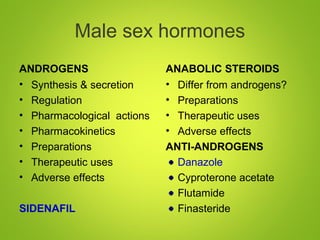
Androgens, Anabolic Steroids
and Antiandrogens
Dr. D. K. Brahma
Department of Pharmacology
NEIGRIHMS, Shillong
Introduction
• Normally, testes are responsible for male characters
• Testes Functions:
1. Production of Androgenic hormones
2. Spermatogenesis occurring within the seminiferous tubules
• Androgens are the substances which cause
development of secondary sex characters in the
castrated male
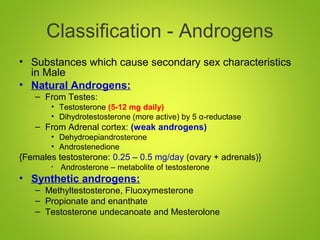
Classification - Androgens
• Natural Androgens:
– From Testes:
• Testosterone (5-12 mg daily)
• Dihydrotestosterone (more active) by 5 α-reductase
– From Adrenal cortex: (weak androgens)
• Dehydroepiandrosterone
• Androstenedione
{Females testosterone: 0.25 – 0.5 mg/day (ovary + adrenals)}
• Androsterone – metabolite of testosterone
• Synthetic androgens: Submaximal andrgenic and Cholestatic
jaundice
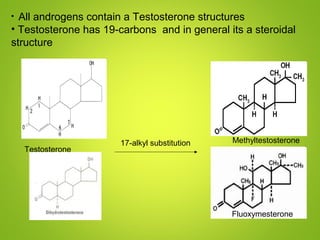
– Methyltestosterone, Fluoxymesterone – 17-alkyl substituted
derivatives
– Orally effective: Testosterone undecanoate and Mesterolone
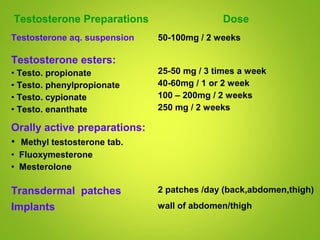
– Lipid soluble esters: Propionate and enanthate salts
Testosterone
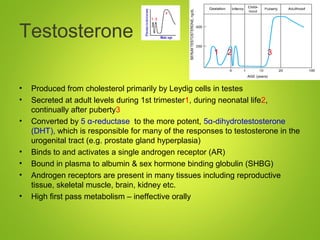
• Produced from cholesterol primarily by Leydig cells in testes
• Secreted at adult levels during 1st trimester1, during neonatal life2,
continually after puberty3
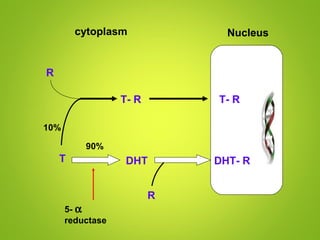
• Converted by 5 α-reductase to the more potent, 5α-dihydrotestosterone
(DHT), which is responsible for many of the responses to testosterone in the
urogenital tract (e.g. prostate gland hyperplasia)
• Binds to and activates a single androgen receptor (AR)
• Androgen receptors are present in many tissues including reproductive
tissue, skeletal muscle, brain, kidney etc.
1 2 3
Testosterone
17-alkyl substitution Methyltestosterone
Fluoxymesterone
• All androgens contain a Testosterone structures
• Testosterone has 19-carbons and in general its a steroidal
structure
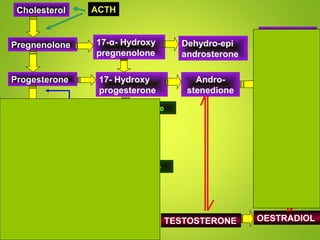
Cholesterol
Pregnenolone
Progesterone
Corticosterone
11-Desoxy-
corticosterone
18-Hydroxy-
corticosterone
ALDOSTERONE
17-α- Hydroxy
pregnenolone
11- Desoxy-
cortisol
17- Hydroxy
progesterone
21,β hydroxylase
CORTISOL
11,β hydroxylase
Dehydro-epi
androsterone
Andro-
stenedione
Oestrone
Oestriol
TESTOSTERONE OESTRADIOL
ACTH
Regulation of Secretion
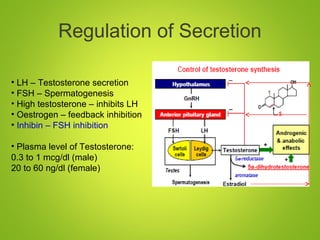
• Testosterone secretion -
Leydig`s cell of testes
• Pulsatile LH – Pituitary
• FSH – only Spermatogenesis
• High testosterone – inhibits LH
(atrophy)
• Oestrogen – feedback inhibition
• Inhibin – FSH inhibition
• Plasma level of Testosterone:
0.3 to 1 mcg/dl (male)
20 to 60 ng/dl (female)
Pharmacological Actions -
Testosterone
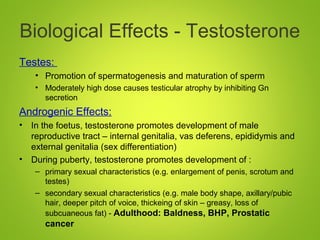
Androgenic Effects:
• In the foetus, testosterone promotes development of male reproductive tract
– internal genitalia, vas deferens, epididymis and external genitalia (sex
differentiation)
• During puberty, testosterone promotes development of :
– primary sexual characteristics (e.g. enlargement of penis, scrotum and
testes)
– secondary sexual characteristics (e.g. male body shape, axillary/pubic
hair, deeper pitch of voice, thickening of skin – greasy, loss of
subcutaneous fat)
– Adulthood: Baldness, BHP, Prostatic cancer
Testes: Promotion of spermatogenesis and maturation of sperm
• Moderately high dose causes testicular atrophy by inhibiting Gn
secretion
• Higher doses: direct sustaining effect and less marked atrophy
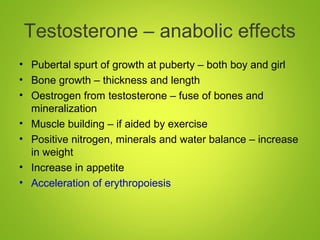
Testosterone – anabolic effects
• Pubertal spurt of growth at puberty
– both boy and girl
• Bone growth – thickness and
length
• Oestrogen from testosterone –
fuse of bones and mineralization
• Muscle building – if aided by
exercise
• Positive nitrogen, minerals and
water balance – increase in weight
• Increase in appetite
• Acceleration of erythropoiesis
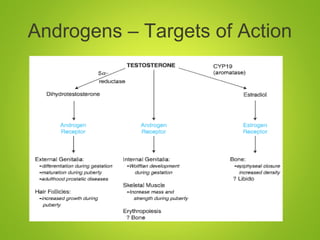
Androgens – Targets of Action
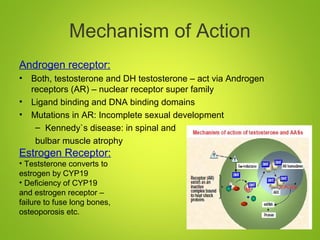
Mechanism of Action
Androgen receptor:
• Both, testosterone and DH testosterone – act via Androgen
receptors (AR) – nuclear receptor super family
• Ligand binding and DNA binding domains
• Mutations in AR: Incomplete sexual development
– Kennedy`s disease: in spinal and
bulbar muscle atrophy
Estrogen Receptor:
• Teststerone converts to
estrogen by CYP19
• Deficiency of CYP19
and estrogen receptor –
failure to fuse long bones,
osteoporosis etc.
T DHT DHT- R
T- R
R
R
T- R
Nucleus
90%
10%
5- α
reductase
cytoplasm
Androgen - Pharmacokinetics
• Absorption: undergoes high first pass
metabolism. Therefore IM injections or synthetic
preparations are used
• Transport: highly protein bound in plasma to
albumin & sex hormone binding globulin (SHBG)
(98%, SHBG, albumin)
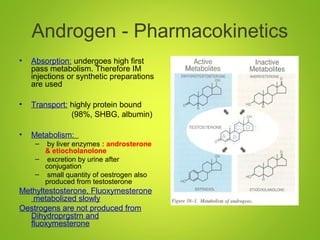
• Metabolism:
– by liver enzymes : androsterone & etiocholanolone
– excretion by urine after conjugation
– small quantity of oestrogen also produced from
testosterone, but not from fluoxymesterone and
Dihydrotestosterone
Therapeutic Uses of Androgens
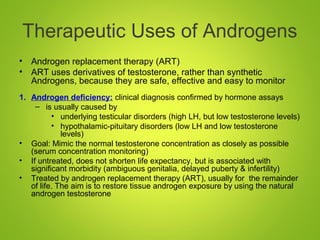
• Androgen replacement therapy (ART)
• ART uses derivatives of testosterone, rather than synthetic
Androgens, because they are safe, effective and easy to monitor
1. Androgen deficiency: clinical diagnosis confirmed by hormone assays
– is usually caused by
• underlying testicular disorders (high LH, but low testosterone levels)
• hypothalamic-pituitary disorders (low LH and low testosterone
levels)
• Goal: Mimic the normal testosterone concentration as closely as possible
(serum concentration monitoring)
• If untreated, does not shorten life expectancy, but is associated with
significant morbidity (ambiguous genitalia, delayed puberty & infertility)
• Treated by androgen replacement therapy (ART), usually for the remainder
of life. The aim is to restore tissue androgen exposure by using the natural
androgen testosterone
Uses – contd.
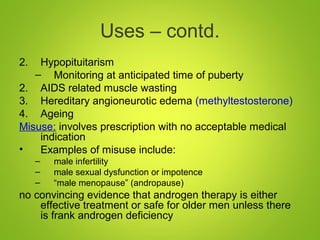
2. Hypopituitarism
– Monitoring at anticipated time of puberty
2. AIDS related muscle wasting
3. Hereditary angioneurotic edema (methyltestosterone)
4. Ageing
Misuse: involves prescription with no acceptable medical
indication
• Examples of misuse include:
– male infertility
– male sexual dysfunction or impotence
– “male menopause” (andropause)
no convincing evidence that androgen therapy is either
effective treatment or safe for older men unless there
is frank androgen deficiency
Androgens –
Adverse Effects
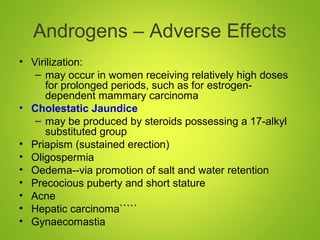
• Virilization:
– may occur in women receiving relatively high doses
for prolonged periods, such as for estrogen-dependent
mammary carcinoma
• Cholestatic Jaundice
– may be produced by steroids possessing a 17-alkyl substituted
group
• Priapism (sustained erection)
• Oligospermia
• Oedema--via promotion of salt and water retention
• Precocious puberty and short stature
• Acne
• Hepatic carcinoma`````
• Gynaecomastia
Anabolic Steroids
• Synthetic androgens – higher anabolic but lower
androgenic activity (1: 3 ratio) – decreased
virilizing effect
• Similar anabolic effect, same receptors and
same androgenic effects
• Examples:
– Nandrolone propionate 10-25 mg/ml (10 – 50 mg
IM/week) – inj. Durabolin
– Nandrolone decanoate 25-100 mg/ml (25-
100mg/week) – inj. Decadurabolin
– Stanazolol (2 mg tablets (2-6 mg/day)
Anabolic Steroids – Therapeutic
uses
1. Catabolic states: Acute illness, severe trauma, major
surgery
2. Renal insufficiency
3. Osteoporosis
4. Suboptimal growth in boys
5. Anaemia: haemolytic and malignancy associated
6. Performance enhancement
Anti-androgens
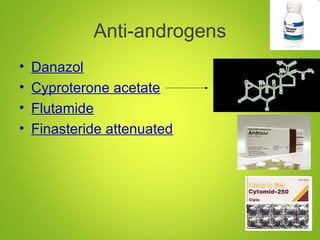
• Danazol
• Cyproterone acetate
• Flutamide
• Finasteride, Bicalutamide
Danazol
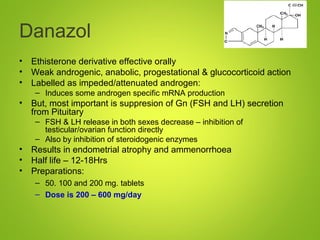
• Ethisterone derivative effective orally
• Weak androgenic, anabolic, progestational & glucocorticoid action
• Also Labeled as impeded/attenuated androgen:
– Induces some androgen specific mRNA production
• Prominent effect –
– suppression of Gn (FSH and LH) secretion from Pituitary - FSH & LH
release in both sexes decrease – inhibition of testicular/ovarian function
directly
– Directly by inhibition of steroidogenic enzymes
– Results in endometrial atrophy and ammenorrhoea
• Half life – 12-18Hrs
• Preparations:
– 50. 100 and 200 mg. tablets
– Dose is 200 – 600 mg/day
Danazol – contd.
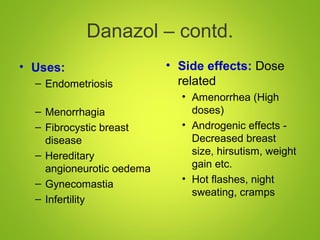
• Uses:
– Endometriosis : 3-6
months course
– Menorrhagia
– Fibrocystic breast
disease
– Hereditary
angioneurotic oedema
– Gynecomastia
– Infertility
• Side effects: Dose
related
• Amenorrhea (High
doses)
• Androgenic effects -
Decreased breast
size, hirsutism, weight
gain etc.
• Hot flashes, night
sweating, cramps
• Loss of libido in men
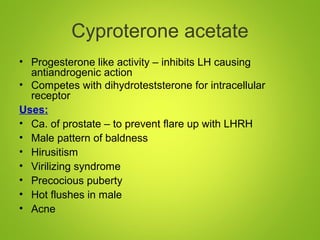
Cyproterone acetate
• Direct antiantiandrogenic action
• Progesterone like activity – inhibits LH causing
antiandrogenic action
• Competes with dihydroteststerone for intracellular
receptor
Uses:
• Precocious puberty in Boys
• Inappropriate sexual behaviour in men
• Virilization in women
• Limited use
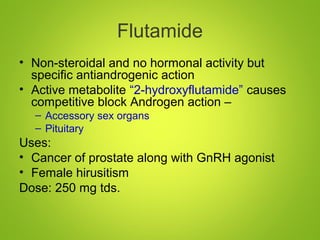
Flutamide
• Non-steroidal and no hormonal activity but specific
antiandrogenic action
• Active metabolite “2-hydroxyflutamide” causes
competitive block Androgen action – Accessory sex
organs and Pituitary
• Increased LH secretion by blocking feedback inhibition
• Plasma testosterone level may increase – to overcome
direct antiandrogenic effect
• Uses:
– Cancer of prostate along with GnRH agonist
– Female hirusitism
• ADRs: Gynaecomastia and breast tenderness and also
liver damage
• Dose: 250 mg tds.
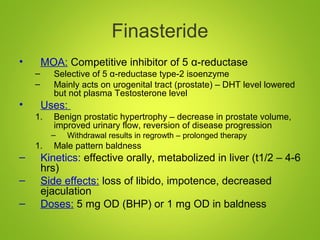
Finasteride
• MOA: Competitive inhibitor of 5 α-reductase
– Selective of 5 α-reductase type-2 isoenzyme
– Mainly acts on urogenital tract (prostate) – DHT level lowered
but not plasma Testosterone level
• Uses:
1. Benign prostatic hypertrophy – decrease in prostate volume,
improved urinary flow, reversion of disease progression
– Withdrawal results in regrowth – prolonged therapy
1. Male pattern baldness
– Kinetics: effective orally, metabolized in liver (t1/2 – 4-6
hrs)
– Side effects: loss of libido, impotence, decreased
ejaculation
– Doses: 5 mg OD (BHP) or 1 mg OD in baldness
Erectile Dysfunction Drugs
PDE-5 Inhibitors: Sidenafil, tadalafil
– Nitric oxide (NO) pathway
Sidenafil
• Absorbed orally and half-life is 4 Hrs
• Inhibits PDE5 in the corpus cavernosa of the penis
• 50 mg 1 h before sexual activity
• Potentiate nitrate’s hypotension activity
• Ketoconazole, erythromycin, Verapamil increases its level – due to
CYP3A4 inhibition
• renal & hepatic disease increases its level
• Side effects:
– headache, flushing, dyspepsia, myalgia, loose motion
– Colour vision impairement (PDE6)
– NAION
– Fall in BP and precipitation of MI
– Patient with Nitrates for angina
• Other Uses: Pulmonary hypertension
Summary
1. Testosterone – Pharmacological action,
MOA, Pharmacokinetics, Uses and its
preparations
2. Anabolic steroids and uses
3. Antiandrogens – details of Danazol and
Flutamide
4. PDE – 5 inhibitors, MOA and Adverse
effects
Thank you