(An Autonomous Institute affiliated to Savitribai Phule Pune University)
Name Batch Roll no. PRN Mail ID
Atharva Pisal
L1-3
12011 22010199 atharva.22010199@viit.ac.in
Vardal Kalaskar 12012 22010215 vardal.22010215@viit.ac.in
Krushna Nemade 12013 22010231 krushna.22010231@viit.ac.in
Pravin Rajguru 12014 22010247 pravin.22010247@viit.ac.in
Ashok Pawar 12015 22010263 ashok.22010263@viit.ac.in
Sr. no. Sub-Topic Slides
1 Polyamide 6.6 01
2 Lexan 02
3 Testing mechanical properties of Lexan 03
4 Tensile Test 04
5 Flexural Test 05
6 Izod impact Test 06
7 Double Shear Test 07
8 Hardness Test 08
9 Conclusion 09
10 Reference 10
C12O2H20(NH)2
1. Polyamide 6.6 is one of the most popular engineering
thermoplastic and majorly used as a replacement to metal.
2. It has high strength and stiffness and good impact strength.
3. This polymer is mainly used in making of Firearms.
4. This polymer also plays a vital role in auto-motive and construction sector.
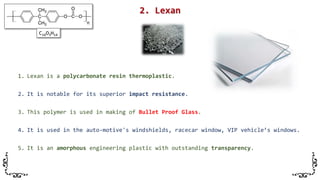
1. Lexan is a polycarbonate resin thermoplastic.
2. It is notable for its superior impact resistance.
3. This polymer is used in making of Bullet Proof Glass.
4. It is used in the auto-motive's windshields, racecar window, VIP vehicle’s windows.
5. It is an amorphous engineering plastic with outstanding transparency.
C16O3H14
1.Tensile Test
2.Flexural Test
3.Izod impact Test
4.Double Shear Test
5.Hardness Test
1. The tensile test was carried out using the Universal
Test Machine (UTM) having capacity of 5 tons.
2. The test specimen is prepared according to ASTM standard
D638-08.
3. Formula used to calculate the tensile strength is 𝝈 =
𝑷
𝑨
4. For gradual loading, the gear rotation speed is 1.25,
1.5 and 2.5 mm/min.
5. Elongation is found to be 17.8% with ultimate stress of
0.062Gpa
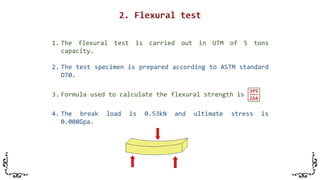
1. The flexural test is carried out in UTM of 5 tons
capacity.
2. The test specimen is prepared according to ASTM standard
D70.
3. Formula used to calculate the flexural strength is
𝟑𝑷𝑳
𝟐𝒃𝒉
4. The break load is 0.53kN and ultimate stress is
0.008Gpa.
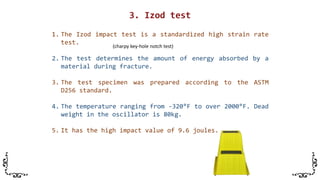
1. The Izod impact test is a standardized high strain rate
test.
2. The test determines the amount of energy absorbed by a
material during fracture.
3. The test specimen was prepared according to the ASTM
D256 standard.
4. The temperature ranging from -320°F to over 2000°F. Dead
weight in the oscillator is 80kg.
5. It has the high impact value of 9.6 joules.
(charpy key-hole notch test)
1. The double shear test is carried out using UTM of 5 ton
capacity.
2. The test specimen was prepared according to the ASTM
2324 standard.
3. For gradual loading, the gear rotation speed is 1.25,
1.5 and 2.5 mm/min
4. The break load is 3.36kN and the ultimate stress is
0.064Gpa.
1. The test was conducted using Wilson Rockwell L-scale,
which is especially for plastic material.
2. The indenter chosen is of steel ball of 1/4th diameter.
The amount of load 60kg was used for this test.
3. The test specimen was prepared according to ASTM D875
standard
4. It has good hardness value of 98HRL
1. Polycarbonate was successfully fabricated by molding
process and testing of mechanical properties was held
successfully.
2. The result of the study is good in agreement with those
obtained mechanical properties using standard FIE
software.
3. The analysis of different testing and loading
arrangements leads to a better understanding of the
mechanical properties of poly-carbonate.
4. Experimental results shown indicates that the impact
testing gives better result than the chopped e-glass
fibre.
1. Polycarbonate, Polycarbonate.city plastics retrieved 2013-12-
18,www.cityplastics.com.au/materials-polycarbonate
2. Fluorinated poly(meth)acrylate:synthesis and properties, Wenqiang
yao,youngicenli,xiooyu huang.
3. McIntyre, JE, Sythetic fibres: nylon, polyester, acrylic,
polyolefin. 2005: Taylor & Francis.
4. Seymour, RB and Kirshebaum, GS, High performance polymers, their
origin and development. 1986: Springer
Testing strength of polymers

Testing strength of polymers

  • 1.
    (An Autonomous Instituteaffiliated to Savitribai Phule Pune University) Name Batch Roll no. PRN Mail ID Atharva Pisal L1-3 12011 22010199 atharva.22010199@viit.ac.in Vardal Kalaskar 12012 22010215 vardal.22010215@viit.ac.in Krushna Nemade 12013 22010231 krushna.22010231@viit.ac.in Pravin Rajguru 12014 22010247 pravin.22010247@viit.ac.in Ashok Pawar 12015 22010263 ashok.22010263@viit.ac.in
  • 2.
    Sr. no. Sub-TopicSlides 1 Polyamide 6.6 01 2 Lexan 02 3 Testing mechanical properties of Lexan 03 4 Tensile Test 04 5 Flexural Test 05 6 Izod impact Test 06 7 Double Shear Test 07 8 Hardness Test 08 9 Conclusion 09 10 Reference 10
  • 3.
    C12O2H20(NH)2 1. Polyamide 6.6is one of the most popular engineering thermoplastic and majorly used as a replacement to metal. 2. It has high strength and stiffness and good impact strength. 3. This polymer is mainly used in making of Firearms. 4. This polymer also plays a vital role in auto-motive and construction sector.
  • 4.
    1. Lexan isa polycarbonate resin thermoplastic. 2. It is notable for its superior impact resistance. 3. This polymer is used in making of Bullet Proof Glass. 4. It is used in the auto-motive's windshields, racecar window, VIP vehicle’s windows. 5. It is an amorphous engineering plastic with outstanding transparency. C16O3H14
  • 5.
    1.Tensile Test 2.Flexural Test 3.Izodimpact Test 4.Double Shear Test 5.Hardness Test
  • 6.
    1. The tensiletest was carried out using the Universal Test Machine (UTM) having capacity of 5 tons. 2. The test specimen is prepared according to ASTM standard D638-08. 3. Formula used to calculate the tensile strength is 𝝈 = 𝑷 𝑨 4. For gradual loading, the gear rotation speed is 1.25, 1.5 and 2.5 mm/min. 5. Elongation is found to be 17.8% with ultimate stress of 0.062Gpa
  • 7.
    1. The flexuraltest is carried out in UTM of 5 tons capacity. 2. The test specimen is prepared according to ASTM standard D70. 3. Formula used to calculate the flexural strength is 𝟑𝑷𝑳 𝟐𝒃𝒉 4. The break load is 0.53kN and ultimate stress is 0.008Gpa.
  • 8.
    1. The Izodimpact test is a standardized high strain rate test. 2. The test determines the amount of energy absorbed by a material during fracture. 3. The test specimen was prepared according to the ASTM D256 standard. 4. The temperature ranging from -320°F to over 2000°F. Dead weight in the oscillator is 80kg. 5. It has the high impact value of 9.6 joules. (charpy key-hole notch test)
  • 9.
    1. The doubleshear test is carried out using UTM of 5 ton capacity. 2. The test specimen was prepared according to the ASTM 2324 standard. 3. For gradual loading, the gear rotation speed is 1.25, 1.5 and 2.5 mm/min 4. The break load is 3.36kN and the ultimate stress is 0.064Gpa.
  • 10.
    1. The testwas conducted using Wilson Rockwell L-scale, which is especially for plastic material. 2. The indenter chosen is of steel ball of 1/4th diameter. The amount of load 60kg was used for this test. 3. The test specimen was prepared according to ASTM D875 standard 4. It has good hardness value of 98HRL
  • 11.
    1. Polycarbonate wassuccessfully fabricated by molding process and testing of mechanical properties was held successfully. 2. The result of the study is good in agreement with those obtained mechanical properties using standard FIE software. 3. The analysis of different testing and loading arrangements leads to a better understanding of the mechanical properties of poly-carbonate. 4. Experimental results shown indicates that the impact testing gives better result than the chopped e-glass fibre.
  • 13.
    1. Polycarbonate, Polycarbonate.cityplastics retrieved 2013-12- 18,www.cityplastics.com.au/materials-polycarbonate 2. Fluorinated poly(meth)acrylate:synthesis and properties, Wenqiang yao,youngicenli,xiooyu huang. 3. McIntyre, JE, Sythetic fibres: nylon, polyester, acrylic, polyolefin. 2005: Taylor & Francis. 4. Seymour, RB and Kirshebaum, GS, High performance polymers, their origin and development. 1986: Springer

Editor's Notes

  • #7 The maximum tension that the material can bear, that is, when the material goes under compression can be found out by The UTM, that is, the Universal Test Machine having 5 tons capacity. The test specimen is prepared to according to the American Society for Testing Materials standard (ASTM) – D638-08 Formula used here to find Tensile Strength is sigma = P by A where P is the ultimate load on the specimen and A is for area of the specimen so the unit of tensile strength will be Newton per meter square. For gradual loading, the gear rotation speed is 1.25, 1.5 and 2.5 mili meter per minute. The Elongation reading from the machine is found to be 17.8 percent with the ultimate stress of 0.062 gigapascal
  • #8 The flexural test is also carried out in UTM of 5 tons capacity as the Tensile test but here the ASTM standard is D70 as we are trying to twist it. Here the Formula used to calculate the flexural strength is thrice the Maximum load into the span length of the specimen divided by twice the breadth into its thickness. The break load is found to be 0.53 kilo Newton and the ultimate stress being 0.008 Giga Pascal.
  • #9 Charpy key-hole notch test
  • #11 98 Rockwell Hardness