Thermoset Polymer matrix
Prepared By
Mr.P.Senthamaraikannan, M.E., (Ph.D).
Assistant professor,
Department of Mechanical engineering,
Kamaraj college of engineering and technology,
Virudhunagar
Thermoset Polymer matrix
• In a thermoset polymer also called resin, the molecules
are chemically joined together by cross-links. Therefore
these polymers cannot be reused once cross-links are
formed on curing. They are used in continuous or long
fiber-reinforced composites mainly because of the ease
of processing due to their low viscosity. The drawbacks
that thermoset polymers suffer are limited storage life
at room temperature, long fabrication time in the
mould and low strain-to-failure. Thermoset polymers
used in composite materials are epoxy, polyester,
vinylester, polyimides
Epoxy resin
A common starting material for the epoxy
resin is diglycidyl ether of bisphenol A
(DGEBA). In general, the tensile modulus, glass
transition temperature, and thermal stability
as well as chemical resistance are improved
with increasing cross-link density, but the
strain-to-failure and fracture toughness are
reduced. Epoxy resin is very commonly used in
aerospace structures
Advantages of epoxy resin
• Good adherence to metal and glass fibers
• Curing agents, and modifiers are available
• Absence of volatile matters during curing
• Low shrinkage during curing
• Excellent resistance to chemicals and solvents
Disadvantages of epoxy resin
• Relatively high cost and
• long curing time
Applications
• Paints and coatings
• Adhesives
• Industrial tooling and composites
• Wind Turbine Technology composites
• Electrical systems and electronics
• marine applications
• Aerospace applications
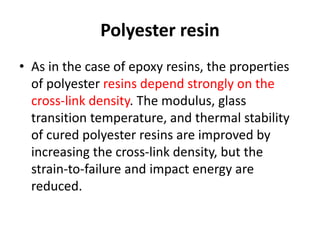
Polyester resin
• As in the case of epoxy resins, the properties
of polyester resins depend strongly on the
cross-link density. The modulus, glass
transition temperature, and thermal stability
of cured polyester resins are improved by
increasing the cross-link density, but the
strain-to-failure and impact energy are
reduced.
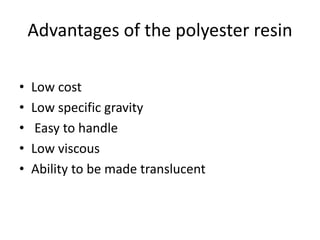
Advantages of the polyester resin
• Low cost
• Low specific gravity
• Easy to handle
• Low viscous
• Ability to be made translucent
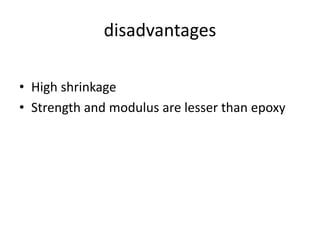
disadvantages
• High shrinkage
• Strength and modulus are lesser than epoxy
Applications
• making trays,
• shower stalls,
• boats,
• swimming pool,
• water tanks
Vinyl ester resin
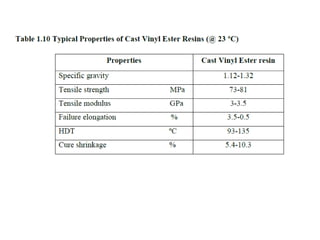
Vinyl ester resins possess good characteristics
of epoxy resins, such as excellent chemical
resistance and tensile strength, and of
unsaturated polyester resins, such as low
viscosity and fast curing. However, the
volumetric shrinkage of vinyl ester resins is in
the range of 5%–10%, which is higher than
that of the parent epoxy resins
Advantages
• Low cost
• Excellent wet-out and good adhesion with
glass fibers
• High tensile strength
• Excellent chemical resistance
• Low viscosity leads to good wetability
• Fast curing (solidification)
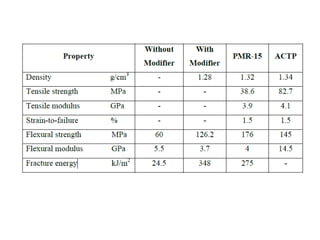
Thermoset Polyimides
• Thermoset polyimides are obtained by addition
polymerization of liquid monomeric or oligomeric
imides to form a cross-linked infusible structure.
On curing, they not only offer high temperature
resistance, but also high chemical and solvent
resistance. However, these materials are
inherently very brittle due to their densely cross-
linked molecular structure. As a result, their
composites are prone to excessive microcracking.
• Due to their high temperature resistance, they
are used in high temperature applications
advantages
• Good dimensional stability
• Good resistance to thermal stresses
drawback
• brittle in nature, resulting in micro cracks
Applications
• Printing ink technology and manufacture
• Polyamide resins for laminating inks
• Laser sintering of stainless steel powder using
resin powder
• Production of 3D Structures in Printing

Thermoset polymer matrix

  • 1.
    Thermoset Polymer matrix PreparedBy Mr.P.Senthamaraikannan, M.E., (Ph.D). Assistant professor, Department of Mechanical engineering, Kamaraj college of engineering and technology, Virudhunagar
  • 2.
    Thermoset Polymer matrix •In a thermoset polymer also called resin, the molecules are chemically joined together by cross-links. Therefore these polymers cannot be reused once cross-links are formed on curing. They are used in continuous or long fiber-reinforced composites mainly because of the ease of processing due to their low viscosity. The drawbacks that thermoset polymers suffer are limited storage life at room temperature, long fabrication time in the mould and low strain-to-failure. Thermoset polymers used in composite materials are epoxy, polyester, vinylester, polyimides
  • 3.
    Epoxy resin A commonstarting material for the epoxy resin is diglycidyl ether of bisphenol A (DGEBA). In general, the tensile modulus, glass transition temperature, and thermal stability as well as chemical resistance are improved with increasing cross-link density, but the strain-to-failure and fracture toughness are reduced. Epoxy resin is very commonly used in aerospace structures
  • 4.
    Advantages of epoxyresin • Good adherence to metal and glass fibers • Curing agents, and modifiers are available • Absence of volatile matters during curing • Low shrinkage during curing • Excellent resistance to chemicals and solvents
  • 5.
    Disadvantages of epoxyresin • Relatively high cost and • long curing time
  • 7.
    Applications • Paints andcoatings • Adhesives • Industrial tooling and composites • Wind Turbine Technology composites • Electrical systems and electronics • marine applications • Aerospace applications
  • 8.
    Polyester resin • Asin the case of epoxy resins, the properties of polyester resins depend strongly on the cross-link density. The modulus, glass transition temperature, and thermal stability of cured polyester resins are improved by increasing the cross-link density, but the strain-to-failure and impact energy are reduced.
  • 9.
    Advantages of thepolyester resin • Low cost • Low specific gravity • Easy to handle • Low viscous • Ability to be made translucent
  • 10.
    disadvantages • High shrinkage •Strength and modulus are lesser than epoxy
  • 12.
    Applications • making trays, •shower stalls, • boats, • swimming pool, • water tanks
  • 13.
    Vinyl ester resin Vinylester resins possess good characteristics of epoxy resins, such as excellent chemical resistance and tensile strength, and of unsaturated polyester resins, such as low viscosity and fast curing. However, the volumetric shrinkage of vinyl ester resins is in the range of 5%–10%, which is higher than that of the parent epoxy resins
  • 14.
    Advantages • Low cost •Excellent wet-out and good adhesion with glass fibers • High tensile strength • Excellent chemical resistance • Low viscosity leads to good wetability • Fast curing (solidification)
  • 16.
    Thermoset Polyimides • Thermosetpolyimides are obtained by addition polymerization of liquid monomeric or oligomeric imides to form a cross-linked infusible structure. On curing, they not only offer high temperature resistance, but also high chemical and solvent resistance. However, these materials are inherently very brittle due to their densely cross- linked molecular structure. As a result, their composites are prone to excessive microcracking. • Due to their high temperature resistance, they are used in high temperature applications
  • 17.
    advantages • Good dimensionalstability • Good resistance to thermal stresses
  • 18.
    drawback • brittle innature, resulting in micro cracks
  • 20.
    Applications • Printing inktechnology and manufacture • Polyamide resins for laminating inks • Laser sintering of stainless steel powder using resin powder • Production of 3D Structures in Printing