TEST FOR NORMAL URINE
SNEHITA PRASAD
LECTURER, Department of Biochemistry
Narsinhbhai patel dental college & hospital
SPU
Urine is an excretory product of the body, which is formed in the kidneys.
Urine can be defined as ultra filtrate of plasma, the composition of urine varies
with the type of diet.
The analysis of urine consists of the following physical and chemical tests.
Thus examination of urine is quick and convenient method of obtaining
information of considerable diagnostic, prognostic and therapeutic values.
The composition of urine is a mirror not only of renal function but also of many
physiological and metabolic processes occurring in the body.
Diabetes mellitus
· Diabetes insipidus
(low specific gravity
of urine)
· Diuretics drug
therapy
Dehydration
Renal failure
Some
condition
increases
urine
volume
Some
condition
decreases
urine
volume
Volume: 1000 ml to 1500 ml in 24 hrs
Appearance Clear or may be cloudy due to presence of phosphates
Color pale yellow, amber yellow, straw color
Odor characteristic aromatic odor when fresh On standing develops unpleasant ammonical
odor due to bacterial decomposition
PH slightly acidic (6.2-6.4)
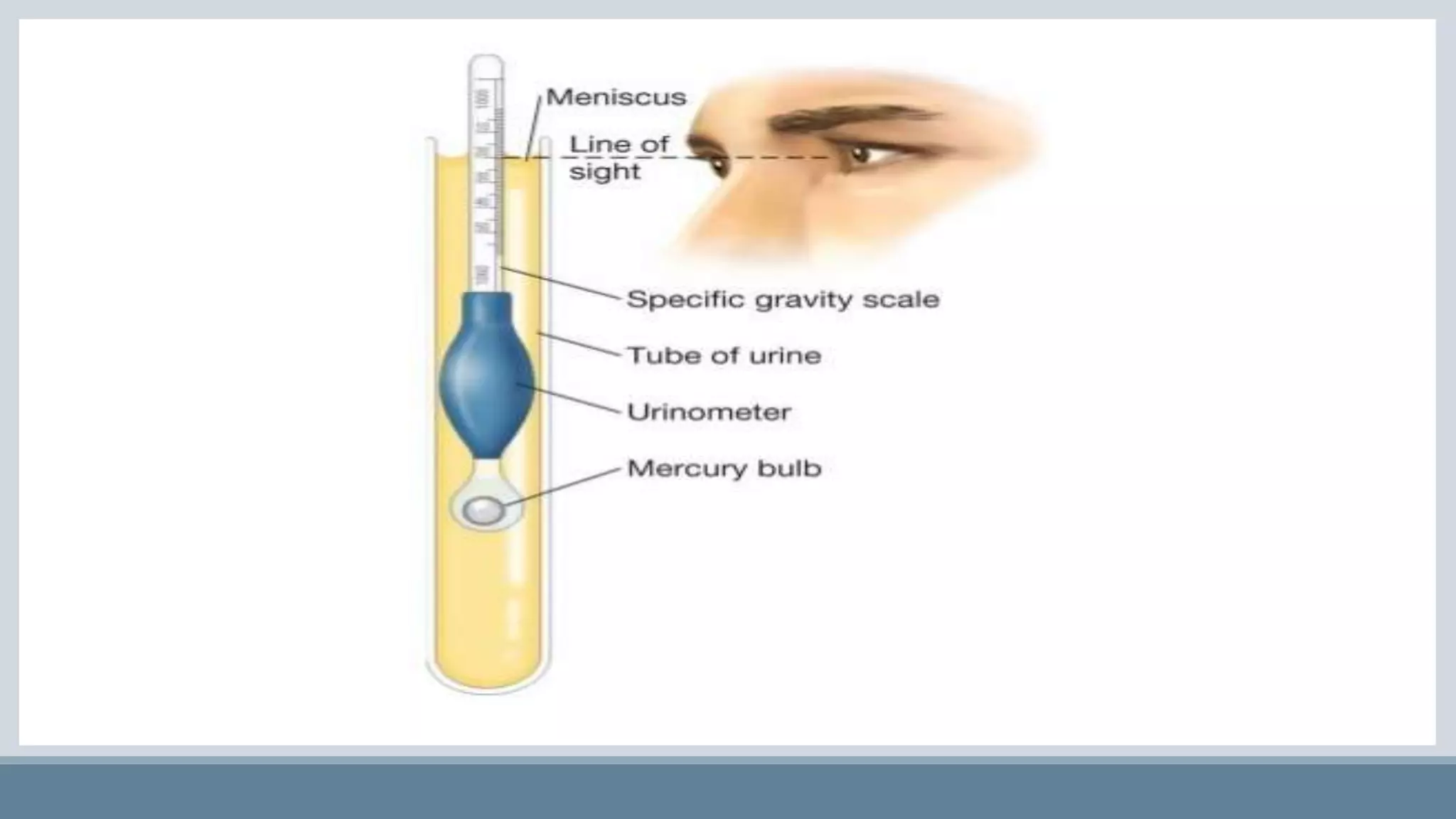
Specific Gravity Measured with urinometer normally between 1.002 to 1.030
URINOMETER :- USED TO MEASURE THE
URINE
URINOMETER
Chemical characteristics
of Normal urine
1) TEST FOR UREA :-
Urea - 25-30 gm/day
Urea is the principal nitrogenous waste product of metabolism and is generated from
protein breakdown.
PRINCIPLE:- sodium hypobromite reacts with urea
and nitrogen gas is released as brisk effervescence.
UREASE TEST:-
Principle:- urease act on urea in optimum condition to generate NH3 and CO2
which on reaction with water form (NH4)2CO3 which gives pink color.
Method :- Take 3 ml of urine in test-tube and add 1-2 drops of phenolphthalein
indicator, to this Add a pinch of urease powder. Allow to stand for 5-10
minutes.
Observation :- Pink color develops
Inference:- Urea is present in urine.
2)TEST FOR URIC ACID
Uric acid - 0.5-0.8 gm/day
The final breakdown product of purine catabolism in humans is uric acid.
Uric acid TEST:-
Principle:- Uric acid is reducing agent in alkaline medium. It reduced phosphotungstic
acid into tungsten blue.
Method :- Take 3 ml of urine in test-tube and add 1- 2 drops of uric acid reagent then
add I drop of 10% sodium hydroxide solution.
Observation :- blue color develops
Inference:- Uric acid is present in urine.
SCHIFF TEST:-
Principle:- uric acid reduces ammonical Silver nitrate into silver which gives black stain.
Method :- Urine (1ml) + sodium carbonate (1ml) pour a few drops of this solution on
a filter paper , already moistened with AgNO3 solution
Observation :- black stain appear on filter paper indicate presence of uric acid.
Inference:- URIC ACID is present in urine.
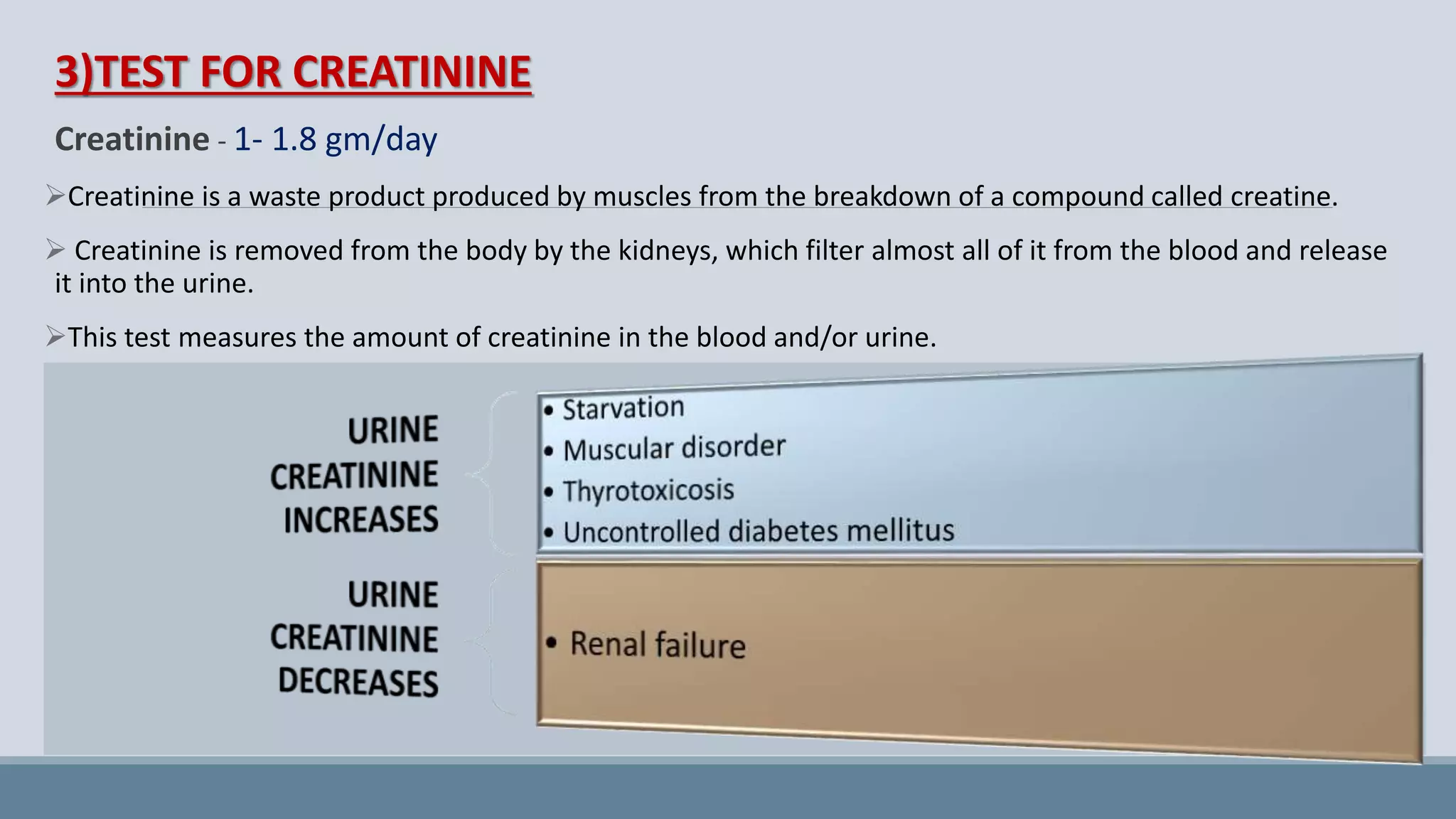
3)TEST FOR CREATININE
Creatinine - 1- 1.8 gm/day
Creatinine is a waste product produced by muscles from the breakdown of a compound called creatine.
 Creatinine is removed from the body by the kidneys, which filter almost all of it from the blood and release
it into the urine.
This test measures the amount of creatinine in the blood and/or urine.
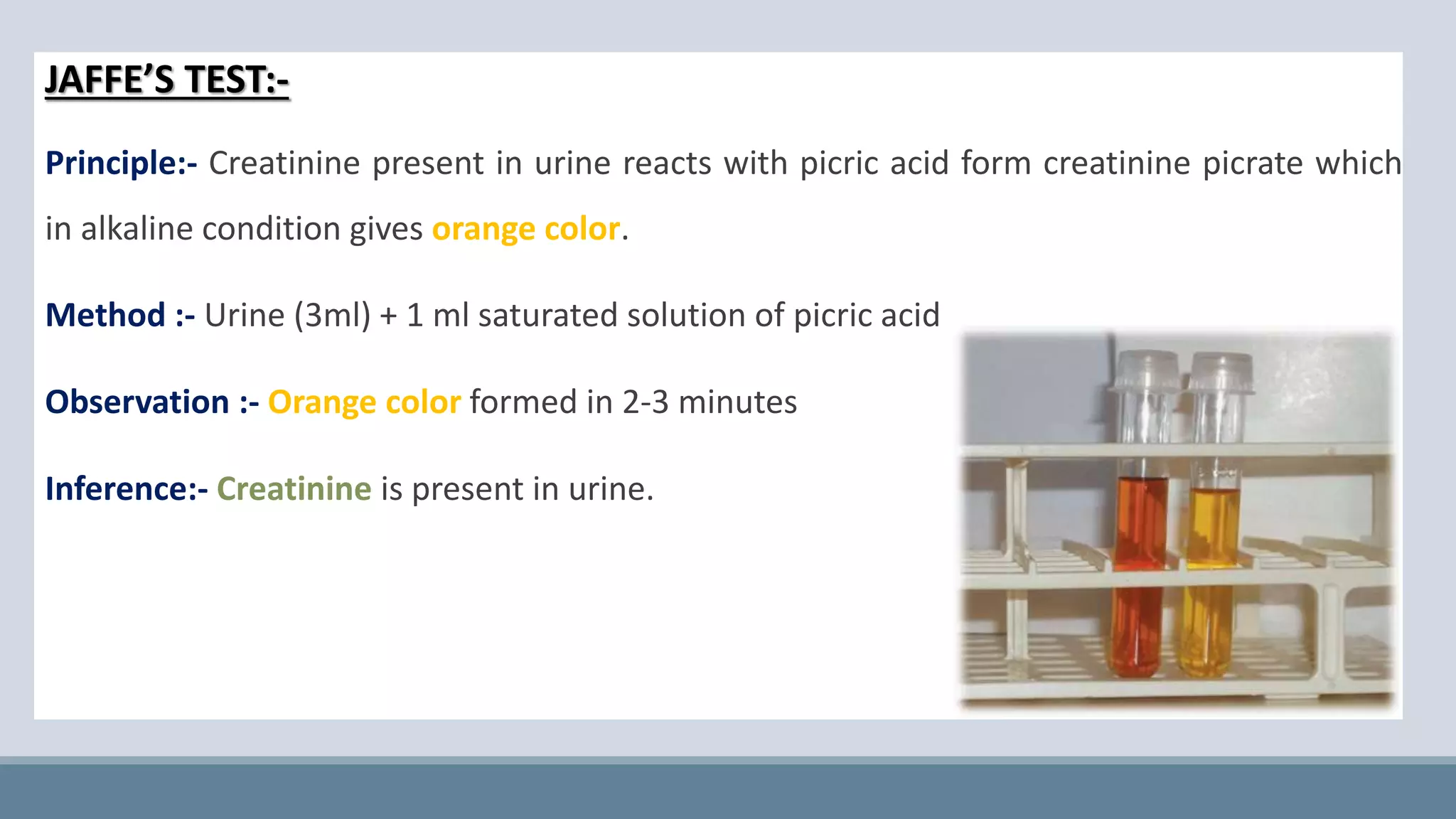
JAFFE’S TEST:-
Principle:- Creatinine present in urine reacts with picric acid form creatinine picrate which
in alkaline condition gives orange color.
Method :- Urine (3ml) + 1 ml saturated solution of picric acid
Observation :- Orange color formed in 2-3 minutes
Inference:- Creatinine is present in urine.
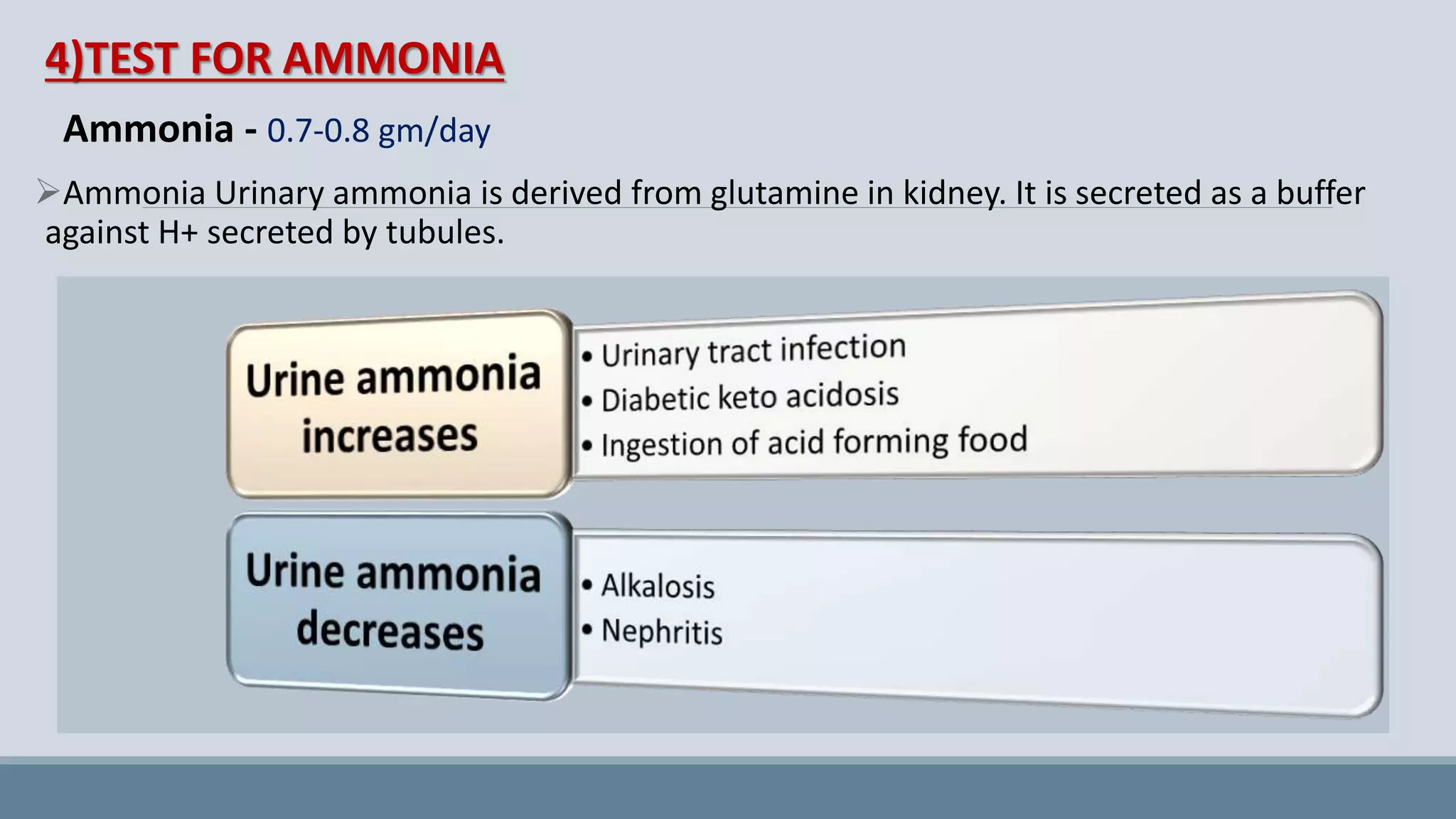
4)TEST FOR AMMONIA
Ammonia - 0.7-0.8 gm/day
Ammonia Urinary ammonia is derived from glutamine in kidney. It is secreted as a buffer
against H+ secreted by tubules.
AMMONIA TEST:-
Principle:- Ammonia alkaline in nature turns phenolphthalein pink.
Method :- Put a drop of phenolphthalein on filter paper & hold it at the mouth
of test tube containing 5 ml. urine and 3 ml of 10% NaOH boil to allow vapour
only to contact filter paper Observation :- Phenolphthalein turns pink
Inference:- Ammonia is present in urine.
TEST FOR CHLORIDE:-
Principle:- Chloride ion present in urine reacts with silver ion of AgNO3 and for white
precipitates of silver chloride.
Method :- Urine (2ml) + 2 drops of conc.HNO3 and 1 ml of Silver Nitrate solution
Observation :- White precipitate formed
Inference:- CHLORIDE is present in urine.
Chlorides - 10- 15 gm/day
URINE CHLORIDE INCREASES
• Polydipsia
• Use of diuretics
URINE CHLORIDE DECREASES
• Excessive sweating, vomiting
• Diarrhea
• Edema
• Diabetes insipidus
• Adrenocortical hyper function
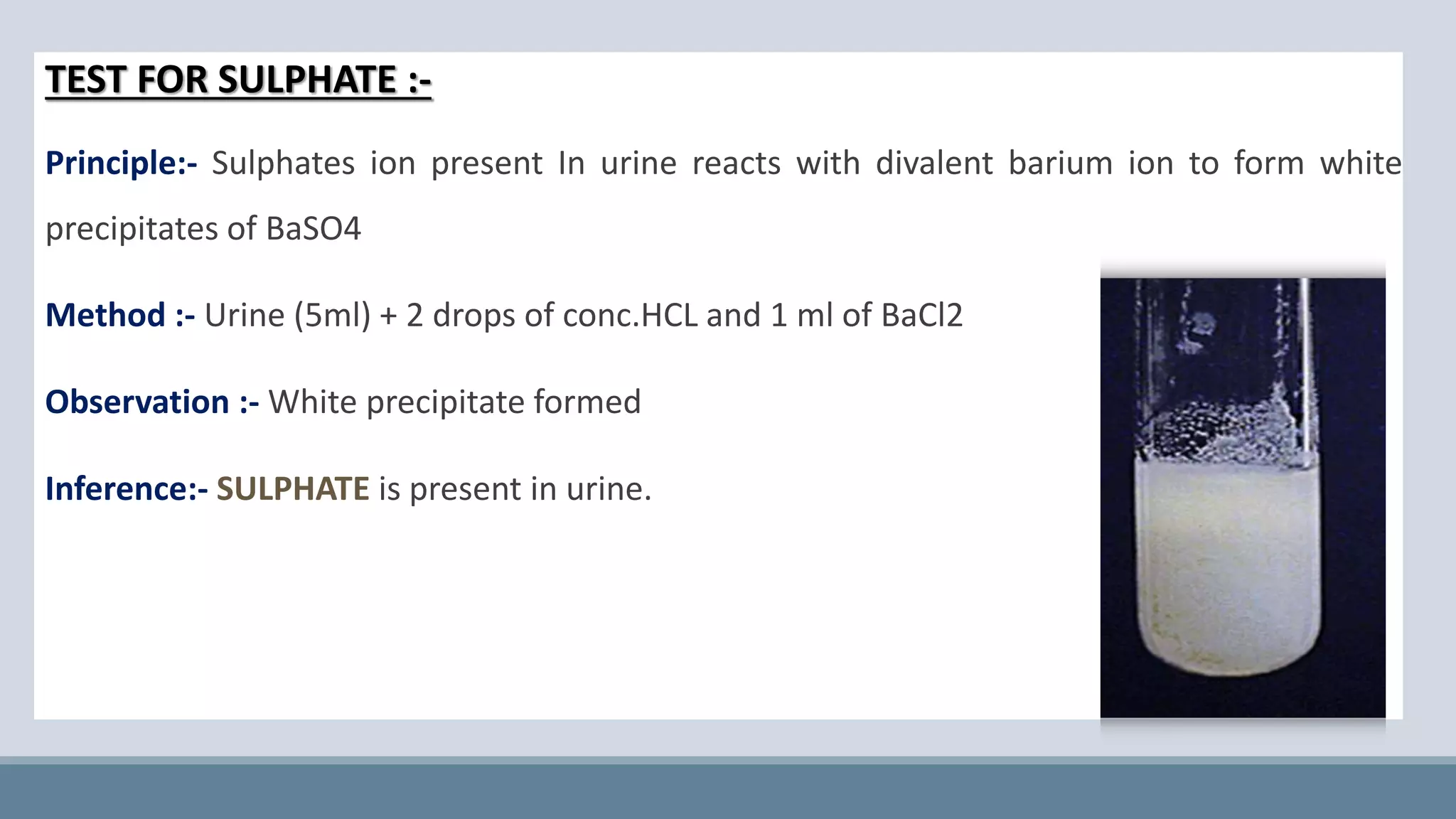
TEST FOR SULPHATE :-
Principle:- Sulphates ion present In urine reacts with divalent barium ion to form white
precipitates of BaSO4
Method :- Urine (5ml) + 2 drops of conc.HCL and 1 ml of BaCl2
Observation :- White precipitate formed
Inference:- SULPHATE is present in urine.
Sulphates - 1- 1.2 gm/day
URINE SULPHATE INCREASES
• Cystinuria
• Homocystinuria
• Obstructive jaundice
• Hepatocellular jaundice
• Cyanide poisoning
• High protein diet
URINE SULPHATE DECREASES
• Renal function impairment
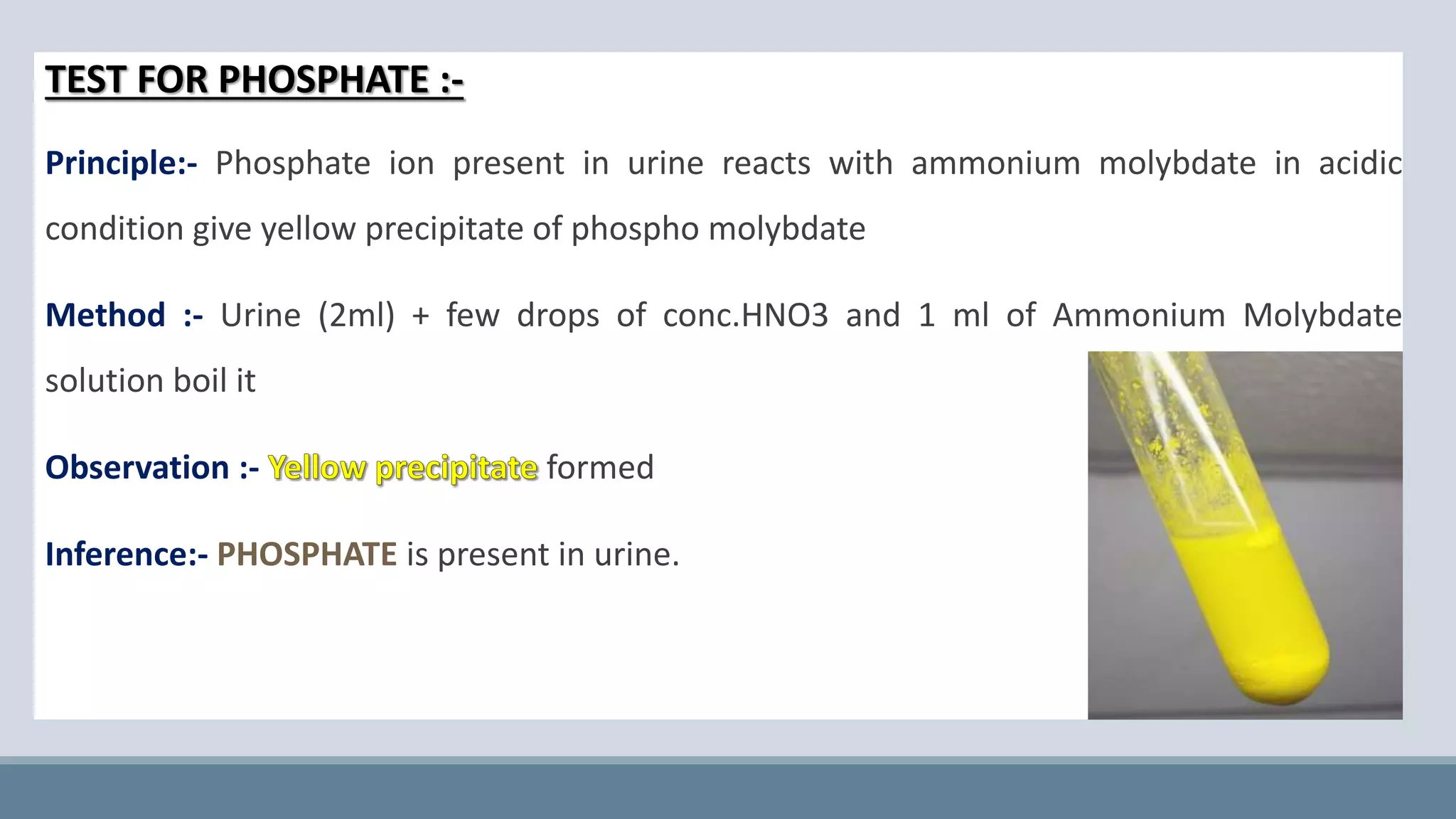
TEST FOR PHOSPHATE :-
Principle:- Phosphate ion present in urine reacts with ammonium molybdate in acidic
condition give yellow precipitate of phospho molybdate
Method :- Urine (2ml) + few drops of conc.HNO3 and 1 ml of Ammonium Molybdate
solution boil it
Observation :- formed
Inference:- PHOSPHATE is present in urine.
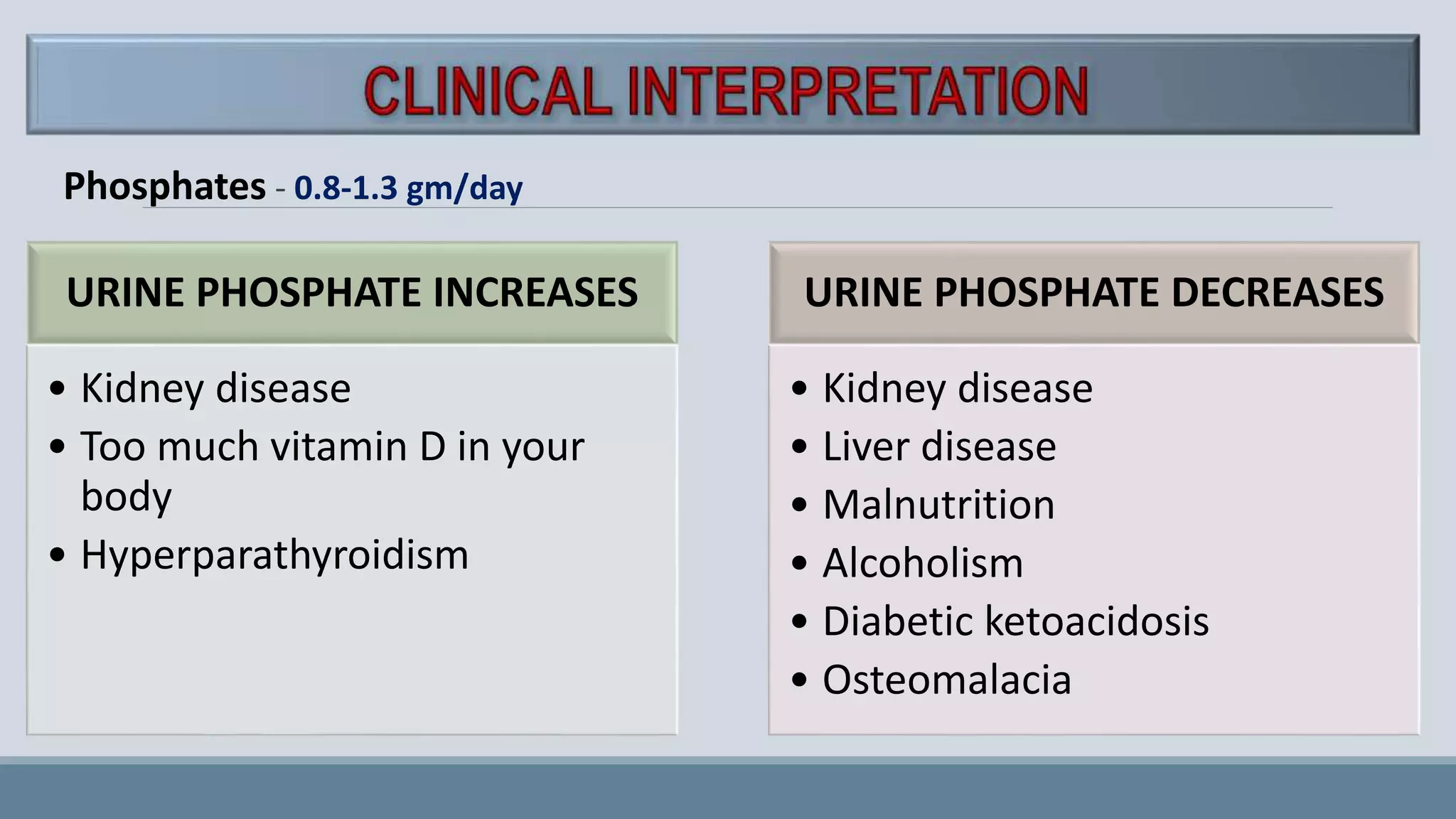
Phosphates - 0.8-1.3 gm/day
URINE PHOSPHATE INCREASES
• Kidney disease
• Too much vitamin D in your
body
• Hyperparathyroidism
URINE PHOSPHATE DECREASES
• Kidney disease
• Liver disease
• Malnutrition
• Alcoholism
• Diabetic ketoacidosis
• Osteomalacia
Test for Normal urine (Practical )

Test for Normal urine (Practical )

  • 1.
    TEST FOR NORMALURINE SNEHITA PRASAD LECTURER, Department of Biochemistry Narsinhbhai patel dental college & hospital SPU
  • 2.
    Urine is anexcretory product of the body, which is formed in the kidneys. Urine can be defined as ultra filtrate of plasma, the composition of urine varies with the type of diet. The analysis of urine consists of the following physical and chemical tests. Thus examination of urine is quick and convenient method of obtaining information of considerable diagnostic, prognostic and therapeutic values. The composition of urine is a mirror not only of renal function but also of many physiological and metabolic processes occurring in the body.
  • 5.
    Diabetes mellitus · Diabetesinsipidus (low specific gravity of urine) · Diuretics drug therapy Dehydration Renal failure Some condition increases urine volume Some condition decreases urine volume
  • 10.
    Volume: 1000 mlto 1500 ml in 24 hrs Appearance Clear or may be cloudy due to presence of phosphates Color pale yellow, amber yellow, straw color Odor characteristic aromatic odor when fresh On standing develops unpleasant ammonical odor due to bacterial decomposition PH slightly acidic (6.2-6.4) Specific Gravity Measured with urinometer normally between 1.002 to 1.030 URINOMETER :- USED TO MEASURE THE URINE URINOMETER
  • 12.
  • 14.
    1) TEST FORUREA :- Urea - 25-30 gm/day Urea is the principal nitrogenous waste product of metabolism and is generated from protein breakdown.
  • 15.
    PRINCIPLE:- sodium hypobromitereacts with urea and nitrogen gas is released as brisk effervescence.
  • 16.
    UREASE TEST:- Principle:- ureaseact on urea in optimum condition to generate NH3 and CO2 which on reaction with water form (NH4)2CO3 which gives pink color. Method :- Take 3 ml of urine in test-tube and add 1-2 drops of phenolphthalein indicator, to this Add a pinch of urease powder. Allow to stand for 5-10 minutes. Observation :- Pink color develops Inference:- Urea is present in urine.
  • 18.
    2)TEST FOR URICACID Uric acid - 0.5-0.8 gm/day The final breakdown product of purine catabolism in humans is uric acid.
  • 19.
    Uric acid TEST:- Principle:-Uric acid is reducing agent in alkaline medium. It reduced phosphotungstic acid into tungsten blue. Method :- Take 3 ml of urine in test-tube and add 1- 2 drops of uric acid reagent then add I drop of 10% sodium hydroxide solution. Observation :- blue color develops Inference:- Uric acid is present in urine.
  • 20.
    SCHIFF TEST:- Principle:- uricacid reduces ammonical Silver nitrate into silver which gives black stain. Method :- Urine (1ml) + sodium carbonate (1ml) pour a few drops of this solution on a filter paper , already moistened with AgNO3 solution Observation :- black stain appear on filter paper indicate presence of uric acid. Inference:- URIC ACID is present in urine.
  • 21.
    3)TEST FOR CREATININE Creatinine- 1- 1.8 gm/day Creatinine is a waste product produced by muscles from the breakdown of a compound called creatine.  Creatinine is removed from the body by the kidneys, which filter almost all of it from the blood and release it into the urine. This test measures the amount of creatinine in the blood and/or urine.
  • 22.
    JAFFE’S TEST:- Principle:- Creatininepresent in urine reacts with picric acid form creatinine picrate which in alkaline condition gives orange color. Method :- Urine (3ml) + 1 ml saturated solution of picric acid Observation :- Orange color formed in 2-3 minutes Inference:- Creatinine is present in urine.
  • 23.
    4)TEST FOR AMMONIA Ammonia- 0.7-0.8 gm/day Ammonia Urinary ammonia is derived from glutamine in kidney. It is secreted as a buffer against H+ secreted by tubules.
  • 24.
    AMMONIA TEST:- Principle:- Ammoniaalkaline in nature turns phenolphthalein pink. Method :- Put a drop of phenolphthalein on filter paper & hold it at the mouth of test tube containing 5 ml. urine and 3 ml of 10% NaOH boil to allow vapour only to contact filter paper Observation :- Phenolphthalein turns pink Inference:- Ammonia is present in urine.
  • 26.
    TEST FOR CHLORIDE:- Principle:-Chloride ion present in urine reacts with silver ion of AgNO3 and for white precipitates of silver chloride. Method :- Urine (2ml) + 2 drops of conc.HNO3 and 1 ml of Silver Nitrate solution Observation :- White precipitate formed Inference:- CHLORIDE is present in urine.
  • 27.
    Chlorides - 10-15 gm/day URINE CHLORIDE INCREASES • Polydipsia • Use of diuretics URINE CHLORIDE DECREASES • Excessive sweating, vomiting • Diarrhea • Edema • Diabetes insipidus • Adrenocortical hyper function
  • 28.
    TEST FOR SULPHATE:- Principle:- Sulphates ion present In urine reacts with divalent barium ion to form white precipitates of BaSO4 Method :- Urine (5ml) + 2 drops of conc.HCL and 1 ml of BaCl2 Observation :- White precipitate formed Inference:- SULPHATE is present in urine.
  • 29.
    Sulphates - 1-1.2 gm/day URINE SULPHATE INCREASES • Cystinuria • Homocystinuria • Obstructive jaundice • Hepatocellular jaundice • Cyanide poisoning • High protein diet URINE SULPHATE DECREASES • Renal function impairment
  • 30.
    TEST FOR PHOSPHATE:- Principle:- Phosphate ion present in urine reacts with ammonium molybdate in acidic condition give yellow precipitate of phospho molybdate Method :- Urine (2ml) + few drops of conc.HNO3 and 1 ml of Ammonium Molybdate solution boil it Observation :- formed Inference:- PHOSPHATE is present in urine.
  • 31.
    Phosphates - 0.8-1.3gm/day URINE PHOSPHATE INCREASES • Kidney disease • Too much vitamin D in your body • Hyperparathyroidism URINE PHOSPHATE DECREASES • Kidney disease • Liver disease • Malnutrition • Alcoholism • Diabetic ketoacidosis • Osteomalacia