KENDRIYA VIDYALAYA SANGATHAN
Gurugram Region
CLASS -XI
CHAPTER-4
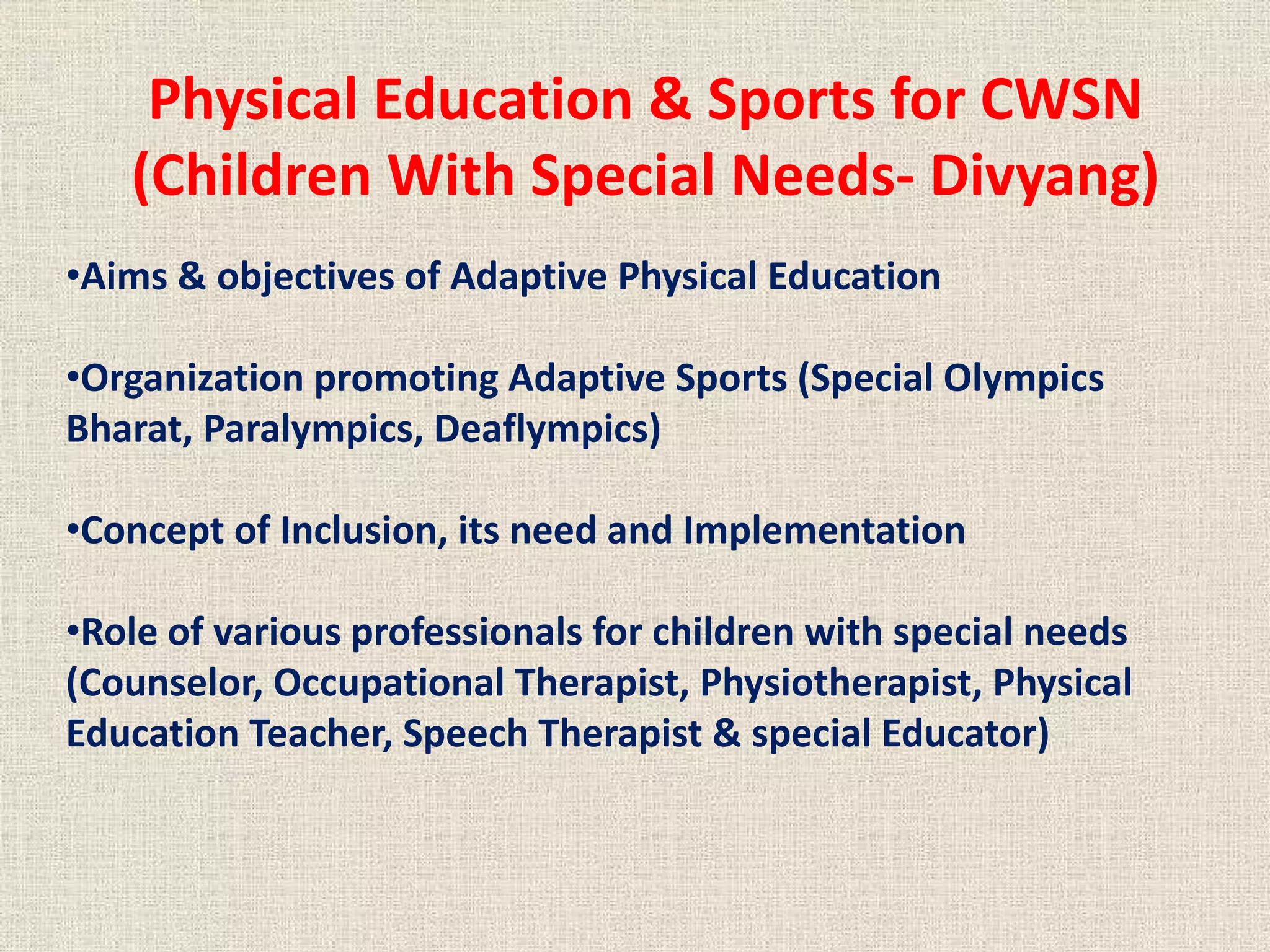
Physical Education & Sports for CWSN (Children
With Special Needs- Divyang)
Prepared by
Anil Dahiya
TGT-P&HE
KV Harsinghpura, Karnal
Physical Education & Sports for CWSN
(Children With Special Needs- Divyang)
•Aims & objectives of Adaptive Physical Education
•Organization promoting Adaptive Sports (Special Olympics
Bharat, Paralympics, Deaflympics)
•Concept of Inclusion, its need and Implementation
•Role of various professionals for children with special needs
(Counselor, Occupational Therapist, Physiotherapist, Physical
Education Teacher, Speech Therapist & special Educator)
Aims of Adaptive Physical Education
•The primary aim of adapted physical education should be to
ensure that the child is provided with physical education services
that meet his/her unique needs.
•A consideration of an adapted program would be the safety of
the student.
•Another consideration would be the development of the
student’s motor skills.
•Adapted physical education programs strive to ensure that each
student actively participates in physical education programs at his
or her own level and that the student is integrated into the regular
education program whenever possible.
•Other goals might include assisting students to develop self-
esteem, further socialization skills, and promote sportsmanship.
Objectives of Adaptive Physical Education
1. Participate regularly in developmentally age-appropriate
movement and motor skills.
2. Regular Medical Check Up
3. Develop a healthy level of flexibility, balance, muscular
strength and endurance, body composition, and cardio-
respiratory endurance.
4. Develop competency in movement and motor skills.
5. Learn game rules and strategies and demonstrate their
use in game settings.
6. Demonstrate appropriate social skills in a physical
activity setting.
7. Understand the benefits of regular physical activity.
8. Proper Equipments as per the unique need of the child
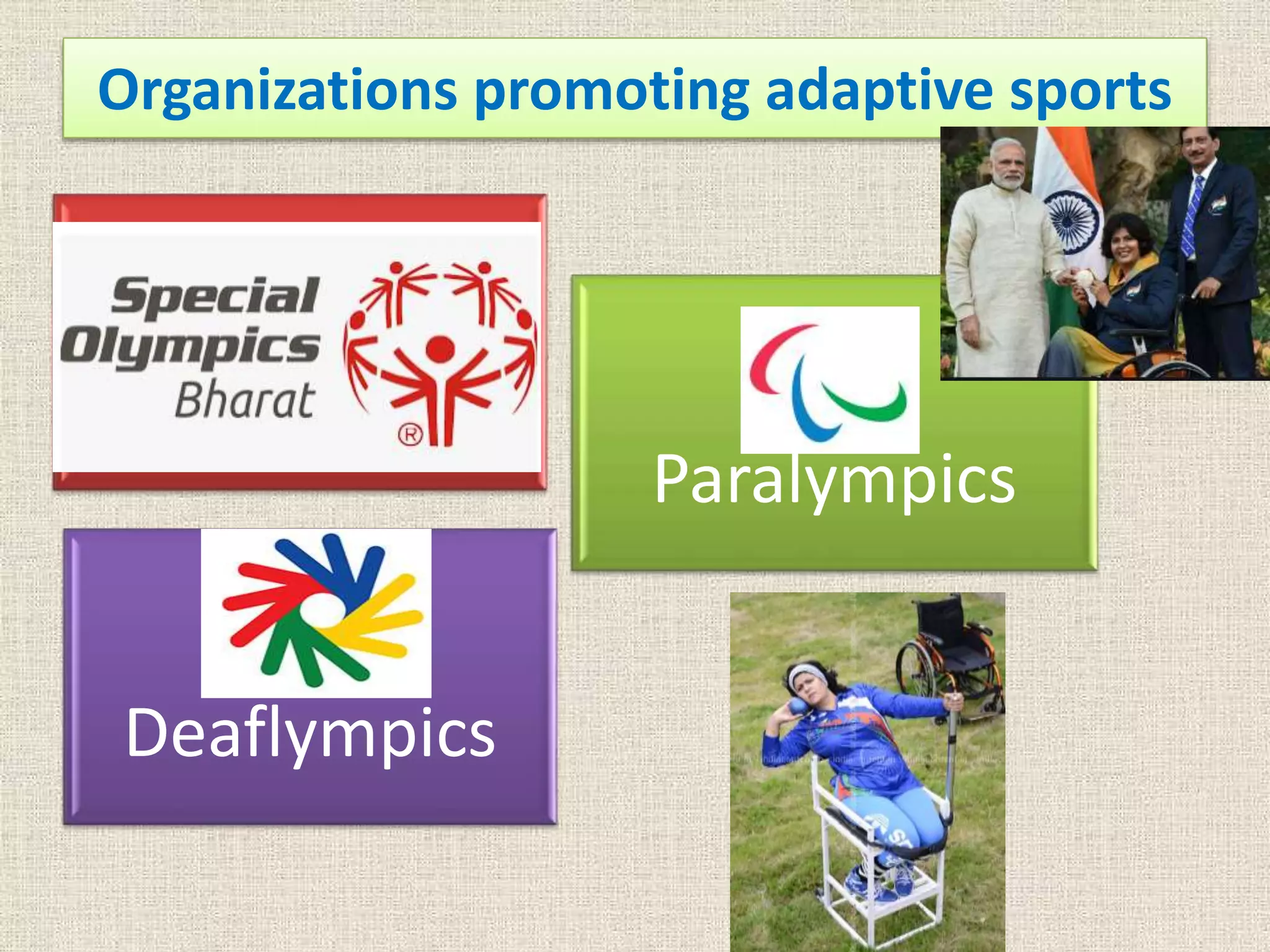
Organizations promoting adaptive sports
Special
Olympics
Bharat
Paralympics
Deaflympics
Oath
"Let me win. But if I cannot win, let me be brave in the attempt.”
This organization prepares the progress with physical and mental disability for special
Olympic. At national level, they are trained to participate in 24 single and team games by
the sports authority of India. This organization was established in 2001 as per the act of
1982.
Achievements
A total of 885 Special Olympics Bharat athletes have participated in eight World Summer
Games and five World Winter Games between 1987 and 2015. They have won 322 gold,
343 silver and 397 bronze medals in the world summer and world winter games bringing
a combined count to 1062 Medals.
14 sport disciplines.
: Athletics, Aquatics, Bocce, Basketball, Badminton
, TableTennis, Volleyball, Softball, Football, Power
lifting, Roller kating, Handball, Cycling & Unified
Golf
Paralympics
This is similar to Olympic game for disabled
sports person in 1960 first time it was
organized in Rome. The head quarter of
international Paralympics is situated at
Bonn, Germany. The international
Paralympics is responsible for organizing
summer and winter Olympic games. At
present it comprises of 176 National Para
Olympic Committees.
Summer Paralympics Games[92]
Winter Paralympics
Games
Year
No. of
Nations
Host(s)
1960 1 Rome
1964 2 Tokyo
1968 3 Tel Aviv
1972 4 Heidelberg
1976 5 Toronto 1 Örnsköldsvik
1980 6 Arnhem 2 Geilo
1984 7
New York
Stoke Mandeville
3 Innsbruck
1988 8 Seoul 4 Innsbruck
1992 9 Barcelona & Madrid[94] 5
Tignes & Albertvill
e
1994 6 Lillehammer
1996 10 Atlanta
1998 7 Nagano
2000 11 Sydney
2002 8 Salt Lake City
2004 12 Athens
2006 9 Turin
2008 13 Beijing
2010 10 Vancouver
2012 14 London
2014 11 Sochi
2016 15 Rio de Janeiro
2018 12 PyeongChang
2020 16 Tokyo[a]
2022 13 Beijing
2024 17 Paris
2026 14
Milan and Cortina
d'Ampezzo
2028 18 Los Angeles
Deaflympics
•The ‘Deaflympics’ are games for deaf athletes. Previously they were called the
International games for the Deaf. These games are organized by “The
International committee of sports for the Deaf” since the first event and they
are sanctioned by International Olympic committee.
•The deaf Olympian can not be guided by sounds for example, the starter gun,
bullhorn commands or referee whistles.
•The Deaflympics were held in Paris in 1924 and were also the first ever
international sporting events for athletes with disability.
•The Deaflympic winter games, was added in 1949. The games began as a small
gathering of 148 athletes. Now these games are grown into a global movement.
•To qualify for the games, athletes must have a hearing loss of at least 55db in
their “better ear”. Hearing aids, cochlear implant and the leke are not allowed to
be used in competition.
•Deaflympions can not be guided by sounds so alternative methods are used to
address the athletes. For example the football referees wave a flag instead of
blowing a whistle, on the track races are started by using a light, instead of using
a starting pistol.
Concept and need of Integrated Physical Education
Integrated Physical Educations using physical activities and games to teach
others subjects. This is a new concept in the field of Physical Education.
Research and studies have shown that integrating two or more subject at areas
can stimulate the interest of students and hence promote the learning of each
subjects. Teachers are increasing conducting activities both side and outside
the classroom to teach various concepts of Science, Social science and
Mathematics.
Integrated physical education is a comprehension concept. It is not only limited
to physical activities, games and sports but has become a complete discipline
within the past two decades the knowledge in this field has increased
tremendously. Due to research works, various sub disciplines such as sports
sociology, sports Biomechanics, Sports medicine, sports pedagogy, Exercise
Physiology, Sports Psychology, Sports Philosophy and sports management, etc.
This knowledge of integrated physical education would be able to help in the
fitness, health and wellness of all individuals. High quality physical education
programmes can be prepared with the help of integrated physical education.
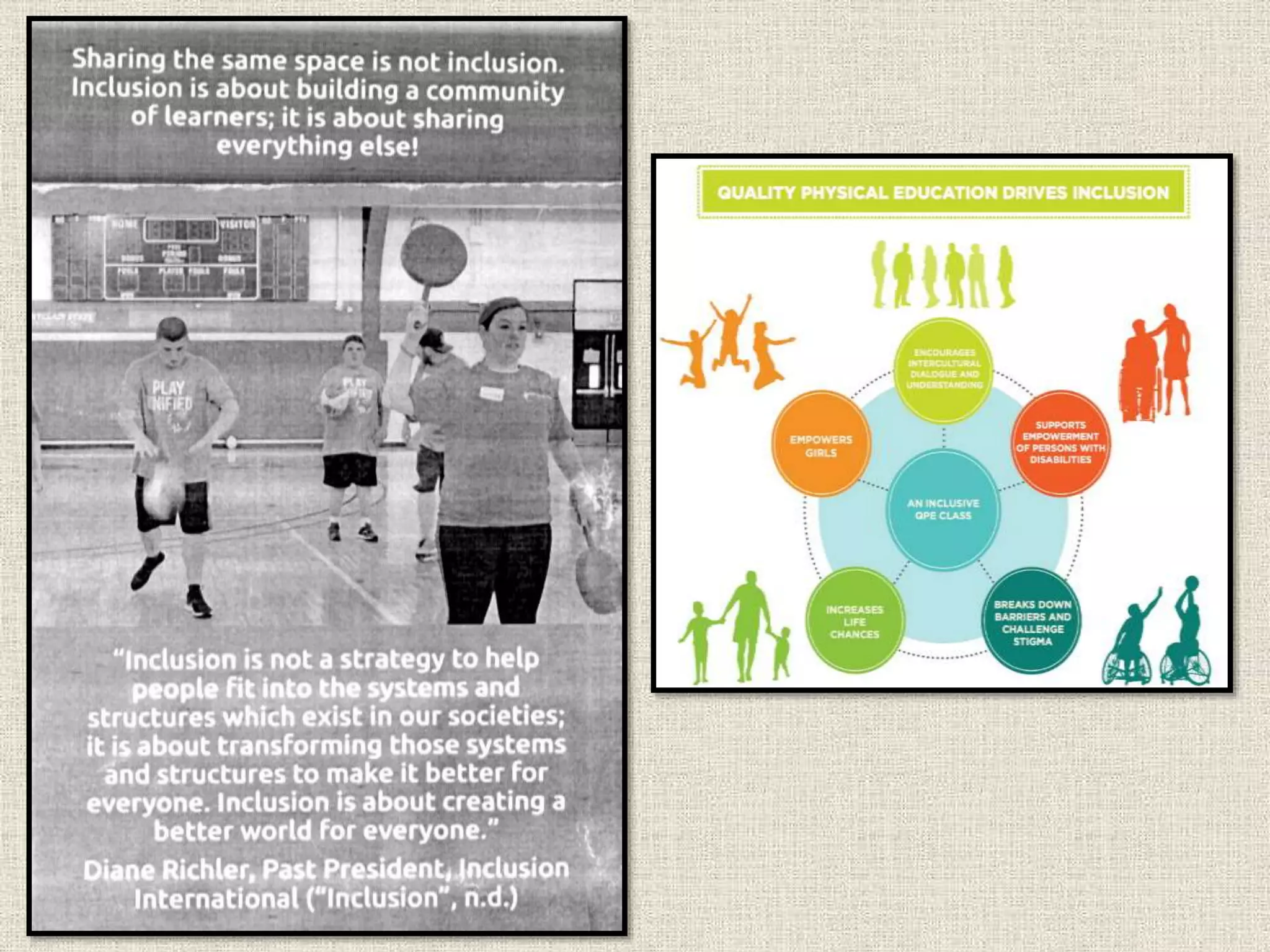
Concept of Inclusion
Inclusion
The practice of placing many different kinds of students together in general physical
education, and the philosophy that students should be educated together in one
classroom instead of separate classrooms designed to meet special needs.
Need of Inclusion
1. Increase their social skills and in making friends.
2. Develop Feeling of belongingness in the group.
3. Develop Motor skills and expense success with peers.
4. Develop self esteem & Confidence
5. Acquire leadership skills
6. Improve affective development
7. Improve affective Interacting amongst each other
8. Role models to each other
9. Team building -Seeking assistance/giving assistance
Role of various professionals CWSN
School Counselor
Special education counselors work with special need children in elementary
school, middle schools and high schools to ensure they have the support
services they need in order to achieve their highest potential in the areas of
academics, personal and social and career development.
Occupational Therapist
The goods of occupational therapy for a child are to improve participation and
performance of a child and all the child’s “occupation” like self care, play,
school and other daily activities. The occupational therapist well assess the
child and modify the environment, or the way of doing a task to promote a
better participation and independence.
Physical Education Teacher
Physical education program plays a very progressive role in improving cognitive
functions and academic performance. Social skills and collaborative team work
can also be enhanced through the different programs of physical education.
The physical education teacher helps in executing these programs.
Physiotherapist
Physiotherapist the best known therapist who work with children with special
needs. They use exercises to help their patients and keep the best possible use of
their bodies. They also try to improve breathing to prevent the development of
deformities and to slowdown the detoriation caused by some progressive
diseases.
Speech Therapist
Speech therapist is know by many names like speech language pathologist,
speech pathologist and speech teacher. They work with children with a variety of
delays and disorders spanning from mild articulation delays to more complex
disorders such as autism, down syndroms, hearing imparment, motor speech
disorders and other developmental delays. Speech teacher helps your child with
speech, talking and communication.
Special Education Teacher
Special education teachers work in classrooms or resource centers that only
include students with disabilities. Students with disability may attend classes
with general education students also known as inclusive classrooms. special
education teacher’s duties vary by the type of setting they work in, student
disabilities and teacher specialty.

PPT on chapter 4 class XI sports for cwsn Physical Education

  • 1.
    KENDRIYA VIDYALAYA SANGATHAN GurugramRegion CLASS -XI CHAPTER-4 Physical Education & Sports for CWSN (Children With Special Needs- Divyang) Prepared by Anil Dahiya TGT-P&HE KV Harsinghpura, Karnal
  • 2.
    Physical Education &Sports for CWSN (Children With Special Needs- Divyang) •Aims & objectives of Adaptive Physical Education •Organization promoting Adaptive Sports (Special Olympics Bharat, Paralympics, Deaflympics) •Concept of Inclusion, its need and Implementation •Role of various professionals for children with special needs (Counselor, Occupational Therapist, Physiotherapist, Physical Education Teacher, Speech Therapist & special Educator)
  • 3.
    Aims of AdaptivePhysical Education •The primary aim of adapted physical education should be to ensure that the child is provided with physical education services that meet his/her unique needs. •A consideration of an adapted program would be the safety of the student. •Another consideration would be the development of the student’s motor skills. •Adapted physical education programs strive to ensure that each student actively participates in physical education programs at his or her own level and that the student is integrated into the regular education program whenever possible. •Other goals might include assisting students to develop self- esteem, further socialization skills, and promote sportsmanship.
  • 4.
    Objectives of AdaptivePhysical Education 1. Participate regularly in developmentally age-appropriate movement and motor skills. 2. Regular Medical Check Up 3. Develop a healthy level of flexibility, balance, muscular strength and endurance, body composition, and cardio- respiratory endurance. 4. Develop competency in movement and motor skills. 5. Learn game rules and strategies and demonstrate their use in game settings. 6. Demonstrate appropriate social skills in a physical activity setting. 7. Understand the benefits of regular physical activity. 8. Proper Equipments as per the unique need of the child
  • 5.
    Organizations promoting adaptivesports Special Olympics Bharat Paralympics Deaflympics
  • 6.
    Oath "Let me win.But if I cannot win, let me be brave in the attempt.” This organization prepares the progress with physical and mental disability for special Olympic. At national level, they are trained to participate in 24 single and team games by the sports authority of India. This organization was established in 2001 as per the act of 1982. Achievements A total of 885 Special Olympics Bharat athletes have participated in eight World Summer Games and five World Winter Games between 1987 and 2015. They have won 322 gold, 343 silver and 397 bronze medals in the world summer and world winter games bringing a combined count to 1062 Medals. 14 sport disciplines. : Athletics, Aquatics, Bocce, Basketball, Badminton , TableTennis, Volleyball, Softball, Football, Power lifting, Roller kating, Handball, Cycling & Unified Golf
  • 7.
    Paralympics This is similarto Olympic game for disabled sports person in 1960 first time it was organized in Rome. The head quarter of international Paralympics is situated at Bonn, Germany. The international Paralympics is responsible for organizing summer and winter Olympic games. At present it comprises of 176 National Para Olympic Committees. Summer Paralympics Games[92] Winter Paralympics Games Year No. of Nations Host(s) 1960 1 Rome 1964 2 Tokyo 1968 3 Tel Aviv 1972 4 Heidelberg 1976 5 Toronto 1 Örnsköldsvik 1980 6 Arnhem 2 Geilo 1984 7 New York Stoke Mandeville 3 Innsbruck 1988 8 Seoul 4 Innsbruck 1992 9 Barcelona & Madrid[94] 5 Tignes & Albertvill e 1994 6 Lillehammer 1996 10 Atlanta 1998 7 Nagano 2000 11 Sydney 2002 8 Salt Lake City 2004 12 Athens 2006 9 Turin 2008 13 Beijing 2010 10 Vancouver 2012 14 London 2014 11 Sochi 2016 15 Rio de Janeiro 2018 12 PyeongChang 2020 16 Tokyo[a] 2022 13 Beijing 2024 17 Paris 2026 14 Milan and Cortina d'Ampezzo 2028 18 Los Angeles
  • 8.
    Deaflympics •The ‘Deaflympics’ aregames for deaf athletes. Previously they were called the International games for the Deaf. These games are organized by “The International committee of sports for the Deaf” since the first event and they are sanctioned by International Olympic committee. •The deaf Olympian can not be guided by sounds for example, the starter gun, bullhorn commands or referee whistles. •The Deaflympics were held in Paris in 1924 and were also the first ever international sporting events for athletes with disability. •The Deaflympic winter games, was added in 1949. The games began as a small gathering of 148 athletes. Now these games are grown into a global movement. •To qualify for the games, athletes must have a hearing loss of at least 55db in their “better ear”. Hearing aids, cochlear implant and the leke are not allowed to be used in competition. •Deaflympions can not be guided by sounds so alternative methods are used to address the athletes. For example the football referees wave a flag instead of blowing a whistle, on the track races are started by using a light, instead of using a starting pistol.
  • 9.
    Concept and needof Integrated Physical Education Integrated Physical Educations using physical activities and games to teach others subjects. This is a new concept in the field of Physical Education. Research and studies have shown that integrating two or more subject at areas can stimulate the interest of students and hence promote the learning of each subjects. Teachers are increasing conducting activities both side and outside the classroom to teach various concepts of Science, Social science and Mathematics. Integrated physical education is a comprehension concept. It is not only limited to physical activities, games and sports but has become a complete discipline within the past two decades the knowledge in this field has increased tremendously. Due to research works, various sub disciplines such as sports sociology, sports Biomechanics, Sports medicine, sports pedagogy, Exercise Physiology, Sports Psychology, Sports Philosophy and sports management, etc. This knowledge of integrated physical education would be able to help in the fitness, health and wellness of all individuals. High quality physical education programmes can be prepared with the help of integrated physical education.
  • 10.
    Concept of Inclusion Inclusion Thepractice of placing many different kinds of students together in general physical education, and the philosophy that students should be educated together in one classroom instead of separate classrooms designed to meet special needs. Need of Inclusion 1. Increase their social skills and in making friends. 2. Develop Feeling of belongingness in the group. 3. Develop Motor skills and expense success with peers. 4. Develop self esteem & Confidence 5. Acquire leadership skills 6. Improve affective development 7. Improve affective Interacting amongst each other 8. Role models to each other 9. Team building -Seeking assistance/giving assistance
  • 12.
    Role of variousprofessionals CWSN School Counselor Special education counselors work with special need children in elementary school, middle schools and high schools to ensure they have the support services they need in order to achieve their highest potential in the areas of academics, personal and social and career development. Occupational Therapist The goods of occupational therapy for a child are to improve participation and performance of a child and all the child’s “occupation” like self care, play, school and other daily activities. The occupational therapist well assess the child and modify the environment, or the way of doing a task to promote a better participation and independence. Physical Education Teacher Physical education program plays a very progressive role in improving cognitive functions and academic performance. Social skills and collaborative team work can also be enhanced through the different programs of physical education. The physical education teacher helps in executing these programs.
  • 13.
    Physiotherapist Physiotherapist the bestknown therapist who work with children with special needs. They use exercises to help their patients and keep the best possible use of their bodies. They also try to improve breathing to prevent the development of deformities and to slowdown the detoriation caused by some progressive diseases. Speech Therapist Speech therapist is know by many names like speech language pathologist, speech pathologist and speech teacher. They work with children with a variety of delays and disorders spanning from mild articulation delays to more complex disorders such as autism, down syndroms, hearing imparment, motor speech disorders and other developmental delays. Speech teacher helps your child with speech, talking and communication. Special Education Teacher Special education teachers work in classrooms or resource centers that only include students with disabilities. Students with disability may attend classes with general education students also known as inclusive classrooms. special education teacher’s duties vary by the type of setting they work in, student disabilities and teacher specialty.