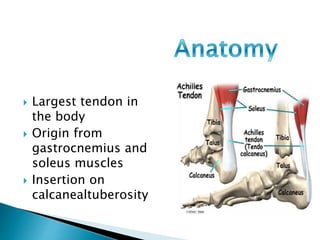
 Largest tendon in
the body
 Origin from
gastrocnemius and
soleus muscles
 Insertion on
calcanealtuberosity
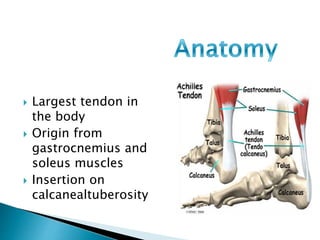
 Largest tendon in
the body
 Origin from
gastrocnemius and
soleus muscles
 Insertion on
calcanealtuberosity
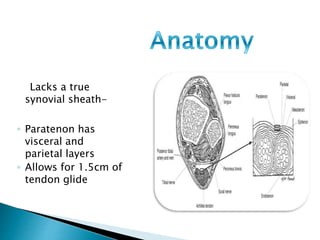
Lacks a true
synovial sheath-
◦ Paratenon has
visceral and
parietal layers
◦ Allows for 1.5cm of
tendon glide
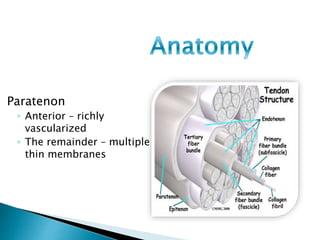
Paratenon
◦ Anterior – richly
vascularized
◦ The remainder – multiple
thin membranes
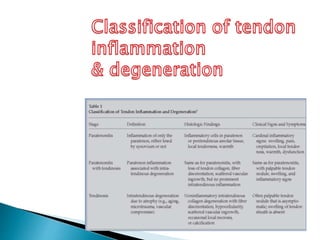
*Also Called Achilles Tenosynovitis
or Achilles tendinopathy.
*Generally Caused By overuse of
the limb
*More Common in Athletes.
 Most Commonly Found In individuals Aged
30-40 years.
 90% of injury occurs while playing Sports.
 Most Common in Males.
 Risk Factors are walking ,Running
,Age,Gender,improper stretching and overuse
of the tendon.
 Physiologically it is subjected to poor blood
supply through the synovial sheath that
surrounds it.
 Tightness og muscle is also involved in the
cause of onset on tendinitis.
 Excessive pronation of the foot in the
subtalar joint.
 Pain or ache and swelling in the local area of
the ankle.
 Pain Is usually worse during and after the
activity.
 This injury can be slow to heal as the tendon has
poor blood supply or cell activity.
 It receives nutrition from the tendon sheath and
paratendon.
 Repair takes place by the cells in the surrounding
structures .
 Along with the Cells Blood vessels also Come to aid
in Healing.
 Along with the Blood Vessels come nerve Fibres
which Leads to the pain.
 The Local Anaesthetics is given around the Blood
Vessels to relieve the pain.
 Possible with Ice,Cold compression Therapy
Wearing Heel Pads.
 Compression around ankle and lower Calf can
also lead to improvement.
 Other treatments are non steroidal anti
inflammatory Drugs such as ibuprofen.
 Ultrasound Therapy
 Manual Therapy Techniques.
 Rehabilitation Programmes.
 Performing consistent physical activity will
improve the elasticity and strength of the tendon,
which will assist in resisting the forces that are
applied.
 Stretch and warm-up before beginning an
exercise session in order to prepare and protect
the tendon for work is essential.
 In the case of incorrect foot alignment, orthotics
can be used as a preventative way to properly
position the feet
 Eccentric exercises improve the tensile strength
of the tendon and lengthen the muscle-tendon
junction, decreasing the amount of strain
experienced with ankle joint movements.
*Eccentric Exercise involve repetitions of slowly raising
and lowering the body while standing on the affected
leg, using the opposite arm to assist balance and
support if necessary, and starting with the heel in a
hyperextended position. (Hyperextension is typically
achieved by balancing the forefoot on the edge of a
step, a thick book, or a barbell weight. so that the
point of the heel is a couple of inches below the
forefoot.)
 Achilles tendon is fibrous tissue that connects the heel
to the muscles of the lower leg(the calf muscles).
 The Achilles tendon is the thickest and strongest tendon
in the body.
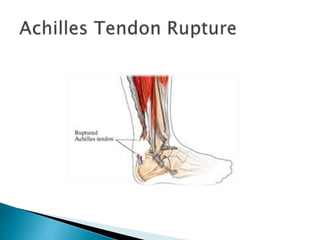
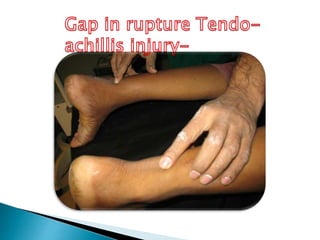
 Achilles tendon rupture is a complete or partial tear
through the tendon, which usually occurs about 2
inches above the heel bone.
 It most commonly occurs in people playing recreational
sports.
 commonly occur to otherwise healthy men between the
ages of 30 and 50 years
 Forceful push-off with your foot while your knee is
straightened by the powerful thigh muscles. One
example might be starting a foot race or jumping.
 Suddenly trip or stumble, and your foot is thrust in
front to break a fall, forcefully overstretching the
tendon.
 You fall from a significant height.
 Improper footwear.
 Pain along the back of foot and above the heel
 An inability to bend the foot downward or "push off"
the injured leg.
 An inability to stand up on the injured leg
 A popping or snapping sound when the injury occurs
 Tenderness, swelling
 Stiffness
 Ultrasound: An ultrasound uses sound waves to show
pictures if your Achilles tendon is torn.
 MRI: this image to see how much tendon damage you have.
This image may show if you have swelling and bleeding
around the torn tendon.
 Thompson test: The patient is placed prone, with both feet
extended off the end of the table. Both calf muscles are
squeezed by the examiner alternately and compared.
◦ Negative sign: foot will plantar flex when the calf is
squeezed
◦ Positive sign: normal plantar flexion will not occur
 NSAIDs : to relief pain
 Non operative
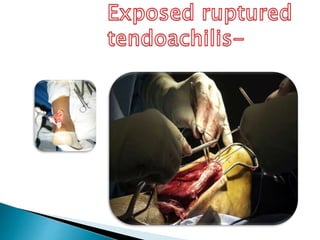
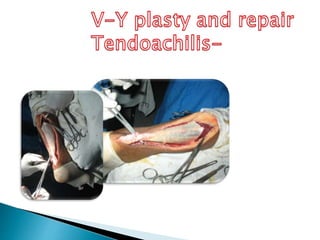
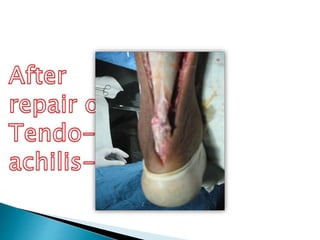
 Surgery : Surgery is a common treatment for a
complete rupture of the Achilles tendon. The procedure
generally involves making an incision in the back of
your lower leg and stitching the torn tendon together.
 Acute immobilization
 Pain mx: cryotherapy ( to reduce pain & swelling)
 Gait: Use crutches - Non-weight bearing
 Subacute post-immobilization
 Pain mx: Ice massage (to reduce pain & swelling)
 Gait: Use cruthes – PWB
 Mobilizing exs: to increase ROM (dorsiflexion)
 Strengthening exs: improve strength of calf and tendon – heel
raise, close kinetic chain exs.
 Stationary bicycle: to improved cardiovascular endurance.
 Terminal
 Gait: crutches – full weight bearing
 Improve ROM: achilles tendon stretching( increase flexibility
of the calf muscle)
 Improve strength calf ms: elastic resistance(theraband)
 Improved CV endurance: stationary bicycle
 Return to activity
 Improve gait: crutches – full weight bearing
 Improved strength of calf ms: controlled squats,
lunges, bilateral calf raise, toe raise.
 Improved CV endurance: stair climber
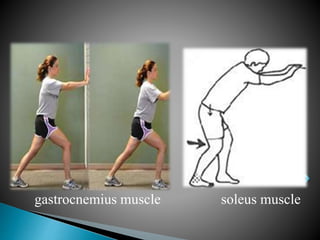
gastrocnemius muscle soleus muscle
Tendo achilles inflammation and rupture

Tendo achilles inflammation and rupture

  • 2.
     Largest tendonin the body  Origin from gastrocnemius and soleus muscles  Insertion on calcanealtuberosity
  • 3.
     Largest tendonin the body  Origin from gastrocnemius and soleus muscles  Insertion on calcanealtuberosity
  • 4.
    Lacks a true synovialsheath- ◦ Paratenon has visceral and parietal layers ◦ Allows for 1.5cm of tendon glide
  • 5.
    Paratenon ◦ Anterior –richly vascularized ◦ The remainder – multiple thin membranes
  • 6.
    *Also Called AchillesTenosynovitis or Achilles tendinopathy. *Generally Caused By overuse of the limb *More Common in Athletes.
  • 7.
     Most CommonlyFound In individuals Aged 30-40 years.  90% of injury occurs while playing Sports.  Most Common in Males.  Risk Factors are walking ,Running ,Age,Gender,improper stretching and overuse of the tendon.
  • 8.
     Physiologically itis subjected to poor blood supply through the synovial sheath that surrounds it.  Tightness og muscle is also involved in the cause of onset on tendinitis.  Excessive pronation of the foot in the subtalar joint.
  • 9.
     Pain orache and swelling in the local area of the ankle.  Pain Is usually worse during and after the activity.
  • 10.
     This injurycan be slow to heal as the tendon has poor blood supply or cell activity.  It receives nutrition from the tendon sheath and paratendon.  Repair takes place by the cells in the surrounding structures .  Along with the Cells Blood vessels also Come to aid in Healing.  Along with the Blood Vessels come nerve Fibres which Leads to the pain.  The Local Anaesthetics is given around the Blood Vessels to relieve the pain.
  • 11.
     Possible withIce,Cold compression Therapy Wearing Heel Pads.  Compression around ankle and lower Calf can also lead to improvement.  Other treatments are non steroidal anti inflammatory Drugs such as ibuprofen.  Ultrasound Therapy  Manual Therapy Techniques.  Rehabilitation Programmes.
  • 12.
     Performing consistentphysical activity will improve the elasticity and strength of the tendon, which will assist in resisting the forces that are applied.  Stretch and warm-up before beginning an exercise session in order to prepare and protect the tendon for work is essential.  In the case of incorrect foot alignment, orthotics can be used as a preventative way to properly position the feet  Eccentric exercises improve the tensile strength of the tendon and lengthen the muscle-tendon junction, decreasing the amount of strain experienced with ankle joint movements.
  • 13.
    *Eccentric Exercise involverepetitions of slowly raising and lowering the body while standing on the affected leg, using the opposite arm to assist balance and support if necessary, and starting with the heel in a hyperextended position. (Hyperextension is typically achieved by balancing the forefoot on the edge of a step, a thick book, or a barbell weight. so that the point of the heel is a couple of inches below the forefoot.)
  • 16.
     Achilles tendonis fibrous tissue that connects the heel to the muscles of the lower leg(the calf muscles).  The Achilles tendon is the thickest and strongest tendon in the body.
  • 17.
     Achilles tendonrupture is a complete or partial tear through the tendon, which usually occurs about 2 inches above the heel bone.  It most commonly occurs in people playing recreational sports.  commonly occur to otherwise healthy men between the ages of 30 and 50 years
  • 18.
     Forceful push-offwith your foot while your knee is straightened by the powerful thigh muscles. One example might be starting a foot race or jumping.  Suddenly trip or stumble, and your foot is thrust in front to break a fall, forcefully overstretching the tendon.  You fall from a significant height.  Improper footwear.
  • 19.
     Pain alongthe back of foot and above the heel  An inability to bend the foot downward or "push off" the injured leg.  An inability to stand up on the injured leg  A popping or snapping sound when the injury occurs  Tenderness, swelling  Stiffness
  • 20.
     Ultrasound: Anultrasound uses sound waves to show pictures if your Achilles tendon is torn.  MRI: this image to see how much tendon damage you have. This image may show if you have swelling and bleeding around the torn tendon.  Thompson test: The patient is placed prone, with both feet extended off the end of the table. Both calf muscles are squeezed by the examiner alternately and compared. ◦ Negative sign: foot will plantar flex when the calf is squeezed ◦ Positive sign: normal plantar flexion will not occur
  • 21.
     NSAIDs :to relief pain  Non operative  Surgery : Surgery is a common treatment for a complete rupture of the Achilles tendon. The procedure generally involves making an incision in the back of your lower leg and stitching the torn tendon together.
  • 22.
     Acute immobilization Pain mx: cryotherapy ( to reduce pain & swelling)  Gait: Use crutches - Non-weight bearing  Subacute post-immobilization  Pain mx: Ice massage (to reduce pain & swelling)  Gait: Use cruthes – PWB  Mobilizing exs: to increase ROM (dorsiflexion)  Strengthening exs: improve strength of calf and tendon – heel raise, close kinetic chain exs.
  • 23.
     Stationary bicycle:to improved cardiovascular endurance.  Terminal  Gait: crutches – full weight bearing  Improve ROM: achilles tendon stretching( increase flexibility of the calf muscle)  Improve strength calf ms: elastic resistance(theraband)  Improved CV endurance: stationary bicycle
  • 24.
     Return toactivity  Improve gait: crutches – full weight bearing  Improved strength of calf ms: controlled squats, lunges, bilateral calf raise, toe raise.  Improved CV endurance: stair climber
  • 25.