TENDONTRANSFER
• Tendon transfer:
• It is an operation in which insertion of the
tendon of the functioning muscle is moved
to a new site
• So that the muscle has a different action
from that time
• It is planned in such a way that loss of the
transferred muscle's original function does not
cause any problem
• A single tendon should be used to restore a
single function if transfer of single tendon for
multiple functions it will compromise
strength and movement
• Classified in to either
• POWER or
• POSITIONAL
• POWER : done to perform
motion
• require more powerful
donor
• POSITIONAL: done to maintain
correct posture
• not require powerful
donor
INDICATIONS
Main application in three group of
conditions
1. Muscle paralysis
2. Muscle imbalance
3. Rupture of tendon
• In other conditions like nervous system
disorder
e.g. CP or stroke
• Any birth defects
• Commonly done for radial nerve palsy
(Jone's transfer)
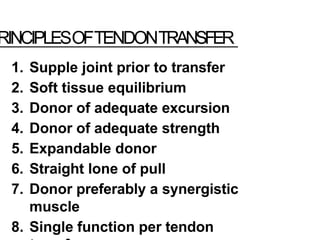
RINCIPLESOFTENDONTRANSFER
1. Supple joint prior to transfer
2. Soft tissue equilibrium
3. Donor of adequate excursion
4. Donor of adequate strength
5. Expandable donor
6. Straight lone of pull
7. Donor preferably a synergistic
muscle
8. Single function per tendon
PROCEDURE
• Usually a distal attachment of muscle
tendon unit is removed from its bony
attachment.
• Rettached to a different bone
• Or
• To a different location on the same
bone
• Or
• To a adjacent soft tissue.
• Then MTU is immobilized in a
shortened position for period of
time
Common tendon transfer
procedures
• To restore elbow extension:
• Pactoralis major / latissimus
dorsi
• Transfer to > triceps
• (In radial nerve lesion)
• To restore wrist extension:
• Pronator teres(MN) > ECRL &
ECRB
• To restore finger extension to MCP joint:
• FCU divided in 4/5 slips > attach
dorsally
• To restore thumb ext. And abd.:
• Palmaris longus or pronator
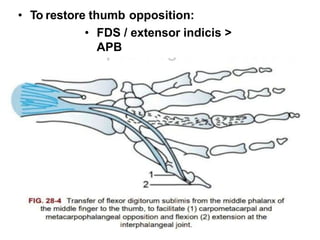
• To restore thumb opposition:
• FDS / extensor indicis >
APB
• To correct ulnar claw hand :
• FDS > EXTENSORS
• (Mainly in hansen's disease)
• To correct foot drop:
• Tibialis posterior > dorsum of
foot
• In poliomyelitis also to improve
functional ability tendon transfer is
done...
• UPPER LIMB:
• Shoulder abduction:
• Strong trapezius > neck of
humerus
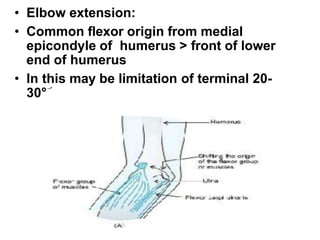
• Elbow extension:
• Common flexor origin from medial
epicondyle of humerus > front of lower
end of humerus
• In this may be limitation of terminal 20-
30° of elbow ext.
LOWER
LIMB:
• Hip:
.
Paralysis of glutei
Rarely undertaken surgery
• Iliopsoas/ erector spinae > gluteus
max.
• TFL > posteriorly for gluteus
med.
• Kne
e:
quadriceps
paralysis
• Hamstring > into
patella
• Foot
:
valgus deformity
correction
• Peroneus bravis > medial
cuneiform
• First metatarsal drop correction
• EHL > neck of 1st
metatarsal
• With
• Fusion of IP joint of big toe
MANAGEMENT
Preoperative:
• Four factors need special consideration
1. releases joint stiffness
2. Muscle should be stronger
3. Prevent previous action after transfer
4. Strengthening of associated muscle
group of the movement
Post
operative:
• During immobilization exercise are given
to the joints free from immobilization
• Proper positioning of joints during
immobilization
• After removal of POP Isometric of
• Glutei &
• Quadriceps
• Begin with > guided passive full ROM in
expected arc of movement
• Gradually progress to assisted
movement by encouraging pt. To
actively contract the transferred
muscle
• ESsynchronized with
patient'seffoet is extremely
useful in re-education
• Bio feedback also provide an excellent
means of re-education
• Session of re-education and
strengthening should be continued and
progressed till the active strong and
controlled movement by the transferred
muscle is achieved
• Guided functional training faster the
recovery
• Dyanamic orthosis may some time
become necessary to provide
assistance and prevent unwanted
movement
• Gait training: started as the pain
recedes
• As the initial weight bearing is
painful
• Weight transfer to limb
• single leg balance
• Ambulation
• Are done in graduated manner
• Walking aids may be necessary initially
but it should be decrease gradually
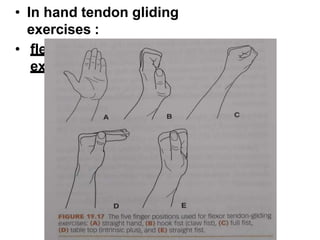
• In hand tendon gliding
exercises :
• flexor tendon gliding
exercise
• Extensor tendon gliding
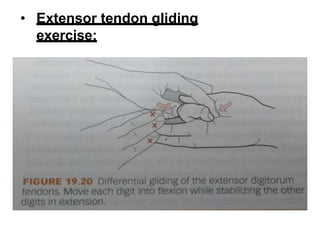
exercise:

TENDON TRANSFER-WPS Office_WPS PDF convert-converted.pptx

  • 1.
  • 2.
    • Tendon transfer: •It is an operation in which insertion of the tendon of the functioning muscle is moved to a new site • So that the muscle has a different action from that time • It is planned in such a way that loss of the transferred muscle's original function does not cause any problem • A single tendon should be used to restore a single function if transfer of single tendon for multiple functions it will compromise strength and movement
  • 3.
    • Classified into either • POWER or • POSITIONAL • POWER : done to perform motion • require more powerful donor • POSITIONAL: done to maintain correct posture • not require powerful donor
  • 4.
    INDICATIONS Main application inthree group of conditions 1. Muscle paralysis 2. Muscle imbalance 3. Rupture of tendon • In other conditions like nervous system disorder e.g. CP or stroke • Any birth defects • Commonly done for radial nerve palsy (Jone's transfer)
  • 5.
    RINCIPLESOFTENDONTRANSFER 1. Supple jointprior to transfer 2. Soft tissue equilibrium 3. Donor of adequate excursion 4. Donor of adequate strength 5. Expandable donor 6. Straight lone of pull 7. Donor preferably a synergistic muscle 8. Single function per tendon
  • 6.
    PROCEDURE • Usually adistal attachment of muscle tendon unit is removed from its bony attachment. • Rettached to a different bone • Or • To a different location on the same bone • Or • To a adjacent soft tissue. • Then MTU is immobilized in a shortened position for period of time
  • 7.
    Common tendon transfer procedures •To restore elbow extension: • Pactoralis major / latissimus dorsi • Transfer to > triceps • (In radial nerve lesion) • To restore wrist extension: • Pronator teres(MN) > ECRL & ECRB • To restore finger extension to MCP joint: • FCU divided in 4/5 slips > attach dorsally • To restore thumb ext. And abd.: • Palmaris longus or pronator
  • 8.
    • To restorethumb opposition: • FDS / extensor indicis > APB
  • 9.
    • To correctulnar claw hand : • FDS > EXTENSORS • (Mainly in hansen's disease) • To correct foot drop: • Tibialis posterior > dorsum of foot • In poliomyelitis also to improve functional ability tendon transfer is done... • UPPER LIMB: • Shoulder abduction: • Strong trapezius > neck of humerus
  • 10.
    • Elbow extension: •Common flexor origin from medial epicondyle of humerus > front of lower end of humerus • In this may be limitation of terminal 20- 30° of elbow ext.
  • 11.
    LOWER LIMB: • Hip: . Paralysis ofglutei Rarely undertaken surgery • Iliopsoas/ erector spinae > gluteus max. • TFL > posteriorly for gluteus med. • Kne e: quadriceps paralysis • Hamstring > into patella • Foot : valgus deformity correction • Peroneus bravis > medial cuneiform • First metatarsal drop correction • EHL > neck of 1st metatarsal • With • Fusion of IP joint of big toe
  • 12.
    MANAGEMENT Preoperative: • Four factorsneed special consideration 1. releases joint stiffness 2. Muscle should be stronger 3. Prevent previous action after transfer 4. Strengthening of associated muscle group of the movement
  • 13.
    Post operative: • During immobilizationexercise are given to the joints free from immobilization • Proper positioning of joints during immobilization • After removal of POP Isometric of • Glutei & • Quadriceps • Begin with > guided passive full ROM in expected arc of movement • Gradually progress to assisted movement by encouraging pt. To actively contract the transferred muscle
  • 14.
    • ESsynchronized with patient'seffoetis extremely useful in re-education • Bio feedback also provide an excellent means of re-education • Session of re-education and strengthening should be continued and progressed till the active strong and controlled movement by the transferred muscle is achieved • Guided functional training faster the recovery • Dyanamic orthosis may some time become necessary to provide assistance and prevent unwanted movement
  • 15.
    • Gait training:started as the pain recedes • As the initial weight bearing is painful • Weight transfer to limb • single leg balance • Ambulation • Are done in graduated manner • Walking aids may be necessary initially but it should be decrease gradually
  • 16.
    • In handtendon gliding exercises : • flexor tendon gliding exercise
  • 17.
    • Extensor tendongliding exercise: