
Prof. Satyen Bhattacharyya
Associate Professor: BIMLS, Bardhaman
Chief Physio: Fit O Fine
Director: Well O Fit Healthcare PVT. LTD.
Muscle Testing of Neck &
Scapula
Neck Manual Muscle
Testing
Neck Flexion
• Sternocleidomatioideus
Origin: Anterior and superior
manubrium and superior medial
third of clavicle
Insertion: Lateral aspect of
mastoid process and anterior half
of superior nuchal line
Nerve supply: Axillary Nerve
Sternocleidomatioideus
Note
• Factors Limiting Motion:
1- Tension of posterior longitudinal ligament,
ligamenta flava, and interspinal and supraspinal
ligaments
2- Tension of posterior muscles of neck
3- Apposition of lower lips of vertebral bodies
anteriorly with surfaces of subjacent vertebrae
4- Compression of intervertebral fibrocartilages
in front
• Fixation:
1- Contraction of anterior abdominal muscles
2-Weight of thorax and upper extremities
Normal & Good
• Position: Supine.
• Stabilization: Stabilize lower thorax.
• Desired Motion: Patient flexes cervical
spine through range of motion.
• Resistance: Is given on forehead
Note
►If there is a difference in strength of the two
Sternocleidomastoideus muscles, they may be tested separately by
rotation of head to one side and flexion of neck.
► Resistance is given above ear.
Fair & Poor
• Position: supine.
• Stabilization: Stabilize lower thorax.
• Desired Motion: Patient flexes
cervical spine through full ROM for
fair grade and through partial range
for poor.
Trace & Zero
• The Sternocleidomastoideus muscles
maybe palpated on each side of neck
as patient attempts to flex.
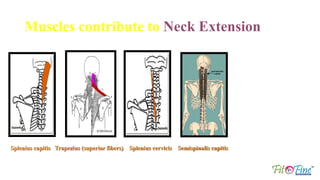
Muscles contribute to Neck Extension
Splenius capitis Trapezius (superior fibers) Splenius cervicis Semispinalis capitis
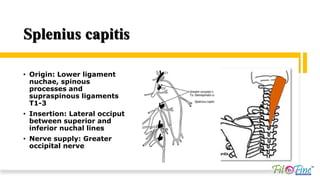
Splenius capitis
• Origin: Lower ligament
nuchae, spinous
processes and
supraspinous ligaments
T1-3
• Insertion: Lateral occiput
between superior and
inferior nuchal lines
• Nerve supply: Greater
occipital nerve
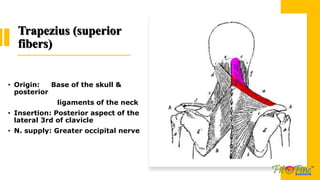
Trapezius (superior
fibers)
• Origin: Base of the skull &
posterior
ligaments of the neck
• Insertion: Posterior aspect of the
lateral 3rd of clavicle
• N. supply: Greater occipital nerve
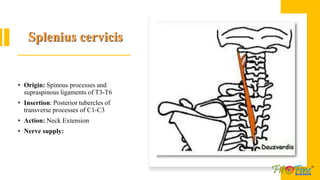
Splenius cervicis
• Origin: Spinous processes and
supraspinous ligaments of T3-T6
• Insertion: Posterior tubercles of
transverse processes of C1-C3
• Action: Neck Extension
• Nerve supply:
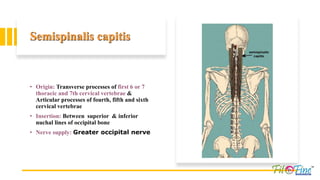
Semispinalis capitis
• Origin: Transverse processes of first 6 or 7
thoracic and 7th cervical vertebrae &
Articular processes of fourth, fifth and sixth
cervical vertebrae
• Insertion: Between superior & inferior
nuchal lines of occipital bone
• Nerve supply: Greater occipital nerve
Note
• Factors Limiting Motion:
1-Tension of anterior longitudinal ligament of spine
2-Tension of ventral neck muscles
3-Approximation of spinous processes
• Fixation:
1-Contraction of spinal extensor muscles of thorax and depressor
muscles of scapulae and clavicles
2- Weight of trunk and upper extremities
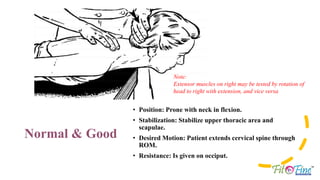
Normal & Good
• Position: Prone with neck in flexion.
• Stabilization: Stabilize upper thoracic area and
scapulae.
• Desired Motion: Patient extends cervical spine through
ROM.
• Resistance: Is given on occiput.
Note:
Extensor muscles on right may be tested by rotation of
head to right with extension, and vice versa
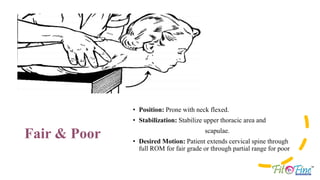
Fair & Poor
• Position: Prone with neck flexed.
• Stabilization: Stabilize upper thoracic area and
scapulae.
• Desired Motion: Patient extends cervical spine through
full ROM for fair grade or through partial range for poor
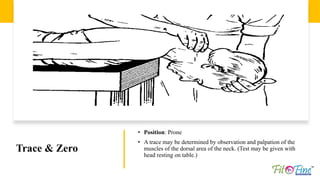
Trace & Zero
• Position: Prone
• A trace may be determined by observation and palpation of the
muscles of the dorsal area of the neck. (Test may be given with
head resting on table.)
Note
• Be sure patient completes full range of
motion of neck extension. Back muscles
may contract and lift upper trunk from
table, giving the appearance of extension
in cervical
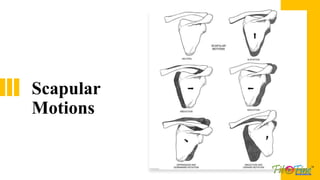
Scapular
Motions
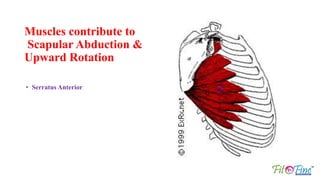
Muscles contribute to
Scapular Abduction &
Upward Rotation
• Serratus Anterior
Serratus
Anterior
• Origin: lateral, anterior
surface of the upper 8th-
9th ribs
• Insertion: Anterior aspect of
the medial vertebral border
of the scapula
• Action: Shoulder Abduction
to 90º
• Nerve supply: Long thoracic
nerve (C5 – C7)
Note
• Factors Limiting Motion:
1-Tension of trapezoid ligament (limits forward rotation of scapula upon
clavicle).
2-Tension of trapezius and Rhomboid major and minor muscles
• Fixation:
1- In strong scapular abduction, pull of external Obliquus externus
abdominus on same side.
2-Weight of thorax
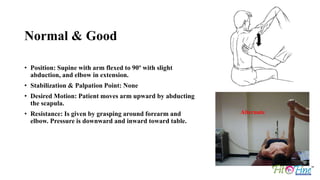
Normal & Good
• Position: Supine with arm flexed to 90º with slight
abduction, and elbow in extension.
• Stabilization & Palpation Point: None
• Desired Motion: Patient moves arm upward by abducting
the scapula.
• Resistance: Is given by grasping around forearm and
elbow. Pressure is downward and inward toward table.
Alternate
Fair
• Position: Supine with arm flexed to 90º and
scapula resting on table.
• Stabilization and Palpation: None
• Desired Motion: Patient forces arm upward.
Scapula should be completely abducted without
"winging' (If extensor muscles of elbow are weak,
elbow may be flexed, or forearm may be supported.
Alternate
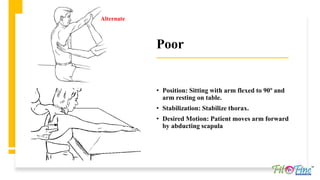
Poor
• Position: Sitting with arm flexed to 90º and
arm resting on table.
• Stabilization: Stabilize thorax.
• Desired Motion: Patient moves arm forward
by abducting scapula
Alternate
Trace & Zero
• Examiner lightly forces arm backward to
determine presence of a contraction of
Serratus anterior.
• Scapula should be observed for "winging."
• Digitations of Serratus anterior may be
palpated on outer surface of ribs for a
contraction
Muscles contribute to
Scapular Elevation
Upper Trapezius
Levator scapulae
Upper Trapezius
• Origin: Base of the skull & posterior
ligaments of the neck
• Insertion: Posterior aspect of the lateral
3rd of clavicle
• Nerve supply: Accessory nerve (C3 – C4)
Lavetor scapulae
• Origin: Transverse process
of 1st four cervical
• Insertion: Medial border of
the scapula
• Nerve supply: Dorsal
Scapular Nerve (C5)
Note
• Factors Limiting Motion:
1-Tension of costoclavicular ligament
2- Tension of muscles depressing scapula and clavicle: Pectoralis minor,
subclavius, and Trapezius (lower fibers).
• Fixation:
1-Flexor muscles of cervical spine (for tests done in sitting position).
2-Weight of head (foe tests done in prone position).
Normal & Good
• Position: Sitting with arms at sides.
• Stabilization: No fixation necessary.
• Palpation point: Between lateral
neck and acromion.
• Desired Motion: Patient raises
shoulders as high as possible
• Resistance: Is given downward on
top of shoulders.
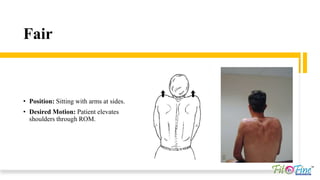
Fair
• Position: Sitting with arms at sides.
• Desired Motion: Patient elevates
shoulders through ROM.
Poor
• Position: Prone with shoulders
supported by examiner and forehead
resting on table.
• Desired Motion: Patient moves
shoulders toward ears through ROM.
Trace & Zero
• Examiner palpates upper fibers of
Trapezius parallel to cervical Vertebrae
and near their insertion above clavicle.
Note
Muscles contribute
to Scapular
Adduction
• Middle Trapezius
Middle Trapezius
• Origin: Spinous process of 7th cervical & 1st -
3rd thoracic
• Insertion:
• Medial border of acromion process
• Upper border of scapular spine
• Nerve supply: XI Accessory nerve (C3 – C4)
Note
• Factors Limiting Motion:
1-Tension of conoid ligament (limits backward rotation of scapula upon clavicle)
2-Tension of Pectoralis major and minor and Serratus anterior muscles.
3-Contact of vertebral border of scapula with spinal musculature.
• Fixation:
• Weight of trunk
Normal & Good
• Position: Prone with arm abducted to 90º and laterally rotated,
elbow flexed to a right angle.
• Stabilization: Stabilize thorax.
• Palpation point: Base of spine of scapula, fibers run horizontally
down to vertebra
• Desired Motion:
• Patient raises arm in horizontal abduction, motion taking place
primarily between the scapula and thorax and not at
glenohumeral joint.
• Scapula is adducted and fixed by middle section of the trapezius.
• Resistance: Is given on lateral angle of scapula. (no pressure is
placed on the humerus).
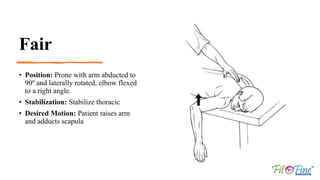
Fair
• Position: Prone with arm abducted to
90º and laterally rotated, elbow flexed
to a right angle.
• Stabilization: Stabilize thoracic
• Desired Motion: Patient raises arm
and adducts scapula
Poor
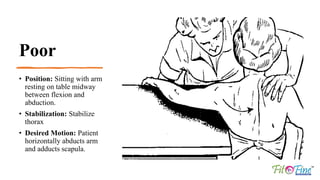
• Position: Sitting with arm
resting on table midway
between flexion and
abduction.
• Stabilization: Stabilize
thorax
• Desired Motion: Patient
horizontally abducts arm
and adducts scapula.
Trace &
Zero
• Position: Sitting or Face
lying.
• Palpation: Middle fibers of
Trapezius are palpated
between root of spine of
scapula and vertebral
column to determine
presence of a contraction.
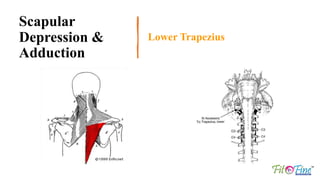
Scapular
Depression &
Adduction
Lower Trapezius
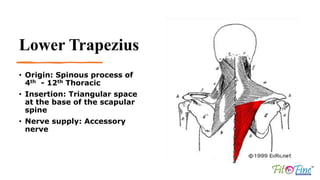
Lower Trapezius
• Origin: Spinous process of
4th - 12th Thoracic
• Insertion: Triangular space
at the base of the scapular
spine
• Nerve supply: Accessory
nerve
Note
• Factors Limiting Motion:
1- Tension of interclavicles ligament and articular disk of sternoclavicular joint.
2- Tension of Trapezius (upper fibers), Levator scapular and sternocleidomastoideus
(clavicular head).
• Fixation:
1-Contraction of spinal extensor muscles
2- Weight of trunk.
Normal & Good
• Position: Prone with forehead resting on table and arm to be
tested extended overhead.
• Palpation point:
• Diagonally down and medially from the base of the spine of
scapula.
• Desired Motion:
• Patient raises arm and fixates scapula strongly with lower part
of Trapezius.
• Resistance:
• Is given on lateral angle of scapula in upward and outward
direction. If shoulder flexion is limited, arm may be placed over
edge of table.)
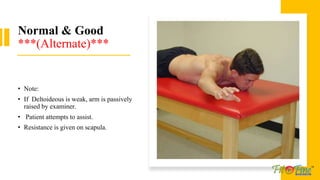
Normal & Good
***(Alternate)***
• Note:
• If Deltoideous is weak, arm is passively
raised by examiner.
• Patient attempts to assist.
• Resistance is given on scapula.
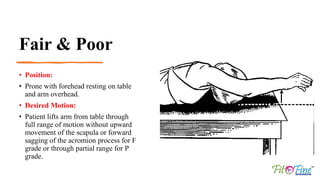
Fair & Poor
• Position:
• Prone with forehead resting on table
and arm overhead.
• Desired Motion:
• Patient lifts arm from table through
full range of motion without upward
movement of the scapula or forward
sagging of the acromion process for F
grade or through partial range for P
grade.
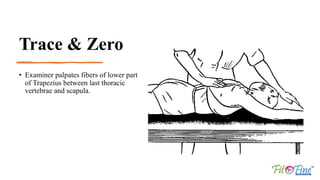
Trace & Zero
• Examiner palpates fibers of lower part
of Trapezius between last thoracic
vertebrae and scapula.
Scapular Adduction &
Downward Rotation
Rhomboid
Major
• Origin: Spinous process of T
2 –T 7 vertebrae
• Insertion: Medial border of
scapula inferior to spine
• Nerve supply: Dorsal
Scapular nerve (C5)
Rhomboid
Minor
• Origin: Spinous process of
C7 –T 1 vertebrae
• Insertion: Medial border of
scapula superior to spine
• Nerve supply: Dorsal
Scapular nerve (C5)
Note
• Factors Limiting Motion:
1-Tension of conoid ligament (limits backward rotation of scapula upon clavicle).
2-Tension of Pectoralis major and minor and Serratus anterior muscles
3-Contact of vertebral border of scapula with spinal musculature
• Fixation:
• Weight of trunk
• Substitutions:
1-Middle trapezius
2-Pectoralis Minor
3-Lower trapezius
4-Latissimus Dorsi
5-Levator Scapula
Caution !!!!
Normal & Good
• Position: Prone with arm medially rotated and
adducted across back, with the elbow flexed and
hand on buttocks. Shoulders relaxed.
• Stabilization: Roll the shoulder forward to pull
vertebral border of scapula, to eliminate Pectoralis
major.
• Palpation Point: Along vertebral border of scapula.
• Desired Motion: Patient raises arm and adducts
scapula.
• Resistance: Is given on vertebral border of scapula
in outward and slightly downward direction.
Fair
• Position:
• Prone with arm medially rotated and adducted
across back and shoulders relaxed.
• Desired Motion:
• Patient raises arm and adducts scapula through
range of motion. (If the glenohumeral muscles are
weak, slight resistance may be given to the scapula
for a fair grade.)
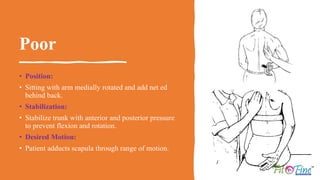
Poor
• Position:
• Sitting with arm medially rotated and add net ed
behind back.
• Stabilization:
• Stabilize trunk with anterior and posterior pressure
to prevent flexion and rotation.
• Desired Motion:
• Patient adducts scapula through range of motion.
Trace &
Zero
• Examiner palpates
Rhomboid muscles at the
angle formed by the
vertebral border of the
scapula and the lateral
fibers of the lower
Trapezius.
Reference
• Daniels and Wortingham’s Muscle Testing
Techniques of Manual Examination
• Physiopedia

MMT Neck & Scapula.pptx

  • 1.
    Prof. Satyen Bhattacharyya AssociateProfessor: BIMLS, Bardhaman Chief Physio: Fit O Fine Director: Well O Fit Healthcare PVT. LTD. Muscle Testing of Neck & Scapula
  • 2.
  • 3.
  • 4.
    Origin: Anterior andsuperior manubrium and superior medial third of clavicle Insertion: Lateral aspect of mastoid process and anterior half of superior nuchal line Nerve supply: Axillary Nerve Sternocleidomatioideus
  • 5.
    Note • Factors LimitingMotion: 1- Tension of posterior longitudinal ligament, ligamenta flava, and interspinal and supraspinal ligaments 2- Tension of posterior muscles of neck 3- Apposition of lower lips of vertebral bodies anteriorly with surfaces of subjacent vertebrae 4- Compression of intervertebral fibrocartilages in front • Fixation: 1- Contraction of anterior abdominal muscles 2-Weight of thorax and upper extremities
  • 6.
    Normal & Good •Position: Supine. • Stabilization: Stabilize lower thorax. • Desired Motion: Patient flexes cervical spine through range of motion. • Resistance: Is given on forehead
  • 7.
    Note ►If there isa difference in strength of the two Sternocleidomastoideus muscles, they may be tested separately by rotation of head to one side and flexion of neck. ► Resistance is given above ear.
  • 8.
    Fair & Poor •Position: supine. • Stabilization: Stabilize lower thorax. • Desired Motion: Patient flexes cervical spine through full ROM for fair grade and through partial range for poor.
  • 9.
    Trace & Zero •The Sternocleidomastoideus muscles maybe palpated on each side of neck as patient attempts to flex.
  • 10.
    Muscles contribute toNeck Extension Splenius capitis Trapezius (superior fibers) Splenius cervicis Semispinalis capitis
  • 11.
    Splenius capitis • Origin:Lower ligament nuchae, spinous processes and supraspinous ligaments T1-3 • Insertion: Lateral occiput between superior and inferior nuchal lines • Nerve supply: Greater occipital nerve
  • 12.
    Trapezius (superior fibers) • Origin:Base of the skull & posterior ligaments of the neck • Insertion: Posterior aspect of the lateral 3rd of clavicle • N. supply: Greater occipital nerve
  • 13.
    Splenius cervicis • Origin:Spinous processes and supraspinous ligaments of T3-T6 • Insertion: Posterior tubercles of transverse processes of C1-C3 • Action: Neck Extension • Nerve supply:
  • 14.
    Semispinalis capitis • Origin:Transverse processes of first 6 or 7 thoracic and 7th cervical vertebrae & Articular processes of fourth, fifth and sixth cervical vertebrae • Insertion: Between superior & inferior nuchal lines of occipital bone • Nerve supply: Greater occipital nerve
  • 15.
    Note • Factors LimitingMotion: 1-Tension of anterior longitudinal ligament of spine 2-Tension of ventral neck muscles 3-Approximation of spinous processes • Fixation: 1-Contraction of spinal extensor muscles of thorax and depressor muscles of scapulae and clavicles 2- Weight of trunk and upper extremities
  • 16.
    Normal & Good •Position: Prone with neck in flexion. • Stabilization: Stabilize upper thoracic area and scapulae. • Desired Motion: Patient extends cervical spine through ROM. • Resistance: Is given on occiput. Note: Extensor muscles on right may be tested by rotation of head to right with extension, and vice versa
  • 17.
    Fair & Poor •Position: Prone with neck flexed. • Stabilization: Stabilize upper thoracic area and scapulae. • Desired Motion: Patient extends cervical spine through full ROM for fair grade or through partial range for poor
  • 18.
    Trace & Zero •Position: Prone • A trace may be determined by observation and palpation of the muscles of the dorsal area of the neck. (Test may be given with head resting on table.)
  • 19.
    Note • Be surepatient completes full range of motion of neck extension. Back muscles may contract and lift upper trunk from table, giving the appearance of extension in cervical
  • 20.
  • 21.
    Muscles contribute to ScapularAbduction & Upward Rotation • Serratus Anterior
  • 22.
    Serratus Anterior • Origin: lateral,anterior surface of the upper 8th- 9th ribs • Insertion: Anterior aspect of the medial vertebral border of the scapula • Action: Shoulder Abduction to 90º • Nerve supply: Long thoracic nerve (C5 – C7)
  • 23.
    Note • Factors LimitingMotion: 1-Tension of trapezoid ligament (limits forward rotation of scapula upon clavicle). 2-Tension of trapezius and Rhomboid major and minor muscles • Fixation: 1- In strong scapular abduction, pull of external Obliquus externus abdominus on same side. 2-Weight of thorax
  • 24.
    Normal & Good •Position: Supine with arm flexed to 90º with slight abduction, and elbow in extension. • Stabilization & Palpation Point: None • Desired Motion: Patient moves arm upward by abducting the scapula. • Resistance: Is given by grasping around forearm and elbow. Pressure is downward and inward toward table. Alternate
  • 25.
    Fair • Position: Supinewith arm flexed to 90º and scapula resting on table. • Stabilization and Palpation: None • Desired Motion: Patient forces arm upward. Scapula should be completely abducted without "winging' (If extensor muscles of elbow are weak, elbow may be flexed, or forearm may be supported. Alternate
  • 26.
    Poor • Position: Sittingwith arm flexed to 90º and arm resting on table. • Stabilization: Stabilize thorax. • Desired Motion: Patient moves arm forward by abducting scapula Alternate
  • 27.
    Trace & Zero •Examiner lightly forces arm backward to determine presence of a contraction of Serratus anterior. • Scapula should be observed for "winging." • Digitations of Serratus anterior may be palpated on outer surface of ribs for a contraction
  • 28.
    Muscles contribute to ScapularElevation Upper Trapezius Levator scapulae
  • 29.
    Upper Trapezius • Origin:Base of the skull & posterior ligaments of the neck • Insertion: Posterior aspect of the lateral 3rd of clavicle • Nerve supply: Accessory nerve (C3 – C4)
  • 30.
    Lavetor scapulae • Origin:Transverse process of 1st four cervical • Insertion: Medial border of the scapula • Nerve supply: Dorsal Scapular Nerve (C5)
  • 31.
    Note • Factors LimitingMotion: 1-Tension of costoclavicular ligament 2- Tension of muscles depressing scapula and clavicle: Pectoralis minor, subclavius, and Trapezius (lower fibers). • Fixation: 1-Flexor muscles of cervical spine (for tests done in sitting position). 2-Weight of head (foe tests done in prone position).
  • 32.
    Normal & Good •Position: Sitting with arms at sides. • Stabilization: No fixation necessary. • Palpation point: Between lateral neck and acromion. • Desired Motion: Patient raises shoulders as high as possible • Resistance: Is given downward on top of shoulders.
  • 33.
    Fair • Position: Sittingwith arms at sides. • Desired Motion: Patient elevates shoulders through ROM.
  • 34.
    Poor • Position: Pronewith shoulders supported by examiner and forehead resting on table. • Desired Motion: Patient moves shoulders toward ears through ROM.
  • 35.
    Trace & Zero •Examiner palpates upper fibers of Trapezius parallel to cervical Vertebrae and near their insertion above clavicle.
  • 36.
  • 37.
  • 38.
    Middle Trapezius • Origin:Spinous process of 7th cervical & 1st - 3rd thoracic • Insertion: • Medial border of acromion process • Upper border of scapular spine • Nerve supply: XI Accessory nerve (C3 – C4)
  • 39.
    Note • Factors LimitingMotion: 1-Tension of conoid ligament (limits backward rotation of scapula upon clavicle) 2-Tension of Pectoralis major and minor and Serratus anterior muscles. 3-Contact of vertebral border of scapula with spinal musculature. • Fixation: • Weight of trunk
  • 40.
    Normal & Good •Position: Prone with arm abducted to 90º and laterally rotated, elbow flexed to a right angle. • Stabilization: Stabilize thorax. • Palpation point: Base of spine of scapula, fibers run horizontally down to vertebra • Desired Motion: • Patient raises arm in horizontal abduction, motion taking place primarily between the scapula and thorax and not at glenohumeral joint. • Scapula is adducted and fixed by middle section of the trapezius. • Resistance: Is given on lateral angle of scapula. (no pressure is placed on the humerus).
  • 41.
    Fair • Position: Pronewith arm abducted to 90º and laterally rotated, elbow flexed to a right angle. • Stabilization: Stabilize thoracic • Desired Motion: Patient raises arm and adducts scapula
  • 42.
    Poor • Position: Sittingwith arm resting on table midway between flexion and abduction. • Stabilization: Stabilize thorax • Desired Motion: Patient horizontally abducts arm and adducts scapula.
  • 43.
    Trace & Zero • Position:Sitting or Face lying. • Palpation: Middle fibers of Trapezius are palpated between root of spine of scapula and vertebral column to determine presence of a contraction.
  • 44.
  • 45.
    Lower Trapezius • Origin:Spinous process of 4th - 12th Thoracic • Insertion: Triangular space at the base of the scapular spine • Nerve supply: Accessory nerve
  • 46.
    Note • Factors LimitingMotion: 1- Tension of interclavicles ligament and articular disk of sternoclavicular joint. 2- Tension of Trapezius (upper fibers), Levator scapular and sternocleidomastoideus (clavicular head). • Fixation: 1-Contraction of spinal extensor muscles 2- Weight of trunk.
  • 47.
    Normal & Good •Position: Prone with forehead resting on table and arm to be tested extended overhead. • Palpation point: • Diagonally down and medially from the base of the spine of scapula. • Desired Motion: • Patient raises arm and fixates scapula strongly with lower part of Trapezius. • Resistance: • Is given on lateral angle of scapula in upward and outward direction. If shoulder flexion is limited, arm may be placed over edge of table.)
  • 48.
    Normal & Good ***(Alternate)*** •Note: • If Deltoideous is weak, arm is passively raised by examiner. • Patient attempts to assist. • Resistance is given on scapula.
  • 49.
    Fair & Poor •Position: • Prone with forehead resting on table and arm overhead. • Desired Motion: • Patient lifts arm from table through full range of motion without upward movement of the scapula or forward sagging of the acromion process for F grade or through partial range for P grade.
  • 50.
    Trace & Zero •Examiner palpates fibers of lower part of Trapezius between last thoracic vertebrae and scapula.
  • 51.
  • 52.
    Rhomboid Major • Origin: Spinousprocess of T 2 –T 7 vertebrae • Insertion: Medial border of scapula inferior to spine • Nerve supply: Dorsal Scapular nerve (C5)
  • 53.
    Rhomboid Minor • Origin: Spinousprocess of C7 –T 1 vertebrae • Insertion: Medial border of scapula superior to spine • Nerve supply: Dorsal Scapular nerve (C5)
  • 54.
    Note • Factors LimitingMotion: 1-Tension of conoid ligament (limits backward rotation of scapula upon clavicle). 2-Tension of Pectoralis major and minor and Serratus anterior muscles 3-Contact of vertebral border of scapula with spinal musculature • Fixation: • Weight of trunk • Substitutions: 1-Middle trapezius 2-Pectoralis Minor 3-Lower trapezius 4-Latissimus Dorsi 5-Levator Scapula Caution !!!!
  • 55.
    Normal & Good •Position: Prone with arm medially rotated and adducted across back, with the elbow flexed and hand on buttocks. Shoulders relaxed. • Stabilization: Roll the shoulder forward to pull vertebral border of scapula, to eliminate Pectoralis major. • Palpation Point: Along vertebral border of scapula. • Desired Motion: Patient raises arm and adducts scapula. • Resistance: Is given on vertebral border of scapula in outward and slightly downward direction.
  • 56.
    Fair • Position: • Pronewith arm medially rotated and adducted across back and shoulders relaxed. • Desired Motion: • Patient raises arm and adducts scapula through range of motion. (If the glenohumeral muscles are weak, slight resistance may be given to the scapula for a fair grade.)
  • 57.
    Poor • Position: • Sittingwith arm medially rotated and add net ed behind back. • Stabilization: • Stabilize trunk with anterior and posterior pressure to prevent flexion and rotation. • Desired Motion: • Patient adducts scapula through range of motion.
  • 58.
    Trace & Zero • Examinerpalpates Rhomboid muscles at the angle formed by the vertebral border of the scapula and the lateral fibers of the lower Trapezius.
  • 59.
    Reference • Daniels andWortingham’s Muscle Testing Techniques of Manual Examination • Physiopedia