Tendon Mechanics

 Biomechanics for Sport III


John McMahon BSc (Hons), ASCC, CSCS
Lecture Aims
• To remind you of the mechanical concepts of
  strain, stiffness and compliance
• To examine the rheological properties of
  materials & illustrate mechanical responses to
  loading
• To discuss the influence of tendon mechanical
  properties on muscle function
• To introduce the affect of stretching & training on
  tendon mechanical properties
• To understand in vivo measurement of tendon
  stiffness during dynamic exercises
                                                   32
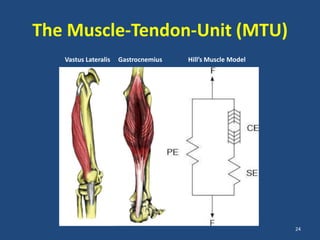
The Muscle-Tendon-Unit (MTU)
   Vastus Lateralis   Gastrocnemius   Hill’s Muscle Model


                                                            24
Strain
• The loading of a material will cause a deformation, which is
  known as strain

• There are 3 main types of load and therefore strain:

• Tension = pulling force - makes object longer and thinner

• Compression = pushing force - makes object shorter and
  thicker

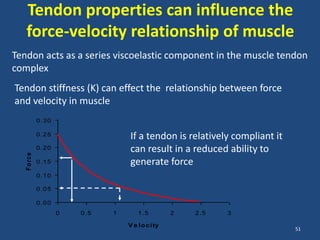
• Shear = a load comprised of 2 equal, opposite and parallel
  forces that tend to displace one part of an object with
  respect to an adjacent part along a plane parallel and
  between the line of the forces                          47
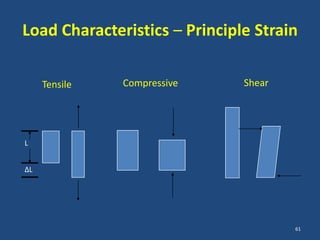
Load Characteristics – Principle Strain

     Tensile   Compressive     Shear


L


∆L


                                       61
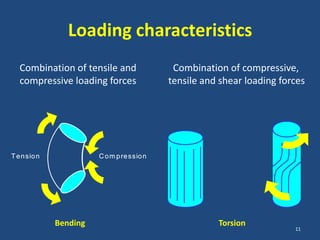
Loading characteristics
   Combination of tensile and                Combination of compressive,
   compressive loading forces               tensile and shear loading forces


T e n sio n             C o m p re ssio n


              Bending                                  Torsion
                                                                         11
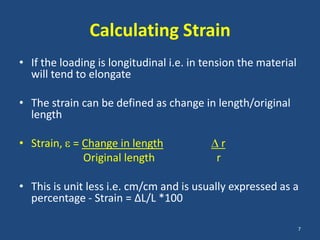
Calculating Strain
• If the loading is longitudinal i.e. in tension the material
  will tend to elongate

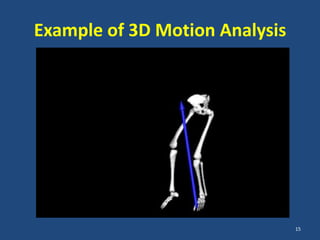
• The strain can be defined as change in length/original
  length

• Strain, = Change in length                   r
            Original length                r

• This is unit less i.e. cm/cm and is usually expressed as a
  percentage - Strain = ∆L/L *100

                                                                7
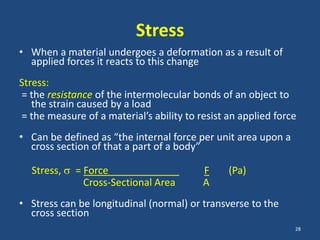
Stress
• When a material undergoes a deformation as a result of
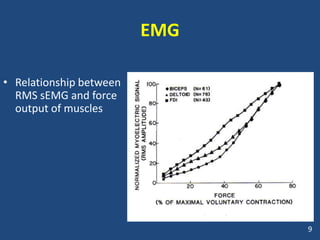
  applied forces it reacts to this change
Stress:
= the resistance of the intermolecular bonds of an object to
   the strain caused by a load
= the measure of a material’s ability to resist an applied force
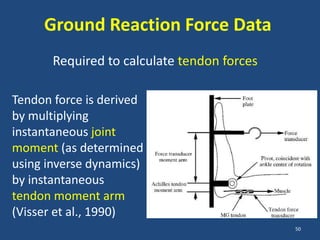
• Can be defined as “the internal force per unit area upon a
  cross section of that a part of a body”

  Stress,   = Force                       F     (Pa)
              Cross-Sectional Area        A
• Stress can be longitudinal (normal) or transverse to the
  cross section
                                                               28
Rheological Properties of Materials
     Rheology - the study of the deformation and flow of matter

• Elasticity – relates to the ability of the material to return to
  its original dimension after loading – for a purely elastic
  material the relationship between loading and deformation
  will be a straight line – i.e. energy is stored

• Viscosity – here the material will deform with loading but
  will have a lag between developing stress and the resultant
  strain – the greater the rate of loading, the greater the
  stress developed – the material will retain its new
  shape/size – i.e. energy is absorbed


                                                                  49
Rheological Properties of Materials
• Material can possess properties of both viscosity
  and elasticity and hence be viscoelastic. Here the
  material will tend to deform and return to its
  original shape in a non linear fashion

• Plasticity – here when the material is deformed it
  tends to retain its new shape/size. Deformation
  tends to be without a lag and energy is absorbed


                                                  56
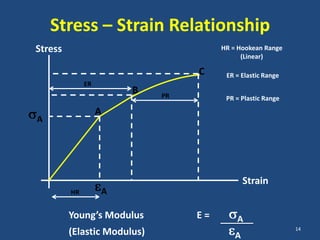
Stress – Strain Relationship
Stress                                 HR = Hookean Range
                                             (Linear)

                                  C     ER = Elastic Range
              ER
                       B     PR         PR = Plastic Range
                   A
A


                                               Strain
         HR        A

         Young’s Modulus          E=       A
                                                             14
         (Elastic Modulus)                 A
Stress – Strain Relationship
            (Stiffness and Compliance)
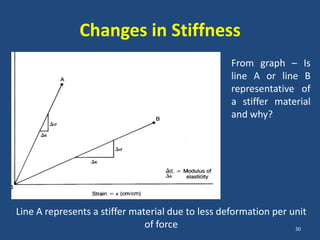
• It allows the description of the material in terms of the
  rheological properties previously defined

• It relates to Hooke’s law and allows the determination of
  the material ‘stiffness’ – Young’s modulus (E = ∆σ/∆ε)

• A very stiff material can tolerate high loads (stress) with
  only small deformations (strain)

• A higher value for E is indicative of a stiffer material

• Compliance is sometimes used instead of stiffness and is
  simply the inverse of stiffness i.e. the ratio of strain change
  to stress change                                               52
Changes in Stiffness
                                                   From graph – Is
                                                   line A or line B
                                                   representative of
                                                   a stiffer material
                                                   and why?


Line A represents a stiffer material due to less deformation per unit
                               of force                           30
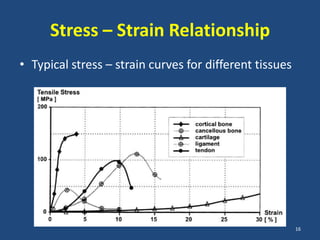
Stress – Strain Relationship
• Typical stress – strain curves for different tissues


                                                         16
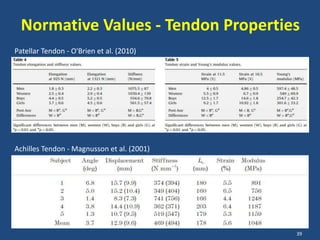
Normative Values - Tendon Properties
Patellar Tendon - O'Brien et al. (2010)


Achilles Tendon - Magnusson et al. (2001)


                                            39
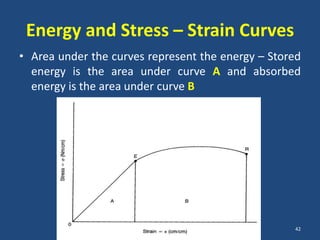
Energy and Stress – Strain Curves
• Area under the curves represent the energy – Stored
  energy is the area under curve A and absorbed
  energy is the area under curve B


                                                   42
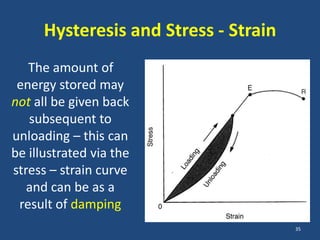
Hysteresis and Stress - Strain
   The amount of
 energy stored may
not all be given back
   subsequent to
unloading – this can
be illustrated via the
stress – strain curve
   and can be as a
 result of damping
                                       35
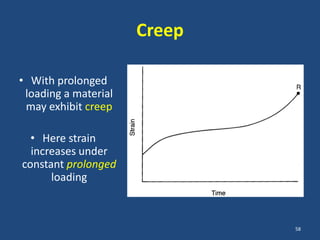
Creep

• With prolonged
 loading a material
 may exhibit creep

  • Here strain
  increases under
constant prolonged
      loading


                              58
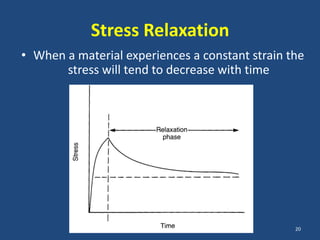
Stress Relaxation
• When a material experiences a constant strain the
       stress will tend to decrease with time


                                                 20
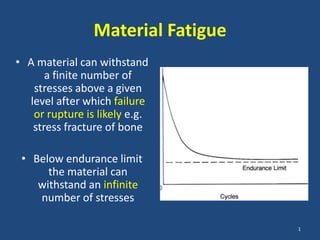
Material Fatigue
• A material can withstand
      a finite number of
   stresses above a given
  level after which failure
   or rupture is likely e.g.
   stress fracture of bone

 • Below endurance limit
      the material can
    withstand an infinite
    number of stresses

                                   1
Tendon Injury
Research performed using isolated tendons:

For Achilles tendon:
• Maximum Modulus: 819 MPa
• Failure Load: 5098 N
• Failure Stress: 79 MPa (Wren et al., 2001)

Damage may occur at:
• 15-30% strain (Haut & Pawlinson, 1990;
  Stäubli et al., 1999)
                                               43
Tendon Injury
However, in vivo tendon research has shown:

• Tendon strains of 6-14% during MVC and up to
  11.4% during SSC without injury occurrence
• Tendon forces to reach in excess of 5000 N
Differences due to:

• Preservatives
• Tendon tested
• Region of tendon tested
                                              22
Factors Affecting Mechanical
    Properties of Tendon

            • Age
          • Gender
         • Stretching
          • Training
          • Fatigue
       • Chronic disease
         • Time of day
                               3
Influence of Tendon Mechanical
 Properties on Muscle Function


                                 37
Why study tendon mechanical
                properties?
  Function of tendons:
  • Tensile force transmission
  • Storage and release of energy during locomotion
                                     (Maganaris and Paul, 2002)


The mechanical properties of tendon significantly affect muscle
output and function


                                                                  25
Tendon properties can influence the
   force-velocity relationship of muscle
Tendon acts as a series viscoelastic component in the muscle tendon
complex
Tendon stiffness (K) can effect the relationship between force
and velocity in muscle
             0.30

             0.25                  If a tendon is relatively compliant it
             0.20                  can result in a reduced ability to
   F o rce


             0.15                  generate force
             0.10

             0.05

             0.00
                    0   0.5   1       1.5          2   2.5   3

                                  V e l o c i ty
                                                                            51
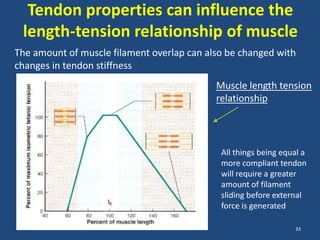
Tendon properties can influence the
 length-tension relationship of muscle
The amount of muscle filament overlap can also be changed with
changes in tendon stiffness
                                            Muscle length tension
                                            relationship


                                             All things being equal a
                                             more compliant tendon
                                             will require a greater
                                             amount of filament
                                             sliding before external
                                             force is generated

                                                                 33
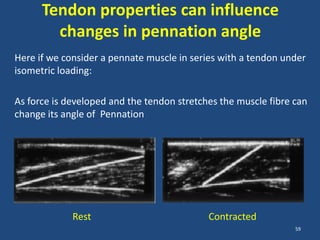
Tendon properties can influence
        changes in pennation angle
Here if we consider a pennate muscle in series with a tendon under
isometric loading:

As force is developed and the tendon stretches the muscle fibre can
change its angle of Pennation


             Rest                           Contracted
                                                                59
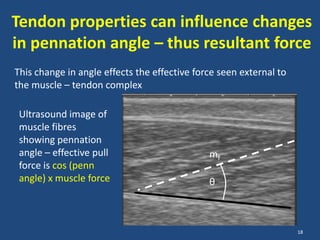
Tendon properties can influence changes
in pennation angle – thus resultant force
This change in angle effects the effective force seen external to
the muscle – tendon complex

 Ultrasound image of
 muscle fibres
 showing pennation
 angle – effective pull                       mf
 force is cos (penn
 angle) x muscle force                        θ


                                                                    18
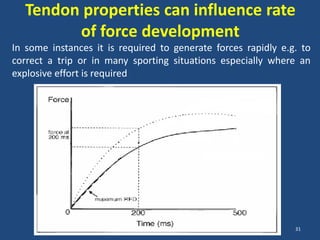
Tendon properties can influence rate
        of force development
In some instances it is required to generate forces rapidly e.g. to
correct a trip or in many sporting situations especially where an
explosive effort is required


                                              Low K
                                              High K


                                                               31
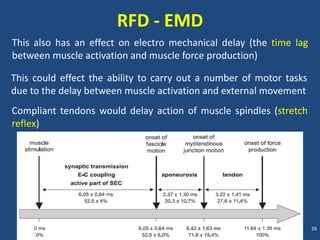
RFD - EMD
This also has an effect on electro mechanical delay (the time lag
between muscle activation and muscle force production)

This could effect the ability to carry out a number of motor tasks
due to the delay between muscle activation and external movement
Compliant tendons would delay action of muscle spindles (stretch
reflex)


                                                                     26
Energy storage and release - SSC
Movement economy can also be modulated as energy is capable
of being stored and released from the tendon

Stretch-shorten-cycle (SSC)

Activation of muscle during
lengthening of muscle –
increased lengthening of
tendon

Energy stored in tendon
and released during                                 From Kawakami
concentric contraction –                            et al. J. Physiol.
up to ~93% of energy is                             (2002)
returned (Alexander, 2000)                                    40
Affect of Stretching and Training on
  Tendon Mechanical Properties


                                       5
Passive Stretching
Acute:
• 10 min calf stretch - ↓ K & Hysteresis (Kubo et al., 2001a)
• 5 min calf stretch - ↓ K & Young’s Modulus (Burgess et al., 2009)
  - greater decreases in female subjects

• 5 min calf stretch - ↓ K & Hysteresis (Kubo et al., 2002b)
  Changes above due to ↓ Viscosity & ↑ Elasticity

Chronic:
• 5 x 45s (15s rest) calf stretch 2 x day for 3 weeks:
  ↔ K & ↓ Hysteresis (Kubo et al., 2002a)
                                                               8
Isotonic Resistance Training
    6 weeks of:
•   ‘Eccentric’ heel drops (BW): ↔ K (Mahieu et al., 2008)
    8 weeks of:
•   Calf raises (70% 1RM):↑ K & ↔ Hysteresis (Kubo et al., 2002c)
    12 weeks of:
•   Leg extension (70% 1RM): ↑ K (Kongsgaard et al., 2007)
    14 weeks of:
•   Leg extension/leg press (80% 1RM): ↑ K (Reeves et al., 2003a,b)
    6 months of:
•   BW squat: ↔ K (Kubo et al., 2003)                          38
Isometric Resistance Training
 12 weeks of isometric knee extension performed at
                70% MVC for 15-20s:
• ↑ K (Kubo et al., 2001c,d; 2006; 2009)
• ↑ muscle size and RFD (Kubo et al., 2001d)

  ↔ K during above exercise when:
- Performed for short duration (1s)
- Performed at short muscle length (50 deg)
- Performed for < 8 weeks
                                               45
Isometric Resistance Training
14 weeks of isometric plantar flexion performed
              at 90% MVC for 3s:
• ↑ K (Arampatzis et al., 2007; 2010)

Authors concluded that the strain magnitude
during isometric training should exceed the
value experienced during habitual loading for
mechanical adaptations in tendon to occur.

                                              62
Plyometric Training
   14 weeks of plyometric training (SJ, CMJ, DJ
           (40+60+80), over barrier)

• ↑ K (Fouré et al., 2010)

Trained with high volume: 36 sessions in total
consisting of 200-600 jumps per session


                                                  10
Combination Training
6 weeks of Plyometric (DJ) vs Isometric (Plantar):
• Plyo: ↑ K (29%), ↑ RFD (19%) & ↑ SJ height (59%)
• Iso: ↑ K (62%), ↑ RFD (17%) & ↑ SJ height (64%)
                     (Burgess et al., 2007)


12 weeks of Iso RT (80% 1RM calf raise) vs Plyo (sledge
hopping & DJ (20)):
• Iso RT: ↑ K, ↑ SJ height
• Plyo: ↔ K, ↑ SJ, CMJ & DJ height
                      (Kubo et al., 2007)

                                                     19
Endurance Training
• No effect of endurance training on mechanical
  properties (i.e. K/Young’s Modulus) of the PT or AT

     (Rosager et al., 2002; Hansen et al., 2003;
 Karamanidis and Arampatzis, 2006; Arampatzis et
                       al., 2007)


                                                 46
Training Summary
For necessary adaptations of tendon mechanical
properties to occur, training should:

•   Include high loads
•   Involve high tendon strains
•   If isometric, be performed at long muscle lengths
•   If isometric, be performed for at least 3s/rep
•   Be performed consistently for at least 6-8 weeks

                                                   21
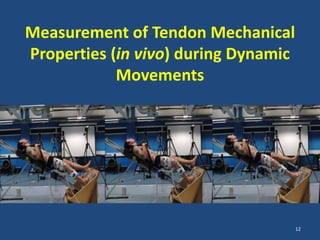
Measurement of Tendon Mechanical
Properties (in vivo) during Dynamic
            Movements


                                      12
Measurement of Tendon Properties
    In order to estimate tendon mechanical properties
    (stiffness) both elongation and force in the tendon
    have to be determined

    In order to measure the mechanical properties of
    tendon in vivo we use a combination of:

•   Motion Analysis
•   Ultrasonography
•   Electromyography
•   Dynamometry
•   Force
                                                    36
Motion Analysis – Sagittal Plane
• Can use 2D or 3D motion capture depending on
  information required for research

• Markers placed on lateral aspects of ankle, knee
  and hip joints (marker on tendon insertion may
  also be necessary)

• Sagittal motion of the above joints required to
  calculate instantaneous MTU length and tendon
  moment arms using regression equations
  obtained from cadaver studies (Hawkins and Hull,
  1990; Visser et al., 1990)
                                                 44
Example of 3D Motion Analysis


                                15
Ultrasound – Mode of Operation
• B-mode ultrasound is a useful tool for the
  imaging of soft tissue.

• Its mode of operation is via the transmission and
  reception of sound waves.

• Ultrasound waves are produced by oscillating
  crystals at a frequency that is inaudible to the
  human ear.

• Transducers located in the probe produce sound
  (for example) at 7.5mhz which is then pulsed at
  intervals which occur every 20 micro-seconds.
                                                  2
Ultrasound – Mode of Operation
• These sound waves penetrate and encounter the
  different tissue interfaces as they travels through
  the body.

• When sound encounters tissues or tissue planes,
  part of the wave is reflected back to receivers in
  this same probe.

• The transducer must be in contact with the
  medium scanned, in this case skin, so a
  "transmission jelly" is used to insure a complete
  "union". The ultrasound produced can not travel
  through the air and then into the body.
                                                   23
Ultrasound – Mode of Operation
• This mode analyses the intensity of the returning
  ultrasound signal as well as the direction and depth
  from, which it was reflected

• A two-dimensional grey-scale image is constructed
  with different intensities from the returning signals
  being assigned different levels of brightness

• Generally, a high-density structure such as
  tendon/bone will reflect a high-intensity signal back to
  the probe and be displayed as white on the screen

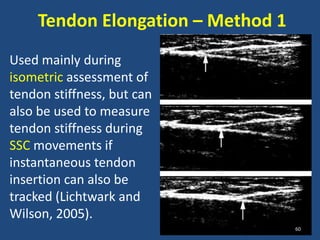
• We use ultrasonography to measure tendon elongation
                                                        53
Tendon Elongation – Method 1
Used mainly during
isometric assessment of
tendon stiffness, but can
also be used to measure
tendon stiffness during
SSC movements if
instantaneous tendon
insertion can also be
tracked (Lichtwark and
Wilson, 2005).
                                   60
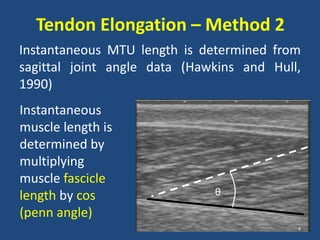
Tendon Elongation – Method 2
Instantaneous MTU length is determined from
sagittal joint angle data (Hawkins and Hull,
1990)
Instantaneous
muscle length is
determined by
multiplying
muscle fascicle
length by cos                 θ

(penn angle)
                                           4
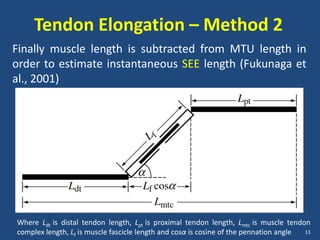
Tendon Elongation – Method 2
Finally muscle length is subtracted from MTU length in
order to estimate instantaneous SEE length (Fukunaga et
al., 2001)


Where Ldt is distal tendon length, Lpt is proximal tendon length, Lmtc is muscle tendon
complex length, Lf is muscle fascicle length and cosα is cosine of the pennation angle 13
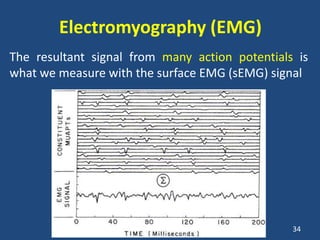
Electromyography (EMG)
The resultant signal from many action potentials is
what we measure with the surface EMG (sEMG) signal


                                                34
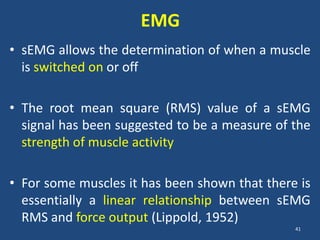
EMG
• sEMG allows the determination of when a muscle
  is switched on or off

• The root mean square (RMS) value of a sEMG
  signal has been suggested to be a measure of the
  strength of muscle activity

• For some muscles it has been shown that there is
  essentially a linear relationship between sEMG
  RMS and force output (Lippold, 1952)
                                               41
EMG

• Relationship between
  RMS sEMG and force
  output of muscles


                               9
EMG
   How do we measure this electrical activity?
• For simple single differential measurement (to
  reduce noise) 2 electrodes are placed over the
  muscle belly of interest
• The signal is then
  amplified and
  filtered before
  being sampled by
  a computer to be
  saved
                                                 17
EMG’s use in
   determining tendon properties
• To determine levels of co-contraction and
  hence co-contraction force.

• During agonist muscle contraction antagonists
  are also active and producing force.

• The agonists must overcome this ‘hidden’
  force before external torque is recorded
  through force readings.
                                              44
Dynamometry
• Used to determine EMG activity of agonist and antagonist
  muscles during MVC – used to calculate antagonist force

          Co-contraction effort (CT) defined as:
(EMG during extension / Max flexor EMG)*Max flexor torque

        Total extensor torque = CT + Extensor torque

• Allows EMG activity attained during dynamic movement to
  be normalised to EMG activity attained during MVC (when
  comparing groups)

• Can be assessed over a range of joint angles specific to the
  range demonstrated during the dynamic task               38
Ground Reaction Force Data
       Required to calculate tendon forces

Tendon force is derived
by multiplying
instantaneous joint
moment (as determined
using inverse dynamics)
by instantaneous
tendon moment arm
(Visser et al., 1990)
                                             50
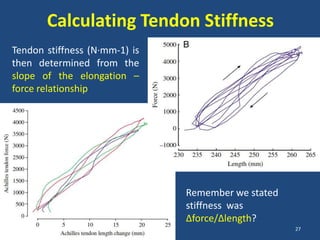
Calculating Tendon Stiffness
Tendon stiffness (N·mm-1) is
then determined from the
slope of the elongation –
force relationship


                               Remember we stated
                               stiffness was
                               ∆force/∆length?
                                                    27
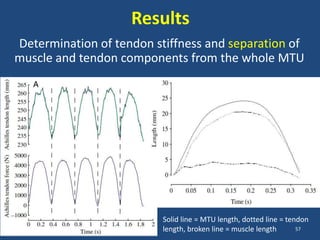
Results
Determination of tendon stiffness and separation of
muscle and tendon components from the whole MTU


                          Solid line = MTU length, dotted line = tendon
                          length, broken line = muscle length       57
Normalizing Values
• Differences in tendon length and/or cross
  sectional area can affect the stiffness values

• It is therefore important to normalise the
  stiffness to account for these dimensional
  factors when comparing different groups

        Young's modulus is such a value:
           K*(L/CSA) or stress/strain
                                              29
Any Questions?


                 54

Tendon Mechanics Lecture

  • 1.
    Tendon Mechanics Biomechanicsfor Sport III John McMahon BSc (Hons), ASCC, CSCS
  • 2.
    Lecture Aims • Toremind you of the mechanical concepts of strain, stiffness and compliance • To examine the rheological properties of materials & illustrate mechanical responses to loading • To discuss the influence of tendon mechanical properties on muscle function • To introduce the affect of stretching & training on tendon mechanical properties • To understand in vivo measurement of tendon stiffness during dynamic exercises 32
  • 3.
    The Muscle-Tendon-Unit (MTU) Vastus Lateralis Gastrocnemius Hill’s Muscle Model 24
  • 4.
    Strain • The loadingof a material will cause a deformation, which is known as strain • There are 3 main types of load and therefore strain: • Tension = pulling force - makes object longer and thinner • Compression = pushing force - makes object shorter and thicker • Shear = a load comprised of 2 equal, opposite and parallel forces that tend to displace one part of an object with respect to an adjacent part along a plane parallel and between the line of the forces 47
  • 5.
    Load Characteristics –Principle Strain Tensile Compressive Shear L ∆L 61
  • 6.
    Loading characteristics Combination of tensile and Combination of compressive, compressive loading forces tensile and shear loading forces T e n sio n C o m p re ssio n Bending Torsion 11
  • 7.
    Calculating Strain • Ifthe loading is longitudinal i.e. in tension the material will tend to elongate • The strain can be defined as change in length/original length • Strain, = Change in length r Original length r • This is unit less i.e. cm/cm and is usually expressed as a percentage - Strain = ∆L/L *100 7
  • 8.
    Stress • When amaterial undergoes a deformation as a result of applied forces it reacts to this change Stress: = the resistance of the intermolecular bonds of an object to the strain caused by a load = the measure of a material’s ability to resist an applied force • Can be defined as “the internal force per unit area upon a cross section of that a part of a body” Stress, = Force F (Pa) Cross-Sectional Area A • Stress can be longitudinal (normal) or transverse to the cross section 28
  • 9.
    Rheological Properties ofMaterials Rheology - the study of the deformation and flow of matter • Elasticity – relates to the ability of the material to return to its original dimension after loading – for a purely elastic material the relationship between loading and deformation will be a straight line – i.e. energy is stored • Viscosity – here the material will deform with loading but will have a lag between developing stress and the resultant strain – the greater the rate of loading, the greater the stress developed – the material will retain its new shape/size – i.e. energy is absorbed 49
  • 10.
    Rheological Properties ofMaterials • Material can possess properties of both viscosity and elasticity and hence be viscoelastic. Here the material will tend to deform and return to its original shape in a non linear fashion • Plasticity – here when the material is deformed it tends to retain its new shape/size. Deformation tends to be without a lag and energy is absorbed 56
  • 11.
    Stress – StrainRelationship Stress HR = Hookean Range (Linear) C ER = Elastic Range ER B PR PR = Plastic Range A A Strain HR A Young’s Modulus E= A 14 (Elastic Modulus) A
  • 12.
    Stress – StrainRelationship (Stiffness and Compliance) • It allows the description of the material in terms of the rheological properties previously defined • It relates to Hooke’s law and allows the determination of the material ‘stiffness’ – Young’s modulus (E = ∆σ/∆ε) • A very stiff material can tolerate high loads (stress) with only small deformations (strain) • A higher value for E is indicative of a stiffer material • Compliance is sometimes used instead of stiffness and is simply the inverse of stiffness i.e. the ratio of strain change to stress change 52
  • 13.
    Changes in Stiffness From graph – Is line A or line B representative of a stiffer material and why? Line A represents a stiffer material due to less deformation per unit of force 30
  • 14.
    Stress – StrainRelationship • Typical stress – strain curves for different tissues 16
  • 15.
    Normative Values -Tendon Properties Patellar Tendon - O'Brien et al. (2010) Achilles Tendon - Magnusson et al. (2001) 39
  • 16.
    Energy and Stress– Strain Curves • Area under the curves represent the energy – Stored energy is the area under curve A and absorbed energy is the area under curve B 42
  • 17.
    Hysteresis and Stress- Strain The amount of energy stored may not all be given back subsequent to unloading – this can be illustrated via the stress – strain curve and can be as a result of damping 35
  • 18.
    Creep • With prolonged loading a material may exhibit creep • Here strain increases under constant prolonged loading 58
  • 19.
    Stress Relaxation • Whena material experiences a constant strain the stress will tend to decrease with time 20
  • 20.
    Material Fatigue • Amaterial can withstand a finite number of stresses above a given level after which failure or rupture is likely e.g. stress fracture of bone • Below endurance limit the material can withstand an infinite number of stresses 1
  • 21.
    Tendon Injury Research performedusing isolated tendons: For Achilles tendon: • Maximum Modulus: 819 MPa • Failure Load: 5098 N • Failure Stress: 79 MPa (Wren et al., 2001) Damage may occur at: • 15-30% strain (Haut & Pawlinson, 1990; Stäubli et al., 1999) 43
  • 22.
    Tendon Injury However, invivo tendon research has shown: • Tendon strains of 6-14% during MVC and up to 11.4% during SSC without injury occurrence • Tendon forces to reach in excess of 5000 N Differences due to: • Preservatives • Tendon tested • Region of tendon tested 22
  • 23.
    Factors Affecting Mechanical Properties of Tendon • Age • Gender • Stretching • Training • Fatigue • Chronic disease • Time of day 3
  • 24.
    Influence of TendonMechanical Properties on Muscle Function 37
  • 25.
    Why study tendonmechanical properties? Function of tendons: • Tensile force transmission • Storage and release of energy during locomotion (Maganaris and Paul, 2002) The mechanical properties of tendon significantly affect muscle output and function 25
  • 26.
    Tendon properties caninfluence the force-velocity relationship of muscle Tendon acts as a series viscoelastic component in the muscle tendon complex Tendon stiffness (K) can effect the relationship between force and velocity in muscle 0.30 0.25 If a tendon is relatively compliant it 0.20 can result in a reduced ability to F o rce 0.15 generate force 0.10 0.05 0.00 0 0.5 1 1.5 2 2.5 3 V e l o c i ty 51
  • 27.
    Tendon properties caninfluence the length-tension relationship of muscle The amount of muscle filament overlap can also be changed with changes in tendon stiffness Muscle length tension relationship All things being equal a more compliant tendon will require a greater amount of filament sliding before external force is generated 33
  • 28.
    Tendon properties caninfluence changes in pennation angle Here if we consider a pennate muscle in series with a tendon under isometric loading: As force is developed and the tendon stretches the muscle fibre can change its angle of Pennation Rest Contracted 59
  • 29.
    Tendon properties caninfluence changes in pennation angle – thus resultant force This change in angle effects the effective force seen external to the muscle – tendon complex Ultrasound image of muscle fibres showing pennation angle – effective pull mf force is cos (penn angle) x muscle force θ 18
  • 30.
    Tendon properties caninfluence rate of force development In some instances it is required to generate forces rapidly e.g. to correct a trip or in many sporting situations especially where an explosive effort is required Low K High K 31
  • 31.
    RFD - EMD Thisalso has an effect on electro mechanical delay (the time lag between muscle activation and muscle force production) This could effect the ability to carry out a number of motor tasks due to the delay between muscle activation and external movement Compliant tendons would delay action of muscle spindles (stretch reflex) 26
  • 32.
    Energy storage andrelease - SSC Movement economy can also be modulated as energy is capable of being stored and released from the tendon Stretch-shorten-cycle (SSC) Activation of muscle during lengthening of muscle – increased lengthening of tendon Energy stored in tendon and released during From Kawakami concentric contraction – et al. J. Physiol. up to ~93% of energy is (2002) returned (Alexander, 2000) 40
  • 33.
    Affect of Stretchingand Training on Tendon Mechanical Properties 5
  • 34.
    Passive Stretching Acute: • 10min calf stretch - ↓ K & Hysteresis (Kubo et al., 2001a) • 5 min calf stretch - ↓ K & Young’s Modulus (Burgess et al., 2009) - greater decreases in female subjects • 5 min calf stretch - ↓ K & Hysteresis (Kubo et al., 2002b) Changes above due to ↓ Viscosity & ↑ Elasticity Chronic: • 5 x 45s (15s rest) calf stretch 2 x day for 3 weeks: ↔ K & ↓ Hysteresis (Kubo et al., 2002a) 8
  • 35.
    Isotonic Resistance Training 6 weeks of: • ‘Eccentric’ heel drops (BW): ↔ K (Mahieu et al., 2008) 8 weeks of: • Calf raises (70% 1RM):↑ K & ↔ Hysteresis (Kubo et al., 2002c) 12 weeks of: • Leg extension (70% 1RM): ↑ K (Kongsgaard et al., 2007) 14 weeks of: • Leg extension/leg press (80% 1RM): ↑ K (Reeves et al., 2003a,b) 6 months of: • BW squat: ↔ K (Kubo et al., 2003) 38
  • 36.
    Isometric Resistance Training 12 weeks of isometric knee extension performed at 70% MVC for 15-20s: • ↑ K (Kubo et al., 2001c,d; 2006; 2009) • ↑ muscle size and RFD (Kubo et al., 2001d) ↔ K during above exercise when: - Performed for short duration (1s) - Performed at short muscle length (50 deg) - Performed for < 8 weeks 45
  • 37.
    Isometric Resistance Training 14weeks of isometric plantar flexion performed at 90% MVC for 3s: • ↑ K (Arampatzis et al., 2007; 2010) Authors concluded that the strain magnitude during isometric training should exceed the value experienced during habitual loading for mechanical adaptations in tendon to occur. 62
  • 38.
    Plyometric Training 14 weeks of plyometric training (SJ, CMJ, DJ (40+60+80), over barrier) • ↑ K (Fouré et al., 2010) Trained with high volume: 36 sessions in total consisting of 200-600 jumps per session 10
  • 39.
    Combination Training 6 weeksof Plyometric (DJ) vs Isometric (Plantar): • Plyo: ↑ K (29%), ↑ RFD (19%) & ↑ SJ height (59%) • Iso: ↑ K (62%), ↑ RFD (17%) & ↑ SJ height (64%) (Burgess et al., 2007) 12 weeks of Iso RT (80% 1RM calf raise) vs Plyo (sledge hopping & DJ (20)): • Iso RT: ↑ K, ↑ SJ height • Plyo: ↔ K, ↑ SJ, CMJ & DJ height (Kubo et al., 2007) 19
  • 40.
    Endurance Training • Noeffect of endurance training on mechanical properties (i.e. K/Young’s Modulus) of the PT or AT (Rosager et al., 2002; Hansen et al., 2003; Karamanidis and Arampatzis, 2006; Arampatzis et al., 2007) 46
  • 41.
    Training Summary For necessaryadaptations of tendon mechanical properties to occur, training should: • Include high loads • Involve high tendon strains • If isometric, be performed at long muscle lengths • If isometric, be performed for at least 3s/rep • Be performed consistently for at least 6-8 weeks 21
  • 42.
    Measurement of TendonMechanical Properties (in vivo) during Dynamic Movements 12
  • 43.
    Measurement of TendonProperties In order to estimate tendon mechanical properties (stiffness) both elongation and force in the tendon have to be determined In order to measure the mechanical properties of tendon in vivo we use a combination of: • Motion Analysis • Ultrasonography • Electromyography • Dynamometry • Force 36
  • 44.
    Motion Analysis –Sagittal Plane • Can use 2D or 3D motion capture depending on information required for research • Markers placed on lateral aspects of ankle, knee and hip joints (marker on tendon insertion may also be necessary) • Sagittal motion of the above joints required to calculate instantaneous MTU length and tendon moment arms using regression equations obtained from cadaver studies (Hawkins and Hull, 1990; Visser et al., 1990) 44
  • 45.
    Example of 3DMotion Analysis 15
  • 46.
    Ultrasound – Modeof Operation • B-mode ultrasound is a useful tool for the imaging of soft tissue. • Its mode of operation is via the transmission and reception of sound waves. • Ultrasound waves are produced by oscillating crystals at a frequency that is inaudible to the human ear. • Transducers located in the probe produce sound (for example) at 7.5mhz which is then pulsed at intervals which occur every 20 micro-seconds. 2
  • 47.
    Ultrasound – Modeof Operation • These sound waves penetrate and encounter the different tissue interfaces as they travels through the body. • When sound encounters tissues or tissue planes, part of the wave is reflected back to receivers in this same probe. • The transducer must be in contact with the medium scanned, in this case skin, so a "transmission jelly" is used to insure a complete "union". The ultrasound produced can not travel through the air and then into the body. 23
  • 48.
    Ultrasound – Modeof Operation • This mode analyses the intensity of the returning ultrasound signal as well as the direction and depth from, which it was reflected • A two-dimensional grey-scale image is constructed with different intensities from the returning signals being assigned different levels of brightness • Generally, a high-density structure such as tendon/bone will reflect a high-intensity signal back to the probe and be displayed as white on the screen • We use ultrasonography to measure tendon elongation 53
  • 49.
    Tendon Elongation –Method 1 Used mainly during isometric assessment of tendon stiffness, but can also be used to measure tendon stiffness during SSC movements if instantaneous tendon insertion can also be tracked (Lichtwark and Wilson, 2005). 60
  • 50.
    Tendon Elongation –Method 2 Instantaneous MTU length is determined from sagittal joint angle data (Hawkins and Hull, 1990) Instantaneous muscle length is determined by multiplying muscle fascicle length by cos θ (penn angle) 4
  • 51.
    Tendon Elongation –Method 2 Finally muscle length is subtracted from MTU length in order to estimate instantaneous SEE length (Fukunaga et al., 2001) Where Ldt is distal tendon length, Lpt is proximal tendon length, Lmtc is muscle tendon complex length, Lf is muscle fascicle length and cosα is cosine of the pennation angle 13
  • 52.
    Electromyography (EMG) The resultantsignal from many action potentials is what we measure with the surface EMG (sEMG) signal 34
  • 53.
    EMG • sEMG allowsthe determination of when a muscle is switched on or off • The root mean square (RMS) value of a sEMG signal has been suggested to be a measure of the strength of muscle activity • For some muscles it has been shown that there is essentially a linear relationship between sEMG RMS and force output (Lippold, 1952) 41
  • 54.
    EMG • Relationship between RMS sEMG and force output of muscles 9
  • 55.
    EMG How do we measure this electrical activity? • For simple single differential measurement (to reduce noise) 2 electrodes are placed over the muscle belly of interest • The signal is then amplified and filtered before being sampled by a computer to be saved 17
  • 56.
    EMG’s use in determining tendon properties • To determine levels of co-contraction and hence co-contraction force. • During agonist muscle contraction antagonists are also active and producing force. • The agonists must overcome this ‘hidden’ force before external torque is recorded through force readings. 44
  • 57.
    Dynamometry • Used todetermine EMG activity of agonist and antagonist muscles during MVC – used to calculate antagonist force Co-contraction effort (CT) defined as: (EMG during extension / Max flexor EMG)*Max flexor torque Total extensor torque = CT + Extensor torque • Allows EMG activity attained during dynamic movement to be normalised to EMG activity attained during MVC (when comparing groups) • Can be assessed over a range of joint angles specific to the range demonstrated during the dynamic task 38
  • 58.
    Ground Reaction ForceData Required to calculate tendon forces Tendon force is derived by multiplying instantaneous joint moment (as determined using inverse dynamics) by instantaneous tendon moment arm (Visser et al., 1990) 50
  • 59.
    Calculating Tendon Stiffness Tendonstiffness (N·mm-1) is then determined from the slope of the elongation – force relationship Remember we stated stiffness was ∆force/∆length? 27
  • 60.
    Results Determination of tendonstiffness and separation of muscle and tendon components from the whole MTU Solid line = MTU length, dotted line = tendon length, broken line = muscle length 57
  • 61.
    Normalizing Values • Differencesin tendon length and/or cross sectional area can affect the stiffness values • It is therefore important to normalise the stiffness to account for these dimensional factors when comparing different groups Young's modulus is such a value: K*(L/CSA) or stress/strain 29
  • 62.

Editor's Notes

  • #35 Gender diffs may be due to diffs in collagen content and collagen composition