TEMPORIZATION


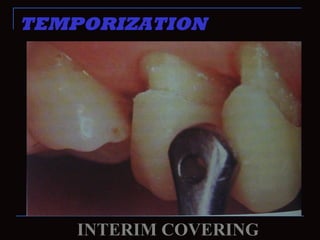
    INTERIM COVERING
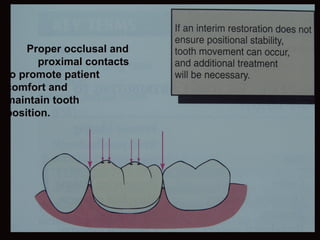
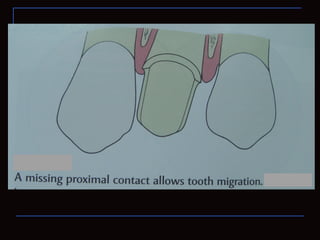
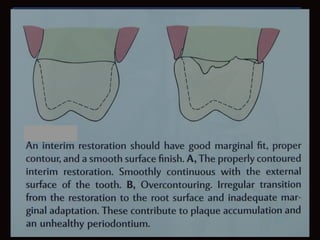
Proper occlusal and
       proximal contacts
to promote patient
comfort and
maintain tooth
position.
Proper occlusal and
       proximal contacts
to promote patient
comfort and
maintain tooth
position.
   The placement of an interim
    covering on a tooth after
    preparation   is   a     biologic
    mandate to maintain vitality.

   There are three major problems
    commonly associated with the
    clinical fabrication of temporary
    crown:
1.      The     time      involvement
     necessary for the fabrication of
     adequate       interim      tooth
     coverage is underestimated by
     the majority of the dentists.
2. Treatment coverage is not
  always      replaced      by
  permanent       restorations
  within the shortest possible
  time.
3. There are presently no
    inexpensive, tissue
   compatible materials that
   are fabricated by the
   dentist.
***One possible measure to combat
  these problems is to increase the
  length of the appointments to
  prevent      hastily   constructed
  treatment restoration.

    Another is to program and
 coordinate appointment dates with
 lab services to accelerate the date of
 insertion of the final restorations.
8 Cardinal Requirements for
Temporization:
  1. The pulp of the tooth must be
     insulated from all forms of
     adverse stimuli.

  2. Arch position of the prepared
     teeth should be maintained and
     stabilized to prevent extrusion of
     teeth and promote the accuracy of
     the impression.
3. Treatment restorations should
   not impinge the gingival
   tissues causing inflammation
   and tissue recession.

4. It should appear reasonably
  esthetic, particularly in the
  incisor and premolar areas.
5. Treatment restorations should
   develop occlusal function to
   assist in the establishment of
   a satisfactory maxillo-
   mandibular relationship.

6.     It should also possess
     sufficient inherent strength to
     withstand light forces of
     occlusion.
7. It should be fabricated in such
   a manner to permit the patient
   to keep the area clean and
   serve as a healing matrix to
   tissues surrounding prepared
   teeth and edentulous areas.
8. Construction techniques
 should be within the realm
 of the average dentist and
 also capable of being easily
 removed      with   minimal
 damage to the teeth and
 supportive tissues.
Types of Temporary
Crowns:
   Metal (precious and non-
   precious) and Non-metal
   Materials
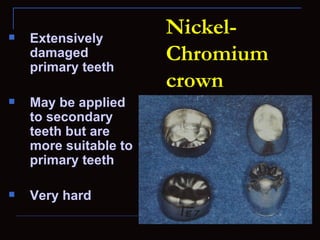
   Extensively
                       Nickel-
    damaged            Chromium
    primary teeth
                       crown
   May be applied
    to secondary
    teeth but are
    more suitable to
    primary teeth

   Very hard
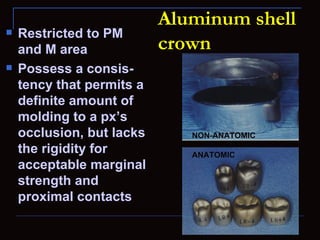
Aluminum shell
   Restricted to PM
    and M area             crown
   Possess a consis-
    tency that permits a
    definite amount of
    molding to a px’s
    occlusion, but lacks      NON-ANATOMIC
    the rigidity for          ANATOMIC
    acceptable marginal
    strength and
    proximal contacts
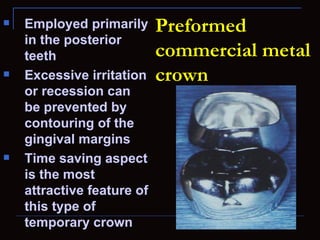
   Employed primarily      Preformed
    in the posterior
    teeth                   commercial metal
   Excessive irritation    crown
    or recession can
    be prevented by
    contouring of the
    gingival margins
   Time saving aspect
    is the most
    attractive feature of
    this type of
    temporary crown
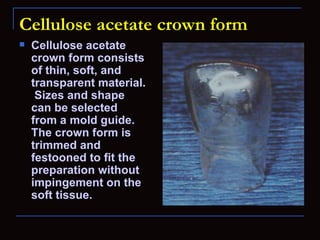
Cellulose acetate crown form
   Cellulose acetate
    crown form consists
    of thin, soft, and
    transparent material.
     Sizes and shape
    can be selected
    from a mold guide.
    The crown form is
    trimmed and
    festooned to fit the
    preparation without
    impingement on the
    soft tissue.
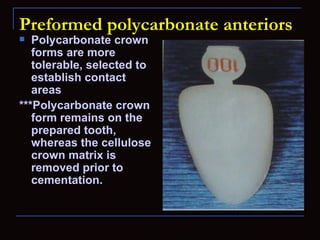
Preformed polycarbonate anteriors
  Polycarbonate crown
   forms are more
   tolerable, selected to
   establish contact
   areas
***Polycarbonate crown
   form remains on the
   prepared tooth,
   whereas the cellulose
   crown matrix is
   removed prior to
   cementation.
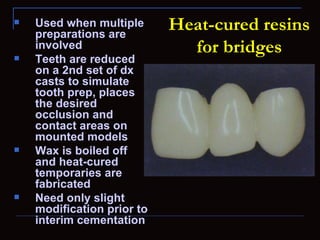
   Used when multiple
    preparations are
                            Heat-cured resins
    involved                  for bridges
   Teeth are reduced
    on a 2nd set of dx
    casts to simulate
    tooth prep, places
    the desired
    occlusion and
    contact areas on
    mounted models
   Wax is boiled off
    and heat-cured
    temporaries are
    fabricated
   Need only slight
    modification prior to
    interim cementation
Cold-cure alginate impression
            technique
   An alginate             After the prep., resin
    impression of the        mixture is placed on
    teeth is taken on        the alginate
    the day of the           impression
    preparations are         corresponding to the
    made but before          crown prep.
    any reduction of        Alginate impression
    teeth                    with the resin mixture
                             is placed back into
   Alginate impres-         the mouth
    sion is set aside       Impression is
    and kept in a damp       removed just prior to
    environment to           the rigid set of the
    prevent excessive        acrylic
    distortion
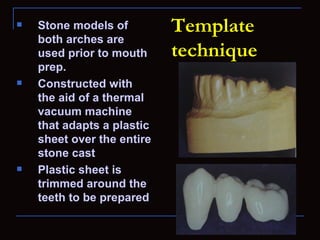
   Stone models of         Template
    both arches are
    used prior to mouth     technique
    prep.
   Constructed with
    the aid of a thermal
    vacuum machine
    that adapts a plastic
    sheet over the entire
    stone cast
   Plastic sheet is
    trimmed around the
    teeth to be prepared
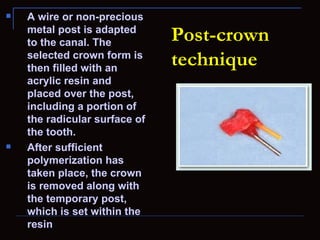
   A wire or non-precious
    metal post is adapted
    to the canal. The          Post-crown
    selected crown form is
    then filled with an
                               technique
    acrylic resin and
    placed over the post,
    including a portion of
    the radicular surface of
    the tooth.
   After sufficient
    polymerization has
    taken place, the crown
    is removed along with
    the temporary post,
    which is set within the
    resin
Limitations of Temporization:
    Lack of inherent strength
    Poor marginal adaptation
    Color instability
    Poor wear properties
    Inadequate bonding characteristics
    Poor tissue response to irritation
    Arduous cement removal
    Detectable odor emission
Uses of Temporary Crowns
   1. Serves as a healing matrix for
      the gingival tissue

   2. Serve as a predictor of the final
      result

   3. Serve as an oral hygiene
     training device
4. Provide security and comfort to
  the patient while the final
  restoration is being fabricated.

5. Saves considerable time at each
  subsequent appointment, during
  which castings are fitted, joints
  are soldered and porcelain is
  adapted prior to the final delivery
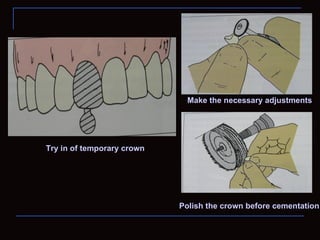
Make the necessary adjustments


Try in of temporary crown


                            Polish the crown before cementation

Temporization2

  • 1.
    TEMPORIZATION INTERIM COVERING
  • 2.
    Proper occlusal and proximal contacts to promote patient comfort and maintain tooth position.
  • 3.
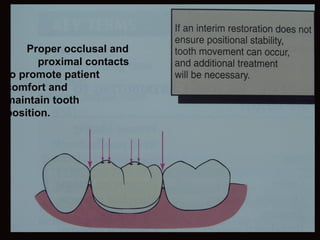
    Proper occlusal and proximal contacts to promote patient comfort and maintain tooth position.
  • 6.
    The placement of an interim covering on a tooth after preparation is a biologic mandate to maintain vitality.  There are three major problems commonly associated with the clinical fabrication of temporary crown:
  • 7.
    1. The time involvement necessary for the fabrication of adequate interim tooth coverage is underestimated by the majority of the dentists.
  • 8.
    2. Treatment coverageis not always replaced by permanent restorations within the shortest possible time.
  • 9.
    3. There arepresently no inexpensive, tissue compatible materials that are fabricated by the dentist.
  • 10.
    ***One possible measureto combat these problems is to increase the length of the appointments to prevent hastily constructed treatment restoration. Another is to program and coordinate appointment dates with lab services to accelerate the date of insertion of the final restorations.
  • 11.
    8 Cardinal Requirementsfor Temporization: 1. The pulp of the tooth must be insulated from all forms of adverse stimuli. 2. Arch position of the prepared teeth should be maintained and stabilized to prevent extrusion of teeth and promote the accuracy of the impression.
  • 12.
    3. Treatment restorationsshould not impinge the gingival tissues causing inflammation and tissue recession. 4. It should appear reasonably esthetic, particularly in the incisor and premolar areas.
  • 13.
    5. Treatment restorationsshould develop occlusal function to assist in the establishment of a satisfactory maxillo- mandibular relationship. 6. It should also possess sufficient inherent strength to withstand light forces of occlusion.
  • 14.
    7. It shouldbe fabricated in such a manner to permit the patient to keep the area clean and serve as a healing matrix to tissues surrounding prepared teeth and edentulous areas.
  • 15.
    8. Construction techniques should be within the realm of the average dentist and also capable of being easily removed with minimal damage to the teeth and supportive tissues.
  • 16.
    Types of Temporary Crowns: Metal (precious and non- precious) and Non-metal Materials
  • 17.
    Extensively Nickel- damaged Chromium primary teeth crown  May be applied to secondary teeth but are more suitable to primary teeth  Very hard
  • 18.
    Aluminum shell  Restricted to PM and M area crown  Possess a consis- tency that permits a definite amount of molding to a px’s occlusion, but lacks NON-ANATOMIC the rigidity for ANATOMIC acceptable marginal strength and proximal contacts
  • 19.
    Employed primarily Preformed in the posterior teeth commercial metal  Excessive irritation crown or recession can be prevented by contouring of the gingival margins  Time saving aspect is the most attractive feature of this type of temporary crown
  • 20.
    Cellulose acetate crownform  Cellulose acetate crown form consists of thin, soft, and transparent material. Sizes and shape can be selected from a mold guide. The crown form is trimmed and festooned to fit the preparation without impingement on the soft tissue.
  • 21.
    Preformed polycarbonate anteriors  Polycarbonate crown forms are more tolerable, selected to establish contact areas ***Polycarbonate crown form remains on the prepared tooth, whereas the cellulose crown matrix is removed prior to cementation.
  • 22.
    Used when multiple preparations are Heat-cured resins involved for bridges  Teeth are reduced on a 2nd set of dx casts to simulate tooth prep, places the desired occlusion and contact areas on mounted models  Wax is boiled off and heat-cured temporaries are fabricated  Need only slight modification prior to interim cementation
  • 23.
    Cold-cure alginate impression technique  An alginate  After the prep., resin impression of the mixture is placed on teeth is taken on the alginate the day of the impression preparations are corresponding to the made but before crown prep. any reduction of  Alginate impression teeth with the resin mixture is placed back into  Alginate impres- the mouth sion is set aside  Impression is and kept in a damp removed just prior to environment to the rigid set of the prevent excessive acrylic distortion
  • 24.
    Stone models of Template both arches are used prior to mouth technique prep.  Constructed with the aid of a thermal vacuum machine that adapts a plastic sheet over the entire stone cast  Plastic sheet is trimmed around the teeth to be prepared
  • 25.
    A wire or non-precious metal post is adapted to the canal. The Post-crown selected crown form is then filled with an technique acrylic resin and placed over the post, including a portion of the radicular surface of the tooth.  After sufficient polymerization has taken place, the crown is removed along with the temporary post, which is set within the resin
  • 26.
    Limitations of Temporization:  Lack of inherent strength  Poor marginal adaptation  Color instability  Poor wear properties  Inadequate bonding characteristics  Poor tissue response to irritation  Arduous cement removal  Detectable odor emission
  • 27.
    Uses of TemporaryCrowns 1. Serves as a healing matrix for the gingival tissue 2. Serve as a predictor of the final result 3. Serve as an oral hygiene training device
  • 28.
    4. Provide securityand comfort to the patient while the final restoration is being fabricated. 5. Saves considerable time at each subsequent appointment, during which castings are fitted, joints are soldered and porcelain is adapted prior to the final delivery
  • 29.
    Make the necessaryadjustments Try in of temporary crown Polish the crown before cementation