POST-RETAINED CROWN (Restoration of the Endodontically Treated  Tooth )
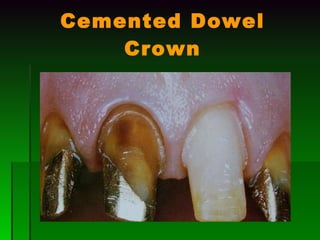
Cemented Dowel Crown
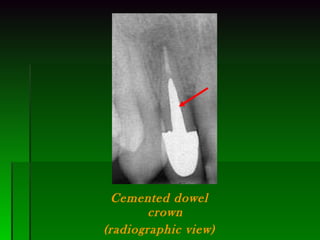
Cemented dowel crown (radiographic view)
Treatment Planning Endodontically treated tooth need to be assessed carefully for the following: 1.      Good apical seal 2.      No sensitivity to pressure 3.      No exudates 4.      No fistula 5.      No apical sensitivity 6.  No active inflammation
Disadvantages to the routine use of a cemented post: Placing the post require an additional operative  procedure Preparing a tooth to accommodate the post removes additional tooth structure
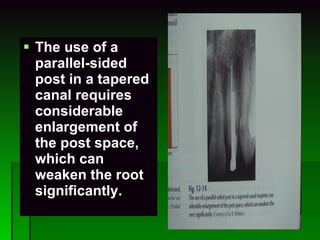
The use of a parallel-sided post in a tapered canal requires considerable enlargement of the post space, which can weaken the root significantly.
c.  It may be difficult to restore the tooth later, when a complete crown is needed, because the  cemented post may have failed to provide adequate retention for the core material. d.  The post can complicate or prevent future   endodontic retreatment if this becomes necessary.
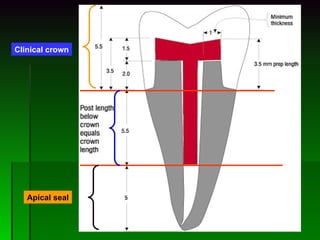
Requirements for traditional core and dowel construction: a. Ideally the length of post should be equal to, at  least, the length of the estimated clinical  crown. b. The post must have an occlusal stop to prevent displacement apically. This is of vital importance since displacement toward the apex commonly results in fracture of the  prepared root.
c. Included in this construction should be resistance to rotational forces. d.  Posts should be of sufficient thickness to resist  displacement and assist stabilization.
Clinical crown Apical seal
 
 
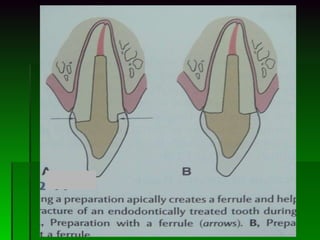
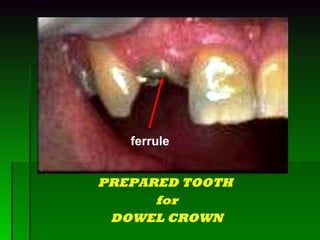
PREPARED TOOTH  for DOWEL CROWN ferrule
 
 
Principle of Post Support (Retention) A. Minimum post length should equal restored crown length or engage 2/3 of natural root B. Cylindrical posts are more retentive than similarly size tapered posts C. Wrought (bent/twisted/formed) gold alloy posts are two to four times stronger than cast gold alloy posts of equal diameter D. Serrated posts are 30% to 40% more retentive than are smooth posts
3 Stages in Tooth Preparation 1.   Removal of the root canal filling  material to the appropriate  depth 2.   Enlargement of the canal 3.   Preparation of the coronal tooth      structure
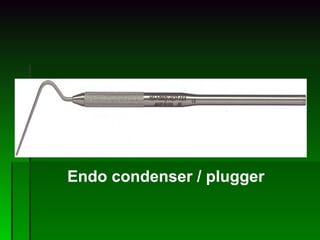
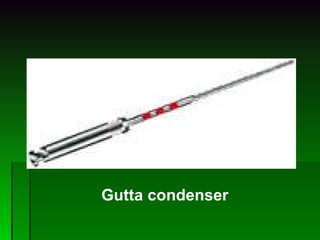
REMOVAL OF THE ENDO FILLING MATERIAL 2 Methods of Removing Gutta  Percha: a.  With a warmed condenser b.  With a rotary instrument  (sometimes  used with a  chemical agent such as  chloroform)
Endo condenser / plugger
Gutta condenser
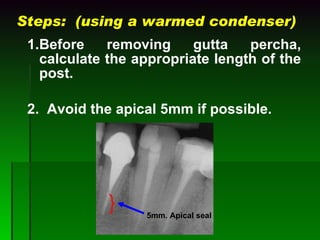
Steps:  (using a warmed condenser) 1. Before removing gutta percha, calculate the appropriate length of the post. 2.  Avoid the apical 5mm if possible.   5mm. Apical seal
3.  To prevent aspiration of an endo. instrument, apply a rubber dam before preparing the post space. 4. Select an endo. condenser large enough to hold heat well but not so large that it binds against the canal walls.
5.  Mark it at the appropriate length, heat it, and place it in the  canal to soften the gutta percha. 6.   When the gutta percha has been removed to the appropriate  depth, shape the canal as needed.
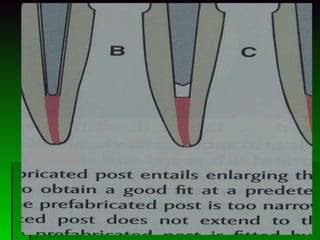
ENLARGEMENT OF THE CANAL For Prefabricated Posts 1. Enlarge the canal one to two sizes with a    drill, endo file and reamer that matches    the configuration of the post 2. Use a prefabricated post that matches    standard endo instruments   3. Be especially careful not to remove    more dentin at the apical extent of the    post space than is necessary
For Custom-made Posts 1. Use custom-made posts in canals  that have a non-circular cross  section or extreme taper.  Enlarging canals to conform to  a preformed post may lead to  perforation.   2. Be most careful on molars to avoid  root  perforation.
PREPARATION OF THE CORONAL TOOTH STRUCTURE Ignore any missing tooth structure and prepare the remaining tooth as though it were undamaged.  Be sure that the facial surface of the tooth is adequately reduced for good esthetics. Remove all undercuts that would prevent withdrawal of the pattern
4. Remove any unsupported tooth structure, but be careful to preserve as much of the crown as possible.  5. Be sure that part of the crown is prepared perpendicular to the post. 6. Complete the preparation by eliminating sharp angles and establishing a smooth finish   line.
Post Fabrication: a.   Prefabricated Posts   - One advantage of using prefabricated posts is the simplicity of the technique   - A post is selected to match the dimensions of the canal, and only minimum adjustment is needed for seating it to the full depth of the post space   - Coronal half of the post may have an inadequate fit because the root canal has been flared, this is corrected by adding material when the core is made
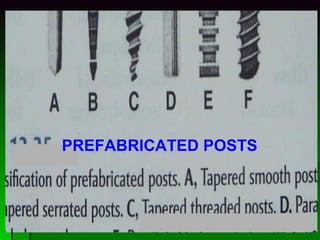
PREFABRICATED POSTS
b.   Custom-made Posts   - Can be cast from direct pattern or  an indirect one   - Direct technique utilizes  autopolymerizing resin and is   indicated for single canals  whereas an indirect technique  is more  appropriate  for  multiple canals
Core Fabrication :   The core replaces missing coronal tooth structure, and thereby forms the shape of the tooth preparation.  It can be shaped in resin or wax and added to the post pattern before the assembly is  cast into metal. The core can also be cast onto most prefabricated post systems. A third alternative is to make the core from a restorative material such as amalgam, GI or composite resin. A
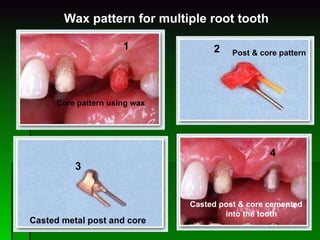
1 2 3 4 Casted metal post and core Post & core pattern Core pattern using wax Casted post & core cemented  into the tooth Wax pattern for multiple root tooth
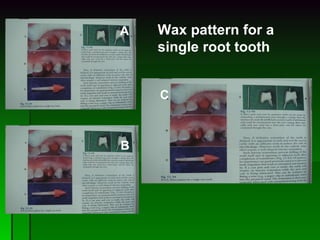
Wax pattern for a  single root tooth A B C
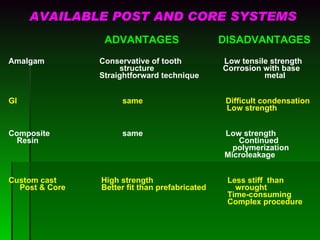
AVAILABLE POST AND CORE SYSTEMS ADVANTAGES   DISADVANTAGES Amalgam   Conservative of tooth  Low tensile strength     structure   Corrosion with base      Straightforward technique  metal   GI    same  Difficult condensation   Low strength   Composite     same  Low strength Resin   Continued  polymerization   Microleakage   Custom cast  High strength   Less stiff  than  Post & Core  Better fit than prefabricated  wrought   Time-consuming       Complex procedure  
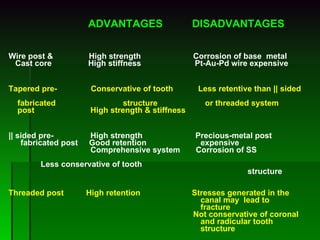
  ADVANTAGES   DISADVANTAGES Wire post &  High strength   Corrosion of base  metal Cast core   High stiffness  Pt-Au-Pd wire expensive   Tapered pre-   Conservative of tooth  Less retentive than || sided  fabricated  structure   or threaded system post   High strength & stiffness   || sided pre-   High strength   Precious-metal post fabricated post  Good retention expensive   Comprehensive system  Corrosion of SS     Less conservative of tooth    structure    Threaded post  High retention  Stresses generated in the  canal may  lead to  fracture     Not conservative of coronal  and radicular tooth  structure
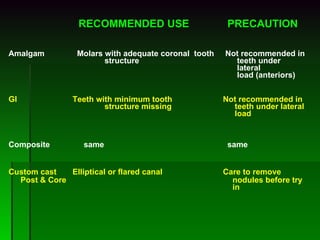
  RECOMMENDED USE   PRECAUTION Amalgam   Molars with adequate coronal  tooth  Not recommended in  structure     teeth under    lateral    load (anteriors)   GI   Teeth with minimum tooth   Not recommended in  structure missing  teeth under lateral   load Composite   same   same   Custom cast  Elliptical or flared canal   Care to remove   Post & Core  nodules before try  in
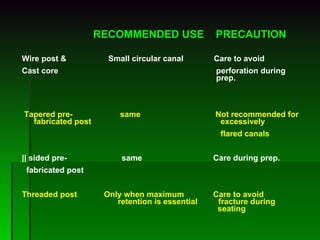
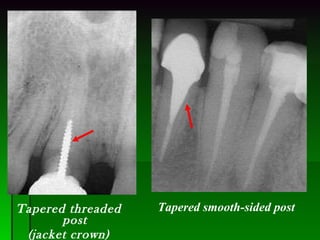
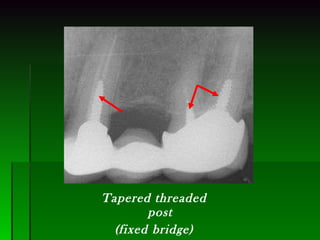
  RECOMMENDED USE  PRECAUTION Wire post &    Small circular canal  Care to avoid  Cast core    perforation during   prep.        Tapered pre-   same   Not recommended for fabricated post   excessively     flared canals || sided pre-   same   Care during prep.    fabricated post Threaded post  Only when maximum  Care to avoid  retention is essential   fracture during    seating
Tapered threaded post (jacket crown) Tapered smooth-sided post
Tapered threaded post (fixed bridge)
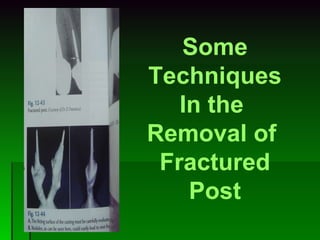
Some Techniques In the  Removal of  Fractured Post
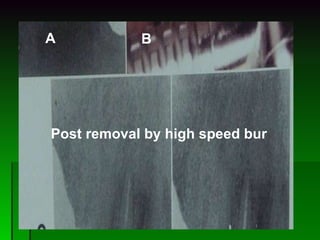
Post Removal by High Speed Bur A post that has fractured within the root canal cannot be removed with a post puller or forceps. The post can be drilled out, but great care is needed to avoid deviation. This technique is best limited to relatively short fractured posts.
Post removal by high speed bur A B
Masseran Technique Uses special hollow end-cutting tubes or trephines to prepare a thin trench around the post. Removal or retrieval can be facilitated by using an adhesive to attach a hollow tube extractor or by using a threaded extractor.
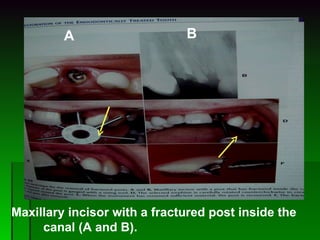
Maxillary incisor with a fractured post inside the  canal (A and B). A B
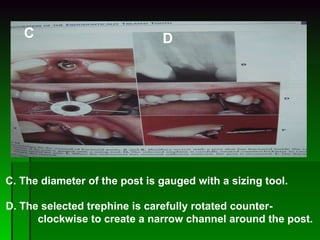
C. The diameter of the post is gauged with a sizing tool. D. The selected trephine is carefully rotated counter- clockwise to create a narrow channel around the post. C D
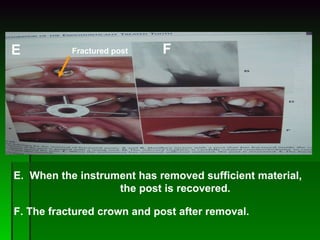
E.  When the instrument has removed sufficient material,  the post is recovered. F. The fractured crown and post after removal. F E Fractured post
Cementation of Post and Core
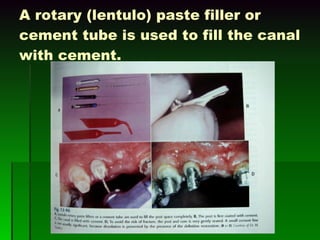
A rotary (lentulo) paste filler or cement tube is used to fill the canal with cement.
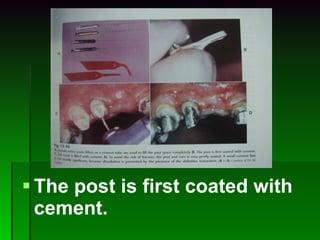
The post is first coated with cement.
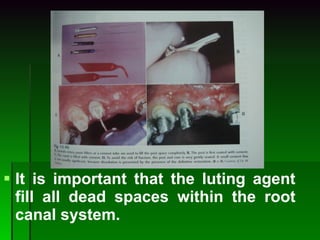
It is important that the luting agent fill all dead spaces within the root canal system.
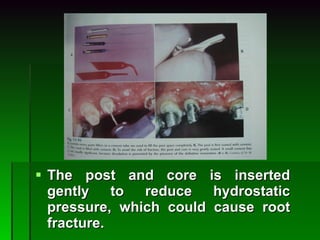
The post and core is inserted gently to reduce hydrostatic pressure, which could cause root fracture.
It is recommended that a groove be placed along the side of the post to allow excess cement to escape, if a parallel-sided post is being used.

3. post retained crown-midterm3

  • 1.
    POST-RETAINED CROWN (Restorationof the Endodontically Treated Tooth )
  • 2.
  • 3.
    Cemented dowel crown(radiographic view)
  • 4.
    Treatment Planning Endodonticallytreated tooth need to be assessed carefully for the following: 1.      Good apical seal 2.      No sensitivity to pressure 3.      No exudates 4.      No fistula 5.      No apical sensitivity 6. No active inflammation
  • 5.
    Disadvantages to theroutine use of a cemented post: Placing the post require an additional operative procedure Preparing a tooth to accommodate the post removes additional tooth structure
  • 6.
    The use ofa parallel-sided post in a tapered canal requires considerable enlargement of the post space, which can weaken the root significantly.
  • 7.
    c.  It maybe difficult to restore the tooth later, when a complete crown is needed, because the cemented post may have failed to provide adequate retention for the core material. d. The post can complicate or prevent future endodontic retreatment if this becomes necessary.
  • 8.
    Requirements for traditionalcore and dowel construction: a. Ideally the length of post should be equal to, at least, the length of the estimated clinical crown. b. The post must have an occlusal stop to prevent displacement apically. This is of vital importance since displacement toward the apex commonly results in fracture of the prepared root.
  • 9.
    c. Included inthis construction should be resistance to rotational forces. d. Posts should be of sufficient thickness to resist displacement and assist stabilization.
  • 10.
  • 11.
  • 12.
  • 13.
    PREPARED TOOTH for DOWEL CROWN ferrule
  • 14.
  • 15.
  • 16.
    Principle of PostSupport (Retention) A. Minimum post length should equal restored crown length or engage 2/3 of natural root B. Cylindrical posts are more retentive than similarly size tapered posts C. Wrought (bent/twisted/formed) gold alloy posts are two to four times stronger than cast gold alloy posts of equal diameter D. Serrated posts are 30% to 40% more retentive than are smooth posts
  • 17.
    3 Stages inTooth Preparation 1.   Removal of the root canal filling material to the appropriate depth 2.   Enlargement of the canal 3.   Preparation of the coronal tooth structure
  • 18.
    REMOVAL OF THEENDO FILLING MATERIAL 2 Methods of Removing Gutta Percha: a. With a warmed condenser b. With a rotary instrument (sometimes used with a chemical agent such as chloroform)
  • 19.
  • 20.
  • 21.
    Steps: (usinga warmed condenser) 1. Before removing gutta percha, calculate the appropriate length of the post. 2.  Avoid the apical 5mm if possible.   5mm. Apical seal
  • 22.
    3.  To prevent aspirationof an endo. instrument, apply a rubber dam before preparing the post space. 4. Select an endo. condenser large enough to hold heat well but not so large that it binds against the canal walls.
  • 23.
    5.  Mark it atthe appropriate length, heat it, and place it in the canal to soften the gutta percha. 6.   When the gutta percha has been removed to the appropriate depth, shape the canal as needed.
  • 24.
    ENLARGEMENT OF THECANAL For Prefabricated Posts 1. Enlarge the canal one to two sizes with a drill, endo file and reamer that matches the configuration of the post 2. Use a prefabricated post that matches standard endo instruments   3. Be especially careful not to remove more dentin at the apical extent of the post space than is necessary
  • 25.
    For Custom-made Posts1. Use custom-made posts in canals that have a non-circular cross section or extreme taper. Enlarging canals to conform to a preformed post may lead to perforation.   2. Be most careful on molars to avoid root perforation.
  • 26.
    PREPARATION OF THECORONAL TOOTH STRUCTURE Ignore any missing tooth structure and prepare the remaining tooth as though it were undamaged.  Be sure that the facial surface of the tooth is adequately reduced for good esthetics. Remove all undercuts that would prevent withdrawal of the pattern
  • 27.
    4. Remove anyunsupported tooth structure, but be careful to preserve as much of the crown as possible. 5. Be sure that part of the crown is prepared perpendicular to the post. 6. Complete the preparation by eliminating sharp angles and establishing a smooth finish line.
  • 28.
    Post Fabrication: a.  Prefabricated Posts - One advantage of using prefabricated posts is the simplicity of the technique - A post is selected to match the dimensions of the canal, and only minimum adjustment is needed for seating it to the full depth of the post space - Coronal half of the post may have an inadequate fit because the root canal has been flared, this is corrected by adding material when the core is made
  • 29.
  • 30.
    b.   Custom-made Posts - Can be cast from direct pattern or an indirect one - Direct technique utilizes autopolymerizing resin and is indicated for single canals whereas an indirect technique is more appropriate for multiple canals
  • 31.
    Core Fabrication : The core replaces missing coronal tooth structure, and thereby forms the shape of the tooth preparation. It can be shaped in resin or wax and added to the post pattern before the assembly is cast into metal. The core can also be cast onto most prefabricated post systems. A third alternative is to make the core from a restorative material such as amalgam, GI or composite resin. A
  • 32.
    1 2 34 Casted metal post and core Post & core pattern Core pattern using wax Casted post & core cemented into the tooth Wax pattern for multiple root tooth
  • 33.
    Wax pattern fora single root tooth A B C
  • 34.
    AVAILABLE POST ANDCORE SYSTEMS ADVANTAGES DISADVANTAGES Amalgam Conservative of tooth Low tensile strength structure Corrosion with base Straightforward technique metal   GI same Difficult condensation Low strength   Composite same Low strength Resin Continued polymerization Microleakage   Custom cast High strength Less stiff than Post & Core Better fit than prefabricated wrought Time-consuming Complex procedure  
  • 35.
    ADVANTAGES DISADVANTAGES Wire post & High strength Corrosion of base metal Cast core High stiffness Pt-Au-Pd wire expensive   Tapered pre- Conservative of tooth Less retentive than || sided fabricated structure or threaded system post High strength & stiffness   || sided pre- High strength Precious-metal post fabricated post Good retention expensive Comprehensive system Corrosion of SS Less conservative of tooth structure Threaded post High retention Stresses generated in the canal may lead to fracture Not conservative of coronal and radicular tooth structure
  • 36.
    RECOMMENDEDUSE PRECAUTION Amalgam Molars with adequate coronal tooth Not recommended in structure teeth under lateral load (anteriors)   GI Teeth with minimum tooth Not recommended in structure missing teeth under lateral load Composite same same   Custom cast Elliptical or flared canal Care to remove Post & Core nodules before try in
  • 37.
    RECOMMENDEDUSE PRECAUTION Wire post & Small circular canal Care to avoid Cast core perforation during prep.     Tapered pre- same Not recommended for fabricated post excessively flared canals || sided pre- same Care during prep.   fabricated post Threaded post Only when maximum Care to avoid retention is essential fracture during seating
  • 38.
    Tapered threaded post(jacket crown) Tapered smooth-sided post
  • 39.
    Tapered threaded post(fixed bridge)
  • 40.
    Some Techniques Inthe Removal of Fractured Post
  • 41.
    Post Removal byHigh Speed Bur A post that has fractured within the root canal cannot be removed with a post puller or forceps. The post can be drilled out, but great care is needed to avoid deviation. This technique is best limited to relatively short fractured posts.
  • 42.
    Post removal byhigh speed bur A B
  • 43.
    Masseran Technique Usesspecial hollow end-cutting tubes or trephines to prepare a thin trench around the post. Removal or retrieval can be facilitated by using an adhesive to attach a hollow tube extractor or by using a threaded extractor.
  • 44.
    Maxillary incisor witha fractured post inside the canal (A and B). A B
  • 45.
    C. The diameterof the post is gauged with a sizing tool. D. The selected trephine is carefully rotated counter- clockwise to create a narrow channel around the post. C D
  • 46.
    E. Whenthe instrument has removed sufficient material, the post is recovered. F. The fractured crown and post after removal. F E Fractured post
  • 47.
  • 48.
    A rotary (lentulo)paste filler or cement tube is used to fill the canal with cement.
  • 49.
    The post isfirst coated with cement.
  • 50.
    It is importantthat the luting agent fill all dead spaces within the root canal system.
  • 51.
    The post andcore is inserted gently to reduce hydrostatic pressure, which could cause root fracture.
  • 52.
    It is recommendedthat a groove be placed along the side of the post to allow excess cement to escape, if a parallel-sided post is being used.