Temporal database, Multimedia
database, Access control, Flow
control
Prof. Neeraj Bhargava
Pooja Dixit
Department of Computer Science
School of Engineering & System Science
MDS, University Ajmer, Rajasthan, India
 Temporal database
 notions of time
 Multimedia database
 Content of Multimedia Database
 Types of multimedia applications
 Access control
 types of access control
 flow control
 A temporal database stores data relating to time
instances.
 It offers temporal data types and stores information
relating to past, present and future time.
 Transaction time is the time period during which a
fact stored in the database in the database was
known. Bi temporal data combines both Valid and
Transaction Time.
 Valid time denotes the time period during
which a fact is true with respect to the real
world.
 Transaction time is the time period during
which a fact is stored in the database.
 Multimedia database is the collection of interrelated
multimedia data that includes text, graphics (sketches,
drawings), images, animations, video, audio etc.
 It have vast amounts of multisource multimedia data. The
framework that manages different types of multimedia
data which can be stored, delivered and utilized in
different ways is known as multimedia database
management .
 Media data – The actual data representing an object.
 Media format data – Information such as sampling
rate, resolution, encoding scheme etc.
 Media keyword data – Keywords description relating
to the generation of data.
 Media feature data – Content dependent data such as
the distribution of colors, kinds of texture and
different shapes present in data.
 Repository applications – A Large amount of
multimedia data as well as meta-data(Media format
date, Media keyword data, Media feature data) .
 Presentation applications – They involve delivery of
multimedia data subject to temporal constraint.
 Collaborative work using multimedia information – It
involves executing a complex task by merging
drawings, changing notifications. Example: Intelligent
healthcare network.
 Access control is a security technique that
regulates who or what can view or use
resources in a computing environment.
 It is a fundamental concept in security that
minimizes risk to the business or
organization.
 Physical access control : limits access to
campuses, buildings, rooms and physical IT
assets.
 Logical access control : limits connections to
computer networks, system files and data.
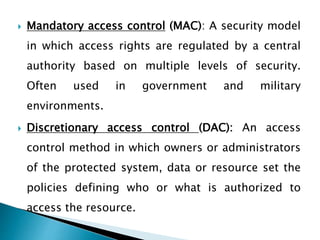
 Mandatory access control (MAC): A security model
in which access rights are regulated by a central
authority based on multiple levels of security.
Often used in government and military
environments.
 Discretionary access control (DAC): An access
control method in which owners or administrators
of the protected system, data or resource set the
policies defining who or what is authorized to
access the resource.
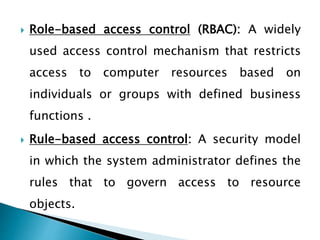
 Role-based access control (RBAC): A widely
used access control mechanism that restricts
access to computer resources based on
individuals or groups with defined business
functions .
 Rule-based access control: A security model
in which the system administrator defines the
rules that to govern access to resource
objects.
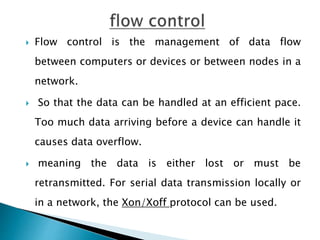
 Flow control is the management of data flow
between computers or devices or between nodes in a
network.
 So that the data can be handled at an efficient pace.
Too much data arriving before a device can handle it
causes data overflow.
 meaning the data is either lost or must be
retransmitted. For serial data transmission locally or
in a network, the Xon/Xoff protocol can be used.

Temporal database, Multimedia database, Access control, Flow control

  • 1.
    Temporal database, Multimedia database,Access control, Flow control Prof. Neeraj Bhargava Pooja Dixit Department of Computer Science School of Engineering & System Science MDS, University Ajmer, Rajasthan, India
  • 2.
     Temporal database notions of time  Multimedia database  Content of Multimedia Database  Types of multimedia applications  Access control  types of access control  flow control
  • 3.
     A temporaldatabase stores data relating to time instances.  It offers temporal data types and stores information relating to past, present and future time.  Transaction time is the time period during which a fact stored in the database in the database was known. Bi temporal data combines both Valid and Transaction Time.
  • 4.
     Valid timedenotes the time period during which a fact is true with respect to the real world.  Transaction time is the time period during which a fact is stored in the database.
  • 5.
     Multimedia databaseis the collection of interrelated multimedia data that includes text, graphics (sketches, drawings), images, animations, video, audio etc.  It have vast amounts of multisource multimedia data. The framework that manages different types of multimedia data which can be stored, delivered and utilized in different ways is known as multimedia database management .
  • 6.
     Media data– The actual data representing an object.  Media format data – Information such as sampling rate, resolution, encoding scheme etc.  Media keyword data – Keywords description relating to the generation of data.  Media feature data – Content dependent data such as the distribution of colors, kinds of texture and different shapes present in data.
  • 7.
     Repository applications– A Large amount of multimedia data as well as meta-data(Media format date, Media keyword data, Media feature data) .  Presentation applications – They involve delivery of multimedia data subject to temporal constraint.  Collaborative work using multimedia information – It involves executing a complex task by merging drawings, changing notifications. Example: Intelligent healthcare network.
  • 8.
     Access controlis a security technique that regulates who or what can view or use resources in a computing environment.  It is a fundamental concept in security that minimizes risk to the business or organization.
  • 9.
     Physical accesscontrol : limits access to campuses, buildings, rooms and physical IT assets.  Logical access control : limits connections to computer networks, system files and data.
  • 10.
     Mandatory accesscontrol (MAC): A security model in which access rights are regulated by a central authority based on multiple levels of security. Often used in government and military environments.  Discretionary access control (DAC): An access control method in which owners or administrators of the protected system, data or resource set the policies defining who or what is authorized to access the resource.
  • 11.
     Role-based accesscontrol (RBAC): A widely used access control mechanism that restricts access to computer resources based on individuals or groups with defined business functions .  Rule-based access control: A security model in which the system administrator defines the rules that to govern access to resource objects.
  • 12.
     Flow controlis the management of data flow between computers or devices or between nodes in a network.  So that the data can be handled at an efficient pace. Too much data arriving before a device can handle it causes data overflow.  meaning the data is either lost or must be retransmitted. For serial data transmission locally or in a network, the Xon/Xoff protocol can be used.