Risk Mitigation Monitoring
Management (RMMM)
• Risk
 Possible loss (S/W development domain).
• Mitigation
 Efforts made in order to reduce (next after
avoidance).
• Monitoring
 A sort of careful check (under observance).
• Management
 The art of coping (art of dealing).
2
Foreground
An EFFECTIVE STRATEGY to tackle RISK
must consider three issues:-
If (RISK is avoidable)
{
 Risk Mitigation. //(1)
 Risk Monitoring. //(2)
}
else //(i.e. RISK is unavoidable)
{
 Risk Management. //(3)
}
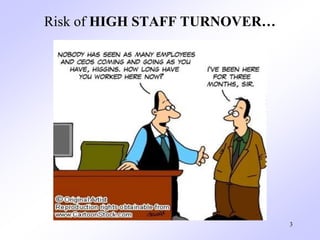
Risk of HIGH STAFF TURNOVER…
3
4
 Meet with current staff to determine causes for turnover (e.g., poor
working conditions, low pay, competitive job market)
 Mitigate those causes that are under our control before the project
starts
 Once the project commences, assume turnover will occur and
develop techniques to ensure continuity when people leave
 Organize project teams so that information about each
development activity is widely dispersed
 Define documentation standards and establish mechanisms to
ensure that documents are developed in a timely manner
 Conduct peer reviews of all work (so that more than one person is
"up to speed")
 Assign a backup staff member for every critical technologist
Strategy/Plan for Reducing Staff Turnover
Risk Mitigation (Avoidance)
5
Risk Monitoring(Tracking)
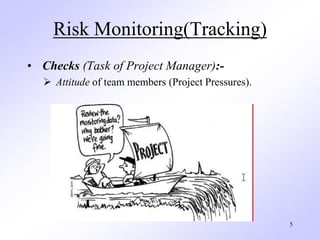
• Checks (Task of Project Manager):-
 Attitude of team members (Project Pressures).
 Degree to which team has jelled.
6
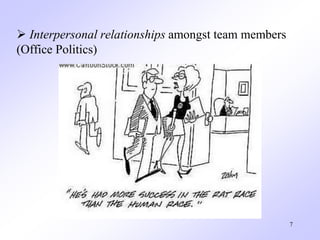
 Interpersonal relationships amongst team members
(Office Politics)
7
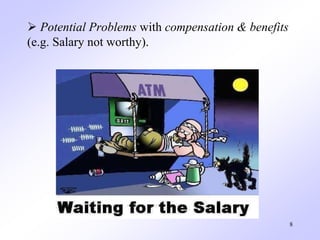
 Potential Problems with compensation & benefits
(e.g. Salary not worthy).
8
Availability of job within the company or outside it.
9
10
Risk Management(Dealing)
• Risk Management and contingency planning assume that mitigation
efforts have failed and that the risk has become a reality.
• RMMM steps incur additional project cost
– Large projects may have identified 30 – 40 risks
• Risk is not limited to the software project itself
– Risks can occur after the software has been delivered to the user.
• Software safety and hazard analysis
– These are software quality assurance activities that focus on the
identification and assessment of potential hazards that may affect software
negatively and cause an entire system to fail
– If hazards can be identified early in the software process, software design
features can be specified that will either eliminate or control potential
hazards
RMMM Plan
11
• The PLAN (may be a part of the S/W development plan) may
take any of following forms:-
 Separate document.
 RIS(Risk Information Sheet).
• Once RMMM has been documented and the project has begun,
the Risk Mitigation and Monitoring steps are followed.
• RMMM(Functionality):-
 To assess whether predicted risks do occur or not.
 To ensure that risk aversion steps defined for the risk are
being properly applied.
 To collect information that can be used for future risk
analysis.

• The findings from RMMM Plan may tell the project manager to
ascertain what risks caused which problems throughout the
project.
Query Time!!!
12

RMMM Plan

  • 1.
    Risk Mitigation Monitoring Management(RMMM) • Risk  Possible loss (S/W development domain). • Mitigation  Efforts made in order to reduce (next after avoidance). • Monitoring  A sort of careful check (under observance). • Management  The art of coping (art of dealing).
  • 2.
    2 Foreground An EFFECTIVE STRATEGYto tackle RISK must consider three issues:- If (RISK is avoidable) {  Risk Mitigation. //(1)  Risk Monitoring. //(2) } else //(i.e. RISK is unavoidable) {  Risk Management. //(3) }
  • 3.
    Risk of HIGHSTAFF TURNOVER… 3
  • 4.
    4  Meet withcurrent staff to determine causes for turnover (e.g., poor working conditions, low pay, competitive job market)  Mitigate those causes that are under our control before the project starts  Once the project commences, assume turnover will occur and develop techniques to ensure continuity when people leave  Organize project teams so that information about each development activity is widely dispersed  Define documentation standards and establish mechanisms to ensure that documents are developed in a timely manner  Conduct peer reviews of all work (so that more than one person is "up to speed")  Assign a backup staff member for every critical technologist Strategy/Plan for Reducing Staff Turnover Risk Mitigation (Avoidance)
  • 5.
    5 Risk Monitoring(Tracking) • Checks(Task of Project Manager):-  Attitude of team members (Project Pressures).
  • 6.
     Degree towhich team has jelled. 6
  • 7.
     Interpersonal relationshipsamongst team members (Office Politics) 7
  • 8.
     Potential Problemswith compensation & benefits (e.g. Salary not worthy). 8
  • 9.
    Availability of jobwithin the company or outside it. 9
  • 10.
    10 Risk Management(Dealing) • RiskManagement and contingency planning assume that mitigation efforts have failed and that the risk has become a reality. • RMMM steps incur additional project cost – Large projects may have identified 30 – 40 risks • Risk is not limited to the software project itself – Risks can occur after the software has been delivered to the user. • Software safety and hazard analysis – These are software quality assurance activities that focus on the identification and assessment of potential hazards that may affect software negatively and cause an entire system to fail – If hazards can be identified early in the software process, software design features can be specified that will either eliminate or control potential hazards
  • 11.
    RMMM Plan 11 • ThePLAN (may be a part of the S/W development plan) may take any of following forms:-  Separate document.  RIS(Risk Information Sheet). • Once RMMM has been documented and the project has begun, the Risk Mitigation and Monitoring steps are followed. • RMMM(Functionality):-  To assess whether predicted risks do occur or not.  To ensure that risk aversion steps defined for the risk are being properly applied.  To collect information that can be used for future risk analysis. • The findings from RMMM Plan may tell the project manager to ascertain what risks caused which problems throughout the project.
  • 12.