

Good Morning
Grade 5-SST
The Temperate Zone-KWL Chart
2
What I know? What I want to know? What I learnt?
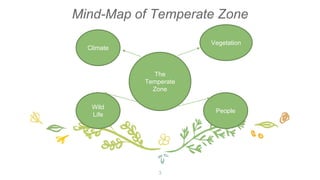
Mind-Map of Temperate Zone
3
The
Temperate
Zone
Climate
Wild
Life
People
Vegetation
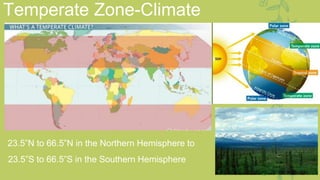
Temperate Zone-Climate
23.5”N to 66.5”N in the Northern Hemisphere to
23.5”S to 66.5”S in the Southern Hemisphere
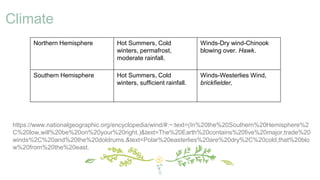
Climate
5
Northern Hemisphere Hot Summers, Cold
winters, permafrost,
moderate rainfall.
Winds-Dry wind-Chinook
blowing over. Hawk.
Southern Hemisphere Hot Summers, Cold
winters, sufficient rainfall.
Winds-Westerlies Wind,
brickfielder,
https://www.nationalgeographic.org/encyclopedia/wind/#:~:text=(In%20the%20Southern%20Hemisphere%2
C%20low,will%20be%20on%20your%20right.)&text=The%20Earth%20contains%20five%20major,trade%20
winds%2C%20and%20the%20doldrums.&text=Polar%20easterlies%20are%20dry%2C%20cold,that%20blo
w%20from%20the%20east.
Vegetation-Flora and Fauna-
Grasslands
6
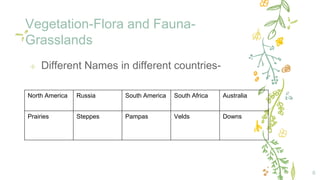
✢ Different Names in different countries-
North America Russia South America South Africa Australia
Prairies Steppes Pampas Velds Downs
Vegetation-Flora and Fauna-
Grasslands
7
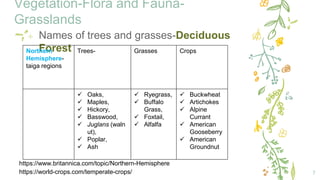
✢ Names of trees and grasses-Deciduous
Forest
Northern
Hemisphere-
taiga regions
Trees- Grasses Crops
 Oaks,
 Maples,
 Hickory,
 Basswood,
 Juglans (waln
ut),
 Poplar,
 Ash
 Ryegrass,
 Buffalo
Grass,
 Foxtail,
 Alfalfa
 Buckwheat
 Artichokes
 Alpine
Currant
 American
Gooseberry
 American
Groundnut
https://www.britannica.com/topic/Northern-Hemisphere
https://world-crops.com/temperate-crops/
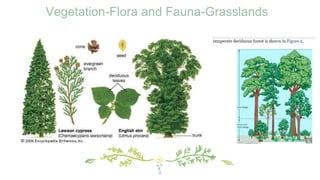
Vegetation-Flora and Fauna-Grasslands
8
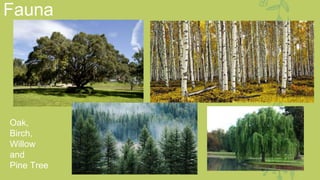
Fauna
Oak,
Birch,
Willow
and
Pine Tree
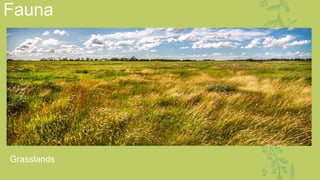
Fauna
Grasslands
Vegetation-Flora and Fauna-
Grasslands
11
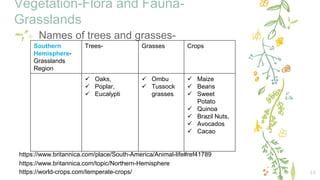
✢ Names of trees and grasses-
Southern
Hemisphere-
Grasslands
Region
Trees- Grasses Crops
 Oaks,
 Poplar,
 Eucalypti
 Ombu
 Tussock
grasses
 Maize
 Beans
 Sweet
Potato
 Quinoa
 Brazil Nuts,
 Avocados
 Cacao
https://www.britannica.com/topic/Northern-Hemisphere
https://world-crops.com/temperate-crops/
https://www.britannica.com/place/South-America/Animal-life#ref41789
Wild Life
12
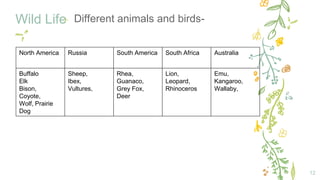
✢ Different animals and birds-
North America Russia South America South Africa Australia
Buffalo
Elk
Bison,
Coyote,
Wolf, Prairie
Dog
Sheep,
Ibex,
Vultures,
Rhea,
Guanaco,
Grey Fox,
Deer
Lion,
Leopard,
Rhinoceros
Emu,
Kangaroo,
Wallaby,
Wild Life
13
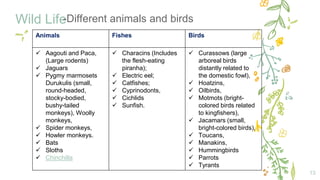
-Different animals and birds
Animals Fishes Birds
 Aagouti and Paca,
(Large rodents)
 Jaguars
 Pygmy marmosets
Durukulis (small,
round-headed,
stocky-bodied,
bushy-tailed
monkeys), Woolly
monkeys,
 Spider monkeys,
 Howler monkeys.
 Bats
 Sloths
 Chinchilla
 Characins (Includes
the flesh-eating
piranha);
 Electric eel;
 Catfishes;
 Cyprinodonts,
 Cichlids
 Sunfish.
 Curassows (large
arboreal birds
distantly related to
the domestic fowl),
 Hoatzins,
 Oilbirds,
 Motmots (bright-
colored birds related
to kingfishers),
 Jacamars (small,
bright-colored birds),
 Toucans,
 Manakins,
 Hummingbirds
 Parrots
 Tyrants
Different animals and
birds
23.5”N to 66.5”N in the
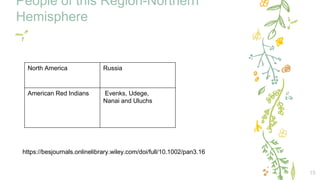
People of this Region-Northern
Hemisphere
15
North America Russia
American Red Indians Evenks, Udege,
Nanai and Uluchs
https://besjournals.onlinelibrary.wiley.com/doi/full/10.1002/pan3.16
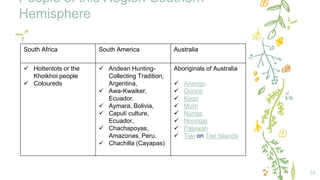
People of this Region-Southern
Hemisphere
16
South Africa South America Australia
 Hottentots or the
Khoikhoi people
 Coloureds
 Andean Hunting-
Collecting Tradition,
Argentina,
 Awa-Kwaiker,
Ecuador.
 Aymara, Bolivia,
 Capulí culture,
Ecuador,
 Chachapoyas,
Amazonas, Peru.
 Chachilla (Cayapas)
Aboriginals of Australia
 Anangu
 Goorie
 Koori
 Murri
 Nunga
 Noongar
 Palawah
 Tiwi on Tiwi Islands
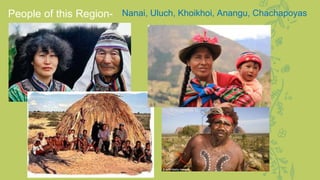
People of this Region- Nanai, Uluch, Khoikhoi, Anangu, Chachapoyas
18
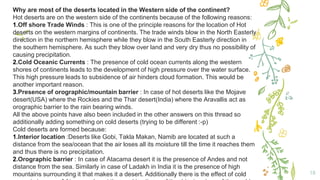
Why are most of the deserts located in the Western side of the continent?
Hot deserts are on the western side of the continents because of the following reasons:
1.Off shore Trade Winds : This is one of the principle reasons for the location of Hot
deserts on the western margins of continents. The trade winds blow in the North Easterly
direction in the northern hemisphere while they blow in the South Easterly direction in
the southern hemisphere. As such they blow over land and very dry thus no possibility of
causing precipitation.
2.Cold Oceanic Currents : The presence of cold ocean currents along the western
shores of continents leads to the development of high pressure over the water surface.
This high pressure leads to subsidence of air hinders cloud formation. This would be
another important reason.
3.Presence of orographic/mountain barrier : In case of hot deserts like the Mojave
desert(USA) where the Rockies and the Thar desert(India) where the Aravallis act as
orographic barrier to the rain bearing winds.
All the above points have also been included in the other answers on this thread so
additionally adding something on cold deserts (trying to be different :-p)
Cold deserts are formed because:
1.Interior location :Deserts like Gobi, Takla Makan, Namib are located at such a
distance from the sea/ocean that the air loses all its moisture till the time it reaches them
and thus there is no precipitation.
2.Orographic barrier : In case of Atacama desert it is the presence of Andes and not
distance from the sea. Similarly in case of Ladakh in India it is the presence of high
mountains surrounding it that makes it a desert. Additionally there is the effect of cold

temperate zone

  • 1.
  • 2.
    The Temperate Zone-KWLChart 2 What I know? What I want to know? What I learnt?
  • 3.
    Mind-Map of TemperateZone 3 The Temperate Zone Climate Wild Life People Vegetation
  • 4.
    Temperate Zone-Climate 23.5”N to66.5”N in the Northern Hemisphere to 23.5”S to 66.5”S in the Southern Hemisphere
  • 5.
    Climate 5 Northern Hemisphere HotSummers, Cold winters, permafrost, moderate rainfall. Winds-Dry wind-Chinook blowing over. Hawk. Southern Hemisphere Hot Summers, Cold winters, sufficient rainfall. Winds-Westerlies Wind, brickfielder, https://www.nationalgeographic.org/encyclopedia/wind/#:~:text=(In%20the%20Southern%20Hemisphere%2 C%20low,will%20be%20on%20your%20right.)&text=The%20Earth%20contains%20five%20major,trade%20 winds%2C%20and%20the%20doldrums.&text=Polar%20easterlies%20are%20dry%2C%20cold,that%20blo w%20from%20the%20east.
  • 6.
    Vegetation-Flora and Fauna- Grasslands 6 ✢Different Names in different countries- North America Russia South America South Africa Australia Prairies Steppes Pampas Velds Downs
  • 7.
    Vegetation-Flora and Fauna- Grasslands 7 ✢Names of trees and grasses-Deciduous Forest Northern Hemisphere- taiga regions Trees- Grasses Crops  Oaks,  Maples,  Hickory,  Basswood,  Juglans (waln ut),  Poplar,  Ash  Ryegrass,  Buffalo Grass,  Foxtail,  Alfalfa  Buckwheat  Artichokes  Alpine Currant  American Gooseberry  American Groundnut https://www.britannica.com/topic/Northern-Hemisphere https://world-crops.com/temperate-crops/
  • 8.
  • 9.
  • 10.
  • 11.
    Vegetation-Flora and Fauna- Grasslands 11 ✢Names of trees and grasses- Southern Hemisphere- Grasslands Region Trees- Grasses Crops  Oaks,  Poplar,  Eucalypti  Ombu  Tussock grasses  Maize  Beans  Sweet Potato  Quinoa  Brazil Nuts,  Avocados  Cacao https://www.britannica.com/topic/Northern-Hemisphere https://world-crops.com/temperate-crops/ https://www.britannica.com/place/South-America/Animal-life#ref41789
  • 12.
    Wild Life 12 ✢ Differentanimals and birds- North America Russia South America South Africa Australia Buffalo Elk Bison, Coyote, Wolf, Prairie Dog Sheep, Ibex, Vultures, Rhea, Guanaco, Grey Fox, Deer Lion, Leopard, Rhinoceros Emu, Kangaroo, Wallaby,
  • 13.
    Wild Life 13 -Different animalsand birds Animals Fishes Birds  Aagouti and Paca, (Large rodents)  Jaguars  Pygmy marmosets Durukulis (small, round-headed, stocky-bodied, bushy-tailed monkeys), Woolly monkeys,  Spider monkeys,  Howler monkeys.  Bats  Sloths  Chinchilla  Characins (Includes the flesh-eating piranha);  Electric eel;  Catfishes;  Cyprinodonts,  Cichlids  Sunfish.  Curassows (large arboreal birds distantly related to the domestic fowl),  Hoatzins,  Oilbirds,  Motmots (bright- colored birds related to kingfishers),  Jacamars (small, bright-colored birds),  Toucans,  Manakins,  Hummingbirds  Parrots  Tyrants
  • 14.
  • 15.
    People of thisRegion-Northern Hemisphere 15 North America Russia American Red Indians Evenks, Udege, Nanai and Uluchs https://besjournals.onlinelibrary.wiley.com/doi/full/10.1002/pan3.16
  • 16.
    People of thisRegion-Southern Hemisphere 16 South Africa South America Australia  Hottentots or the Khoikhoi people  Coloureds  Andean Hunting- Collecting Tradition, Argentina,  Awa-Kwaiker, Ecuador.  Aymara, Bolivia,  Capulí culture, Ecuador,  Chachapoyas, Amazonas, Peru.  Chachilla (Cayapas) Aboriginals of Australia  Anangu  Goorie  Koori  Murri  Nunga  Noongar  Palawah  Tiwi on Tiwi Islands
  • 17.
    People of thisRegion- Nanai, Uluch, Khoikhoi, Anangu, Chachapoyas
  • 18.
    18 Why are mostof the deserts located in the Western side of the continent? Hot deserts are on the western side of the continents because of the following reasons: 1.Off shore Trade Winds : This is one of the principle reasons for the location of Hot deserts on the western margins of continents. The trade winds blow in the North Easterly direction in the northern hemisphere while they blow in the South Easterly direction in the southern hemisphere. As such they blow over land and very dry thus no possibility of causing precipitation. 2.Cold Oceanic Currents : The presence of cold ocean currents along the western shores of continents leads to the development of high pressure over the water surface. This high pressure leads to subsidence of air hinders cloud formation. This would be another important reason. 3.Presence of orographic/mountain barrier : In case of hot deserts like the Mojave desert(USA) where the Rockies and the Thar desert(India) where the Aravallis act as orographic barrier to the rain bearing winds. All the above points have also been included in the other answers on this thread so additionally adding something on cold deserts (trying to be different :-p) Cold deserts are formed because: 1.Interior location :Deserts like Gobi, Takla Makan, Namib are located at such a distance from the sea/ocean that the air loses all its moisture till the time it reaches them and thus there is no precipitation. 2.Orographic barrier : In case of Atacama desert it is the presence of Andes and not distance from the sea. Similarly in case of Ladakh in India it is the presence of high mountains surrounding it that makes it a desert. Additionally there is the effect of cold