DIGITAL PATHOLOGY
&
IMAGE ANALYSIS
MITHUN VENUGOPAL.A
OVERVIEW
• Digital Pathology & its importance
• Components
• Systems & its key features Pros and cons
• Summary
What is digital pathology....
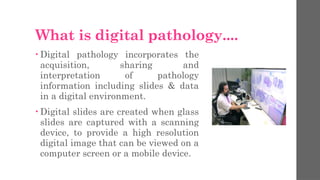
• Digital pathology incorporates the
acquisition, sharing and
interpretation of pathology
information including slides & data
in a digital environment.
• Digital slides are created when glass
slides are captured with a scanning
device, to provide a high resolution
digital image that can be viewed on a
computer screen or a mobile device.
Digital Pathology
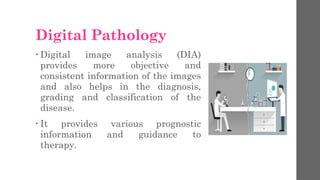
• Digital image analysis (DIA)
provides more objective and
consistent information of the images
and also helps in the diagnosis,
grading and classification of the
disease.
• It provides various prognostic
information and guidance to
therapy.
Digital Pathology
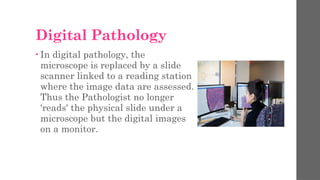
• In digital pathology, the
microscope is replaced by a slide
scanner linked to a reading station
where the image data are assessed.
Thus the Pathologist no longer
'reads' the physical slide under a
microscope but the digital images
on a monitor.
Applications of Digital Pathology
• Education & Publication: The digital slides to use for teaching.
• Telepathology: Digital slides to use for immediate online opinion.
• Detection of malignancy: Malignant cells are detected such as in
cervical smear.
• Detailed morphologic study of DNA and chromosomes.
• Pattern recognition and grading of carcinoma.
• Quantitation of immunohistochemistry.
• Assessment of aggressiveness of a tumor for personalized
medicine.
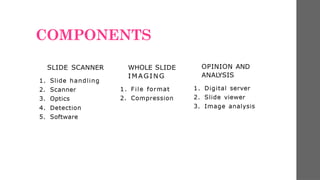
COMPONENTS
Principles of Image Analysis
Image digitalization:
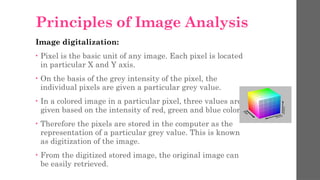
• Pixel is the basic unit of any image. Each pixel is located
in particular X and Y axis.
• On the basis of the grey intensity of the pixel, the
individual pixels are given a particular grey value.
• In a colored image in a particular pixel, three values are
given based on the intensity of red, green and blue color.
• Therefore the pixels are stored in the computer as the
representation of a particular grey value. This is known
as digitization of the image.
• From the digitized stored image, the original image can
be easily retrieved.
Principles of Image Analysis
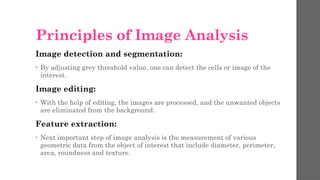
Image detection and segmentation:
• By adjusting grey threshold value, one can detect the cells or image of the
interest.
Image editing:
• With the help of editing, the images are processed, and the unwanted objects
are eliminated from the background.
Feature extraction:
• Next important step of image analysis is the measurement of various
geometric data from the object of interest that include diameter, perimeter,
area, roundness and texture.
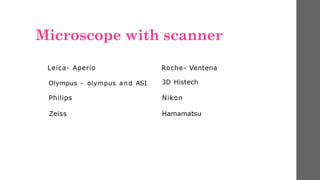
Microscope with scanner
ADVANTAGES
• Opinion on difficult and cancer cases is sought from
renowned expert pathologist located across the world
• Many centers in India has been seeking opinion from
experts by sending digital images over web server to expert
pathologists
• In addition, patients are benefitted as slides and blocks no
need to be transported. Most importantly, the period of
anxiety for the patients and their families is tremendously
reduced and treatment is received by the patient at the
earliest.
ADVANTAGES
• Use of digital pathology is highly recommended for
second opinion.
• Brings together experts from all over the world to work
collaboratively-faster diagnosis and therapy
• It also frees pathologists to work on different tasks,
leaving the menial ones to technology
ADVANTAGES
• Networking with labs having the capacity and
with top notch knowledge
• Work from home Consultations are easily made
• Clinicopathological conferences without glass
slides Measurements are easy using the built in
ruler Image analysis( prognostic, prediction)
• Easier to recruit young pathologists
DISADVANTAGES
• Expensive equipment
• Large storage component (36000Gb/year, 60k
slides,0.6Gb/slide)
• Lab without unstable technology, lack of IT standards
system unable to support digitalization

Image analysis in pathology, histopathology

  • 1.
  • 2.
    OVERVIEW • Digital Pathology& its importance • Components • Systems & its key features Pros and cons • Summary
  • 3.
    What is digitalpathology.... • Digital pathology incorporates the acquisition, sharing and interpretation of pathology information including slides & data in a digital environment. • Digital slides are created when glass slides are captured with a scanning device, to provide a high resolution digital image that can be viewed on a computer screen or a mobile device.
  • 4.
    Digital Pathology • Digitalimage analysis (DIA) provides more objective and consistent information of the images and also helps in the diagnosis, grading and classification of the disease. • It provides various prognostic information and guidance to therapy.
  • 5.
    Digital Pathology • Indigital pathology, the microscope is replaced by a slide scanner linked to a reading station where the image data are assessed. Thus the Pathologist no longer 'reads' the physical slide under a microscope but the digital images on a monitor.
  • 6.
    Applications of DigitalPathology • Education & Publication: The digital slides to use for teaching. • Telepathology: Digital slides to use for immediate online opinion. • Detection of malignancy: Malignant cells are detected such as in cervical smear. • Detailed morphologic study of DNA and chromosomes. • Pattern recognition and grading of carcinoma. • Quantitation of immunohistochemistry. • Assessment of aggressiveness of a tumor for personalized medicine.
  • 7.
  • 8.
    Principles of ImageAnalysis Image digitalization: • Pixel is the basic unit of any image. Each pixel is located in particular X and Y axis. • On the basis of the grey intensity of the pixel, the individual pixels are given a particular grey value. • In a colored image in a particular pixel, three values are given based on the intensity of red, green and blue color. • Therefore the pixels are stored in the computer as the representation of a particular grey value. This is known as digitization of the image. • From the digitized stored image, the original image can be easily retrieved.
  • 9.
    Principles of ImageAnalysis Image detection and segmentation: • By adjusting grey threshold value, one can detect the cells or image of the interest. Image editing: • With the help of editing, the images are processed, and the unwanted objects are eliminated from the background. Feature extraction: • Next important step of image analysis is the measurement of various geometric data from the object of interest that include diameter, perimeter, area, roundness and texture.
  • 10.
  • 11.
    ADVANTAGES • Opinion ondifficult and cancer cases is sought from renowned expert pathologist located across the world • Many centers in India has been seeking opinion from experts by sending digital images over web server to expert pathologists • In addition, patients are benefitted as slides and blocks no need to be transported. Most importantly, the period of anxiety for the patients and their families is tremendously reduced and treatment is received by the patient at the earliest.
  • 12.
    ADVANTAGES • Use ofdigital pathology is highly recommended for second opinion. • Brings together experts from all over the world to work collaboratively-faster diagnosis and therapy • It also frees pathologists to work on different tasks, leaving the menial ones to technology
  • 13.
    ADVANTAGES • Networking withlabs having the capacity and with top notch knowledge • Work from home Consultations are easily made • Clinicopathological conferences without glass slides Measurements are easy using the built in ruler Image analysis( prognostic, prediction) • Easier to recruit young pathologists
  • 14.
    DISADVANTAGES • Expensive equipment •Large storage component (36000Gb/year, 60k slides,0.6Gb/slide) • Lab without unstable technology, lack of IT standards system unable to support digitalization