TELEMEDICINE
“TELEMEDICINE
PROVIDES HEALTHCARE
WHERE THERE IS NONE
AND
IMPROVES THE HEALTH
CARE WHERE THERE IS
SOME”
WHAT IS
TELEMEDICINE ?
Telemedicine is an upcoming field
in health science arising out of the
effective fusion of Information and
Communication Technologies (ICT)
with Medical Science having
enormous potential in meeting the
challenges of healthcare delivery to
rural and remote areas .
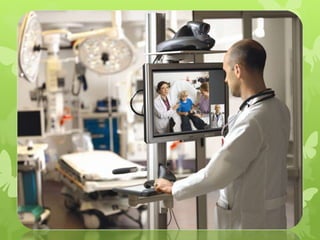
It may be as simple as two health professionals
discussing medical problems of a patient and
seeking advice over a simple telephone to as
complex as transmission of electronic medical
records of clinical information, diagnostic tests
such as BLOOD TESTS,URINE TESTS,BP etc,and
carrying out real time interactive medical video
conference with the help of IT based hardware
and software, video-conference using broadband
telecommunication media provided by
satellite and terrestrial network.
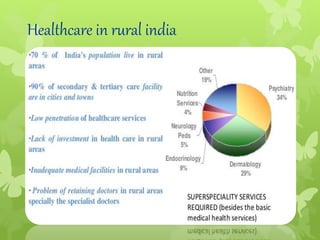
Healthcare in rural india
TYPES OF TELEMEDICINE PROCESS :
1.TECHNOLOGY INVOLVED
2.APPLICATION ADOPTED
TECHNOLOGY INVOLVED :
REAL TIME OR SYNCHRONOUS:
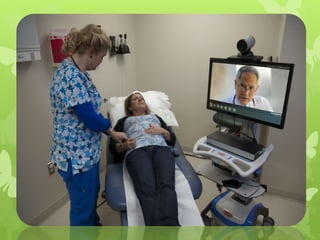
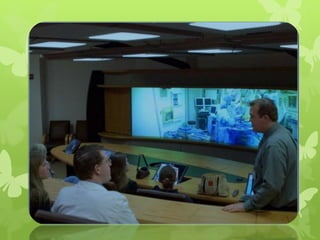
Real time telemedicine could be as simple as a
telephone call or as complex as telemedical
video conference and tele-robotic surgery. It
requires the presence of both parties at the
same time and a telecommunication link
between them that allows a real-time
interaction to take place. Video-conferencing
equipment is one of the most common forms
of technology used in synchronous
telemedicine.
STORE-AND-FORWARD
TELEMEDICINE OR ASYNCHRONOUS:
It involves acquiring medical data (like
medical history, images, etc.) and then
transmitting this data to a doctor or
medical specialist at a convenient time
later for assessment offline. It does not
require the presence of both parties at
the same time. Examples are tele-
pathology, tele-radiology, tele-
dermatolgy.
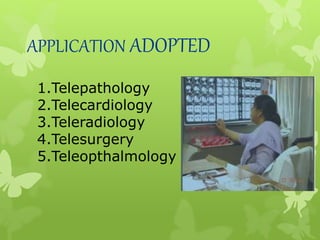
APPLICATION ADOPTED
1.Telepathology
2.Telecardiology
3.Teleradiology
4.Telesurgery
5.Teleopthalmology
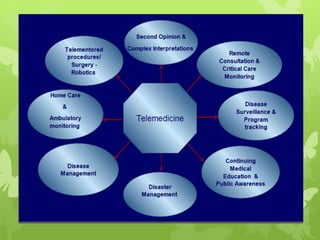
Applications
of telemedicine
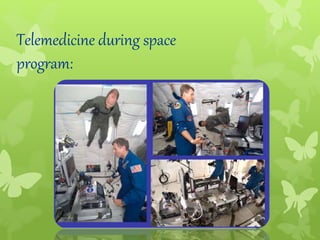
Telemedicine during space
program:
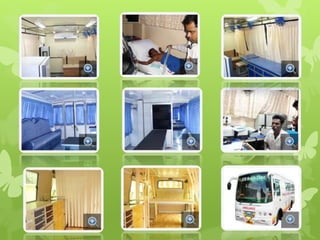
TELEMEDICINE FACILITY
IN MOBILE VANS
1.Festivals and melas.
2.During disasters.
3.Emergency cases.
4.Long journey like amarnath yatra .
Telemedicine also helps
Through mobile vans during:
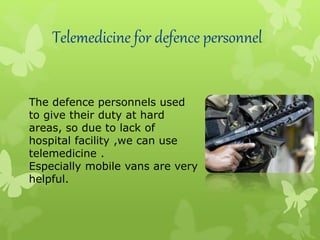
Telemedicine for defence personnel
The defence personnels used
to give their duty at hard
areas, so due to lack of
hospital facility ,we can use
telemedicine .
Especially mobile vans are very
helpful.
Benefits of telemedicine to patients :
1.Access to specialized healthcare services to
under served rural, semi-urban and
remote areas.
2.Early diagnosis and treatment.
3.Reduced physician’s fees and cost of
medicine.
4.Reduced visits to special hospitals.
5.Reduced travel expenses.
6.Early detection of disease.
7. Reduced burden of morbidity.
CURRENT EFFORTS
IN INDIA TELEMEDICINE PROGRAMS ACTIVELY
SUPPORTED BY:
• Dept. of Information Technology
• Indian Space Research Organization
• ONGC (finding petroleum)
• Apollo Hospitals
• Asia Heart Foundation
• State governments.
TELEMEDICINE INCLUDES
MEMBERS FROM VARIOUS
DEPARTMENTS
1.Health communication and
information technology.
2.Indian space research organisation.
3.Indian council of medical research.
4.Medical council of india.
5.Centre for development of advanced
computing.
6.Academic medical institutions and
corporate health hospitals.
DEPARTMENTS ARE :
Telemedicine during mela
Festivals/disasters
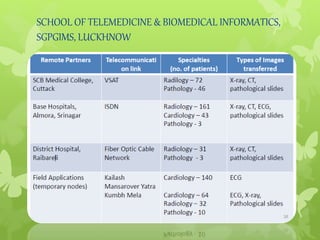
• Maha Kumbhamela
– Attended by about 10 million people
in about a month.
• Implemented by SGPGIMS, OTRI &
State Govt. of uttar pradesh.
–Tele-monitoring of Public Health
activities.
telemedicine
system
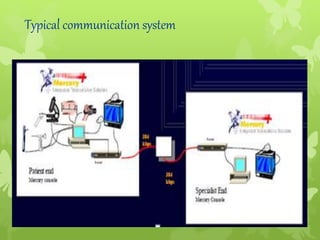
ACTUALLYWHATHAPPENS
DURINGA TELEMEDICINE
PROGRAM?
Typical communication system
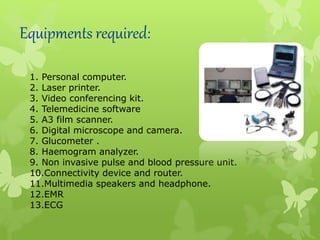
Equipments required:
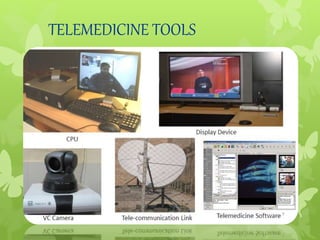
1. Personal computer.
2. Laser printer.
3. Video conferencing kit.
4. Telemedicine software
5. A3 film scanner.
6. Digital microscope and camera.
7. Glucometer .
8. Haemogram analyzer.
9. Non invasive pulse and blood pressure unit.
10.Connectivity device and router.
11.Multimedia speakers and headphone.
12.EMR
13.ECG
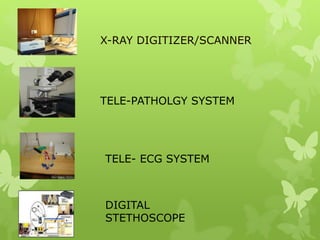
TELEMEDICINE TOOLS
Medical
Diagnostic
equipments
X-RAY DIGITIZER/SCANNER
TELE-PATHOLGY SYSTEM
TELE- ECG SYSTEM
DIGITAL
STETHOSCOPE
CRUCIAL BRANCH OF
TELEMEDICINE
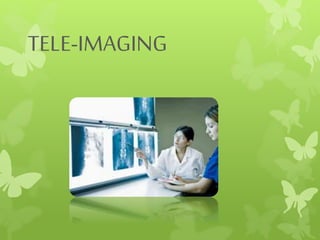
TELE-IMAGING
WHAT IS TELE-IMAGING ?
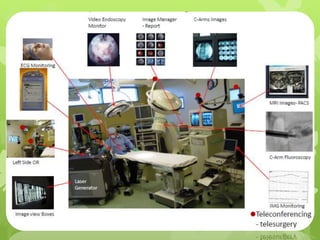
Tele-imaging includes the transmission
of medical digital images, and plays a
role in all fields of telemedicine,such as
expertise.consultation,teaching and
research.
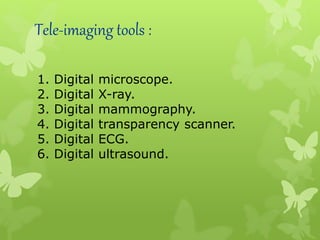
Tele-imaging tools :
1. Digital microscope.
2. Digital X-ray.
3. Digital mammography.
4. Digital transparency scanner.
5. Digital ECG.
6. Digital ultrasound.
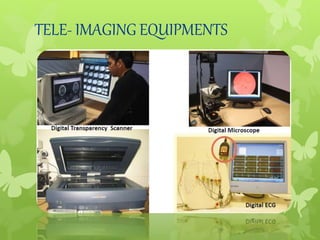
TELE- IMAGING EQUIPMENTS
Facilitating quality of tele-imaging:
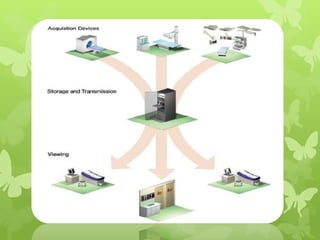
1.DIGITALIZATION OF MEDICAL IMAGES IS
REQUIRED FOR TELE-IMAGING in TWO WAYS:
-digitalization of medical imaging.
-direct acquisition of digital images.
2. TO OBTAIN GOOD QUALITY OF IMAGE :
-compression of data without loss of
information.
-transmission requires a high data rate.
3.TRANSMISSION OF GOOD QUALITY
OF IMAGES REQUIRED :
-high speed network.
-high database system.
-a super high definition imaging
system.
-a video conference system.
SCHOOL OF TELEMEDICINE & BIOMEDICAL INFORMATICS,
SGPGIMS, LUCKHNOW
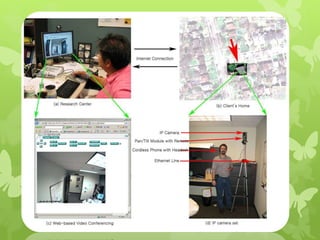
Whole set up of tele-imaging
CHALLENGES OF
TELEMEDICINE
1.Low or small bandwidth.
2.Neither telephone lines nor electricity in
rural and remote areas.
3.Satellite transmission can help but it is
very costly.
4.Unstable electricity supply.
5.patient’s fear and unfamiliarity.
6.Financial unavailability.
7.Lack of basic amenities.
8.Literacy rate and diversity in languages.
9.Quality aspect.
10.Government support.
Advantages of
telemedicine
1.Eliminate distance barriers and improve access to
quality health services.
2.In emergency and critical care situations where
moving a patient may be undesirable and/or not
feasible.
3.Facilitate patients and rural practitioners’ access to
specialist health services and support
4.Lessen the inconvenience and/or cost of patient
transfers.
5.Reduce unnecessary travel time for health
professionals.
6.Reduce isolation of rural practice by upgrading their
knowledge through tele-education or tele-CME.
Conclusion
“TELEMEDICINE:
ONE SMALL STEP
FOR IT , A GIANT
LEAP FOR
HEALTHCARE !!”
-BY NEIL ARMSTRONG
THANK YOU !!

Telemedicine

  • 1.
  • 2.
    “TELEMEDICINE PROVIDES HEALTHCARE WHERE THEREIS NONE AND IMPROVES THE HEALTH CARE WHERE THERE IS SOME”
  • 3.
    WHAT IS TELEMEDICINE ? Telemedicineis an upcoming field in health science arising out of the effective fusion of Information and Communication Technologies (ICT) with Medical Science having enormous potential in meeting the challenges of healthcare delivery to rural and remote areas .
  • 4.
    It may beas simple as two health professionals discussing medical problems of a patient and seeking advice over a simple telephone to as complex as transmission of electronic medical records of clinical information, diagnostic tests such as BLOOD TESTS,URINE TESTS,BP etc,and carrying out real time interactive medical video conference with the help of IT based hardware and software, video-conference using broadband telecommunication media provided by satellite and terrestrial network.
  • 5.
  • 6.
    TYPES OF TELEMEDICINEPROCESS : 1.TECHNOLOGY INVOLVED 2.APPLICATION ADOPTED
  • 7.
    TECHNOLOGY INVOLVED : REALTIME OR SYNCHRONOUS: Real time telemedicine could be as simple as a telephone call or as complex as telemedical video conference and tele-robotic surgery. It requires the presence of both parties at the same time and a telecommunication link between them that allows a real-time interaction to take place. Video-conferencing equipment is one of the most common forms of technology used in synchronous telemedicine.
  • 8.
    STORE-AND-FORWARD TELEMEDICINE OR ASYNCHRONOUS: Itinvolves acquiring medical data (like medical history, images, etc.) and then transmitting this data to a doctor or medical specialist at a convenient time later for assessment offline. It does not require the presence of both parties at the same time. Examples are tele- pathology, tele-radiology, tele- dermatolgy.
  • 9.
  • 10.
  • 12.
  • 13.
  • 14.
    1.Festivals and melas. 2.Duringdisasters. 3.Emergency cases. 4.Long journey like amarnath yatra . Telemedicine also helps Through mobile vans during:
  • 15.
    Telemedicine for defencepersonnel The defence personnels used to give their duty at hard areas, so due to lack of hospital facility ,we can use telemedicine . Especially mobile vans are very helpful.
  • 17.
    Benefits of telemedicineto patients : 1.Access to specialized healthcare services to under served rural, semi-urban and remote areas. 2.Early diagnosis and treatment. 3.Reduced physician’s fees and cost of medicine. 4.Reduced visits to special hospitals. 5.Reduced travel expenses. 6.Early detection of disease. 7. Reduced burden of morbidity.
  • 18.
    CURRENT EFFORTS IN INDIATELEMEDICINE PROGRAMS ACTIVELY SUPPORTED BY: • Dept. of Information Technology • Indian Space Research Organization • ONGC (finding petroleum) • Apollo Hospitals • Asia Heart Foundation • State governments.
  • 19.
  • 20.
    1.Health communication and informationtechnology. 2.Indian space research organisation. 3.Indian council of medical research. 4.Medical council of india. 5.Centre for development of advanced computing. 6.Academic medical institutions and corporate health hospitals. DEPARTMENTS ARE :
  • 21.
    Telemedicine during mela Festivals/disasters •Maha Kumbhamela – Attended by about 10 million people in about a month. • Implemented by SGPGIMS, OTRI & State Govt. of uttar pradesh. –Tele-monitoring of Public Health activities.
  • 22.
  • 23.
  • 27.
  • 28.
    Equipments required: 1. Personalcomputer. 2. Laser printer. 3. Video conferencing kit. 4. Telemedicine software 5. A3 film scanner. 6. Digital microscope and camera. 7. Glucometer . 8. Haemogram analyzer. 9. Non invasive pulse and blood pressure unit. 10.Connectivity device and router. 11.Multimedia speakers and headphone. 12.EMR 13.ECG
  • 29.
  • 30.
  • 31.
  • 32.
  • 33.
  • 34.
    WHAT IS TELE-IMAGING? Tele-imaging includes the transmission of medical digital images, and plays a role in all fields of telemedicine,such as expertise.consultation,teaching and research.
  • 36.
    Tele-imaging tools : 1.Digital microscope. 2. Digital X-ray. 3. Digital mammography. 4. Digital transparency scanner. 5. Digital ECG. 6. Digital ultrasound.
  • 37.
  • 38.
    Facilitating quality oftele-imaging: 1.DIGITALIZATION OF MEDICAL IMAGES IS REQUIRED FOR TELE-IMAGING in TWO WAYS: -digitalization of medical imaging. -direct acquisition of digital images. 2. TO OBTAIN GOOD QUALITY OF IMAGE : -compression of data without loss of information. -transmission requires a high data rate.
  • 39.
    3.TRANSMISSION OF GOODQUALITY OF IMAGES REQUIRED : -high speed network. -high database system. -a super high definition imaging system. -a video conference system.
  • 40.
    SCHOOL OF TELEMEDICINE& BIOMEDICAL INFORMATICS, SGPGIMS, LUCKHNOW
  • 41.
    Whole set upof tele-imaging
  • 44.
  • 45.
    1.Low or smallbandwidth. 2.Neither telephone lines nor electricity in rural and remote areas. 3.Satellite transmission can help but it is very costly. 4.Unstable electricity supply. 5.patient’s fear and unfamiliarity. 6.Financial unavailability. 7.Lack of basic amenities. 8.Literacy rate and diversity in languages. 9.Quality aspect. 10.Government support.
  • 46.
  • 47.
    1.Eliminate distance barriersand improve access to quality health services. 2.In emergency and critical care situations where moving a patient may be undesirable and/or not feasible. 3.Facilitate patients and rural practitioners’ access to specialist health services and support 4.Lessen the inconvenience and/or cost of patient transfers. 5.Reduce unnecessary travel time for health professionals. 6.Reduce isolation of rural practice by upgrading their knowledge through tele-education or tele-CME.
  • 48.
  • 49.
    “TELEMEDICINE: ONE SMALL STEP FORIT , A GIANT LEAP FOR HEALTHCARE !!” -BY NEIL ARMSTRONG
  • 50.