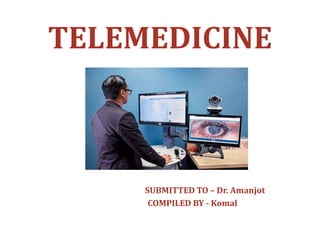
TELEMEDICINE
SUBMITTED TO – Dr. Amanjot
COMPILED BY - Komal
INTRODUCTION
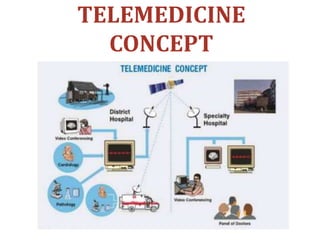
Telemedicine is the use of telecommunication, satellite
communication and information technology to provide clinical
health care from a distance. It has been used to overcome distance
barriers and to improve access to medical services that would often
not be consistently available in distant rural communities. It is also
used to save lives in critical care and emergency situations.
There are three common types of telemedicine:
• Interactive medicine: Also called “live telemedicine,” this is
when physicians and patients communicate in real time.
• Remote patient monitoring: This allows caregivers to monitor
patients who use mobile medical equipment to collect data on
things like blood pressure, blood sugar levels, etc.
• Store and forward: Providers can share a patient’s health
information with other healthcare professionals or specialists.
FATHER OF TELEMEDICINE
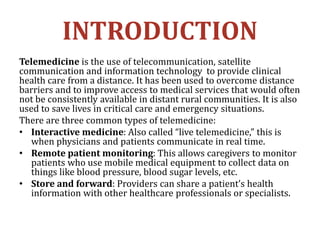
• First setup of telemedicine Boston Logan
Airport to Massachusetts in general hospital
1967.
• Jay Sanders
TELEMEDICINE
CONCEPT
HISTORIC PERSPECTIVE OF
TELEMEDICINE
• The National Aeronautics and Space Administration (NASA)
played an important part in the early development of
telemedicine.
• 1960 - NASA’s efforts in telemedicine began in the early when
human began flying in space. Physiological parameters were
transmitted from both the spacecraft and the space suits during
missions.
• 1972-75 - one of the earliest endeavors in telemedicine, Space
Technology Applied to Rural Papago Advanced Health Care
(STARPAHC) delivered medical care to the Papago Indian
Reservation in Arizona. It was conceived by the NASA.
• 1977 - the Telemedicine Centre at the Memorial University of
Newfoundland has worked toward developing interactive audio
networks for educational programs and the transmission of
medical data.
TELEHEALTH VERSUS
TELEMEDICINE
• Telehealth is sometimes discussed interchangeably with
telemedicine, the latter being more common than the
former. The Health Resources and Services
Administration distinguishes telehealth from telemedicine
in its scope, defining telemedicine only as describing
remote clinical services, such as diagnosis and monitoring,
while telehealth includes preventative, promotive, and
curative care delivery. This includes the above-mentioned
non-clinical applications, like administration and provider
education.
METHODS AND MODALITIES
Delivery can come within four distinct domains:
 Store and forward-
Store-and-forward telemedicine involves acquiring medical data
(like medical images, biosignals etc.) and then transmitting this
data to a doctor or medical specialist at a convenient time for
assessment offline. It does not require the presence of both parties
at the same time. Dermatology, radiology, and pathology are
common specialties that are conducive to asynchronous
telemedicine. A properly structured medical record preferably
in electronic form should be a component of this transfer. The
'store-and-forward' process requires the clinician to rely on a
history report and audio/video information in lieu of a physical
examination.
 Remote monitoring-
A blood pressure monitor Remote monitoring, also known as
self-monitoring or testing, enables medical professionals to
monitor a patient remotely using various technological
devices. This method is primarily used for managing chronic
diseases or specific conditions, such as heart disease, diabetes
mellitus, or asthma. These services can provide comparable
health outcomes to traditional in-person patient encounters,
supply greater satisfaction to patients, and may be cost-
effective.[Examples include home-based nocturnal dialysis
and improved joint management.
 Real-time interactive-
Electronic consultations are possible through interactive
telemedicine services which provide real-time
interactions between patient and provider.
Videoconferencing has been used in a wide range of
clinical disciplines and settings for various purposes
including management, diagnosis, counseling and
monitoring of patients.
 Videotelephony -
• Videotelephony comprises the technologies for the reception
and transmission of audio-video signals by users at different
locations, for communication between people in real-time. At
the dawn of the technology, videotelephony also included image
phones which would exchange still images between units every
few seconds over conventional POTS-type telephone lines,
essentially the same as slow scan TV systems.
• Currently, videotelephony is particularly useful to the deaf
and speech - impaired who can use them with sign language and
also with a video relay services, and well as to those
with mobility issues or those who are located in distant places
and are in need of telemedical or tele-educational services.
FEATURES OF TELEMEDICINE
Teleconsultation
Telemonitoring
Telepresence
Telediagnosis
Teletreatment
CATEGORIES
 Telenutrition-
Telenutrition refers to the use of video conferencing/
telephony to provide online consultation by a nutritionist
or dietician. Patient or clients upload their vital statistics,
diet logs, food pictures etc. on TeleNutrition portal which
are then used by nutritionist or dietician to analyze their
current health condition.
 Telenursing -
Telenursing refers to the use of telecommunication
and information technology in order to provide nursing
services in health care whenever a large physical distance
exists between patient and nurse, or between any
number of nurses.
 Teleneurology -
Teleneurology describes the use of mobile technology to
provide neurological care remotely, including care for stroke,
movement disorders like Parkinson's disease, seizure
disorders (e.g., epilepsy), etc.
 Telerehabilitation -
Telerehabilitation (or e-rehabilitationis the delivery
of rehabiliation services over telecommunication
networks and the Internet. Most types of services fall into two
categories: clinical assessment (the patient's functional
abilities in his or her environment), and clinical therapy.
NATIONAL RURAL TELEMEDICINE
NETWORK(NTRN)
• Hierarchical Structure of NRTN :
 LEVEL-1: Primary Health Center (PHC) / Community
Health Center (CHC)connected to a District Hospital
 LEVEL-2: District Hospital connected to a State
Hospital / National Super Specialty Hospital .
 LEVEL-3: State Hospital / National Super Specialty
Hospital connected to each other
 LEVEL- M: Mobile Telemedicine Unit covering few
villages connected to nearest PHC/CHC or directly to
District Hospital
ADVANTAGES OF TELEMEDICINE
SYSTEM
• Easy access to specialists.
• Improves communication between health providers
separated by distance.
• Medical access for people without health insurance.
• Monitoring home care and ambulatory monitoring.
• Medical access for people in underserved urban areas.
• Reduced exposure to pathogens.
• Using telemedicine in peripheral health set-ups can
significantly reduce the time and costs of patient
transportation
LIMITATIONS AND
RESTRICTIONS
• Technical glitches and obstacles.
• Not everyone can use video for
appointments.
• Distractions can lower the quality of
the appointment.
• You might not know the doctor on the
other side of the phone.
• State laws can narrow access to out-of-
state doctors.
BARRIERS TO TELEMEDICINE
• Resistance on part of general public and healthcare
personnel to adopt new technology as a result of
ignorance.
• Technological challenges: the system used are complex,
there is always a potential for malfunction resulting in
hardware and soft ware failure.
• Linguistic and cultural divide between patients and
healthcare providers.
• Legal consideration: lack of policies that govern patient
privacy and confidentiality in relation to data transfer,
storage and sharing between health professionals and
govt./private agencies
REFERENCES
 https://en.m.wikiversity.org/wiki/Telemedicine
 https://www.slideserve.com/caine/telemedicine
 https://en.wikipedia.org/wiki/Telehealth#Ethical_i
ssues
 https://zaggocare.org/pros-cons-telemedicine/
THANK YOU

TELEMEDICINE.pptx

  • 1.
    TELEMEDICINE SUBMITTED TO –Dr. Amanjot COMPILED BY - Komal
  • 2.
    INTRODUCTION Telemedicine is theuse of telecommunication, satellite communication and information technology to provide clinical health care from a distance. It has been used to overcome distance barriers and to improve access to medical services that would often not be consistently available in distant rural communities. It is also used to save lives in critical care and emergency situations. There are three common types of telemedicine: • Interactive medicine: Also called “live telemedicine,” this is when physicians and patients communicate in real time. • Remote patient monitoring: This allows caregivers to monitor patients who use mobile medical equipment to collect data on things like blood pressure, blood sugar levels, etc. • Store and forward: Providers can share a patient’s health information with other healthcare professionals or specialists.
  • 3.
    FATHER OF TELEMEDICINE •First setup of telemedicine Boston Logan Airport to Massachusetts in general hospital 1967. • Jay Sanders
  • 4.
  • 5.
    HISTORIC PERSPECTIVE OF TELEMEDICINE •The National Aeronautics and Space Administration (NASA) played an important part in the early development of telemedicine. • 1960 - NASA’s efforts in telemedicine began in the early when human began flying in space. Physiological parameters were transmitted from both the spacecraft and the space suits during missions. • 1972-75 - one of the earliest endeavors in telemedicine, Space Technology Applied to Rural Papago Advanced Health Care (STARPAHC) delivered medical care to the Papago Indian Reservation in Arizona. It was conceived by the NASA. • 1977 - the Telemedicine Centre at the Memorial University of Newfoundland has worked toward developing interactive audio networks for educational programs and the transmission of medical data.
  • 6.
    TELEHEALTH VERSUS TELEMEDICINE • Telehealthis sometimes discussed interchangeably with telemedicine, the latter being more common than the former. The Health Resources and Services Administration distinguishes telehealth from telemedicine in its scope, defining telemedicine only as describing remote clinical services, such as diagnosis and monitoring, while telehealth includes preventative, promotive, and curative care delivery. This includes the above-mentioned non-clinical applications, like administration and provider education.
  • 7.
    METHODS AND MODALITIES Deliverycan come within four distinct domains:  Store and forward- Store-and-forward telemedicine involves acquiring medical data (like medical images, biosignals etc.) and then transmitting this data to a doctor or medical specialist at a convenient time for assessment offline. It does not require the presence of both parties at the same time. Dermatology, radiology, and pathology are common specialties that are conducive to asynchronous telemedicine. A properly structured medical record preferably in electronic form should be a component of this transfer. The 'store-and-forward' process requires the clinician to rely on a history report and audio/video information in lieu of a physical examination.
  • 8.
     Remote monitoring- Ablood pressure monitor Remote monitoring, also known as self-monitoring or testing, enables medical professionals to monitor a patient remotely using various technological devices. This method is primarily used for managing chronic diseases or specific conditions, such as heart disease, diabetes mellitus, or asthma. These services can provide comparable health outcomes to traditional in-person patient encounters, supply greater satisfaction to patients, and may be cost- effective.[Examples include home-based nocturnal dialysis and improved joint management.
  • 9.
     Real-time interactive- Electronicconsultations are possible through interactive telemedicine services which provide real-time interactions between patient and provider. Videoconferencing has been used in a wide range of clinical disciplines and settings for various purposes including management, diagnosis, counseling and monitoring of patients.
  • 10.
     Videotelephony - •Videotelephony comprises the technologies for the reception and transmission of audio-video signals by users at different locations, for communication between people in real-time. At the dawn of the technology, videotelephony also included image phones which would exchange still images between units every few seconds over conventional POTS-type telephone lines, essentially the same as slow scan TV systems. • Currently, videotelephony is particularly useful to the deaf and speech - impaired who can use them with sign language and also with a video relay services, and well as to those with mobility issues or those who are located in distant places and are in need of telemedical or tele-educational services.
  • 11.
  • 12.
    CATEGORIES  Telenutrition- Telenutrition refersto the use of video conferencing/ telephony to provide online consultation by a nutritionist or dietician. Patient or clients upload their vital statistics, diet logs, food pictures etc. on TeleNutrition portal which are then used by nutritionist or dietician to analyze their current health condition.  Telenursing - Telenursing refers to the use of telecommunication and information technology in order to provide nursing services in health care whenever a large physical distance exists between patient and nurse, or between any number of nurses.
  • 13.
     Teleneurology - Teleneurologydescribes the use of mobile technology to provide neurological care remotely, including care for stroke, movement disorders like Parkinson's disease, seizure disorders (e.g., epilepsy), etc.  Telerehabilitation - Telerehabilitation (or e-rehabilitationis the delivery of rehabiliation services over telecommunication networks and the Internet. Most types of services fall into two categories: clinical assessment (the patient's functional abilities in his or her environment), and clinical therapy.
  • 14.
    NATIONAL RURAL TELEMEDICINE NETWORK(NTRN) •Hierarchical Structure of NRTN :  LEVEL-1: Primary Health Center (PHC) / Community Health Center (CHC)connected to a District Hospital  LEVEL-2: District Hospital connected to a State Hospital / National Super Specialty Hospital .  LEVEL-3: State Hospital / National Super Specialty Hospital connected to each other  LEVEL- M: Mobile Telemedicine Unit covering few villages connected to nearest PHC/CHC or directly to District Hospital
  • 15.
    ADVANTAGES OF TELEMEDICINE SYSTEM •Easy access to specialists. • Improves communication between health providers separated by distance. • Medical access for people without health insurance. • Monitoring home care and ambulatory monitoring. • Medical access for people in underserved urban areas. • Reduced exposure to pathogens. • Using telemedicine in peripheral health set-ups can significantly reduce the time and costs of patient transportation
  • 16.
    LIMITATIONS AND RESTRICTIONS • Technicalglitches and obstacles. • Not everyone can use video for appointments. • Distractions can lower the quality of the appointment. • You might not know the doctor on the other side of the phone. • State laws can narrow access to out-of- state doctors.
  • 17.
    BARRIERS TO TELEMEDICINE •Resistance on part of general public and healthcare personnel to adopt new technology as a result of ignorance. • Technological challenges: the system used are complex, there is always a potential for malfunction resulting in hardware and soft ware failure. • Linguistic and cultural divide between patients and healthcare providers. • Legal consideration: lack of policies that govern patient privacy and confidentiality in relation to data transfer, storage and sharing between health professionals and govt./private agencies
  • 18.
    REFERENCES  https://en.m.wikiversity.org/wiki/Telemedicine  https://www.slideserve.com/caine/telemedicine https://en.wikipedia.org/wiki/Telehealth#Ethical_i ssues  https://zaggocare.org/pros-cons-telemedicine/
  • 19.