TELEMEDICINE
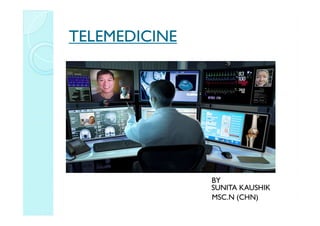
TELEMEDICINE
BY
SUNITA KAUSHIK
MSC.N (CHN)
INTRODUCTION
INTRODUCTION
Telemedicine is the use of technologies to
remotely diagnose , monitor , and treat
patients.
Exchange of information from one site to
another site through electronic communication
Exchange of information from one site to
another site through electronic communication
to improve clinical health status .
DEFINITION
DEFINITION
 According to WHO.(world health
organization’’
 Telemedicine is defined as a delivery of
health care services , where distance in
critical factor , by all health care professional
health care services , where distance in
critical factor , by all health care professional
using information and communication
technology for exchange of valid information
for diagnosis , treatment and prevention of
disease and injuries , research and evaluation
, and for continuing education of health care
provider .
DEFINITION
DEFINITION
 Telemedicine is defined as the use of tele
communication , to deliver health care
expert sharing of medical knowledge
with person are distance location .
AIM OFTELIMEDICINE
AIM OFTELIMEDICINE –
–
 To deliver specialized medical care and advice
with in reach of patent at distance place .
OBJECTIVES OFTELIMEDICINE
 To provide specialized medical advice .
 To monitor patient condition .
 To guide other medical staff about treatment
procedure .
 Share patient data among institution for
research purpose .
PRINCIPLES OFTELIMEDICINE
 Is only a tool ( like a stethoscope)
 Must be physician directed
 Must be integrated into established clinical
operation and routine
 Physician – patient must be preserved
STAFFING
STAFFING –
–
 Head of the department
 Consultant
 Network manager
 Program manager
 Program manager
 Web developer
 Telemedicine technician
 Telephone attendant
FUNCTION
FUNCTION –
–
 Video conferencing between patient and
specialist doctors
 Video conference between different specialist
and other health care professional
 Monitoring patient vitals and statics in ICU
 Security in data connection and storage of
information .
 Transfer of patient`s medical data among
hospitals .
BENEFITS OFTELIMEDICINE –
 Resource utilization
 Early intervention
 Avoids unnecessary transportation
 Community based care
 Medical education and research
 Cost saving
 Improving patient documentation
 Increase range of care and education
LIMITITIONTO SPREAD
LIMITITIONTO SPREAD
TELIMEDICINE
TELIMEDICINE
 Poor patient – Doctor relationship
 Patient acceptance
 Fear of technology
 Low rates of utilization
THANK YOU
THANK YOU
THANK YOU
THANK YOU

TELEMEDICINE

  • 1.
  • 2.
    INTRODUCTION INTRODUCTION Telemedicine is theuse of technologies to remotely diagnose , monitor , and treat patients. Exchange of information from one site to another site through electronic communication Exchange of information from one site to another site through electronic communication to improve clinical health status .
  • 3.
    DEFINITION DEFINITION  According toWHO.(world health organization’’  Telemedicine is defined as a delivery of health care services , where distance in critical factor , by all health care professional health care services , where distance in critical factor , by all health care professional using information and communication technology for exchange of valid information for diagnosis , treatment and prevention of disease and injuries , research and evaluation , and for continuing education of health care provider .
  • 4.
    DEFINITION DEFINITION  Telemedicine isdefined as the use of tele communication , to deliver health care expert sharing of medical knowledge expert sharing of medical knowledge with person are distance location .
  • 5.
    AIM OFTELIMEDICINE AIM OFTELIMEDICINE– –  To deliver specialized medical care and advice with in reach of patent at distance place .
  • 6.
    OBJECTIVES OFTELIMEDICINE OBJECTIVES OFTELIMEDICINE To provide specialized medical advice .  To monitor patient condition .  To guide other medical staff about treatment  To guide other medical staff about treatment procedure .  Share patient data among institution for research purpose .
  • 7.
    PRINCIPLES OFTELIMEDICINE PRINCIPLES OFTELIMEDICINE Is only a tool ( like a stethoscope)  Must be physician directed  Must be integrated into established clinical  Must be integrated into established clinical operation and routine  Physician – patient must be preserved
  • 8.
    STAFFING STAFFING – –  Headof the department  Consultant  Network manager  Program manager  Program manager  Web developer  Telemedicine technician  Telephone attendant
  • 9.
    FUNCTION FUNCTION – –  Videoconferencing between patient and specialist doctors  Video conference between different specialist and other health care professional and other health care professional  Monitoring patient vitals and statics in ICU  Security in data connection and storage of information .  Transfer of patient`s medical data among hospitals .
  • 10.
    BENEFITS OFTELIMEDICINE – Resource utilization  Early intervention  Avoids unnecessary transportation  Avoids unnecessary transportation  Community based care  Medical education and research  Cost saving  Improving patient documentation  Increase range of care and education
  • 11.
    LIMITITIONTO SPREAD LIMITITIONTO SPREAD TELIMEDICINE TELIMEDICINE Poor patient – Doctor relationship  Patient acceptance  Fear of technology  Fear of technology  Low rates of utilization
  • 12.