DIGITAL SUBSCRIBER LINE
Prepared by:
Ebrahim Mohammed Abdo
M031220004
Definition
 DSL is a high-speed Internet service like cable

Internet.
 DSL provides high-speed networking over
ordinary phone lines using broadband
modem technology.
 DSL technology allows Internet and telephone

service to work over the same phone line without
requiring customers to disconnect either their
voice or Internet connections.
 DSL Internet services are used primarily in homes
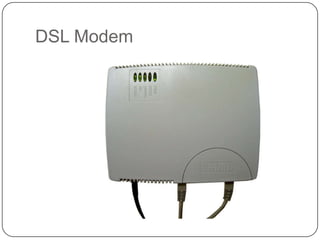
DSL Modem
What Are the Different Types of DSL
Technology?
 All types of DSL Internet service can be categorized as :
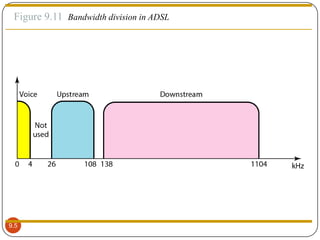
 Asymmetric DSL ( ADSL) : provide more network

bandwidth for downloading than for uploading. By reducing
upstream bandwidth, service providers are able to offer
more bandwidth downstream.
 Asymmetric DSL technology is designed for residential
users; it is not suitable for businesses.
 Symmetric DSL (SDSL): provide equal bandwidth for both

uploads and downloads.
 Symmetric DSL technology is popular for business-class
DSL services as companies often have greater needs for
transferring data.
Figure 9.11 Bandwidth division in ADSL

9.5
Equipment
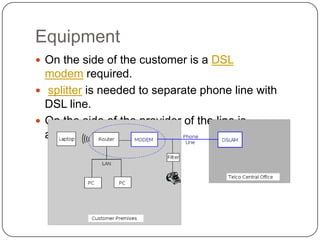
 On the side of the customer is a DSL

modem required.
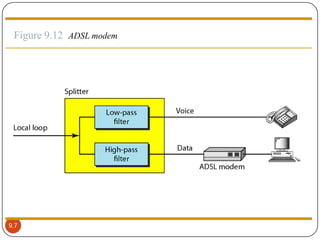
 splitter is needed to separate phone line with
DSL line.
 On the side of the provider of the line is
a DSLAM equipped.
Figure 9.12 ADSL modem

9.7
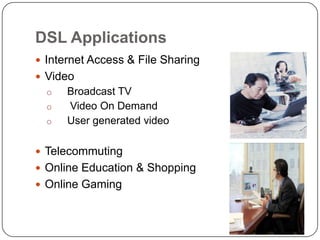
DSL Applications
 Internet Access & File Sharing
 Video
o
o
o

Broadcast TV
Video On Demand
User generated video

 Telecommuting
 Online Education & Shopping
 Online Gaming
Market Status of DSL Technology
 DSL is the #1 Broadband Choice in the World

with over 65% market share and more than
200 million users
 DSL is available in every region of the world,

and ADSL owns the majority of the market.
 DSL is capable of providing up to 100 Mbp,

and supports voice, video and data.
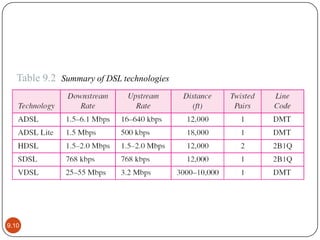
Table 9.2 Summary of DSL technologies

9.10

DSL

  • 1.
    DIGITAL SUBSCRIBER LINE Preparedby: Ebrahim Mohammed Abdo M031220004
  • 2.
    Definition  DSL isa high-speed Internet service like cable Internet.  DSL provides high-speed networking over ordinary phone lines using broadband modem technology.  DSL technology allows Internet and telephone service to work over the same phone line without requiring customers to disconnect either their voice or Internet connections.  DSL Internet services are used primarily in homes
  • 3.
  • 4.
    What Are theDifferent Types of DSL Technology?  All types of DSL Internet service can be categorized as :  Asymmetric DSL ( ADSL) : provide more network bandwidth for downloading than for uploading. By reducing upstream bandwidth, service providers are able to offer more bandwidth downstream.  Asymmetric DSL technology is designed for residential users; it is not suitable for businesses.  Symmetric DSL (SDSL): provide equal bandwidth for both uploads and downloads.  Symmetric DSL technology is popular for business-class DSL services as companies often have greater needs for transferring data.
  • 5.
    Figure 9.11 Bandwidthdivision in ADSL 9.5
  • 6.
    Equipment  On theside of the customer is a DSL modem required.  splitter is needed to separate phone line with DSL line.  On the side of the provider of the line is a DSLAM equipped.
  • 7.
  • 8.
    DSL Applications  InternetAccess & File Sharing  Video o o o Broadcast TV Video On Demand User generated video  Telecommuting  Online Education & Shopping  Online Gaming
  • 9.
    Market Status ofDSL Technology  DSL is the #1 Broadband Choice in the World with over 65% market share and more than 200 million users  DSL is available in every region of the world, and ADSL owns the majority of the market.  DSL is capable of providing up to 100 Mbp, and supports voice, video and data.
  • 10.
    Table 9.2 Summaryof DSL technologies 9.10

Editor's Notes

  • #3  "Digital Subscriber Line." It is medium for transferring data over regular phone lines and can be used to connect to the Internet.
  • #7  digital subscriber line access multiplexer (DSLAM)