Chapter 4
Data Communication & Networking
4.1
Digital Transmission
4
4-
-2 ANALOG
2 ANALOG-
-TO
TO-
-DIGITAL CONVERSION
DIGITAL CONVERSION
A
A digital
digital signal
signal is
is superior
superior to
to an
an analog
analog signal
signal because
because
it
it is
is more
more robust
robust to
to noise
noise and
and can
can easily
easily be
be recovered,
recovered,
corrected
corrected and
and amplified
amplified.
. For
For this
this reason,
reason, the
the tendency
tendency
today
today is
is to
to change
change an
an analog
analog signal
signal to
to digital
digital data
data.
. In
In
this
this section
section we
we describe
describe two
two techniques,
techniques, pulse
pulse code
code
4.2
this
this section
section we
we describe
describe two
two techniques,
techniques, pulse
pulse code
code
modulation
modulation and
and delta
delta modulation
modulation.
.
 Pulse Code Modulation (PCM)
 Delta Modulation (DM)
Topics discussed in this section:
PCM
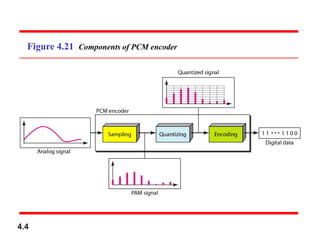
 PCM consists of three steps to digitize an
analog signal:
1. Sampling
2. Quantization
3. Binary encoding
4.3
3. Binary encoding
 Before we sample, we have to filter the
signal to limit the maximum frequency of
the signal as it affects the sampling rate.
 Filtering should ensure that we do not
distort the signal, ie remove high frequency
components that affect the signal shape.
Figure 4.21 Components of PCM encoder
4.4
Sampling
 Analog signal is sampled every TS secs.
 Ts is referred to as the sampling interval.
 fs = 1/Ts is called the sampling rate or
sampling frequency.
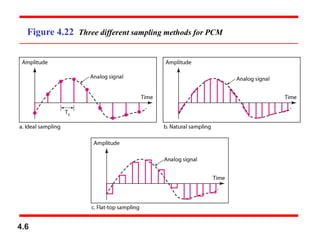
 There are 3 sampling methods:
Ideal - an impulse at each sampling instant
4.5
 Ideal - an impulse at each sampling instant
 Natural - a pulse of short width with varying
amplitude
 Flattop - sample and hold, like natural but with
single amplitude value
 The process is referred to as pulse amplitude
modulation PAM and the outcome is a signal
with analog (non integer) values
Figure 4.22 Three different sampling methods for PCM
4.6
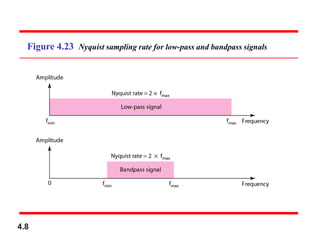
According to the Nyquist theorem, the
sampling rate must be
Note
4.7
sampling rate must be
at least 2 times the highest frequency
contained in the signal.
Figure 4.23 Nyquist sampling rate for low-pass and bandpass signals
4.8
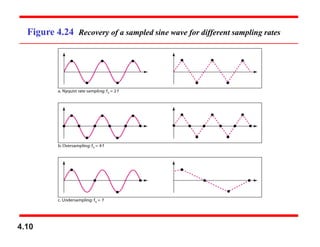
For an intuitive example of the Nyquist theorem, let us
sample a simple sine wave at three sampling rates: fs = 4f
(2 times the Nyquist rate), fs = 2f (Nyquist rate), and
fs = f (one-half the Nyquist rate). Figure 4.24 shows the
sampling and the subsequent recovery of the signal.
Example 4.6
4.9
It can be seen that sampling at the Nyquist rate can create
a good approximation of the original sine wave (part a).
Oversampling in part b can also create the same
approximation, but it is redundant and unnecessary.
Sampling below the Nyquist rate (part c) does not produce
a signal that looks like the original sine wave.
Figure 4.24 Recovery of a sampled sine wave for different sampling rates
4.10
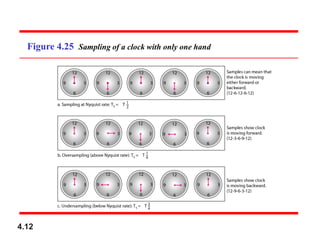
Consider the revolution of a hand of a clock. The second
hand of a clock has a period of 60 s. According to the
Nyquist theorem, we need to sample the hand every 30 s
(Ts = T or fs = 2f ). In Figure 4.25a, the sample points, in
order, are 12, 6, 12, 6, 12, and 6. The receiver of the
samples cannot tell if the clock is moving forward or
Example 4.7
4.11
samples cannot tell if the clock is moving forward or
backward. In part b, we sample at double the Nyquist rate
(every 15 s). The sample points are 12, 3, 6, 9, and 12.
The clock is moving forward. In part c, we sample below
the Nyquist rate (Ts = T or fs = f ). The sample points are
12, 9, 6, 3, and 12. Although the clock is moving forward,
the receiver thinks that the clock is moving backward.
Figure 4.25 Sampling of a clock with only one hand
4.12
An example related to Example 4.7 is the seemingly
backward rotation of the wheels of a forward-moving car
in a movie. This can be explained by under-sampling. A
movie is filmed at 24 frames per second. If a wheel is
rotating more than 12 times per second, the under-
sampling creates the impression of a backward rotation.
Example 4.8
4.13
sampling creates the impression of a backward rotation.
Telephone companies digitize voice by assuming a
maximum frequency of 4000 Hz. The sampling rate
therefore is 8000 samples per second.
Example 4.9
4.14
A complex low-pass signal has a bandwidth of 200 kHz.
What is the minimum sampling rate for this signal?
Solution
Example 4.10
4.15
Solution
The bandwidth of a low-pass signal is between 0
and f, where f is the maximum frequency in the
signal. Therefore, we can sample this signal at 2
times the highest frequency (200 kHz). The
sampling rate is therefore 400,000 samples per
second.
A complex bandpass signal has a bandwidth of 200 kHz.
What is the minimum sampling rate for this signal?
Solution
Example 4.11
4.16
Solution
We cannot find the minimum sampling rate in this
case because we do not know where the
bandwidth starts or ends. We do not know the
maximum frequency in the signal.
Quantization
 Sampling results in a series of pulses of
varying amplitude values ranging between
two limits: a min and a max.
 The amplitude values are infinite between the
two limits.
4.17
two limits.
 We need to map the infinite amplitude values
onto a finite set of known values.
 This is achieved by dividing the distance
between min and max into L zones, each of
height 
 = (max - min)/L
Quantization Levels
 The midpoint of each zone is assigned a
value from 0 to L-1 (resulting in L
values)
4.18
values)
 Each sample falling in a zone is then
approximated to the value of the
midpoint.
Quantization Zones
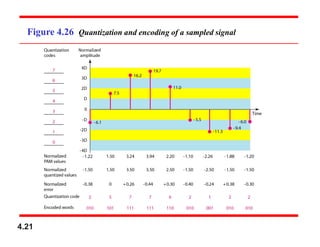
 Assume we have a voltage signal with
amplitutes Vmin=-20V and Vmax=+20V.
 We want to use L=8 quantization levels.
 Zone width = (20 - -20)/8 = 5
4.19
 Zone width = (20 - -20)/8 = 5
 The 8 zones are: -20 to -15, -15 to -10,
-10 to -5, -5 to 0, 0 to +5, +5 to +10,
+10 to +15, +15 to +20
 The midpoints are: -17.5, -12.5, -7.5, -
2.5, 2.5, 7.5, 12.5, 17.5
Assigning Codes to Zones
 Each zone is then assigned a binary code.
 The number of bits required to encode the
zones, or the number of bits per sample as it
is commonly referred to, is obtained as
follows:
n = log L
4.20
nb = log2 L
 Given our example, nb = 3
 The 8 zone (or level) codes are therefore:
000, 001, 010, 011, 100, 101, 110, and 111
 Assigning codes to zones:
 000 will refer to zone -20 to -15
 001 to zone -15 to -10, etc.
Figure 4.26 Quantization and encoding of a sampled signal
4.21
Quantization Error
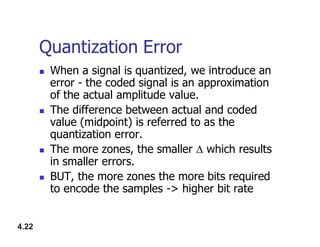
 When a signal is quantized, we introduce an
error - the coded signal is an approximation
of the actual amplitude value.
 The difference between actual and coded
value (midpoint) is referred to as the
4.22
value (midpoint) is referred to as the
quantization error.
 The more zones, the smaller  which results
in smaller errors.
 BUT, the more zones the more bits required
to encode the samples -> higher bit rate
Quantization Error and SNQR
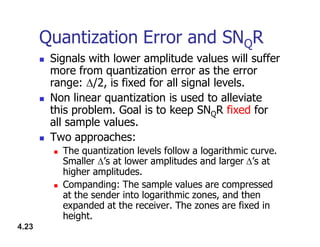
 Signals with lower amplitude values will suffer
more from quantization error as the error
range: /2, is fixed for all signal levels.
 Non linear quantization is used to alleviate
this problem. Goal is to keep SNQR fixed for
all sample values.
4.23
all sample values.
 Two approaches:
 The quantization levels follow a logarithmic curve.
Smaller ’s at lower amplitudes and larger’s at
higher amplitudes.
 Companding: The sample values are compressed
at the sender into logarithmic zones, and then
expanded at the receiver. The zones are fixed in
height.
Bit rate and bandwidth
requirements of PCM
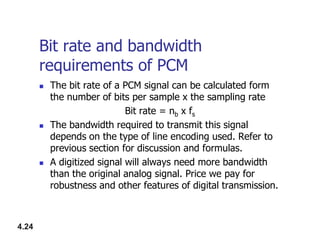
 The bit rate of a PCM signal can be calculated form
the number of bits per sample x the sampling rate
Bit rate = nb x fs
 The bandwidth required to transmit this signal
4.24
 The bandwidth required to transmit this signal
depends on the type of line encoding used. Refer to
previous section for discussion and formulas.
 A digitized signal will always need more bandwidth
than the original analog signal. Price we pay for
robustness and other features of digital transmission.
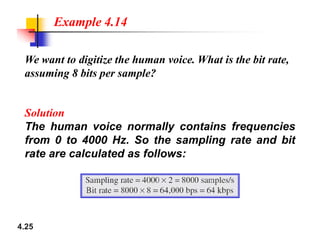
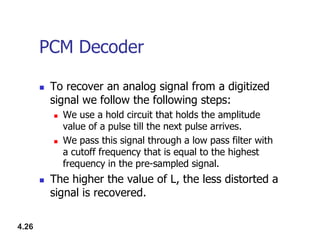
We want to digitize the human voice. What is the bit rate,
assuming 8 bits per sample?
Solution
The human voice normally contains frequencies
Example 4.14
4.25
The human voice normally contains frequencies
from 0 to 4000 Hz. So the sampling rate and bit
rate are calculated as follows:
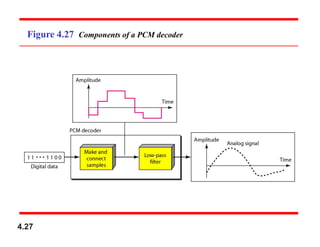
PCM Decoder
 To recover an analog signal from a digitized
signal we follow the following steps:
 We use a hold circuit that holds the amplitude
value of a pulse till the next pulse arrives.
4.26
value of a pulse till the next pulse arrives.
 We pass this signal through a low pass filter with
a cutoff frequency that is equal to the highest
frequency in the pre-sampled signal.
 The higher the value of L, the less distorted a
signal is recovered.
Figure 4.27 Components of a PCM decoder
4.27
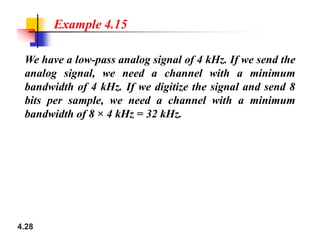
We have a low-pass analog signal of 4 kHz. If we send the
analog signal, we need a channel with a minimum
bandwidth of 4 kHz. If we digitize the signal and send 8
bits per sample, we need a channel with a minimum
bandwidth of 8 × 4 kHz = 32 kHz.
Example 4.15
4.28
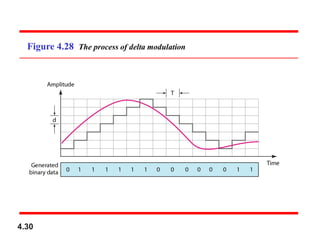
Delta Modulation
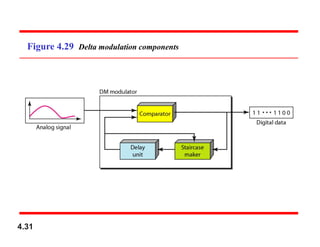
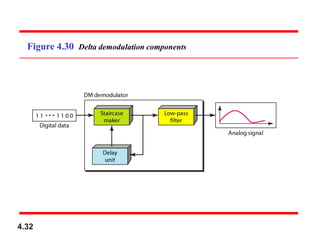
 This scheme sends only the difference
between pulses, if the pulse at time tn+1 is
higher in amplitude value than the pulse at
time tn, then a single bit, say a “1”, is used to
indicate the positive value.
4.29
indicate the positive value.
 If the pulse is lower in value, resulting in a
negative value, a “0” is used.
 This scheme works well for small changes in
signal values between samples.
 If changes in amplitude are large, this will
result in large errors.
Figure 4.28 The process of delta modulation
4.30
Figure 4.29 Delta modulation components
4.31
Figure 4.30 Delta demodulation components
4.32
Delta PCM (DPCM)
 Instead of using one bit to indicate positive
and negative differences, we can use more
bits -> quantization of the difference.
Each bit code is used to represent the value
4.33
 Each bit code is used to represent the value
of the difference.
 The more bits the more levels -> the higher
the accuracy.
4
4-
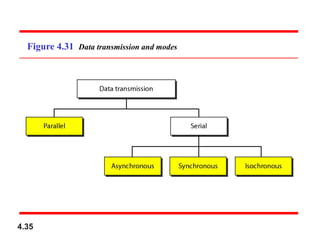
-3 TRANSMISSION MODES
3 TRANSMISSION MODES
The
The transmission
transmission of
of binary
binary data
data across
across a
a link
link can
can be
be
accomplished
accomplished in
in either
either parallel
parallel or
or serial
serial mode
mode.
. In
In
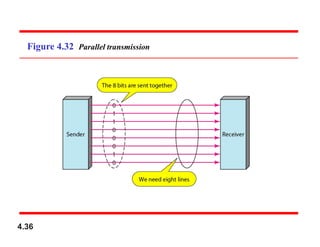
parallel
parallel mode,
mode, multiple
multiple bits
bits are
are sent
sent with
with each
each clock
clock
tick
tick.
. In
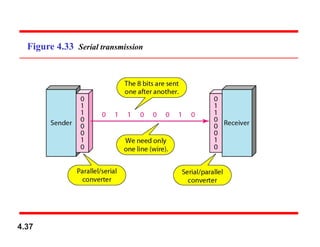
In serial
serial mode,
mode, 1
1 bit
bit is
is sent
sent with
with each
each clock
clock tick
tick.
.
While
While there
there is
is only
only one
one way
way to
to send
send parallel
parallel data,
data, there
there
4.34
While
While there
there is
is only
only one
one way
way to
to send
send parallel
parallel data,
data, there
there
are
are three
three subclasses
subclasses of
of serial
serial transmission
transmission:
:
asynchronous,
asynchronous, synchronous,
synchronous, and
and isochronous
isochronous.
.
 Parallel Transmission
 Serial Transmission
Topics discussed in this section:
Figure 4.31 Data transmission and modes
4.35
Figure 4.32 Parallel transmission
4.36
Figure 4.33 Serial transmission
4.37
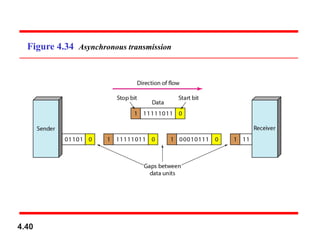
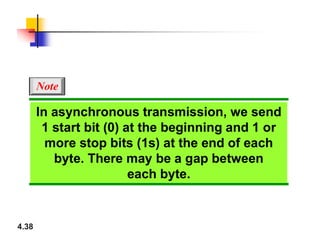
In asynchronous transmission, we send
1 start bit (0) at the beginning and 1 or
Note
4.38
1 start bit (0) at the beginning and 1 or
more stop bits (1s) at the end of each
byte. There may be a gap between
each byte.
Asynchronous here means
“asynchronous at the byte level,”
Note
4.39
“asynchronous at the byte level,”
but the bits are still synchronized;
their durations are the same.
Figure 4.34 Asynchronous transmission
4.40
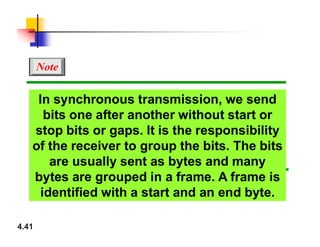
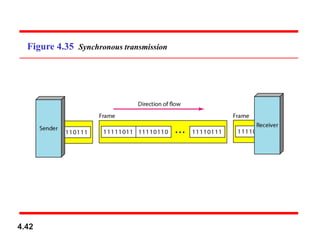
In synchronous transmission, we send
bits one after another without start or
stop bits or gaps. It is the responsibility
Note
4.41
stop bits or gaps. It is the responsibility
of the receiver to group the bits. The bits
are usually sent as bytes and many
bytes are grouped in a frame. A frame is
identified with a start and an end byte.
Figure 4.35 Synchronous transmission
4.42
Isochronous
 In isochronous transmission we cannot
have uneven gaps between frames.
 Transmission of bits is fixed with equal
4.43
 Transmission of bits is fixed with equal
gaps.

COML02E_Data Communication _8_Pulse Modulation.pdf

  • 1.
    Chapter 4 Data Communication& Networking 4.1 Digital Transmission
  • 2.
    4 4- -2 ANALOG 2 ANALOG- -TO TO- -DIGITALCONVERSION DIGITAL CONVERSION A A digital digital signal signal is is superior superior to to an an analog analog signal signal because because it it is is more more robust robust to to noise noise and and can can easily easily be be recovered, recovered, corrected corrected and and amplified amplified. . For For this this reason, reason, the the tendency tendency today today is is to to change change an an analog analog signal signal to to digital digital data data. . In In this this section section we we describe describe two two techniques, techniques, pulse pulse code code 4.2 this this section section we we describe describe two two techniques, techniques, pulse pulse code code modulation modulation and and delta delta modulation modulation. .  Pulse Code Modulation (PCM)  Delta Modulation (DM) Topics discussed in this section: Topics discussed in this section:
  • 3.
    PCM  PCM consistsof three steps to digitize an analog signal: 1. Sampling 2. Quantization 3. Binary encoding 4.3 3. Binary encoding  Before we sample, we have to filter the signal to limit the maximum frequency of the signal as it affects the sampling rate.  Filtering should ensure that we do not distort the signal, ie remove high frequency components that affect the signal shape.
  • 4.
    Figure 4.21 Componentsof PCM encoder 4.4
  • 5.
    Sampling  Analog signalis sampled every TS secs.  Ts is referred to as the sampling interval.  fs = 1/Ts is called the sampling rate or sampling frequency.  There are 3 sampling methods: Ideal - an impulse at each sampling instant 4.5  Ideal - an impulse at each sampling instant  Natural - a pulse of short width with varying amplitude  Flattop - sample and hold, like natural but with single amplitude value  The process is referred to as pulse amplitude modulation PAM and the outcome is a signal with analog (non integer) values
  • 6.
    Figure 4.22 Threedifferent sampling methods for PCM 4.6
  • 7.
    According to theNyquist theorem, the sampling rate must be Note 4.7 sampling rate must be at least 2 times the highest frequency contained in the signal.
  • 8.
    Figure 4.23 Nyquistsampling rate for low-pass and bandpass signals 4.8
  • 9.
    For an intuitiveexample of the Nyquist theorem, let us sample a simple sine wave at three sampling rates: fs = 4f (2 times the Nyquist rate), fs = 2f (Nyquist rate), and fs = f (one-half the Nyquist rate). Figure 4.24 shows the sampling and the subsequent recovery of the signal. Example 4.6 4.9 It can be seen that sampling at the Nyquist rate can create a good approximation of the original sine wave (part a). Oversampling in part b can also create the same approximation, but it is redundant and unnecessary. Sampling below the Nyquist rate (part c) does not produce a signal that looks like the original sine wave.
  • 10.
    Figure 4.24 Recoveryof a sampled sine wave for different sampling rates 4.10
  • 11.
    Consider the revolutionof a hand of a clock. The second hand of a clock has a period of 60 s. According to the Nyquist theorem, we need to sample the hand every 30 s (Ts = T or fs = 2f ). In Figure 4.25a, the sample points, in order, are 12, 6, 12, 6, 12, and 6. The receiver of the samples cannot tell if the clock is moving forward or Example 4.7 4.11 samples cannot tell if the clock is moving forward or backward. In part b, we sample at double the Nyquist rate (every 15 s). The sample points are 12, 3, 6, 9, and 12. The clock is moving forward. In part c, we sample below the Nyquist rate (Ts = T or fs = f ). The sample points are 12, 9, 6, 3, and 12. Although the clock is moving forward, the receiver thinks that the clock is moving backward.
  • 12.
    Figure 4.25 Samplingof a clock with only one hand 4.12
  • 13.
    An example relatedto Example 4.7 is the seemingly backward rotation of the wheels of a forward-moving car in a movie. This can be explained by under-sampling. A movie is filmed at 24 frames per second. If a wheel is rotating more than 12 times per second, the under- sampling creates the impression of a backward rotation. Example 4.8 4.13 sampling creates the impression of a backward rotation.
  • 14.
    Telephone companies digitizevoice by assuming a maximum frequency of 4000 Hz. The sampling rate therefore is 8000 samples per second. Example 4.9 4.14
  • 15.
    A complex low-passsignal has a bandwidth of 200 kHz. What is the minimum sampling rate for this signal? Solution Example 4.10 4.15 Solution The bandwidth of a low-pass signal is between 0 and f, where f is the maximum frequency in the signal. Therefore, we can sample this signal at 2 times the highest frequency (200 kHz). The sampling rate is therefore 400,000 samples per second.
  • 16.
    A complex bandpasssignal has a bandwidth of 200 kHz. What is the minimum sampling rate for this signal? Solution Example 4.11 4.16 Solution We cannot find the minimum sampling rate in this case because we do not know where the bandwidth starts or ends. We do not know the maximum frequency in the signal.
  • 17.
    Quantization  Sampling resultsin a series of pulses of varying amplitude values ranging between two limits: a min and a max.  The amplitude values are infinite between the two limits. 4.17 two limits.  We need to map the infinite amplitude values onto a finite set of known values.  This is achieved by dividing the distance between min and max into L zones, each of height   = (max - min)/L
  • 18.
    Quantization Levels  Themidpoint of each zone is assigned a value from 0 to L-1 (resulting in L values) 4.18 values)  Each sample falling in a zone is then approximated to the value of the midpoint.
  • 19.
    Quantization Zones  Assumewe have a voltage signal with amplitutes Vmin=-20V and Vmax=+20V.  We want to use L=8 quantization levels.  Zone width = (20 - -20)/8 = 5 4.19  Zone width = (20 - -20)/8 = 5  The 8 zones are: -20 to -15, -15 to -10, -10 to -5, -5 to 0, 0 to +5, +5 to +10, +10 to +15, +15 to +20  The midpoints are: -17.5, -12.5, -7.5, - 2.5, 2.5, 7.5, 12.5, 17.5
  • 20.
    Assigning Codes toZones  Each zone is then assigned a binary code.  The number of bits required to encode the zones, or the number of bits per sample as it is commonly referred to, is obtained as follows: n = log L 4.20 nb = log2 L  Given our example, nb = 3  The 8 zone (or level) codes are therefore: 000, 001, 010, 011, 100, 101, 110, and 111  Assigning codes to zones:  000 will refer to zone -20 to -15  001 to zone -15 to -10, etc.
  • 21.
    Figure 4.26 Quantizationand encoding of a sampled signal 4.21
  • 22.
    Quantization Error  Whena signal is quantized, we introduce an error - the coded signal is an approximation of the actual amplitude value.  The difference between actual and coded value (midpoint) is referred to as the 4.22 value (midpoint) is referred to as the quantization error.  The more zones, the smaller  which results in smaller errors.  BUT, the more zones the more bits required to encode the samples -> higher bit rate
  • 23.
    Quantization Error andSNQR  Signals with lower amplitude values will suffer more from quantization error as the error range: /2, is fixed for all signal levels.  Non linear quantization is used to alleviate this problem. Goal is to keep SNQR fixed for all sample values. 4.23 all sample values.  Two approaches:  The quantization levels follow a logarithmic curve. Smaller ’s at lower amplitudes and larger’s at higher amplitudes.  Companding: The sample values are compressed at the sender into logarithmic zones, and then expanded at the receiver. The zones are fixed in height.
  • 24.
    Bit rate andbandwidth requirements of PCM  The bit rate of a PCM signal can be calculated form the number of bits per sample x the sampling rate Bit rate = nb x fs  The bandwidth required to transmit this signal 4.24  The bandwidth required to transmit this signal depends on the type of line encoding used. Refer to previous section for discussion and formulas.  A digitized signal will always need more bandwidth than the original analog signal. Price we pay for robustness and other features of digital transmission.
  • 25.
    We want todigitize the human voice. What is the bit rate, assuming 8 bits per sample? Solution The human voice normally contains frequencies Example 4.14 4.25 The human voice normally contains frequencies from 0 to 4000 Hz. So the sampling rate and bit rate are calculated as follows:
  • 26.
    PCM Decoder  Torecover an analog signal from a digitized signal we follow the following steps:  We use a hold circuit that holds the amplitude value of a pulse till the next pulse arrives. 4.26 value of a pulse till the next pulse arrives.  We pass this signal through a low pass filter with a cutoff frequency that is equal to the highest frequency in the pre-sampled signal.  The higher the value of L, the less distorted a signal is recovered.
  • 27.
    Figure 4.27 Componentsof a PCM decoder 4.27
  • 28.
    We have alow-pass analog signal of 4 kHz. If we send the analog signal, we need a channel with a minimum bandwidth of 4 kHz. If we digitize the signal and send 8 bits per sample, we need a channel with a minimum bandwidth of 8 × 4 kHz = 32 kHz. Example 4.15 4.28
  • 29.
    Delta Modulation  Thisscheme sends only the difference between pulses, if the pulse at time tn+1 is higher in amplitude value than the pulse at time tn, then a single bit, say a “1”, is used to indicate the positive value. 4.29 indicate the positive value.  If the pulse is lower in value, resulting in a negative value, a “0” is used.  This scheme works well for small changes in signal values between samples.  If changes in amplitude are large, this will result in large errors.
  • 30.
    Figure 4.28 Theprocess of delta modulation 4.30
  • 31.
    Figure 4.29 Deltamodulation components 4.31
  • 32.
    Figure 4.30 Deltademodulation components 4.32
  • 33.
    Delta PCM (DPCM) Instead of using one bit to indicate positive and negative differences, we can use more bits -> quantization of the difference. Each bit code is used to represent the value 4.33  Each bit code is used to represent the value of the difference.  The more bits the more levels -> the higher the accuracy.
  • 34.
    4 4- -3 TRANSMISSION MODES 3TRANSMISSION MODES The The transmission transmission of of binary binary data data across across a a link link can can be be accomplished accomplished in in either either parallel parallel or or serial serial mode mode. . In In parallel parallel mode, mode, multiple multiple bits bits are are sent sent with with each each clock clock tick tick. . In In serial serial mode, mode, 1 1 bit bit is is sent sent with with each each clock clock tick tick. . While While there there is is only only one one way way to to send send parallel parallel data, data, there there 4.34 While While there there is is only only one one way way to to send send parallel parallel data, data, there there are are three three subclasses subclasses of of serial serial transmission transmission: : asynchronous, asynchronous, synchronous, synchronous, and and isochronous isochronous. .  Parallel Transmission  Serial Transmission Topics discussed in this section: Topics discussed in this section:
  • 35.
    Figure 4.31 Datatransmission and modes 4.35
  • 36.
    Figure 4.32 Paralleltransmission 4.36
  • 37.
    Figure 4.33 Serialtransmission 4.37
  • 38.
    In asynchronous transmission,we send 1 start bit (0) at the beginning and 1 or Note 4.38 1 start bit (0) at the beginning and 1 or more stop bits (1s) at the end of each byte. There may be a gap between each byte.
  • 39.
    Asynchronous here means “asynchronousat the byte level,” Note 4.39 “asynchronous at the byte level,” but the bits are still synchronized; their durations are the same.
  • 40.
    Figure 4.34 Asynchronoustransmission 4.40
  • 41.
    In synchronous transmission,we send bits one after another without start or stop bits or gaps. It is the responsibility Note 4.41 stop bits or gaps. It is the responsibility of the receiver to group the bits. The bits are usually sent as bytes and many bytes are grouped in a frame. A frame is identified with a start and an end byte.
  • 42.
    Figure 4.35 Synchronoustransmission 4.42
  • 43.
    Isochronous  In isochronoustransmission we cannot have uneven gaps between frames.  Transmission of bits is fixed with equal 4.43  Transmission of bits is fixed with equal gaps.