ICT in Microfinance
                             Course:MFABP
   Indian Institute of Plantation Management, Bangalore

Presented by: Bidhu Bhushan Binit(11PGDM08)
Contents
 Transformation    of Indian financial(banking) sector
 Typical Information flow and genesis of Problem
 Potential Answer
 Technology
      -levels of implementation
      -facilitating infrastructure
 DCCB, Bidar case
 Conclusion
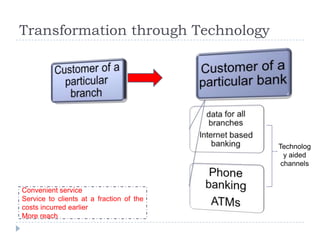
Transformation through Technology


                                          Technolog
                                            y aided
                                           channels


Convenient service
Service to clients at a fraction of the
costs incurred earlier
More reach
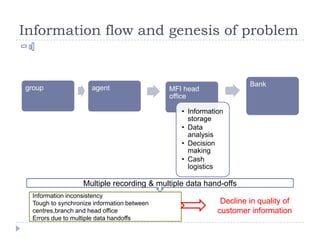
Information flow and genesis of problem


                                                                   Bank
group                agent                  MFI head
                                            office

                                               • Information
                                                 storage
                                               • Data
                                                 analysis
                                               • Decision
                                                 making
                                               • Cash
                                                 logistics

                  Multiple recording & multiple data hand-offs
 Information inconsistency
 Tough to synchronize information between                  Decline in quality of
 centres,branch and head office                           customer information
 Errors due to multiple data handoffs
Potential Answer


 Technology can address the fundamental issue
 constraining the growth of the microfinance sector,
 i.e Customer information systems and management.
Levels of implementation

Central System                  Field level

   Main computing                 Standardized
    platform for the multiple       information collection
    channels                       Transmission to central
   Handling huge amount            location
    of customer data               Eliminating multiple
   Simultaneous analysis           hand offs
   Tracking and monitoring        Agent:- as a
    of a customer across            decentralized branch,
    multiple channels               able to perform head
                                    office function
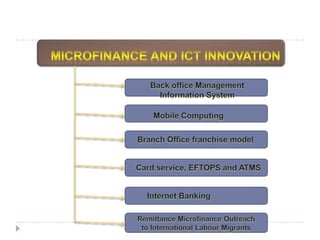
Back-Office Management Information
System (MIS)
   The most fundamental ICT application is back-
    office MIS.

   Sophisticated MIS is prerequisite for MFIs to
    monitor the quality, sustainability, and efficiency
    of its loan portfolio, to monitor development
    impact, and manage general administrative
    tasks.

   MFIs also track the non-financial information. So,
    they need modified off-the-self software package
    for these requirements.
Mobile Computing
   The back-office MIS helps the MFIs to monitor its
    loan portfolio, this functionality is undermined if
    the data analysed by the MIS is not up-to-date or
    contains errors.

   Through mobile computing systems the Loan
    officer have a palmtop computer, so that the
    financial transaction can be recorded directly into
    the MIS.

   It has significant implication with respect to data
    accuracy and integrity, there by enhancing “client
    confidence”.
The Branch Office Franchise Model

   MFIs have an overwhelming pressure to reduce
    transaction costs and increase profit margins.

   Through branch office franchise model, the MFI
    links with third-party merchants in remote areas.

   The rural telecentre networks are particularly
    suited to serving as retail outlets for MFIs.
Card Service, EFTPOS and ATMs

   There are many similarities between consumer
    credit cards and microcredit services. Both tries
    to reduce high cost associated with small
    transaction lending.

   Introduction of card-based services require the
    roll-out of either EFTPOS functionality with third-
    party merchants and/or ATMs.

   Card- based microfinance offers even more
    opportunities like allowing clients who have
    proven creditworthiness over time should given
    access to additional products and services.
Internet Banking
   Gives client real-time information about their
    account, and the ability to transfer funds between
    accounts.

   It is an efficient tool to reduce the work of tellers
    and therefore reduce the labor costs.

   Rural tele-centre networks can help in
    implementing Internet Banking for MFIs.
Remittances: Microfinance Outreach to
International Labour Migrants
   MFIs through technological innovation, product
    design can tap this market by extending outreach to
    these migrant workers and their families at home.

   For example Sri Lanka’s Hatton National Bank,
    whose “HNB Easy Remittance” help Sri Lankan
    migrant workers to remit funds directly to HNB
    accounts.
Facilitating Infrastructure

Unique Identifier
   Helps to create a repository of customer information.
   Availability of basic demographic data.
   Can be used to track customer behavior across multiple
    relationship.
   Eg.-Smart cards in developed countries
Credit information Bureau

   Creation of mechanism allowing sharing of
    information where documented sources of
    information are not available.
   To track repayment history for efficient client
    screening process.
Helping Access capital


   Microfinance assets will become transparent.

   Information system will help attract private capital
    from individuals and venture capitalists.
DCCB Bidar Case
   District Central Cooperative Bank, Bidar has 171 PACS.
    Average accounts a PACS handles is 800-1000. All the
    books are maintained by CEO of PACS manually
   PACS delivers Kisan Credit Card loan, SHG and BDP
    loans. It also provides fertilizers and grocery items like
    wheat, sugar and K oil.
   All the problems of manually maintained accounts – time
    spent in correcting, reports not ready on time etc
…DCCB Bidar Case
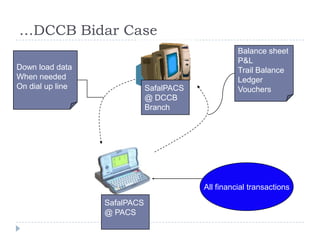
                                                    Balance sheet
                                                    P&L
Down load data                                      Trail Balance
When needed                                         Ledger
On dial up line               SafalPACS             Vouchers
                              @ DCCB
                              Branch


                                          All financial transactions
                  SafalPACS
                  @ PACS
….DCCB Bidar Case
   SafalPACS is a package where there are two sets of
    software – one installed on iStation a hand held device
    and the second is intalled on a PC located in the Bank
    branch of DCCB.
   Day to day transactions are entered online on iStation
    and monthly balance sheet, P&L, Stock book are printed
    in the PACS
   For SHG, Digitized Demand information (DIDI) sheet is
    printed and updated at PACS level
   Depending on transactions, data is transferred on dial up
    line to DCCB branch PC.
….DCCB Bidar Case
   Advantages of SafalPACS

       Affordable solutions for automation at PACS level
       Low power and low maintenance requirement and low
        bandwidth, Hence one need not wait for long
       Advantage of automation – timely reports, elimination of
        human error
Conclusion


   Some says “it can’t be done in microfinance,
    electronic banking for poor will not work”.
   20 years ago when microfinance was in its
    infancy many said “poor can’t repay, the poor will
    not repay, the poor can’t save.
….conclusion
   Inclusive growth has been marked as a necessary
    way of development, not just by India but by UN
    also. Microfinance is really giving a helping hand to
    poor and unbanked segment. The problem of
    information asymmetry facing by microfinance can
    be addressed today by using technology.
   It has to work. Otherwise will be at a continuing
    disadvantage with current economies and
    enterprises.
Thank You !

References
:microfinance in India(edited by K.G.Kamkar)
:Safal Solutions pvt.ltd
:the case of correspondent banking in Brazil by Diniz,Pozzebon,Jayo,Araujo.

Technology in Microfinance

  • 1.
    ICT in Microfinance Course:MFABP Indian Institute of Plantation Management, Bangalore Presented by: Bidhu Bhushan Binit(11PGDM08)
  • 2.
    Contents  Transformation of Indian financial(banking) sector  Typical Information flow and genesis of Problem  Potential Answer  Technology -levels of implementation -facilitating infrastructure  DCCB, Bidar case  Conclusion
  • 3.
    Transformation through Technology Technolog y aided channels Convenient service Service to clients at a fraction of the costs incurred earlier More reach
  • 4.
    Information flow andgenesis of problem Bank group agent MFI head office • Information storage • Data analysis • Decision making • Cash logistics Multiple recording & multiple data hand-offs Information inconsistency Tough to synchronize information between Decline in quality of centres,branch and head office customer information Errors due to multiple data handoffs
  • 5.
    Potential Answer Technologycan address the fundamental issue constraining the growth of the microfinance sector, i.e Customer information systems and management.
  • 6.
    Levels of implementation CentralSystem Field level  Main computing  Standardized platform for the multiple information collection channels  Transmission to central  Handling huge amount location of customer data  Eliminating multiple  Simultaneous analysis hand offs  Tracking and monitoring  Agent:- as a of a customer across decentralized branch, multiple channels able to perform head office function
  • 8.
    Back-Office Management Information System(MIS)  The most fundamental ICT application is back- office MIS.  Sophisticated MIS is prerequisite for MFIs to monitor the quality, sustainability, and efficiency of its loan portfolio, to monitor development impact, and manage general administrative tasks.  MFIs also track the non-financial information. So, they need modified off-the-self software package for these requirements.
  • 9.
    Mobile Computing  The back-office MIS helps the MFIs to monitor its loan portfolio, this functionality is undermined if the data analysed by the MIS is not up-to-date or contains errors.  Through mobile computing systems the Loan officer have a palmtop computer, so that the financial transaction can be recorded directly into the MIS.  It has significant implication with respect to data accuracy and integrity, there by enhancing “client confidence”.
  • 10.
    The Branch OfficeFranchise Model  MFIs have an overwhelming pressure to reduce transaction costs and increase profit margins.  Through branch office franchise model, the MFI links with third-party merchants in remote areas.  The rural telecentre networks are particularly suited to serving as retail outlets for MFIs.
  • 11.
    Card Service, EFTPOSand ATMs  There are many similarities between consumer credit cards and microcredit services. Both tries to reduce high cost associated with small transaction lending.  Introduction of card-based services require the roll-out of either EFTPOS functionality with third- party merchants and/or ATMs.  Card- based microfinance offers even more opportunities like allowing clients who have proven creditworthiness over time should given access to additional products and services.
  • 12.
    Internet Banking  Gives client real-time information about their account, and the ability to transfer funds between accounts.  It is an efficient tool to reduce the work of tellers and therefore reduce the labor costs.  Rural tele-centre networks can help in implementing Internet Banking for MFIs.
  • 13.
    Remittances: Microfinance Outreachto International Labour Migrants  MFIs through technological innovation, product design can tap this market by extending outreach to these migrant workers and their families at home.  For example Sri Lanka’s Hatton National Bank, whose “HNB Easy Remittance” help Sri Lankan migrant workers to remit funds directly to HNB accounts.
  • 14.
    Facilitating Infrastructure Unique Identifier  Helps to create a repository of customer information.  Availability of basic demographic data.  Can be used to track customer behavior across multiple relationship.  Eg.-Smart cards in developed countries
  • 15.
    Credit information Bureau  Creation of mechanism allowing sharing of information where documented sources of information are not available.  To track repayment history for efficient client screening process.
  • 16.
    Helping Access capital  Microfinance assets will become transparent.  Information system will help attract private capital from individuals and venture capitalists.
  • 17.
    DCCB Bidar Case  District Central Cooperative Bank, Bidar has 171 PACS. Average accounts a PACS handles is 800-1000. All the books are maintained by CEO of PACS manually  PACS delivers Kisan Credit Card loan, SHG and BDP loans. It also provides fertilizers and grocery items like wheat, sugar and K oil.  All the problems of manually maintained accounts – time spent in correcting, reports not ready on time etc
  • 18.
    …DCCB Bidar Case Balance sheet P&L Down load data Trail Balance When needed Ledger On dial up line SafalPACS Vouchers @ DCCB Branch All financial transactions SafalPACS @ PACS
  • 19.
    ….DCCB Bidar Case  SafalPACS is a package where there are two sets of software – one installed on iStation a hand held device and the second is intalled on a PC located in the Bank branch of DCCB.  Day to day transactions are entered online on iStation and monthly balance sheet, P&L, Stock book are printed in the PACS  For SHG, Digitized Demand information (DIDI) sheet is printed and updated at PACS level  Depending on transactions, data is transferred on dial up line to DCCB branch PC.
  • 20.
    ….DCCB Bidar Case  Advantages of SafalPACS  Affordable solutions for automation at PACS level  Low power and low maintenance requirement and low bandwidth, Hence one need not wait for long  Advantage of automation – timely reports, elimination of human error
  • 21.
    Conclusion  Some says “it can’t be done in microfinance, electronic banking for poor will not work”.  20 years ago when microfinance was in its infancy many said “poor can’t repay, the poor will not repay, the poor can’t save.
  • 22.
    ….conclusion  Inclusive growth has been marked as a necessary way of development, not just by India but by UN also. Microfinance is really giving a helping hand to poor and unbanked segment. The problem of information asymmetry facing by microfinance can be addressed today by using technology.  It has to work. Otherwise will be at a continuing disadvantage with current economies and enterprises.
  • 23.
    Thank You ! References :microfinancein India(edited by K.G.Kamkar) :Safal Solutions pvt.ltd :the case of correspondent banking in Brazil by Diniz,Pozzebon,Jayo,Araujo.

Editor's Notes

  • #12 EFTPOS : Electronic Fund Transfer at point of Sale
  • #18 PACS : PRIMARY AGRICULTRAL COOPERATIVE SOCIETY.