Financial Services

                                System
                              Architecture
                                  for
                             Central Banks

Jean-Marc Lepain
Central Bank Specialist
The World of Central Banking
• Central Banks moving toward more
  independence
• Exchange rate more difficult to manage
•   More focus on Monetary Policy
•   Tighten control on Commercial Banks
•   More dynamic reserves management
•   More need for risk management
IT Evolution in Central Banking

• Reducing the number of systems
• Moving to standard applications
• Developing Internet based applications
• Data Warehousing
• OLAP based Decision Support tools
Special Requirements of Central
         Banks Systems
• No concept of profitability
• Different sets of activities loosely integrated (Settlement,
  Credit to Com. Banks, Monitoring of the Banking System, Foreign Reserves Mgt.,
  Monetary Policy, Balance of Payment, Macro and Micro-economic analysis)

• Necessity to cross information between different
  activities (Ex: BoP and Com. Banks’ statutory reports)
• Accounting view rather than a transactional view
• Different Charts of Account and accounting rules
• Use of GL information for Monetary Policy and
  Macro economic analysis
• Importance of the interface with the Payment System
1. GENERAL ARCHITECTURE
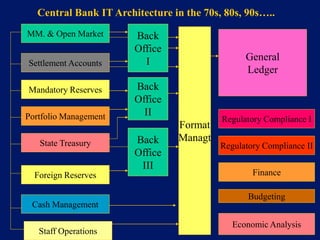
Central Bank IT Architecture in the 70s, 80s, 90s…..
MM. & Open Market       Back
                        Office
                          I                      General
Settlement Accounts
                                                 Ledger
Mandatory Reserves      Back
                        Office
Portfolio Management      II
                                           Regulatory Compliance I
                                 Format
   State Treasury       Back     Managt
                                           Regulatory Compliance II
                        Office
                         III
  Foreign Reserves                                 Finance

                                                  Budgeting
 Cash Management

                                              Economic Analysis
   Staff Operations
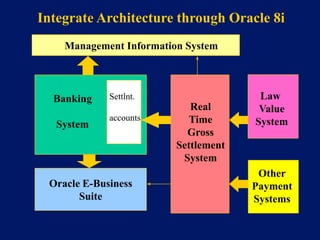
Integrate Architecture through Oracle 8i
    Management Information System


  Banking    Settlnt.                  Law
                            Real       Value
             accounts       Time      System
   System
                           Gross
                         Settlement
                          System
                                       Other
 Oracle E-Business                    Payment
       Suite                          Systems
Central Banks and the E-business
           paradigm
• The Web will become the main mean of
  communication between central banks and
  commercial banks and other institutions
• Web centric applications allow a complete
  centralisation of information
• Web application reduce drastically the cost
  of implementation and the cost of
  ownership
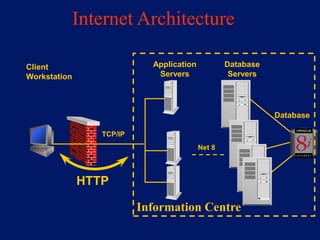
Internet Architecture

Client                      Application           Database
Workstation                  Servers               Servers


                                                             Database

                 TCP/IP
                                          Net 8


              HTTP

                          Information Centre
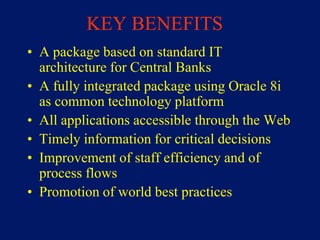
KEY BENEFITS
• A package based on standard IT
  architecture for Central Banks
• A fully integrated package using Oracle 8i
  as common technology platform
• All applications accessible through the Web
• Timely information for critical decisions
• Improvement of staff efficiency and of
  process flows
• Promotion of world best practices
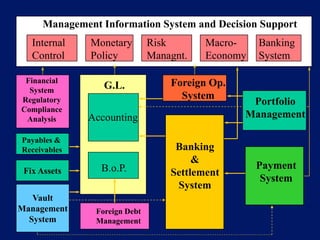
Management Information System and Decision Support
   Internal    Monetary        Risk       Macro-    Banking
   Control     Policy          Managnt.   Economy   System

 Financial                         Foreign Op.
  System
                  G.L.
Regulatory                           System
                                                  Portfolio
Compliance
 Analysis     Accounting                         Management

Payables &
Receivables                         Banking
                                        &
 Fix Assets      B.o.P.                             Payment
                                   Settlement
                                                     System
                                    System
   Vault
Management      Foreign Debt
  System        Management
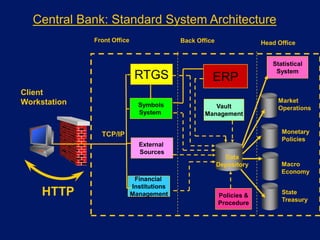
Central Bank: Standard System Architecture
              Front Office                  Back Office                Head Office


                                                                          Statistical
                                                                           System
                              RTGS                    ERP
Client
Workstation                                                                 Market
                               Symbols                Vault                 Operations
                               System              Management


                TCP/IP                                                       Monetary
                                                                             Policies
                               External
                               Sources
                                                            Data
                                                          Depository         Macro
                                                                             Economy
                              Financial
                             Institutions
     HTTP                    Management                   Policies &
                                                                             State
                                                                             Treasury
                                                          Procedure
2. ENTERPRISE RESOURCE
  PLANING APPLICATION
Oracle Enterprise Resources
      Planning Application
• GL can be fully integrated with the Banking
  System and the Payment System
• Webanabled
• Central Bank references
• Special functionalities for Central Banks
• Flexible use of the Chart of Account
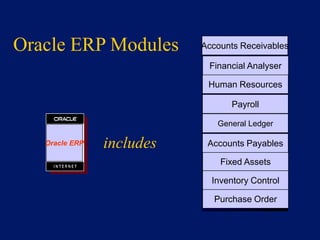
Oracle ERP Modules         Accounts Receivables

                            Financial Analyser

                            Human Resources

                                  Payroll

                              General Ledger

   Oracle ERP   includes    Accounts Payables

                               Fixed Assets

                             Inventory Control

                             Purchase Order
Modules Common Components

•   Oracle Financial Analyser
•   Oracle Business Intelligence
•   Oracle Implementation Wizard
•   Workflow
•   Alert
General Ledger
• All types of journal entries and accounting
  rules
• Fully Multi-Currencies
• Consolidation of multiple sets of books
• High level of security in managing posting
  and transaction processing
• Large reporting capability
Oracle GL Special Features for
         Central Banks
• Precious Metal Management
• Coins and Bills Issuance Management
• Cash Management
• Budgeting
• Monitoring of the Money Supply and of the
  Monetary Base
• Balance of Paymen
Account Structure
•   Independence from Chart of Account
•   Account Structure on-line
•   Up to 30 segments
•   Intuitive Account Hierarchy Editor
•   Reflect the organisation (branches, departments,
    cost centres, instruments)
• Flexible calendar structure (Up to 366 periods,
    uneven periods adjustment periods, multiple calendar)
• Multiple closing dates
Benefits of Oracle General
               Ledger
• Software easily tailored to the Bank’s
  requirements
• Seamless integration with other applications
• High number of automated functions (periodic
  journals, data import and data validation, etc.)
• Customisation of reports without programming
• Reduce time in the closing process
• Improve productivity
• Improve accounting controls
Cash Issuance and Vault
            Management
Oracle Inventory plus some custom development
• Track bills of different denominations
• Track serial numbers
• Track bank note status
• Manage precious metals (gold coins, ingots, etc.)
• Manage paper securities, monetary exhibits, etc.
• Perform reconciliation with General Ledger
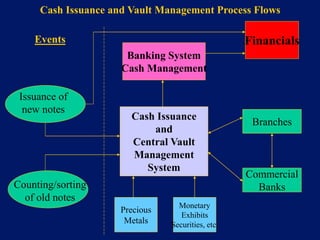
Cash Issuance and Vault Management Process Flows

    Events                                         Financials
                      Banking System
                     Cash Management

 Issuance of
  new notes
                       Cash Issuance
                                                    Branches
                           and
                       Central Vault
                       Management
                          System
                                                   Commercial
Counting/sorting                                     Banks
  of old notes
                                  Monetary
                     Precious
                                   Exhibits
                      Metals    Securities, etc.
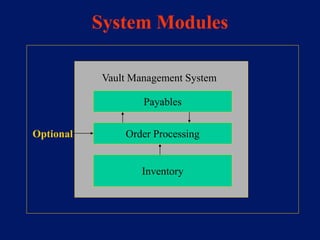
System Modules

            Vault Management System

                    Payables


Optional        Order Processing


                    Inventory
3. PAYMENT SYSTEMS
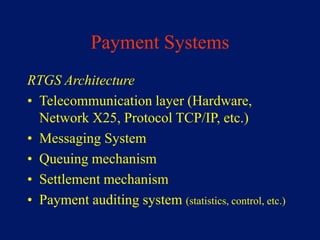
Payment Systems
RTGS Architecture
• Telecommunication layer (Hardware,
  Network X25, Protocol TCP/IP, etc.)
• Messaging System
• Queuing mechanism
• Settlement mechanism
• Payment auditing system (statistics, control, etc.)
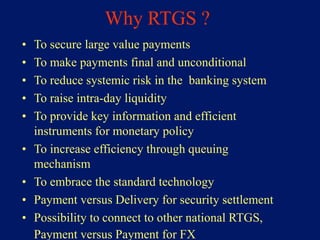
Why RTGS ?
•   To secure large value payments
•   To make payments final and unconditional
•   To reduce systemic risk in the banking system
•   To raise intra-day liquidity
•   To provide key information and efficient
    instruments for monetary policy
•   To increase efficiency through queuing
    mechanism
•   To embrace the standard technology
•   Payment versus Delivery for security settlement
•   Possibility to connect to other national RTGS,
    Payment versus Payment for FX
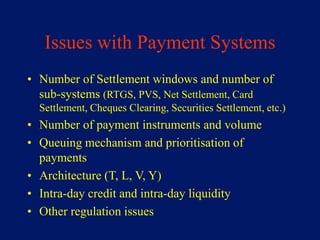
Issues with Payment Systems
• Number of Settlement windows and number of
  sub-systems (RTGS, PVS, Net Settlement, Card
  Settlement, Cheques Clearing, Securities Settlement, etc.)
• Number of payment instruments and volume
• Queuing mechanism and prioritisation of
  payments
• Architecture (T, L, V, Y)
• Intra-day credit and intra-day liquidity
• Other regulation issues
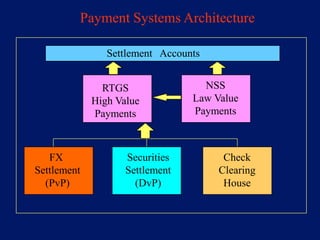
Payment Systems Architecture

                Settlement Accounts


               RTGS                NSS
             High Value          Law Value
             Payments            Payments


   FX               Securities         Check
Settlement          Settlement        Clearing
  (PvP)               (DvP)            House
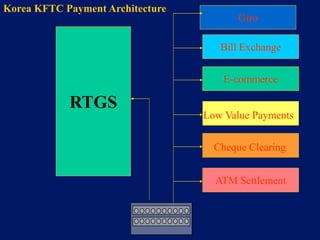
Korea KFTC Payment Architecture
                                         Giro

                                     Bill Exchange


                                      E-commerce

            RTGS
                                  Low Value Payments


                                    Cheque Clearing


                                    ATM Settlement
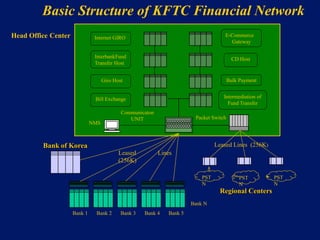
Basic Structure of KFTC Financial Network
Head Office Center             Internet GIRO                                        E-Commerce
                                                                                      Gateway

                               InterbankFund                                              CD Host
                               Transfer Host


                                    Giro Host                                           Bulk Payment


                               Bill Exchange                                        Intermediation of
                                                                                      Fund Transfer
                                            Communicaton
                                               UNIT                     Packet Switch
                              NMS


         Bank of Korea                                                           Leased Lines (256K)
                                           Leased          Lines
                                           (256K)

                                                                           PST               PST        PST
                                                                           N                 N          N
                                                                                  Regional Centers
                                                                       Bank N
                     Bank 1    Bank 2       Bank 3   Bank 4   Bank 5
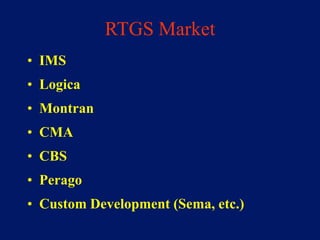
RTGS Market
• IMS
• Logica
• Montran
• CMA
• CBS
• Perago
• Custom Development (Sema, etc.)
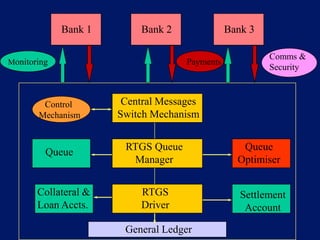
Bank 1       Bank 2               Bank 3

                                                        Comms &
Monitoring                          Payments
                                                        Security


        Control        Central Messages
       Mechanism      Switch Mechanism


                       RTGS Queue                 Queue
         Queue
                        Manager                  Optimiser


       Collateral &       RTGS                   Settlement
                                                 Settlement
       Loan Accts.        Driver                  Account

                       General Ledger
RTGS Functionalties
• Payment and Settlement finality
• Queue Management and optimisation
  facility
• Collateral Management, Repo transactions
• Payment versus Delivery (PvD)
  functionalities
RTGS Functionalities
• Gridlock resolution
• Liquidity Management
• Forecasting tools to predict end of day
  position
• Risk Management
• Enhanced security features
• Comprehensive audit controls
Account Management
• Queued Payment account and suspended
  payments
• Settlement Account management
  (mandatory reserves, other reserves, etc.)
• Collateral Account
• Securities Account (DvP)
Parameterisation
• Criteria for prioritisation of payments
• Possibility of intra-day credit
• Possibility of settlement against collateral
  deposits
• Possibility of adjustment of Mandatory
  reserves
4. BUSINESS INTELLIGENCE
           AND
DECISION SUPPORT SYTEM
Data Depository and Analysis
            System
A Data Depository is a Data Warehouse on
  top of which we can perform analysis in
  different business areas.
“A Data Warehouse is a subject-oriented,
  integrated, time-variant, non-volatile
  collection of data for management
  purposes.” Bill Inmon
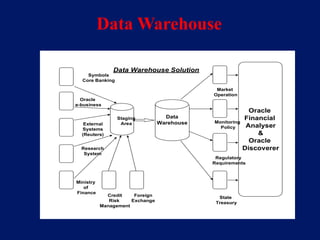
Data Warehouse

               Data Warehouse Solution
    Symbols
  Core Banking

                                              Market
                                             Operation
  Oracle
e-business
                                                            Oracle
                 Staging           Data                   Financial
   External       Area           Warehouse   Monitoring
  Systems                                      Policy      Analyser
  (Reuters)                                                   &
                                                            Oracle
  Research                                                Discoverer
   System
                                              Regulatory
                                             Requirements


Ministry
   of
Finance
             Credit    Foreign                 State
              Risk    Exchange                Treasury
           Management
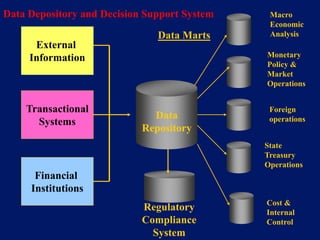
Data Depository and Decision Support System    Macro
                                               Economic
                               Data Marts      Analysis
      External
     Information                              Monetary
                                              Policy &
                                              Market
                                              Operations


    Transactional                              Foreign
                              Data             operations
      Systems
                            Repository
                                              State
                                              Treasury
                                              Operations
      Financial
     Institutions
                                              Cost &
                            Regulatory        Internal
                            Compliance        Control
                              System
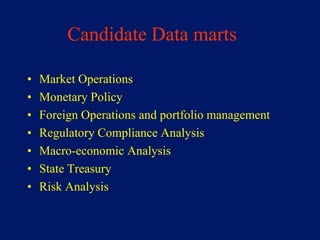
Candidate Data marts

•   Market Operations
•   Monetary Policy
•   Foreign Operations and portfolio management
•   Regulatory Compliance Analysis
•   Macro-economic Analysis
•   State Treasury
•   Risk Analysis
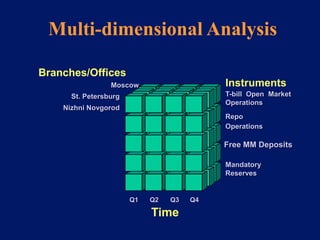
Multi-dimensional Analysis

Branches/Offices
                 Moscow                    Instruments
      St. Petersburg                       T-bill Open Market
                                           Operations
    Nizhni Novgorod
                                           Repo
                                           Operations

                                           Free MM Deposits

                                           Mandatory
                                           Reserves


                       Q1   Q2   Q3   Q4

                            Time
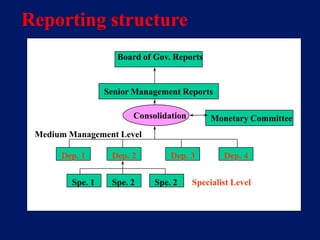
Reporting structure
                     Board of Gov. Reports


                  Senior Management Reports

                        Consolidation        Monetary Committee
 Medium Management Level

      Dep. 1       Dep. 2         Dep. 3        Dep. 4

         Spe. 1    Spe. 2     Spe. 2    Specialist Level
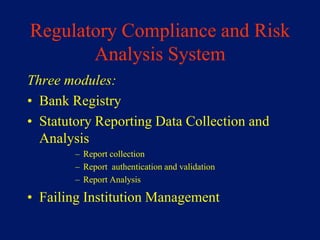
Regulatory Compliance and Risk
       Analysis System
Three modules:
• Bank Registry
• Statutory Reporting Data Collection and
  Analysis
        – Report collection
        – Report authentication and validation
        – Report Analysis

• Failing Institution Management
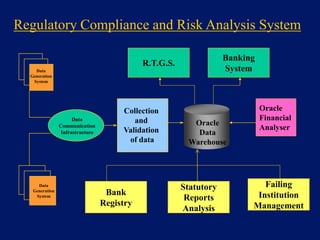
Regulatory Compliance and Risk Analysis System

                                                                    Banking
                                             R.T.G.S.
    Data                                                            System
  Generation
   System


                                       Collection                             Oracle
                      Data                and                                 Financial
                Communication                             Oracle
                                       Validation                             Analyser
                 Infrastructure                            Data
                                        of data          Warehouse


     Data
                                                        Statutory            Failing
   Generation
                                   Bank                                    Institution
    System
                                                         Reports
                                  Registry                                Management
                                                        Analysis
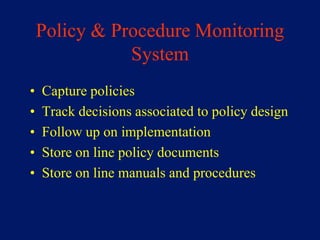
Policy & Procedure Monitoring
               System
•   Capture policies
•   Track decisions associated to policy design
•   Follow up on implementation
•   Store on line policy documents
•   Store on line manuals and procedures
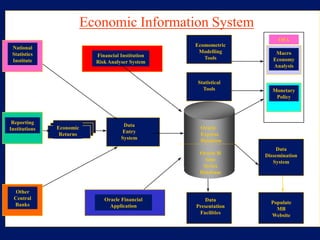
Economic Information System
                                                                        OFA
                                                    Ecomometric
 National
                                                     Modelling         Macro
 Statistics                 Financial Institution      Tools          Economy
 Institute                  Risk Analyser System
                                                                      Analysis


                                                    Statistical
                                                      Tools           Monetary
                                                                       Policy


 Reporting
                                       Data          Oracle
Institutions   Economic
                                      Entry          Express
                Returns
                                      System         Database
                                                                        Data
                                                     Oracle 8i     Dissemination
                                                       time           System
                                                      Series
                                                     Database


   Other
  Central                      Oracle Financial        Data
  Banks                                                              Populate
                                 Application        Presentation       MB
                                                     Facilities      Website

System architecture for central banks

  • 1.
    Financial Services System Architecture for Central Banks Jean-Marc Lepain Central Bank Specialist
  • 2.
    The World ofCentral Banking • Central Banks moving toward more independence • Exchange rate more difficult to manage • More focus on Monetary Policy • Tighten control on Commercial Banks • More dynamic reserves management • More need for risk management
  • 3.
    IT Evolution inCentral Banking • Reducing the number of systems • Moving to standard applications • Developing Internet based applications • Data Warehousing • OLAP based Decision Support tools
  • 4.
    Special Requirements ofCentral Banks Systems • No concept of profitability • Different sets of activities loosely integrated (Settlement, Credit to Com. Banks, Monitoring of the Banking System, Foreign Reserves Mgt., Monetary Policy, Balance of Payment, Macro and Micro-economic analysis) • Necessity to cross information between different activities (Ex: BoP and Com. Banks’ statutory reports) • Accounting view rather than a transactional view • Different Charts of Account and accounting rules • Use of GL information for Monetary Policy and Macro economic analysis • Importance of the interface with the Payment System
  • 5.
  • 6.
    Central Bank ITArchitecture in the 70s, 80s, 90s….. MM. & Open Market Back Office I General Settlement Accounts Ledger Mandatory Reserves Back Office Portfolio Management II Regulatory Compliance I Format State Treasury Back Managt Regulatory Compliance II Office III Foreign Reserves Finance Budgeting Cash Management Economic Analysis Staff Operations
  • 7.
    Integrate Architecture throughOracle 8i Management Information System Banking Settlnt. Law Real Value accounts Time System System Gross Settlement System Other Oracle E-Business Payment Suite Systems
  • 8.
    Central Banks andthe E-business paradigm • The Web will become the main mean of communication between central banks and commercial banks and other institutions • Web centric applications allow a complete centralisation of information • Web application reduce drastically the cost of implementation and the cost of ownership
  • 9.
    Internet Architecture Client Application Database Workstation Servers Servers Database TCP/IP Net 8 HTTP Information Centre
  • 10.
    KEY BENEFITS • Apackage based on standard IT architecture for Central Banks • A fully integrated package using Oracle 8i as common technology platform • All applications accessible through the Web • Timely information for critical decisions • Improvement of staff efficiency and of process flows • Promotion of world best practices
  • 11.
    Management Information Systemand Decision Support Internal Monetary Risk Macro- Banking Control Policy Managnt. Economy System Financial Foreign Op. System G.L. Regulatory System Portfolio Compliance Analysis Accounting Management Payables & Receivables Banking & Fix Assets B.o.P. Payment Settlement System System Vault Management Foreign Debt System Management
  • 12.
    Central Bank: StandardSystem Architecture Front Office Back Office Head Office Statistical System RTGS ERP Client Workstation Market Symbols Vault Operations System Management TCP/IP Monetary Policies External Sources Data Depository Macro Economy Financial Institutions HTTP Management Policies & State Treasury Procedure
  • 13.
    2. ENTERPRISE RESOURCE PLANING APPLICATION
  • 14.
    Oracle Enterprise Resources Planning Application • GL can be fully integrated with the Banking System and the Payment System • Webanabled • Central Bank references • Special functionalities for Central Banks • Flexible use of the Chart of Account
  • 15.
    Oracle ERP Modules Accounts Receivables Financial Analyser Human Resources Payroll General Ledger Oracle ERP includes Accounts Payables Fixed Assets Inventory Control Purchase Order
  • 16.
    Modules Common Components • Oracle Financial Analyser • Oracle Business Intelligence • Oracle Implementation Wizard • Workflow • Alert
  • 17.
    General Ledger • Alltypes of journal entries and accounting rules • Fully Multi-Currencies • Consolidation of multiple sets of books • High level of security in managing posting and transaction processing • Large reporting capability
  • 18.
    Oracle GL SpecialFeatures for Central Banks • Precious Metal Management • Coins and Bills Issuance Management • Cash Management • Budgeting • Monitoring of the Money Supply and of the Monetary Base • Balance of Paymen
  • 19.
    Account Structure • Independence from Chart of Account • Account Structure on-line • Up to 30 segments • Intuitive Account Hierarchy Editor • Reflect the organisation (branches, departments, cost centres, instruments) • Flexible calendar structure (Up to 366 periods, uneven periods adjustment periods, multiple calendar) • Multiple closing dates
  • 20.
    Benefits of OracleGeneral Ledger • Software easily tailored to the Bank’s requirements • Seamless integration with other applications • High number of automated functions (periodic journals, data import and data validation, etc.) • Customisation of reports without programming • Reduce time in the closing process • Improve productivity • Improve accounting controls
  • 21.
    Cash Issuance andVault Management Oracle Inventory plus some custom development • Track bills of different denominations • Track serial numbers • Track bank note status • Manage precious metals (gold coins, ingots, etc.) • Manage paper securities, monetary exhibits, etc. • Perform reconciliation with General Ledger
  • 22.
    Cash Issuance andVault Management Process Flows Events Financials Banking System Cash Management Issuance of new notes Cash Issuance Branches and Central Vault Management System Commercial Counting/sorting Banks of old notes Monetary Precious Exhibits Metals Securities, etc.
  • 23.
    System Modules Vault Management System Payables Optional Order Processing Inventory
  • 24.
  • 25.
    Payment Systems RTGS Architecture •Telecommunication layer (Hardware, Network X25, Protocol TCP/IP, etc.) • Messaging System • Queuing mechanism • Settlement mechanism • Payment auditing system (statistics, control, etc.)
  • 26.
    Why RTGS ? • To secure large value payments • To make payments final and unconditional • To reduce systemic risk in the banking system • To raise intra-day liquidity • To provide key information and efficient instruments for monetary policy • To increase efficiency through queuing mechanism • To embrace the standard technology • Payment versus Delivery for security settlement • Possibility to connect to other national RTGS, Payment versus Payment for FX
  • 27.
    Issues with PaymentSystems • Number of Settlement windows and number of sub-systems (RTGS, PVS, Net Settlement, Card Settlement, Cheques Clearing, Securities Settlement, etc.) • Number of payment instruments and volume • Queuing mechanism and prioritisation of payments • Architecture (T, L, V, Y) • Intra-day credit and intra-day liquidity • Other regulation issues
  • 28.
    Payment Systems Architecture Settlement Accounts RTGS NSS High Value Law Value Payments Payments FX Securities Check Settlement Settlement Clearing (PvP) (DvP) House
  • 29.
    Korea KFTC PaymentArchitecture Giro Bill Exchange E-commerce RTGS Low Value Payments Cheque Clearing ATM Settlement
  • 30.
    Basic Structure ofKFTC Financial Network Head Office Center Internet GIRO E-Commerce Gateway InterbankFund CD Host Transfer Host Giro Host Bulk Payment Bill Exchange Intermediation of Fund Transfer Communicaton UNIT Packet Switch NMS Bank of Korea Leased Lines (256K) Leased Lines (256K) PST PST PST N N N Regional Centers Bank N Bank 1 Bank 2 Bank 3 Bank 4 Bank 5
  • 31.
    RTGS Market • IMS •Logica • Montran • CMA • CBS • Perago • Custom Development (Sema, etc.)
  • 32.
    Bank 1 Bank 2 Bank 3 Comms & Monitoring Payments Security Control Central Messages Mechanism Switch Mechanism RTGS Queue Queue Queue Manager Optimiser Collateral & RTGS Settlement Settlement Loan Accts. Driver Account General Ledger
  • 33.
    RTGS Functionalties • Paymentand Settlement finality • Queue Management and optimisation facility • Collateral Management, Repo transactions • Payment versus Delivery (PvD) functionalities
  • 34.
    RTGS Functionalities • Gridlockresolution • Liquidity Management • Forecasting tools to predict end of day position • Risk Management • Enhanced security features • Comprehensive audit controls
  • 35.
    Account Management • QueuedPayment account and suspended payments • Settlement Account management (mandatory reserves, other reserves, etc.) • Collateral Account • Securities Account (DvP)
  • 36.
    Parameterisation • Criteria forprioritisation of payments • Possibility of intra-day credit • Possibility of settlement against collateral deposits • Possibility of adjustment of Mandatory reserves
  • 37.
    4. BUSINESS INTELLIGENCE AND DECISION SUPPORT SYTEM
  • 38.
    Data Depository andAnalysis System A Data Depository is a Data Warehouse on top of which we can perform analysis in different business areas. “A Data Warehouse is a subject-oriented, integrated, time-variant, non-volatile collection of data for management purposes.” Bill Inmon
  • 39.
    Data Warehouse Data Warehouse Solution Symbols Core Banking Market Operation Oracle e-business Oracle Staging Data Financial External Area Warehouse Monitoring Systems Policy Analyser (Reuters) & Oracle Research Discoverer System Regulatory Requirements Ministry of Finance Credit Foreign State Risk Exchange Treasury Management
  • 40.
    Data Depository andDecision Support System Macro Economic Data Marts Analysis External Information Monetary Policy & Market Operations Transactional Foreign Data operations Systems Repository State Treasury Operations Financial Institutions Cost & Regulatory Internal Compliance Control System
  • 41.
    Candidate Data marts • Market Operations • Monetary Policy • Foreign Operations and portfolio management • Regulatory Compliance Analysis • Macro-economic Analysis • State Treasury • Risk Analysis
  • 42.
    Multi-dimensional Analysis Branches/Offices Moscow Instruments St. Petersburg T-bill Open Market Operations Nizhni Novgorod Repo Operations Free MM Deposits Mandatory Reserves Q1 Q2 Q3 Q4 Time
  • 43.
    Reporting structure Board of Gov. Reports Senior Management Reports Consolidation Monetary Committee Medium Management Level Dep. 1 Dep. 2 Dep. 3 Dep. 4 Spe. 1 Spe. 2 Spe. 2 Specialist Level
  • 44.
    Regulatory Compliance andRisk Analysis System Three modules: • Bank Registry • Statutory Reporting Data Collection and Analysis – Report collection – Report authentication and validation – Report Analysis • Failing Institution Management
  • 45.
    Regulatory Compliance andRisk Analysis System Banking R.T.G.S. Data System Generation System Collection Oracle Data and Financial Communication Oracle Validation Analyser Infrastructure Data of data Warehouse Data Statutory Failing Generation Bank Institution System Reports Registry Management Analysis
  • 46.
    Policy & ProcedureMonitoring System • Capture policies • Track decisions associated to policy design • Follow up on implementation • Store on line policy documents • Store on line manuals and procedures
  • 47.
    Economic Information System OFA Ecomometric National Modelling Macro Statistics Financial Institution Tools Economy Institute Risk Analyser System Analysis Statistical Tools Monetary Policy Reporting Data Oracle Institutions Economic Entry Express Returns System Database Data Oracle 8i Dissemination time System Series Database Other Central Oracle Financial Data Banks Populate Application Presentation MB Facilities Website