Submitted to-Dr. S. John
    Manoraj
Bidhu Bhushan Binit (11PGDM08)
Indian   Institute   of  Plantation
Management
Bangalore.
Contents :
   1. Background of the study
   2.About Company
   3. Statement of the problem
   4.Objective of the research project
   5. Research Design
   6.Data Analysis and Interpretation
   7.Findings
   8. Recommendations
1.Background of the study


   Huge potential of Indian vegetable seed market.

   Hyper competition amongst industry players.

   Direct linkage with the vegetable seed industry.

   Dearth of literature and has not been focused by
    companies so far.
2.Monsanto
   Total turnover is around US11.8 billion.
   It is one of the biggest agri-business companies in
    the world and as well as in India.
   It has a separate R&D department devoted to
    biotechnology research work which brought the bt
    cotton in India for the first time.
   Seminis is the vegetable seed division of Monsanto.
   Round- up,Sitara, Indu are famous brands amongst
    others.
3.Statement of the problem


 Is the vegetable nursery business calling to be
 considered as a separate strategic segment in the
 next two years in Gujarat and Maharashtra for a
 vegetable hybrid seed manufacturing company ?
4.Objective


    To understand current status and market scenario of Vegetable
             Nursery Business in Gujarat & Maharashtra.


       Price spread analysis of vegetable seed used in Nursery.


     Growth potential of Vegetable Nursery business in these two
                               states
                                  &
         To identify business opportunity for Monsanto and
                      recommendations for this.
5.1 Research Design
       • Primary Research
Method • Survey [Questionnaire(structured)]

       • Descriptive
Design • Cross-sectional


        • Gujarat & Maharashtra
 Area
5.2 Research Design
                 • Gujarat-[ Vadodara,Junagadh,Rajkot,Mehsana]
                 • Maharashtra- [Pune,Nasik]
Sampling Frame


                 • Probabilistic Sampling(Multistage/Combination Sampling)
  Sampling
  Technique


                 • Sampling Elements: Nursery grower, Farmer & Distributor/Dealer
                 • Sample Size- 180 [nursery grower -35;Farmer -130;Distributor-15
  Sampling
  element &
 Sample Size
Data Analysis & Interpretation
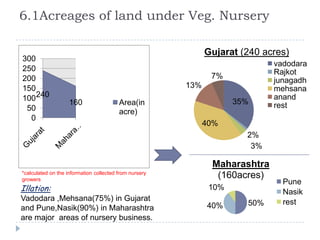
6.1Acreages of land under Veg. Nursery

                                                              Gujarat (240 acres)
300
                                                                             vadodara
250                                                                          Rajkot
200                                                            7%
                                                                             junagadh
150                                                     13%                  mehsana
100 240                                                              35%
                                                                             anand
                    160                  Area(in                             rest
 50                                      acre)
  0
                                                              40%
                                                                       2%
                                                                        3%

                                                               Maharashtra
*calculated on the information collected from nursery
growers
                                                                (160acres)
                                                                               Pune
Illation:                                                      10%
                                                                               Nasik
Vadodara ,Mehsana(75%) in Gujarat                                              rest
                                                              40%      50%
and Pune,Nasik(90%) in Maharashtra
are major areas of nursery business.
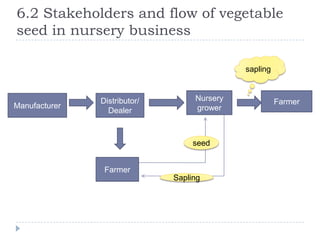
6.2 Stakeholders and flow of vegetable
seed in nursery business

                                             sapling


               Distributor/        Nursery             Farmer
Manufacturer                       grower
                 Dealer


                                   seed


                Farmer
                              Sapling
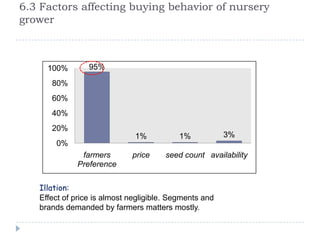
6.3 Factors affecting buying behavior of nursery
grower


     100%        95%

      80%
      60%
      40%
      20%
                              1%           1%           3%
       0%
              farmers        price     seed count availability
             Preference

   Illation:
   Effect of price is almost negligible. Segments and
   brands demanded by farmers matters mostly.
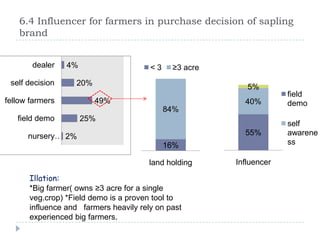
6.4 Influencer for farmers in purchase decision of sapling
    brand


       dealer    4%                    <3    ≥3 acre
 self decision    20%                                     5%
                                                                    field
fellow farmers          49%                              40%        demo
                                            84%
   field demo         25%
                                                                    self
      nursery… 2%                                        55%        awarene
                                            16%                     ss

                                       land holding    Influencer

      Illation:
      *Big farmer( owns ≥3 acre for a single
      veg.crop) *Field demo is a proven tool to
      influence and farmers heavily rely on past
      experienced big farmers.
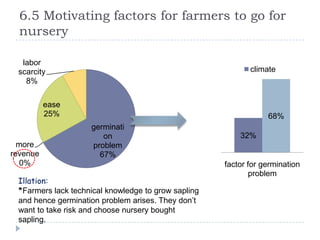
6.5 Motivating factors for farmers to go for
  nursery

  labor
 scarcity                                                   climate
   8%

          ease
          25%                                                    68%
                    germinati
                       on                                32%
  more              problem
revenue               67%
   0%                                                factor for germination
                                                             problem
 Illation:
 *Farmers lack technical knowledge to grow sapling
 and hence germination problem arises. They don‟t
 want to take risk and choose nursery bought
 sapling.
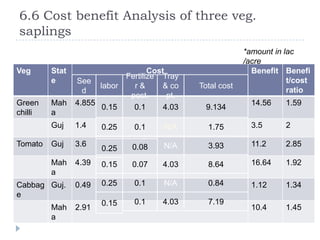
6.6 Cost benefit Analysis of three veg.
saplings
                                                           *amount in lac
                                                           /acre
Veg      Stat                      Cost                      Benefit Benefi
                            Fertilize Tray
         e      See                                                    t/cost
                      labor   r&       & co   Total cost
                  d                                                    ratio
                             pest.      pt.
Green    Mah    4.855                                        14.56    1.59
                       0.15   0.1      4.03     9.134
chilli   a
         Guj    1.4    0.25    0.1     N/A      1.75         3.5      2

Tomato   Guj    3.6           0.08     N/A      3.93         11.2     2.85
                       0.25
         Mah    4.39   0.15   0.07    4.03      8.64         16.64    1.92
         a
Cabbag Guj.     0.49   0.25    0.1     N/A      0.84         1.12     1.34
e
                       0.15    0.1    4.03      7.19
         Mah    2.91                                         10.4     1.45
         a
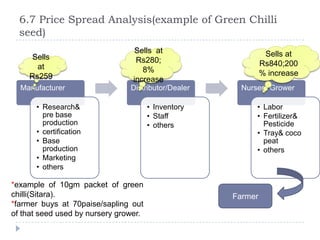
6.7 Price Spread Analysis(example of Green Chilli
  seed)
                                  Sells at                     Sells at
    Sells                         Rs280;
      at                                                      Rs840;200
                                    8%                        % increase
    Rs259                        increase
  Manufacturer                  Distributor/Dealer     Nursery Grower

      • Research&                      • Inventory         • Labor
        pre base                       • Staff             • Fertilizer&
        production                     • others              Pesticide
      • certification                                      • Tray& coco
      • Base                                                 peat
        production                                         • others
      • Marketing
      • others

*example of 10gm packet of green
chilli(Sitara).                                      Farmer
*farmer buys at 70paise/sapling out
of that seed used by nursery grower.
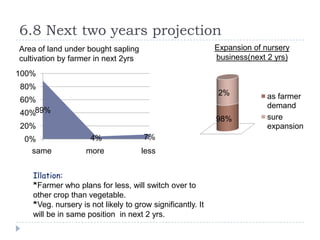
6.8 Next two years projection
Area of land under bought sapling                          Expansion of nursery
cultivation by farmer in next 2yrs                         business(next 2 yrs)

100%
80%
                                                           2%            as farmer
60%
                                                                         demand
40%89%
                                                           98%           sure
20%                                                                      expansion
 0%                 4%               7%
  same             more              less


   Illation:
   *Farmer who plans for less, will switch over to
   other crop than vegetable.
   *Veg. nursery is not likely to grow significantly. It
   will be in same position in next 2 yrs.
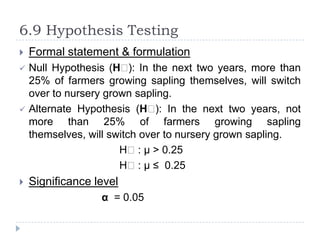
6.9 Hypothesis Testing
   Formal statement & formulation
   Null Hypothesis (Hₒ In the next two years, more than
                          ):
    25% of farmers growing sapling themselves, will switch
    over to nursery grown sapling.
   Alternate Hypothesis (Hₒ In the next two years, not
                               ):
    more than 25% of farmers growing sapling
    themselves, will switch over to nursery grown sapling.
                       Hₒ: µ > 0.25
                       Hₒ: µ ≤ 0.25
   Significance level
                  α = 0.05
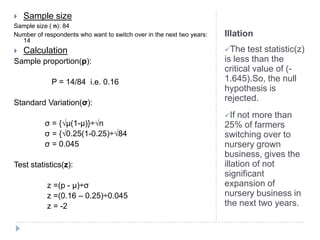
   Sample size
Sample size ( n): 84
Number of respondents who want to switch over in the next two years:   Illation
  14
   Calculation                                                        The   test statistic(z)
Sample proportion(p):                                                  is less than the
                                                                       critical value of (-
             P = 14/84 i.e. 0.16                                       1.645).So, the null
                                                                       hypothesis is
Standard Variation(σ):
                                                                       rejected.
                                                                       If  not more than
          σ = {√µ(1-µ)}÷√n                                             25% of farmers
          σ = {√0.25(1-0.25)÷√84                                       switching over to
          σ = 0.045                                                    nursery grown
                                                                       business, gives the
Test statistics(z):                                                    illation of not
                                                                       significant
           z =(p - µ)÷σ                                                expansion of
           z =(0.16 – 0.25)÷0.045                                      nursery business in
           z = -2                                                      the next two years.
Findings
Findings
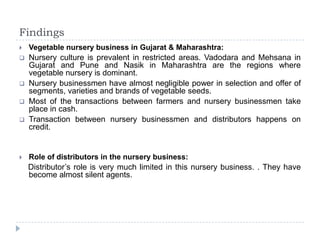
   Vegetable nursery business in Gujarat & Maharashtra:
   Nursery culture is prevalent in restricted areas. Vadodara and Mehsana in
    Gujarat and Pune and Nasik in Maharashtra are the regions where
    vegetable nursery is dominant.
   Nursery businessmen have almost negligible power in selection and offer of
    segments, varieties and brands of vegetable seeds.
   Most of the transactions between farmers and nursery businessmen take
    place in cash.
   Transaction between nursery businessmen and distributors happens on
    credit.


   Role of distributors in the nursery business:
    Distributor‟s role is very much limited in this nursery business. . They have
    become almost silent agents.
Findings
   Practices in vegetable nursery business:
   In Maharashtra, nursery businessmen are progressive especially in
    Nasik district. Their promotion mix includes local newspaper
    advertisement, organizing stalls in „Kisan Melas‟, and distributing
    leaflets. In Gujarat, most of the nurseries distribute leaflets.
   Word of the mouth plays major role in marketing for nurseries.

   In Vijapur talluka of Mehasana district of Gujarat, most of the nursery
    businessmen are in the practice of pre-booking for saplings. They
    run their campaign during season in which they go to the door steps
    of the farmers and book the orders, take advance cash and advertise
    their nurseries at the same time.
Findings

   Power of farmer
   Farmer can be said as the King in this vegetable nursery business.

   Farmer has the pure power of preference in selection of
    variety, segment, and brand of the seed used in sapling.
   Farmer buys sapling to avoid germination problem and it also gives
    ease.
   However germination problem can be overcome because it is due to
    lack of technical disadvantage.

   Farmer demand is the sole reason of existence of vegetable nursery
    business.

   Farmers ask their fellow experienced farmers for suggestion and rely
    on them. Another factor is field demos which impacts substantially on
    farmers in deciding the seed varieties and brand.
Recommendations
Recommendation

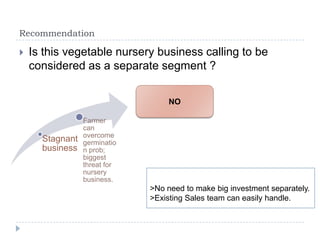
   Is this vegetable nursery business calling to be
    considered as a separate segment ?


                                   NO

                 Farmer
                 can
                 overcome
      Stagnant   germinatio
      business   n prob;
                 biggest
                 threat for
                 nursery
                 business.
                              >No need to make big investment separately.
                              >Existing Sales team can easily handle.
Recommendations

   Relationship with Nursery grower:
          Make them feel as an important channel partner who are
                       invaluable for the company.

   regular visits to nurseries is required. Current situation
    shows much less visits than required especially in
    Nasik, Maharashtra.
   one officer from TD department assigned to nursery
    only, employed to each major nursery areas-
    (Vadodara, Mehsana,Pune,Nasik) is highly
    recommended.
Recommendations

   Promotion
   Intensive field demonstrations to farmers are required
    as farmer preference is the biggest influencer for nursery
    grower.

   Distributing free samples to farmers has become old
    technique; nevertheless still it is one of the fruitful ways of
    promotion. But there is need of add on tools which could
    turn farmers attached to the brand emotionally.
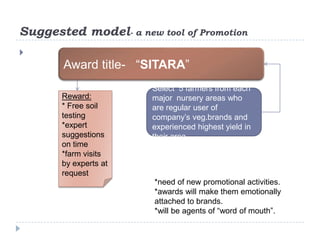
Suggested model- a new tool of Promotion

       Award title- “SITARA”
                       Select 5 farmers from each
       Reward:         major nursery areas who
       * Free soil     are regular user of
       testing         company‟s veg.brands and
       *expert         experienced highest yield in
       suggestions     their area.
       on time
       *farm visits
       by experts at
       request
                       *need of new promotional activities.
                       *awards will make them emotionally
                       attached to brands.
                       *will be agents of “word of mouth”.
Recommendation

   Further Research

   This research study is not an end. There is acute lack of
    research on vegetable nursery business and uses of
    marketing concepts in the same. Branding is one of
    them for which I recommend to carry out a separate
    research study.
Vote of thanks
   My thanks with utmost respect to Dr. S. John Manoraj, Assistant
    Professor (Marketing) for his encouragement as a teacher and for
    fruitful discussions, critical review and direction as an academic
    project guide.
   I am especially thankful to Mr. K.
    Venkateswaran, lecturer((International Business & Computer
    Applications) for his untiring support and helping me to understand
    questionnaire design.
   I am thankful to Mr. Vinay Sharma,Technology Development
    Manager,Monsanto India ltd for guiding me through out the project
    period.


                            Thank You

Vegetable Nursery Business in Gujarat & Maharashtra

  • 1.
    Submitted to-Dr. S.John Manoraj Bidhu Bhushan Binit (11PGDM08) Indian Institute of Plantation Management Bangalore.
  • 2.
    Contents :  1. Background of the study  2.About Company  3. Statement of the problem  4.Objective of the research project  5. Research Design  6.Data Analysis and Interpretation  7.Findings  8. Recommendations
  • 3.
    1.Background of thestudy  Huge potential of Indian vegetable seed market.  Hyper competition amongst industry players.  Direct linkage with the vegetable seed industry.  Dearth of literature and has not been focused by companies so far.
  • 4.
    2.Monsanto  Total turnover is around US11.8 billion.  It is one of the biggest agri-business companies in the world and as well as in India.  It has a separate R&D department devoted to biotechnology research work which brought the bt cotton in India for the first time.  Seminis is the vegetable seed division of Monsanto.  Round- up,Sitara, Indu are famous brands amongst others.
  • 5.
    3.Statement of theproblem Is the vegetable nursery business calling to be considered as a separate strategic segment in the next two years in Gujarat and Maharashtra for a vegetable hybrid seed manufacturing company ?
  • 6.
    4.Objective To understand current status and market scenario of Vegetable Nursery Business in Gujarat & Maharashtra. Price spread analysis of vegetable seed used in Nursery. Growth potential of Vegetable Nursery business in these two states & To identify business opportunity for Monsanto and recommendations for this.
  • 7.
    5.1 Research Design • Primary Research Method • Survey [Questionnaire(structured)] • Descriptive Design • Cross-sectional • Gujarat & Maharashtra Area
  • 8.
    5.2 Research Design • Gujarat-[ Vadodara,Junagadh,Rajkot,Mehsana] • Maharashtra- [Pune,Nasik] Sampling Frame • Probabilistic Sampling(Multistage/Combination Sampling) Sampling Technique • Sampling Elements: Nursery grower, Farmer & Distributor/Dealer • Sample Size- 180 [nursery grower -35;Farmer -130;Distributor-15 Sampling element & Sample Size
  • 9.
    Data Analysis &Interpretation
  • 10.
    6.1Acreages of landunder Veg. Nursery Gujarat (240 acres) 300 vadodara 250 Rajkot 200 7% junagadh 150 13% mehsana 100 240 35% anand 160 Area(in rest 50 acre) 0 40% 2% 3% Maharashtra *calculated on the information collected from nursery growers (160acres) Pune Illation: 10% Nasik Vadodara ,Mehsana(75%) in Gujarat rest 40% 50% and Pune,Nasik(90%) in Maharashtra are major areas of nursery business.
  • 11.
    6.2 Stakeholders andflow of vegetable seed in nursery business sapling Distributor/ Nursery Farmer Manufacturer grower Dealer seed Farmer Sapling
  • 12.
    6.3 Factors affectingbuying behavior of nursery grower 100% 95% 80% 60% 40% 20% 1% 1% 3% 0% farmers price seed count availability Preference Illation: Effect of price is almost negligible. Segments and brands demanded by farmers matters mostly.
  • 13.
    6.4 Influencer forfarmers in purchase decision of sapling brand dealer 4% <3 ≥3 acre self decision 20% 5% field fellow farmers 49% 40% demo 84% field demo 25% self nursery… 2% 55% awarene 16% ss land holding Influencer Illation: *Big farmer( owns ≥3 acre for a single veg.crop) *Field demo is a proven tool to influence and farmers heavily rely on past experienced big farmers.
  • 14.
    6.5 Motivating factorsfor farmers to go for nursery labor scarcity climate 8% ease 25% 68% germinati on 32% more problem revenue 67% 0% factor for germination problem Illation: *Farmers lack technical knowledge to grow sapling and hence germination problem arises. They don‟t want to take risk and choose nursery bought sapling.
  • 15.
    6.6 Cost benefitAnalysis of three veg. saplings *amount in lac /acre Veg Stat Cost Benefit Benefi Fertilize Tray e See t/cost labor r& & co Total cost d ratio pest. pt. Green Mah 4.855 14.56 1.59 0.15 0.1 4.03 9.134 chilli a Guj 1.4 0.25 0.1 N/A 1.75 3.5 2 Tomato Guj 3.6 0.08 N/A 3.93 11.2 2.85 0.25 Mah 4.39 0.15 0.07 4.03 8.64 16.64 1.92 a Cabbag Guj. 0.49 0.25 0.1 N/A 0.84 1.12 1.34 e 0.15 0.1 4.03 7.19 Mah 2.91 10.4 1.45 a
  • 16.
    6.7 Price SpreadAnalysis(example of Green Chilli seed) Sells at Sells at Sells Rs280; at Rs840;200 8% % increase Rs259 increase Manufacturer Distributor/Dealer Nursery Grower • Research& • Inventory • Labor pre base • Staff • Fertilizer& production • others Pesticide • certification • Tray& coco • Base peat production • others • Marketing • others *example of 10gm packet of green chilli(Sitara). Farmer *farmer buys at 70paise/sapling out of that seed used by nursery grower.
  • 17.
    6.8 Next twoyears projection Area of land under bought sapling Expansion of nursery cultivation by farmer in next 2yrs business(next 2 yrs) 100% 80% 2% as farmer 60% demand 40%89% 98% sure 20% expansion 0% 4% 7% same more less Illation: *Farmer who plans for less, will switch over to other crop than vegetable. *Veg. nursery is not likely to grow significantly. It will be in same position in next 2 yrs.
  • 18.
    6.9 Hypothesis Testing  Formal statement & formulation  Null Hypothesis (Hₒ In the next two years, more than ): 25% of farmers growing sapling themselves, will switch over to nursery grown sapling.  Alternate Hypothesis (Hₒ In the next two years, not ): more than 25% of farmers growing sapling themselves, will switch over to nursery grown sapling. Hₒ: µ > 0.25 Hₒ: µ ≤ 0.25  Significance level α = 0.05
  • 19.
    Sample size Sample size ( n): 84 Number of respondents who want to switch over in the next two years: Illation 14  Calculation The test statistic(z) Sample proportion(p): is less than the critical value of (- P = 14/84 i.e. 0.16 1.645).So, the null hypothesis is Standard Variation(σ): rejected. If not more than σ = {√µ(1-µ)}÷√n 25% of farmers σ = {√0.25(1-0.25)÷√84 switching over to σ = 0.045 nursery grown business, gives the Test statistics(z): illation of not significant z =(p - µ)÷σ expansion of z =(0.16 – 0.25)÷0.045 nursery business in z = -2 the next two years.
  • 20.
  • 21.
    Findings  Vegetable nursery business in Gujarat & Maharashtra:  Nursery culture is prevalent in restricted areas. Vadodara and Mehsana in Gujarat and Pune and Nasik in Maharashtra are the regions where vegetable nursery is dominant.  Nursery businessmen have almost negligible power in selection and offer of segments, varieties and brands of vegetable seeds.  Most of the transactions between farmers and nursery businessmen take place in cash.  Transaction between nursery businessmen and distributors happens on credit.  Role of distributors in the nursery business: Distributor‟s role is very much limited in this nursery business. . They have become almost silent agents.
  • 22.
    Findings  Practices in vegetable nursery business:  In Maharashtra, nursery businessmen are progressive especially in Nasik district. Their promotion mix includes local newspaper advertisement, organizing stalls in „Kisan Melas‟, and distributing leaflets. In Gujarat, most of the nurseries distribute leaflets.  Word of the mouth plays major role in marketing for nurseries.  In Vijapur talluka of Mehasana district of Gujarat, most of the nursery businessmen are in the practice of pre-booking for saplings. They run their campaign during season in which they go to the door steps of the farmers and book the orders, take advance cash and advertise their nurseries at the same time.
  • 23.
    Findings  Power of farmer  Farmer can be said as the King in this vegetable nursery business.  Farmer has the pure power of preference in selection of variety, segment, and brand of the seed used in sapling.  Farmer buys sapling to avoid germination problem and it also gives ease.  However germination problem can be overcome because it is due to lack of technical disadvantage.  Farmer demand is the sole reason of existence of vegetable nursery business.  Farmers ask their fellow experienced farmers for suggestion and rely on them. Another factor is field demos which impacts substantially on farmers in deciding the seed varieties and brand.
  • 24.
  • 25.
    Recommendation  Is this vegetable nursery business calling to be considered as a separate segment ? NO Farmer can overcome Stagnant germinatio business n prob; biggest threat for nursery business. >No need to make big investment separately. >Existing Sales team can easily handle.
  • 26.
    Recommendations  Relationship with Nursery grower: Make them feel as an important channel partner who are invaluable for the company.  regular visits to nurseries is required. Current situation shows much less visits than required especially in Nasik, Maharashtra.  one officer from TD department assigned to nursery only, employed to each major nursery areas- (Vadodara, Mehsana,Pune,Nasik) is highly recommended.
  • 27.
    Recommendations  Promotion  Intensive field demonstrations to farmers are required as farmer preference is the biggest influencer for nursery grower.  Distributing free samples to farmers has become old technique; nevertheless still it is one of the fruitful ways of promotion. But there is need of add on tools which could turn farmers attached to the brand emotionally.
  • 28.
    Suggested model- anew tool of Promotion  Award title- “SITARA” Select 5 farmers from each Reward: major nursery areas who * Free soil are regular user of testing company‟s veg.brands and *expert experienced highest yield in suggestions their area. on time *farm visits by experts at request *need of new promotional activities. *awards will make them emotionally attached to brands. *will be agents of “word of mouth”.
  • 29.
    Recommendation  Further Research  This research study is not an end. There is acute lack of research on vegetable nursery business and uses of marketing concepts in the same. Branding is one of them for which I recommend to carry out a separate research study.
  • 30.
    Vote of thanks  My thanks with utmost respect to Dr. S. John Manoraj, Assistant Professor (Marketing) for his encouragement as a teacher and for fruitful discussions, critical review and direction as an academic project guide.  I am especially thankful to Mr. K. Venkateswaran, lecturer((International Business & Computer Applications) for his untiring support and helping me to understand questionnaire design.  I am thankful to Mr. Vinay Sharma,Technology Development Manager,Monsanto India ltd for guiding me through out the project period. Thank You