International Monetary Fund:
Responsiblities & Roles
Abu Sadat Mohammad Saleh
ID# 801518001
Dept. of International Business
Faculty of Business Studies
University of Dhaka
Abbreviation IMF
Formation The IMF, or ‘The Fund’,
was conceived at a UN
conference in 7 July 1944
and officially created in
1945.
Type International financial
institution
Headquarters Washington, D.C., United
States
Region Worldwide
Official
language
English
Main organ Board of governors
Parent
organization
United Nations
Website imf.org
Coat of arms
Introduction
Introduction.. …cont’d
• The aims were
• To avoid a repetition of the competitive devaluations of currencies that had
contributed to the Great Depression of the 1930s.
• To globally stabilize Post-WW2 exchange rates and financial communication between
countries.
• To reduce the Poverty around the world.
• IMF now seeks to promote
• High employment
• Sustainable economic growth, and reduce
• Now The IMF :
• The central institution embodying the international monetary system
• Promotes balanced expansion of world trade
• Makes correction of balance-of-payment problems.
• Makes stable exchange rates
History of contribution in global economy
• Cooperation and reconstruction of post-ww2 economy (1944–71)
• Managing the collapse of the Bretton Woods system (1972–81)
• Societal Change for Eastern Europe and Asian Upheaval (1990–2004)
• Globalization and the Crisis (2005 - present)
The IMF Today
• Membership: 189 countries
• Board of Governors
• Executive Board: 24 Directors each representing a single country or a
group of countries
• Staff: Approximately 2,663 from 148 countries
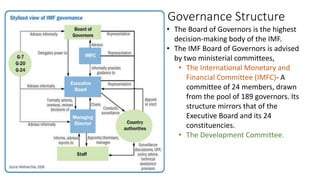
Governance Structure
• The Board of Governors is the highest
decision-making body of the IMF.
• The IMF Board of Governors is advised
by two ministerial committees,
• The International Monetary and
Financial Committee (IMFC)- A
committee of 24 members, drawn
from the pool of 189 governors. Its
structure mirrors that of the
Executive Board and its 24
constituencies.
• The Development Committee.
Governance Structure… …cont’d
• Executive board members are selected by governors and exercises most of
delegated powers except the right for
• Approving quota increases
• Special drawing right (SDR) allocations
• Admittance of new members
• Compulsory withdrawal of members
• Articles of Agreement
• By-Laws.
Country Representation
How a Country Can Join the IMF?
• Application to be a part of the IMF
• Membership payments, or quotas, which are assigned to individual countries
based on their economic size and stipulate how much they contribute.
• Adherence to the Code of Conduct, and stricter regulations
• Each country or region is represented by a member on the Fund's Executive
Board and numerous staff members.
• The ratio of board members & Voting power from each country is based on
the country's Relative Position in Global Economy.
The IMF’s responsibilities
• Surveillance
• IMF reviews country policies and national, regional, and global economic and financial
developments
• Financial assistance
• The IMF lends to all member countries under safeguard and with international obligations.
• For poor countries, it makes such loans at low interest rates and with a longer-than-normal
pay-back period.
• Correcting balance of payments problems.
• Reformed financial aids focused on prevention of global financial crisis and Poverty.
• Technical assistance
• To help member countries strengthen their capacity to design and implement effective
policies including in the areas of tax policy and administration, expenditure management,
monetary and exchange rate policies, banking and financial system supervision and
regulation, legislative frameworks, and statistics.
• Issuing SDRs
Roles of IMF
• Promote international monetary cooperation
• Facilitate the expansion and balanced growth of international trade
• Promote exchange stability
• Assist in the establishment of a multilateral system of payments
• Make resources available (with adequate safeguards) to members
experiencing balance of payments difficulties
The IMF and the World Bank:
The Bretton Woods Institutions
• IMF focusing on macroeconomic issues and the World Bank concentrating
on long-term economic development and poverty reduction.
• The IMF promotes international monetary cooperation and provides policy
advice and capacity development support; On the other hand, the World
Bank promotes long-term economic development and poverty reduction
by providing technical and financial support.
• IMF loans are short and medium term and funded mainly by the pool of
quota contributions that its members provide. World Bank assistance is
generally long term loan and is funded both by member country
contributions and through bond issuance.
Criticism of IMF
• Loans are too intrusive and compromise the economic and political
sovereignty of the receiving countries.
• ‘One-size-fits-all’ policies on countries
• Policies were imposed all at once
• Not open to criticism or public oversight
IMF and Bangladesh
• The IMF has provided financial assistance to Bangladesh over the past
decades
• It has come with requirements and other recommendations for
Bangladesh to follow in order to receive the payments.
• This has resulted both a range of benefits and difficulties
• In this regard, Bangladesh needs to closely examine these policy
recommendations by the IMF which were previously imposed upon
developing countries in the Asian and African region due to some
criticism and burden had arisen therein.
Conclusion
• The IMF is one of most influential International Financial Institution committed
for the reducing global poverty by meeting the challenges and opportunities of
globalization. Hence, It urges on its member countries continued cooperation
on transparent monetary and economic policies, honest government, and the
establishment of rule of law. Although the IMF has been contributing to the
economic development of developing countries including Bangladesh, we need
to deeply examine the recommendations before accept the Fund’s assistance
because of some controversial events has arisen before.
THANKS
International monetary fund   ppt

International monetary fund ppt

  • 1.
    International Monetary Fund: Responsiblities& Roles Abu Sadat Mohammad Saleh ID# 801518001 Dept. of International Business Faculty of Business Studies University of Dhaka
  • 2.
    Abbreviation IMF Formation TheIMF, or ‘The Fund’, was conceived at a UN conference in 7 July 1944 and officially created in 1945. Type International financial institution Headquarters Washington, D.C., United States Region Worldwide Official language English Main organ Board of governors Parent organization United Nations Website imf.org Coat of arms Introduction
  • 3.
    Introduction.. …cont’d • Theaims were • To avoid a repetition of the competitive devaluations of currencies that had contributed to the Great Depression of the 1930s. • To globally stabilize Post-WW2 exchange rates and financial communication between countries. • To reduce the Poverty around the world. • IMF now seeks to promote • High employment • Sustainable economic growth, and reduce • Now The IMF : • The central institution embodying the international monetary system • Promotes balanced expansion of world trade • Makes correction of balance-of-payment problems. • Makes stable exchange rates
  • 4.
    History of contributionin global economy • Cooperation and reconstruction of post-ww2 economy (1944–71) • Managing the collapse of the Bretton Woods system (1972–81) • Societal Change for Eastern Europe and Asian Upheaval (1990–2004) • Globalization and the Crisis (2005 - present)
  • 5.
    The IMF Today •Membership: 189 countries • Board of Governors • Executive Board: 24 Directors each representing a single country or a group of countries • Staff: Approximately 2,663 from 148 countries
  • 6.
    Governance Structure • TheBoard of Governors is the highest decision-making body of the IMF. • The IMF Board of Governors is advised by two ministerial committees, • The International Monetary and Financial Committee (IMFC)- A committee of 24 members, drawn from the pool of 189 governors. Its structure mirrors that of the Executive Board and its 24 constituencies. • The Development Committee.
  • 7.
    Governance Structure… …cont’d •Executive board members are selected by governors and exercises most of delegated powers except the right for • Approving quota increases • Special drawing right (SDR) allocations • Admittance of new members • Compulsory withdrawal of members • Articles of Agreement • By-Laws.
  • 8.
    Country Representation How aCountry Can Join the IMF? • Application to be a part of the IMF • Membership payments, or quotas, which are assigned to individual countries based on their economic size and stipulate how much they contribute. • Adherence to the Code of Conduct, and stricter regulations • Each country or region is represented by a member on the Fund's Executive Board and numerous staff members. • The ratio of board members & Voting power from each country is based on the country's Relative Position in Global Economy.
  • 9.
    The IMF’s responsibilities •Surveillance • IMF reviews country policies and national, regional, and global economic and financial developments • Financial assistance • The IMF lends to all member countries under safeguard and with international obligations. • For poor countries, it makes such loans at low interest rates and with a longer-than-normal pay-back period. • Correcting balance of payments problems. • Reformed financial aids focused on prevention of global financial crisis and Poverty. • Technical assistance • To help member countries strengthen their capacity to design and implement effective policies including in the areas of tax policy and administration, expenditure management, monetary and exchange rate policies, banking and financial system supervision and regulation, legislative frameworks, and statistics. • Issuing SDRs
  • 10.
    Roles of IMF •Promote international monetary cooperation • Facilitate the expansion and balanced growth of international trade • Promote exchange stability • Assist in the establishment of a multilateral system of payments • Make resources available (with adequate safeguards) to members experiencing balance of payments difficulties
  • 11.
    The IMF andthe World Bank: The Bretton Woods Institutions • IMF focusing on macroeconomic issues and the World Bank concentrating on long-term economic development and poverty reduction. • The IMF promotes international monetary cooperation and provides policy advice and capacity development support; On the other hand, the World Bank promotes long-term economic development and poverty reduction by providing technical and financial support. • IMF loans are short and medium term and funded mainly by the pool of quota contributions that its members provide. World Bank assistance is generally long term loan and is funded both by member country contributions and through bond issuance.
  • 12.
    Criticism of IMF •Loans are too intrusive and compromise the economic and political sovereignty of the receiving countries. • ‘One-size-fits-all’ policies on countries • Policies were imposed all at once • Not open to criticism or public oversight
  • 14.
    IMF and Bangladesh •The IMF has provided financial assistance to Bangladesh over the past decades • It has come with requirements and other recommendations for Bangladesh to follow in order to receive the payments. • This has resulted both a range of benefits and difficulties • In this regard, Bangladesh needs to closely examine these policy recommendations by the IMF which were previously imposed upon developing countries in the Asian and African region due to some criticism and burden had arisen therein.
  • 15.
    Conclusion • The IMFis one of most influential International Financial Institution committed for the reducing global poverty by meeting the challenges and opportunities of globalization. Hence, It urges on its member countries continued cooperation on transparent monetary and economic policies, honest government, and the establishment of rule of law. Although the IMF has been contributing to the economic development of developing countries including Bangladesh, we need to deeply examine the recommendations before accept the Fund’s assistance because of some controversial events has arisen before.
  • 16.