Arun Sitaraman      02
Tejas Pawar         20
Rakhi S             27
Sunitha Sivadasan   39
Aditi Mahapadi      40
“It is an organization of 186 countries ,working to
foster global monetary cooperation , secure financial
stability ,facilitate international trade ,promote high
employment and sustainable economic growth and
reduce poverty” .
The IMF is the most detailed attempt to organize the
conduct of international monetary affairs.
The International Monetary Fund Was created in
1944, at the Bretton Woods conference to prevent the
kinds of chain reaction in the economic system that
caused world currencies to collapse like in the Great
Depression of the 1930s.
Bretton wood agreement was contracted in 1944 and
IMF was created in 1946.
IMF started to make service with IBRD (international
bank of reconstruction and development) in 1947.
The IMF was created to support orderly international
currency exchanges and to help nations having balance
of payment problems through short term loans of cash.
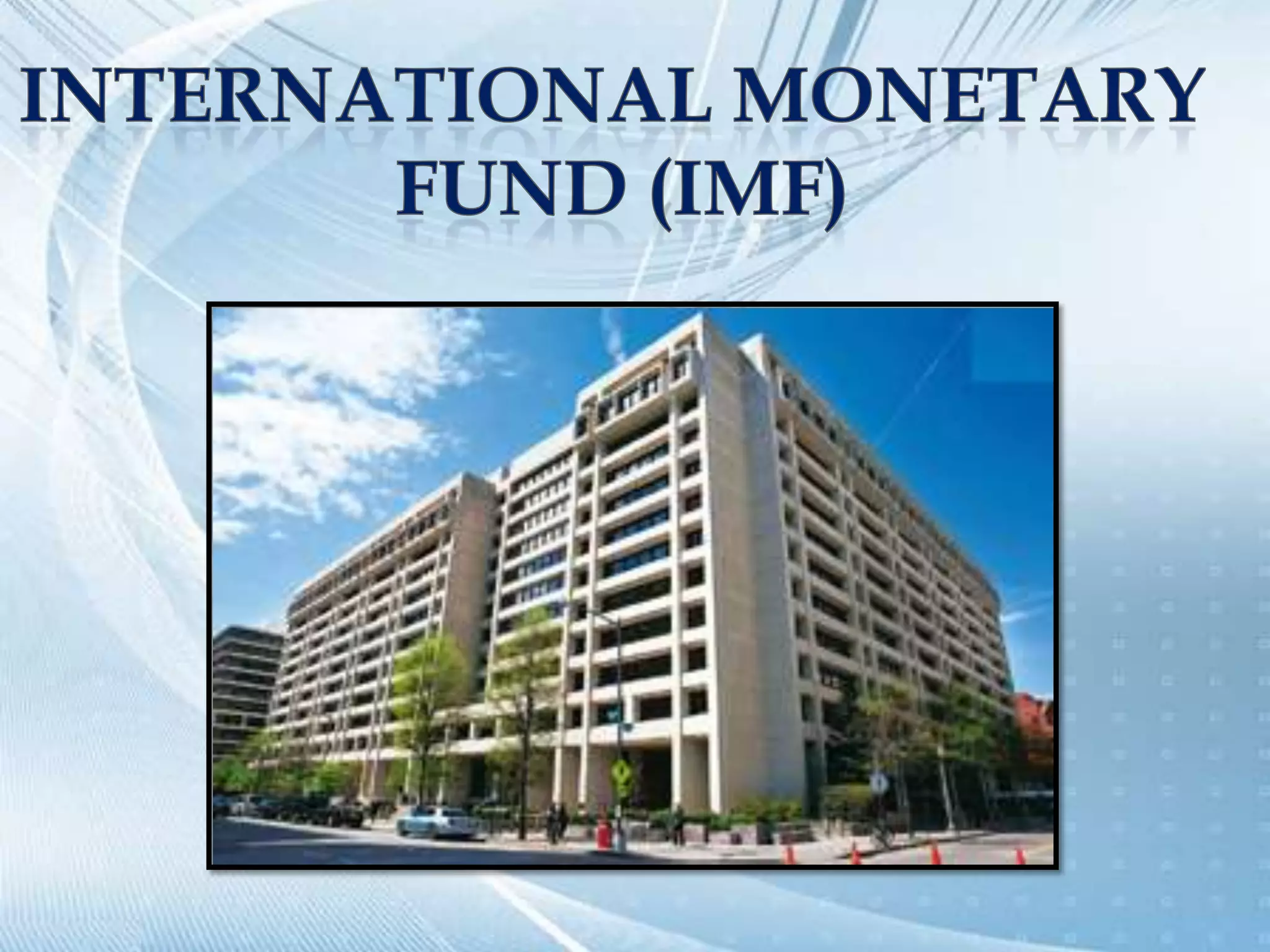
IMF headquarters is in Washington D.C , U.S.A
Five largest shareholders are United
States, Japan, Germany, France, United Kingdom.
China, Russia, and Saudi Arabia have their own seats
on the Board.
16 other Executive Directors are elected for two year
terms by groups of countries, known as
“Constituencies”.
Total quotas of $312 billion; outstanding loans of $71
billion to 82 countries (According to the report of
August 31, 2005).
The International Monetary Fund (IMF) is an
organization of 186 countries.
Original members- All those countries whose
representatives took part in Bretton woods conference and
who agreed to be the members
  Ordinary Members- All those who became its members
subsequently
  Process- Board of directors—Board of governors with
supported all documents and subscription and quota
amount as per the terms of membership
Fund has the authority to suspend any member and
similarly every member is free to resign.
Total 187 members
Only North Korea, the Vatican, and four other small
countries in Europe—none having its own currency—are
not members of the Fund
To promote international monetary cooperation.
To facilitate the expansion and balanced growth of
international trade.
To promote exchange rate stability
To correct maladjustments in the balance of payment.
To shorten the duration and lessen the degree of
disequilibrium in the international balance of payments
of members
Quotas
Gold Holdings
Borrowings Arrangements
    General Arrangements To Borrow (GAB)
    New Arrangements To Borrow (NAB)
Drawing Rights (Lending)
  Gold (Reserve) Tranche
  Credit Tranche
Lending Under Different Schemes
  Compensatory and Contingency Financing Facility
 (CCFF)
 Buffer Stock Financing Facility
  Supplemental Reserve Facility (SRF)
Structural Adjustment Facility (SAF)
Enhanced Structural Adjustment Facility (ESAF)
Emergency Financing Mechanism (EFM)
In recent years the IMF has taken up new
responsibilities, some of them are
Poverty Reduction and Growth Facility (PRGF)
Multilateral Debt Relief Initiative Assistance (MDRI)
Assistance to heavily Indebted Poor Countries (HIPC)
Emergency Assistance for natural disaster and countries
emerging from armed conflict
SDR is created by IMF
It is not linked to any single currency nor does its
creation depend on the supply or stock of gold.
It does not belong to any single country
All member countries have a claim on the created SDR.
It is not tangible but only a book entry.
Its value is determined by a basket of currencies and the
value is usually expressed in US Dollar.
  At Present it is used for transactions between the
governments.
  It is the unit of account of the IMF and used as an unit of
account or as a basis of unit of account by a number of
international organizations.
  Besides the members, SDRs are also held by „prescribed‟
international institutions. There are 15 such institutions at
present.
What is International Liquidity?
Components of International Liquidity
  Gold reserves with the Central bank of the country.
  Foreign currencies held by Central Banks.
  IMF Drawing Rights/Special Drawing Rights(SDRs).
  A country‟s borrowing capacity in the international money market.
International Liquidity problem arises when demand for
it exceeds its supply.
It is a problem of liquidity gap.
Affects both the developing and the developed
countries.
The problem is a result of world trade expanding at a
faster rate than the supply of international liquidity.
Supply of Gold and Foreign exchange was growing far
less than the growth of International trade
IMF is an important source from where member
countries obtain a part of international Liquidity.
The main objective of IMF is to provide financial
assistance to meet short term balance of payments
problems.
It also provides help to meet foreign exchange shortage
that arises due to some unforeseen emergencies.
IMF has played an important role in :-
  Drawing Rights.
  Lending Schemes
  By Creating Special Drawing Rights
Exacerbates Economic Problems

One Size Fits All

Decline in Public Services

Takes away political autonomy.

Moral Hazard

„Conditionality's‟ imposed on borrower countries.

Governance structures

Lack of Transparency and involvement‟

Supporting Military dictatorships.

Conditions of Loans
Sovereign debt       Regulation

Growth.              Europe's debt crisis

Social instability   Governance and reform

Global imbalances    Development

Unemployment
   www.imf.org
   The Guardian UK
   www.eui.eu
   www.financeinvestments.com
Thank You

International Monetary Fund

  • 2.
    Arun Sitaraman 02 Tejas Pawar 20 Rakhi S 27 Sunitha Sivadasan 39 Aditi Mahapadi 40
  • 3.
    “It is anorganization of 186 countries ,working to foster global monetary cooperation , secure financial stability ,facilitate international trade ,promote high employment and sustainable economic growth and reduce poverty” . The IMF is the most detailed attempt to organize the conduct of international monetary affairs.
  • 4.
    The International MonetaryFund Was created in 1944, at the Bretton Woods conference to prevent the kinds of chain reaction in the economic system that caused world currencies to collapse like in the Great Depression of the 1930s. Bretton wood agreement was contracted in 1944 and IMF was created in 1946. IMF started to make service with IBRD (international bank of reconstruction and development) in 1947. The IMF was created to support orderly international currency exchanges and to help nations having balance of payment problems through short term loans of cash.
  • 5.
    IMF headquarters isin Washington D.C , U.S.A Five largest shareholders are United States, Japan, Germany, France, United Kingdom. China, Russia, and Saudi Arabia have their own seats on the Board. 16 other Executive Directors are elected for two year terms by groups of countries, known as “Constituencies”. Total quotas of $312 billion; outstanding loans of $71 billion to 82 countries (According to the report of August 31, 2005). The International Monetary Fund (IMF) is an organization of 186 countries.
  • 6.
    Original members- Allthose countries whose representatives took part in Bretton woods conference and who agreed to be the members Ordinary Members- All those who became its members subsequently Process- Board of directors—Board of governors with supported all documents and subscription and quota amount as per the terms of membership
  • 7.
    Fund has theauthority to suspend any member and similarly every member is free to resign. Total 187 members Only North Korea, the Vatican, and four other small countries in Europe—none having its own currency—are not members of the Fund
  • 8.
    To promote internationalmonetary cooperation. To facilitate the expansion and balanced growth of international trade. To promote exchange rate stability To correct maladjustments in the balance of payment. To shorten the duration and lessen the degree of disequilibrium in the international balance of payments of members
  • 9.
    Quotas Gold Holdings Borrowings Arrangements General Arrangements To Borrow (GAB) New Arrangements To Borrow (NAB)
  • 10.
    Drawing Rights (Lending) Gold (Reserve) Tranche Credit Tranche Lending Under Different Schemes Compensatory and Contingency Financing Facility (CCFF) Buffer Stock Financing Facility Supplemental Reserve Facility (SRF)
  • 11.
    Structural Adjustment Facility(SAF) Enhanced Structural Adjustment Facility (ESAF) Emergency Financing Mechanism (EFM) In recent years the IMF has taken up new responsibilities, some of them are Poverty Reduction and Growth Facility (PRGF) Multilateral Debt Relief Initiative Assistance (MDRI) Assistance to heavily Indebted Poor Countries (HIPC) Emergency Assistance for natural disaster and countries emerging from armed conflict
  • 12.
    SDR is createdby IMF It is not linked to any single currency nor does its creation depend on the supply or stock of gold. It does not belong to any single country All member countries have a claim on the created SDR. It is not tangible but only a book entry.
  • 13.
    Its value isdetermined by a basket of currencies and the value is usually expressed in US Dollar. At Present it is used for transactions between the governments. It is the unit of account of the IMF and used as an unit of account or as a basis of unit of account by a number of international organizations. Besides the members, SDRs are also held by „prescribed‟ international institutions. There are 15 such institutions at present.
  • 14.
    What is InternationalLiquidity? Components of International Liquidity Gold reserves with the Central bank of the country. Foreign currencies held by Central Banks. IMF Drawing Rights/Special Drawing Rights(SDRs). A country‟s borrowing capacity in the international money market.
  • 15.
    International Liquidity problemarises when demand for it exceeds its supply. It is a problem of liquidity gap. Affects both the developing and the developed countries. The problem is a result of world trade expanding at a faster rate than the supply of international liquidity. Supply of Gold and Foreign exchange was growing far less than the growth of International trade
  • 16.
    IMF is animportant source from where member countries obtain a part of international Liquidity. The main objective of IMF is to provide financial assistance to meet short term balance of payments problems. It also provides help to meet foreign exchange shortage that arises due to some unforeseen emergencies. IMF has played an important role in :- Drawing Rights. Lending Schemes By Creating Special Drawing Rights
  • 17.
    Exacerbates Economic Problems OneSize Fits All Decline in Public Services Takes away political autonomy. Moral Hazard „Conditionality's‟ imposed on borrower countries. Governance structures Lack of Transparency and involvement‟ Supporting Military dictatorships. Conditions of Loans
  • 18.
    Sovereign debt Regulation Growth. Europe's debt crisis Social instability Governance and reform Global imbalances Development Unemployment
  • 19.
    www.imf.org  The Guardian UK  www.eui.eu  www.financeinvestments.com
  • 20.

Editor's Notes

  • #12 Apart from this IMF has taken up new responsibilities.
  • #13 SDR is an artificial currency created by IMF in the year 1969. It is also know as paper gold as it is expected to replace the gold which is the most important international monetary asset. It is created because there were concerns about the limitation of gold and dollars as they were the sole means of settling international accounts. Some of the characteristics of SDR are…
  • #14 And Currentlythere are 15 such institutions which hold SDR.
  • #20 European University Institute. (EUI)