TECHNOLOGY DIFFUSION,
CHANGING SHAPE OF
GLOBAL
TELECOMMUNICATIONS
PRESENTED BY:
NAUMAN KHAN
ASSIGNED BY:
SIR RAMZAN AZHAR
TECHNOLOGY DIFFUSION
• Definition:
The widespread adoption and use of a
particular technology.
Broad term explaining diffusion of all kinds of newly emerged
technologies which are gradually adopted by societies. It is
strictly associated with time, communication channels, learning
abilities of people that gain access to new technology.
Technological diffusion is defined widely as the process by which
the market for a new technology changes over time and from
which production and usage patterns of new products and
production processes result.
TECHNOLOGY DIFFUSION
• Theoretical Background:
• Diffusion of Innovation Theory: (DOI): Developed by E.M.Rogers
1962:-
• It originated in communication to explain how, over time, an
idea or product gains momentum and diffuses (or spreads)
through a specific population or social system. The end result
of this diffusion is that people, as part of a social system, adopt
a new idea, behavior, or product.
• Five established adopter categories:
1. Innovators, 2. Early Adopters, 3. Early Majority, 4.
Late Majority, 5. Laggards.
CHANGING SHAPE OF GLOBAL
TELECOMMUNICATIONS:
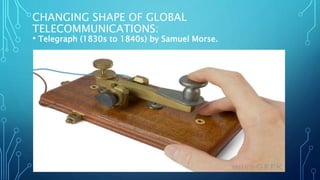
• Telegraph (1830s to 1840s) by Samuel Morse.
CHANGING SHAPE OF GLOBAL
TELECOMMUNICATIONS:
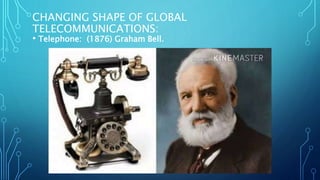
• Telephone: (1876) Graham Bell.
CHANGING SHAPE OF GLOBAL
TELECOMMUNICATIONS:
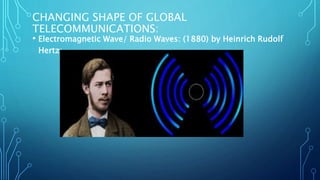
• Electromagnetic Wave/ Radio Waves: (1880) by Heinrich Rudolf
Hertz:
CHANGING SHAPE OF GLOBAL
TELECOMMUNICATIONS:
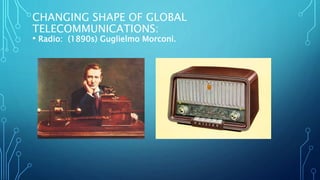
• Radio: (1890s) Guglielmo Morconi.
CHANGING SHAPE OF GLOBAL
TELECOMMUNICATIONS:
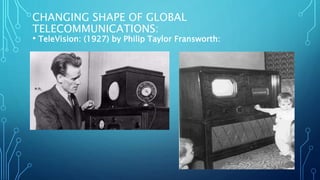
• TeleVision: (1927) by Philip Taylor Fransworth:
CHANGING SHAPE OF GLOBAL
TELECOMMUNICATIONS:
• Satellite: (1880) by Galileo Galilei:
• First Communication Satellite by Arther C Clark. (1954) Wireless
World.
• First ever Satellite launched on October 4, 1957 by Soviet
Union (Sputnik-1).
CHANGING SHAPE OF GLOBAL
TELECOMMUNICATIONS:
• Internet:
• Started in 1960s.
• ARPANET was the first de-centralized Network in 1969.
• Introduction of Email 1975.
• Hypertext language Tim Berners Lee (1989).
• Client browser Software (World Wide Web) 1991.
• Microsoft Window browser explorer 1995.
• Widely used among business and public elites in Western Societies by
mid 1990s.
CHANGING SHAPE OF GLOBAL
TELECOMMUNICATIONS:
• Definition:
Telecommunications has allowed a virtual world to emerge—one
in which time and distance no longer represent a barrier to doing
business or communicating—but we were lacking something that was a
critical part of the human information-processing realm. The human
mind acts on physical sensations in the course of its information
processing; the senses of sight, sound, touch, and motion are key to
our perception and decision making. Developments in sensory
technologies and networks will allow a new genre of sensory reality to
emerge, bridging the gap between humans and machines. One of the
most significant evolutions occurring in computing and
communications is the introduction of the human senses into
electronic information streams.
CHANGING SHAPE OF GLOBAL
TELECOMMUNICATIONS:
• Alternative Public Sphere.
• Almost Free from rules and regulations even.
• Every one has free access to information.
• Decreasing the knowledge Gap to some extent.
• Instant Communication.
• Enhancing the life standards.
Technology Diffusion, Internet and Global Technological Organization

Technology Diffusion, Internet and Global Technological Organization

  • 1.
    TECHNOLOGY DIFFUSION, CHANGING SHAPEOF GLOBAL TELECOMMUNICATIONS PRESENTED BY: NAUMAN KHAN ASSIGNED BY: SIR RAMZAN AZHAR
  • 2.
    TECHNOLOGY DIFFUSION • Definition: Thewidespread adoption and use of a particular technology. Broad term explaining diffusion of all kinds of newly emerged technologies which are gradually adopted by societies. It is strictly associated with time, communication channels, learning abilities of people that gain access to new technology. Technological diffusion is defined widely as the process by which the market for a new technology changes over time and from which production and usage patterns of new products and production processes result.
  • 3.
    TECHNOLOGY DIFFUSION • TheoreticalBackground: • Diffusion of Innovation Theory: (DOI): Developed by E.M.Rogers 1962:- • It originated in communication to explain how, over time, an idea or product gains momentum and diffuses (or spreads) through a specific population or social system. The end result of this diffusion is that people, as part of a social system, adopt a new idea, behavior, or product. • Five established adopter categories: 1. Innovators, 2. Early Adopters, 3. Early Majority, 4. Late Majority, 5. Laggards.
  • 4.
    CHANGING SHAPE OFGLOBAL TELECOMMUNICATIONS: • Telegraph (1830s to 1840s) by Samuel Morse.
  • 5.
    CHANGING SHAPE OFGLOBAL TELECOMMUNICATIONS: • Telephone: (1876) Graham Bell.
  • 6.
    CHANGING SHAPE OFGLOBAL TELECOMMUNICATIONS: • Electromagnetic Wave/ Radio Waves: (1880) by Heinrich Rudolf Hertz:
  • 7.
    CHANGING SHAPE OFGLOBAL TELECOMMUNICATIONS: • Radio: (1890s) Guglielmo Morconi.
  • 8.
    CHANGING SHAPE OFGLOBAL TELECOMMUNICATIONS: • TeleVision: (1927) by Philip Taylor Fransworth:
  • 9.
    CHANGING SHAPE OFGLOBAL TELECOMMUNICATIONS: • Satellite: (1880) by Galileo Galilei: • First Communication Satellite by Arther C Clark. (1954) Wireless World. • First ever Satellite launched on October 4, 1957 by Soviet Union (Sputnik-1).
  • 10.
    CHANGING SHAPE OFGLOBAL TELECOMMUNICATIONS: • Internet: • Started in 1960s. • ARPANET was the first de-centralized Network in 1969. • Introduction of Email 1975. • Hypertext language Tim Berners Lee (1989). • Client browser Software (World Wide Web) 1991. • Microsoft Window browser explorer 1995. • Widely used among business and public elites in Western Societies by mid 1990s.
  • 11.
    CHANGING SHAPE OFGLOBAL TELECOMMUNICATIONS: • Definition: Telecommunications has allowed a virtual world to emerge—one in which time and distance no longer represent a barrier to doing business or communicating—but we were lacking something that was a critical part of the human information-processing realm. The human mind acts on physical sensations in the course of its information processing; the senses of sight, sound, touch, and motion are key to our perception and decision making. Developments in sensory technologies and networks will allow a new genre of sensory reality to emerge, bridging the gap between humans and machines. One of the most significant evolutions occurring in computing and communications is the introduction of the human senses into electronic information streams.
  • 12.
    CHANGING SHAPE OFGLOBAL TELECOMMUNICATIONS: • Alternative Public Sphere. • Almost Free from rules and regulations even. • Every one has free access to information. • Decreasing the knowledge Gap to some extent. • Instant Communication. • Enhancing the life standards.