WEEK 10 – PUBLISHING AND CONSUMPTION  BINDING TIME IN DIGITAL CIVILISATIONS: RE-EVALUATING INNIS AFTER NEW MEDIA Chris Chesner –Digital Cultures, The University of Sydney
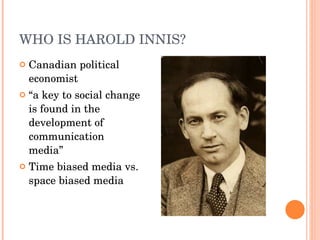
WHO IS HAROLD INNIS? Canadian political economist  “ a key to social change is found in the development of communication media”   Time biased media vs. space biased media
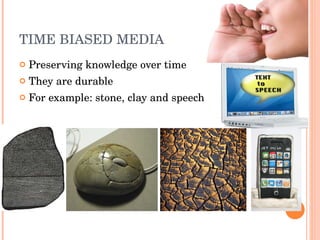
TIME BIASED MEDIA Preserving knowledge over time They are durable For example: stone, clay and speech
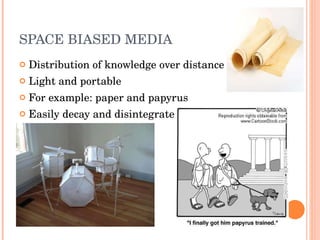
SPACE BIASED MEDIA Distribution of knowledge over distance Light and portable For example: paper and papyrus Easily decay and disintegrate
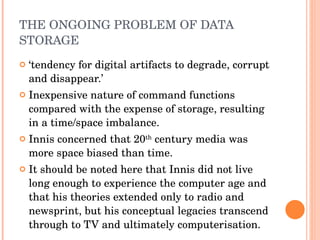
THE ONGOING PROBLEM OF DATA STORAGE ‘ tendency for digital artifacts to degrade, corrupt and disappear.’  Inexpensive nature of command functions compared with the expense of storage, resulting in a time/space imbalance. Innis concerned that 20 th  century media was more space biased than time. It should be noted here that Innis did not live long enough to experience the computer age and that his theories extended only to radio and newsprint, but his conceptual legacies transcend through to TV and ultimately computerisation.
DATA STORAGE AND ARCHIVING Innis did live long enough to experience Alan Turing’s 1936 theories of computerized memory devices that automatically recalled memory that could be written, read and erased . a digital “stream of consciousness” - fast memory being very expansive & thus the splitting of main memory and storage that still exists today .
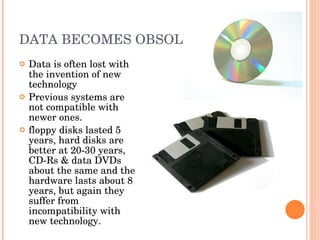
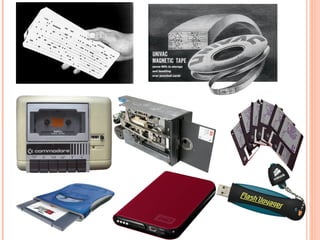
DATA BECOMES OBSOLETE  Data is often lost with the invention of new technology Previous systems are not compatible with newer ones. floppy disks lasted 5 years, hard disks are better at 20-30 years, CD-Rs & data DVDs about the same and the hardware lasts about 8 years, but again they suffer from incompatibility with new technology.
THE DIGITAL DARK AGE ‘ Our cultural legacy would be lost to the fragility of digital records.’  Language and genre also played a significant role. Whereby hieroglyphics were symbolic & pictographic, it enshrined a centralised authority with religious backing, the development of writing was more secular but became entrenched in religious groups, so too computer language became, initially for the specialists in a type of binary coded mystification. ‘ The diversity of standards and the frequency of upgrades are major culprits in the “digital dark ages scenarios”’.
 
WHAT INNIS WOULD HAVE THOUGHT ABOUT TODAY  Facebook and Twitter whereby people are asked to do what they are doing NOW, status updates and their availability to ‘chat’ being projected out into the Internet network.
http://www.youtube.com/watch?v=T65XnegbEo0 http://www.youtube.com/watch?v=6jpJNwC3NqY
QUESTIONS So is digital media time or space biased? If time based media concentrates on enduring examples and spaced biased on portability how can we look at the internet and web?

Week10presentation

  • 1.
    WEEK 10 –PUBLISHING AND CONSUMPTION BINDING TIME IN DIGITAL CIVILISATIONS: RE-EVALUATING INNIS AFTER NEW MEDIA Chris Chesner –Digital Cultures, The University of Sydney
  • 2.
    WHO IS HAROLDINNIS? Canadian political economist “ a key to social change is found in the development of communication media” Time biased media vs. space biased media
  • 3.
    TIME BIASED MEDIAPreserving knowledge over time They are durable For example: stone, clay and speech
  • 4.
    SPACE BIASED MEDIADistribution of knowledge over distance Light and portable For example: paper and papyrus Easily decay and disintegrate
  • 5.
    THE ONGOING PROBLEMOF DATA STORAGE ‘ tendency for digital artifacts to degrade, corrupt and disappear.’ Inexpensive nature of command functions compared with the expense of storage, resulting in a time/space imbalance. Innis concerned that 20 th century media was more space biased than time. It should be noted here that Innis did not live long enough to experience the computer age and that his theories extended only to radio and newsprint, but his conceptual legacies transcend through to TV and ultimately computerisation.
  • 6.
    DATA STORAGE ANDARCHIVING Innis did live long enough to experience Alan Turing’s 1936 theories of computerized memory devices that automatically recalled memory that could be written, read and erased . a digital “stream of consciousness” - fast memory being very expansive & thus the splitting of main memory and storage that still exists today .
  • 7.
    DATA BECOMES OBSOLETE Data is often lost with the invention of new technology Previous systems are not compatible with newer ones. floppy disks lasted 5 years, hard disks are better at 20-30 years, CD-Rs & data DVDs about the same and the hardware lasts about 8 years, but again they suffer from incompatibility with new technology.
  • 8.
    THE DIGITAL DARKAGE ‘ Our cultural legacy would be lost to the fragility of digital records.’ Language and genre also played a significant role. Whereby hieroglyphics were symbolic & pictographic, it enshrined a centralised authority with religious backing, the development of writing was more secular but became entrenched in religious groups, so too computer language became, initially for the specialists in a type of binary coded mystification. ‘ The diversity of standards and the frequency of upgrades are major culprits in the “digital dark ages scenarios”’.
  • 9.
  • 10.
    WHAT INNIS WOULDHAVE THOUGHT ABOUT TODAY Facebook and Twitter whereby people are asked to do what they are doing NOW, status updates and their availability to ‘chat’ being projected out into the Internet network.
  • 11.
  • 12.
    QUESTIONS So isdigital media time or space biased? If time based media concentrates on enduring examples and spaced biased on portability how can we look at the internet and web?