EN1052Introduction to TelecommunicationsSemester 2 April 2010
EN1052 Introduction to TelecommunicationsCredits2 ( 2 lecture hours per week)Practical work in EN1092Scheme of EvaluationContinuous assessment – 40%  (mid-term test, assignments, quizzes)End of semester examination – 60%Learning ObjectivesThe basic concepts related to communication systemsThe difference between analog and digital communications principlesThe basic aspects of a computer networkThe difference between network topologies and types of networksThe operation of end user equipment in communications.
EN1052 Introduction to TelecommunicationsContents
EN1052 Introduction to TelecommunicationsCourse material will be available in LearnOrg-Moodlehttp://lms.uom.lk/Please enroll yourself as a participant
The big picture….SandInterconnected Systems (Global)World of Telecommunication and  IT (ICT)Systems (With software)Sub Systems (With software/Firmware)World of Electronic AssemblyAssemblies/ModulesSub Assemblies/HybridsPackaged Components(Diodes,Transistors,ICs,….)DiceProcessed WafersBlank Wafers CAD Tools& ProcessingBlank wafersProcessing Silicon           GaAsSemiconductorWorldDistributed nature, in-built intelligenceVery low investment,limited infrastructure and practical training necessaryVery high investment, infrastructure and training necessaryCourtsey: Mr. NihalKularatna, University of Waikat0, New Zealand
What is Telecommunications ?One of the fastest-growing areas of technology in the world. Rapid growthBusinesses and individuals can access information at electronic speed from almost anywhere in the world. Businesses can provide better services and products to their customers.
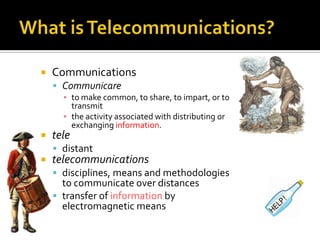
What is Telecommunications?CommunicationsCommunicareto make common, to share, to impart, or to transmitthe activity associated with distributing or exchanging information. teledistanttelecommunicationsdisciplines, means and methodologies to communicate over distancestransfer of information by electromagnetic means
What is Information?Information is created or used in every human and machine activityInformation is distributed or exchanged in communicationInformation needs to be quantifiedInformation in a message is related (inversely) to the probability associated with itThe sun has risen todayThe sun will rise tomorrowThe sun will rise at 5.44 a.m. tomorrow
Historical MilestonesMid 1800s: the telegraph, whereby letters were translated into sounds manually, and vice-versa1857: The Ceylon Telegraph Department is established1858: The fist telegraph circuit established between Galle and Colombo1864:  James Clerk Maxwell predicts the existence of radio waves1864: The International Telegraph Union founded, the precursor to today’s International Telecommunications Union (ITU)1866: The first transatlantic telegraph cable is laid1876: thetelephone is invented1877: first private line telephones installed for business use1800 s
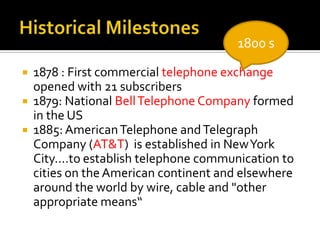
Historical Milestones1878 : First commercial telephone exchange opened with 21 subscribers1879: National Bell Telephone Company formed in the US1885: American Telephone and Telegraph Company (AT&T)  is established in New York City....to establish telephone communication to cities on the American continent and elsewhere around the world by wire, cable and "other appropriate means“1800 s
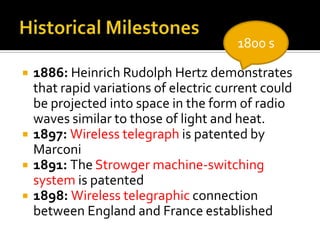
Historical Milestones1886: Heinrich Rudolph Hertz demonstrates that rapid variations of electric current could be projected into space in the form of radio waves similar to those of light and heat.1897: Wireless telegraph is patented by Marconi1891: The Strowger machine-switching system is patented1898: Wireless telegraphic connection between England and France established1800 s
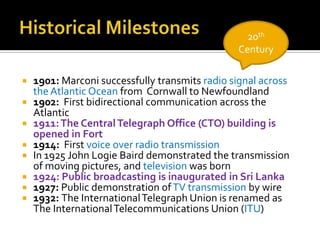
Historical Milestones1901: Marconi successfully transmits radio signal across the Atlantic Ocean from  Cornwall to Newfoundland1902:  First bidirectional communication across the Atlantic1911: The Central Telegraph Office (CTO) building is opened in Fort1914:  First voice over radio transmissionIn 1925 John Logie Baird demonstrated the transmission of moving pictures, and television was born1924: Public broadcasting is inaugurated in Sri Lanka1927: Public demonstration of TV transmission by wire1932: The International Telegraph Union is renamed as The International Telecommunications Union (ITU)20th Century
Historical Milestones20th century:1900: 855,900 telephones in the Bell system1910: 5,883,0001920: 15,000,0001948: 30,000,0001956: 50,000,0001971: 100,000,00020th Century
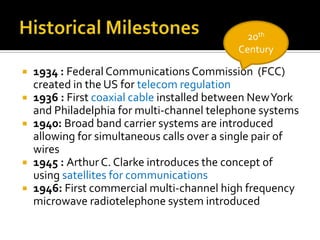
Historical Milestones1934 : Federal Communications Commission  (FCC) created in the US for telecom regulation1936 : First coaxial cable installed between New York and Philadelphia for multi-channel telephone systems1940: Broad band carrier systems are introduced allowing for simultaneous calls over a single pair of wires1945 : Arthur C. Clarke introduces the concept of using satellites for communications1946: First commercial multi-channel high frequency microwave radiotelephone system introduced20th Century
Historical Milestones20th Century1960 : Bell Laboratories demonstrates a trans-US telephone call by bouncing signals off the moon1948: First public demonstration of the transistor by Bell Telephone Laboratories1949 : The ITU becomes a member of the United Nations family of organizations 1955 : Initial trial installation of an  electronic switch1956:  First transatlantic cable goes into service with 36 channels between Newfoundland and Scotland
Historical Milestones20th Century1962:world’s first international telecommunications satellite, Telstar is launched160 million telephones worldwideINTELSAT formed with 11 participating countries1965: The first commercial communications satellite, Early Bird, is launched from Cape Kennedy with 240 telephone circuitsThe first Soviet communications satellite, Molniya 1 is launched. This carries out transmissions of television programsThe first  commercial electronic switching office goes into operation
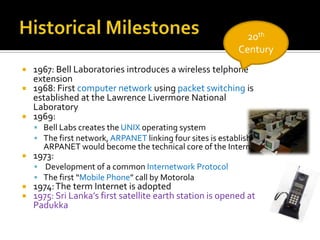
Historical Milestones20th Century1967: Bell Laboratories introduces a wireless telphone extension1968: First computer network using packet switching is established at the Lawrence Livermore National Laboratory1969: Bell Labs creates the UNIX operating systemThe first network, ARPANET linking four sites is established . ARPANET would become the technical core of the Internet1973: Development of a common Internetwork ProtocolThe first “Mobile Phone” call by Motorola1974: The term Internet is adopted1975: Sri Lanka’s first satellite earth station is opened at Padukka
Historical Milestones20th Century1976 : AT&T installs its first digital switch.1978: Field trials of the first cellular system, AMPS1980: International Direct Dialling (IDD) is established in Sri Lanka1983:The fist cellular system goes into operation in the US.1 million subscribers by 1987UN declares the year as the  World Communications Year1985: Sri Lanka subscribes to the SEA-ME-WE submarine cable1986: First optical fiber cable is laid in Sri Lanka1984:The AT&T Divestiture creates seven (7) regional Bell operating companies.1987:  GSM, the first digital cellular system Standard is made available
Historical Milestones20th Century1988 :The first transatlantic fiber optic cable is installed between USA and England/France with 40, 000 channelsThe first cellular license is issued in Sri Lanka1991  Bell Labs develops photonic switchingThe first US digital cellular system introduced 1992 – US introduces the first CDMA-based digital cellular system introduced1993 – The first digital mobile network is established in the U.S.	The first web browser, Mosaic, is introduced
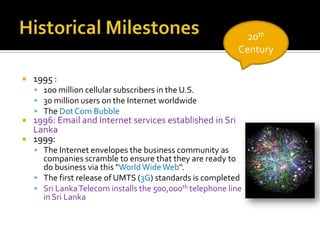
Historical Milestones20th Century1995 :100 million cellular subscribers in the U.S.30 million users on the Internet worldwideThe Dot Com Bubble1996: Email and Internet services established in Sri Lanka1999: The Internet envelopes the business community as companies scramble to ensure that they are ready to do business via this "World Wide Web". The first release of UMTS (3G) standards is completedSri Lanka Telecom installs the 500,000th telephone line in Sri Lanka
Historical Milestones20th Century2000: Financial disaster for many so called "dot com" companies as venture capital and high stock prices dry up resulting in layoffs, bankruptcies (dot com  bubble burst)World’s first 3G/UMTS call2001: NTT DoCoMo launches the first commercial WCDMA 3G mobile network9/11 attacks demonstrated the resilience of the telecom infrastructure2002:SK Telecom in Korea launches the world's first commercial CDMA2000 3G networkMobilkom Austria launches Europe's First UMTS-Network20003:Korean mobile operator KTF announced plans to begin transmitting TV direct to 3G mobile phones via the CDMA2000 system2006:SLT installs 1 millionth telephone line in Sri Lanka
Current statusSubmarine cables of the world
Current StatusCommunications satellites in geostationary orbitSource: http://www.tekjo.com/Geostationary-Communication-Satellites-in-Orbit-Today.htm
Current StatusCellular networks
Current Status: Fixed vs. MobileFixed and Mobile International TrafficSource: ITU
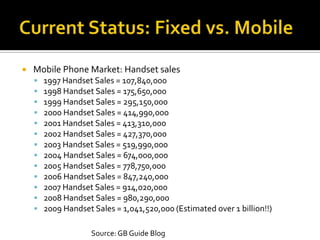
Current Status: Fixed vs. MobileMobile Phone Market: Handset sales1997 Handset Sales = 107,840,0001998 Handset Sales = 175,650,0001999 Handset Sales = 295,150,0002000 Handset Sales = 414,990,0002001 Handset Sales = 413,310,0002002 Handset Sales = 427,370,0002003 Handset Sales = 519,990,0002004 Handset Sales = 674,000,0002005 Handset Sales = 778,750,0002006 Handset Sales = 847,240,0002007 Handset Sales = 914,020,0002008 Handset Sales = 980,290,0002009 Handset Sales = 1,041,520,000 (Estimated over 1 billion!!)Source: GB Guide Blog
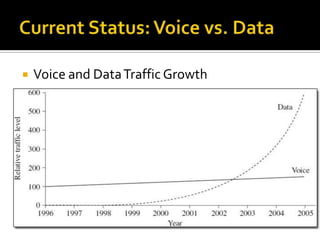
Current Status: Voice vs. DataVoice and Data Traffic Growth
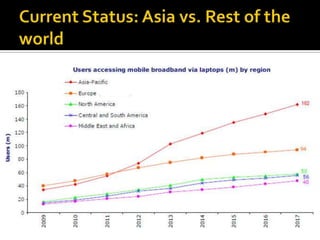
Current Status: Asia vs. Rest of the world
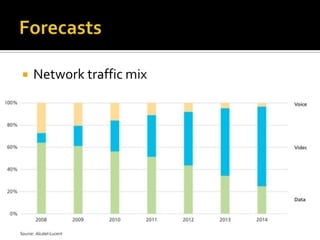
ForecastsNetwork traffic mix
…………But….
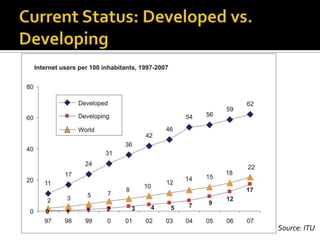
Current Status: Developed vs. DevelopingSource: ITU
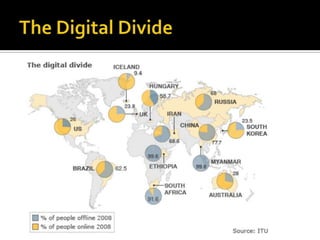
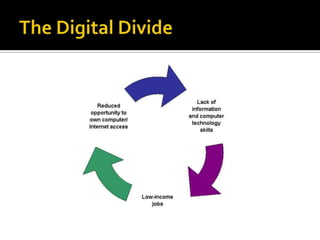
The Digital Divide"The term 'digital divide' describes the fact that the world can be divided into people who do and people who don't have access to - and the capability to use - modern information technologyTelephoneTelevision InternetThe digital divide exists between those in cities and those in rural areasthe educated and the uneducatedeconomic classesandglobally, between the more and less industrially developed nations"(Whatis?com, 1999)
The Digital Divide
The Digital Divide
Current Status: Sri LankaService ProvidersSource: TRCSL
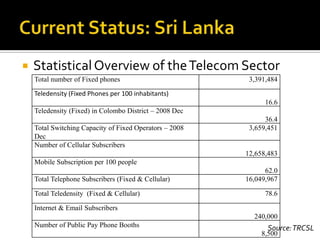
Current Status: Sri LankaStatistical Overview of the Telecom SectorSource: TRCSL
Current Status: Sri LankaFixed Access Subscriber GrowthSource: TRCSL
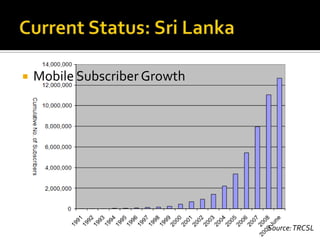
Current Status: Sri LankaMobile Subscriber GrowthSource: TRCSL
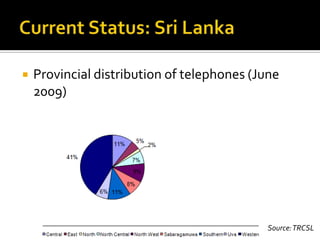
Current Status: Sri LankaProvincial distribution of telephones (June 2009)Source: TRCSL
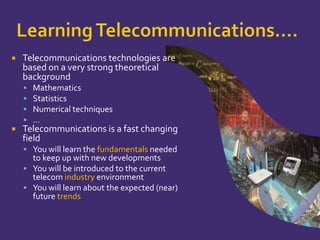
Learning Telecommunications….Telecommunications technologies are based on a very strong theoretical backgroundMathematicsStatisticsNumerical techniques…Telecommunications is a fast changing fieldYou will learn the fundamentalsneeded to keep up with new developmentsYou will be introduced to the current telecom industry environmentYou will learn about the expected (near) future trends
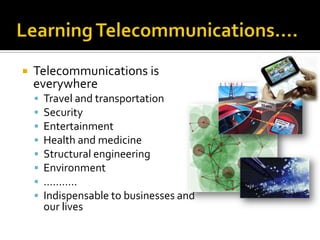
Telecommunications is everywhereTravel and transportationSecurityEntertainmentHealth and medicineStructural engineeringEnvironment………..Indispensable to businesses and our livesLearning Telecommunications….
Opportunities for you….Employment as telecom engineersInnovation and self-employmentPostgraduate study and researchBuild a bridge across the digital divide

1 introduction to telecom.pptx

  • 1.
  • 2.
    EN1052 Introduction toTelecommunicationsCredits2 ( 2 lecture hours per week)Practical work in EN1092Scheme of EvaluationContinuous assessment – 40% (mid-term test, assignments, quizzes)End of semester examination – 60%Learning ObjectivesThe basic concepts related to communication systemsThe difference between analog and digital communications principlesThe basic aspects of a computer networkThe difference between network topologies and types of networksThe operation of end user equipment in communications.
  • 3.
    EN1052 Introduction toTelecommunicationsContents
  • 4.
    EN1052 Introduction toTelecommunicationsCourse material will be available in LearnOrg-Moodlehttp://lms.uom.lk/Please enroll yourself as a participant
  • 5.
    The big picture….SandInterconnectedSystems (Global)World of Telecommunication and IT (ICT)Systems (With software)Sub Systems (With software/Firmware)World of Electronic AssemblyAssemblies/ModulesSub Assemblies/HybridsPackaged Components(Diodes,Transistors,ICs,….)DiceProcessed WafersBlank Wafers CAD Tools& ProcessingBlank wafersProcessing Silicon GaAsSemiconductorWorldDistributed nature, in-built intelligenceVery low investment,limited infrastructure and practical training necessaryVery high investment, infrastructure and training necessaryCourtsey: Mr. NihalKularatna, University of Waikat0, New Zealand
  • 6.
    What is Telecommunications?One of the fastest-growing areas of technology in the world. Rapid growthBusinesses and individuals can access information at electronic speed from almost anywhere in the world. Businesses can provide better services and products to their customers.
  • 7.
    What is Telecommunications?CommunicationsCommunicaretomake common, to share, to impart, or to transmitthe activity associated with distributing or exchanging information. teledistanttelecommunicationsdisciplines, means and methodologies to communicate over distancestransfer of information by electromagnetic means
  • 8.
    What is Information?Informationis created or used in every human and machine activityInformation is distributed or exchanged in communicationInformation needs to be quantifiedInformation in a message is related (inversely) to the probability associated with itThe sun has risen todayThe sun will rise tomorrowThe sun will rise at 5.44 a.m. tomorrow
  • 9.
    Historical MilestonesMid 1800s:the telegraph, whereby letters were translated into sounds manually, and vice-versa1857: The Ceylon Telegraph Department is established1858: The fist telegraph circuit established between Galle and Colombo1864: James Clerk Maxwell predicts the existence of radio waves1864: The International Telegraph Union founded, the precursor to today’s International Telecommunications Union (ITU)1866: The first transatlantic telegraph cable is laid1876: thetelephone is invented1877: first private line telephones installed for business use1800 s
  • 10.
    Historical Milestones1878 :First commercial telephone exchange opened with 21 subscribers1879: National Bell Telephone Company formed in the US1885: American Telephone and Telegraph Company (AT&T) is established in New York City....to establish telephone communication to cities on the American continent and elsewhere around the world by wire, cable and "other appropriate means“1800 s
  • 11.
    Historical Milestones1886: HeinrichRudolph Hertz demonstrates that rapid variations of electric current could be projected into space in the form of radio waves similar to those of light and heat.1897: Wireless telegraph is patented by Marconi1891: The Strowger machine-switching system is patented1898: Wireless telegraphic connection between England and France established1800 s
  • 12.
    Historical Milestones1901: Marconisuccessfully transmits radio signal across the Atlantic Ocean from Cornwall to Newfoundland1902: First bidirectional communication across the Atlantic1911: The Central Telegraph Office (CTO) building is opened in Fort1914: First voice over radio transmissionIn 1925 John Logie Baird demonstrated the transmission of moving pictures, and television was born1924: Public broadcasting is inaugurated in Sri Lanka1927: Public demonstration of TV transmission by wire1932: The International Telegraph Union is renamed as The International Telecommunications Union (ITU)20th Century
  • 13.
    Historical Milestones20th century:1900:855,900 telephones in the Bell system1910: 5,883,0001920: 15,000,0001948: 30,000,0001956: 50,000,0001971: 100,000,00020th Century
  • 14.
    Historical Milestones1934 :Federal Communications Commission (FCC) created in the US for telecom regulation1936 : First coaxial cable installed between New York and Philadelphia for multi-channel telephone systems1940: Broad band carrier systems are introduced allowing for simultaneous calls over a single pair of wires1945 : Arthur C. Clarke introduces the concept of using satellites for communications1946: First commercial multi-channel high frequency microwave radiotelephone system introduced20th Century
  • 15.
    Historical Milestones20th Century1960: Bell Laboratories demonstrates a trans-US telephone call by bouncing signals off the moon1948: First public demonstration of the transistor by Bell Telephone Laboratories1949 : The ITU becomes a member of the United Nations family of organizations 1955 : Initial trial installation of an electronic switch1956: First transatlantic cable goes into service with 36 channels between Newfoundland and Scotland
  • 16.
    Historical Milestones20th Century1962:world’sfirst international telecommunications satellite, Telstar is launched160 million telephones worldwideINTELSAT formed with 11 participating countries1965: The first commercial communications satellite, Early Bird, is launched from Cape Kennedy with 240 telephone circuitsThe first Soviet communications satellite, Molniya 1 is launched. This carries out transmissions of television programsThe first commercial electronic switching office goes into operation
  • 17.
    Historical Milestones20th Century1967:Bell Laboratories introduces a wireless telphone extension1968: First computer network using packet switching is established at the Lawrence Livermore National Laboratory1969: Bell Labs creates the UNIX operating systemThe first network, ARPANET linking four sites is established . ARPANET would become the technical core of the Internet1973: Development of a common Internetwork ProtocolThe first “Mobile Phone” call by Motorola1974: The term Internet is adopted1975: Sri Lanka’s first satellite earth station is opened at Padukka
  • 18.
    Historical Milestones20th Century1976: AT&T installs its first digital switch.1978: Field trials of the first cellular system, AMPS1980: International Direct Dialling (IDD) is established in Sri Lanka1983:The fist cellular system goes into operation in the US.1 million subscribers by 1987UN declares the year as the World Communications Year1985: Sri Lanka subscribes to the SEA-ME-WE submarine cable1986: First optical fiber cable is laid in Sri Lanka1984:The AT&T Divestiture creates seven (7) regional Bell operating companies.1987: GSM, the first digital cellular system Standard is made available
  • 19.
    Historical Milestones20th Century1988:The first transatlantic fiber optic cable is installed between USA and England/France with 40, 000 channelsThe first cellular license is issued in Sri Lanka1991 Bell Labs develops photonic switchingThe first US digital cellular system introduced 1992 – US introduces the first CDMA-based digital cellular system introduced1993 – The first digital mobile network is established in the U.S. The first web browser, Mosaic, is introduced
  • 20.
    Historical Milestones20th Century1995:100 million cellular subscribers in the U.S.30 million users on the Internet worldwideThe Dot Com Bubble1996: Email and Internet services established in Sri Lanka1999: The Internet envelopes the business community as companies scramble to ensure that they are ready to do business via this "World Wide Web". The first release of UMTS (3G) standards is completedSri Lanka Telecom installs the 500,000th telephone line in Sri Lanka
  • 21.
    Historical Milestones20th Century2000:Financial disaster for many so called "dot com" companies as venture capital and high stock prices dry up resulting in layoffs, bankruptcies (dot com bubble burst)World’s first 3G/UMTS call2001: NTT DoCoMo launches the first commercial WCDMA 3G mobile network9/11 attacks demonstrated the resilience of the telecom infrastructure2002:SK Telecom in Korea launches the world's first commercial CDMA2000 3G networkMobilkom Austria launches Europe's First UMTS-Network20003:Korean mobile operator KTF announced plans to begin transmitting TV direct to 3G mobile phones via the CDMA2000 system2006:SLT installs 1 millionth telephone line in Sri Lanka
  • 22.
  • 23.
    Current StatusCommunications satellitesin geostationary orbitSource: http://www.tekjo.com/Geostationary-Communication-Satellites-in-Orbit-Today.htm
  • 24.
  • 25.
    Current Status: Fixedvs. MobileFixed and Mobile International TrafficSource: ITU
  • 26.
    Current Status: Fixedvs. MobileMobile Phone Market: Handset sales1997 Handset Sales = 107,840,0001998 Handset Sales = 175,650,0001999 Handset Sales = 295,150,0002000 Handset Sales = 414,990,0002001 Handset Sales = 413,310,0002002 Handset Sales = 427,370,0002003 Handset Sales = 519,990,0002004 Handset Sales = 674,000,0002005 Handset Sales = 778,750,0002006 Handset Sales = 847,240,0002007 Handset Sales = 914,020,0002008 Handset Sales = 980,290,0002009 Handset Sales = 1,041,520,000 (Estimated over 1 billion!!)Source: GB Guide Blog
  • 27.
    Current Status: Voicevs. DataVoice and Data Traffic Growth
  • 28.
    Current Status: Asiavs. Rest of the world
  • 29.
  • 30.
  • 31.
    Current Status: Developedvs. DevelopingSource: ITU
  • 32.
    The Digital Divide"Theterm 'digital divide' describes the fact that the world can be divided into people who do and people who don't have access to - and the capability to use - modern information technologyTelephoneTelevision InternetThe digital divide exists between those in cities and those in rural areasthe educated and the uneducatedeconomic classesandglobally, between the more and less industrially developed nations"(Whatis?com, 1999)
  • 33.
  • 34.
  • 35.
    Current Status: SriLankaService ProvidersSource: TRCSL
  • 36.
    Current Status: SriLankaStatistical Overview of the Telecom SectorSource: TRCSL
  • 37.
    Current Status: SriLankaFixed Access Subscriber GrowthSource: TRCSL
  • 38.
    Current Status: SriLankaMobile Subscriber GrowthSource: TRCSL
  • 39.
    Current Status: SriLankaProvincial distribution of telephones (June 2009)Source: TRCSL
  • 40.
    Learning Telecommunications….Telecommunications technologiesare based on a very strong theoretical backgroundMathematicsStatisticsNumerical techniques…Telecommunications is a fast changing fieldYou will learn the fundamentalsneeded to keep up with new developmentsYou will be introduced to the current telecom industry environmentYou will learn about the expected (near) future trends
  • 41.
    Telecommunications is everywhereTraveland transportationSecurityEntertainmentHealth and medicineStructural engineeringEnvironment………..Indispensable to businesses and our livesLearning Telecommunications….
  • 42.
    Opportunities for you….Employmentas telecom engineersInnovation and self-employmentPostgraduate study and researchBuild a bridge across the digital divide