What is Communication?
Communication is the activity of conveying information.
The word communication has been derived from the Latin
word ‘communis’, meaning to share. It basically involves
a sender, a message and a receiver.
Communication is giving, receiving or exchanging ideas,
data, information, signals or messages through
appropriate media, enabling individuals or groups to
persuade, to seek information, to give information or to
express emotions.
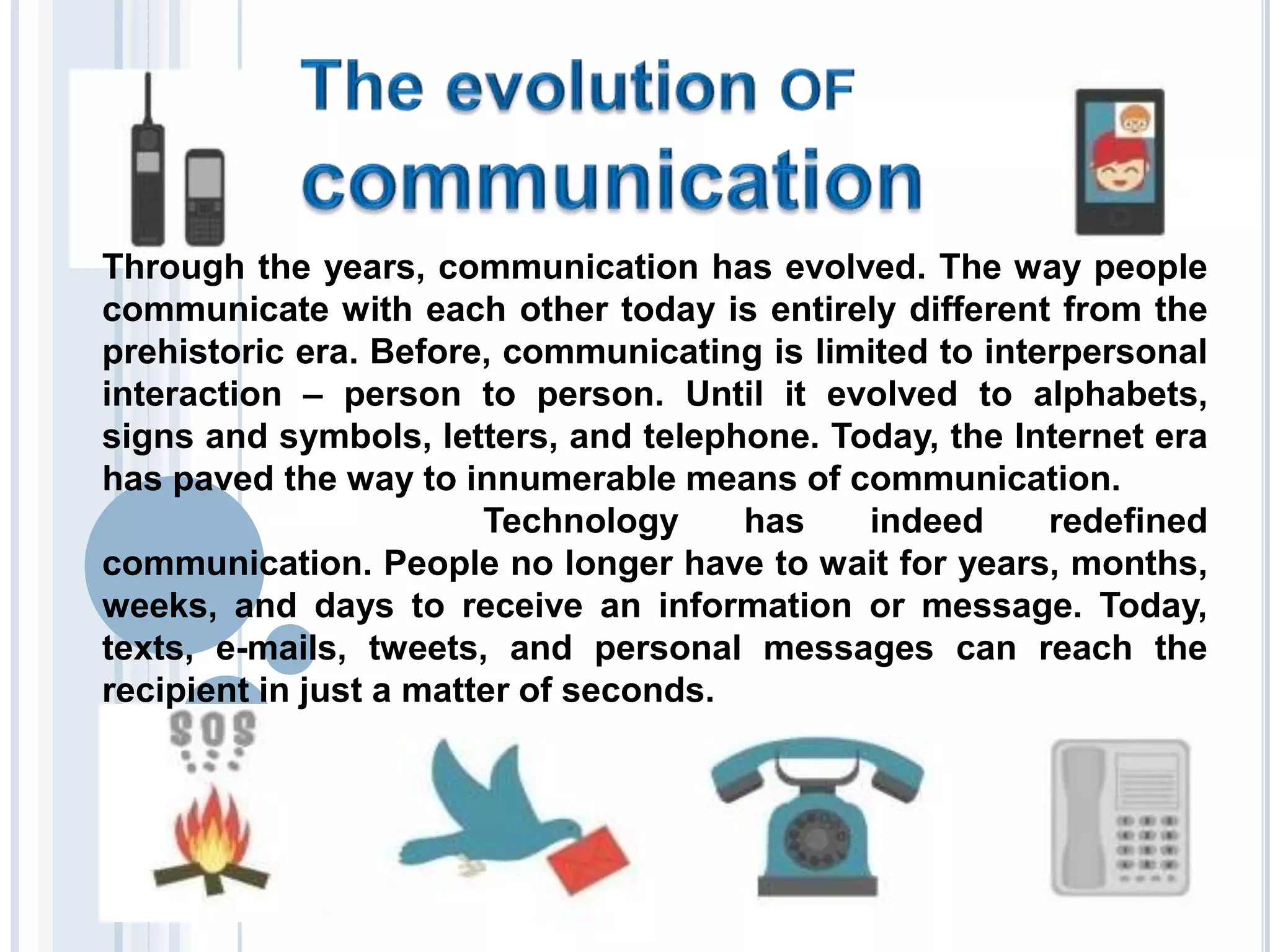
Through the years, communication has evolved. The way people
communicate with each other today is entirely different from the
prehistoric era. Before, communicating is limited to interpersonal
interaction – person to person. Until it evolved to alphabets,
signs and symbols, letters, and telephone. Today, the Internet era
has paved the way to innumerable means of communication.
Technology has indeed redefined
communication. People no longer have to wait for years, months,
weeks, and days to receive an information or message. Today,
texts, e-mails, tweets, and personal messages can reach the
recipient in just a matter of seconds.
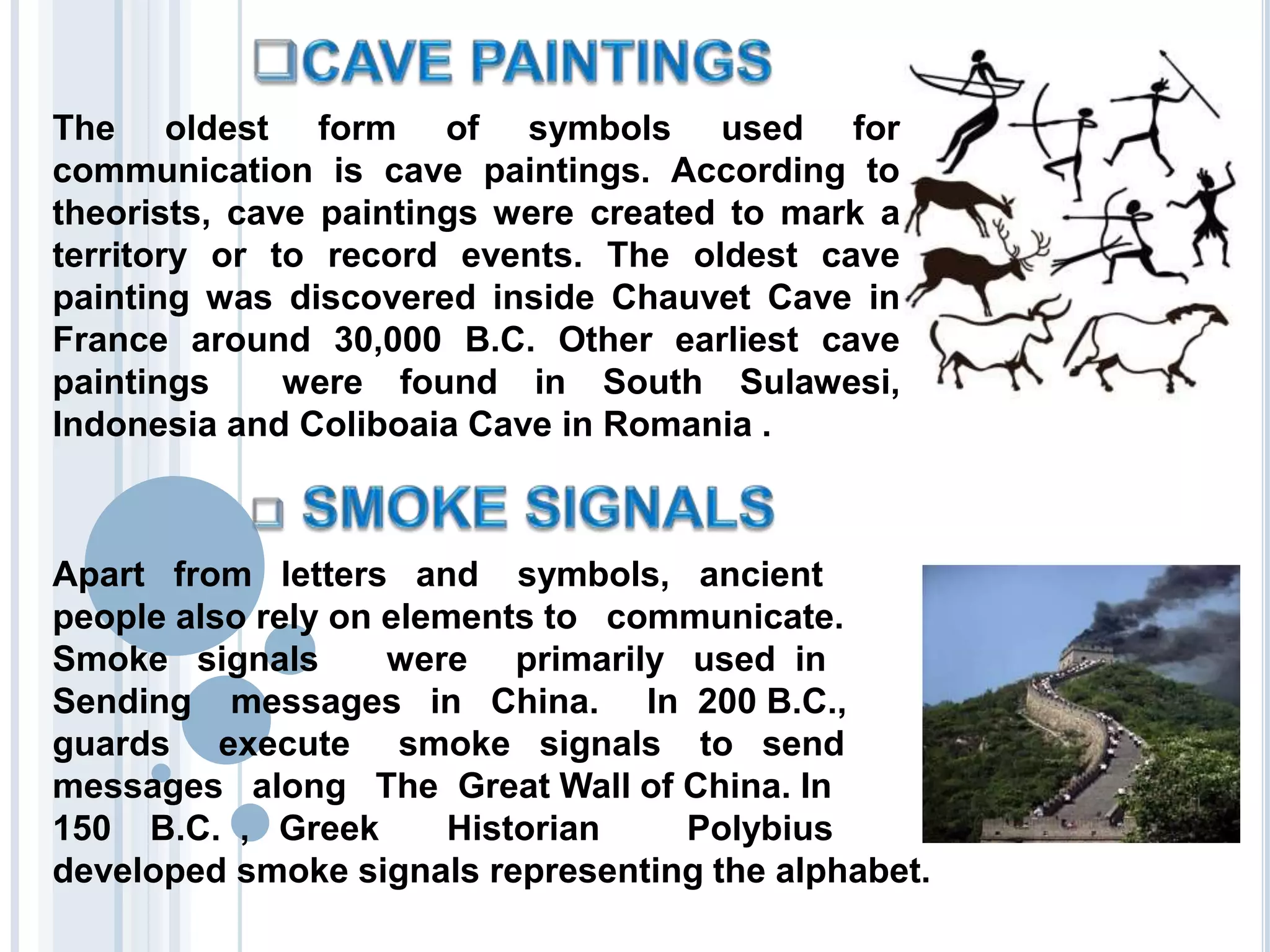
The oldest form of symbols used for
communication is cave paintings. According to
theorists, cave paintings were created to mark a
territory or to record events. The oldest cave
painting was discovered inside Chauvet Cave in
France around 30,000 B.C. Other earliest cave
paintings were found in South Sulawesi,
Indonesia and Coliboaia Cave in Romania .
Apart from letters and symbols, ancient
people also rely on elements to communicate.
Smoke signals were primarily used in
Sending messages in China. In 200 B.C.,
guards execute smoke signals to send
messages along The Great Wall of China. In
150 B.C. , Greek Historian Polybius
developed smoke signals representing the alphabet.
As we all know, pigeons are naturally great with
directions. Over 2,000 years ago, the ancient
Romans used pigeons as primary messengers
between military men. In the 12th century,
messenger pigeons were widely used. According to
Naval chaplain Henry Teonge, merchants used
pigeons as a “postal” service.
During the ancient period, Egyptians used courier
serve to send out decrees in 2,400 B.C. Until now,
a piece of mail which dates back to 255 B.C. is still
preserved. Postal systems were also organized in
Persia, China, India, and Rome before. On the
other hand, it was only in 1653 when Frenchman
De Valaver started a postal system in Paris which
involved the use of mailboxes and delivery of paid
envelope.
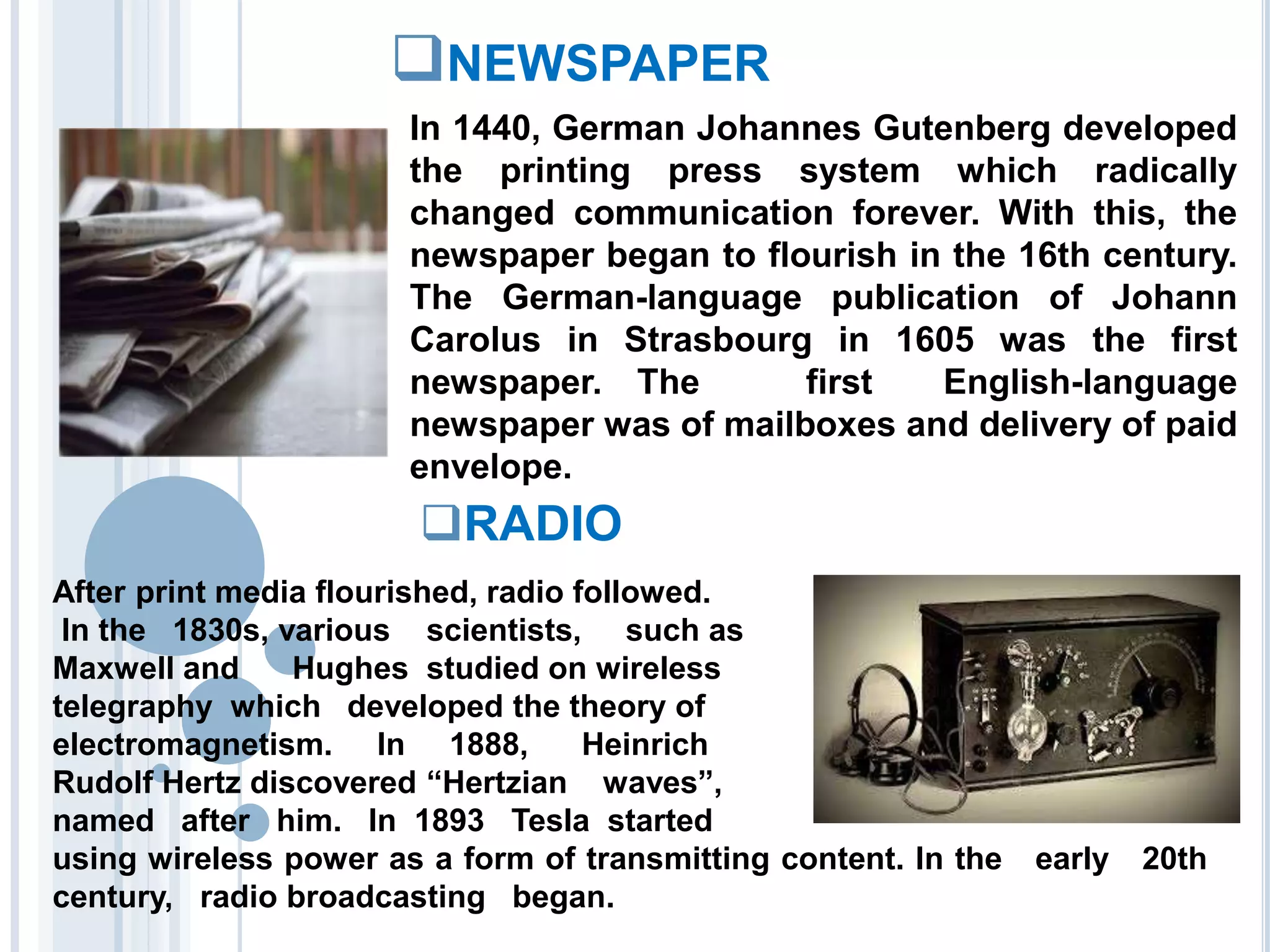
NEWSPAPER
In 1440, German Johannes Gutenberg developed
the printing press system which radically
changed communication forever. With this, the
newspaper began to flourish in the 16th century.
The German-language publication of Johann
Carolus in Strasbourg in 1605 was the first
newspaper. The first English-language
newspaper was of mailboxes and delivery of paid
envelope.
RADIO
After print media flourished, radio followed.
In the 1830s, various scientists, such as
Maxwell and Hughes studied on wireless
telegraphy which developed the theory of
electromagnetism. In 1888, Heinrich
Rudolf Hertz discovered “Hertzian waves”,
named after him. In 1893 Tesla started
using wireless power as a form of transmitting content. In the early 20th
century, radio broadcasting began.
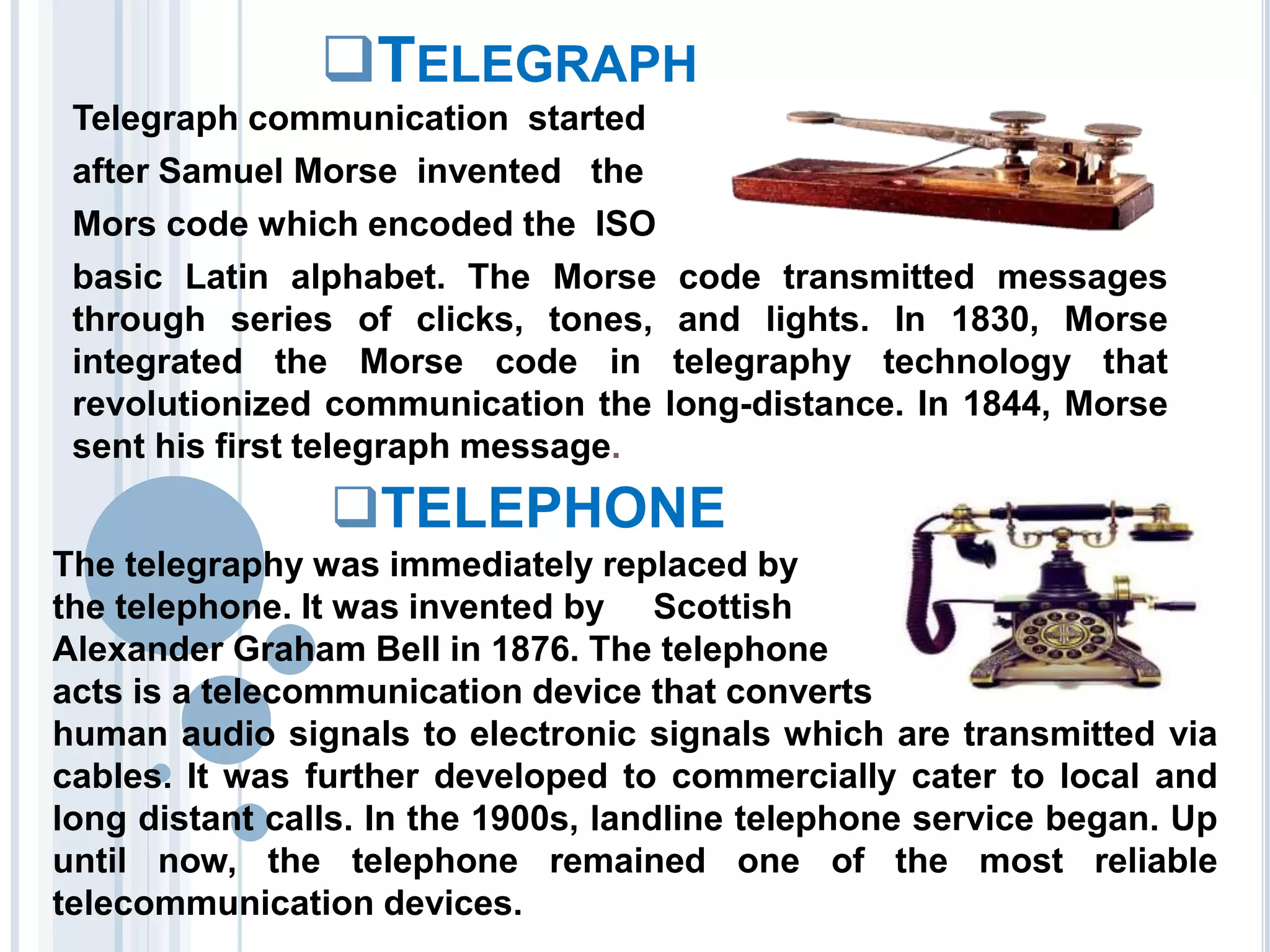
TELEGRAPH
Telegraph communication started
after Samuel Morse invented the
Mors code which encoded the ISO
basic Latin alphabet. The Morse code transmitted messages
through series of clicks, tones, and lights. In 1830, Morse
integrated the Morse code in telegraphy technology that
revolutionized communication the long-distance. In 1844, Morse
sent his first telegraph message.
TELEPHONE
The telegraphy was immediately replaced by
the telephone. It was invented by Scottish
Alexander Graham Bell in 1876. The telephone
acts is a telecommunication device that converts
human audio signals to electronic signals which are transmitted via
cables. It was further developed to commercially cater to local and
long distant calls. In the 1900s, landline telephone service began. Up
until now, the telephone remained one of the most reliable
telecommunication devices.
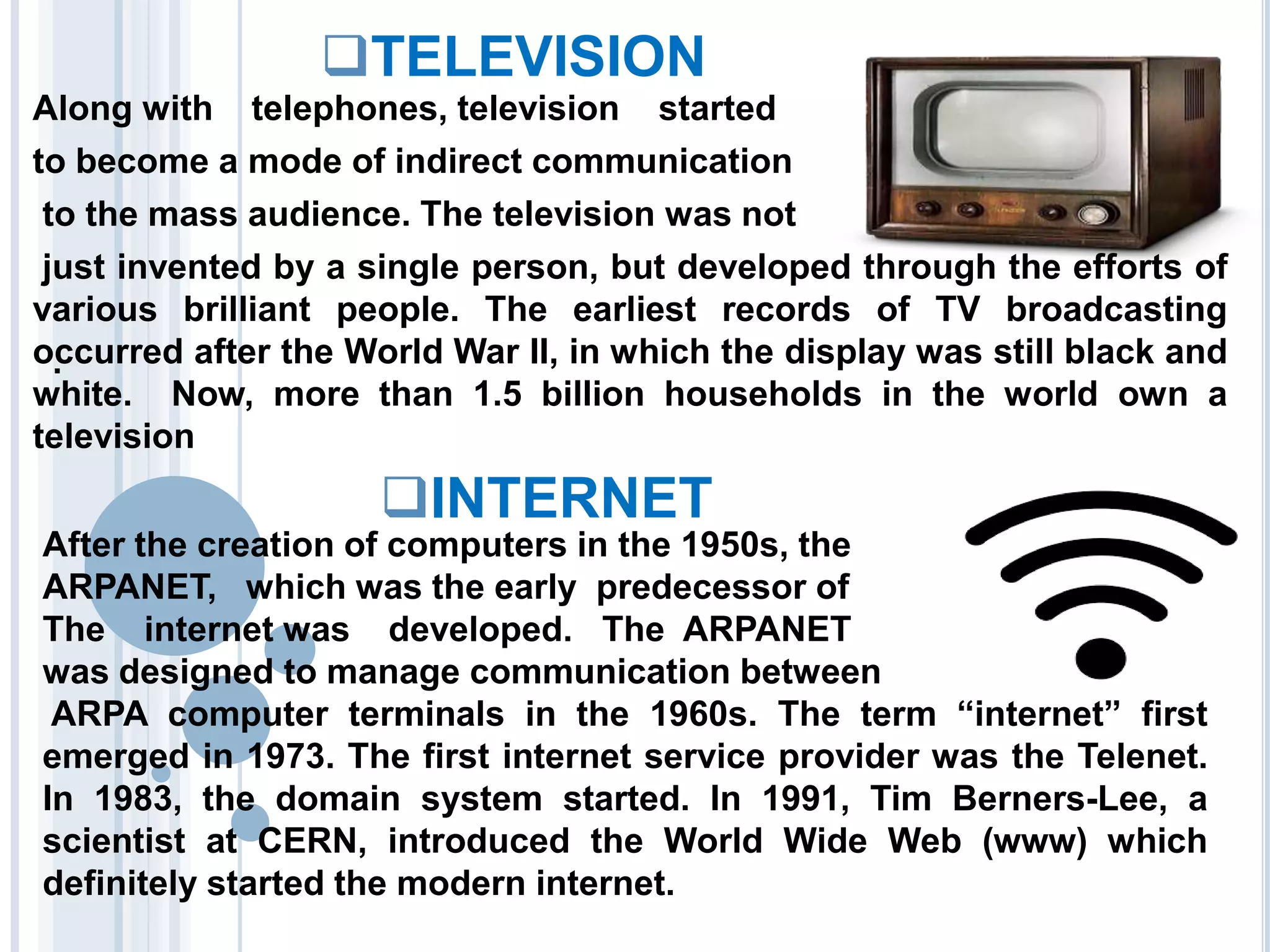
TELEVISION
Along with telephones, television started
to become a mode of indirect communication
to the mass audience. The television was not
just invented by a single person, but developed through the efforts of
various brilliant people. The earliest records of TV broadcasting
occurred after the World War II, in which the display was still black and
white. Now, more than 1.5 billion households in the world own a
television
.
INTERNET
After the creation of computers in the 1950s, the
ARPANET, which was the early predecessor of
The internet was developed. The ARPANET
was designed to manage communication between
ARPA computer terminals in the 1960s. The term “internet” first
emerged in 1973. The first internet service provider was the Telenet.
In 1983, the domain system started. In 1991, Tim Berners-Lee, a
scientist at CERN, introduced the World Wide Web (www) which
definitely started the modern internet.
E-MAIL
With the onset of the internet, electronic mails started
to become popular. Although emails came before the
ARPANET, however, it was “offline”. In 1975, John
Vittal developed a software to organize emails.
From that time, 75% of ARPANET traffic was email. In
1994, Yahoo! was born. It was followed by other
mailing platforms, including Hotmail and Google Mail.
TEXT MESSAGE
The first official SMS messaging took place on
December 3, 1992, when Neil Pap worth, an
Engineer from Sema Group (now Air wide
Solutions) used a computer to send “Merry
Christmas” through the Vodafone network. In
1994, the Radio linja was the first network
service provider to carry out person-to-person text messaging. Now,
SMS has evolved in which over 9 trillion SMS are sent every year.
The latest mode of communication in the digital era is the use of
social media platforms. It has become more available because of
the proliferation of smart phones where social media apps can
easily be installed. In 2004, Facebook was created by Mark
Zuckerberg. Today, the Messenger is one of the most widely
used messaging apps. There are more than two billion Facebook
users worldwide. In 2005, YouTube became the first-ever popular
video hosting social media site. In 2006, Twitter began to
dominate the social media scene. Other social media platforms
have followed.

The evolution of communication

  • 2.
    What is Communication? Communicationis the activity of conveying information. The word communication has been derived from the Latin word ‘communis’, meaning to share. It basically involves a sender, a message and a receiver. Communication is giving, receiving or exchanging ideas, data, information, signals or messages through appropriate media, enabling individuals or groups to persuade, to seek information, to give information or to express emotions.
  • 3.
    Through the years,communication has evolved. The way people communicate with each other today is entirely different from the prehistoric era. Before, communicating is limited to interpersonal interaction – person to person. Until it evolved to alphabets, signs and symbols, letters, and telephone. Today, the Internet era has paved the way to innumerable means of communication. Technology has indeed redefined communication. People no longer have to wait for years, months, weeks, and days to receive an information or message. Today, texts, e-mails, tweets, and personal messages can reach the recipient in just a matter of seconds.
  • 4.
    The oldest formof symbols used for communication is cave paintings. According to theorists, cave paintings were created to mark a territory or to record events. The oldest cave painting was discovered inside Chauvet Cave in France around 30,000 B.C. Other earliest cave paintings were found in South Sulawesi, Indonesia and Coliboaia Cave in Romania . Apart from letters and symbols, ancient people also rely on elements to communicate. Smoke signals were primarily used in Sending messages in China. In 200 B.C., guards execute smoke signals to send messages along The Great Wall of China. In 150 B.C. , Greek Historian Polybius developed smoke signals representing the alphabet.
  • 5.
    As we allknow, pigeons are naturally great with directions. Over 2,000 years ago, the ancient Romans used pigeons as primary messengers between military men. In the 12th century, messenger pigeons were widely used. According to Naval chaplain Henry Teonge, merchants used pigeons as a “postal” service. During the ancient period, Egyptians used courier serve to send out decrees in 2,400 B.C. Until now, a piece of mail which dates back to 255 B.C. is still preserved. Postal systems were also organized in Persia, China, India, and Rome before. On the other hand, it was only in 1653 when Frenchman De Valaver started a postal system in Paris which involved the use of mailboxes and delivery of paid envelope.
  • 6.
    NEWSPAPER In 1440, GermanJohannes Gutenberg developed the printing press system which radically changed communication forever. With this, the newspaper began to flourish in the 16th century. The German-language publication of Johann Carolus in Strasbourg in 1605 was the first newspaper. The first English-language newspaper was of mailboxes and delivery of paid envelope. RADIO After print media flourished, radio followed. In the 1830s, various scientists, such as Maxwell and Hughes studied on wireless telegraphy which developed the theory of electromagnetism. In 1888, Heinrich Rudolf Hertz discovered “Hertzian waves”, named after him. In 1893 Tesla started using wireless power as a form of transmitting content. In the early 20th century, radio broadcasting began.
  • 7.
    TELEGRAPH Telegraph communication started afterSamuel Morse invented the Mors code which encoded the ISO basic Latin alphabet. The Morse code transmitted messages through series of clicks, tones, and lights. In 1830, Morse integrated the Morse code in telegraphy technology that revolutionized communication the long-distance. In 1844, Morse sent his first telegraph message. TELEPHONE The telegraphy was immediately replaced by the telephone. It was invented by Scottish Alexander Graham Bell in 1876. The telephone acts is a telecommunication device that converts human audio signals to electronic signals which are transmitted via cables. It was further developed to commercially cater to local and long distant calls. In the 1900s, landline telephone service began. Up until now, the telephone remained one of the most reliable telecommunication devices.
  • 8.
    TELEVISION Along with telephones,television started to become a mode of indirect communication to the mass audience. The television was not just invented by a single person, but developed through the efforts of various brilliant people. The earliest records of TV broadcasting occurred after the World War II, in which the display was still black and white. Now, more than 1.5 billion households in the world own a television . INTERNET After the creation of computers in the 1950s, the ARPANET, which was the early predecessor of The internet was developed. The ARPANET was designed to manage communication between ARPA computer terminals in the 1960s. The term “internet” first emerged in 1973. The first internet service provider was the Telenet. In 1983, the domain system started. In 1991, Tim Berners-Lee, a scientist at CERN, introduced the World Wide Web (www) which definitely started the modern internet.
  • 9.
    E-MAIL With the onsetof the internet, electronic mails started to become popular. Although emails came before the ARPANET, however, it was “offline”. In 1975, John Vittal developed a software to organize emails. From that time, 75% of ARPANET traffic was email. In 1994, Yahoo! was born. It was followed by other mailing platforms, including Hotmail and Google Mail. TEXT MESSAGE The first official SMS messaging took place on December 3, 1992, when Neil Pap worth, an Engineer from Sema Group (now Air wide Solutions) used a computer to send “Merry Christmas” through the Vodafone network. In 1994, the Radio linja was the first network service provider to carry out person-to-person text messaging. Now, SMS has evolved in which over 9 trillion SMS are sent every year.
  • 10.
    The latest modeof communication in the digital era is the use of social media platforms. It has become more available because of the proliferation of smart phones where social media apps can easily be installed. In 2004, Facebook was created by Mark Zuckerberg. Today, the Messenger is one of the most widely used messaging apps. There are more than two billion Facebook users worldwide. In 2005, YouTube became the first-ever popular video hosting social media site. In 2006, Twitter began to dominate the social media scene. Other social media platforms have followed.