Week 9 Lecture Notes COM325
Personal Connections: chapter 2
Blogging: Chap 2 (pages 50 – 57); chapter 3 (pages 82 - 86)
Everybody Writes: Part Four (pages 160- 178)
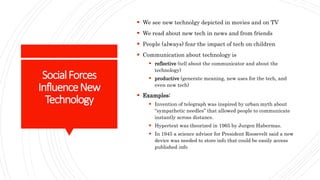
SocialForces
InfluenceNew
Technology
 We see new technolgy depicted in movies and on TV
 We read about new tech in news and from friends
 People (always) fear the impact of tech on children
 Communication about technology is
 reflective (tell about the communicator and about the
technology)
 productive (generate meaning, new uses for the tech, and
even new tech)
 Examples:
 Invention of telegraph was inspired by urban myth about
“sympathetic needles” that allowed people to communicate
instantly across distance.
 Hypertext was theorized in 1965 by Jurgen Habermas.
 In 1945 a science advisor for President Roosevelt said a new
device was needed to store info that could be easily access
published info
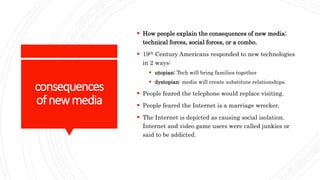
consequences
ofnewmedia
 How people explain the consequences of new media:
technical forces, social forces, or a combo.
 19th Century Americans responded to new technologies
in 2 ways:
 utopian: Tech will bring families together
 dystopian: media will create substitute relationships.
 People feared the telephone would replace visiting.
 People feared the Internet is a marriage wrecker.
 The Internet is depicted as causing social isolation.
Internet and video game users were called junkies or
said to be addicted.
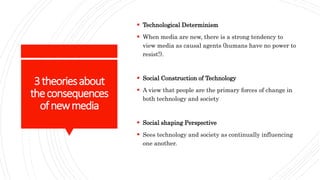
3theoriesabout
theconsequences
ofnewmedia
 Technological Determinism
 When media are new, there is a strong tendency to
view media as causal agents (humans have no power to
resist!).
 Social Construction of Technology
 A view that people are the primary forces of change in
both technology and society
 Social shaping Perspective
 Sees technology and society as continually influencing
one another.
Domestication
oftechnology
 At some point the public accepts and works with new
technology without all the hand wringing about its
impact. The ordinary becomes invisible.
 As time passes, people stop questioning technology and
tech becomes a part of everyday life.
 New technology moves from wild to tame
 New Tech becomes everyday objects embedded in the
practices of daily life.
 Domestication determines where to place devices and
who gets to use them.
 The Internet and mobile phones have been
domesticated.
Technological
Determinism
 Machines change us. We are a passive recipient
transformed by an outside force.
 Focuses on authenticity of identity and the well-being
of relationships
 Popular visions of technology tend toward technological
determinism in history
 Technology is feared until it is used
 Greeks feared writing: Writing would kill memory.
 McLuhan said the “medium is the message” meaning
technologies characteristics are transferred to those
who use them (impact-imprint)
Social
Constructionof
Technology(SCOT)
 Focuses on how tech arises from social processes
 Humans are the agents of change
 New tech comes from
 1- Inventors responding to needs
 2 -Investors who provide resources
 3 - Competitors who drive development
 4 - Government agencies 5-users shape how tech develops
 SCOT focuses on the process of adoption and how the uses
of the technology affect adoption.
 Telegraph, radio, refrigerator, and Internet are all tech re-
envisioned and transformed by the users.
 Costs, access, availability, and marketing affect adoption
of technology.
TheSocial
Influence Theory
 Janet Fulk, 1993. The theory focuses on the influence
of peers on a person’s perception and use of media.
 New media causes fear of moral decline.
 Example: movies were suspected to use subliminal
messages to affect behavior. The Internet brings
cyberbullies and sexual predators.
 Statistic do not support this fear of moral decline.
 Moral Panic: Anxieties over uncontrollable social forces
become the focus of efforts to understand a new
cultural trend.
SocialShaping
ofTechnology
 Middle ground in the theories about how new
technologies interact with society
 Posits that people, technology, and institutions all have
power to influence the development and use of
technology.
 This theory see consequences of technology for social
life as emergent.
ThePublic
Sphere
 Ideal democratic space for rational debate among
informed citizens
 The idea of public sphere came from the liberal,
capitalistic society in the 18th and 19th centuries.
 Came from cultures of open debate in coffee shops of
large European cities
 World War II marked the decline of public sphere
 Radio and TV were said to have killed the public
sphere because broadcasting is one-way with no
serious feedback from the audience.
 Today the audience is not passive.
 We have increased participation through social media
and mobile phones
Socialmediaand
blogginginthe
publicsphere
 When we blog we publically proclaim our network.
 Publically articulated relationships have 4
characteristics.
 1-persistence: info is recorded and accessed later
 2-searchability: people can find the info
 3-replicability: the photos and info can be copied
 4-invisible audiences: You do not know who will read
your profile or information. A later audience may see
your info out of context.
 Social media results in colliding networks.
Dangersfor
bloggers
 Blogger should understand attribution.
 Information should be properly cited
 Seek permission to use information
 Accidental plagiarism can result when information is
not properly connected to original sources.
 Failing to cite the source of info hurts the reputation of
the blogger
 Copyright infringement is expensive: From $200 to
$150,000 for each infringement and the infringer pays
attorney fees and court costs.
Content
Curation
 Information found, collected, and organized using
technology to which new info is added to present fresh
content.
 Curation means getting the info from somewhere else,
not of one’s own creation.
 Credit the original sources to avoid copyright
violations.
 Do not use much from the original source without
permission.
References
 Baym, N. (2015). Personal connections in the digital
age (2nd ed). Malden, MA: Polity Press.
 Handley, A. (2014). Everybody writes: Your go-to guide
to creating ridicoulsly good content (2nd ed.). Hoboken,
NJ: Wiley.
 Rettberg. J.W., (2013). Blogging (2nd ed). Malden,
MA: Polity Press.

Week9 lecture notes com325

  • 1.
    Week 9 LectureNotes COM325 Personal Connections: chapter 2 Blogging: Chap 2 (pages 50 – 57); chapter 3 (pages 82 - 86) Everybody Writes: Part Four (pages 160- 178)
  • 2.
    SocialForces InfluenceNew Technology  We seenew technolgy depicted in movies and on TV  We read about new tech in news and from friends  People (always) fear the impact of tech on children  Communication about technology is  reflective (tell about the communicator and about the technology)  productive (generate meaning, new uses for the tech, and even new tech)  Examples:  Invention of telegraph was inspired by urban myth about “sympathetic needles” that allowed people to communicate instantly across distance.  Hypertext was theorized in 1965 by Jurgen Habermas.  In 1945 a science advisor for President Roosevelt said a new device was needed to store info that could be easily access published info
  • 3.
    consequences ofnewmedia  How peopleexplain the consequences of new media: technical forces, social forces, or a combo.  19th Century Americans responded to new technologies in 2 ways:  utopian: Tech will bring families together  dystopian: media will create substitute relationships.  People feared the telephone would replace visiting.  People feared the Internet is a marriage wrecker.  The Internet is depicted as causing social isolation. Internet and video game users were called junkies or said to be addicted.
  • 4.
    3theoriesabout theconsequences ofnewmedia  Technological Determinism When media are new, there is a strong tendency to view media as causal agents (humans have no power to resist!).  Social Construction of Technology  A view that people are the primary forces of change in both technology and society  Social shaping Perspective  Sees technology and society as continually influencing one another.
  • 5.
    Domestication oftechnology  At somepoint the public accepts and works with new technology without all the hand wringing about its impact. The ordinary becomes invisible.  As time passes, people stop questioning technology and tech becomes a part of everyday life.  New technology moves from wild to tame  New Tech becomes everyday objects embedded in the practices of daily life.  Domestication determines where to place devices and who gets to use them.  The Internet and mobile phones have been domesticated.
  • 6.
    Technological Determinism  Machines changeus. We are a passive recipient transformed by an outside force.  Focuses on authenticity of identity and the well-being of relationships  Popular visions of technology tend toward technological determinism in history  Technology is feared until it is used  Greeks feared writing: Writing would kill memory.  McLuhan said the “medium is the message” meaning technologies characteristics are transferred to those who use them (impact-imprint)
  • 7.
    Social Constructionof Technology(SCOT)  Focuses onhow tech arises from social processes  Humans are the agents of change  New tech comes from  1- Inventors responding to needs  2 -Investors who provide resources  3 - Competitors who drive development  4 - Government agencies 5-users shape how tech develops  SCOT focuses on the process of adoption and how the uses of the technology affect adoption.  Telegraph, radio, refrigerator, and Internet are all tech re- envisioned and transformed by the users.  Costs, access, availability, and marketing affect adoption of technology.
  • 8.
    TheSocial Influence Theory  JanetFulk, 1993. The theory focuses on the influence of peers on a person’s perception and use of media.  New media causes fear of moral decline.  Example: movies were suspected to use subliminal messages to affect behavior. The Internet brings cyberbullies and sexual predators.  Statistic do not support this fear of moral decline.  Moral Panic: Anxieties over uncontrollable social forces become the focus of efforts to understand a new cultural trend.
  • 9.
    SocialShaping ofTechnology  Middle groundin the theories about how new technologies interact with society  Posits that people, technology, and institutions all have power to influence the development and use of technology.  This theory see consequences of technology for social life as emergent.
  • 10.
    ThePublic Sphere  Ideal democraticspace for rational debate among informed citizens  The idea of public sphere came from the liberal, capitalistic society in the 18th and 19th centuries.  Came from cultures of open debate in coffee shops of large European cities  World War II marked the decline of public sphere  Radio and TV were said to have killed the public sphere because broadcasting is one-way with no serious feedback from the audience.  Today the audience is not passive.  We have increased participation through social media and mobile phones
  • 11.
    Socialmediaand blogginginthe publicsphere  When weblog we publically proclaim our network.  Publically articulated relationships have 4 characteristics.  1-persistence: info is recorded and accessed later  2-searchability: people can find the info  3-replicability: the photos and info can be copied  4-invisible audiences: You do not know who will read your profile or information. A later audience may see your info out of context.  Social media results in colliding networks.
  • 12.
    Dangersfor bloggers  Blogger shouldunderstand attribution.  Information should be properly cited  Seek permission to use information  Accidental plagiarism can result when information is not properly connected to original sources.  Failing to cite the source of info hurts the reputation of the blogger  Copyright infringement is expensive: From $200 to $150,000 for each infringement and the infringer pays attorney fees and court costs.
  • 13.
    Content Curation  Information found,collected, and organized using technology to which new info is added to present fresh content.  Curation means getting the info from somewhere else, not of one’s own creation.  Credit the original sources to avoid copyright violations.  Do not use much from the original source without permission.
  • 14.
    References  Baym, N.(2015). Personal connections in the digital age (2nd ed). Malden, MA: Polity Press.  Handley, A. (2014). Everybody writes: Your go-to guide to creating ridicoulsly good content (2nd ed.). Hoboken, NJ: Wiley.  Rettberg. J.W., (2013). Blogging (2nd ed). Malden, MA: Polity Press.