Unit-3 Teaching
Prepared by
Deepa Manandhar
Lecturer
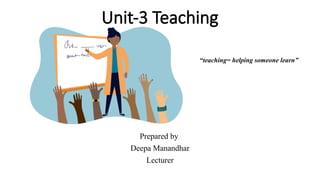
“teaching= helping someone learn”
Introduction
• Teaching was present since the human existence.
• In ancient days, people looked to the past for the knowledge,
guidance and strength which was passed on from one generation to the
next in formally by teaching at home.
Introduction
• As human civilization grew and people started forming society at
various level, the form and the place of teaching changed.
• During ‘vedic’ period, young ones went to ‘gurukuls’ for formal
education where saints– usually Brahmins– were the teachers.
• As the time passed by, the formal education was extended to other
types of schools.
Introduction
• In the modern era, along with the developing curriculum and studying
learning and the learner, the notion of developing teaching as
profession found its way in the field of education.
• Considering the nature of teaching, we can say that it is both the
science and the arts. In order for learning to occur, a teacher has to
know and use all the art of influencing learner so as to bring the
desired changes in his/her behaviour.
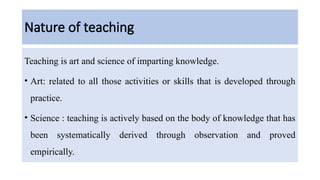
Nature of teaching
Teaching is art and science of imparting knowledge.
• Art: related to all those activities or skills that is developed through
practice.
• Science : teaching is actively based on the body of knowledge that has
been systematically derived through observation and proved
empirically.
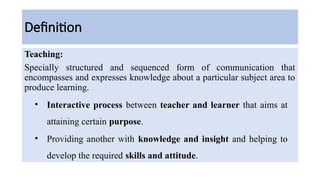
Definition
Teaching:
Specially structured and sequenced form of communication that
encompasses and expresses knowledge about a particular subject area to
produce learning.
• Interactive process between teacher and learner that aims at
attaining certain purpose.
• Providing another with knowledge and insight and helping to
develop the required skills and attitude.
Teaching
• Interactive process between teacher and learner that aims at
attaining certain purpose.
• Providing another with knowledge and insight and helping to
develop the required skills and attitude.
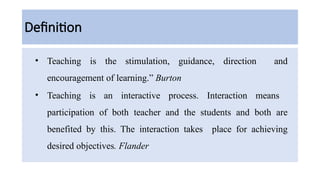
Definition
• Teaching is the stimulation, guidance, direction and
encouragement of learning.” Burton
• Teaching is an interactive process. Interaction means
participation of both teacher and the students and both are
benefited by this. The interaction takes place for achieving
desired objectives. Flander
Teacher
• The person who carries out teaching activities is a teacher.
• To behaviourist :Teacher plays mechanical role.
• B.F. skinner: “the one who arranges the contingencies of
reinforcement under which the pupils are automatically
conditioned toward specified terminal behaviours”
Teacher
• A person engaged in interactive behaviour with one or more
students for the purpose of effecting a change in those students.
• - Mc Neil and Popham
Teaching process
• Is a systematic planned course of action that both the teacher and
learner to achieve learning outcome.
Purposes of teaching
•To help the learner to acquire new habits, knowledge and skills, which
together enable him/her to do something that he /she could not do
before.
Purposes of teaching
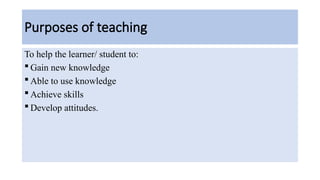
To help the learner/ student to:
 Gain new knowledge
 Able to use knowledge
 Achieve skills
 Develop attitudes.
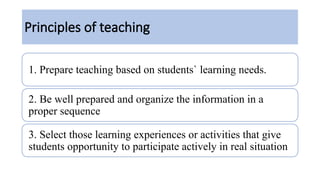
Principles of teaching
1. Prepare teaching based on students` learning needs.
2. Be well prepared and organize the information in a
proper sequence
3. Select those learning experiences or activities that give
students opportunity to participate actively in real situation
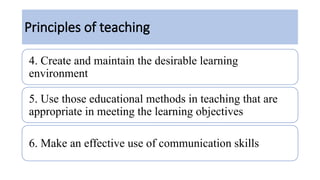
Principles of teaching
4. Create and maintain the desirable learning
environment
5. Use those educational methods in teaching that are
appropriate in meeting the learning objectives
6. Make an effective use of communication skills
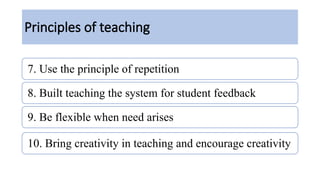
Principles of teaching
7. Use the principle of repetition
8. Built teaching the system for student feedback
9. Be flexible when need arises
10. Bring creativity in teaching and encourage creativity