1
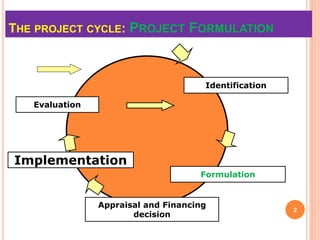
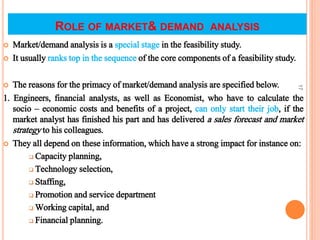
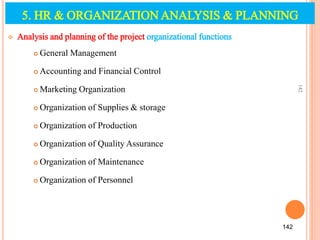
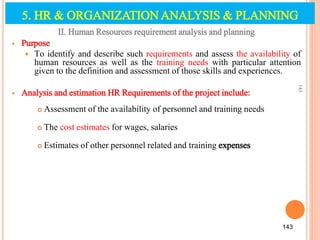
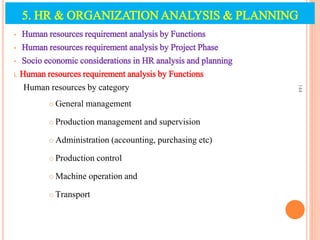
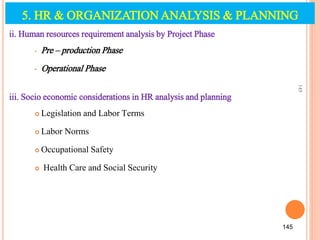
Implementation
Formulation
Evaluation
Identification
THE PROJECT CYCLE: PROJECT FORMULATION
Appraisal and Financing
decision
2
At the end of this session, participants will be able to:
 Define project feasibility studies and appreciate their services in the
effective management of projects.
 Conduct project analysis focusing on
 the marketing,
 technical,
 financial,
 socio-economic,
 environmental, and
 human resources/organizational factors.
 Prepare project proposal, and
 Conduct project appraisal.
3
LEARNING OBJECTIVES
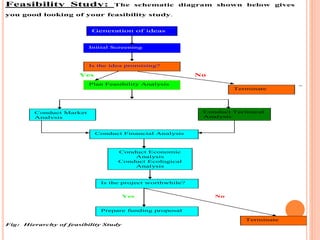
Feasibility Study: The schematic diagram shown below gives
you good looking of your feasibility study.
Yes No
Yes No
Fig: Hierarchy of feasibility Study
Generation of ideas
Initial Screening
Is the idea promising?
Plan Feasibility Analysis
Conduct Market
Analysis
Conduct Technical
Analysis
Conduct Financial Analysis
Conduct Economic
Analysis
Conduct Ecological
Analysis
Is the project worthwhile?
Prepare funding proposal
Terminate
Terminate
1
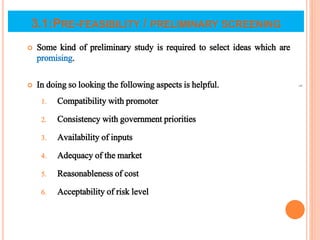
3.1:PRE-FEASIBILITY / PRELIMINARY SCREENING
 Some kind of preliminary study is required to select ideas which are
promising.
 In doing so looking the following aspects is helpful.
1. Compatibility with promoter
2. Consistency with government priorities
3. Availability of inputs
4. Adequacy of the market
5. Reasonableness of cost
6. Acceptability of risk level
5
PRELIMINARY SCREENING .......
 Compatibility with the Promoter
 It fits the personality of the entrepreneur
 It is accessible to him
 It offers him the prospect of rapid growth and high return on
the invested capital
6
PRELIMINARY SCREENING ........
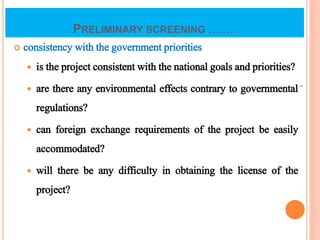
 consistency with the government priorities
 is the project consistent with the national goals and priorities?
 are there any environmental effects contrary to governmental
regulations?
 can foreign exchange requirements of the project be easily
accommodated?
 will there be any difficulty in obtaining the license of the
project?
7
PRELIMINARY SCREENING ...............
 availability of inputs
 are the capital requirements of the project within manageable
limits?
 can technical know-how required for the project be obtained?
 are the raw material required for the project available
domestically at a reasonable cost? if the raw materials have to
be imported, will there be problems?
 is the power supply for the project reasonably obtainable from
external sources and captive power resources
8
PRELIMINARY SCREENING ..........
 Adequacy of Market
 Total present domestic/foreign market
 Competitors and their market share
 Export markets
 Sales and distribution system
 Projected increase in consumption
 Barriers to the entry of new entrants
 Economic, social and demographic trends
 Patent protection
9
PRELIMINARY SCREENING ..........
 Reasonableness of Cost
 Cost of material inputs
 Labour costs
 Factory overheads
 General administrative expenses
 Selling and distribution cost
 Service cost
 Economies of scale
10
PRELIMINARY SCREENING
 Acceptability of Risk Level
 Vulnerability of business cycles
 Technological changes
 Competition from substitutes
 Competition from imports
 Governmental control over price and distribution
11
YOUR REFLECTION!!
 What are the differences between pre-
feasibility and feasibility study?
 What the various aspects/components of
project feasibility study?
1
3.2:PROJECT FEASIBILITY STUDY: OVERVIEW
• Meaning and Background
 It is an analysis of the viability of a project idea using
different parameters.
• Indications of a Feasible Project
 Generating adequate cash-flow and profits,
 Withstanding the risks it will encounter,
 Remaining viable in the long-term and meet the goals of the
founders.
13
FEASIBILITY …CONT’D…
• Consequences of poor feasibility studies
 Overstatement of returns, market share, sales volume, etc.
 Underestimated costs, resources, risk, etc.
 Omission of a necessary component
 Failure to consider the variability of environment
 Optimistic calendar for implementation,
 Low capacity utilization,
 Heavy costs overruns,
 Deteriorated financial profitability.
14
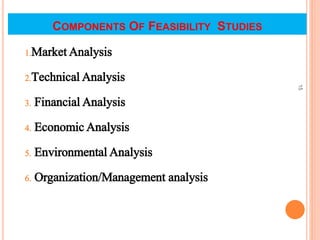
COMPONENTS OF FEASIBILITY STUDIES
1.Market Analysis
2.Technical Analysis
3. Financial Analysis
4. Economic Analysis
5. Environmental Analysis
6. Organization/Management analysis
15
1. MARKET/DEMAND ANALYSIS
• In most cases, the first step in project analysis is to estimate the potential size
of the market
• Market/demand analysis : meaning & purposes:
 Market: any set of individuals, households, or organizations with
potential/actual demand to be satisfied.
 Demand: the ability as well as willingness to acquire and use something
(goods/services) of value.
• Market and demand analysis involves and focuses on:
 the level of demand for the product or service
 marketability of the product or the service of the project
 the market determining factors
 demand forecasting and analysis
16
ROLE OF MARKET& DEMAND ANALYSIS
 Market/demand analysis is a special stage in the feasibility study.
 It usually ranks top in the sequence of the core components of a feasibility study.
 The reasons for the primacy of market/demand analysis are specified below.
1. Engineers, financial analysts, as well as Economist, who have to calculate the
socio – economic costs and benefits of a project, can only start their job, if the
market analyst has finished his part and has delivered a sales forecast and market
strategy to his colleagues.
 They all depend on these information, which have a strong impact for instance on:
 Capacity planning,
 Technology selection,
 Staffing,
 Promotion and service department
 Working capital, and
 Financial planning.
17
ROLE OF MARKET NLYIS
2. they rely on the quality of the market analysis, since their
calculations can easily turn out to be waste of time, if the demand
and sales forecast has to be revised.
3. Moreover, market analysis is obviously more ambitious and risky
in comparison to the other parts of a feasibility study, as it has to
fight with the future.
 The projection of future demand and expected sales needs the
orientation about the external environment and its factors.
4. The marketing demand and sales forecast should necessarily be the
base for analysis on the subsequent components because:
It has to deal with the behavior of human beings;
It has to assume how customers respond to the taste, smell
and to all the properties of the product, to the design,
packaging, labeling and not to forget to the price.
18
MARKET ANALYSIS ..CONT’D….
• Major Dimensions of Market/Demand Analysis
 General Indicators of the Economy
 Product
 Demand
 Supply
 Marketing Environment /Marketing mix/Strategy
• Process of Market and Demand Analysis
 Situational analysis and specification of objectives
 Collection of secondary information
 Conduct of market survey (primary information)
 Characterization of the market
 Demand forecasting
 Market planning
19
MARKET ANALYSIS….CONT’D….
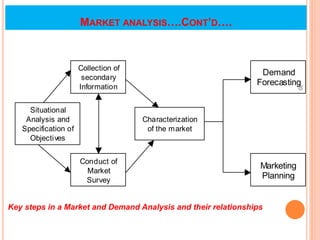
Collection of
secondary
Information
Situational
Analysis and
Specification of
Objectives
Conduct of
Market
Survey
Characterization
of the market
Demand
Forecasting
Marketing
Planning
Key steps in a Market and Demand Analysis and their relationships
20
MARKET ANALYSIS …CONT’D….
Step1: Situational Analysis and Specification of Objectives
 It is where the project analyst may informally talk to customers,
competitors, middlemen, and others in the industry
 If such a situational analysis generates enough data to measure the market
and get a reliable handle over project demand and revenues, a formal study
need not to be out, particularly when cost and time considerations so
suggest.
 In most cases, of course, a formal study of market and demand are
warranted
21
MARKET ANALYSIS …CONT’D….
Step1: Situational Analysis and Specification of Objectives
 Purpose
 to get a "feel" for the relationship between the product and its market.
 to answer the following questions:
 Who are the buyers of the product?
 What is the total current demand for the product?
22
MARKET ANALYSIS …CONT’D….
 How is the demand distributed (pattern of sales over the year) and
geographically?
 What price will the customers be willing to pay for the product?
 How can potential customers be convinced about the superiority of the
new product?
 What channels of distribution are most suited for the product?
 What trade margins will induce distributors to carry it?
 What are the prospects for immediate sales?
23
Step 2: Collection of Secondary Information
 In order to answer the questions raised above while under taking market and
demand analysis, information is obtained from secondary and/or primary
sources.
 Secondary information is information that has been gathered from some other
context.
 General/Major Source of Secondary Information
 National Census reports
 National sample survey report
 Economic survey
 Annual survey of industry
 Industry potential survey 24
MARKET ANALYSIS …CONT’D….
 Evaluation of Secondary Information
 Who gathered the information and What was the objective?
 When was the information gathered? When was it published?
 How representative was the period for which the information was
gathered?
 What was the target population?
 How was the sample chosen? How representative was the sample?
 How satisfactory was the process of information gathering?
 What was the degree of misrepresentation by respondents?
 How accurately was the information edited, tabulated and analyzed?
 Was statistical analysis properly applied?
25
MARKET ANALYSIS …CONT’D….
Step 3: Conduct of Market Survey
 Secondary information, though useful, does not often provide a
comprehensive basis for market and demand analysis.
 It needs to be supplemented with primary information gathered through a
market survey, specific to the project being proposed.
 The market survey may be a census survey where the entire population is
covered (the word 'population' is used here in a particular sense.
 Examples are, all industries using milling machines, all readers of the
Economic Times.
 Census surveys are employed principally for intermediate goods and
investment goods when such goods are used by a smaller number of firms.
 In other cases, a census survey is prohibitively costly and may be infeasible.
26
MARKET ANALYSIS …CONT’D….
Step 3: Conduct of Market Survey
 Focus points
 Total demand and rate of growth of demand
 Demand in different segments of the market
 Income and price elasticity's of demand
 Motives for buying
 Purchasing plans and intentions
 Satisfaction with existing products
 Unsatisfied needs
 Attitudes towards various products
 Socio-economic characteristics of buyers
27
MARKET ANALYSIS …CONT’D….
 Steps in market Survey
 Define the target population
 Develop the questionnaires (data collection instruments)
 Recruit and train field investigators
 Obtain information as per the questionnaire from the sample of
respondents
 Scrutinize the information Gathered
 Analyze and interpret the information
 Report the findings
28
MARKET ANALYSIS …CONT’D….
Step 4: Characterization of the Market
 Based on the information gathered from secondary sources and through the
market survey, the market of the product/service may be described in terms of
the following:
 Effective demand in the past and present
 Breakdown of demand
 Price
 Methods of distribution and sales promotion
 Consumers
 Supply and competition
 Government policy
29
MARKET ANALYSIS …CONT’D….
Step 4: Characterization of the Market
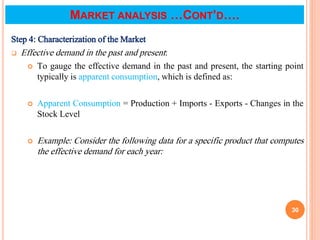
 Effective demand in the past and present:
 To gauge the effective demand in the past and present, the starting point
typically is apparent consumption, which is defined as:
 Apparent Consumption = Production + Imports - Exports - Changes in the
Stock Level
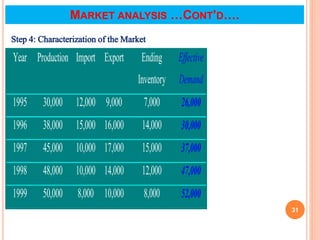
 Example: Consider the following data for a specific product that computes
the effective demand for each year:
30
MARKET ANALYSIS …CONT’D….
Step 4: Characterization of the Market
31
MARKET ANALYSIS …CONT’D….
Year Production Import Export Ending
Inventory
Effective
Demand
1995 30,000 12,000 9,000 7,000 26,000
1996 38,000 15,000 16,000 14,000 30,000
1997 45,000 10,000 17,000 15,000 37,000
1998 48,000 10,000 14,000 12,000 47,000
1999 50,000 8,000 10,000 8,000 52,000
Step 4: Characterization of the Market
Breakdown of demand:
 To get deeper insight into the nature of demand, the aggregate (total) market
demand may need to breakdown into demand for different segments of the
market.
 Market segments may be defined by nature of product, consumer group, and
geographical division.
32
MARKET ANALYSIS …CONT’D….
Step 4: Characterization of the Market
a. Nature of product: One generic name often subsumes many different
products:
 steel covers sections, rolled products, and various semi-finished products,
 commercial vehicles cover trucks and buses of various capacities; so on and so
forth.
b. Consumer group: Consumers of a product may be divided into industrial
consumers and domestic consumers.
 Industrial consumers may be sub-divided industry-wise.
 Domestic consumers may be further divided into different income groups.
c. Geographical division: A geographical breakdown of consumers, particularly
for products, which have a small value-to-weight relationship, and products,
which require regular, efficient after-sale service, is helpful. 33
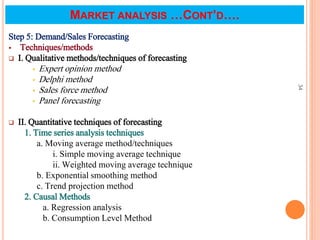
MARKET ANALYSIS …CONT’D….
Step 5: Demand/Sales Forecasting
 Techniques/methods
 I. Qualitative methods/techniques of forecasting
 Expert opinion method
 Delphi method
 Sales force method
 Panel forecasting
 II. Quantitative techniques of forecasting
1. Time series analysis techniques
a. Moving average method/techniques
i. Simple moving average technique
ii. Weighted moving average technique
b. Exponential smoothing method
c. Trend projection method
2. Causal Methods
a. Regression analysis
b. Consumption Level Method
34
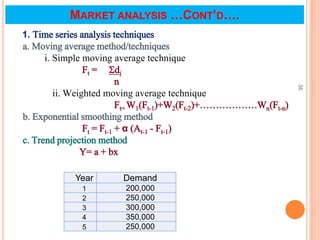
MARKET ANALYSIS …CONT’D….
1. Time series analysis techniques
a. Moving average method/techniques
i. Simple moving average technique
Ft = di
n
ii. Weighted moving average technique
Ft= W1(Ft-1)+W2(Ft-2)+………………Wn(Ft-n)
b. Exponential smoothing method
Ft = Ft-1 + α (At-1 - Ft-1)
c. Trend projection method
Y= a + bx
Year Demand
1 200,000
2 250,000
3 300,000
4 350,000
5 250,000
35
MARKET ANALYSIS …CONT’D….
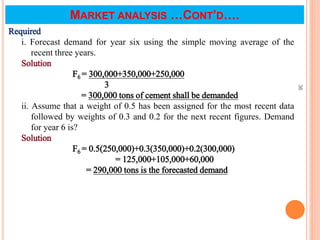
Required
i. Forecast demand for year six using the simple moving average of the
recent three years.
Solution
F6 = 300,000+350,000+250,000
3
= 300,000 tons of cement shall be demanded
ii. Assume that a weight of 0.5 has been assigned for the most recent data
followed by weights of 0.3 and 0.2 for the next recent figures. Demand
for year 6 is?
Solution
F6 = 0.5(250,000)+0.3(350,000)+0.2(300,000)
= 125,000+105,000+60,000
= 290,000 tons is the forecasted demand
36
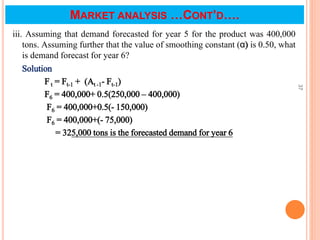
MARKET ANALYSIS …CONT’D….
iii. Assuming that demand forecasted for year 5 for the product was 400,000
tons. Assuming further that the value of smoothing constant (α) is 0.50, what
is demand forecast for year 6?
Solution
F t = Ft-1 + (At -1- Ft-1)
F6 = 400,000+ 0.5(250,000 – 400,000)
F6 = 400,000+0.5(- 150,000)
F6 = 400,000+(- 75,000)
= 325,000 tons is the forecasted demand for year 6
37
MARKET ANALYSIS …CONT’D….
 Assuming that demand forecasted for 1996 for Coffee was 18,000 quintals
per year and actual demand for coffee was 15,000 quintals and smoothing
constant of 0.70, what will be demand forecasted for the year 1997?
FD (t) = FDt-1 + (Adt-1 – FDt-1)
FD1997 = 18,000 + 0.7(15,000 - 18,000)
FD1997 = 18,000- 2,100 = 15,900
 Assume actual demand for 1996 was 19,800 quintals instead of 15,000
quintals. Then forecasted demand for 1997 should be as follows:
DD (t) = FDt-1 + (Adt-1 – FDt-1)
DD1997 = 18,000 + 0.7(19,800 - 18,000)
DD1997 = 18,000 + 1,260 = 19,260
38
MARKET ANALYSIS …CONT’D….
39
MARKET ANALYSIS …CONT’D….
Y= a + bx
y= demand for the year (dependent variable)
x= time variable (Independent variable)
a = intercept of the relationship
b= Slope of the relationship
b = 2
2
x
n
x
y
x
n
xy




a= )
( x
b
y 
Trend projection method
40
MARKET ANALYSIS …CONT’D….
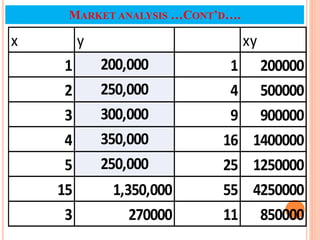
x y xy
1 200,000 1 200000
2 250,000 4 500000
3 300,000 9 900000
4 350,000 16 1400000
5 250,000 25 1250000
15 1,350,000 55 4250000
3 270000 11 850000
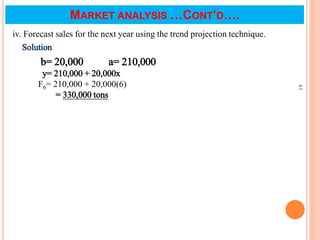
iv. Forecast sales for the next year using the trend projection technique.
Solution
b= 20,000 a= 210,000
y= 210,000 + 20,000x
F6= 210,000 + 20,000(6)
= 330,000 tons
41
MARKET ANALYSIS …CONT’D….
42
MARKET ANALYSIS …CONT’D….
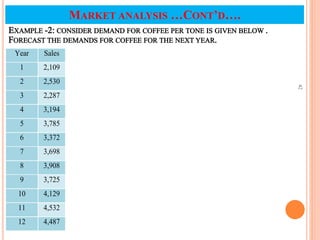
Year Sales
1 2,109
2 2,530
3 2,287
4 3,194
5 3,785
6 3,372
7 3,698
8 3,908
9 3,725
10 4,129
11 4,532
12 4,487
EXAMPLE -2: CONSIDER DEMAND FOR COFFEE PER TONE IS GIVEN BELOW .
FORECAST THE DEMANDS FOR COFFEE FOR THE NEXT YEAR.
43
MARKET ANALYSIS …CONT’D….
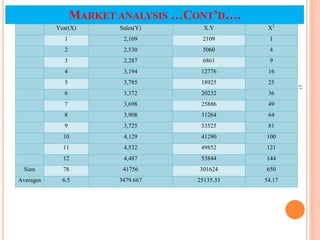
Year(X) Sales(Y) X.Y X2
1 2,109 2109 1
2 2,530 5060 4
3 2,287 6861 9
4 3,194 12776 16
5 3,785 18925 25
6 3,372 20232 36
7 3,698 25886 49
8 3,908 31264 64
9 3,725 33525 81
10 4,129 41290 100
11 4,532 49852 121
12 4,487 53844 144
Sum 78 41756 301624 650
Averages 6.5 3479.667 25135.33 54.17
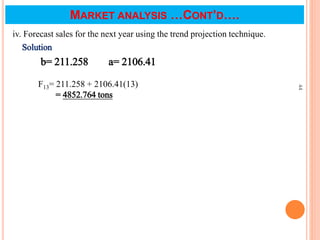
iv. Forecast sales for the next year using the trend projection technique.
Solution
b= 211.258 a= 2106.41
F13= 211.258 + 2106.41(13)
= 4852.764 tons
44
MARKET ANALYSIS …CONT’D….
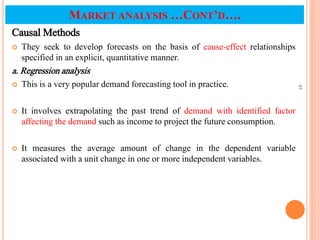
Causal Methods
 They seek to develop forecasts on the basis of cause-effect relationships
specified in an explicit, quantitative manner.
a. Regression analysis
 This is a very popular demand forecasting tool in practice.
 It involves extrapolating the past trend of demand with identified factor
affecting the demand such as income to project the future consumption.
 It measures the average amount of change in the dependent variable
associated with a unit change in one or more independent variables.
45
MARKET ANALYSIS …CONT’D….
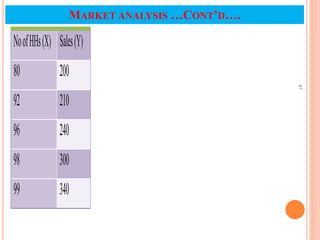
 To illustrate the linear demand equation, assume that demand for a
commodity in a town is a function of number of households (HHs).
 The equation to forecast demand called the linear regression equation and
the forecast results will be as shown below.
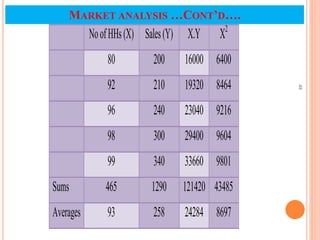
 (Note: The formula to compute a and b in the equations are the same as the
linear time series analysis except that the independent variable in this case is
not time but number of households).
 Forecast the sales for commodity (in tones) if the number of households is
100.
46
MARKET ANALYSIS …CONT’D….
47
MARKET ANALYSIS …CONT’D….
NoofHHs(X) Sales(Y)
80 200
92 210
96 240
98 300
99 340
48
MARKET ANALYSIS …CONT’D….
NoofHHs(X) Sales(Y) X.Y X2
80 200 16000 6400
92 210 19320 8464
96 240 23040 9216
98 300 29400 9604
99 340 33660 9801
Sums 465 1290 121420 43485
Averages 93 258 24284 8697
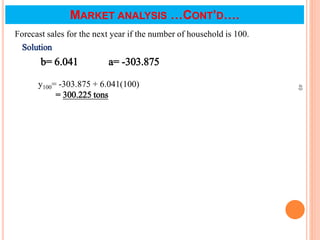
Forecast sales for the next year if the number of household is 100.
Solution
b= 6.041 a= -303.875
y100= -303.875 + 6.041(100)
= 300.225 tons
49
MARKET ANALYSIS …CONT’D….
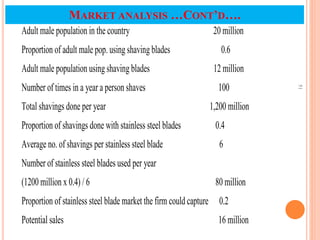
Chain ratio method
 The potential sale of a product is estimated by applying a series of factors to
a measure of aggregate demand.
 It uses a simple analytical approach to demand estimation.
 Example: A firm that plans to manufacture stainless steel blades in Ethiopia
may estimate its potential sales as follows:
50
MARKET ANALYSIS …CONT’D….
51
MARKET ANALYSIS …CONT’D….
Adult male population in the country 20 million
Proportion of adult male pop. using shaving blades 0.6
Adult male population using shaving blades 12 million
Number of times in a year a person shaves 100
Total shavings done per year 1,200 million
Proportion of shavings done with stainless steel blades 0.4
Average no. of shavings per stainless steel blade 6
Number of stainless steel blades used per year
(1200 million x 0.4) / 6 80 million
Proportion of stainless steel blade market the firm could capture 0.2
Potential sales 16 million
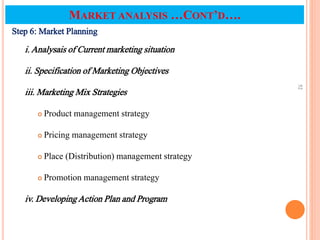
Step 6: Market Planning
i. Analysais of Current marketing situation
ii. Specification of Marketing Objectives
iii. Marketing Mix Strategies
 Product management strategy
 Pricing management strategy
 Place (Distribution) management strategy
 Promotion management strategy
iv. Developing Action Plan and Program
52
MARKET ANALYSIS …CONT’D….
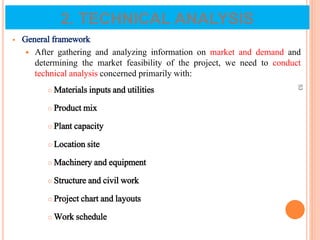
2. TECHNICAL ANALYSIS
 General framework
 After gathering and analyzing information on market and demand and
determining the market feasibility of the project, we need to conduct
technical analysis concerned primarily with:
 Materials inputs and utilities
 Product mix
 Plant capacity
 Location site
 Machinery and equipment
 Structure and civil work
 Project chart and layouts
 Work schedule
53
I. Raw material and Supplies Study
 Importance
 Materials and supplies are the major inputs (ingredients) of any project
 Some (raw materials and supplies) will be incorporated in the finished
product as tangible and visible items.
 There is a closer relationship between the definition of input
requirements and other aspects of the project formulation, such as the
definition of plant capacity, location, and selection of technology and
equipment.
54
2. TECHNICAL ANALYSIS
I. Issues to be raised in relation to materials analysis:
 What types of materials are needed?
 Where are the sources of the materials and supplies?
 How the materials and supplies are obtained?
 What are the costs of each material?
 What environmental factors should be considered?
55
2. TECHNICAL ANALYSIS
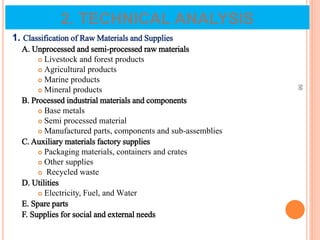
1. Classification of Raw Materials and Supplies
A. Unprocessed and semi-processed raw materials
 Livestock and forest products
 Agricultural products
 Marine products
 Mineral products
B. Processed industrial materials and components
 Base metals
 Semi processed material
 Manufactured parts, components and sub-assemblies
C. Auxiliary materials factory supplies
 Packaging materials, containers and crates
 Other supplies
 Recycled waste
D. Utilities
 Electricity, Fuel, and Water
E. Spare parts
F. Supplies for social and external needs
56
2. TECHNICAL ANALYSIS
2. Specification of Requirements
 Why specification of material requirements?
 It is the basis for the assessment and analysis of the availability of the
project inputs.
 only when the detailed specifications of the inputs available are known, the
final engineering design of the project can be prepared.
 It describes and analyzes features and characteristics in such a way that a
good understanding of what the project requires is developed.
 It will form the basis for the supply program and the subsequent cost
estimates.
 The supply program and cost estimates may be known as bill of materials
(BOM) in production/operations management.
57
2. TECHNICAL ANALYSIS
 Factors Considered
 Technical factors- such as technology and production process,
type of machinery and equipment, production capacity and
program.
 Commercial and financial factors- such as market demand
regarding products quality, competition for materials.
 Socio-economic factors- such as skill of work force,
environmental policies, etc
58
2. TECHNICAL ANALYSIS
3. Availability and Supply
i. Availability and sources of materials
issues to be precisely determined:
 Materials and inputs available from local sources: location and area of
supplies, concentrated or dispersed, alternative uses, transportability
and transport costs.
 Materials and inputs to be imported: sources, foreign exchange
restrictions, reliability of supplies and uncertainty that relate to the
import etc.
59
2. TECHNICAL ANALYSIS
ii. Supply Marketing and Supply Programs
a. Supply Marketing
 Objectives are cost minimization, risk minimization, and cultivation
of relations with supplier.
b. Supply Program
 should deal with the following:
 Identification of supply sources and suppliers, Agreements and
regulations, Quantities and qualities, Consignments, Means of
transport, Storage, Risk assessment
60
2. TECHNICAL ANALYSIS
c. Considerations in selecting supplier/s
 location
 ownership
 main activities
 financial strength and profitability
 production capacity, output over last years
 key customers and business experience
61
2. TECHNICAL ANALYSIS
d. The supply program shall indicate the following clearly
 The quantities and qualities that can be supplied from various
sources (in comparison with the specified requirements in terms of
all relevant factors)
 Means of transport for key materials and inputs such as by air,
water, road, or rail including their availability, capacity, reliability
and technical condition
 Loading, unloading, and storage facilities at the ports as well as at
the plant
62
2. TECHNICAL ANALYSIS
4. Cost of Raw Materials and Parts
Objective
 to estimate the current and projected prices of materials and inputs in the
context of past trends and future prospects for both locally available and
imported items.
63
2. TECHNICAL ANALYSIS
i. Unit costs
 Domestic materials costs: are projected set in the context of past trends
and future projections of the elasticity of supply.
 Imported material inputs: CIF (cost, insurance, and freight) should be
adopted with clearing charges such as loading, unloading, port charges,
tariffs, local insurance and taxes, and costs of internal transport to the
plant.
64
2. TECHNICAL ANALYSIS
ii. Annual costs
 cost estimates should be associated to a hypothetical level of production
and capacity utilization levels
 A distinction should be made between materials and inputs to be
purchased and those actually to be consumed in a particular year –(the
difference being stocked.)
 calculating indirect costs should be established per unit of production or
per accounting period whichever is appropriate.
 material and input requirements of other project’s components (service,
administration, and sales) should also be considered.
65
2. TECHNICAL ANALYSIS
II. PRODUCT MIX
 Product Mix Decisions
 The breadth of the product line/s being managed currently
 The depth of the product line/s being managed currently
 Project Analysis & Initiation Vs Product Mix Options
 Expansion
 Contraction
 Differentiation
 Trading up vs trading down
 Substitution
66
2. TECHNICALANALYSIS
III. PROJECT CAPACITYAND PRODUCTION PROGRAM
A. Project/Plant Capacity
 the volume or number of units that can be produced during a given
period.
 This definition implies the output expectation from the production of a
plant.
Capacity Decision Factors
 Technological Requirement
 Input constraints
 Investment cost
 Market conditions
 Resources of the firm
 Government policy
67
2. TECHNICAL ANALYSIS
Capacity Decision Levels/Terms
I. Nominal Maximum Capacity (NMC)
 Is the technically feasible capacity, frequently corresponds to the
installed capacity as guaranteed by the supplier of the plant and
includes reserve and stand-by capacity.
II. Feasible Normal Capacity
 is achievable under normal working conditions taking into account the
installed equipment and technical conditions of the plant, such as
Normal stoppages, Downtime, Maintenance, Tool checks, Desired
shift patterns and the management system.
Determination of the Feasible Normal Plant Capacity
 Economies of Scale
 Minimum Economic Size and Equipment Constraints
68
2. TECHNICAL ANALYSIS
B. Production Program
 It should define the levels of output to be achieved during specified periods
and, from this viewpoint, should be directly related to the specific sales
forecasts.
Functions
(1) indicates the basic products, by – products, and wastes during the process.
(2) Plans changes in time during project life.
(3) Plans/determines extraction rates and operating ratios effectively and
adequately
69
2. TECHNICALANALYSIS
(4) Once
 a production program defines the levels of outputs in terms of end product,
and
 possibly of intermediate products and the operating ratio between various
production lines and processes,
 the specific requirements of materials and labour should be qualified for
each stage.
(5)The specific quantities needed for each stage of the production program and
costs that these entail should be determined.
The input requirements and costs have to be assessed for:
 Basic materials such as raw materials, semi – process, bought – out
items
 Auxiliary materials and factory supplies
 Major utilities and
 Direct labour requirements
70
2. TECHNICALANALYSIS
IV. Location Analysis
 The strategic orientation of the choice of suitable locations requires an
assessment of
 Market and marketing aspects
 The availability of critical project inputs, such as raw materials and
factory supplies
 Technical project requirements
 The type of industry
 Technology and process
 Characteristics of products and outputs
 Size of the plant
 Organizational requirements and management structure
71
2. TECHNICAL ANALYSIS
Location selection factors
i. Proximity to Raw Materials and Market
 A resource based project like a cement factory or still mill should be
located close to the source of basic materials;
 A product based on imported materials may be located near the port;
and
 A project manufacturing a perishable product should be close to the
center of consumption.
ii. Availability of Infrastructure
 Availability of electric power, transportation, water, and
communications should be carefully assessed before a location decision
is made.
iii. Government Policies
 Government policies have a bearing on location.
 In the case of public sectors projects, location is directly decided by the
government.
 There are also some private sector projects on which government
makes subsidies.
72
2. TECHNICAL ANALYSIS
Choice of Site
 Selection factors
 Ecological conditions of sites
 Environmental impacts
 Socio–economic conditions (restrictions, incentives, requirements)
 Costs of land
 Infrastructure
 Site preparation and development costs
 Strategy of the projects such as future expansion
 Cost of utility lines extension
 Size and shape of the available area
 Nature of goods (products) produced (perishables or no)
 Proximity of centers of consumption (market orientation
 Distance to seaport (import and export)
73
2. TECHNICALANALYSIS
V. TECHNOLOGY/ENGINEERING (Analysis & Selection)
 Focuses on (involves)
The selection of an appropriate technology, and
 Planning of the acquisition and absorption of this technology and the
corresponding know – how.
74
2. TECHNICAL ANALYSIS
a. Engineering analysis and design
 Is responsible to design the functional and physical layout for the industrial
plant necessary to produce the defined output and to determine the
corresponding investment expenditures as well as the costs arising during
the operational phase.
 The scope of engineering also includes
 Infrastructure
 Factory and other buildings and civil works
 Their inter relationship with utilities, material flows, machinery
installations
 Other aspects of plant construction and operations.
75
2. TECHNICALANALYSIS
b. Technology Choice
considerations
 Plant capacity
 Principal inputs
 Investment outlay and production cost
 Use by other units
 Product mix
 Latest developments
 Ease of absorption
76
2. TECHNICAL ANALYSIS
c. Technology Evaluation and Selection
 Appropriate technology refers to the methods of production, which are
suitable to heal economic, social, and cultural conditions.
 Technology should be evaluated in terms of:
 Whether the technology utilizes local raw materials
 Whether the technology utilized local man power
 Whether the goods and services produced cater the basic needs
 Whether the technology protects ecological balance
 Whether the technology is harmonious with social and cultural
conditions
77
2. TECHNICAL ANALYSIS
d. Technology Acquisition and Transfer
It involves:
i. Securing Industrial Property Rights
 considering patents, trade marks, copyright and proprietary
technology or be in the form of un-patented know – how that is
available from only a limited number of sources.
ii. Selecting Means of Technology acquisition and transfer options
 Technology licensing
 Outright purchase of technology,
 A joint venture involving participation in ownership by the
technology supplier
iii. Specifying Contract Terms and Conditions
78
2. TECHNICALANALYSIS
VI. Detailed Plant Layout analysis and planning
o The important considerations in preparing the plant layout are:
 Consistency with production technology
 Smooth flow of goods from one stage to another
 Proper utilization of space
 Scope of expansion
 Minimization of production cost
 Safety of personnel.
79
2. TECHNICALANALYSIS
3. FINANCIAL ANALYSIS AND PLANNING
Financial Analysis
Objective/s
 to identify the project’s
 Financial efficiency
 Incentive or impact to the participants (investors, creditors, sponsors,
etc.)
 Creditworthiness and
 Liquidity
80
3. FINANCIAL ANALYSIS AND PLANNING
Information requirement
 Cost of project
 Means of financing
 Estimates of sales and production
 Working capital requirement and its financing
 Projected cash flow statements (based on projected balance sheets & income
statements)
 Break even points
 Projected profits
 Projected risks
81
I. Analysis and planning of Cost of Project
A. Estimate Investment Costs
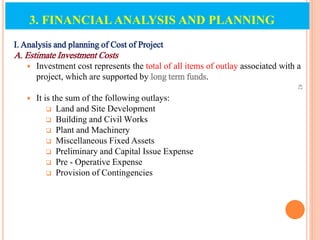
 Investment cost represents the total of all items of outlay associated with a
project, which are supported by long term funds.
 It is the sum of the following outlays:
 Land and Site Development
 Building and Civil Works
 Plant and Machinery
 Miscellaneous Fixed Assets
 Preliminary and Capital Issue Expense
 Pre - Operative Expense
 Provision of Contingencies
82
3. FINANCIAL ANALYSIS AND PLANNING
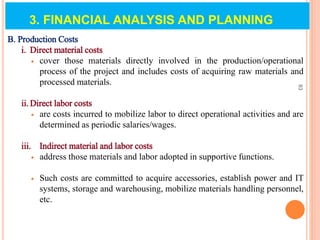
B. Production Costs
i. Direct material costs
 cover those materials directly involved in the production/operational
process of the project and includes costs of acquiring raw materials and
processed materials.
ii. Direct labor costs
 are costs incurred to mobilize labor to direct operational activities and are
determined as periodic salaries/wages.
iii. Indirect material and labor costs
 address those materials and labor adopted in supportive functions.
 Such costs are committed to acquire accessories, establish power and IT
systems, storage and warehousing, mobilize materials handling personnel,
etc.
83
3. FINANCIAL ANALYSIS AND PLANNING
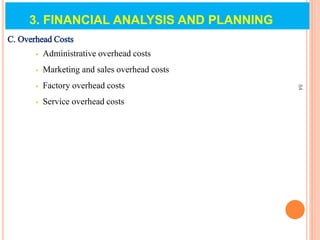
C. Overhead Costs
 Administrative overhead costs
 Marketing and sales overhead costs
 Factory overhead costs
 Service overhead costs
84
3. FINANCIAL ANALYSIS AND PLANNING
II. Analysis & Planning of Means of Financing a Project
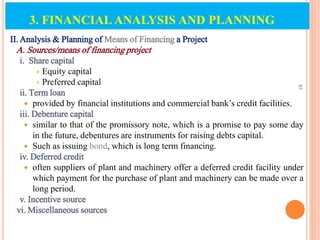
A. Sources/means of financing project
i. Share capital
 Equity capital
 Preferred capital
ii. Term loan
 provided by financial institutions and commercial bank’s credit facilities.
iii. Debenture capital
 similar to that of the promissory note, which is a promise to pay some day
in the future, debentures are instruments for raising debts capital.
 Such as issuing bond, which is long term financing.
iv. Deferred credit
 often suppliers of plant and machinery offer a deferred credit facility under
which payment for the purchase of plant and machinery can be made over a
long period.
v. Incentive source
vi. Miscellaneous sources
85
3. FINANCIAL ANALYSIS AND PLANNING
B. Selecting the Project Financing Means
 Guidelines that should be born in mind are:
i. Norms of regulatory bodies and Financial Institutions
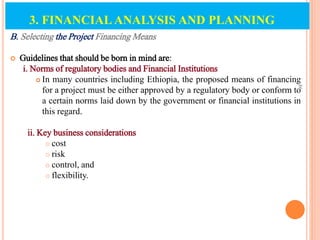
 In many countries including Ethiopia, the proposed means of financing
for a project must be either approved by a regulatory body or conform to
a certain norms laid down by the government or financial institutions in
this regard.
ii. Key business considerations
 cost
 risk
 control, and
 flexibility.
86
3. FINANCIAL ANALYSIS AND PLANNING
III. Develop Projection of Financial Statements
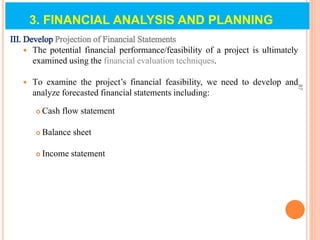
 The potential financial performance/feasibility of a project is ultimately
examined using the financial evaluation techniques.
 To examine the project’s financial feasibility, we need to develop and
analyze forecasted financial statements including:
 Cash flow statement
 Balance sheet
 Income statement
87
3. FINANCIAL ANALYSIS AND PLANNING
 Prepare Projected Cash Flow Statements (CFS)
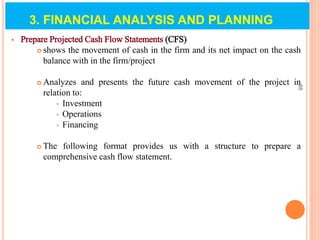
 shows the movement of cash in the firm and its net impact on the cash
balance with in the firm/project
 Analyzes and presents the future cash movement of the project in
relation to:
 Investment
 Operations
 Financing
 The following format provides us with a structure to prepare a
comprehensive cash flow statement.
88
3. FINANCIAL ANALYSIS AND PLANNING
Illustration: cash flow statement
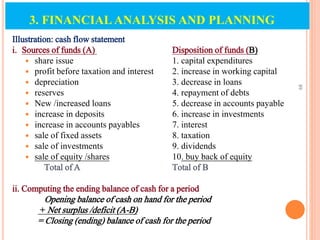
i. Sources of funds (A) Disposition of funds (B)
 share issue 1. capital expenditures
 profit before taxation and interest 2. increase in working capital
 depreciation 3. decrease in loans
 reserves 4. repayment of debts
 New /increased loans 5. decrease in accounts payable
 increase in deposits 6. increase in investments
 increase in accounts payables 7. interest
 sale of fixed assets 8. taxation
 sale of investments 9. dividends
 sale of equity /shares 10. buy back of equity
Total of A Total of B
ii. Computing the ending balance of cash for a period
Opening balance of cash on hand for the period
+ Net surplus /deficit (A-B)
= Closing (ending) balance of cash for the period
89
3. FINANCIAL ANALYSIS AND PLANNING
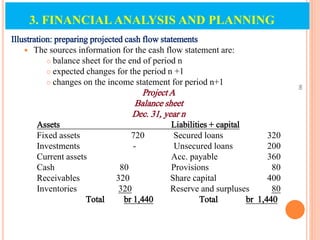
Illustration: preparing projected cash flow statements
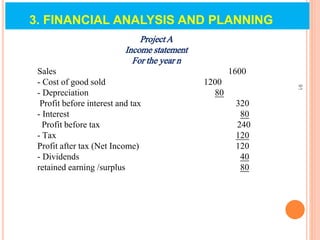
 The sources information for the cash flow statement are:
 balance sheet for the end of period n
 expected changes for the period n +1
 changes on the income statement for period n+1
Project A
Balance sheet
Dec. 31, year n
Assets Liabilities + capital
Fixed assets 720 Secured loans 320
Investments - Unsecured loans 200
Current assets Acc. payable 360
Cash 80 Provisions 80
Receivables 320 Share capital 400
Inventories 320 Reserve and surpluses 80
Total br 1,440 Total br 1,440
90
3. FINANCIAL ANALYSIS AND PLANNING
Project A
Income statement
For the year n
Sales 1600
- Cost of good sold 1200
- Depreciation 80
Profit before interest and tax 320
- Interest 80
Profit before tax 240
- Tax 120
Profit after tax (Net Income) 120
- Dividends 40
retained earning /surplus 80
91
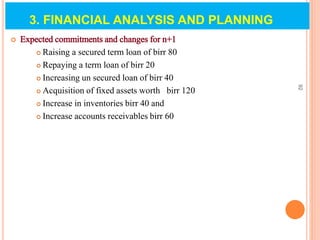
3. FINANCIAL ANALYSIS AND PLANNING
 Expected commitments and changes for n+1
 Raising a secured term loan of birr 80
 Repaying a term loan of birr 20
 Increasing un secured loan of birr 40
 Acquisition of fixed assets worth birr 120
 Increase in inventories birr 40 and
 Increase accounts receivables birr 60
92
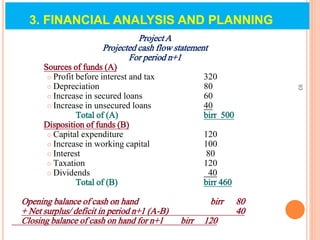
3. FINANCIAL ANALYSIS AND PLANNING
Project A
Projected cash flow statement
For period n+1
Sources of funds (A)
 Profit before interest and tax 320
 Depreciation 80
 Increase in secured loans 60
 Increase in unsecured loans 40
Total of (A) birr 500
Disposition of funds (B)
 Capital expenditure 120
 Increase in working capital 100
 Interest 80
 Taxation 120
 Dividends 40
Total of (B) birr 460
Opening balance of cash on hand birr 80
+ Net surplus/ deficit in period n+1 (A-B) 40
Closing balance of cash on hand for n+1 birr 120
93
3. FINANCIAL ANALYSIS AND PLANNING
Project A
Projected balance sheet
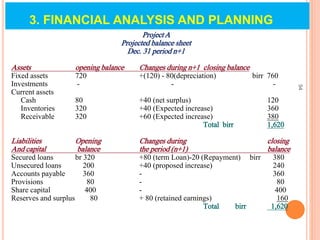
Dec. 31 period n+1
Assets opening balance Changes during n+1 closing balance
Fixed assets 720 +(120) - 80(depreciation) birr 760
Investments - - -
Current assets
Cash 80 +40 (net surplus) 120
Inventories 320 +40 (Expected increase) 360
Receivable 320 +60 (Expected increase) 380
Total birr 1,620
Liabilities Opening Changes during closing
And capital balance the period (n+1) balance
Secured loans br 320 +80 (term Loan)-20 (Repayment) birr 380
Unsecured loans 200 +40 (proposed increase) 240
Accounts payable 360 - 360
Provisions 80 - 80
Share capital 400 - 400
Reserves and surplus 80 + 80 (retained earnings) 160
Total birr 1,620
94
3. FINANCIAL ANALYSIS AND PLANNING
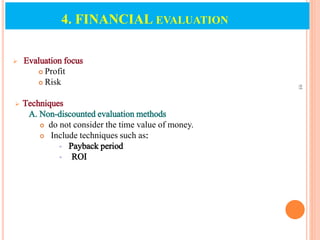
 Evaluation focus
 Profit
 Risk
 Techniques
A. Non-discounted evaluation methods
 do not consider the time value of money.
 Include techniques such as:
 Payback period
 ROI
95
4. FINANCIAL EVALUATION
1. PAYBACK PERIOD
 considers the time taken to gain a financial return equal to the initial
investment.
 The period is usually expressed in years and months.
 Payback period = Initial Investment
Accumulated annual cash flows
 The initial investment outlay includes all capital investments made before
the plant starts operation as well as during the plant operation
96
Illustration 1: uniform annual cash flows
 A project whose initial investment outlay is Birr 800,000 is expected to
remain active for the next 12 years earning a uniform annual net cash
flow of Birr 150, 000.
Solution
 Since the project has a uniform cash flow over its lifetime, dividing the
initial investment by annual cash flow will give you the payback
period.
Payback period = 800,000 = 5.33 years
150,000
97
97
1. PAYBACK PERIOD
Illustration 2: different annual cash flows
 a company wishes to buy a new machine for a 5-year project. The
manager has to choose between machine A and machine B, so it is
mutually exclusive solution.
 Although both machines have the same initial cost (Birr 700,000), their
cash flows perform differently over the 5-year period.
98
1. PAYBACK PERIOD
99
99
Year
Cash-Flow (Birr)
Initial investment cost 700,000, - for each
machine
Machine A Machine B
0 (700,000) (700,000)
1 200,000 100,000
2 380,000 300,000
3 240,000 150,000
4 100,000 300,000
5 150,000 400,000
Payback period 2 and half years 3 and half years
1. PAYBACK PERIOD
2. RETURN ON INVESTMENT (ROI)
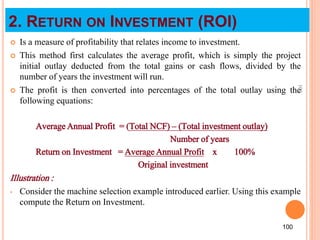
 Is a measure of profitability that relates income to investment.
 This method first calculates the average profit, which is simply the project
initial outlay deducted from the total gains or cash flows, divided by the
number of years the investment will run.
 The profit is then converted into percentages of the total outlay using the
following equations:
Average Annual Profit = (Total NCF) – (Total investment outlay)
Number of years
Return on Investment = Average Annual Profit x 100%
Original investment
Illustration :
• Consider the machine selection example introduced earlier. Using this example
compute the Return on Investment.
100
100
Solution
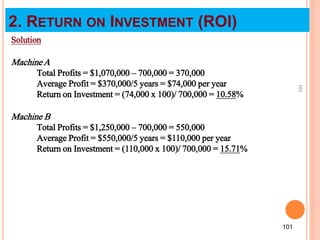
Machine A
Total Profits = $1,070,000 – 700,000 = 370,000
Average Profit = $370,000/5 years = $74,000 per year
Return on Investment = (74,000 x 100)/ 700,000 = 10.58%
Machine B
Total Profits = $1,250,000 – 700,000 = 550,000
Average Profit = $550,000/5 years = $110,000 per year
Return on Investment = (110,000 x 100)/ 700,000 = 15.71%
101
101
2. RETURN ON INVESTMENT (ROI)
Selection criteria for ROI
 All independent projects having a ROI equal to or greater than a pre-specified
ROI are accepted.
 For mutually exclusive projects, we will accept a project with higher ROI.
Selection decisions
 Machine A realizes its payback period earlier than machine B, meaning it has a
better chance getting selected than B.
 Machine B has larger rate of ROI than machine A, meaning it has a better
chance getting selected than A.
102
2. RETURN ON INVESTMENT (ROI)
DISCOUNTING TECHNIQUES
 Concept of discounting
 Money has time value
 One birr received today is more than one birr received in 2 years. Why?
1. Psychological explanation
2. If invested, can generate positive return
3. During inflation the future purchasing power decreases
1
104
104
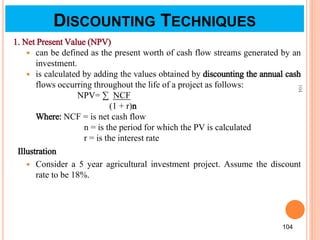
1. Net Present Value (NPV)
 can be defined as the present worth of cash flow streams generated by an
investment.
 is calculated by adding the values obtained by discounting the annual cash
flows occurring throughout the life of a project as follows:
NPV= ∑ NCF
(1 + r)n
Where: NCF = is net cash flow
n = is the period for which the PV is calculated
r = is the interest rate
Illustration
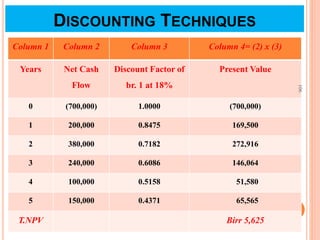
 Consider a 5 year agricultural investment project. Assume the discount
rate to be 18%.
DISCOUNTING TECHNIQUES
The steps to calculate NPV are:
 Setting up the NPV format/table
 Writing the corresponding years in the project life in column 1
 Writing the net cash flows in column 2
 Writing the corresponding discount factors of each year at the specified
discount rate in column 3
 Writing the present value of the net cash flow of each year in column 4
by multiplying net cash flow by the corresponding discount factor.
 Aggregating the present values to give the NPV
105
DISCOUNTING TECHNIQUES
Column 1 Column 2 Column 3 Column 4= (2) x (3)
Years Net Cash
Flow
Discount Factor of
br. 1 at 18%
Present Value
0 (700,000) 1.0000 (700,000)
1 200,000 0.8475 169,500
2 380,000 0.7182 272,916
3 240,000 0.6086 146,064
4 100,000 0.5158 51,580
5 150,000 0.4371 65,565
T.NPV Birr 5,625
106
DISCOUNTING TECHNIQUES
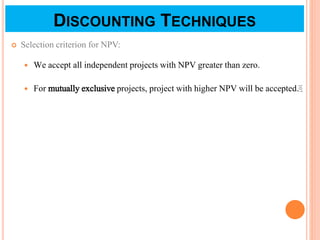
 Selection criterion for NPV:
 We accept all independent projects with NPV greater than zero.
 For mutually exclusive projects, project with higher NPV will be accepted.
107
DISCOUNTING TECHNIQUES
2. INTERNAL RATE OF RETURN (IRR)
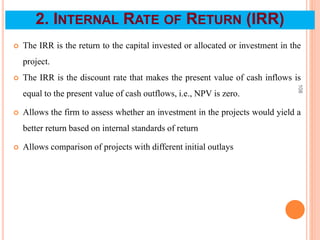
 The IRR is the return to the capital invested or allocated or investment in the
project.
 The IRR is the discount rate that makes the present value of cash inflows is
equal to the present value of cash outflows, i.e., NPV is zero.
 Allows the firm to assess whether an investment in the projects would yield a
better return based on internal standards of return
 Allows comparison of projects with different initial outlays
108
STEPS IN APPROXIMATING THE IRR
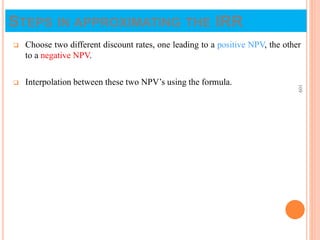
 Choose two different discount rates, one leading to a positive NPV, the other
to a negative NPV.
 Interpolation between these two NPV’s using the formula.
109
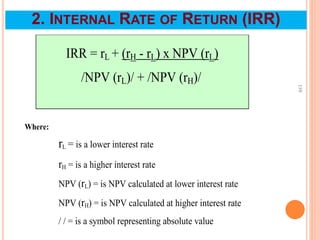
110
IRR = rL + (rH - rL) x NPV (rL)
/NPV (rL)/ + /NPV (rH)/
Where:
rL = is a lower interest rate
rH = is a higher interest rate
NPV (rL) = is NPV calculated at lower interest rate
NPV (rH) = is NPV calculated at higher interest rate
/ / = is a symbol representing absolute value
2. INTERNAL RATE OF RETURN (IRR)
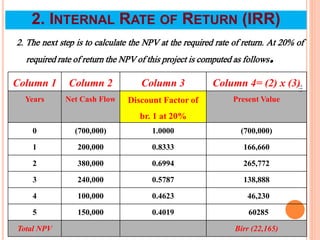
2. The next step is to calculate the NPV at the required rate of return. At 20% of
required rate of return the NPV of this project is computed as follows.
Column 1 Column 2 Column 3 Column 4= (2) x (3)
Years Net Cash Flow Discount Factor of
br. 1 at 20%
Present Value
0 (700,000) 1.0000 (700,000)
1 200,000 0.8333 166,660
2 380,000 0.6994 265,772
3 240,000 0.5787 138,888
4 100,000 0.4623 46,230
5 150,000 0.4019 60285
Total NPV Birr (22,165)
111
2. INTERNAL RATE OF RETURN (IRR)
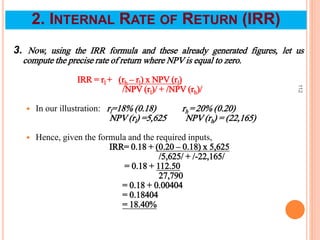
3. Now, using the IRR formula and these already generated figures, let us
compute the precise rate of return where NPV is equal to zero.
IRR = rl + (rh – rl) x NPV (rl)
/NPV (rl)/ + /NPV (rh)/
 In our illustration: rl=18% (0.18) rh =20% (0.20)
NPV (rl) =5,625 NPV (rh) = (22,165)
 Hence, given the formula and the required inputs,
IRR= 0.18 + (0.20 – 0.18) x 5,625
/5,625/ + /-22,165/
= 0.18 + 112.50
27,790
= 0.18 + 0.00404
= 0.18404
= 18.40%
112
2. INTERNAL RATE OF RETURN (IRR)
Example 2
113
2. INTERNAL RATE OF RETURN (IRR)
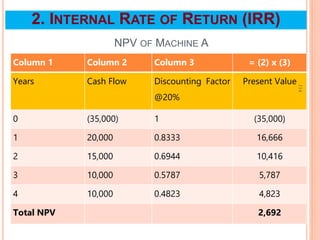
NPV OF MACHINE A
Column 1 Column 2 Column 3 = (2) x (3)
Years Cash Flow Discounting Factor
@20%
Present Value
0 (35,000) 1 (35,000)
1 20,000 0.8333 16,666
2 15,000 0.6944 10,416
3 10,000 0.5787 5,787
4 10,000 0.4823 4,823
Total NPV 2,692
114
2. INTERNAL RATE OF RETURN (IRR)
115
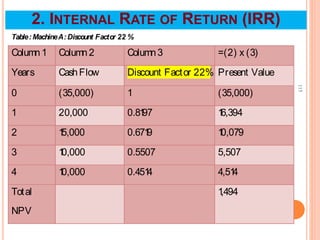
Table: MachineA: Discount Factor 22 %
Column1 Column2 Column3 =(2) x (3)
Years CashFlow Discount Factor 22% Present Value
0 (35,000) 1 (35,000)
1 20,000 0.81
97 1
6,394
2 1
5,000 0.671
9 1
0,079
3 1
0,000 0.5507 5,507
4 1
0,000 0.451
4 4,51
4
Total
NPV
1
,494
2. INTERNAL RATE OF RETURN (IRR)
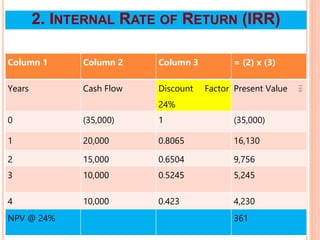
Column 1 Column 2 Column 3 = (2) x (3)
Years Cash Flow Discount Factor
24%
Present Value
0 (35,000) 1 (35,000)
1 20,000 0.8065 16,130
2 15,000 0.6504 9,756
3 10,000 0.5245 5,245
4 10,000 0.423 4,230
NPV @ 24% 361
116
2. INTERNAL RATE OF RETURN (IRR)
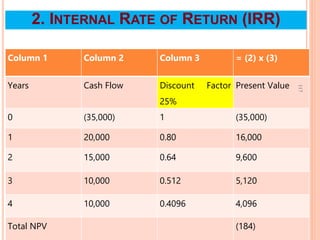
Column 1 Column 2 Column 3 = (2) x (3)
Years Cash Flow Discount Factor
25%
Present Value
0 (35,000) 1 (35,000)
1 20,000 0.80 16,000
2 15,000 0.64 9,600
3 10,000 0.512 5,120
4 10,000 0.4096 4,096
Total NPV (184)
117
2. INTERNAL RATE OF RETURN (IRR)
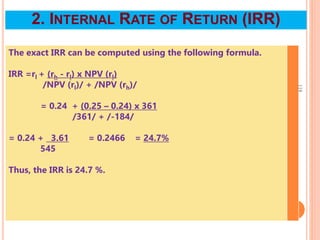
The exact IRR can be computed using the following formula.
IRR =rl + (rh - rl) x NPV (rl)
/NPV (rl)/ + /NPV (rh)/
= 0.24 + (0.25 – 0.24) x 361
/361/ + /-184/
= 0.24 + 3.61 = 0.2466 = 24.7%
545
Thus, the IRR is 24.7 %.
118
2. INTERNAL RATE OF RETURN (IRR)
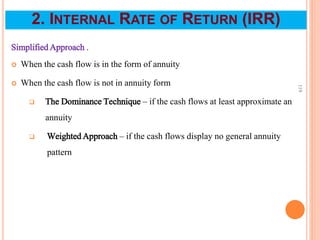
Simplified Approach .
 When the cash flow is in the form of annuity
 When the cash flow is not in annuity form
 The Dominance Technique – if the cash flows at least approximate an
annuity
 Weighted Approach – if the cash flows display no general annuity
pattern
119
2. INTERNAL RATE OF RETURN (IRR)
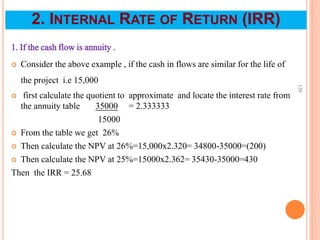
1. If the cash flow is annuity .
 Consider the above example , if the cash in flows are similar for the life of
the project i.e 15,000
 first calculate the quotient to approximate and locate the interest rate from
the annuity table 35000 = 2.333333
15000
 From the table we get 26%
 Then calculate the NPV at 26%=15,000x2.320= 34800-35000=(200)
 Then calculate the NPV at 25%=15000x2.362= 35430-35000=430
Then the IRR = 25.68
120
2. INTERNAL RATE OF RETURN (IRR)
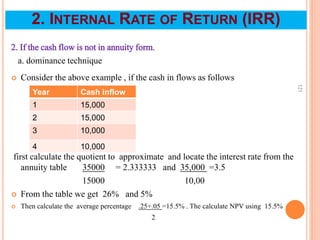
2. If the cash flow is not in annuity form.
a. dominance technique
 Consider the above example , if the cash in flows as follows
first calculate the quotient to approximate and locate the interest rate from the
annuity table 35000 = 2.333333 and 35,000 =3.5
15000 10,00
 From the table we get 26% and 5%
 Then calculate the average percentage .25+.05 =15.5% . The calculate NPV using 15.5%
2
121
2. INTERNAL RATE OF RETURN (IRR)
Year Cash inflow
1 15,000
2 15,000
3 10,000
4 10,000
Column 1 Column 2 Column 3 = (2) x (3)
Years Cash Flow Discount Factor
15.5%
Present Value
0 (35,000) 1 (35,000)
1 15,000 0.8658 12987
2 15,000 0.7496 11244
3 10,000 0.6490 6490
4 10,000 0.5619 5619
Total NPV 1340
122
2. INTERNAL RATE OF RETURN (IRR)
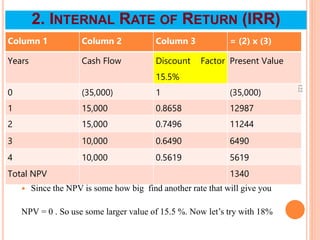
 Since the NPV is some how big find another rate that will give you
NPV = 0 . So use some larger value of 15.5 %. Now let’s try with 18%
Column 1 Column 2 Column 3 = (2) x (3)
Years Cash Flow Discount Factor
18%
Present Value
0 (35,000) 1 (35,000)
1 15,000 0.8475 12713
2 15,000 0.7182 10773
3 10,000 0.6086 6086
4 10,000 0.5158 5158
Total NPV (270)
123
2. INTERNAL RATE OF RETURN (IRR)
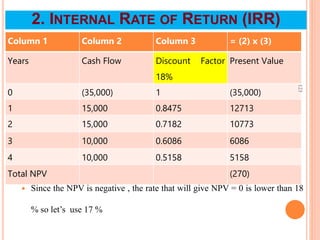
 Since the NPV is negative , the rate that will give NPV = 0 is lower than 18
% so let’s use 17 %
Column 1 Column 2 Column 3 = (2) x (3)
Years Cash Flow Discount Factor
17%
Present Value
0 (35,000) 1 (35,000)
1 15,000 0.8547 12821
2 15,000 0.7305 10957
3 10,000 0.6244 6244
4 10,000 0.5337 5337
Total NPV 359
124
2. INTERNAL RATE OF RETURN (IRR)
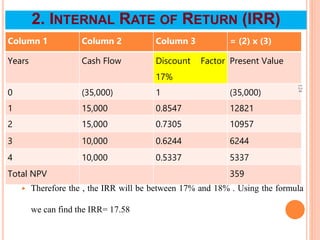
 Therefore the , the IRR will be between 17% and 18% . Using the formula
we can find the IRR= 17.58
2. If the cash flow is not in annuity form.
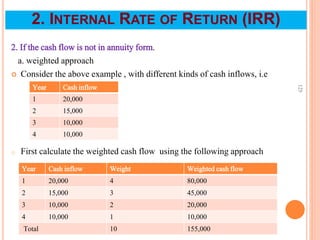
a. weighted approach
 Consider the above example , with different kinds of cash inflows, i.e
o First calculate the weighted cash flow using the following approach
125
2. INTERNAL RATE OF RETURN (IRR)
Year Cash inflow
1 20,000
2 15,000
3 10,000
4 10,000
Year Cash inflow Weight Weighted cash flow
1 20,000 4 80,000
2 15,000 3 45,000
3 10,000 2 20,000
4 10,000 1 10,000
Total 10 155,000
126
2. INTERNAL RATE OF RETURN (IRR)
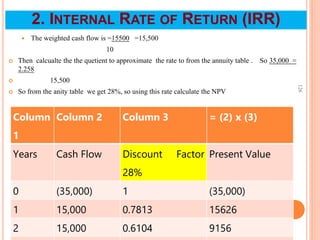
 The weighted cash flow is =15500 =15,500
10
 Then calcualte the the quetient to approximate the rate to from the annuity table . So 35,000 =
2.258
 15,500
 So from the anity table we get 28%, so using this rate calculate the NPV
Column
1
Column 2 Column 3 = (2) x (3)
Years Cash Flow Discount Factor
28%
Present Value
0 (35,000) 1 (35,000)
1 15,000 0.7813 15626
2 15,000 0.6104 9156
127
2. INTERNAL RATE OF RETURN (IRR)
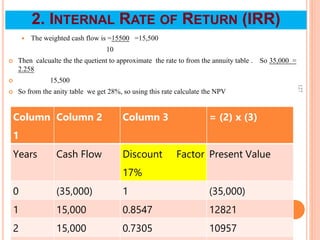
 The weighted cash flow is =15500 =15,500
10
 Then calcualte the the quetient to approximate the rate to from the annuity table . So 35,000 =
2.258
 15,500
 So from the anity table we get 28%, so using this rate calculate the NPV
Column
1
Column 2 Column 3 = (2) x (3)
Years Cash Flow Discount Factor
17%
Present Value
0 (35,000) 1 (35,000)
1 15,000 0.8547 12821
2 15,000 0.7305 10957
128
2. INTERNAL RATE OF RETURN (IRR)
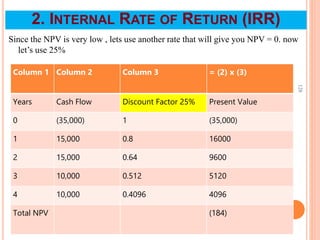
Since the NPV is very low , lets use another rate that will give you NPV = 0. now
let’s use 25%
Column 1 Column 2 Column 3 = (2) x (3)
Years Cash Flow Discount Factor 25% Present Value
0 (35,000) 1 (35,000)
1 15,000 0.8 16000
2 15,000 0.64 9600
3 10,000 0.512 5120
4 10,000 0.4096 4096
Total NPV (184)
129
2. INTERNAL RATE OF RETURN (IRR)
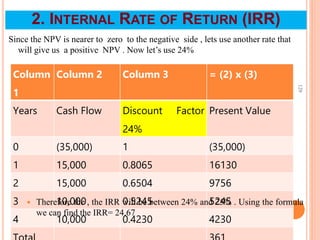
Since the NPV is nearer to zero to the negative side , lets use another rate that
will give us a positive NPV . Now let’s use 24%
Column
1
Column 2 Column 3 = (2) x (3)
Years Cash Flow Discount Factor
24%
Present Value
0 (35,000) 1 (35,000)
1 15,000 0.8065 16130
2 15,000 0.6504 9756
3 10,000 0.5245 5245
4 10,000 0.4230 4230
 Therefore the , the IRR will be between 24% and 25% . Using the formula
we can find the IRR= 24.67
 Selection criterion for IRR
 We accept all independent projects having an IRR equal or grater than
the opportunity cost of capital.
 For mutual exclusive projects, a project with higher IRR is accepted.
130
2. INTERNAL RATE OF RETURN (IRR)
4. SOCIO-ECONOMIC FEASIBILITY ANALYSIS
 Needed when the financial feasibility fails to provide clear idea about the
project due to market price imperfection
 Needed to make sure that the investment on the project contributes to the
national economy
131
 Financial analysis vs economic analysis
 Financial and economic analyses have similar features.
 Both estimate the net-benefits of a project investment based on the
difference between the with-project and the without-project situations.
 However, the two has also differences: the following points indicate their
differences.
132
132
4. SOCIO-ECONOMIC FEASIBILITY ANALYSIS
 Financial analysis vs economic analysis
• Financial analysis
 aims at appraising the financial and commercial feasibility of a project
from the viewpoint of an entrepreneurs, investor, or financier.
 covers only private costs and benefits
• Economic analysis
 deals with the economic contribution and impact of a project at the macro
or national level.
 uses the same financial statements and schedules as a financial analysis
but adjust market prices and costs (to eliminate distortions) by converting
market values to economic values.
133
133
4. SOCIO-ECONOMIC FEASIBILITY ANALYSIS
 Financial analysis vs economic analysis
 Economic analysis is concerned with the true value a project holds for the
society as a whole.
 It subsumes all members of society, and measures the project’s positive and
negative impacts.
 In addition, economic analysis would also cover costs and benefits of goods
and services that are not sold in the market and therefore have no market
price.
 There are two more significant differences between financial and economic
analysis:
134
134
4. SOCIO-ECONOMIC FEASIBILITY ANALYSIS
 Financial analysis vs economic analysis
 While financial analysis uses market prices to check the balance of
investment and the sustainability of a project,
 Economic analysis uses economic prices that are converted from the market
price by excluding tax, profit, subsidy, etc. to measure the legitimacy of using
national resources to certain projects.
135
135
4. SOCIO-ECONOMIC FEASIBILITY ANALYSIS
 Financial analysis vs economic analysis
 Financial and economic analyses also differ in their treatment of external
effects (benefits and costs), such as favourable effects on health.
 Economic analysis attempts to value such externalities in order to reflect the
true cost and value to the society.
 The inclusion of externalities raises difficult questions of their identification
and measurement in terms of money.
136
136
4. SOCIO-ECONOMIC FEASIBILITY ANALYSIS
 Financial analysis vs economic analysis
 But note that, economic and financial analysis are also complementary.
 For a project to be economically viable, it must be financially sustainable.
 If a project is not financially sustainable, there will be no adequate funds to
properly operate, maintain and replace assets.
 It has sometimes been suggested that financial viability should not be made a
concern because as long as a project is economically sound, it can be
supported through government subsidies.
137
137
4. SOCIO-ECONOMIC FEASIBILITY ANALYSIS
 Social cost benefit analysis approach
Assumptions
 For financial analysts, Income distribution issues are beyond the concern of
the project analyst or
 But for economic analysts the issue of the distribution of income in the
country is considered appropriate.
 Project analysis and choice has consequences for employment, output,
consumption, savings, foreign exchange earnings, income distribution, and
other things of relevance to national objectives.
138
4. SOCIO-ECONOMIC FEASIBILITY ANALYSIS
 Purpose
 to see whether these consequences taken together are desirable in the light
of the objectives of national planning.
 to determine which project will increase welfare once distributional impact
is considered.
 to determine the not only the level of project’s benefits and costs but who
receives the benefit and pays the costs.
 Rationales of SCBA
 Imperfection in the input and output markets
 Existence of externalities
 Consideration for income distribution
 Consideration for saving
 Treatment of certain costs as revenue lines
 Consideration for merit
139
139
4. SOCIO-ECONOMIC FEASIBILITY ANALYSIS
5. HR & ORGANIZATION ANALYSIS & PLANNING
I. Project Organization and Management
Organizational Design
 depends on internal and external project requirements and conditions &
includes the following steps:
 The goals and objective for the business are stated
 The functions that are necessary to achieve the goals are specified
 The necessary functions are grouped or related
 The organizational framework or structure is designed
 All key jobs are analyzed, designed and described
 A recruiting and training program is prepared
140
140
Organizational Structure
 takes usually the pyramid shape, with three organizational levels.
 Top management
 Middle management
 Supervisor management
141
5. HR & ORGANIZATION ANALYSIS & PLANNING
 Analysis and planning of the project organizational functions
 General Management
 Accounting and Financial Control
 Marketing Organization
 Organization of Supplies & storage
 Organization of Production
 Organization of Quality Assurance
 Organization of Maintenance
 Organization of Personnel
142
142
5. HR & ORGANIZATION ANALYSIS & PLANNING
II. Human Resources requirement analysis and planning
 Purpose
 To identify and describe such requirements and assess the availability of
human resources as well as the training needs with particular attention
given to the definition and assessment of those skills and experiences.
 Analysis and estimation HR Requirements of the project include:
 Assessment of the availability of personnel and training needs
 The cost estimates for wages, salaries
 Estimates of other personnel related and training expenses
143
143
5. HR & ORGANIZATION ANALYSIS & PLANNING
• Human resources requirement analysis by Functions
• Human resources requirement analysis by Project Phase
• Socio economic considerations in HR analysis and planning
i. Human resources requirement analysis by Functions
Human resources by category
 General management
 Production management and supervision
 Administration (accounting, purchasing etc)
 Production control
 Machine operation and
 Transport
144
5. HR & ORGANIZATION ANALYSIS & PLANNING
ii. Human resources requirement analysis by Project Phase
• Pre – production Phase
• Operational Phase
iii. Socio economic considerations in HR analysis and planning
 Legislation and Labor Terms
 Labor Norms
 Occupational Safety
 Health Care and Social Security
145
145
5. HR & ORGANIZATION ANALYSIS & PLANNING
IV. Components of human resources planning
i. Availability and Recruitment
ii. Training Plan
iii. Cost Estimates
146
146
5. HR & ORGANIZATION ANALYSIS & PLANNING
6. ENVIRONMENTAL IMPACT ANALYSIS
 Is very important
 “Environmental Impact Assessment – EIA is a systematic process that
examines the environmental consequences of development actions, in
advance.”
Example:
 If a dam is to be constructed, you have to know the environmental effects on
upstream and downstream of the dam? How bad effects be mitigated?
 If insecticides, pesticides, etc are to be used in large quantities in irrigation
projects, what will be the effects on fishing, farming?
 What is the effect of gas emission, waste material disposal on soil, water,
animals and the health of the residents?
147
 EIA serves many purposes:
1. For the decision maker: it informs the setting of environmental terms and
conditions for approving proposals.
2. For the Developer: it provides information that can improve the design
of the proposal and ensure that resources are used appropriately and
efficiently.
3. For the residents: it ensures that possible negative impacts are
considered and that appropriate measures for mitigating them are
identified.
148
6. ENVIRONMENTAL IMPACT ANALYSIS
EXAMPLE
 A leather factory constructed x years ago around Sululta is one of the projects
that was found having a significant environmental impact in the community.
 What happened then?
 Cattles and other animals died
 Production was interrupted due to community opposition … loss of
income
149
6. ENVIRONMENTAL IMPACT ANALYSIS
PROJECT PROPOSAL /
Feasibility Report /
150
PROJECT PROPOSAL
Meaning
 It is highly condensed report that briefly summarizes the findings of the
feasibility study.
 The contents of the report should include the following areas .
151
STRUCTURE AND CONTENTS
1. Executive summary
Functions
 As managers are busy and most often not expected to go through the whole
report initially, they are offered with the executive summary, which will
motivate them to go to the details if attracted by it.
 The executive summary should have the same structure as the body of the
feasibility study and cover, but not limited to, the following areas:
152
STRUCTURE AND CONTENTS
2. Summary of the project background and history
 Name and address of project promoters
 Project objectives and outline of the proposed basic project strategy
including the selected geographic area and expected market share
 Project location: orientation towards the market or towards resources (raw
materials)
 Economic and industrial policies supporting the project and other
supporting justifications.
153
STRUCTURE AND CONTENTS
3. Summary of market analysis and marketing concept
 Summary results of marketing research: business environment, target
market and market segmentation, channels of distribution, competition
 List of annual data on supply and demand of goods and services
 Indication of projected marketing costs, elements of the projected sales
programs and revenues
 Description of impacts on raw materials and supplies, location, the
environment, the production program, plant capacity and technology
154
4 Raw materials and supplies
 Description of general availability of raw materials, processed industrial
materials and components, factory supplies, spare parts, supplies for social
and external needs
 Listing of annual supply requirements of material inputs
 Summary of critical inputs and possible strategies of securing such inputs
155
155
STRUCTURE AND CONTENTS
5 Location, site and environment
 Identification and description of location and plant site selected, including
ecological and environmental impacts, socio economic policies,
infrastructural conditions and the natural environment
 Summary of critical aspects of site and location and justification of choice
of location and site
 Outlining significant costs relating to location and site
156
STRUCTURE AND CONTENTS
6 Engineering and technology
 Outlining production program and plant capacity
 Description and justification of significant advantages and
disadvantages as well as life cycle and transfer of technology, training,
risk control, costs, legal aspects etc
 Description of the layout and scope of the project
 Summary of main plant items, their availability and costs
 Description of required major civil engineering works
157
157
STRUCTURE AND CONTENTS
7. Organization and Human Resources Issues
 Description of the basic organizational design of the project
 Indication of the requirements of management systems and measures
required
 Description of project’s HR requirements as well as human resources
availability, recruitment and training needs, and reasons for the
employment of foreign experts, to the extent required for the project
 Indication of key persons (skills) required and total employment numbers
and costs
158
158
STRUCTURE AND CONTENTS
8. Financial analysis and investment appraisal
 Determination of total investment costs: major investment data showing
local and foreign components for land and site preparation; structures and
civil engineering works; plant, machinery and equipment; preproduction
expenditures and costs; net working capital requirements
 Determination of total costs of selling products such as operating costs,
depreciation charges, marketing costs, finance costs
 Identification of sources of project financing: sources of finance, impact of
cost of financing and debt servicing on project proposal, and public policy
on financing
 Summary of the projected financial statements: balance sheets, income
statements, and cash flow statements
 Summary of the profitability (financial) evaluation results of the project.
 Managing uncertainties including critical variables, risks and possible
strategies and means of risk management
159
159
STRUCTURE AND CONTENTS
160
9.Economic analysis/evaluation
 Making national economic evaluation
 Conclusions concerning major advantages of the project, major
drawbacks of the project, and chance of implementing the project.
10. Project Implementation Schedule
 Indication of duration of plant erection and installations
 Indication of duration of production start up and running period
 Identification of actions critical for the timely implementation of the
project
160
STRUCTURE AND CONTENTS
1
PROJECTAPPRAISALAND SELECTION: OVERVIEW
I. DEFINITIONSAND DESCRIPTIONS
1. It is a systematic and comprehensive review of the economic, environmental,
financial, social, technical and other such aspects of a project to determine
if it will meet its objectives.
2. The process of assessing and questioning proposals before resources are
committed.
3. A means by which partnerships can choose the best projects to help them
achieve what they want for their neighborhood.
162
Features: Appraisal involves a careful checking of
 the basic data,
 assumptions and methodology used in project preparation,
 an in-depth review of the work plan, cost estimates, and
proposed financing,
 an assessment of the project's organizational and management
aspects,
 finally the viability of project.
163
PROJECTAPPRAISALAND SELECTION: OVERVIEW
II. OBJECTIVES OF PROJECTAPPRAISAL
1. To help stakeholders
 to be consistent and objective in choosing projects,
 make sure its program benefits all sections of the community,
 provide documentation to meet financial and audit requirements and
 to explain decisions to local people.
2. To justify spending money on a project.
Appraisal asks fundamental questions about whether funding is required and
whether a project offers good value for money.
 It can give confidence that public money is being put to good use, and help
identify other funding to support a project.
 Getting it right may help a partnership make its resources go further in
meeting local need.
164
164
PROJECTAPPRAISALAND SELECTION: OVERVIEW
3. To serve as an important decision making tool.
 helps ensure that
 achieve its objectives for its area,
 are deliverable,
 involve local people, and
 are sustainable, and have sensible ways of managing risk.
4. To lay the foundations for delivery.
 helps ensure that projects will be properly managed,
 ensuring appropriate financial and monitoring systems are in place,
 Ensure there are contingency plans to deal with risks and setting
milestones against which progress can be judged.
165
165
PROJECTAPPRAISALAND SELECTION: OVERVIEW
PROJECT APPRAISAL PROCESS
PROCEDURE
Step 1: Developing appraisal bench marks (Terms of Reference)
Step2: Submission of project proposals by project promoters.
Step3: Evaluation of the project proposals in view of predetermined
benchmarks
Step 4: On field investigations
Step 5: Generation of appraisal reports.
Step 6: Decision making
166
CONSIDERATIONS IN PROJECTAPPRAISAL
1. Only manageable number of project proposals has to be received.
2. Precise, up to date, specific, flexible, objective, and measurable appraisal
benchmarks should be used.
3. Proposed projects should be appraised for their feasibility from all aspects and
dimensions.
4. Responsible consultants with professional integrity should be invited to help in
the appraisal studies.
5. As much as experience on previously appraised projects could be an excellent
input, it should not cloud the objectivity on stakeholders on their decisions.
6. Data inputs and outputs provide by project promoters in their proposals should
be checked for factuality and timeliness by the appraising experts/analysis.
7. For the project to move to the next phases, appraising stakeholders should
present their feedbacks as quickly as possible.
8. An individual stakeholder [sponsor, banks, government agency, supplier, etc]
should consider the potential of the proposed project to satisfy the demand of
the other stakeholders.
167
167
PROJECT APPRAISAL FACTORS
1. Marketing/demand Appraisal
 Periodic sales forecast
 Sales revenue
 Sales costs
 Contribution of sales to profit
 Dynamism in product life cycle management
 Impact of substitute & complimentary products
 Prospects of export marketing
 Marketing action plan on product, pricing, promotion, and
distribution.
168
168
PROJECT APPRAISAL FACTORS
2. Technical appraisal
 The raw material input requirement and availability.
 The project’s products and their design
 The capacity requirements
 The location/site selected for the project
 The technology requirement & its availability
 The production programme/schedules
 The civil works and layout arrangements selected.
169
169
4. Economic Appraisal
 Create fair employment opportunities
 Transform the site it uses for the project
 Deliver its outputs on time to the target users
 Pay taxes
 Transfer technology to the economic system
 Create capital [foreign or domestic] for investment
 The Balance between the requirements vs returns from a project is the
basis of project’s economic appraisal.
170
170
PROJECT APPRAISAL FACTORS
4. Economic Appraisal
 Create fair employment opportunities
 Transform the site it uses for the project
 Deliver its outputs on time to the target users
 Pay taxes
 Transfer technology to the economic system
 Create capital [foreign or domestic] for investment
 The Balance between the requirements vs returns from a project is the
basis of project’s economic appraisal.
171
171
PROJECT APPRAISAL FACTORS
5. Human resources/Organizational appraisal
 Skill, knowledge, expertise, and experience related requirements
against the availability.
 Project staff size and composition
 Distribution of project responsibilities and authority
 Flow of communication in and out of the project
 Decision making system in the allocation and use of resources.
 The management skills requirements.
172
172
PROJECT APPRAISAL FACTORS
6. Environmental impact appraisal
 Magnitude of use of raw material inputs
 Degree of hazards related to pollution and wastage
 Product safety and friendliness to users
 Safety risks of the technology used
 Socio economic impacts on the conformity to environmental laws and
regulations set by the government opinions on environment related
issues.
173
173
PROJECT APPRAISAL FACTORS
KEY ISSUES IN PROJECTAPPRAISAL & SELECTION
 Need, targeting and objectives
 Context and connections
 Consultation
 Options
 Inputs
 Outputs and outcomes
 Value for money
 Implementation
 Risk and uncertainty
 Forward strategies
 Sustainability
174
174
APPRAISAL CHECKLIST
 Whether you are involved in a partnership with an appraisal system in place,
or starting to design one from scratch,
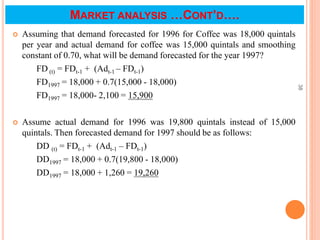
 these questions are worth asking.
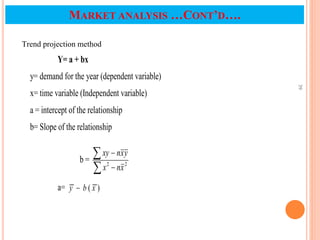
 Are appraisals systematic and disciplined with a clear sequence of
activities and operating rules?
 Is there an independent assessment of the project by someone who has not
been involved with the development of the project?
 Does the appraisal process culminate/conclude in clear recommendations
that inform approval (or rejection) of the project?
 Is the approval stage clearly separate?
175
175
APPRAISAL CHECKLIST
 Is the appraisal process well documented, with key documents signed,
showing ownership and agreement, and allowing the appraisal
documentation to act as a basis for future management, monitoring, and
evaluation?
 Does the appraisal system comply with any relevant government guidance
 Are the right people involved at various stages of the process and, if
necessary, how can you widen involvement? (Here, you may also want to
look at other topics, such as building a partnership, or community
involvement.)
 Does your system enable the key components of successful project
appraisal (summarized above) to be considered within a balanced
appraisal of a project as a whole?
176
176
CHAPTER END QUESTIONS
1. Complete your project proposal within the coming weeks
1/3/2023
177

525412627-2-Project-Management-2018-BAIS-3-4.ppt

  • 1.
  • 2.
    Implementation Formulation Evaluation Identification THE PROJECT CYCLE:PROJECT FORMULATION Appraisal and Financing decision 2
  • 3.
    At the endof this session, participants will be able to:  Define project feasibility studies and appreciate their services in the effective management of projects.  Conduct project analysis focusing on  the marketing,  technical,  financial,  socio-economic,  environmental, and  human resources/organizational factors.  Prepare project proposal, and  Conduct project appraisal. 3 LEARNING OBJECTIVES
  • 4.
    Feasibility Study: Theschematic diagram shown below gives you good looking of your feasibility study. Yes No Yes No Fig: Hierarchy of feasibility Study Generation of ideas Initial Screening Is the idea promising? Plan Feasibility Analysis Conduct Market Analysis Conduct Technical Analysis Conduct Financial Analysis Conduct Economic Analysis Conduct Ecological Analysis Is the project worthwhile? Prepare funding proposal Terminate Terminate 1
  • 5.
    3.1:PRE-FEASIBILITY / PRELIMINARYSCREENING  Some kind of preliminary study is required to select ideas which are promising.  In doing so looking the following aspects is helpful. 1. Compatibility with promoter 2. Consistency with government priorities 3. Availability of inputs 4. Adequacy of the market 5. Reasonableness of cost 6. Acceptability of risk level 5
  • 6.
    PRELIMINARY SCREENING ....... Compatibility with the Promoter  It fits the personality of the entrepreneur  It is accessible to him  It offers him the prospect of rapid growth and high return on the invested capital 6
  • 7.
    PRELIMINARY SCREENING ........ consistency with the government priorities  is the project consistent with the national goals and priorities?  are there any environmental effects contrary to governmental regulations?  can foreign exchange requirements of the project be easily accommodated?  will there be any difficulty in obtaining the license of the project? 7
  • 8.
    PRELIMINARY SCREENING ............... availability of inputs  are the capital requirements of the project within manageable limits?  can technical know-how required for the project be obtained?  are the raw material required for the project available domestically at a reasonable cost? if the raw materials have to be imported, will there be problems?  is the power supply for the project reasonably obtainable from external sources and captive power resources 8
  • 9.
    PRELIMINARY SCREENING .......... Adequacy of Market  Total present domestic/foreign market  Competitors and their market share  Export markets  Sales and distribution system  Projected increase in consumption  Barriers to the entry of new entrants  Economic, social and demographic trends  Patent protection 9
  • 10.
    PRELIMINARY SCREENING .......... Reasonableness of Cost  Cost of material inputs  Labour costs  Factory overheads  General administrative expenses  Selling and distribution cost  Service cost  Economies of scale 10
  • 11.
    PRELIMINARY SCREENING  Acceptabilityof Risk Level  Vulnerability of business cycles  Technological changes  Competition from substitutes  Competition from imports  Governmental control over price and distribution 11
  • 12.
    YOUR REFLECTION!!  Whatare the differences between pre- feasibility and feasibility study?  What the various aspects/components of project feasibility study? 1
  • 13.
    3.2:PROJECT FEASIBILITY STUDY:OVERVIEW • Meaning and Background  It is an analysis of the viability of a project idea using different parameters. • Indications of a Feasible Project  Generating adequate cash-flow and profits,  Withstanding the risks it will encounter,  Remaining viable in the long-term and meet the goals of the founders. 13
  • 14.
    FEASIBILITY …CONT’D… • Consequencesof poor feasibility studies  Overstatement of returns, market share, sales volume, etc.  Underestimated costs, resources, risk, etc.  Omission of a necessary component  Failure to consider the variability of environment  Optimistic calendar for implementation,  Low capacity utilization,  Heavy costs overruns,  Deteriorated financial profitability. 14
  • 15.
    COMPONENTS OF FEASIBILITYSTUDIES 1.Market Analysis 2.Technical Analysis 3. Financial Analysis 4. Economic Analysis 5. Environmental Analysis 6. Organization/Management analysis 15
  • 16.
    1. MARKET/DEMAND ANALYSIS •In most cases, the first step in project analysis is to estimate the potential size of the market • Market/demand analysis : meaning & purposes:  Market: any set of individuals, households, or organizations with potential/actual demand to be satisfied.  Demand: the ability as well as willingness to acquire and use something (goods/services) of value. • Market and demand analysis involves and focuses on:  the level of demand for the product or service  marketability of the product or the service of the project  the market determining factors  demand forecasting and analysis 16
  • 17.
    ROLE OF MARKET&DEMAND ANALYSIS  Market/demand analysis is a special stage in the feasibility study.  It usually ranks top in the sequence of the core components of a feasibility study.  The reasons for the primacy of market/demand analysis are specified below. 1. Engineers, financial analysts, as well as Economist, who have to calculate the socio – economic costs and benefits of a project, can only start their job, if the market analyst has finished his part and has delivered a sales forecast and market strategy to his colleagues.  They all depend on these information, which have a strong impact for instance on:  Capacity planning,  Technology selection,  Staffing,  Promotion and service department  Working capital, and  Financial planning. 17
  • 18.
    ROLE OF MARKETNLYIS 2. they rely on the quality of the market analysis, since their calculations can easily turn out to be waste of time, if the demand and sales forecast has to be revised. 3. Moreover, market analysis is obviously more ambitious and risky in comparison to the other parts of a feasibility study, as it has to fight with the future.  The projection of future demand and expected sales needs the orientation about the external environment and its factors. 4. The marketing demand and sales forecast should necessarily be the base for analysis on the subsequent components because: It has to deal with the behavior of human beings; It has to assume how customers respond to the taste, smell and to all the properties of the product, to the design, packaging, labeling and not to forget to the price. 18
  • 19.
    MARKET ANALYSIS ..CONT’D…. •Major Dimensions of Market/Demand Analysis  General Indicators of the Economy  Product  Demand  Supply  Marketing Environment /Marketing mix/Strategy • Process of Market and Demand Analysis  Situational analysis and specification of objectives  Collection of secondary information  Conduct of market survey (primary information)  Characterization of the market  Demand forecasting  Market planning 19
  • 20.
    MARKET ANALYSIS….CONT’D…. Collection of secondary Information Situational Analysisand Specification of Objectives Conduct of Market Survey Characterization of the market Demand Forecasting Marketing Planning Key steps in a Market and Demand Analysis and their relationships 20
  • 21.
    MARKET ANALYSIS …CONT’D…. Step1:Situational Analysis and Specification of Objectives  It is where the project analyst may informally talk to customers, competitors, middlemen, and others in the industry  If such a situational analysis generates enough data to measure the market and get a reliable handle over project demand and revenues, a formal study need not to be out, particularly when cost and time considerations so suggest.  In most cases, of course, a formal study of market and demand are warranted 21
  • 22.
    MARKET ANALYSIS …CONT’D…. Step1:Situational Analysis and Specification of Objectives  Purpose  to get a "feel" for the relationship between the product and its market.  to answer the following questions:  Who are the buyers of the product?  What is the total current demand for the product? 22
  • 23.
    MARKET ANALYSIS …CONT’D…. How is the demand distributed (pattern of sales over the year) and geographically?  What price will the customers be willing to pay for the product?  How can potential customers be convinced about the superiority of the new product?  What channels of distribution are most suited for the product?  What trade margins will induce distributors to carry it?  What are the prospects for immediate sales? 23
  • 24.
    Step 2: Collectionof Secondary Information  In order to answer the questions raised above while under taking market and demand analysis, information is obtained from secondary and/or primary sources.  Secondary information is information that has been gathered from some other context.  General/Major Source of Secondary Information  National Census reports  National sample survey report  Economic survey  Annual survey of industry  Industry potential survey 24 MARKET ANALYSIS …CONT’D….
  • 25.
     Evaluation ofSecondary Information  Who gathered the information and What was the objective?  When was the information gathered? When was it published?  How representative was the period for which the information was gathered?  What was the target population?  How was the sample chosen? How representative was the sample?  How satisfactory was the process of information gathering?  What was the degree of misrepresentation by respondents?  How accurately was the information edited, tabulated and analyzed?  Was statistical analysis properly applied? 25 MARKET ANALYSIS …CONT’D….
  • 26.
    Step 3: Conductof Market Survey  Secondary information, though useful, does not often provide a comprehensive basis for market and demand analysis.  It needs to be supplemented with primary information gathered through a market survey, specific to the project being proposed.  The market survey may be a census survey where the entire population is covered (the word 'population' is used here in a particular sense.  Examples are, all industries using milling machines, all readers of the Economic Times.  Census surveys are employed principally for intermediate goods and investment goods when such goods are used by a smaller number of firms.  In other cases, a census survey is prohibitively costly and may be infeasible. 26 MARKET ANALYSIS …CONT’D….
  • 27.
    Step 3: Conductof Market Survey  Focus points  Total demand and rate of growth of demand  Demand in different segments of the market  Income and price elasticity's of demand  Motives for buying  Purchasing plans and intentions  Satisfaction with existing products  Unsatisfied needs  Attitudes towards various products  Socio-economic characteristics of buyers 27 MARKET ANALYSIS …CONT’D….
  • 28.
     Steps inmarket Survey  Define the target population  Develop the questionnaires (data collection instruments)  Recruit and train field investigators  Obtain information as per the questionnaire from the sample of respondents  Scrutinize the information Gathered  Analyze and interpret the information  Report the findings 28 MARKET ANALYSIS …CONT’D….
  • 29.
    Step 4: Characterizationof the Market  Based on the information gathered from secondary sources and through the market survey, the market of the product/service may be described in terms of the following:  Effective demand in the past and present  Breakdown of demand  Price  Methods of distribution and sales promotion  Consumers  Supply and competition  Government policy 29 MARKET ANALYSIS …CONT’D….
  • 30.
    Step 4: Characterizationof the Market  Effective demand in the past and present:  To gauge the effective demand in the past and present, the starting point typically is apparent consumption, which is defined as:  Apparent Consumption = Production + Imports - Exports - Changes in the Stock Level  Example: Consider the following data for a specific product that computes the effective demand for each year: 30 MARKET ANALYSIS …CONT’D….
  • 31.
    Step 4: Characterizationof the Market 31 MARKET ANALYSIS …CONT’D…. Year Production Import Export Ending Inventory Effective Demand 1995 30,000 12,000 9,000 7,000 26,000 1996 38,000 15,000 16,000 14,000 30,000 1997 45,000 10,000 17,000 15,000 37,000 1998 48,000 10,000 14,000 12,000 47,000 1999 50,000 8,000 10,000 8,000 52,000
  • 32.
    Step 4: Characterizationof the Market Breakdown of demand:  To get deeper insight into the nature of demand, the aggregate (total) market demand may need to breakdown into demand for different segments of the market.  Market segments may be defined by nature of product, consumer group, and geographical division. 32 MARKET ANALYSIS …CONT’D….
  • 33.
    Step 4: Characterizationof the Market a. Nature of product: One generic name often subsumes many different products:  steel covers sections, rolled products, and various semi-finished products,  commercial vehicles cover trucks and buses of various capacities; so on and so forth. b. Consumer group: Consumers of a product may be divided into industrial consumers and domestic consumers.  Industrial consumers may be sub-divided industry-wise.  Domestic consumers may be further divided into different income groups. c. Geographical division: A geographical breakdown of consumers, particularly for products, which have a small value-to-weight relationship, and products, which require regular, efficient after-sale service, is helpful. 33 MARKET ANALYSIS …CONT’D….
  • 34.
    Step 5: Demand/SalesForecasting  Techniques/methods  I. Qualitative methods/techniques of forecasting  Expert opinion method  Delphi method  Sales force method  Panel forecasting  II. Quantitative techniques of forecasting 1. Time series analysis techniques a. Moving average method/techniques i. Simple moving average technique ii. Weighted moving average technique b. Exponential smoothing method c. Trend projection method 2. Causal Methods a. Regression analysis b. Consumption Level Method 34 MARKET ANALYSIS …CONT’D….
  • 35.
    1. Time seriesanalysis techniques a. Moving average method/techniques i. Simple moving average technique Ft = di n ii. Weighted moving average technique Ft= W1(Ft-1)+W2(Ft-2)+………………Wn(Ft-n) b. Exponential smoothing method Ft = Ft-1 + α (At-1 - Ft-1) c. Trend projection method Y= a + bx Year Demand 1 200,000 2 250,000 3 300,000 4 350,000 5 250,000 35 MARKET ANALYSIS …CONT’D….
  • 36.
    Required i. Forecast demandfor year six using the simple moving average of the recent three years. Solution F6 = 300,000+350,000+250,000 3 = 300,000 tons of cement shall be demanded ii. Assume that a weight of 0.5 has been assigned for the most recent data followed by weights of 0.3 and 0.2 for the next recent figures. Demand for year 6 is? Solution F6 = 0.5(250,000)+0.3(350,000)+0.2(300,000) = 125,000+105,000+60,000 = 290,000 tons is the forecasted demand 36 MARKET ANALYSIS …CONT’D….
  • 37.
    iii. Assuming thatdemand forecasted for year 5 for the product was 400,000 tons. Assuming further that the value of smoothing constant (α) is 0.50, what is demand forecast for year 6? Solution F t = Ft-1 + (At -1- Ft-1) F6 = 400,000+ 0.5(250,000 – 400,000) F6 = 400,000+0.5(- 150,000) F6 = 400,000+(- 75,000) = 325,000 tons is the forecasted demand for year 6 37 MARKET ANALYSIS …CONT’D….
  • 38.
     Assuming thatdemand forecasted for 1996 for Coffee was 18,000 quintals per year and actual demand for coffee was 15,000 quintals and smoothing constant of 0.70, what will be demand forecasted for the year 1997? FD (t) = FDt-1 + (Adt-1 – FDt-1) FD1997 = 18,000 + 0.7(15,000 - 18,000) FD1997 = 18,000- 2,100 = 15,900  Assume actual demand for 1996 was 19,800 quintals instead of 15,000 quintals. Then forecasted demand for 1997 should be as follows: DD (t) = FDt-1 + (Adt-1 – FDt-1) DD1997 = 18,000 + 0.7(19,800 - 18,000) DD1997 = 18,000 + 1,260 = 19,260 38 MARKET ANALYSIS …CONT’D….
  • 39.
    39 MARKET ANALYSIS …CONT’D…. Y=a + bx y= demand for the year (dependent variable) x= time variable (Independent variable) a = intercept of the relationship b= Slope of the relationship b = 2 2 x n x y x n xy     a= ) ( x b y  Trend projection method
  • 40.
    40 MARKET ANALYSIS …CONT’D…. xy xy 1 200,000 1 200000 2 250,000 4 500000 3 300,000 9 900000 4 350,000 16 1400000 5 250,000 25 1250000 15 1,350,000 55 4250000 3 270000 11 850000
  • 41.
    iv. Forecast salesfor the next year using the trend projection technique. Solution b= 20,000 a= 210,000 y= 210,000 + 20,000x F6= 210,000 + 20,000(6) = 330,000 tons 41 MARKET ANALYSIS …CONT’D….
  • 42.
    42 MARKET ANALYSIS …CONT’D…. YearSales 1 2,109 2 2,530 3 2,287 4 3,194 5 3,785 6 3,372 7 3,698 8 3,908 9 3,725 10 4,129 11 4,532 12 4,487 EXAMPLE -2: CONSIDER DEMAND FOR COFFEE PER TONE IS GIVEN BELOW . FORECAST THE DEMANDS FOR COFFEE FOR THE NEXT YEAR.
  • 43.
    43 MARKET ANALYSIS …CONT’D…. Year(X)Sales(Y) X.Y X2 1 2,109 2109 1 2 2,530 5060 4 3 2,287 6861 9 4 3,194 12776 16 5 3,785 18925 25 6 3,372 20232 36 7 3,698 25886 49 8 3,908 31264 64 9 3,725 33525 81 10 4,129 41290 100 11 4,532 49852 121 12 4,487 53844 144 Sum 78 41756 301624 650 Averages 6.5 3479.667 25135.33 54.17
  • 44.
    iv. Forecast salesfor the next year using the trend projection technique. Solution b= 211.258 a= 2106.41 F13= 211.258 + 2106.41(13) = 4852.764 tons 44 MARKET ANALYSIS …CONT’D….
  • 45.
    Causal Methods  Theyseek to develop forecasts on the basis of cause-effect relationships specified in an explicit, quantitative manner. a. Regression analysis  This is a very popular demand forecasting tool in practice.  It involves extrapolating the past trend of demand with identified factor affecting the demand such as income to project the future consumption.  It measures the average amount of change in the dependent variable associated with a unit change in one or more independent variables. 45 MARKET ANALYSIS …CONT’D….
  • 46.
     To illustratethe linear demand equation, assume that demand for a commodity in a town is a function of number of households (HHs).  The equation to forecast demand called the linear regression equation and the forecast results will be as shown below.  (Note: The formula to compute a and b in the equations are the same as the linear time series analysis except that the independent variable in this case is not time but number of households).  Forecast the sales for commodity (in tones) if the number of households is 100. 46 MARKET ANALYSIS …CONT’D….
  • 47.
    47 MARKET ANALYSIS …CONT’D…. NoofHHs(X)Sales(Y) 80 200 92 210 96 240 98 300 99 340
  • 48.
    48 MARKET ANALYSIS …CONT’D…. NoofHHs(X)Sales(Y) X.Y X2 80 200 16000 6400 92 210 19320 8464 96 240 23040 9216 98 300 29400 9604 99 340 33660 9801 Sums 465 1290 121420 43485 Averages 93 258 24284 8697
  • 49.
    Forecast sales forthe next year if the number of household is 100. Solution b= 6.041 a= -303.875 y100= -303.875 + 6.041(100) = 300.225 tons 49 MARKET ANALYSIS …CONT’D….
  • 50.
    Chain ratio method The potential sale of a product is estimated by applying a series of factors to a measure of aggregate demand.  It uses a simple analytical approach to demand estimation.  Example: A firm that plans to manufacture stainless steel blades in Ethiopia may estimate its potential sales as follows: 50 MARKET ANALYSIS …CONT’D….
  • 51.
    51 MARKET ANALYSIS …CONT’D…. Adultmale population in the country 20 million Proportion of adult male pop. using shaving blades 0.6 Adult male population using shaving blades 12 million Number of times in a year a person shaves 100 Total shavings done per year 1,200 million Proportion of shavings done with stainless steel blades 0.4 Average no. of shavings per stainless steel blade 6 Number of stainless steel blades used per year (1200 million x 0.4) / 6 80 million Proportion of stainless steel blade market the firm could capture 0.2 Potential sales 16 million
  • 52.
    Step 6: MarketPlanning i. Analysais of Current marketing situation ii. Specification of Marketing Objectives iii. Marketing Mix Strategies  Product management strategy  Pricing management strategy  Place (Distribution) management strategy  Promotion management strategy iv. Developing Action Plan and Program 52 MARKET ANALYSIS …CONT’D….
  • 53.
    2. TECHNICAL ANALYSIS General framework  After gathering and analyzing information on market and demand and determining the market feasibility of the project, we need to conduct technical analysis concerned primarily with:  Materials inputs and utilities  Product mix  Plant capacity  Location site  Machinery and equipment  Structure and civil work  Project chart and layouts  Work schedule 53
  • 54.
    I. Raw materialand Supplies Study  Importance  Materials and supplies are the major inputs (ingredients) of any project  Some (raw materials and supplies) will be incorporated in the finished product as tangible and visible items.  There is a closer relationship between the definition of input requirements and other aspects of the project formulation, such as the definition of plant capacity, location, and selection of technology and equipment. 54 2. TECHNICAL ANALYSIS
  • 55.
    I. Issues tobe raised in relation to materials analysis:  What types of materials are needed?  Where are the sources of the materials and supplies?  How the materials and supplies are obtained?  What are the costs of each material?  What environmental factors should be considered? 55 2. TECHNICAL ANALYSIS
  • 56.
    1. Classification ofRaw Materials and Supplies A. Unprocessed and semi-processed raw materials  Livestock and forest products  Agricultural products  Marine products  Mineral products B. Processed industrial materials and components  Base metals  Semi processed material  Manufactured parts, components and sub-assemblies C. Auxiliary materials factory supplies  Packaging materials, containers and crates  Other supplies  Recycled waste D. Utilities  Electricity, Fuel, and Water E. Spare parts F. Supplies for social and external needs 56 2. TECHNICAL ANALYSIS
  • 57.
    2. Specification ofRequirements  Why specification of material requirements?  It is the basis for the assessment and analysis of the availability of the project inputs.  only when the detailed specifications of the inputs available are known, the final engineering design of the project can be prepared.  It describes and analyzes features and characteristics in such a way that a good understanding of what the project requires is developed.  It will form the basis for the supply program and the subsequent cost estimates.  The supply program and cost estimates may be known as bill of materials (BOM) in production/operations management. 57 2. TECHNICAL ANALYSIS
  • 58.
     Factors Considered Technical factors- such as technology and production process, type of machinery and equipment, production capacity and program.  Commercial and financial factors- such as market demand regarding products quality, competition for materials.  Socio-economic factors- such as skill of work force, environmental policies, etc 58 2. TECHNICAL ANALYSIS
  • 59.
    3. Availability andSupply i. Availability and sources of materials issues to be precisely determined:  Materials and inputs available from local sources: location and area of supplies, concentrated or dispersed, alternative uses, transportability and transport costs.  Materials and inputs to be imported: sources, foreign exchange restrictions, reliability of supplies and uncertainty that relate to the import etc. 59 2. TECHNICAL ANALYSIS
  • 60.
    ii. Supply Marketingand Supply Programs a. Supply Marketing  Objectives are cost minimization, risk minimization, and cultivation of relations with supplier. b. Supply Program  should deal with the following:  Identification of supply sources and suppliers, Agreements and regulations, Quantities and qualities, Consignments, Means of transport, Storage, Risk assessment 60 2. TECHNICAL ANALYSIS
  • 61.
    c. Considerations inselecting supplier/s  location  ownership  main activities  financial strength and profitability  production capacity, output over last years  key customers and business experience 61 2. TECHNICAL ANALYSIS
  • 62.
    d. The supplyprogram shall indicate the following clearly  The quantities and qualities that can be supplied from various sources (in comparison with the specified requirements in terms of all relevant factors)  Means of transport for key materials and inputs such as by air, water, road, or rail including their availability, capacity, reliability and technical condition  Loading, unloading, and storage facilities at the ports as well as at the plant 62 2. TECHNICAL ANALYSIS
  • 63.
    4. Cost ofRaw Materials and Parts Objective  to estimate the current and projected prices of materials and inputs in the context of past trends and future prospects for both locally available and imported items. 63 2. TECHNICAL ANALYSIS
  • 64.
    i. Unit costs Domestic materials costs: are projected set in the context of past trends and future projections of the elasticity of supply.  Imported material inputs: CIF (cost, insurance, and freight) should be adopted with clearing charges such as loading, unloading, port charges, tariffs, local insurance and taxes, and costs of internal transport to the plant. 64 2. TECHNICAL ANALYSIS
  • 65.
    ii. Annual costs cost estimates should be associated to a hypothetical level of production and capacity utilization levels  A distinction should be made between materials and inputs to be purchased and those actually to be consumed in a particular year –(the difference being stocked.)  calculating indirect costs should be established per unit of production or per accounting period whichever is appropriate.  material and input requirements of other project’s components (service, administration, and sales) should also be considered. 65 2. TECHNICAL ANALYSIS
  • 66.
    II. PRODUCT MIX Product Mix Decisions  The breadth of the product line/s being managed currently  The depth of the product line/s being managed currently  Project Analysis & Initiation Vs Product Mix Options  Expansion  Contraction  Differentiation  Trading up vs trading down  Substitution 66 2. TECHNICALANALYSIS
  • 67.
    III. PROJECT CAPACITYANDPRODUCTION PROGRAM A. Project/Plant Capacity  the volume or number of units that can be produced during a given period.  This definition implies the output expectation from the production of a plant. Capacity Decision Factors  Technological Requirement  Input constraints  Investment cost  Market conditions  Resources of the firm  Government policy 67 2. TECHNICAL ANALYSIS
  • 68.
    Capacity Decision Levels/Terms I.Nominal Maximum Capacity (NMC)  Is the technically feasible capacity, frequently corresponds to the installed capacity as guaranteed by the supplier of the plant and includes reserve and stand-by capacity. II. Feasible Normal Capacity  is achievable under normal working conditions taking into account the installed equipment and technical conditions of the plant, such as Normal stoppages, Downtime, Maintenance, Tool checks, Desired shift patterns and the management system. Determination of the Feasible Normal Plant Capacity  Economies of Scale  Minimum Economic Size and Equipment Constraints 68 2. TECHNICAL ANALYSIS
  • 69.
    B. Production Program It should define the levels of output to be achieved during specified periods and, from this viewpoint, should be directly related to the specific sales forecasts. Functions (1) indicates the basic products, by – products, and wastes during the process. (2) Plans changes in time during project life. (3) Plans/determines extraction rates and operating ratios effectively and adequately 69 2. TECHNICALANALYSIS
  • 70.
    (4) Once  aproduction program defines the levels of outputs in terms of end product, and  possibly of intermediate products and the operating ratio between various production lines and processes,  the specific requirements of materials and labour should be qualified for each stage. (5)The specific quantities needed for each stage of the production program and costs that these entail should be determined. The input requirements and costs have to be assessed for:  Basic materials such as raw materials, semi – process, bought – out items  Auxiliary materials and factory supplies  Major utilities and  Direct labour requirements 70 2. TECHNICALANALYSIS
  • 71.
    IV. Location Analysis The strategic orientation of the choice of suitable locations requires an assessment of  Market and marketing aspects  The availability of critical project inputs, such as raw materials and factory supplies  Technical project requirements  The type of industry  Technology and process  Characteristics of products and outputs  Size of the plant  Organizational requirements and management structure 71 2. TECHNICAL ANALYSIS
  • 72.
    Location selection factors i.Proximity to Raw Materials and Market  A resource based project like a cement factory or still mill should be located close to the source of basic materials;  A product based on imported materials may be located near the port; and  A project manufacturing a perishable product should be close to the center of consumption. ii. Availability of Infrastructure  Availability of electric power, transportation, water, and communications should be carefully assessed before a location decision is made. iii. Government Policies  Government policies have a bearing on location.  In the case of public sectors projects, location is directly decided by the government.  There are also some private sector projects on which government makes subsidies. 72 2. TECHNICAL ANALYSIS
  • 73.
    Choice of Site Selection factors  Ecological conditions of sites  Environmental impacts  Socio–economic conditions (restrictions, incentives, requirements)  Costs of land  Infrastructure  Site preparation and development costs  Strategy of the projects such as future expansion  Cost of utility lines extension  Size and shape of the available area  Nature of goods (products) produced (perishables or no)  Proximity of centers of consumption (market orientation  Distance to seaport (import and export) 73 2. TECHNICALANALYSIS
  • 74.
    V. TECHNOLOGY/ENGINEERING (Analysis& Selection)  Focuses on (involves) The selection of an appropriate technology, and  Planning of the acquisition and absorption of this technology and the corresponding know – how. 74 2. TECHNICAL ANALYSIS
  • 75.
    a. Engineering analysisand design  Is responsible to design the functional and physical layout for the industrial plant necessary to produce the defined output and to determine the corresponding investment expenditures as well as the costs arising during the operational phase.  The scope of engineering also includes  Infrastructure  Factory and other buildings and civil works  Their inter relationship with utilities, material flows, machinery installations  Other aspects of plant construction and operations. 75 2. TECHNICALANALYSIS
  • 76.
    b. Technology Choice considerations Plant capacity  Principal inputs  Investment outlay and production cost  Use by other units  Product mix  Latest developments  Ease of absorption 76 2. TECHNICAL ANALYSIS
  • 77.
    c. Technology Evaluationand Selection  Appropriate technology refers to the methods of production, which are suitable to heal economic, social, and cultural conditions.  Technology should be evaluated in terms of:  Whether the technology utilizes local raw materials  Whether the technology utilized local man power  Whether the goods and services produced cater the basic needs  Whether the technology protects ecological balance  Whether the technology is harmonious with social and cultural conditions 77 2. TECHNICAL ANALYSIS
  • 78.
    d. Technology Acquisitionand Transfer It involves: i. Securing Industrial Property Rights  considering patents, trade marks, copyright and proprietary technology or be in the form of un-patented know – how that is available from only a limited number of sources. ii. Selecting Means of Technology acquisition and transfer options  Technology licensing  Outright purchase of technology,  A joint venture involving participation in ownership by the technology supplier iii. Specifying Contract Terms and Conditions 78 2. TECHNICALANALYSIS
  • 79.
    VI. Detailed PlantLayout analysis and planning o The important considerations in preparing the plant layout are:  Consistency with production technology  Smooth flow of goods from one stage to another  Proper utilization of space  Scope of expansion  Minimization of production cost  Safety of personnel. 79 2. TECHNICALANALYSIS
  • 80.
    3. FINANCIAL ANALYSISAND PLANNING Financial Analysis Objective/s  to identify the project’s  Financial efficiency  Incentive or impact to the participants (investors, creditors, sponsors, etc.)  Creditworthiness and  Liquidity 80
  • 81.
    3. FINANCIAL ANALYSISAND PLANNING Information requirement  Cost of project  Means of financing  Estimates of sales and production  Working capital requirement and its financing  Projected cash flow statements (based on projected balance sheets & income statements)  Break even points  Projected profits  Projected risks 81
  • 82.
    I. Analysis andplanning of Cost of Project A. Estimate Investment Costs  Investment cost represents the total of all items of outlay associated with a project, which are supported by long term funds.  It is the sum of the following outlays:  Land and Site Development  Building and Civil Works  Plant and Machinery  Miscellaneous Fixed Assets  Preliminary and Capital Issue Expense  Pre - Operative Expense  Provision of Contingencies 82 3. FINANCIAL ANALYSIS AND PLANNING
  • 83.
    B. Production Costs i.Direct material costs  cover those materials directly involved in the production/operational process of the project and includes costs of acquiring raw materials and processed materials. ii. Direct labor costs  are costs incurred to mobilize labor to direct operational activities and are determined as periodic salaries/wages. iii. Indirect material and labor costs  address those materials and labor adopted in supportive functions.  Such costs are committed to acquire accessories, establish power and IT systems, storage and warehousing, mobilize materials handling personnel, etc. 83 3. FINANCIAL ANALYSIS AND PLANNING
  • 84.
    C. Overhead Costs Administrative overhead costs  Marketing and sales overhead costs  Factory overhead costs  Service overhead costs 84 3. FINANCIAL ANALYSIS AND PLANNING
  • 85.
    II. Analysis &Planning of Means of Financing a Project A. Sources/means of financing project i. Share capital  Equity capital  Preferred capital ii. Term loan  provided by financial institutions and commercial bank’s credit facilities. iii. Debenture capital  similar to that of the promissory note, which is a promise to pay some day in the future, debentures are instruments for raising debts capital.  Such as issuing bond, which is long term financing. iv. Deferred credit  often suppliers of plant and machinery offer a deferred credit facility under which payment for the purchase of plant and machinery can be made over a long period. v. Incentive source vi. Miscellaneous sources 85 3. FINANCIAL ANALYSIS AND PLANNING
  • 86.
    B. Selecting theProject Financing Means  Guidelines that should be born in mind are: i. Norms of regulatory bodies and Financial Institutions  In many countries including Ethiopia, the proposed means of financing for a project must be either approved by a regulatory body or conform to a certain norms laid down by the government or financial institutions in this regard. ii. Key business considerations  cost  risk  control, and  flexibility. 86 3. FINANCIAL ANALYSIS AND PLANNING
  • 87.
    III. Develop Projectionof Financial Statements  The potential financial performance/feasibility of a project is ultimately examined using the financial evaluation techniques.  To examine the project’s financial feasibility, we need to develop and analyze forecasted financial statements including:  Cash flow statement  Balance sheet  Income statement 87 3. FINANCIAL ANALYSIS AND PLANNING
  • 88.
     Prepare ProjectedCash Flow Statements (CFS)  shows the movement of cash in the firm and its net impact on the cash balance with in the firm/project  Analyzes and presents the future cash movement of the project in relation to:  Investment  Operations  Financing  The following format provides us with a structure to prepare a comprehensive cash flow statement. 88 3. FINANCIAL ANALYSIS AND PLANNING
  • 89.
    Illustration: cash flowstatement i. Sources of funds (A) Disposition of funds (B)  share issue 1. capital expenditures  profit before taxation and interest 2. increase in working capital  depreciation 3. decrease in loans  reserves 4. repayment of debts  New /increased loans 5. decrease in accounts payable  increase in deposits 6. increase in investments  increase in accounts payables 7. interest  sale of fixed assets 8. taxation  sale of investments 9. dividends  sale of equity /shares 10. buy back of equity Total of A Total of B ii. Computing the ending balance of cash for a period Opening balance of cash on hand for the period + Net surplus /deficit (A-B) = Closing (ending) balance of cash for the period 89 3. FINANCIAL ANALYSIS AND PLANNING
  • 90.
    Illustration: preparing projectedcash flow statements  The sources information for the cash flow statement are:  balance sheet for the end of period n  expected changes for the period n +1  changes on the income statement for period n+1 Project A Balance sheet Dec. 31, year n Assets Liabilities + capital Fixed assets 720 Secured loans 320 Investments - Unsecured loans 200 Current assets Acc. payable 360 Cash 80 Provisions 80 Receivables 320 Share capital 400 Inventories 320 Reserve and surpluses 80 Total br 1,440 Total br 1,440 90 3. FINANCIAL ANALYSIS AND PLANNING
  • 91.
    Project A Income statement Forthe year n Sales 1600 - Cost of good sold 1200 - Depreciation 80 Profit before interest and tax 320 - Interest 80 Profit before tax 240 - Tax 120 Profit after tax (Net Income) 120 - Dividends 40 retained earning /surplus 80 91 3. FINANCIAL ANALYSIS AND PLANNING
  • 92.
     Expected commitmentsand changes for n+1  Raising a secured term loan of birr 80  Repaying a term loan of birr 20  Increasing un secured loan of birr 40  Acquisition of fixed assets worth birr 120  Increase in inventories birr 40 and  Increase accounts receivables birr 60 92 3. FINANCIAL ANALYSIS AND PLANNING
  • 93.
    Project A Projected cashflow statement For period n+1 Sources of funds (A)  Profit before interest and tax 320  Depreciation 80  Increase in secured loans 60  Increase in unsecured loans 40 Total of (A) birr 500 Disposition of funds (B)  Capital expenditure 120  Increase in working capital 100  Interest 80  Taxation 120  Dividends 40 Total of (B) birr 460 Opening balance of cash on hand birr 80 + Net surplus/ deficit in period n+1 (A-B) 40 Closing balance of cash on hand for n+1 birr 120 93 3. FINANCIAL ANALYSIS AND PLANNING
  • 94.
    Project A Projected balancesheet Dec. 31 period n+1 Assets opening balance Changes during n+1 closing balance Fixed assets 720 +(120) - 80(depreciation) birr 760 Investments - - - Current assets Cash 80 +40 (net surplus) 120 Inventories 320 +40 (Expected increase) 360 Receivable 320 +60 (Expected increase) 380 Total birr 1,620 Liabilities Opening Changes during closing And capital balance the period (n+1) balance Secured loans br 320 +80 (term Loan)-20 (Repayment) birr 380 Unsecured loans 200 +40 (proposed increase) 240 Accounts payable 360 - 360 Provisions 80 - 80 Share capital 400 - 400 Reserves and surplus 80 + 80 (retained earnings) 160 Total birr 1,620 94 3. FINANCIAL ANALYSIS AND PLANNING
  • 95.
     Evaluation focus Profit  Risk  Techniques A. Non-discounted evaluation methods  do not consider the time value of money.  Include techniques such as:  Payback period  ROI 95 4. FINANCIAL EVALUATION
  • 96.
    1. PAYBACK PERIOD considers the time taken to gain a financial return equal to the initial investment.  The period is usually expressed in years and months.  Payback period = Initial Investment Accumulated annual cash flows  The initial investment outlay includes all capital investments made before the plant starts operation as well as during the plant operation 96
  • 97.
    Illustration 1: uniformannual cash flows  A project whose initial investment outlay is Birr 800,000 is expected to remain active for the next 12 years earning a uniform annual net cash flow of Birr 150, 000. Solution  Since the project has a uniform cash flow over its lifetime, dividing the initial investment by annual cash flow will give you the payback period. Payback period = 800,000 = 5.33 years 150,000 97 97 1. PAYBACK PERIOD
  • 98.
    Illustration 2: differentannual cash flows  a company wishes to buy a new machine for a 5-year project. The manager has to choose between machine A and machine B, so it is mutually exclusive solution.  Although both machines have the same initial cost (Birr 700,000), their cash flows perform differently over the 5-year period. 98 1. PAYBACK PERIOD
  • 99.
    99 99 Year Cash-Flow (Birr) Initial investmentcost 700,000, - for each machine Machine A Machine B 0 (700,000) (700,000) 1 200,000 100,000 2 380,000 300,000 3 240,000 150,000 4 100,000 300,000 5 150,000 400,000 Payback period 2 and half years 3 and half years 1. PAYBACK PERIOD
  • 100.
    2. RETURN ONINVESTMENT (ROI)  Is a measure of profitability that relates income to investment.  This method first calculates the average profit, which is simply the project initial outlay deducted from the total gains or cash flows, divided by the number of years the investment will run.  The profit is then converted into percentages of the total outlay using the following equations: Average Annual Profit = (Total NCF) – (Total investment outlay) Number of years Return on Investment = Average Annual Profit x 100% Original investment Illustration : • Consider the machine selection example introduced earlier. Using this example compute the Return on Investment. 100 100
  • 101.
    Solution Machine A Total Profits= $1,070,000 – 700,000 = 370,000 Average Profit = $370,000/5 years = $74,000 per year Return on Investment = (74,000 x 100)/ 700,000 = 10.58% Machine B Total Profits = $1,250,000 – 700,000 = 550,000 Average Profit = $550,000/5 years = $110,000 per year Return on Investment = (110,000 x 100)/ 700,000 = 15.71% 101 101 2. RETURN ON INVESTMENT (ROI)
  • 102.
    Selection criteria forROI  All independent projects having a ROI equal to or greater than a pre-specified ROI are accepted.  For mutually exclusive projects, we will accept a project with higher ROI. Selection decisions  Machine A realizes its payback period earlier than machine B, meaning it has a better chance getting selected than B.  Machine B has larger rate of ROI than machine A, meaning it has a better chance getting selected than A. 102 2. RETURN ON INVESTMENT (ROI)
  • 103.
    DISCOUNTING TECHNIQUES  Conceptof discounting  Money has time value  One birr received today is more than one birr received in 2 years. Why? 1. Psychological explanation 2. If invested, can generate positive return 3. During inflation the future purchasing power decreases 1
  • 104.
    104 104 1. Net PresentValue (NPV)  can be defined as the present worth of cash flow streams generated by an investment.  is calculated by adding the values obtained by discounting the annual cash flows occurring throughout the life of a project as follows: NPV= ∑ NCF (1 + r)n Where: NCF = is net cash flow n = is the period for which the PV is calculated r = is the interest rate Illustration  Consider a 5 year agricultural investment project. Assume the discount rate to be 18%. DISCOUNTING TECHNIQUES
  • 105.
    The steps tocalculate NPV are:  Setting up the NPV format/table  Writing the corresponding years in the project life in column 1  Writing the net cash flows in column 2  Writing the corresponding discount factors of each year at the specified discount rate in column 3  Writing the present value of the net cash flow of each year in column 4 by multiplying net cash flow by the corresponding discount factor.  Aggregating the present values to give the NPV 105 DISCOUNTING TECHNIQUES
  • 106.
    Column 1 Column2 Column 3 Column 4= (2) x (3) Years Net Cash Flow Discount Factor of br. 1 at 18% Present Value 0 (700,000) 1.0000 (700,000) 1 200,000 0.8475 169,500 2 380,000 0.7182 272,916 3 240,000 0.6086 146,064 4 100,000 0.5158 51,580 5 150,000 0.4371 65,565 T.NPV Birr 5,625 106 DISCOUNTING TECHNIQUES
  • 107.
     Selection criterionfor NPV:  We accept all independent projects with NPV greater than zero.  For mutually exclusive projects, project with higher NPV will be accepted. 107 DISCOUNTING TECHNIQUES
  • 108.
    2. INTERNAL RATEOF RETURN (IRR)  The IRR is the return to the capital invested or allocated or investment in the project.  The IRR is the discount rate that makes the present value of cash inflows is equal to the present value of cash outflows, i.e., NPV is zero.  Allows the firm to assess whether an investment in the projects would yield a better return based on internal standards of return  Allows comparison of projects with different initial outlays 108
  • 109.
    STEPS IN APPROXIMATINGTHE IRR  Choose two different discount rates, one leading to a positive NPV, the other to a negative NPV.  Interpolation between these two NPV’s using the formula. 109
  • 110.
    110 IRR = rL+ (rH - rL) x NPV (rL) /NPV (rL)/ + /NPV (rH)/ Where: rL = is a lower interest rate rH = is a higher interest rate NPV (rL) = is NPV calculated at lower interest rate NPV (rH) = is NPV calculated at higher interest rate / / = is a symbol representing absolute value 2. INTERNAL RATE OF RETURN (IRR)
  • 111.
    2. The nextstep is to calculate the NPV at the required rate of return. At 20% of required rate of return the NPV of this project is computed as follows. Column 1 Column 2 Column 3 Column 4= (2) x (3) Years Net Cash Flow Discount Factor of br. 1 at 20% Present Value 0 (700,000) 1.0000 (700,000) 1 200,000 0.8333 166,660 2 380,000 0.6994 265,772 3 240,000 0.5787 138,888 4 100,000 0.4623 46,230 5 150,000 0.4019 60285 Total NPV Birr (22,165) 111 2. INTERNAL RATE OF RETURN (IRR)
  • 112.
    3. Now, usingthe IRR formula and these already generated figures, let us compute the precise rate of return where NPV is equal to zero. IRR = rl + (rh – rl) x NPV (rl) /NPV (rl)/ + /NPV (rh)/  In our illustration: rl=18% (0.18) rh =20% (0.20) NPV (rl) =5,625 NPV (rh) = (22,165)  Hence, given the formula and the required inputs, IRR= 0.18 + (0.20 – 0.18) x 5,625 /5,625/ + /-22,165/ = 0.18 + 112.50 27,790 = 0.18 + 0.00404 = 0.18404 = 18.40% 112 2. INTERNAL RATE OF RETURN (IRR)
  • 113.
    Example 2 113 2. INTERNALRATE OF RETURN (IRR)
  • 114.
    NPV OF MACHINEA Column 1 Column 2 Column 3 = (2) x (3) Years Cash Flow Discounting Factor @20% Present Value 0 (35,000) 1 (35,000) 1 20,000 0.8333 16,666 2 15,000 0.6944 10,416 3 10,000 0.5787 5,787 4 10,000 0.4823 4,823 Total NPV 2,692 114 2. INTERNAL RATE OF RETURN (IRR)
  • 115.
    115 Table: MachineA: DiscountFactor 22 % Column1 Column2 Column3 =(2) x (3) Years CashFlow Discount Factor 22% Present Value 0 (35,000) 1 (35,000) 1 20,000 0.81 97 1 6,394 2 1 5,000 0.671 9 1 0,079 3 1 0,000 0.5507 5,507 4 1 0,000 0.451 4 4,51 4 Total NPV 1 ,494 2. INTERNAL RATE OF RETURN (IRR)
  • 116.
    Column 1 Column2 Column 3 = (2) x (3) Years Cash Flow Discount Factor 24% Present Value 0 (35,000) 1 (35,000) 1 20,000 0.8065 16,130 2 15,000 0.6504 9,756 3 10,000 0.5245 5,245 4 10,000 0.423 4,230 NPV @ 24% 361 116 2. INTERNAL RATE OF RETURN (IRR)
  • 117.
    Column 1 Column2 Column 3 = (2) x (3) Years Cash Flow Discount Factor 25% Present Value 0 (35,000) 1 (35,000) 1 20,000 0.80 16,000 2 15,000 0.64 9,600 3 10,000 0.512 5,120 4 10,000 0.4096 4,096 Total NPV (184) 117 2. INTERNAL RATE OF RETURN (IRR)
  • 118.
    The exact IRRcan be computed using the following formula. IRR =rl + (rh - rl) x NPV (rl) /NPV (rl)/ + /NPV (rh)/ = 0.24 + (0.25 – 0.24) x 361 /361/ + /-184/ = 0.24 + 3.61 = 0.2466 = 24.7% 545 Thus, the IRR is 24.7 %. 118 2. INTERNAL RATE OF RETURN (IRR)
  • 119.
    Simplified Approach . When the cash flow is in the form of annuity  When the cash flow is not in annuity form  The Dominance Technique – if the cash flows at least approximate an annuity  Weighted Approach – if the cash flows display no general annuity pattern 119 2. INTERNAL RATE OF RETURN (IRR)
  • 120.
    1. If thecash flow is annuity .  Consider the above example , if the cash in flows are similar for the life of the project i.e 15,000  first calculate the quotient to approximate and locate the interest rate from the annuity table 35000 = 2.333333 15000  From the table we get 26%  Then calculate the NPV at 26%=15,000x2.320= 34800-35000=(200)  Then calculate the NPV at 25%=15000x2.362= 35430-35000=430 Then the IRR = 25.68 120 2. INTERNAL RATE OF RETURN (IRR)
  • 121.
    2. If thecash flow is not in annuity form. a. dominance technique  Consider the above example , if the cash in flows as follows first calculate the quotient to approximate and locate the interest rate from the annuity table 35000 = 2.333333 and 35,000 =3.5 15000 10,00  From the table we get 26% and 5%  Then calculate the average percentage .25+.05 =15.5% . The calculate NPV using 15.5% 2 121 2. INTERNAL RATE OF RETURN (IRR) Year Cash inflow 1 15,000 2 15,000 3 10,000 4 10,000
  • 122.
    Column 1 Column2 Column 3 = (2) x (3) Years Cash Flow Discount Factor 15.5% Present Value 0 (35,000) 1 (35,000) 1 15,000 0.8658 12987 2 15,000 0.7496 11244 3 10,000 0.6490 6490 4 10,000 0.5619 5619 Total NPV 1340 122 2. INTERNAL RATE OF RETURN (IRR)  Since the NPV is some how big find another rate that will give you NPV = 0 . So use some larger value of 15.5 %. Now let’s try with 18%
  • 123.
    Column 1 Column2 Column 3 = (2) x (3) Years Cash Flow Discount Factor 18% Present Value 0 (35,000) 1 (35,000) 1 15,000 0.8475 12713 2 15,000 0.7182 10773 3 10,000 0.6086 6086 4 10,000 0.5158 5158 Total NPV (270) 123 2. INTERNAL RATE OF RETURN (IRR)  Since the NPV is negative , the rate that will give NPV = 0 is lower than 18 % so let’s use 17 %
  • 124.
    Column 1 Column2 Column 3 = (2) x (3) Years Cash Flow Discount Factor 17% Present Value 0 (35,000) 1 (35,000) 1 15,000 0.8547 12821 2 15,000 0.7305 10957 3 10,000 0.6244 6244 4 10,000 0.5337 5337 Total NPV 359 124 2. INTERNAL RATE OF RETURN (IRR)  Therefore the , the IRR will be between 17% and 18% . Using the formula we can find the IRR= 17.58
  • 125.
    2. If thecash flow is not in annuity form. a. weighted approach  Consider the above example , with different kinds of cash inflows, i.e o First calculate the weighted cash flow using the following approach 125 2. INTERNAL RATE OF RETURN (IRR) Year Cash inflow 1 20,000 2 15,000 3 10,000 4 10,000 Year Cash inflow Weight Weighted cash flow 1 20,000 4 80,000 2 15,000 3 45,000 3 10,000 2 20,000 4 10,000 1 10,000 Total 10 155,000
  • 126.
    126 2. INTERNAL RATEOF RETURN (IRR)  The weighted cash flow is =15500 =15,500 10  Then calcualte the the quetient to approximate the rate to from the annuity table . So 35,000 = 2.258  15,500  So from the anity table we get 28%, so using this rate calculate the NPV Column 1 Column 2 Column 3 = (2) x (3) Years Cash Flow Discount Factor 28% Present Value 0 (35,000) 1 (35,000) 1 15,000 0.7813 15626 2 15,000 0.6104 9156
  • 127.
    127 2. INTERNAL RATEOF RETURN (IRR)  The weighted cash flow is =15500 =15,500 10  Then calcualte the the quetient to approximate the rate to from the annuity table . So 35,000 = 2.258  15,500  So from the anity table we get 28%, so using this rate calculate the NPV Column 1 Column 2 Column 3 = (2) x (3) Years Cash Flow Discount Factor 17% Present Value 0 (35,000) 1 (35,000) 1 15,000 0.8547 12821 2 15,000 0.7305 10957
  • 128.
    128 2. INTERNAL RATEOF RETURN (IRR) Since the NPV is very low , lets use another rate that will give you NPV = 0. now let’s use 25% Column 1 Column 2 Column 3 = (2) x (3) Years Cash Flow Discount Factor 25% Present Value 0 (35,000) 1 (35,000) 1 15,000 0.8 16000 2 15,000 0.64 9600 3 10,000 0.512 5120 4 10,000 0.4096 4096 Total NPV (184)
  • 129.
    129 2. INTERNAL RATEOF RETURN (IRR) Since the NPV is nearer to zero to the negative side , lets use another rate that will give us a positive NPV . Now let’s use 24% Column 1 Column 2 Column 3 = (2) x (3) Years Cash Flow Discount Factor 24% Present Value 0 (35,000) 1 (35,000) 1 15,000 0.8065 16130 2 15,000 0.6504 9756 3 10,000 0.5245 5245 4 10,000 0.4230 4230  Therefore the , the IRR will be between 24% and 25% . Using the formula we can find the IRR= 24.67
  • 130.
     Selection criterionfor IRR  We accept all independent projects having an IRR equal or grater than the opportunity cost of capital.  For mutual exclusive projects, a project with higher IRR is accepted. 130 2. INTERNAL RATE OF RETURN (IRR)
  • 131.
    4. SOCIO-ECONOMIC FEASIBILITYANALYSIS  Needed when the financial feasibility fails to provide clear idea about the project due to market price imperfection  Needed to make sure that the investment on the project contributes to the national economy 131
  • 132.
     Financial analysisvs economic analysis  Financial and economic analyses have similar features.  Both estimate the net-benefits of a project investment based on the difference between the with-project and the without-project situations.  However, the two has also differences: the following points indicate their differences. 132 132 4. SOCIO-ECONOMIC FEASIBILITY ANALYSIS
  • 133.
     Financial analysisvs economic analysis • Financial analysis  aims at appraising the financial and commercial feasibility of a project from the viewpoint of an entrepreneurs, investor, or financier.  covers only private costs and benefits • Economic analysis  deals with the economic contribution and impact of a project at the macro or national level.  uses the same financial statements and schedules as a financial analysis but adjust market prices and costs (to eliminate distortions) by converting market values to economic values. 133 133 4. SOCIO-ECONOMIC FEASIBILITY ANALYSIS
  • 134.
     Financial analysisvs economic analysis  Economic analysis is concerned with the true value a project holds for the society as a whole.  It subsumes all members of society, and measures the project’s positive and negative impacts.  In addition, economic analysis would also cover costs and benefits of goods and services that are not sold in the market and therefore have no market price.  There are two more significant differences between financial and economic analysis: 134 134 4. SOCIO-ECONOMIC FEASIBILITY ANALYSIS
  • 135.
     Financial analysisvs economic analysis  While financial analysis uses market prices to check the balance of investment and the sustainability of a project,  Economic analysis uses economic prices that are converted from the market price by excluding tax, profit, subsidy, etc. to measure the legitimacy of using national resources to certain projects. 135 135 4. SOCIO-ECONOMIC FEASIBILITY ANALYSIS
  • 136.
     Financial analysisvs economic analysis  Financial and economic analyses also differ in their treatment of external effects (benefits and costs), such as favourable effects on health.  Economic analysis attempts to value such externalities in order to reflect the true cost and value to the society.  The inclusion of externalities raises difficult questions of their identification and measurement in terms of money. 136 136 4. SOCIO-ECONOMIC FEASIBILITY ANALYSIS
  • 137.
     Financial analysisvs economic analysis  But note that, economic and financial analysis are also complementary.  For a project to be economically viable, it must be financially sustainable.  If a project is not financially sustainable, there will be no adequate funds to properly operate, maintain and replace assets.  It has sometimes been suggested that financial viability should not be made a concern because as long as a project is economically sound, it can be supported through government subsidies. 137 137 4. SOCIO-ECONOMIC FEASIBILITY ANALYSIS
  • 138.
     Social costbenefit analysis approach Assumptions  For financial analysts, Income distribution issues are beyond the concern of the project analyst or  But for economic analysts the issue of the distribution of income in the country is considered appropriate.  Project analysis and choice has consequences for employment, output, consumption, savings, foreign exchange earnings, income distribution, and other things of relevance to national objectives. 138 4. SOCIO-ECONOMIC FEASIBILITY ANALYSIS
  • 139.
     Purpose  tosee whether these consequences taken together are desirable in the light of the objectives of national planning.  to determine which project will increase welfare once distributional impact is considered.  to determine the not only the level of project’s benefits and costs but who receives the benefit and pays the costs.  Rationales of SCBA  Imperfection in the input and output markets  Existence of externalities  Consideration for income distribution  Consideration for saving  Treatment of certain costs as revenue lines  Consideration for merit 139 139 4. SOCIO-ECONOMIC FEASIBILITY ANALYSIS
  • 140.
    5. HR &ORGANIZATION ANALYSIS & PLANNING I. Project Organization and Management Organizational Design  depends on internal and external project requirements and conditions & includes the following steps:  The goals and objective for the business are stated  The functions that are necessary to achieve the goals are specified  The necessary functions are grouped or related  The organizational framework or structure is designed  All key jobs are analyzed, designed and described  A recruiting and training program is prepared 140 140
  • 141.
    Organizational Structure  takesusually the pyramid shape, with three organizational levels.  Top management  Middle management  Supervisor management 141 5. HR & ORGANIZATION ANALYSIS & PLANNING
  • 142.
     Analysis andplanning of the project organizational functions  General Management  Accounting and Financial Control  Marketing Organization  Organization of Supplies & storage  Organization of Production  Organization of Quality Assurance  Organization of Maintenance  Organization of Personnel 142 142 5. HR & ORGANIZATION ANALYSIS & PLANNING
  • 143.
    II. Human Resourcesrequirement analysis and planning  Purpose  To identify and describe such requirements and assess the availability of human resources as well as the training needs with particular attention given to the definition and assessment of those skills and experiences.  Analysis and estimation HR Requirements of the project include:  Assessment of the availability of personnel and training needs  The cost estimates for wages, salaries  Estimates of other personnel related and training expenses 143 143 5. HR & ORGANIZATION ANALYSIS & PLANNING
  • 144.
    • Human resourcesrequirement analysis by Functions • Human resources requirement analysis by Project Phase • Socio economic considerations in HR analysis and planning i. Human resources requirement analysis by Functions Human resources by category  General management  Production management and supervision  Administration (accounting, purchasing etc)  Production control  Machine operation and  Transport 144 5. HR & ORGANIZATION ANALYSIS & PLANNING
  • 145.
    ii. Human resourcesrequirement analysis by Project Phase • Pre – production Phase • Operational Phase iii. Socio economic considerations in HR analysis and planning  Legislation and Labor Terms  Labor Norms  Occupational Safety  Health Care and Social Security 145 145 5. HR & ORGANIZATION ANALYSIS & PLANNING
  • 146.
    IV. Components ofhuman resources planning i. Availability and Recruitment ii. Training Plan iii. Cost Estimates 146 146 5. HR & ORGANIZATION ANALYSIS & PLANNING
  • 147.
    6. ENVIRONMENTAL IMPACTANALYSIS  Is very important  “Environmental Impact Assessment – EIA is a systematic process that examines the environmental consequences of development actions, in advance.” Example:  If a dam is to be constructed, you have to know the environmental effects on upstream and downstream of the dam? How bad effects be mitigated?  If insecticides, pesticides, etc are to be used in large quantities in irrigation projects, what will be the effects on fishing, farming?  What is the effect of gas emission, waste material disposal on soil, water, animals and the health of the residents? 147
  • 148.
     EIA servesmany purposes: 1. For the decision maker: it informs the setting of environmental terms and conditions for approving proposals. 2. For the Developer: it provides information that can improve the design of the proposal and ensure that resources are used appropriately and efficiently. 3. For the residents: it ensures that possible negative impacts are considered and that appropriate measures for mitigating them are identified. 148 6. ENVIRONMENTAL IMPACT ANALYSIS
  • 149.
    EXAMPLE  A leatherfactory constructed x years ago around Sululta is one of the projects that was found having a significant environmental impact in the community.  What happened then?  Cattles and other animals died  Production was interrupted due to community opposition … loss of income 149 6. ENVIRONMENTAL IMPACT ANALYSIS
  • 150.
  • 151.
    PROJECT PROPOSAL Meaning  Itis highly condensed report that briefly summarizes the findings of the feasibility study.  The contents of the report should include the following areas . 151
  • 152.
    STRUCTURE AND CONTENTS 1.Executive summary Functions  As managers are busy and most often not expected to go through the whole report initially, they are offered with the executive summary, which will motivate them to go to the details if attracted by it.  The executive summary should have the same structure as the body of the feasibility study and cover, but not limited to, the following areas: 152
  • 153.
    STRUCTURE AND CONTENTS 2.Summary of the project background and history  Name and address of project promoters  Project objectives and outline of the proposed basic project strategy including the selected geographic area and expected market share  Project location: orientation towards the market or towards resources (raw materials)  Economic and industrial policies supporting the project and other supporting justifications. 153
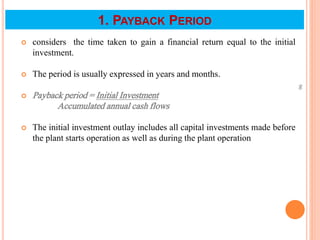
  • 154.
    STRUCTURE AND CONTENTS 3.Summary of market analysis and marketing concept  Summary results of marketing research: business environment, target market and market segmentation, channels of distribution, competition  List of annual data on supply and demand of goods and services  Indication of projected marketing costs, elements of the projected sales programs and revenues  Description of impacts on raw materials and supplies, location, the environment, the production program, plant capacity and technology 154
  • 155.
    4 Raw materialsand supplies  Description of general availability of raw materials, processed industrial materials and components, factory supplies, spare parts, supplies for social and external needs  Listing of annual supply requirements of material inputs  Summary of critical inputs and possible strategies of securing such inputs 155 155 STRUCTURE AND CONTENTS
  • 156.
    5 Location, siteand environment  Identification and description of location and plant site selected, including ecological and environmental impacts, socio economic policies, infrastructural conditions and the natural environment  Summary of critical aspects of site and location and justification of choice of location and site  Outlining significant costs relating to location and site 156 STRUCTURE AND CONTENTS
  • 157.
    6 Engineering andtechnology  Outlining production program and plant capacity  Description and justification of significant advantages and disadvantages as well as life cycle and transfer of technology, training, risk control, costs, legal aspects etc  Description of the layout and scope of the project  Summary of main plant items, their availability and costs  Description of required major civil engineering works 157 157 STRUCTURE AND CONTENTS
  • 158.
    7. Organization andHuman Resources Issues  Description of the basic organizational design of the project  Indication of the requirements of management systems and measures required  Description of project’s HR requirements as well as human resources availability, recruitment and training needs, and reasons for the employment of foreign experts, to the extent required for the project  Indication of key persons (skills) required and total employment numbers and costs 158 158 STRUCTURE AND CONTENTS
  • 159.
    8. Financial analysisand investment appraisal  Determination of total investment costs: major investment data showing local and foreign components for land and site preparation; structures and civil engineering works; plant, machinery and equipment; preproduction expenditures and costs; net working capital requirements  Determination of total costs of selling products such as operating costs, depreciation charges, marketing costs, finance costs  Identification of sources of project financing: sources of finance, impact of cost of financing and debt servicing on project proposal, and public policy on financing  Summary of the projected financial statements: balance sheets, income statements, and cash flow statements  Summary of the profitability (financial) evaluation results of the project.  Managing uncertainties including critical variables, risks and possible strategies and means of risk management 159 159 STRUCTURE AND CONTENTS
  • 160.
    160 9.Economic analysis/evaluation  Makingnational economic evaluation  Conclusions concerning major advantages of the project, major drawbacks of the project, and chance of implementing the project. 10. Project Implementation Schedule  Indication of duration of plant erection and installations  Indication of duration of production start up and running period  Identification of actions critical for the timely implementation of the project 160 STRUCTURE AND CONTENTS
  • 161.
  • 162.
    PROJECTAPPRAISALAND SELECTION: OVERVIEW I.DEFINITIONSAND DESCRIPTIONS 1. It is a systematic and comprehensive review of the economic, environmental, financial, social, technical and other such aspects of a project to determine if it will meet its objectives. 2. The process of assessing and questioning proposals before resources are committed. 3. A means by which partnerships can choose the best projects to help them achieve what they want for their neighborhood. 162
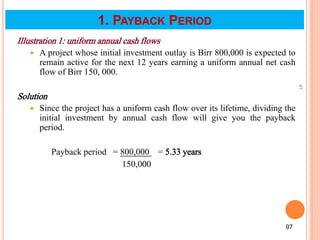
  • 163.
    Features: Appraisal involvesa careful checking of  the basic data,  assumptions and methodology used in project preparation,  an in-depth review of the work plan, cost estimates, and proposed financing,  an assessment of the project's organizational and management aspects,  finally the viability of project. 163 PROJECTAPPRAISALAND SELECTION: OVERVIEW
  • 164.
    II. OBJECTIVES OFPROJECTAPPRAISAL 1. To help stakeholders  to be consistent and objective in choosing projects,  make sure its program benefits all sections of the community,  provide documentation to meet financial and audit requirements and  to explain decisions to local people. 2. To justify spending money on a project. Appraisal asks fundamental questions about whether funding is required and whether a project offers good value for money.  It can give confidence that public money is being put to good use, and help identify other funding to support a project.  Getting it right may help a partnership make its resources go further in meeting local need. 164 164 PROJECTAPPRAISALAND SELECTION: OVERVIEW
  • 165.
    3. To serveas an important decision making tool.  helps ensure that  achieve its objectives for its area,  are deliverable,  involve local people, and  are sustainable, and have sensible ways of managing risk. 4. To lay the foundations for delivery.  helps ensure that projects will be properly managed,  ensuring appropriate financial and monitoring systems are in place,  Ensure there are contingency plans to deal with risks and setting milestones against which progress can be judged. 165 165 PROJECTAPPRAISALAND SELECTION: OVERVIEW
  • 166.
    PROJECT APPRAISAL PROCESS PROCEDURE Step1: Developing appraisal bench marks (Terms of Reference) Step2: Submission of project proposals by project promoters. Step3: Evaluation of the project proposals in view of predetermined benchmarks Step 4: On field investigations Step 5: Generation of appraisal reports. Step 6: Decision making 166
  • 167.
    CONSIDERATIONS IN PROJECTAPPRAISAL 1.Only manageable number of project proposals has to be received. 2. Precise, up to date, specific, flexible, objective, and measurable appraisal benchmarks should be used. 3. Proposed projects should be appraised for their feasibility from all aspects and dimensions. 4. Responsible consultants with professional integrity should be invited to help in the appraisal studies. 5. As much as experience on previously appraised projects could be an excellent input, it should not cloud the objectivity on stakeholders on their decisions. 6. Data inputs and outputs provide by project promoters in their proposals should be checked for factuality and timeliness by the appraising experts/analysis. 7. For the project to move to the next phases, appraising stakeholders should present their feedbacks as quickly as possible. 8. An individual stakeholder [sponsor, banks, government agency, supplier, etc] should consider the potential of the proposed project to satisfy the demand of the other stakeholders. 167 167
  • 168.
    PROJECT APPRAISAL FACTORS 1.Marketing/demand Appraisal  Periodic sales forecast  Sales revenue  Sales costs  Contribution of sales to profit  Dynamism in product life cycle management  Impact of substitute & complimentary products  Prospects of export marketing  Marketing action plan on product, pricing, promotion, and distribution. 168 168
  • 169.
    PROJECT APPRAISAL FACTORS 2.Technical appraisal  The raw material input requirement and availability.  The project’s products and their design  The capacity requirements  The location/site selected for the project  The technology requirement & its availability  The production programme/schedules  The civil works and layout arrangements selected. 169 169
  • 170.
    4. Economic Appraisal Create fair employment opportunities  Transform the site it uses for the project  Deliver its outputs on time to the target users  Pay taxes  Transfer technology to the economic system  Create capital [foreign or domestic] for investment  The Balance between the requirements vs returns from a project is the basis of project’s economic appraisal. 170 170 PROJECT APPRAISAL FACTORS
  • 171.
    4. Economic Appraisal Create fair employment opportunities  Transform the site it uses for the project  Deliver its outputs on time to the target users  Pay taxes  Transfer technology to the economic system  Create capital [foreign or domestic] for investment  The Balance between the requirements vs returns from a project is the basis of project’s economic appraisal. 171 171 PROJECT APPRAISAL FACTORS
  • 172.
    5. Human resources/Organizationalappraisal  Skill, knowledge, expertise, and experience related requirements against the availability.  Project staff size and composition  Distribution of project responsibilities and authority  Flow of communication in and out of the project  Decision making system in the allocation and use of resources.  The management skills requirements. 172 172 PROJECT APPRAISAL FACTORS
  • 173.
    6. Environmental impactappraisal  Magnitude of use of raw material inputs  Degree of hazards related to pollution and wastage  Product safety and friendliness to users  Safety risks of the technology used  Socio economic impacts on the conformity to environmental laws and regulations set by the government opinions on environment related issues. 173 173 PROJECT APPRAISAL FACTORS
  • 174.
    KEY ISSUES INPROJECTAPPRAISAL & SELECTION  Need, targeting and objectives  Context and connections  Consultation  Options  Inputs  Outputs and outcomes  Value for money  Implementation  Risk and uncertainty  Forward strategies  Sustainability 174 174
  • 175.
    APPRAISAL CHECKLIST  Whetheryou are involved in a partnership with an appraisal system in place, or starting to design one from scratch,  these questions are worth asking.  Are appraisals systematic and disciplined with a clear sequence of activities and operating rules?  Is there an independent assessment of the project by someone who has not been involved with the development of the project?  Does the appraisal process culminate/conclude in clear recommendations that inform approval (or rejection) of the project?  Is the approval stage clearly separate? 175 175
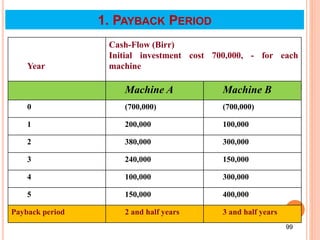
  • 176.
    APPRAISAL CHECKLIST  Isthe appraisal process well documented, with key documents signed, showing ownership and agreement, and allowing the appraisal documentation to act as a basis for future management, monitoring, and evaluation?  Does the appraisal system comply with any relevant government guidance  Are the right people involved at various stages of the process and, if necessary, how can you widen involvement? (Here, you may also want to look at other topics, such as building a partnership, or community involvement.)  Does your system enable the key components of successful project appraisal (summarized above) to be considered within a balanced appraisal of a project as a whole? 176 176
  • 177.
    CHAPTER END QUESTIONS 1.Complete your project proposal within the coming weeks 1/3/2023 177