Department of MBA
IMS Engineering College, Ghaziabad
Marketing Management – II
UNIT 2 PART 1
PRODUCT, PRODUCT MIX, PROODUCT
LEVELS, PRODUCT LIFE CYCLE
Product – Meaning
• According to Philip Kotler, a product is
anything that can be offered to a market for
attention, acquisition, use or consumption that
might satisfy a want or a need.
• It includes physical objects (tangible products),
persons, places, organizations and ideas
• E.g. TV, washing machine, vacation trip
package, hotel stay, driver etc.
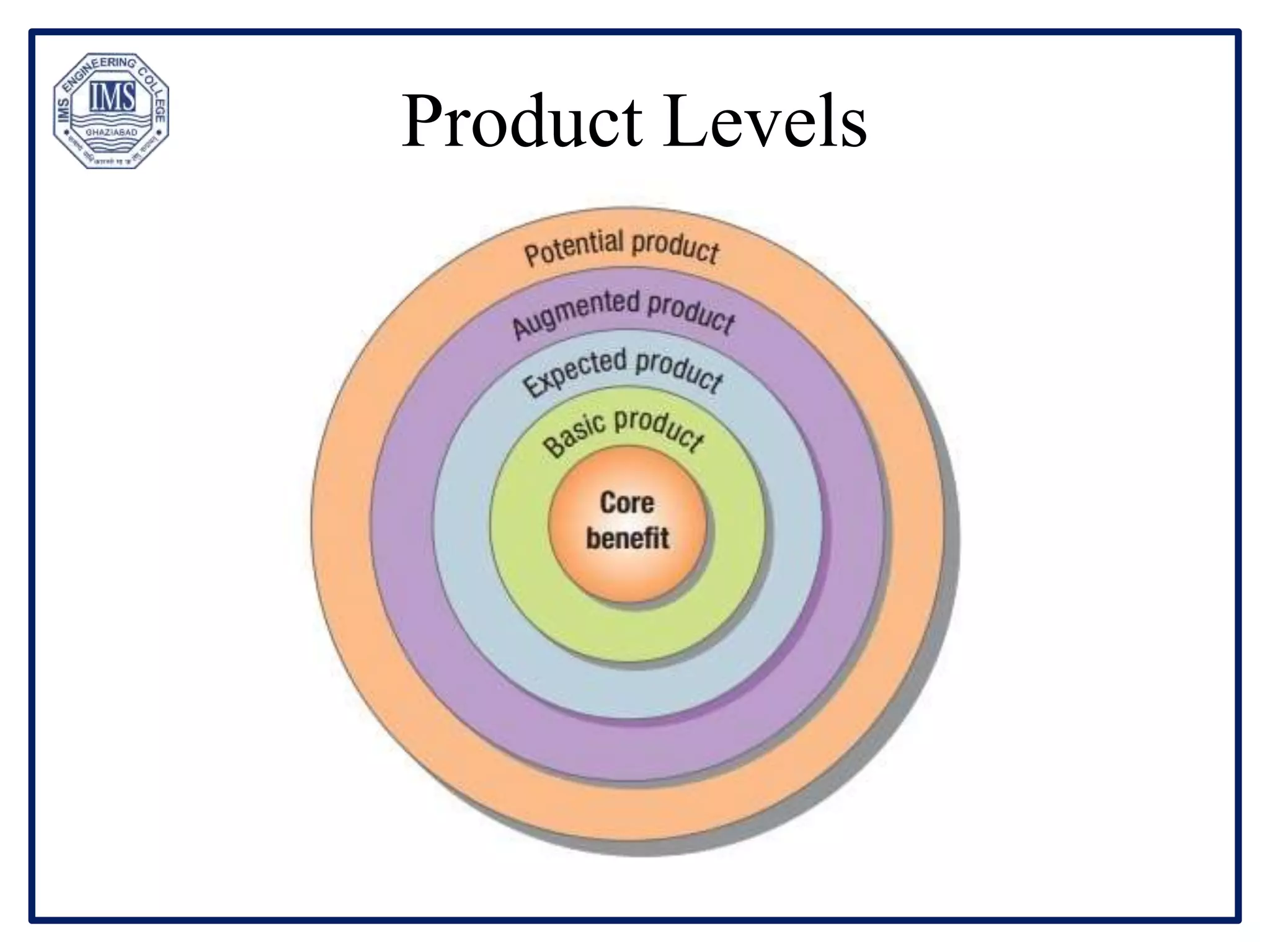
Product Levels
Product Levels
• Core Product: What consumers are really buying
when purchasing a product, in this, it is the core
problem or need which is addressed.
• Basic Product: Basic product is one level up. It
refers to the actual product being offered to the
customer
• Expected Product: Expected product is what the
customer expects from the seller. E.g. in a two
star hotel stay service, air conditioner is expected
Product Levels
• Augmented Product: Augmented product can
be defined as the product in which the seller
has added something from his own.
Augmented means higher than the expectation
of the consumer
• Potential Product: Potential product is one
which does not exist currently but has a
possibility of existing in future. E.g. wi-fi
services during fights
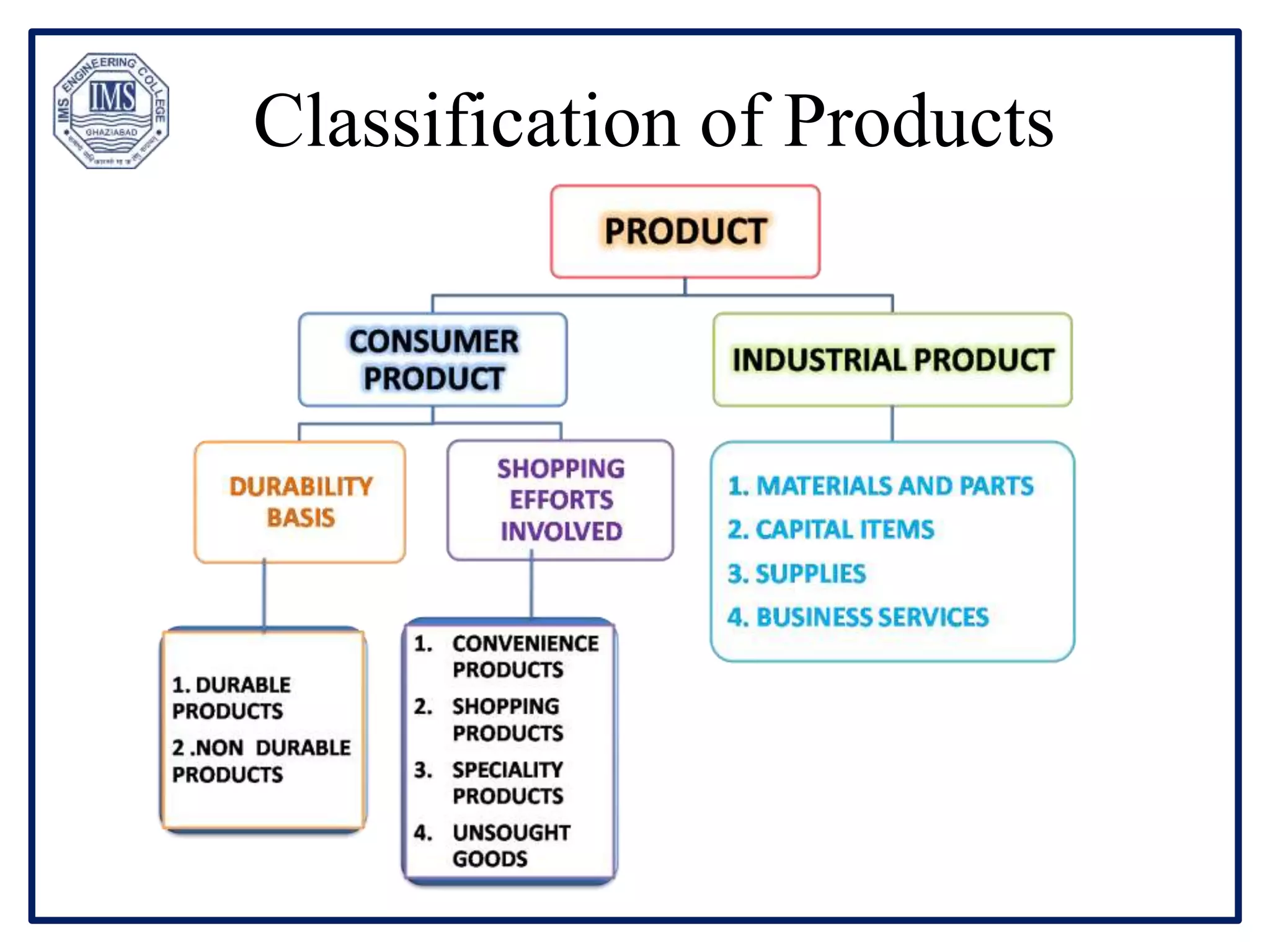
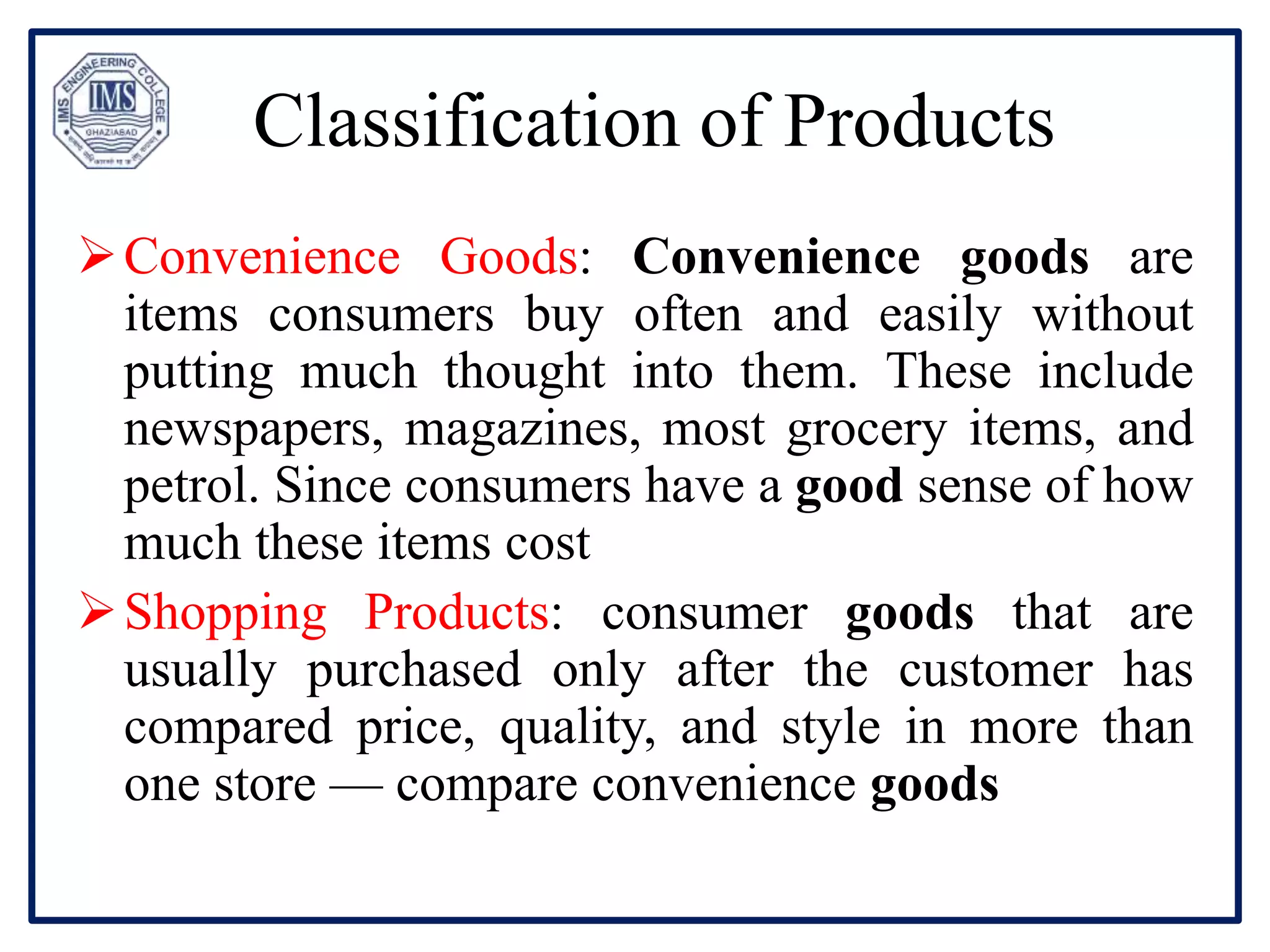
Classification of Products
Convenience Goods: Convenience goods are
items consumers buy often and easily without
putting much thought into them. These include
newspapers, magazines, most grocery items, and
petrol. Since consumers have a good sense of how
much these items cost
Shopping Products: consumer goods that are
usually purchased only after the customer has
compared price, quality, and style in more than
one store — compare convenience goods
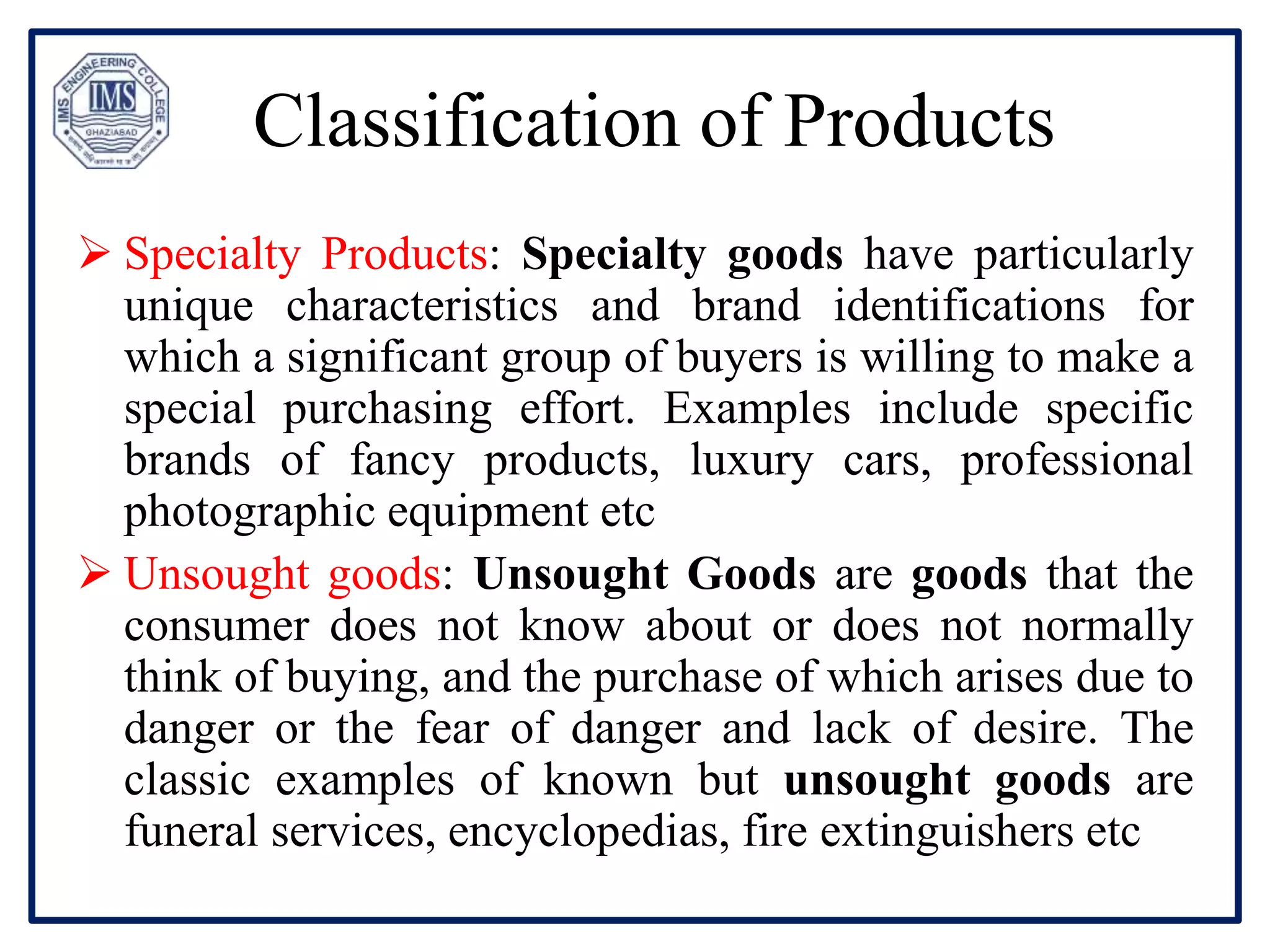
Classification of Products
 Specialty Products: Specialty goods have particularly
unique characteristics and brand identifications for
which a significant group of buyers is willing to make a
special purchasing effort. Examples include specific
brands of fancy products, luxury cars, professional
photographic equipment etc
 Unsought goods: Unsought Goods are goods that the
consumer does not know about or does not normally
think of buying, and the purchase of which arises due to
danger or the fear of danger and lack of desire. The
classic examples of known but unsought goods are
funeral services, encyclopedias, fire extinguishers etc
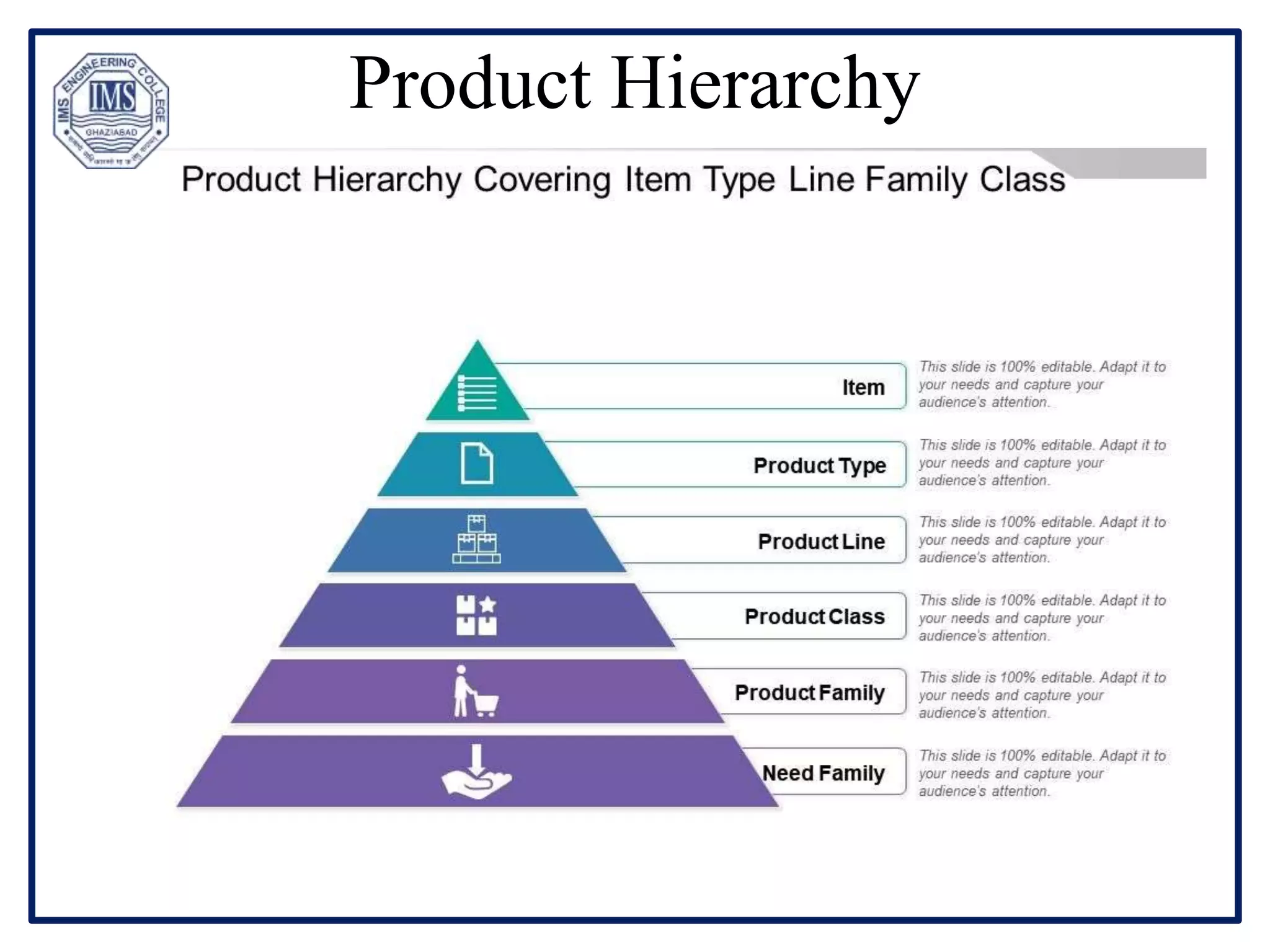
Product Hierarchy
Product Hierarchy
• Need Family: e.g. travelling (going from One
place to another)
• Product Family: e.g. vehicle – cars, bikes,
scooters
• Product Class: e.g. TATA vehicles
• Product Line: e.g. TATA cars
• Product Type: SUVs
• Item or SKU (Stock Keeping Units): Rang
Rover (with model no. and all specifications)
Product Mix
• Product mix of an organization contains three
elements:
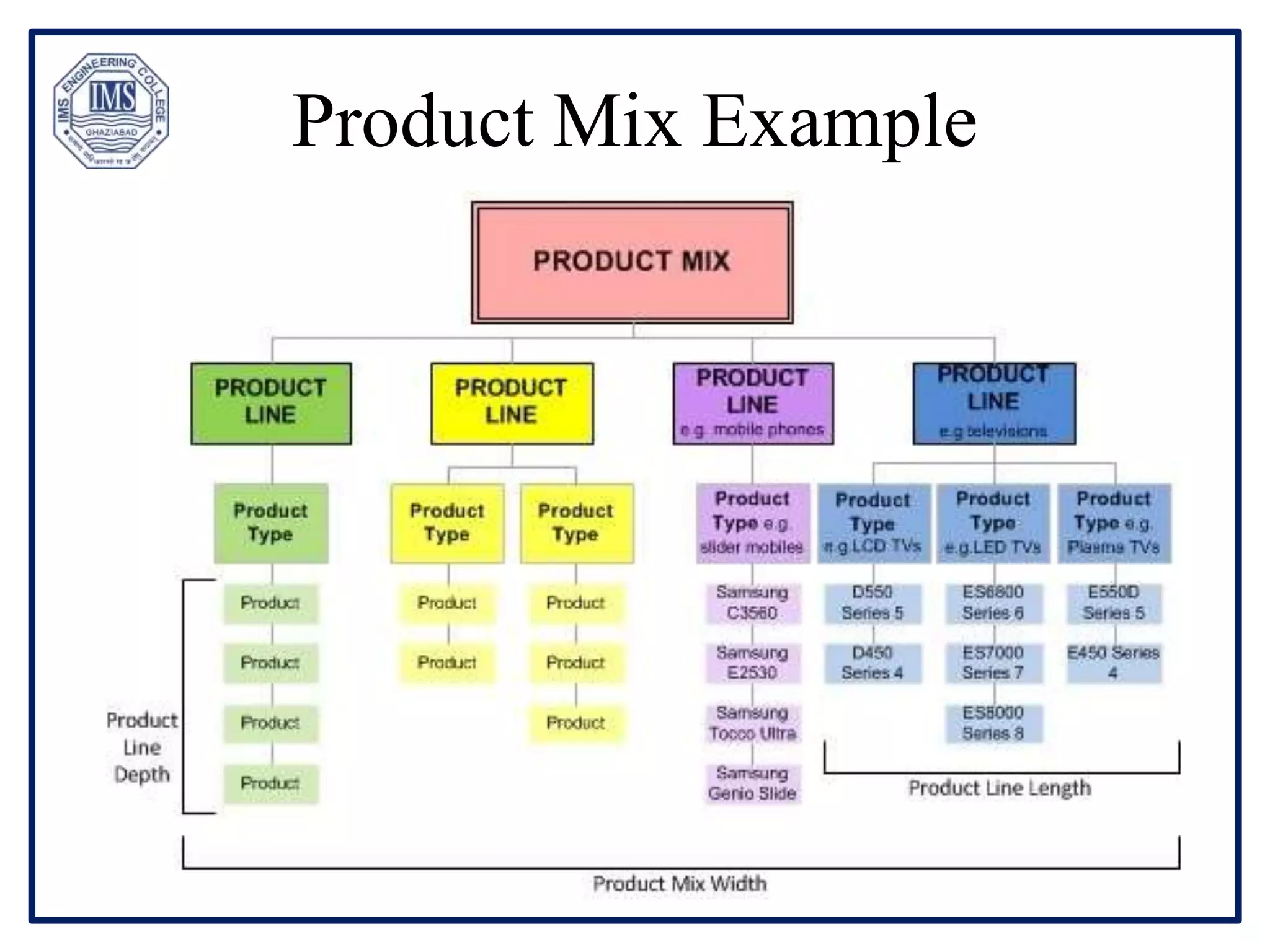
Product width: it is the total no. of product
lines (categories) of an organization.
Product Depth: it is the no. of products in a
particular product line
Product length: it is the total no. of products
manufactured by the company.
Product Mix Example
Product Mix Strategies
 The following strategies can be employed
depending on the stage of the product life
cycle.
Adding a product to a product line
Removing a product from a product line
Adding a product line to the organization
Removing a product line from the organization
Acquiring another company or organization
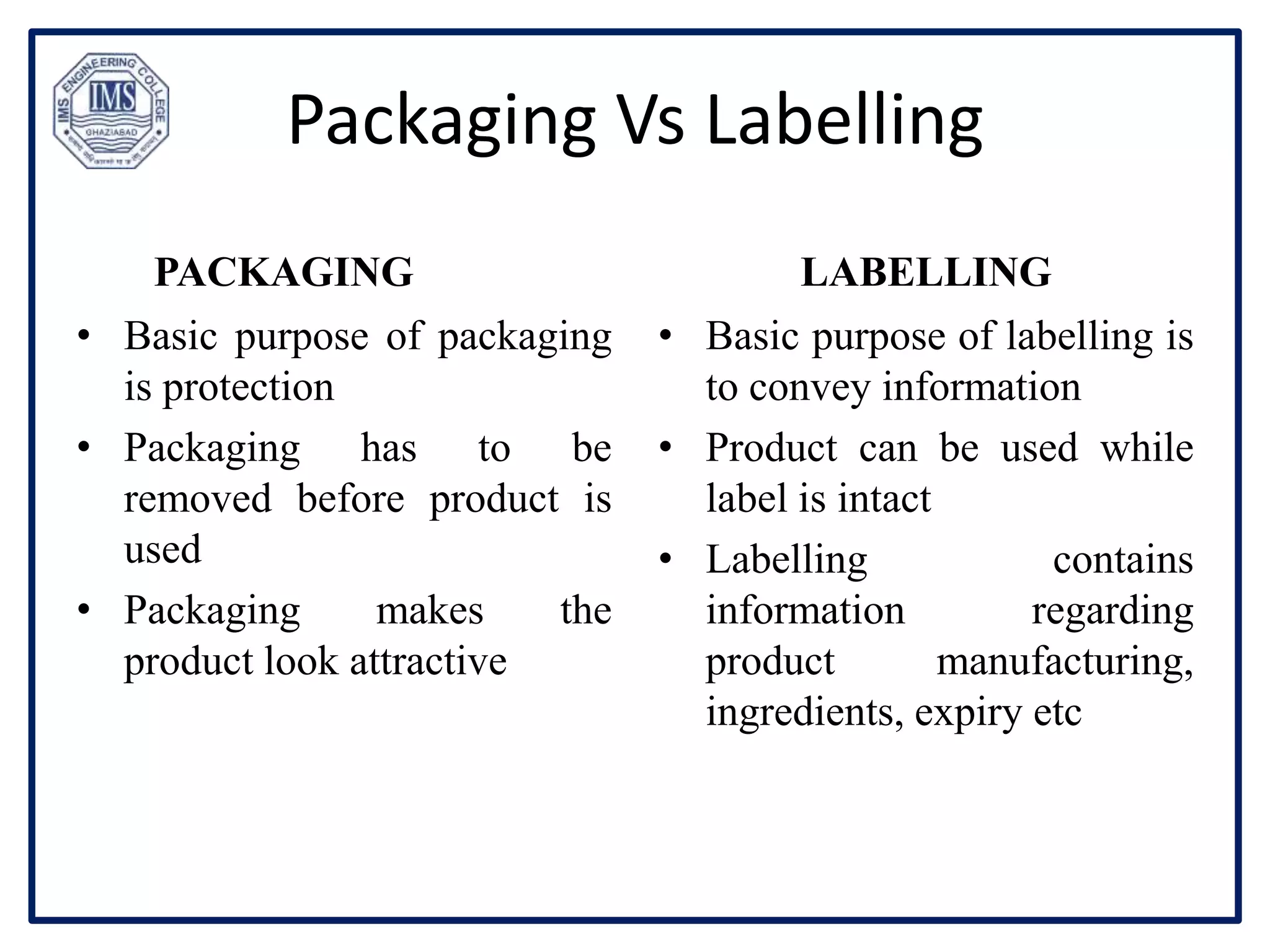
Packaging Vs Labelling
PACKAGING
• Basic purpose of packaging
is protection
• Packaging has to be
removed before product is
used
• Packaging makes the
product look attractive
LABELLING
• Basic purpose of labelling is
to convey information
• Product can be used while
label is intact
• Labelling contains
information regarding
product manufacturing,
ingredients, expiry etc
New Product
Development Process
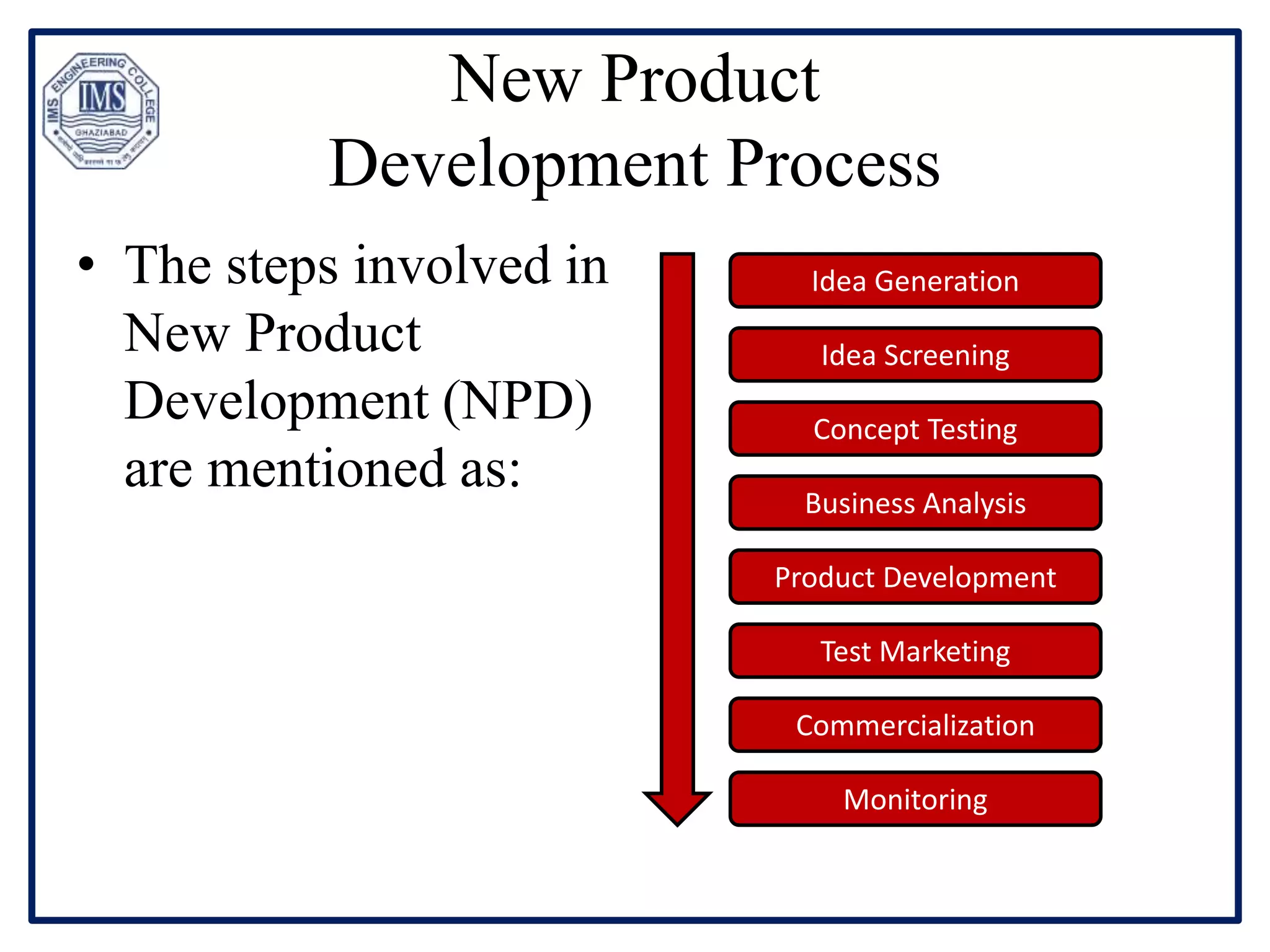
• The steps involved in
New Product
Development (NPD)
are mentioned as:
Idea Generation
Idea Screening
Concept Testing
Business Analysis
Product Development
Test Marketing
Commercialization
Monitoring
New Product
Development Process
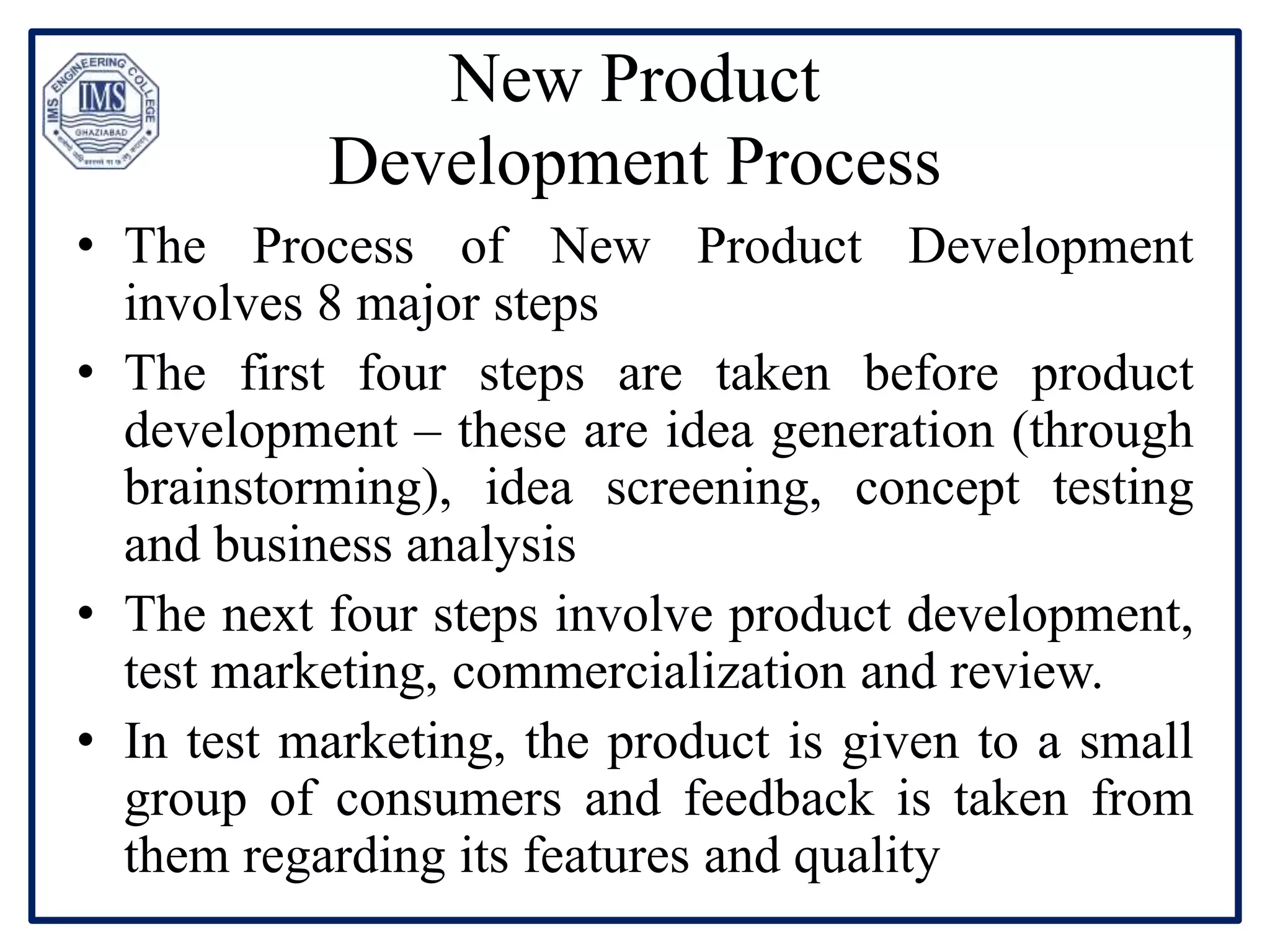
• The Process of New Product Development
involves 8 major steps
• The first four steps are taken before product
development – these are idea generation (through
brainstorming), idea screening, concept testing
and business analysis
• The next four steps involve product development,
test marketing, commercialization and review.
• In test marketing, the product is given to a small
group of consumers and feedback is taken from
them regarding its features and quality
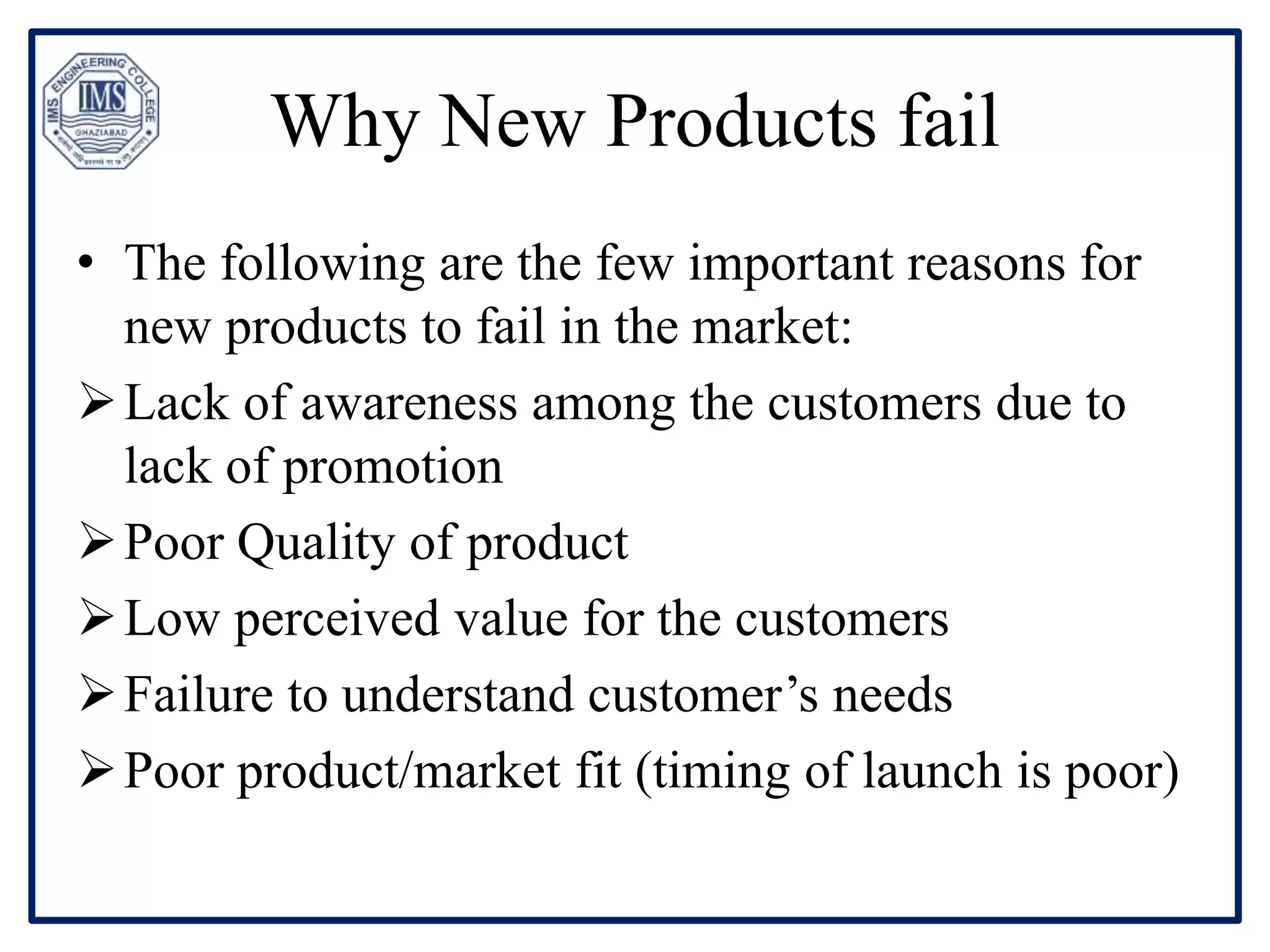
Why New Products fail
• The following are the few important reasons for
new products to fail in the market:
Lack of awareness among the customers due to
lack of promotion
Poor Quality of product
Low perceived value for the customers
Failure to understand customer’s needs
Poor product/market fit (timing of launch is poor)
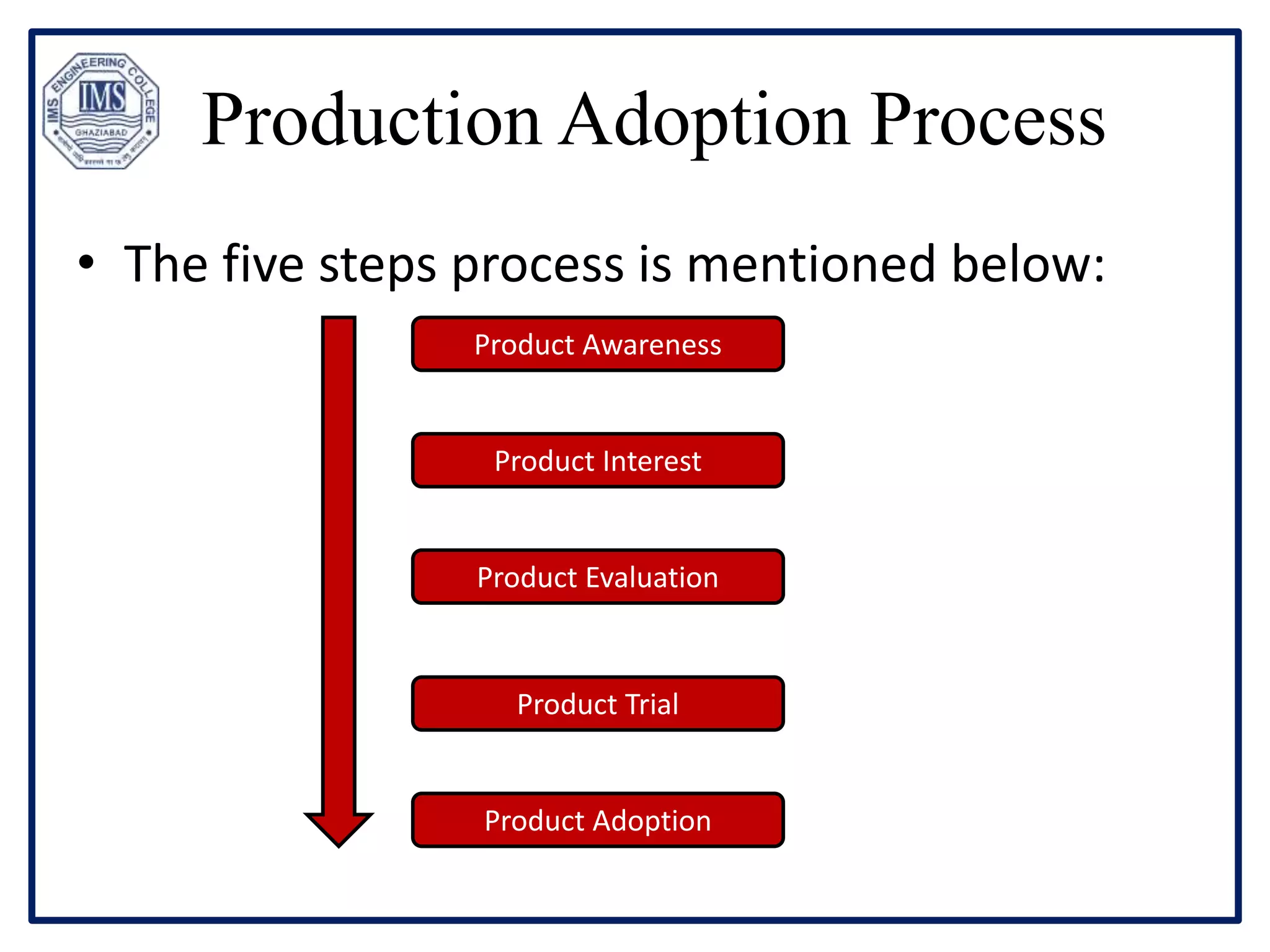
Production Adoption Process
• The five steps process is mentioned below:
Product Awareness
Product Interest
Product Evaluation
Product Trial
Product Adoption
Diffusion of Innovation
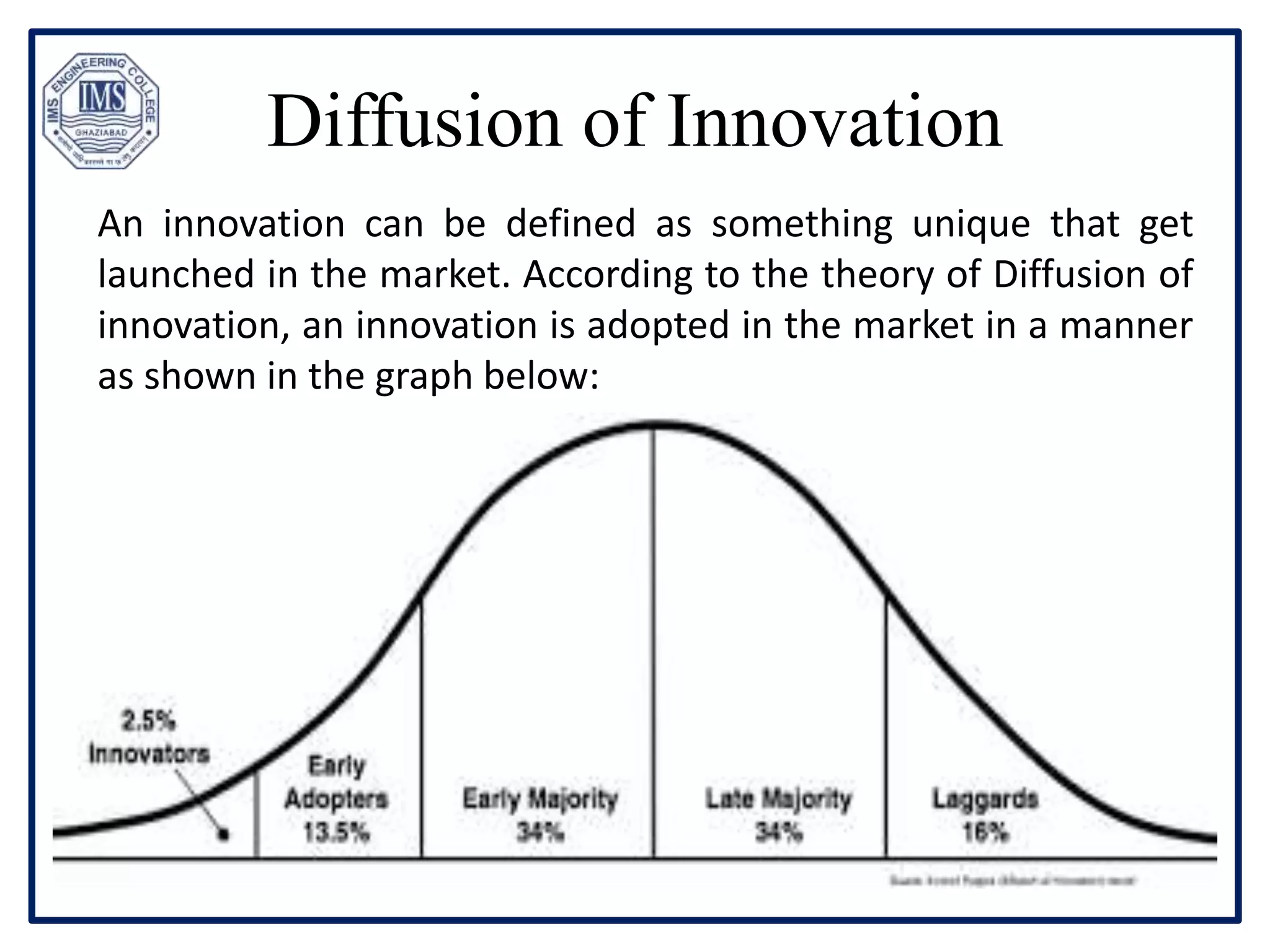
An innovation can be defined as something unique that get
launched in the market. According to the theory of Diffusion of
innovation, an innovation is adopted in the market in a manner
as shown in the graph below:
Diffusion of Innovation
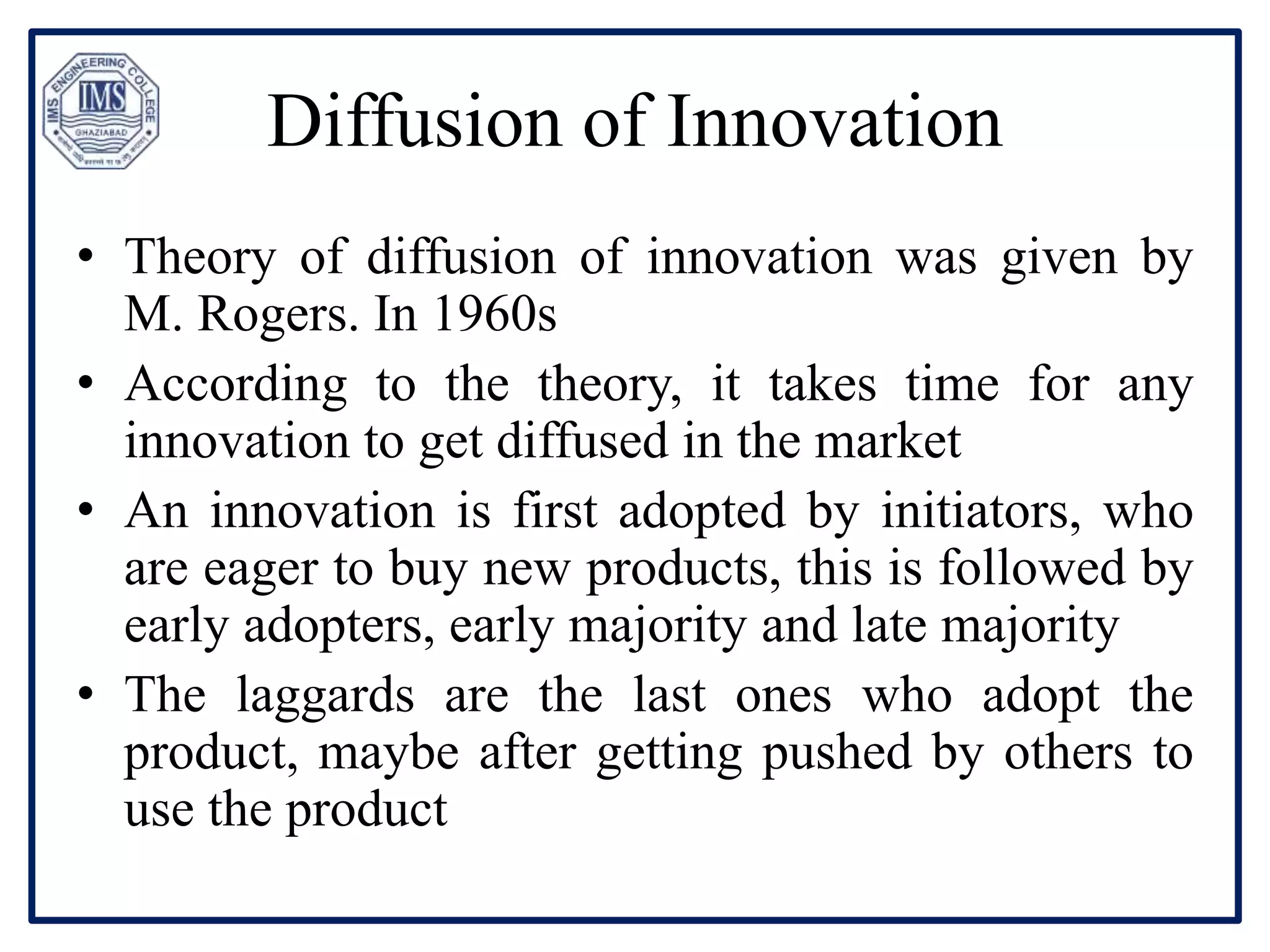
• Theory of diffusion of innovation was given by
M. Rogers. In 1960s
• According to the theory, it takes time for any
innovation to get diffused in the market
• An innovation is first adopted by initiators, who
are eager to buy new products, this is followed by
early adopters, early majority and late majority
• The laggards are the last ones who adopt the
product, maybe after getting pushed by others to
use the product
Product Life Cycle (PLC)
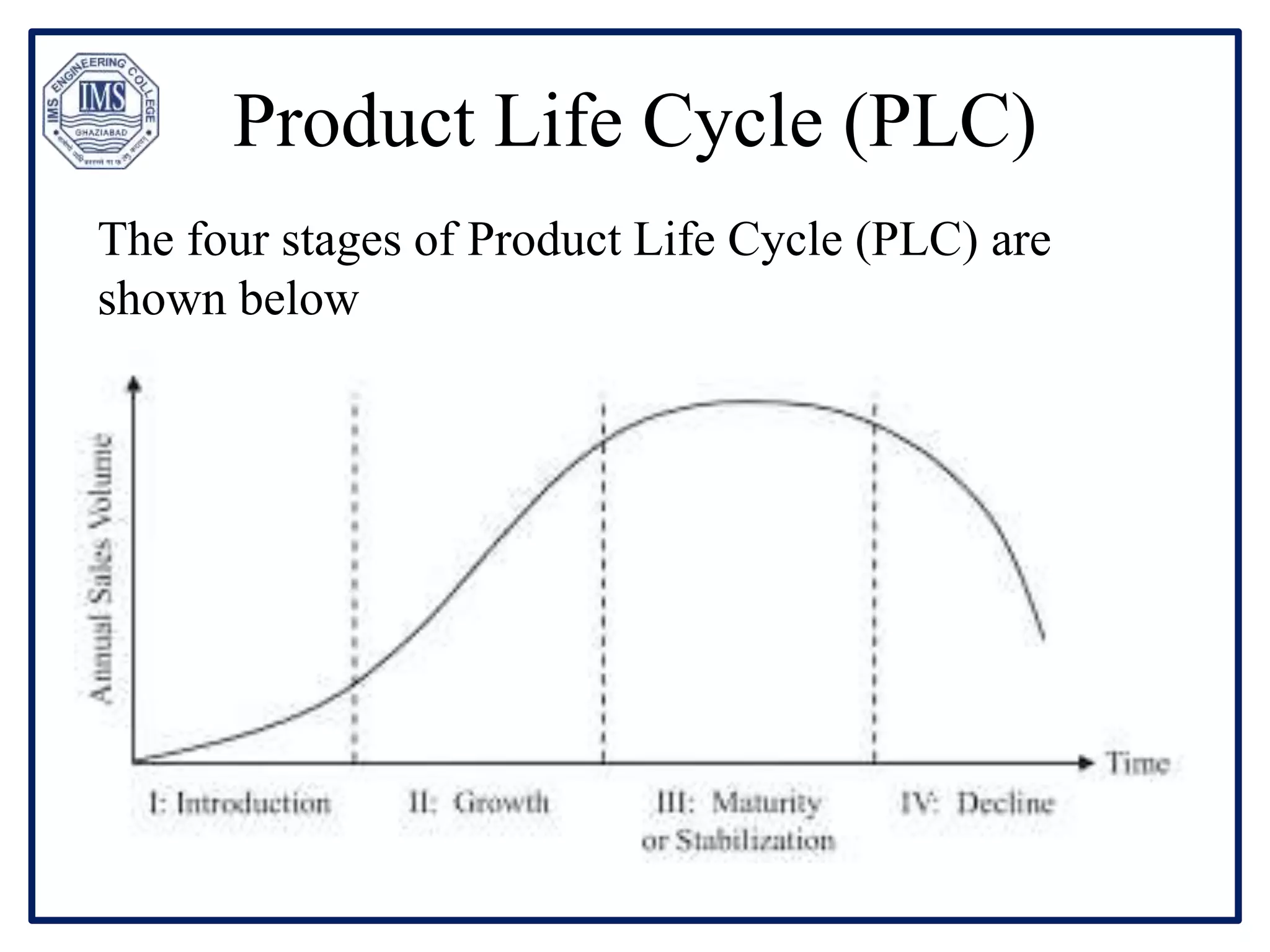
The four stages of Product Life Cycle (PLC) are
shown below
Product Life Cycle (PLC)
• In the introduction stage: Consumers are less
aware of the product hence sale is low,
advertizing expenditures are high in this stage.
Profitability is low or even zero in this stage
• In the growth stage: Advertizing expenditure
are still considerable but because consumers
become aware of the product, the sale
increases bringing profitability
Product Life Cycle (PLC)
• In the maturity stage: in this stage the advertizing
expenditure is low because customers are well
aware of the brand, the product becomes well
established in the market and profitability is high
• In the decline stage: due to various reasons such
as a better product, change in technology etc the
sale declines, at this stage the organization can
either innovate and reintroduce the product or
shut down the business and leave the market

The Product Concept

  • 1.
    Department of MBA IMSEngineering College, Ghaziabad Marketing Management – II UNIT 2 PART 1 PRODUCT, PRODUCT MIX, PROODUCT LEVELS, PRODUCT LIFE CYCLE
  • 2.
    Product – Meaning •According to Philip Kotler, a product is anything that can be offered to a market for attention, acquisition, use or consumption that might satisfy a want or a need. • It includes physical objects (tangible products), persons, places, organizations and ideas • E.g. TV, washing machine, vacation trip package, hotel stay, driver etc.
  • 3.
  • 4.
    Product Levels • CoreProduct: What consumers are really buying when purchasing a product, in this, it is the core problem or need which is addressed. • Basic Product: Basic product is one level up. It refers to the actual product being offered to the customer • Expected Product: Expected product is what the customer expects from the seller. E.g. in a two star hotel stay service, air conditioner is expected
  • 5.
    Product Levels • AugmentedProduct: Augmented product can be defined as the product in which the seller has added something from his own. Augmented means higher than the expectation of the consumer • Potential Product: Potential product is one which does not exist currently but has a possibility of existing in future. E.g. wi-fi services during fights
  • 6.
  • 7.
    Classification of Products ConvenienceGoods: Convenience goods are items consumers buy often and easily without putting much thought into them. These include newspapers, magazines, most grocery items, and petrol. Since consumers have a good sense of how much these items cost Shopping Products: consumer goods that are usually purchased only after the customer has compared price, quality, and style in more than one store — compare convenience goods
  • 8.
    Classification of Products Specialty Products: Specialty goods have particularly unique characteristics and brand identifications for which a significant group of buyers is willing to make a special purchasing effort. Examples include specific brands of fancy products, luxury cars, professional photographic equipment etc  Unsought goods: Unsought Goods are goods that the consumer does not know about or does not normally think of buying, and the purchase of which arises due to danger or the fear of danger and lack of desire. The classic examples of known but unsought goods are funeral services, encyclopedias, fire extinguishers etc
  • 9.
  • 10.
    Product Hierarchy • NeedFamily: e.g. travelling (going from One place to another) • Product Family: e.g. vehicle – cars, bikes, scooters • Product Class: e.g. TATA vehicles • Product Line: e.g. TATA cars • Product Type: SUVs • Item or SKU (Stock Keeping Units): Rang Rover (with model no. and all specifications)
  • 11.
    Product Mix • Productmix of an organization contains three elements: Product width: it is the total no. of product lines (categories) of an organization. Product Depth: it is the no. of products in a particular product line Product length: it is the total no. of products manufactured by the company.
  • 12.
  • 13.
    Product Mix Strategies The following strategies can be employed depending on the stage of the product life cycle. Adding a product to a product line Removing a product from a product line Adding a product line to the organization Removing a product line from the organization Acquiring another company or organization
  • 14.
    Packaging Vs Labelling PACKAGING •Basic purpose of packaging is protection • Packaging has to be removed before product is used • Packaging makes the product look attractive LABELLING • Basic purpose of labelling is to convey information • Product can be used while label is intact • Labelling contains information regarding product manufacturing, ingredients, expiry etc
  • 15.
    New Product Development Process •The steps involved in New Product Development (NPD) are mentioned as: Idea Generation Idea Screening Concept Testing Business Analysis Product Development Test Marketing Commercialization Monitoring
  • 16.
    New Product Development Process •The Process of New Product Development involves 8 major steps • The first four steps are taken before product development – these are idea generation (through brainstorming), idea screening, concept testing and business analysis • The next four steps involve product development, test marketing, commercialization and review. • In test marketing, the product is given to a small group of consumers and feedback is taken from them regarding its features and quality
  • 17.
    Why New Productsfail • The following are the few important reasons for new products to fail in the market: Lack of awareness among the customers due to lack of promotion Poor Quality of product Low perceived value for the customers Failure to understand customer’s needs Poor product/market fit (timing of launch is poor)
  • 18.
    Production Adoption Process •The five steps process is mentioned below: Product Awareness Product Interest Product Evaluation Product Trial Product Adoption
  • 19.
    Diffusion of Innovation Aninnovation can be defined as something unique that get launched in the market. According to the theory of Diffusion of innovation, an innovation is adopted in the market in a manner as shown in the graph below:
  • 20.
    Diffusion of Innovation •Theory of diffusion of innovation was given by M. Rogers. In 1960s • According to the theory, it takes time for any innovation to get diffused in the market • An innovation is first adopted by initiators, who are eager to buy new products, this is followed by early adopters, early majority and late majority • The laggards are the last ones who adopt the product, maybe after getting pushed by others to use the product
  • 21.
    Product Life Cycle(PLC) The four stages of Product Life Cycle (PLC) are shown below
  • 22.
    Product Life Cycle(PLC) • In the introduction stage: Consumers are less aware of the product hence sale is low, advertizing expenditures are high in this stage. Profitability is low or even zero in this stage • In the growth stage: Advertizing expenditure are still considerable but because consumers become aware of the product, the sale increases bringing profitability
  • 23.
    Product Life Cycle(PLC) • In the maturity stage: in this stage the advertizing expenditure is low because customers are well aware of the brand, the product becomes well established in the market and profitability is high • In the decline stage: due to various reasons such as a better product, change in technology etc the sale declines, at this stage the organization can either innovate and reintroduce the product or shut down the business and leave the market