SAQIB IMRAN 0341-7549889 1
Assala mu alykum My Name is saqib imran and I am the
student of b.tech (civil) in sarhad univeristy of
science and technology peshawer.
I have written this notes by different websites and
some by self and prepare it for the student and also
for engineer who work on field to get some knowledge
from it.
I hope you all students may like it.
Remember me in your pray, allah bless me and all of
you friends.
If u have any confusion in this notes contact me on my
gmail id: Saqibimran43@gmail.com
or text me on 0341-7549889.
Saqib imran.
SAQIB IMRAN 0341-7549889 2
Technical Report Writing Skills for Civil Engineers
Definition:
Technical writing is a specialized, structured way of writing, where information is
presented in a format and manner that best suits the psychological needs of the readers,
so that they can respond to a document as its author intended and achieve the purpose
related to that document. The process of gathering information from experts and
presenting it to an audience in a clear, easily understandable form is called technical
writing.
OR
Technical writing is the presentation of information that helps the reader solves a
particular problem. Technical communicators write, design and/or edit proposal, web
pages, lab reports, newsletters and many other kinds of professional documents.
Technical Report Writing Skills include:
 Learn how to get your thoughts on paper
 Understand the features of and differences between various types of technical
documents
 Become a more critical editor of technical documents
 Translate complex and innovative ideas into clear, logical and technically accurate
documents
 Produce technical information for non-specialist audiences
 Help your readers to take action or make decisions effectively
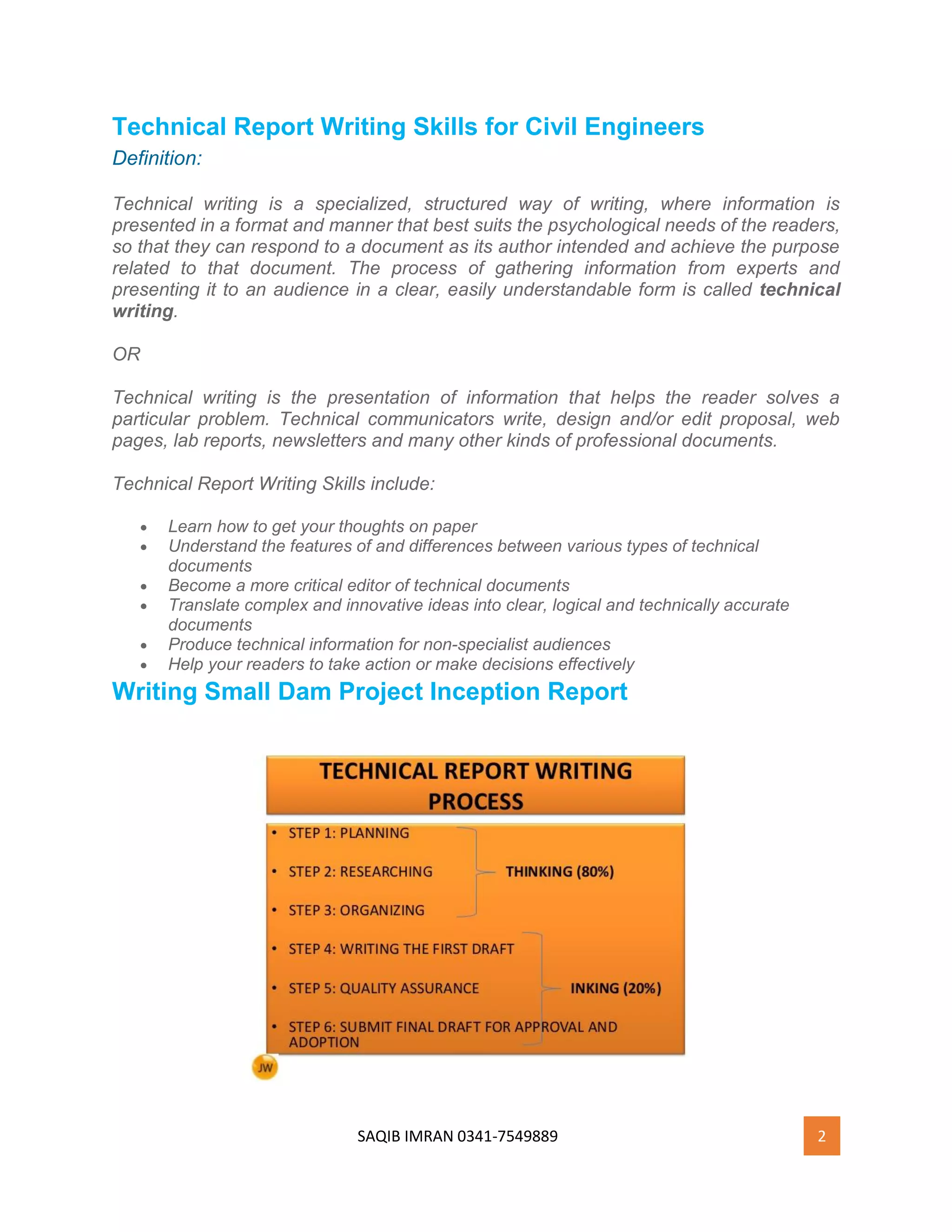
Writing Small Dam Project Inception Report
SAQIB IMRAN 0341-7549889 3
Writing Small Dam Project Inception Report
1. Introduction
This is the foremost part of the report and hence a summary of the whole project, its clients,
funding and the team working on it should be provided here very briefly. This introduction may
also contain background of the inception report, who created it, using what tools, information
and sources and the limitations (if any) of this report.
2. Project Background
It is the key section of the report which explains why the project is needed and what is its
expected impact on the area. It is also of importance to discuss here about the pre requisites of
the projects and its expected results. Discuss here what the project is about, where it is getting
the funding from, how it came into being and what progress (if any) has been achieved on the
project till date.
3. Project Description
It contains a detailed account of the goals and objectives of a project and the implementation
methods, approaches and mechanism to achieve those goals. It also identifies the different
stakeholders of the project.
SAQIB IMRAN 0341-7549889 4
4. Project Location for Small Dam
Every geographic location has different characteristics and properties which in turn affects the
feasibility and implementation of the project and its activities. This section includes a narrative
on the geographical location of the project, the surroundings physical features, other similar or
relevant projects nearby, accessibility to the project site, coordinates of the area, climate, hazard
profile of the region and other relevant geo-spatial information. A map of the area showing the
location of the project site will also make things easier to understand for the readers of the report.
5. Implementation Arrangement
This section describes the responsibilities of all the stakeholders of the project. It defines the
roles of each stakeholder such as who is the client, who will fund the project, who will execute it
and who will monitor/supervise the project. This definition of roles helps in smooth running of
the project.
6. Scope of Consultancy Services
It includes the definition of the range of responsibilities of the consultant. It includes the review
of the feasibility study, preparation of tender documents, review contractor’s
drawings/designs/data, supervision of construction, mobilization of staff, data collection, data
verification etc.
SAQIB IMRAN 0341-7549889 5
7. Preliminary Assessment of Previous Studies
This section is dedicated to a study, assessment and evaluation of any previous studies/reports
conducted on the project. It evaluates the limitations of the study and check if the results are still
applicable or not. This section also takes into account the previous analysis performed (for
instance sediment analysis, seismic analysis, availability of proposed construction materials,
geotechnical investigations, resettlement plans etc.) during the studies and provides
recommendations on whether any more or in-depth analysis is required or not.
8. Site Visits
Site visits are a crucial part of understanding the project and making decisions that are based on
ground realities. It also helps in identification of the steps required to solve conflicting issues in
the project. All of the site visits should be fully documented and reported here with details such
as has any site visits been conducted, what was the purpose of the visits, which technical experts
were on the visit, what studies did they conduct. Each study can be defined under separate heads
later in the report, including the team of the study, purpose, date, their findings, conclusions,
recommendations and challenges. Examples of a few field studies can be as follows:
 Reconnaissance site visit
 Geological/geotechnical data collection
 Resettlement planning
 Environmental study
 Study on social issues regarding the project etc.
a. Access Conditions to Micro Hydel Project
The site visits would have enabled the team to know about the accessibility of the project area.
Here is an opportunity to state how the access conditions to the project site are, what roads to
take, what are the alternatives routes, what are the pros and cons of each route and what mode of
transportation is suited for the journey?
b. Reconnaissance Site Visit
Following the Desk Study, detailed, accurate and latest information can be gained through site
reconnaissance, this involves a visit to the site for inspection.
i. Objectives of Reconnaissance Visit
Reconnaissance can provide information on the following areas of the project
 Terrain and Slopes
 Site Geology
 Surface Water (Ponds And Streams) And Erosion Features
 Groundwater
 Site Access
 Condition of Existing Structures
 Existence of Grave Sites or Archaeological Features
SAQIB IMRAN 0341-7549889 6
ii. Participants
A list of the team goes here, with their qualification, experience and designation.
iii. Findings of Reconnaissance Visit
9. Project Alternative Layouts
There can be many possible alternatives to the current project design. A number of alternatives
should also be sorted out so that the best design with the least cost can be selected. For this
purpose, all the alternatives available should be discussed in detail separately. Some criteria for
the selection and differentiation of project alternatives should be sorted out, for instance as
below:
Criteria for identification of possible layouts like:
 In the same locality
 Less environmental impacts
 Favorable climatic or hydrological conditions
 Favorable in terms of cost, accessibility, construction etc.
a. Possible Project Alternatives
Discuss each alternative in the light of the above mentioned criteria (or your own criteria) and
explain briefly how each one will be built/constructed.
i. ALTERNATIVE-01
ii. ALTERNATIVE-02
iii. ALTERNATIVE-03
b. Conclusions
List the pros and cons of each alternative.
c. Recommendations
Select one or two final designs based on the criteria for selection of the best project design. Also
list any additional studies or resources required for help in choosing the best alternative or for
furthering the work in the selected project design.
10. Approach and Methodology
a. Project Understanding
This is arguably the most important section in the report, as the content of this section will show
how much the author of this inception report has understood the project and what ways and line
of action will be adopted for the efficient implementation of the project activities. It can be
started from providing general project information, capacity, pros, client info, funding sources,
duration completion etc. and the working mechanism for execution of the design.
SAQIB IMRAN 0341-7549889 7
b. Approach
The approach and methodology should be based on the RFP (Request for Proposal) by the client
at the start of the project along with the firm’s own experience and exposure to similar projects.
The firm should start explaining its approach by list the team it has gathered to work on the
project. Then, it should go on to explain its approach towards various activities of the project like
planning, designing, procurement, hiring, construction, monitoring, evaluation etc.
c. Team Composition
Add a table for the team having their names, qualification, experience, designation in the project.
d. Coordination / Information Exchange
Define ways and mechanisms that will be used for information exchange, communication,
financial and progress reporting, equipment (hardware and software) to be used, field or branch
offices established, if any regarding the project.
e. Methodology
Use this section to set out exactly what you plan to do. Methodology section should describe all
the steps to be taken for implementing the project. These steps range from the inception of the
project to the evaluation of the project after it has been completed. All the previous as well as
future steps should be listed here. Remember the following points when writing methodology:
 Explain what methods will be used to run/implement project activities in a timely and budget
efficient method?
 What research methods will be used to collect the required information and why?
 What tests/studies will you conduct?
 What tasks are to be performed and who will perform it?
f. Construction
The construction phase may be divided into a single or more than one phases, with each phase
defined separately.
i. Pre-Construction Stage
Explain the following headings (increase or decrease as per the requirement of the project):
 Review of Feasibility Study and other Available Data
 Facilities Planning and Design – Access Road
 Preparation of Tender Documents
 General Conditions of Contract
 Guidelines for Performance
 Specifications for Civil Works & Electro-Mechanical Equipment
 Conceptual Drawings
 Schedule for EPC Submittals
SAQIB IMRAN 0341-7549889 8
 Evaluation of EPC Tenderer’s Proposals
 Contract Negotiation and Award of Contract
ii. Construction Stage
Engineering
 Review of Selected EPC Contractor’s Design
 Hydrological and Sedimentation Aspects
 Geological Aspects
 Geo-technical Aspects
 Seismic Risk Analysis
 Hydraulic Design
 Civil Design Aspects
 Hydro-Mechanical and Steel Structure Design
 Turbines
 Gates
 Penstock / Siphon
 Cranes
 Dewatering System
 Cooling and Service Water Systems
 Ventilation and Air Conditioning Systems
 Electrical Equipment Design
 Main Generators with Ancillaries
 Set-up Transformers
 Switch Yard
 Stand by Generator
 Station Service Power System
 Transmission Lines
 Drawings, Technical Specifications BOQ and Cost Estimates
 Operation and Maintenance Manuals
 Facilities Planning And Design – Colony & Infrastructure
Procurement
 Construction Management
 Review of Project Construction Schedule
 Review of Environmental, Social and Resettlement Aspects
 Co-ordination Meetings
Quality Assurance
 Health and Safety
 Risk Management Strategy
Quality Control
 Witnessing of Testing and Commissioning Activities
 Variation Orders, Claims And Settlement Of Disputes
Reporting
 Inception Report
 Feasibility Study Review Report
 Monthly Progress Report
 Quarterly Report, Annual Report, Financial Analysis Report, Project Completion Report
11. Activity Schedule and Staffing Plan

o Proposed activity schedule, staffing schedule
o Estimated monthly billing rate
SAQIB IMRAN 0341-7549889 9
o General
Qualities of a Good Technical Report
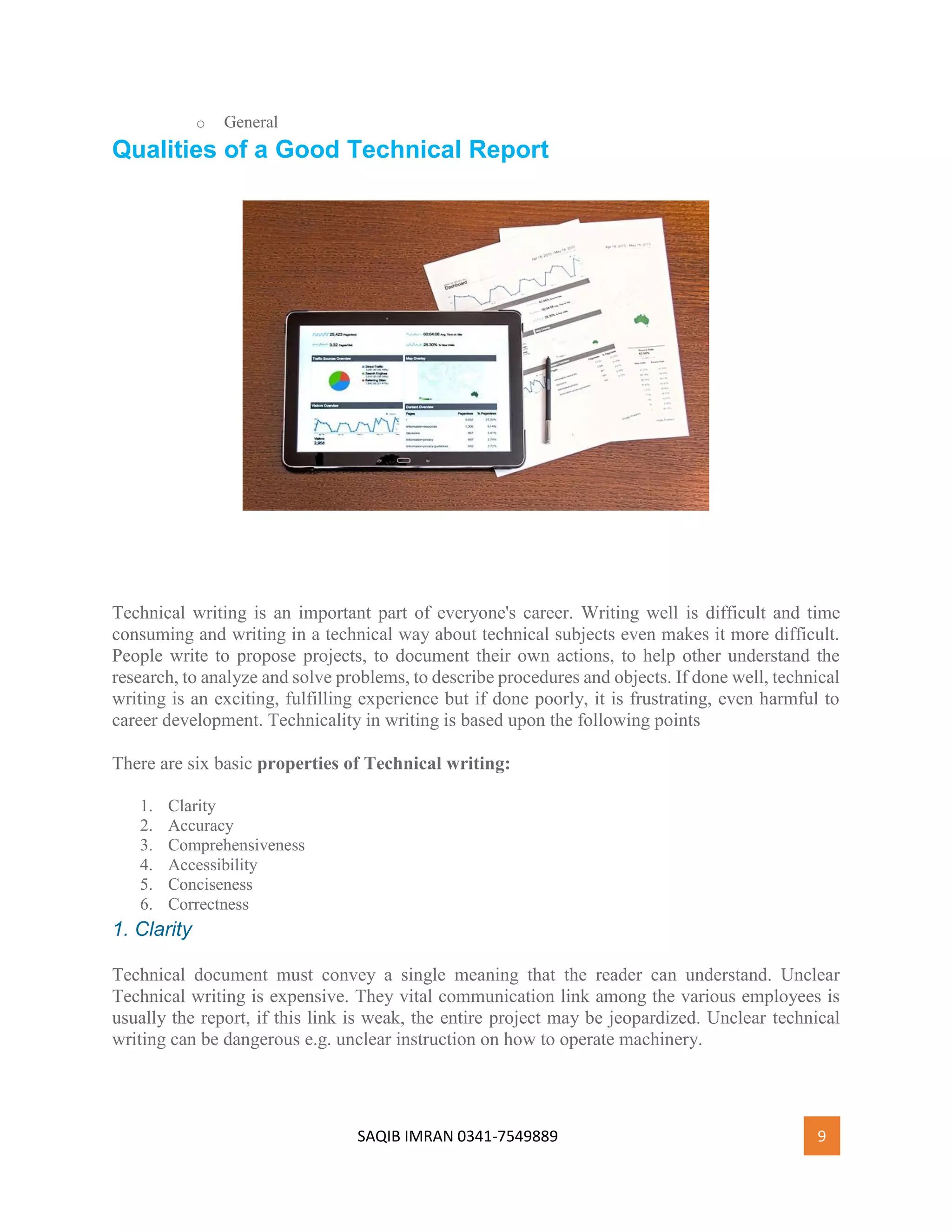
Technical writing is an important part of everyone's career. Writing well is difficult and time
consuming and writing in a technical way about technical subjects even makes it more difficult.
People write to propose projects, to document their own actions, to help other understand the
research, to analyze and solve problems, to describe procedures and objects. If done well, technical
writing is an exciting, fulfilling experience but if done poorly, it is frustrating, even harmful to
career development. Technicality in writing is based upon the following points
There are six basic properties of Technical writing:
1. Clarity
2. Accuracy
3. Comprehensiveness
4. Accessibility
5. Conciseness
6. Correctness
1. Clarity
Technical document must convey a single meaning that the reader can understand. Unclear
Technical writing is expensive. They vital communication link among the various employees is
usually the report, if this link is weak, the entire project may be jeopardized. Unclear technical
writing can be dangerous e.g. unclear instruction on how to operate machinery.
SAQIB IMRAN 0341-7549889 10
2. Accuracy
Unclear writing can cause many problems and even inaccuracy in the report. If you mean to write
40,000 don’t write 400,000. If you mean to refer to fig 3.1 don’t refer to fig 3.2. Slightest error can
confuse or even annoy the reader of the report. If the reader suspects that you are slanting
information they have the right to doubt the entire document.
3. Comprehensiveness:
When writing technically, all the information should be provided, its background must be
described and clear description of any process, or method of carrying out a specific work, should
also be given. It also includes results, conclusions and recommendations.
4. Accessibility:
It means the ease with which the readers can locate the information they seek. To increase
Accessibility, include headings and lists in the report. A table of contents, list of illustrations
glossary and index are preferred.
5. Conciseness:
Technical writing is meant to be useful. The longer a document is, the more difficult it gets to
use it. Even it takes more of the user's time. Conciseness works against clarity and
comprehensiveness. Solution to this conflict is to create a balance between the requirements of
clarity, conciseness and comprehensiveness. In short, in T.W every aspect of the subject is
discussed in optimized detail. Document must be long enough to be clear. It must give the
audience purpose and object but no extra details. Technical writing can be shortened 10-20% by
eliminating unnecessary phrases and choosing short words and sentences.
6. Correctness
Qualities of technical report writing also includes correctnes. Good technical report must also
be correct. It. Must be free from grammatical errors, punctuation mistakes, and should have
appropriate format standard. If a report contains grammatical errors, the reader will doubt the
accuracy of the information in the report. Technical writing is meant to convey information and to
persuade the audience. To accomplish these goals it must be clear auccurate, easy to access and
must be economical and correct. If you mean to write "the three persons: person 1, person 2 and
person 3 attended a session" but you use commas instead of the colon, your readers might think 6
people attended the session, not 3.
Purpose and Uses of Technical Reports
SAQIB IMRAN 0341-7549889 11
Purpose of technical writing - why study technical report writing. Technical report writing has
two basic purposes:
1. To inform
2. To persuade
A tech. report can be used for the physical description of a new machine, the steps in a particular
process, or the results of an experiment. For example: A writer not only describes two sites for a
factory but also persuades readers to accept one of them as the best i.e. to prove your point. The
document that achieves these purposes is called technical writing. Functions of Technical Writing
also includes the following points:
a. Reassure recipients that you are making progress, that the project is going smoothly, and
that it will be completed by the expected date.
b. Provide their recipients with a brief look at some of the findings or some of the work of the
project.
c. Give the recipients a chance to evaluate your work on the project and to request changes.
d. Give you a chance to discuss problems in the project and thus to forewarn recipients.
e. Force you to establish a work schedule so that you'll complete the project on time. It gives
the writer a motivation to work more and produce results more efficiently.
How to Write Technical Construction Proposal
SAQIB IMRAN 0341-7549889 12
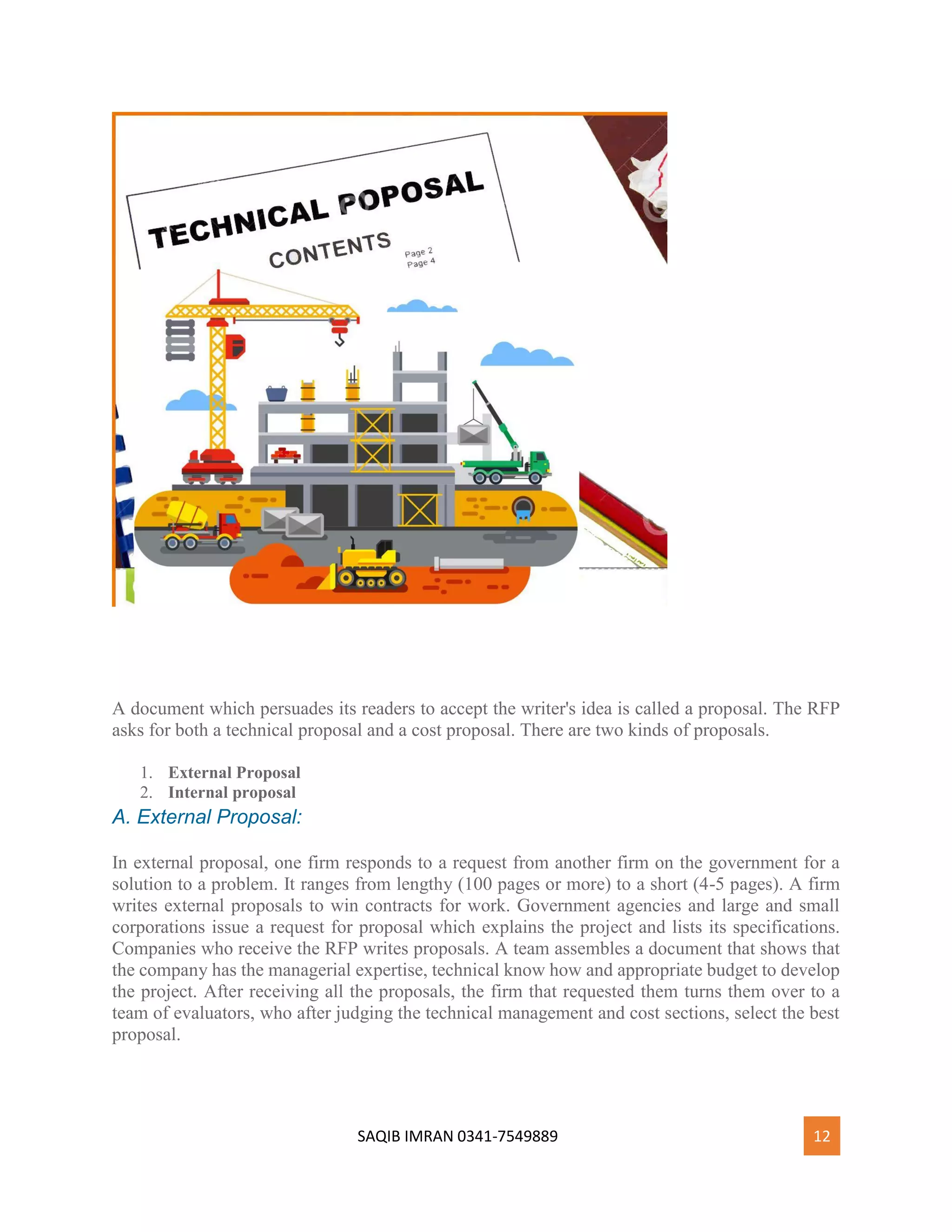
A document which persuades its readers to accept the writer's idea is called a proposal. The RFP
asks for both a technical proposal and a cost proposal. There are two kinds of proposals.
1. External Proposal
2. Internal proposal
A. External Proposal:
In external proposal, one firm responds to a request from another firm on the government for a
solution to a problem. It ranges from lengthy (100 pages or more) to a short (4-5 pages). A firm
writes external proposals to win contracts for work. Government agencies and large and small
corporations issue a request for proposal which explains the project and lists its specifications.
Companies who receive the RFP writes proposals. A team assembles a document that shows that
the company has the managerial expertise, technical know how and appropriate budget to develop
the project. After receiving all the proposals, the firm that requested them turns them over to a
team of evaluators, who after judging the technical management and cost sections, select the best
proposal.
SAQIB IMRAN 0341-7549889 13
Planning the External proposal
To write an external proposal, you must consider your audience, research the situation, use visual
aids, and follow the usual form of this type of document.
1. Consider the audience:
Usually your audience express problem to you in a written statement (an RFP) or in an interview.
You must assess their technical awareness and write accordingly. To write to them effectively, one
should
1. address each need that they have expressed
2. explain in clear terms how your proposal fills their needs
3. Explain the relevance of technical data.
2. Research the situation:
To write the proposal effectively you must clearly understand your cutomer's needs by as well as
your own service. You must research their needs by means of interviewing them or by reading
their printed material.
3. Use visual aids:
Many types of visual aids e.g table, maps etc may be appropriate to your proposal. Your goal is to
convince the decision makers that only your way is the best approach; good visuals are direct and
dramatic, drawing your client into the document.
Writing the external proposal - Organizing
To write an external proposal, follow the usual form for writing the proposals. The four main parts
of a proposal are:
a. Executive summary:
The executive summary contains information designed to convince executives that the proposers
should receive the contract. It should present the content of technical, managerial and financial
sections in clear terms. This section is often designed to make non technical people feel
comfortable with the proposal.
b. Writing the technical section:
A proposal's technical section begins by stating the problem to be solved. The proposers must
clearly demonstrate that they understand what the customer expects. The proposal should describe
its approach towards solving the problem.
SAQIB IMRAN 0341-7549889 14
c. Writing the management section:
This section describes the personnel who will directly be related to the project. The proposal writer
must explain what technical personnel and levels of management will be responsible for the
success of the project. In a large external proposal, this section often contains organization charts
and resumes. In short proposal, this section usually explains qualifications of personnel and firm's
success with other similar projects.
d. Writing the financial section
The financial section provides a breakdown of the costs for every item in the proposal. Often this
section is not just a table of costs. At times a brief introduction and the table may be all you need,
but if you need to explain the significance of certain figures, then do so.
B. The Internal proposal
In an internal proposal, an employee on department urges someone else in the company to accept
an idea or to fund equipment on research. There are two types of internal proposals:
1. Assigned Proposal
2. Uncolicited Proposal
1. Assigned proposal:
In assigned proposal an employee writes solution for a given problem. He does not have to
establish the problem.
2. Unsolicited proposal:
In unsolicited proposal the writer writes the solution of a problem which he has discovered himself.
Planning the internal proposal
The goal of the proposal is to convince the person or group in authority to allow the writer to
implement his idea. To achieve this goal, the writer must consider the audience, use visual aids,
understand organizational principles and design a format.
I. Consider the audience
Writer considers the audience of a proposal in at least three ways; according to their involvement,
their knowledge and their authority.
a. How involved is the audience
In most cases, readers either have assigned the proposal or they are unaware of the problem. In
assigned proposal, the writer does not have to establish that the problem is a problem; but he or
SAQIB IMRAN 0341-7549889 15
she does have to show how the proposal will solve the problem. If the proposal is not assigned
then he first convinces the audience that the problem is a problem then he offers a convincing
solution to the problem.
b. How knowledgeable is the audience.
The audience may or may not have the concepts and facts involved in the proposal. If the audience
is less knowledgeable, take care to define terms, give background and use common examples.
c. How much authority does the audience have?
The audience may or may not be able to order implementation of your proposed solution. A
manager might assign the writer to investigate some problem, but most likely the manager will
have to take the proposal to a higher authority before it is approved.
II. Consider your own position
Your own position mirrors the audience position. If you have been assigned to write the proposal,
you don’t have to establish that the problem is a problem, but you do have to show how your
proposed solution matches the dimension of the problem. If you have discovered the problem then
you have to establish that the problem is a problem and then explain your solution.
III. Use visual aids
Since the proposal probably will have multiple audiences, visual aids can enhance its impact.
Visuals can support any part of the proposal - the problem, the solution, the implementation or
even the benefits.
Writing / Organizing the internal proposal
The writer should organize the proposal around four questions.
What is the problem?
Describing the problem is a key part of proposals. You must establish three things about the
problem.
a. The data
b. The significance
c. The cause
Designing the proposal
To design a proposal, select an appropriate format, either formal or informal. A formal proposal
will have a title page, table of contents and summary. The formats for an informal proposal can be
a memo report on some kind of pre-printed form. The format depends on company policy and on
SAQIB IMRAN 0341-7549889 16
the distance that the proposal must travel in the hierarchy-usually the shorter the distance, the more
informal the format. Also, the less significant the proposal, the more informal the format is.
Use the introduction to orient the reader
The introduction must orient the reader to the writer the problem and the solution. Introductory
sections often contain a separate summary paragraph that ______ the main prints of the body. If
the body contains section on the solution, benefits, cost, implementation and the rejected
alternatives, the summary should cover the same prints.
Use the discussion to convince your audience
The discussion section contains all the detailed information that you must present to convince the
audience. A common approach functions this way:
The problem
1. Explanation of the problem
2. Causes of the problem
The solution
1. Details of the solution
2. Benefits of the solution
3. Ways in which the solution satisfy criteria
The context
 Schedule for implementing the solution
 Personnel involved
 Solutions rejected
How to Write Project Progress Reports
SAQIB IMRAN 0341-7549889 17
Progress reports inform management about the status of the project. It is submitted at regular
intervals throughout the life of the project. It lets the reader know whether work is progressing
satisfactorily, that is within the project’s budget and time limitations.
Planning the progress report
 Consider the audience
Most readers are not fully informed about all aspects of the project. To understand the progress
made to date and the problems that are anticipated, readers must fully grasp what the project
involves. If the report goes only to your immediate supervision, you can assume that he probably
knows technical terms related to the project. If the report goes a greater distance from you, you
should assume that the reader does not know the technical details and perhaps not the technical
concepts. In other words, you must go into as much details as necessary to inform your specific
audience.
 Research the situation
To plan the project, you must select the categories that you need to discuss the project usually two
major categories are budget and schedule. But many other categories are possible.
SAQIB IMRAN 0341-7549889 18
 Visual aids
Visual aids are as effective for progress reports as for any other type. If you need to use a table,
graph or illustration, do so.
 Follow the usual form for progress reports
Progress reports usually follow the form shown in the outline below. Sometimes you will add
special sections
1. Introduction
1. Purpose of report
2. Purpose of the project
2. Work completed
3. Work scheduled
Initial progress reports:
An initial progress report contains a brief introduction and a body that describes the work.
 Writing the introduction:
Begin by stating the purpose of report. A single sentence can name the project, define time period
covered by the project and tell the purpose; to inform readers about current status of the project.
Mention the project, objectives and scope and name the major work areas.
 Writing the work completed section
In the work completed section, specify the time period and divide the project into major tasks.
Second level head will identify the tasks in this and subsequent reports.
 Writing the work schedule section
The work schedule section again specifies, the time period and repeats second level and third level
head from work completed section. If the readers require a more detailed chronology of future
work, divide this section into two parts:
1. Work schedule for next report period
2. Work proposed for future.
Subsequent progress reports
Second and succeeding progress reports maintain continuity and refresh the readers memory by
adding a new section, a summary of work completed prior to the present reporting period.
I. Introduction
II. Summary of work previously completed - dates
SAQIB IMRAN 0341-7549889 19
III. Work completed dates
IV. Work scheduled - dates
Adding special sections
Sometimes other sections need to be added. If readers want specific information on some aspects
of the project that they particularly want to control, you should provide that information e.g. budget
or any other item of special concern can easily be given a main heading of its own and a thorough
accounting.
Sample Format of a Technical Report
Those components which are usually included in a technical report in business and industry are:
1. Letter of transmittal
2. Title page
3. Abstract
4. Table of contents
5. List of illustrations
6. Executive summary
7. Glossary and list of symbols
8. Appendix
SAQIB IMRAN 0341-7549889 20
Also See: Purpose and Uses of Technical Reports
1. Letter of Transmittal
The components of a report are not written in the same order in which they appear e.g. the letter
of transmittal is the first thing the reader sees, but it is probably the last to be created. It introduces
the purpose and content of the report to the principle reader. It gives you an opportunity to
emphasize whatever you think, your reader will find particularly in the attached material. It enables
you to point out any errors or omission in the material. Transmittal letter contains the following
element.
 A statement of title and purpose of report.
 A statement of who authorized the project and when
 A statement of method used in the project or of the principal results, conclusion and
recommendations.
 An acknowledgement of any assistance you received in preparing the material.
2. The title page
Usual elements are
 Title
 Name and position of writer
 Name and position of principle reader
 Date of submission
A good title must be informative. It. answers two basic questions:
1. What is the subject of the report
2. What type of report is it? E.g. sea pollution - control devices
Define the type of report by using a generic term such as analysis, recommendations e.g summary,
review etc. For a simple title page, centre the title (typed in full capital letter) about a third of the
way down the page, then add the readers and writer's position, the organization’s name and date.
3. The abstract
It’s like a brief technical summary, usually not more than 200 words of the report. Its directed to
readers who are familiar with the technical subject and need to know whether to read the full report
or not. This can use technical terminology and refer to advanced concepts. Basic types of abstract
are descriptive and informative abstracts. The descriptive abstract sometime called topical or table
of contents abstract. It does not provide the import results, conclusion or recommendations. It lists
the topic covered giving equal coverage to each. The informative abstract states the problems the
scope and methods, and the major results, conclusion or recommendations.
SAQIB IMRAN 0341-7549889 21
4. The table of contents
It enables different readers to turn to specific pages to find the information they want. Well
organized report becomes ineffective if table of contents, is not clear. T.O.C provide only guide to
report's structure, coverage and pagination. The headings that appear in the report are listed in
T.O.C. For effective T.O.C make sure the report has effective headings.
5. The list of illustrations
It is a T.O.C for the figures and tables of a report. If the report contains figures but not tables, it is
called the list of figures. But if the report contains tables but not figures so is called the list of
tables only. List of illustrations may be on the same page as the table of contents, or may be on the
separate page. If it begins on a separate page, it should be listed in the table of contents.
6. The executive summary
Sometimes called executive overview or the management summary. It is a one page condensation
of a report. Managers don’t need a detailed and deep understanding of various projects undertaken
in their organization because of limitations in time and specialization. The background of the
project is also discussed clearly herein. The specific problem that is to be solved through the project
is clearly discussed; also the conclusion and recommendations are discussed in a full separate
paragraph.
7. The glossary and list of symbols
A glossary is an alphabetic list of definitions. It is useful if you are addressing a multiple audience
that includes readers who will not be familiar with the technical vocabulary used in the report. An
asterisk or any other notation can be used along the word to tell the audience that the word is
defined in glossary. It is generally placed at the end of the report just before the appendix. Though
if the glossary is a brief one, so can be placed right after the table of contents. A list of symbols is
structured like glossary, but rather than defining words and phrases, it defines the symbols and
abbreviations used in the report. Like glossary, the list of symbols may be placed before the
appendices or after the table of content.
8. The appendix
An appendix is any section that follows the body of the report (and the list of references or
bibliography, glossary or list of symbols). Appendices provide information that is too bulky to be
presented in the body or that will interest only a small number of readers. For conciseness in the
report, this information is separated from the body. Examples of the kind of material that are
SAQIB IMRAN 0341-7549889 22
usually found in the appendix include maps, large technical diagrams or charts, computations, test
data and texts of supporting documents. Appendices are usually lettered, rather than numbered and
are listed in the table of contents.

Technical report writing skills for civil engineers pdf

  • 1.
    SAQIB IMRAN 0341-75498891 Assala mu alykum My Name is saqib imran and I am the student of b.tech (civil) in sarhad univeristy of science and technology peshawer. I have written this notes by different websites and some by self and prepare it for the student and also for engineer who work on field to get some knowledge from it. I hope you all students may like it. Remember me in your pray, allah bless me and all of you friends. If u have any confusion in this notes contact me on my gmail id: Saqibimran43@gmail.com or text me on 0341-7549889. Saqib imran.
  • 2.
    SAQIB IMRAN 0341-75498892 Technical Report Writing Skills for Civil Engineers Definition: Technical writing is a specialized, structured way of writing, where information is presented in a format and manner that best suits the psychological needs of the readers, so that they can respond to a document as its author intended and achieve the purpose related to that document. The process of gathering information from experts and presenting it to an audience in a clear, easily understandable form is called technical writing. OR Technical writing is the presentation of information that helps the reader solves a particular problem. Technical communicators write, design and/or edit proposal, web pages, lab reports, newsletters and many other kinds of professional documents. Technical Report Writing Skills include:  Learn how to get your thoughts on paper  Understand the features of and differences between various types of technical documents  Become a more critical editor of technical documents  Translate complex and innovative ideas into clear, logical and technically accurate documents  Produce technical information for non-specialist audiences  Help your readers to take action or make decisions effectively Writing Small Dam Project Inception Report
  • 3.
    SAQIB IMRAN 0341-75498893 Writing Small Dam Project Inception Report 1. Introduction This is the foremost part of the report and hence a summary of the whole project, its clients, funding and the team working on it should be provided here very briefly. This introduction may also contain background of the inception report, who created it, using what tools, information and sources and the limitations (if any) of this report. 2. Project Background It is the key section of the report which explains why the project is needed and what is its expected impact on the area. It is also of importance to discuss here about the pre requisites of the projects and its expected results. Discuss here what the project is about, where it is getting the funding from, how it came into being and what progress (if any) has been achieved on the project till date. 3. Project Description It contains a detailed account of the goals and objectives of a project and the implementation methods, approaches and mechanism to achieve those goals. It also identifies the different stakeholders of the project.
  • 4.
    SAQIB IMRAN 0341-75498894 4. Project Location for Small Dam Every geographic location has different characteristics and properties which in turn affects the feasibility and implementation of the project and its activities. This section includes a narrative on the geographical location of the project, the surroundings physical features, other similar or relevant projects nearby, accessibility to the project site, coordinates of the area, climate, hazard profile of the region and other relevant geo-spatial information. A map of the area showing the location of the project site will also make things easier to understand for the readers of the report. 5. Implementation Arrangement This section describes the responsibilities of all the stakeholders of the project. It defines the roles of each stakeholder such as who is the client, who will fund the project, who will execute it and who will monitor/supervise the project. This definition of roles helps in smooth running of the project. 6. Scope of Consultancy Services It includes the definition of the range of responsibilities of the consultant. It includes the review of the feasibility study, preparation of tender documents, review contractor’s drawings/designs/data, supervision of construction, mobilization of staff, data collection, data verification etc.
  • 5.
    SAQIB IMRAN 0341-75498895 7. Preliminary Assessment of Previous Studies This section is dedicated to a study, assessment and evaluation of any previous studies/reports conducted on the project. It evaluates the limitations of the study and check if the results are still applicable or not. This section also takes into account the previous analysis performed (for instance sediment analysis, seismic analysis, availability of proposed construction materials, geotechnical investigations, resettlement plans etc.) during the studies and provides recommendations on whether any more or in-depth analysis is required or not. 8. Site Visits Site visits are a crucial part of understanding the project and making decisions that are based on ground realities. It also helps in identification of the steps required to solve conflicting issues in the project. All of the site visits should be fully documented and reported here with details such as has any site visits been conducted, what was the purpose of the visits, which technical experts were on the visit, what studies did they conduct. Each study can be defined under separate heads later in the report, including the team of the study, purpose, date, their findings, conclusions, recommendations and challenges. Examples of a few field studies can be as follows:  Reconnaissance site visit  Geological/geotechnical data collection  Resettlement planning  Environmental study  Study on social issues regarding the project etc. a. Access Conditions to Micro Hydel Project The site visits would have enabled the team to know about the accessibility of the project area. Here is an opportunity to state how the access conditions to the project site are, what roads to take, what are the alternatives routes, what are the pros and cons of each route and what mode of transportation is suited for the journey? b. Reconnaissance Site Visit Following the Desk Study, detailed, accurate and latest information can be gained through site reconnaissance, this involves a visit to the site for inspection. i. Objectives of Reconnaissance Visit Reconnaissance can provide information on the following areas of the project  Terrain and Slopes  Site Geology  Surface Water (Ponds And Streams) And Erosion Features  Groundwater  Site Access  Condition of Existing Structures  Existence of Grave Sites or Archaeological Features
  • 6.
    SAQIB IMRAN 0341-75498896 ii. Participants A list of the team goes here, with their qualification, experience and designation. iii. Findings of Reconnaissance Visit 9. Project Alternative Layouts There can be many possible alternatives to the current project design. A number of alternatives should also be sorted out so that the best design with the least cost can be selected. For this purpose, all the alternatives available should be discussed in detail separately. Some criteria for the selection and differentiation of project alternatives should be sorted out, for instance as below: Criteria for identification of possible layouts like:  In the same locality  Less environmental impacts  Favorable climatic or hydrological conditions  Favorable in terms of cost, accessibility, construction etc. a. Possible Project Alternatives Discuss each alternative in the light of the above mentioned criteria (or your own criteria) and explain briefly how each one will be built/constructed. i. ALTERNATIVE-01 ii. ALTERNATIVE-02 iii. ALTERNATIVE-03 b. Conclusions List the pros and cons of each alternative. c. Recommendations Select one or two final designs based on the criteria for selection of the best project design. Also list any additional studies or resources required for help in choosing the best alternative or for furthering the work in the selected project design. 10. Approach and Methodology a. Project Understanding This is arguably the most important section in the report, as the content of this section will show how much the author of this inception report has understood the project and what ways and line of action will be adopted for the efficient implementation of the project activities. It can be started from providing general project information, capacity, pros, client info, funding sources, duration completion etc. and the working mechanism for execution of the design.
  • 7.
    SAQIB IMRAN 0341-75498897 b. Approach The approach and methodology should be based on the RFP (Request for Proposal) by the client at the start of the project along with the firm’s own experience and exposure to similar projects. The firm should start explaining its approach by list the team it has gathered to work on the project. Then, it should go on to explain its approach towards various activities of the project like planning, designing, procurement, hiring, construction, monitoring, evaluation etc. c. Team Composition Add a table for the team having their names, qualification, experience, designation in the project. d. Coordination / Information Exchange Define ways and mechanisms that will be used for information exchange, communication, financial and progress reporting, equipment (hardware and software) to be used, field or branch offices established, if any regarding the project. e. Methodology Use this section to set out exactly what you plan to do. Methodology section should describe all the steps to be taken for implementing the project. These steps range from the inception of the project to the evaluation of the project after it has been completed. All the previous as well as future steps should be listed here. Remember the following points when writing methodology:  Explain what methods will be used to run/implement project activities in a timely and budget efficient method?  What research methods will be used to collect the required information and why?  What tests/studies will you conduct?  What tasks are to be performed and who will perform it? f. Construction The construction phase may be divided into a single or more than one phases, with each phase defined separately. i. Pre-Construction Stage Explain the following headings (increase or decrease as per the requirement of the project):  Review of Feasibility Study and other Available Data  Facilities Planning and Design – Access Road  Preparation of Tender Documents  General Conditions of Contract  Guidelines for Performance  Specifications for Civil Works & Electro-Mechanical Equipment  Conceptual Drawings  Schedule for EPC Submittals
  • 8.
    SAQIB IMRAN 0341-75498898  Evaluation of EPC Tenderer’s Proposals  Contract Negotiation and Award of Contract ii. Construction Stage Engineering  Review of Selected EPC Contractor’s Design  Hydrological and Sedimentation Aspects  Geological Aspects  Geo-technical Aspects  Seismic Risk Analysis  Hydraulic Design  Civil Design Aspects  Hydro-Mechanical and Steel Structure Design  Turbines  Gates  Penstock / Siphon  Cranes  Dewatering System  Cooling and Service Water Systems  Ventilation and Air Conditioning Systems  Electrical Equipment Design  Main Generators with Ancillaries  Set-up Transformers  Switch Yard  Stand by Generator  Station Service Power System  Transmission Lines  Drawings, Technical Specifications BOQ and Cost Estimates  Operation and Maintenance Manuals  Facilities Planning And Design – Colony & Infrastructure Procurement  Construction Management  Review of Project Construction Schedule  Review of Environmental, Social and Resettlement Aspects  Co-ordination Meetings Quality Assurance  Health and Safety  Risk Management Strategy Quality Control  Witnessing of Testing and Commissioning Activities  Variation Orders, Claims And Settlement Of Disputes Reporting  Inception Report  Feasibility Study Review Report  Monthly Progress Report  Quarterly Report, Annual Report, Financial Analysis Report, Project Completion Report 11. Activity Schedule and Staffing Plan  o Proposed activity schedule, staffing schedule o Estimated monthly billing rate
  • 9.
    SAQIB IMRAN 0341-75498899 o General Qualities of a Good Technical Report Technical writing is an important part of everyone's career. Writing well is difficult and time consuming and writing in a technical way about technical subjects even makes it more difficult. People write to propose projects, to document their own actions, to help other understand the research, to analyze and solve problems, to describe procedures and objects. If done well, technical writing is an exciting, fulfilling experience but if done poorly, it is frustrating, even harmful to career development. Technicality in writing is based upon the following points There are six basic properties of Technical writing: 1. Clarity 2. Accuracy 3. Comprehensiveness 4. Accessibility 5. Conciseness 6. Correctness 1. Clarity Technical document must convey a single meaning that the reader can understand. Unclear Technical writing is expensive. They vital communication link among the various employees is usually the report, if this link is weak, the entire project may be jeopardized. Unclear technical writing can be dangerous e.g. unclear instruction on how to operate machinery.
  • 10.
    SAQIB IMRAN 0341-754988910 2. Accuracy Unclear writing can cause many problems and even inaccuracy in the report. If you mean to write 40,000 don’t write 400,000. If you mean to refer to fig 3.1 don’t refer to fig 3.2. Slightest error can confuse or even annoy the reader of the report. If the reader suspects that you are slanting information they have the right to doubt the entire document. 3. Comprehensiveness: When writing technically, all the information should be provided, its background must be described and clear description of any process, or method of carrying out a specific work, should also be given. It also includes results, conclusions and recommendations. 4. Accessibility: It means the ease with which the readers can locate the information they seek. To increase Accessibility, include headings and lists in the report. A table of contents, list of illustrations glossary and index are preferred. 5. Conciseness: Technical writing is meant to be useful. The longer a document is, the more difficult it gets to use it. Even it takes more of the user's time. Conciseness works against clarity and comprehensiveness. Solution to this conflict is to create a balance between the requirements of clarity, conciseness and comprehensiveness. In short, in T.W every aspect of the subject is discussed in optimized detail. Document must be long enough to be clear. It must give the audience purpose and object but no extra details. Technical writing can be shortened 10-20% by eliminating unnecessary phrases and choosing short words and sentences. 6. Correctness Qualities of technical report writing also includes correctnes. Good technical report must also be correct. It. Must be free from grammatical errors, punctuation mistakes, and should have appropriate format standard. If a report contains grammatical errors, the reader will doubt the accuracy of the information in the report. Technical writing is meant to convey information and to persuade the audience. To accomplish these goals it must be clear auccurate, easy to access and must be economical and correct. If you mean to write "the three persons: person 1, person 2 and person 3 attended a session" but you use commas instead of the colon, your readers might think 6 people attended the session, not 3. Purpose and Uses of Technical Reports
  • 11.
    SAQIB IMRAN 0341-754988911 Purpose of technical writing - why study technical report writing. Technical report writing has two basic purposes: 1. To inform 2. To persuade A tech. report can be used for the physical description of a new machine, the steps in a particular process, or the results of an experiment. For example: A writer not only describes two sites for a factory but also persuades readers to accept one of them as the best i.e. to prove your point. The document that achieves these purposes is called technical writing. Functions of Technical Writing also includes the following points: a. Reassure recipients that you are making progress, that the project is going smoothly, and that it will be completed by the expected date. b. Provide their recipients with a brief look at some of the findings or some of the work of the project. c. Give the recipients a chance to evaluate your work on the project and to request changes. d. Give you a chance to discuss problems in the project and thus to forewarn recipients. e. Force you to establish a work schedule so that you'll complete the project on time. It gives the writer a motivation to work more and produce results more efficiently. How to Write Technical Construction Proposal
  • 12.
    SAQIB IMRAN 0341-754988912 A document which persuades its readers to accept the writer's idea is called a proposal. The RFP asks for both a technical proposal and a cost proposal. There are two kinds of proposals. 1. External Proposal 2. Internal proposal A. External Proposal: In external proposal, one firm responds to a request from another firm on the government for a solution to a problem. It ranges from lengthy (100 pages or more) to a short (4-5 pages). A firm writes external proposals to win contracts for work. Government agencies and large and small corporations issue a request for proposal which explains the project and lists its specifications. Companies who receive the RFP writes proposals. A team assembles a document that shows that the company has the managerial expertise, technical know how and appropriate budget to develop the project. After receiving all the proposals, the firm that requested them turns them over to a team of evaluators, who after judging the technical management and cost sections, select the best proposal.
  • 13.
    SAQIB IMRAN 0341-754988913 Planning the External proposal To write an external proposal, you must consider your audience, research the situation, use visual aids, and follow the usual form of this type of document. 1. Consider the audience: Usually your audience express problem to you in a written statement (an RFP) or in an interview. You must assess their technical awareness and write accordingly. To write to them effectively, one should 1. address each need that they have expressed 2. explain in clear terms how your proposal fills their needs 3. Explain the relevance of technical data. 2. Research the situation: To write the proposal effectively you must clearly understand your cutomer's needs by as well as your own service. You must research their needs by means of interviewing them or by reading their printed material. 3. Use visual aids: Many types of visual aids e.g table, maps etc may be appropriate to your proposal. Your goal is to convince the decision makers that only your way is the best approach; good visuals are direct and dramatic, drawing your client into the document. Writing the external proposal - Organizing To write an external proposal, follow the usual form for writing the proposals. The four main parts of a proposal are: a. Executive summary: The executive summary contains information designed to convince executives that the proposers should receive the contract. It should present the content of technical, managerial and financial sections in clear terms. This section is often designed to make non technical people feel comfortable with the proposal. b. Writing the technical section: A proposal's technical section begins by stating the problem to be solved. The proposers must clearly demonstrate that they understand what the customer expects. The proposal should describe its approach towards solving the problem.
  • 14.
    SAQIB IMRAN 0341-754988914 c. Writing the management section: This section describes the personnel who will directly be related to the project. The proposal writer must explain what technical personnel and levels of management will be responsible for the success of the project. In a large external proposal, this section often contains organization charts and resumes. In short proposal, this section usually explains qualifications of personnel and firm's success with other similar projects. d. Writing the financial section The financial section provides a breakdown of the costs for every item in the proposal. Often this section is not just a table of costs. At times a brief introduction and the table may be all you need, but if you need to explain the significance of certain figures, then do so. B. The Internal proposal In an internal proposal, an employee on department urges someone else in the company to accept an idea or to fund equipment on research. There are two types of internal proposals: 1. Assigned Proposal 2. Uncolicited Proposal 1. Assigned proposal: In assigned proposal an employee writes solution for a given problem. He does not have to establish the problem. 2. Unsolicited proposal: In unsolicited proposal the writer writes the solution of a problem which he has discovered himself. Planning the internal proposal The goal of the proposal is to convince the person or group in authority to allow the writer to implement his idea. To achieve this goal, the writer must consider the audience, use visual aids, understand organizational principles and design a format. I. Consider the audience Writer considers the audience of a proposal in at least three ways; according to their involvement, their knowledge and their authority. a. How involved is the audience In most cases, readers either have assigned the proposal or they are unaware of the problem. In assigned proposal, the writer does not have to establish that the problem is a problem; but he or
  • 15.
    SAQIB IMRAN 0341-754988915 she does have to show how the proposal will solve the problem. If the proposal is not assigned then he first convinces the audience that the problem is a problem then he offers a convincing solution to the problem. b. How knowledgeable is the audience. The audience may or may not have the concepts and facts involved in the proposal. If the audience is less knowledgeable, take care to define terms, give background and use common examples. c. How much authority does the audience have? The audience may or may not be able to order implementation of your proposed solution. A manager might assign the writer to investigate some problem, but most likely the manager will have to take the proposal to a higher authority before it is approved. II. Consider your own position Your own position mirrors the audience position. If you have been assigned to write the proposal, you don’t have to establish that the problem is a problem, but you do have to show how your proposed solution matches the dimension of the problem. If you have discovered the problem then you have to establish that the problem is a problem and then explain your solution. III. Use visual aids Since the proposal probably will have multiple audiences, visual aids can enhance its impact. Visuals can support any part of the proposal - the problem, the solution, the implementation or even the benefits. Writing / Organizing the internal proposal The writer should organize the proposal around four questions. What is the problem? Describing the problem is a key part of proposals. You must establish three things about the problem. a. The data b. The significance c. The cause Designing the proposal To design a proposal, select an appropriate format, either formal or informal. A formal proposal will have a title page, table of contents and summary. The formats for an informal proposal can be a memo report on some kind of pre-printed form. The format depends on company policy and on
  • 16.
    SAQIB IMRAN 0341-754988916 the distance that the proposal must travel in the hierarchy-usually the shorter the distance, the more informal the format. Also, the less significant the proposal, the more informal the format is. Use the introduction to orient the reader The introduction must orient the reader to the writer the problem and the solution. Introductory sections often contain a separate summary paragraph that ______ the main prints of the body. If the body contains section on the solution, benefits, cost, implementation and the rejected alternatives, the summary should cover the same prints. Use the discussion to convince your audience The discussion section contains all the detailed information that you must present to convince the audience. A common approach functions this way: The problem 1. Explanation of the problem 2. Causes of the problem The solution 1. Details of the solution 2. Benefits of the solution 3. Ways in which the solution satisfy criteria The context  Schedule for implementing the solution  Personnel involved  Solutions rejected How to Write Project Progress Reports
  • 17.
    SAQIB IMRAN 0341-754988917 Progress reports inform management about the status of the project. It is submitted at regular intervals throughout the life of the project. It lets the reader know whether work is progressing satisfactorily, that is within the project’s budget and time limitations. Planning the progress report  Consider the audience Most readers are not fully informed about all aspects of the project. To understand the progress made to date and the problems that are anticipated, readers must fully grasp what the project involves. If the report goes only to your immediate supervision, you can assume that he probably knows technical terms related to the project. If the report goes a greater distance from you, you should assume that the reader does not know the technical details and perhaps not the technical concepts. In other words, you must go into as much details as necessary to inform your specific audience.  Research the situation To plan the project, you must select the categories that you need to discuss the project usually two major categories are budget and schedule. But many other categories are possible.
  • 18.
    SAQIB IMRAN 0341-754988918  Visual aids Visual aids are as effective for progress reports as for any other type. If you need to use a table, graph or illustration, do so.  Follow the usual form for progress reports Progress reports usually follow the form shown in the outline below. Sometimes you will add special sections 1. Introduction 1. Purpose of report 2. Purpose of the project 2. Work completed 3. Work scheduled Initial progress reports: An initial progress report contains a brief introduction and a body that describes the work.  Writing the introduction: Begin by stating the purpose of report. A single sentence can name the project, define time period covered by the project and tell the purpose; to inform readers about current status of the project. Mention the project, objectives and scope and name the major work areas.  Writing the work completed section In the work completed section, specify the time period and divide the project into major tasks. Second level head will identify the tasks in this and subsequent reports.  Writing the work schedule section The work schedule section again specifies, the time period and repeats second level and third level head from work completed section. If the readers require a more detailed chronology of future work, divide this section into two parts: 1. Work schedule for next report period 2. Work proposed for future. Subsequent progress reports Second and succeeding progress reports maintain continuity and refresh the readers memory by adding a new section, a summary of work completed prior to the present reporting period. I. Introduction II. Summary of work previously completed - dates
  • 19.
    SAQIB IMRAN 0341-754988919 III. Work completed dates IV. Work scheduled - dates Adding special sections Sometimes other sections need to be added. If readers want specific information on some aspects of the project that they particularly want to control, you should provide that information e.g. budget or any other item of special concern can easily be given a main heading of its own and a thorough accounting. Sample Format of a Technical Report Those components which are usually included in a technical report in business and industry are: 1. Letter of transmittal 2. Title page 3. Abstract 4. Table of contents 5. List of illustrations 6. Executive summary 7. Glossary and list of symbols 8. Appendix
  • 20.
    SAQIB IMRAN 0341-754988920 Also See: Purpose and Uses of Technical Reports 1. Letter of Transmittal The components of a report are not written in the same order in which they appear e.g. the letter of transmittal is the first thing the reader sees, but it is probably the last to be created. It introduces the purpose and content of the report to the principle reader. It gives you an opportunity to emphasize whatever you think, your reader will find particularly in the attached material. It enables you to point out any errors or omission in the material. Transmittal letter contains the following element.  A statement of title and purpose of report.  A statement of who authorized the project and when  A statement of method used in the project or of the principal results, conclusion and recommendations.  An acknowledgement of any assistance you received in preparing the material. 2. The title page Usual elements are  Title  Name and position of writer  Name and position of principle reader  Date of submission A good title must be informative. It. answers two basic questions: 1. What is the subject of the report 2. What type of report is it? E.g. sea pollution - control devices Define the type of report by using a generic term such as analysis, recommendations e.g summary, review etc. For a simple title page, centre the title (typed in full capital letter) about a third of the way down the page, then add the readers and writer's position, the organization’s name and date. 3. The abstract It’s like a brief technical summary, usually not more than 200 words of the report. Its directed to readers who are familiar with the technical subject and need to know whether to read the full report or not. This can use technical terminology and refer to advanced concepts. Basic types of abstract are descriptive and informative abstracts. The descriptive abstract sometime called topical or table of contents abstract. It does not provide the import results, conclusion or recommendations. It lists the topic covered giving equal coverage to each. The informative abstract states the problems the scope and methods, and the major results, conclusion or recommendations.
  • 21.
    SAQIB IMRAN 0341-754988921 4. The table of contents It enables different readers to turn to specific pages to find the information they want. Well organized report becomes ineffective if table of contents, is not clear. T.O.C provide only guide to report's structure, coverage and pagination. The headings that appear in the report are listed in T.O.C. For effective T.O.C make sure the report has effective headings. 5. The list of illustrations It is a T.O.C for the figures and tables of a report. If the report contains figures but not tables, it is called the list of figures. But if the report contains tables but not figures so is called the list of tables only. List of illustrations may be on the same page as the table of contents, or may be on the separate page. If it begins on a separate page, it should be listed in the table of contents. 6. The executive summary Sometimes called executive overview or the management summary. It is a one page condensation of a report. Managers don’t need a detailed and deep understanding of various projects undertaken in their organization because of limitations in time and specialization. The background of the project is also discussed clearly herein. The specific problem that is to be solved through the project is clearly discussed; also the conclusion and recommendations are discussed in a full separate paragraph. 7. The glossary and list of symbols A glossary is an alphabetic list of definitions. It is useful if you are addressing a multiple audience that includes readers who will not be familiar with the technical vocabulary used in the report. An asterisk or any other notation can be used along the word to tell the audience that the word is defined in glossary. It is generally placed at the end of the report just before the appendix. Though if the glossary is a brief one, so can be placed right after the table of contents. A list of symbols is structured like glossary, but rather than defining words and phrases, it defines the symbols and abbreviations used in the report. Like glossary, the list of symbols may be placed before the appendices or after the table of content. 8. The appendix An appendix is any section that follows the body of the report (and the list of references or bibliography, glossary or list of symbols). Appendices provide information that is too bulky to be presented in the body or that will interest only a small number of readers. For conciseness in the report, this information is separated from the body. Examples of the kind of material that are
  • 22.
    SAQIB IMRAN 0341-754988922 usually found in the appendix include maps, large technical diagrams or charts, computations, test data and texts of supporting documents. Appendices are usually lettered, rather than numbered and are listed in the table of contents.