Writing an Engineering Design
            Report
Design Report writing is an important skill for engineers. Its purpose is
to prepare you for your future profession. Although this brochure
outlines the key features of a Design Report, always check whether
your lecturer, or client, has specific requirements.


Design Reports are complex because they reflect the final results of
detailed research, often undertaken over an extended period. Yet, little
of this detail is included in the body of the report. The report itself
includes summary information, including the rationale behind critical
decisions leading to the recommendations. However, there is a place for
the detail: the Appendix, where it can be accessed as needed.


The Design Report, therefore, gives the reader access to 3 levels of
information:


  • A Summary


  • The Introduction, the Analyses Sections, the Conclusion


  • The Appendices


Understanding the purpose of the report, providing your reader with a
clear map of your report, writing up your outcomes and
recommendations in appropriate descriptive and summary vocabulary,
using well designed explanatory charts and clear equations are all
important prerequisites for writing a good laboratory report.


      Academic Skills Unit ● 8344 0930 ● www.services.unimelb.edu.au/asu//
Clear Structure
A key element in a good Design Report is a clear structure.


Title page: title of project, client/lecturer/tutor, date, your name
(and student ID).


Summary: the summary page (level 1) sets the problem in
context, summarizes what you have done, and provides the key
outcomes and recommendations


Table of contents: this page clearly outlines each part of the
report using section headings and page numbers (Use Word
heading style for consistency in your document).


Introduction: the introduction (level 2) introduces and situates the
problem being addressed and discusses any previous research in
the area.


Analysis section/s (often given a specific title): you need to
provide a summary walkthrough of the analysis which led to your
recommendations.
Keep it simple, use only key charts and equations. And restrict it to
3 – 7 pages in length.
Note that the detail (e.g. raw data) should be placed in the
appendix.


Conclusion: this should give a brief summary of what you have
done and include your recommendations


References: this is a list in standard form of all the books, web
sites and resources you have referred to.


Bibliography: other books and resources you used.


Appendix: You may have more than one appendix which will
describe in detail, if necessary, the analyses you have undertaken
for the brief and the data you obtained.

                                -2-
Place your work in a Design Folder: Many lecturers recommend you
maintain a design file folder in which you keep a record of the work
undertaken for the brief.


Uses section markers to help you with the summary process.

Remember the cover sheet.


    WRITING-UP YOUR DESIGN REPORT

 Questions to answer before you start writing:


 • Have you clearly understood the brief?


 • Do you clearly understand the context of the brief?


 • Do you clearly understand the processes you have undertaken to fulfill the brief?


 • What knowledge do you need to complete this task?


 • What type of analyses have you undertaken?


 • Have you clearly expressed the results of you research in clear charts, diagrams, graphs
    or equations?


 • Have you considered the different purposes of each section of the report?


 • Have you written your summary report in clear and precise language?


 • Have you used the appropriate and relevant vocabulary?


 • Does the layout of your report clearly map the progression of your research and the
    results?


                                             -3-
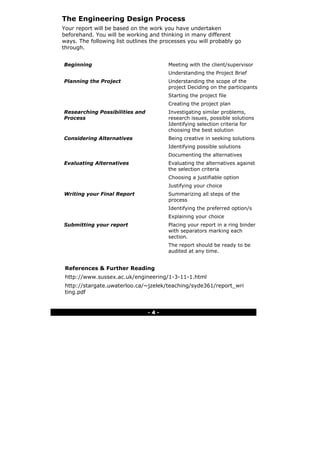
The Engineering Design Process
Your report will be based on the work you have undertaken
beforehand. You will be working and thinking in many different
ways. The following list outlines the processes you will probably go
through.


Beginning                               Meeting with the client/supervisor
                                        Understanding the Project Brief
Planning the Project                    Understanding the scope of the
                                        project Deciding on the participants
                                        Starting the project file
                                        Creating the project plan
Researching Possibilities and           Investigating similar problems,
Process                                 research issues, possible solutions
                                        Identifying selection criteria for
                                        choosing the best solution
Considering Alternatives                Being creative in seeking solutions
                                        Identifying possible solutions
                                        Documenting the alternatives
Evaluating Alternatives                 Evaluating the alternatives against
                                        the selection criteria
                                        Choosing a justifiable option
                                        Justifying your choice
Writing your Final Report               Summarizing all steps of the
                                        process
                                        Identifying the preferred option/s
                                        Explaining your choice
Submitting your report                  Placing your report in a ring binder
                                        with separators marking each
                                        section.
                                        The report should be ready to be
                                        audited at any time.


 References & Further Reading
 http://www.sussex.ac.uk/engineering/1-3-11-1.html
 http://stargate.uwaterloo.ca/~jzelek/teaching/syde361/report_wri
 ting.pdf


                                -4-

Writing+an+engineering+design+report

  • 1.
    Writing an EngineeringDesign Report Design Report writing is an important skill for engineers. Its purpose is to prepare you for your future profession. Although this brochure outlines the key features of a Design Report, always check whether your lecturer, or client, has specific requirements. Design Reports are complex because they reflect the final results of detailed research, often undertaken over an extended period. Yet, little of this detail is included in the body of the report. The report itself includes summary information, including the rationale behind critical decisions leading to the recommendations. However, there is a place for the detail: the Appendix, where it can be accessed as needed. The Design Report, therefore, gives the reader access to 3 levels of information: • A Summary • The Introduction, the Analyses Sections, the Conclusion • The Appendices Understanding the purpose of the report, providing your reader with a clear map of your report, writing up your outcomes and recommendations in appropriate descriptive and summary vocabulary, using well designed explanatory charts and clear equations are all important prerequisites for writing a good laboratory report. Academic Skills Unit ● 8344 0930 ● www.services.unimelb.edu.au/asu//
  • 2.
    Clear Structure A keyelement in a good Design Report is a clear structure. Title page: title of project, client/lecturer/tutor, date, your name (and student ID). Summary: the summary page (level 1) sets the problem in context, summarizes what you have done, and provides the key outcomes and recommendations Table of contents: this page clearly outlines each part of the report using section headings and page numbers (Use Word heading style for consistency in your document). Introduction: the introduction (level 2) introduces and situates the problem being addressed and discusses any previous research in the area. Analysis section/s (often given a specific title): you need to provide a summary walkthrough of the analysis which led to your recommendations. Keep it simple, use only key charts and equations. And restrict it to 3 – 7 pages in length. Note that the detail (e.g. raw data) should be placed in the appendix. Conclusion: this should give a brief summary of what you have done and include your recommendations References: this is a list in standard form of all the books, web sites and resources you have referred to. Bibliography: other books and resources you used. Appendix: You may have more than one appendix which will describe in detail, if necessary, the analyses you have undertaken for the brief and the data you obtained. -2-
  • 3.
    Place your workin a Design Folder: Many lecturers recommend you maintain a design file folder in which you keep a record of the work undertaken for the brief. Uses section markers to help you with the summary process. Remember the cover sheet. WRITING-UP YOUR DESIGN REPORT Questions to answer before you start writing: • Have you clearly understood the brief? • Do you clearly understand the context of the brief? • Do you clearly understand the processes you have undertaken to fulfill the brief? • What knowledge do you need to complete this task? • What type of analyses have you undertaken? • Have you clearly expressed the results of you research in clear charts, diagrams, graphs or equations? • Have you considered the different purposes of each section of the report? • Have you written your summary report in clear and precise language? • Have you used the appropriate and relevant vocabulary? • Does the layout of your report clearly map the progression of your research and the results? -3-
  • 4.
    The Engineering DesignProcess Your report will be based on the work you have undertaken beforehand. You will be working and thinking in many different ways. The following list outlines the processes you will probably go through. Beginning Meeting with the client/supervisor Understanding the Project Brief Planning the Project Understanding the scope of the project Deciding on the participants Starting the project file Creating the project plan Researching Possibilities and Investigating similar problems, Process research issues, possible solutions Identifying selection criteria for choosing the best solution Considering Alternatives Being creative in seeking solutions Identifying possible solutions Documenting the alternatives Evaluating Alternatives Evaluating the alternatives against the selection criteria Choosing a justifiable option Justifying your choice Writing your Final Report Summarizing all steps of the process Identifying the preferred option/s Explaining your choice Submitting your report Placing your report in a ring binder with separators marking each section. The report should be ready to be audited at any time. References & Further Reading http://www.sussex.ac.uk/engineering/1-3-11-1.html http://stargate.uwaterloo.ca/~jzelek/teaching/syde361/report_wri ting.pdf -4-