TECH2002 Studies in Digital Technology Lecture Week 1 Tag:  Introduction 1  ,  TECH2002 ,  Web 2.0 ,  lecture ,  andrew ,  clay ,  the joker ,  new media ,  digital technology
Studies in Digital Technology? Media technology in a social context Participation and communication Module teaching and learning community ‘ Learning by doing’ Play [keywords and concepts] Theory and critical thinking Academic study – reading and writing?
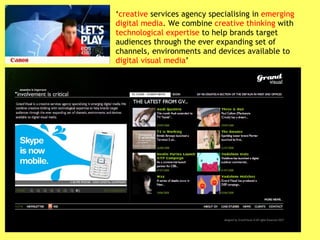
‘ creative  services agency specialising in  emerging digital media . We combine  creative thinking  with  technological expertise  to help brands target audiences through the ever expanding set of channels, environments and devices available to  digital visual media ’
New Media and ‘Old Media in New Times’ New media  web, internet, mobile phones, videogames ‘ Old media in new times’ digital cinema, internet television, digital audio, digital publishing
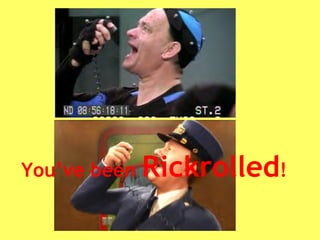
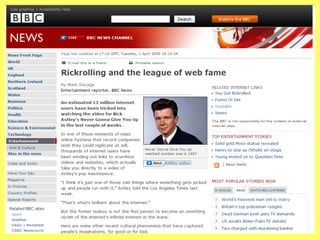
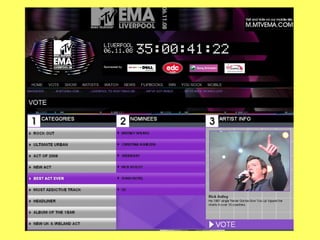
You’ve been  Rickrolled !
 
 
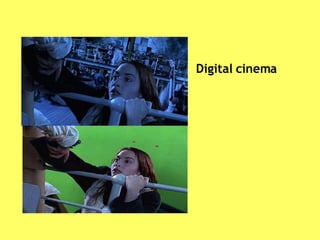
Digital cinema
‘ With the emergence of the computer, entirely new ways of making images, together with ways of assisting and augmenting established methods and techniques have become commonplace within contemporary forms of visual cultural production’   (Darley 2000: p.36)
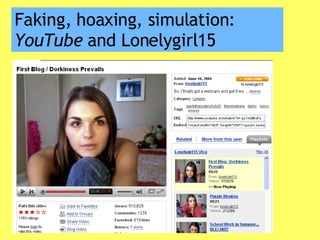
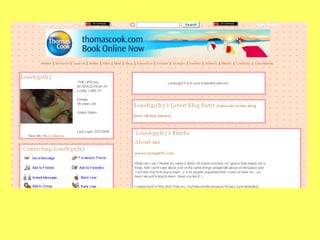
Faking, hoaxing, simulation:  YouTube  and Lonelygirl15
 
New media (Flew 2008) Convergence of computing, communications and content (media)  [‘three Cs’]
New media = digital media? ‘ New media  can also be thought of as  digital media . Digital media are forms of media content that combine and integrate data, text, sound, and images of all kinds; are stored in digital formats; and are increasingly distributed through networks such as those based on broadband fibre-optic cables, satellites, and microwave transmission systems’ (Flew 2008, pp.2-3)
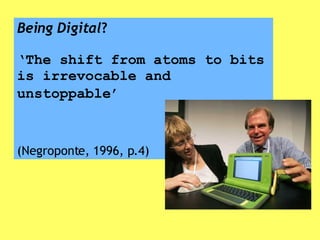
Being Digital ? ‘The shift from atoms to bits is irrevocable and unstoppable’   (Negroponte, 1996, p.4)
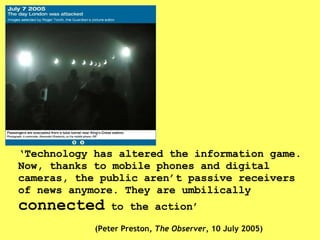
‘ Technology has altered the information game. Now, thanks to mobile phones and digital cameras, the public aren’t passive receivers of news anymore. They are umbilically  connected  to the action’ (Peter Preston,  The Observer , 10 July 2005)
 
What is new for society about new media? New social practices? Artefacts and devices that allow communication Communication activities and practices Social arrangements and organisations formed around devices and practices
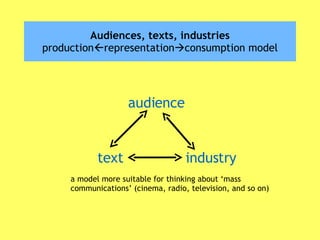
Audiences, texts, industries production  representation  consumption model audience text industry a model more suitable for thinking about ‘mass communications’ (cinema, radio, television, and so on)
Electronically mediated communication (telephones, mobile phones, the internet) don’t study media in isolation, but study the social and cultural context of which the media is a part (Moores, 2005) time-space relations, interactions and sociabilities, meanings, and experiences
Text messaging teenagers and text messaging ‘ ...text messaging influences how teenagers feel about themselves...often mediating intimate relations and becoming a repository for precious memories and gifts’  (McCarthy and Wright, 2004, p.108)
Technology as experience ‘ We don’t just use technology; we live with it. Much more deeply than ever before, we are aware that interacting with technology involves us emotionally, intellectually and sensually’   (McCarthy and Wright, 2004, p.ix)
Our technoid lives The attempt to understand and evaluate how we use technology as part of our mundane and extraordinary everyday lives is one of the most important ways that we become good technologists As  critical technical practitioners  we should think about and investigate the social significance of new technologies and explore and evaluate them by using them to make things –  ‘learning by doing’ with the insight of theory and critical reflection
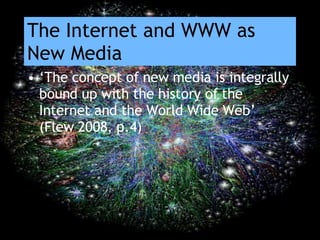
The Internet and WWW as New Media ‘ The concept of new media is integrally bound up with the history of the Internet and the World Wide Web’ (Flew 2008, p.4)
Web 2.0 ‘ The concept of Web 2.0 is centrally important to understanding new media in the 21 st  century’ (Flew 2008, p.16)
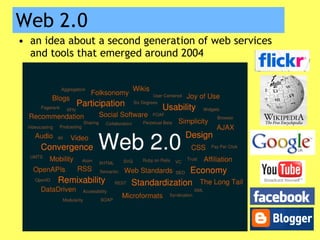
Web 2.0 an idea about a second generation of web services and tools that emerged around 2004
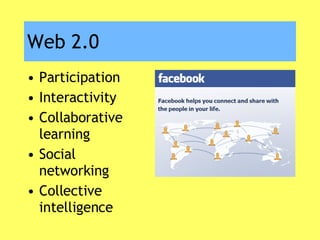
Web 2.0 Participation Interactivity Collaborative learning Social networking Collective intelligence
 
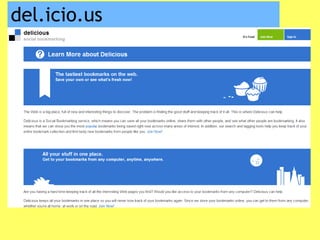
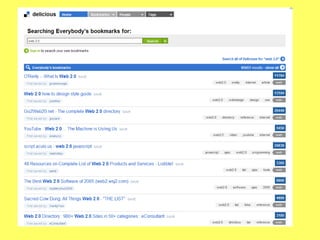
del.icio.us
 
tagging a tag is a keyword assigned to a piece of information metadata – data about data sorting, aggregating, identifying, describing with personal markers
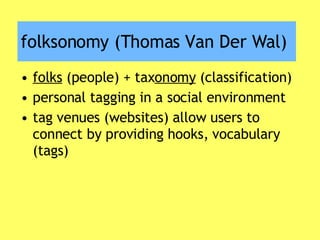
folksonomy (Thomas Van Der Wal) folks  (people) + tax onomy  (classification) personal tagging in a social environment tag venues (websites) allow users to connect by providing hooks, vocabulary (tags)
 
Web 2.0 coursework Essay Project Participation Communication


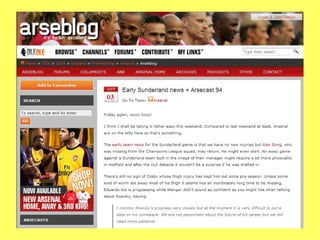
Arseblog ‘ Arseblog does not just provide a daily outlet for its author’s obsession. His daily posts provoke lively discussion often attracting hundreds of contributions and supply a round up of the news in the online and offline editions of all the British newspapers, as well as from France and Spain where many Arsenal players come from. The site links to and often quotes from the other fifteen decent blogs about Arsenal, as well as dipping into blogs run by fans of other clubs’ (Leadbeater 2008)
Arseblog  and Web 2.0 ‘ Arseblog is a perfect example of how Web 2.0 is changing how people relate to information and media. The web provides many more niches for people to start a conversation on something about which they feel passionately. The old, industrial media, newspapers and television, do not have enough room to cater for all the minority interests of their readers and listeners’ (Leadbeater, 2008)
 
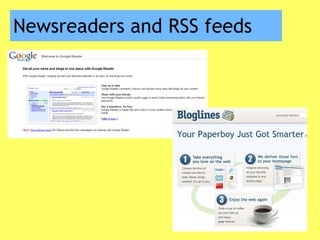
Newsreaders and RSS feeds
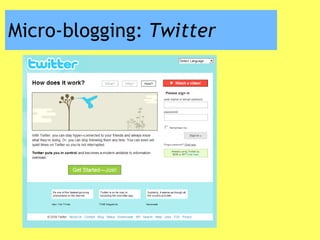
Micro-blogging:  Twitter
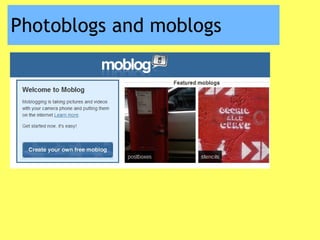
Photoblogs and moblogs
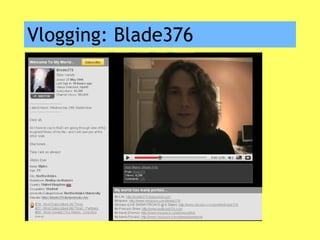
Vlogging: Blade376
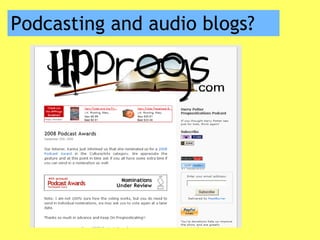
Podcasting and audio blogs?
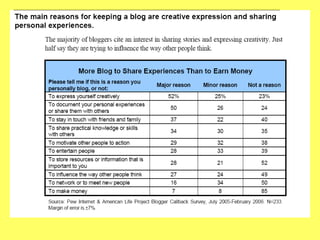
Blogs are social media Blog software and tools are social media They allow people to mediate their lives and share this media with other people People are connected through reading and writing, watching and listening Bloggers integrate convergent media into their everyday lives and turn their everyday life into media Blogging is both technological experience of everyday life and media representation of our everyday lives
Social Media ‘ What's changed is that where once tools for media creation and publishing were controlled by an elite, digital technology is increasingly putting them into our hands. We can consume, interact with, create and share media more freely than ever - and this changes the power relationship between us and the mainstream media. We are entering the age of social media’. Anthony Lilley The Royal Television Society Huw Wheldon Memorial Lecture 2007
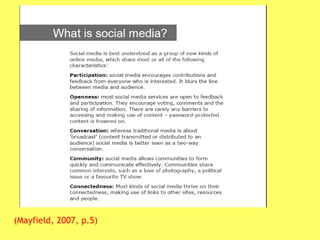
(Mayfield, 2007, p.5)
 
Live Lectures, Published Lectures and Meetings Term 1 2 introductory live lectures 1 summary live lecture in week 12 9 weeks of meetings instead of live lectures 9 published lectures All lectures will be published
Bibliography Darley, A. (2000)  Visual Digital Culture , London, Routledge. Flew, T. (2008)  New Media: An Introduction (3 rd  Edition) , South Melbourne, Oxford University  Press. Leadbeater, C. (2008) We Think [WWW] Available at  http://www.charlesleadbeater.net/cms/xstandard/Rev%20Ch%20Two.pdf  (Accessed 3 October 2008) Lenhart, A. and Fox, S. (2006) Bloggers: A Portrait of the Internet’s New Storytellers [WWW]  Available at http://www.pewinternet.org/pdfs/PIP%20Bloggers %20Report%20July%2019%202006.pdf (Accessed 2 October 2008). Lilley, A. (2007) ‘The Me in Media: Participation, Interactivity and the Rise of the People formerly  known as the audience’, The  Royal Television  Society Huw Wheldon Memorial Lecture 2007. Manovich, L. (2001)  The Language of New Media , Cambridge, Mass, MIT Press. Mayfield, A. (2007) What is social media? [WWW] Available at  http://www.icrossing.co.uk/fileadmin/uploads/eBooks/  What_is_social_media_Nov_2007.pdf (Accessed 24 September  2008). Moores, S. (2005)  Media/Theory: Thinking About Media and Communications , London and New  York, Routledge. Negroponte, N. (1996)  Being Digital , London, Coronet.

Tech2002lecweekone0809

  • 1.
    TECH2002 Studies inDigital Technology Lecture Week 1 Tag: Introduction 1 , TECH2002 , Web 2.0 , lecture , andrew , clay , the joker , new media , digital technology
  • 2.
    Studies in DigitalTechnology? Media technology in a social context Participation and communication Module teaching and learning community ‘ Learning by doing’ Play [keywords and concepts] Theory and critical thinking Academic study – reading and writing?
  • 3.
    ‘ creative services agency specialising in emerging digital media . We combine creative thinking with technological expertise to help brands target audiences through the ever expanding set of channels, environments and devices available to digital visual media ’
  • 4.
    New Media and‘Old Media in New Times’ New media web, internet, mobile phones, videogames ‘ Old media in new times’ digital cinema, internet television, digital audio, digital publishing
  • 5.
    You’ve been Rickrolled !
  • 6.
  • 7.
  • 8.
  • 9.
    ‘ With theemergence of the computer, entirely new ways of making images, together with ways of assisting and augmenting established methods and techniques have become commonplace within contemporary forms of visual cultural production’ (Darley 2000: p.36)
  • 10.
    Faking, hoaxing, simulation: YouTube and Lonelygirl15
  • 11.
  • 12.
    New media (Flew2008) Convergence of computing, communications and content (media) [‘three Cs’]
  • 13.
    New media =digital media? ‘ New media can also be thought of as digital media . Digital media are forms of media content that combine and integrate data, text, sound, and images of all kinds; are stored in digital formats; and are increasingly distributed through networks such as those based on broadband fibre-optic cables, satellites, and microwave transmission systems’ (Flew 2008, pp.2-3)
  • 14.
    Being Digital ?‘The shift from atoms to bits is irrevocable and unstoppable’ (Negroponte, 1996, p.4)
  • 15.
    ‘ Technology hasaltered the information game. Now, thanks to mobile phones and digital cameras, the public aren’t passive receivers of news anymore. They are umbilically connected to the action’ (Peter Preston, The Observer , 10 July 2005)
  • 16.
  • 17.
    What is newfor society about new media? New social practices? Artefacts and devices that allow communication Communication activities and practices Social arrangements and organisations formed around devices and practices
  • 18.
    Audiences, texts, industriesproduction  representation  consumption model audience text industry a model more suitable for thinking about ‘mass communications’ (cinema, radio, television, and so on)
  • 19.
    Electronically mediated communication(telephones, mobile phones, the internet) don’t study media in isolation, but study the social and cultural context of which the media is a part (Moores, 2005) time-space relations, interactions and sociabilities, meanings, and experiences
  • 20.
    Text messaging teenagersand text messaging ‘ ...text messaging influences how teenagers feel about themselves...often mediating intimate relations and becoming a repository for precious memories and gifts’ (McCarthy and Wright, 2004, p.108)
  • 21.
    Technology as experience‘ We don’t just use technology; we live with it. Much more deeply than ever before, we are aware that interacting with technology involves us emotionally, intellectually and sensually’ (McCarthy and Wright, 2004, p.ix)
  • 22.
    Our technoid livesThe attempt to understand and evaluate how we use technology as part of our mundane and extraordinary everyday lives is one of the most important ways that we become good technologists As critical technical practitioners we should think about and investigate the social significance of new technologies and explore and evaluate them by using them to make things – ‘learning by doing’ with the insight of theory and critical reflection
  • 23.
    The Internet andWWW as New Media ‘ The concept of new media is integrally bound up with the history of the Internet and the World Wide Web’ (Flew 2008, p.4)
  • 24.
    Web 2.0 ‘The concept of Web 2.0 is centrally important to understanding new media in the 21 st century’ (Flew 2008, p.16)
  • 25.
    Web 2.0 anidea about a second generation of web services and tools that emerged around 2004
  • 26.
    Web 2.0 ParticipationInteractivity Collaborative learning Social networking Collective intelligence
  • 27.
  • 28.
  • 29.
  • 30.
    tagging a tagis a keyword assigned to a piece of information metadata – data about data sorting, aggregating, identifying, describing with personal markers
  • 31.
    folksonomy (Thomas VanDer Wal) folks (people) + tax onomy (classification) personal tagging in a social environment tag venues (websites) allow users to connect by providing hooks, vocabulary (tags)
  • 32.
  • 33.
    Web 2.0 courseworkEssay Project Participation Communication
  • 34.
  • 35.
  • 36.
  • 37.
  • 38.
    Arseblog ‘ Arseblogdoes not just provide a daily outlet for its author’s obsession. His daily posts provoke lively discussion often attracting hundreds of contributions and supply a round up of the news in the online and offline editions of all the British newspapers, as well as from France and Spain where many Arsenal players come from. The site links to and often quotes from the other fifteen decent blogs about Arsenal, as well as dipping into blogs run by fans of other clubs’ (Leadbeater 2008)
  • 39.
    Arseblog andWeb 2.0 ‘ Arseblog is a perfect example of how Web 2.0 is changing how people relate to information and media. The web provides many more niches for people to start a conversation on something about which they feel passionately. The old, industrial media, newspapers and television, do not have enough room to cater for all the minority interests of their readers and listeners’ (Leadbeater, 2008)
  • 40.
  • 41.
  • 42.
  • 43.
  • 44.
  • 45.
  • 46.
    Blogs are socialmedia Blog software and tools are social media They allow people to mediate their lives and share this media with other people People are connected through reading and writing, watching and listening Bloggers integrate convergent media into their everyday lives and turn their everyday life into media Blogging is both technological experience of everyday life and media representation of our everyday lives
  • 47.
    Social Media ‘What's changed is that where once tools for media creation and publishing were controlled by an elite, digital technology is increasingly putting them into our hands. We can consume, interact with, create and share media more freely than ever - and this changes the power relationship between us and the mainstream media. We are entering the age of social media’. Anthony Lilley The Royal Television Society Huw Wheldon Memorial Lecture 2007
  • 48.
  • 49.
  • 50.
    Live Lectures, PublishedLectures and Meetings Term 1 2 introductory live lectures 1 summary live lecture in week 12 9 weeks of meetings instead of live lectures 9 published lectures All lectures will be published
  • 51.
    Bibliography Darley, A.(2000) Visual Digital Culture , London, Routledge. Flew, T. (2008) New Media: An Introduction (3 rd Edition) , South Melbourne, Oxford University Press. Leadbeater, C. (2008) We Think [WWW] Available at http://www.charlesleadbeater.net/cms/xstandard/Rev%20Ch%20Two.pdf (Accessed 3 October 2008) Lenhart, A. and Fox, S. (2006) Bloggers: A Portrait of the Internet’s New Storytellers [WWW] Available at http://www.pewinternet.org/pdfs/PIP%20Bloggers %20Report%20July%2019%202006.pdf (Accessed 2 October 2008). Lilley, A. (2007) ‘The Me in Media: Participation, Interactivity and the Rise of the People formerly known as the audience’, The Royal Television Society Huw Wheldon Memorial Lecture 2007. Manovich, L. (2001) The Language of New Media , Cambridge, Mass, MIT Press. Mayfield, A. (2007) What is social media? [WWW] Available at http://www.icrossing.co.uk/fileadmin/uploads/eBooks/ What_is_social_media_Nov_2007.pdf (Accessed 24 September 2008). Moores, S. (2005) Media/Theory: Thinking About Media and Communications , London and New York, Routledge. Negroponte, N. (1996) Being Digital , London, Coronet.