Headlines and Some Key Points from the Ofcom Communication Markets Reports 2008 Converging Communication Markets TECH2002 Week 18 Andrew Clay
Ofcom tracking of the theme of convergence Ofcom has published a number of reports examining the theme of convergence in communications markets The reports look at market trends, industry characteristics and consumers across a range of converged devices and services This is the technical convergence of digital media
Ofcom’s definition of convergence Technical definition (compared to the ‘participation culture’ definition of Henry Jenkins) ‘ Convergence’ is the growing tendency for a range of content types (audio, video, text, pictures) and services to be distributed over different digital networks fixed broadband, mobile infrastructure, satellite, cable, digital terrestrial etc) to a variety of consumer devices (PC, personal digital assistant, TV, mobile) Example: a mobile handset can receive voice calls, data, pictures, audio, video and text, all over a 2G/3G network http://www.ofcom.org.uk/research/cm/cmr08/converge/
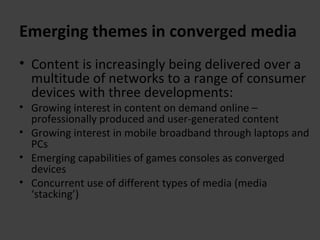
Emerging themes in converged media Content is increasingly being delivered over a multitude of networks to a range of consumer devices with three developments: Growing interest in content on demand online – professionally produced and user-generated content Growing interest in mobile broadband through laptops and PCs Emerging capabilities of games consoles as converged devices Concurrent use of different types of media (media ‘stacking’)
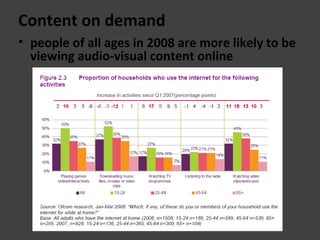
Content on demand people of all ages in 2008 are more likely to be viewing audio-visual content online
 
 
Mobile broadband PCs and laptops that connect to the internet using a third-generation mobile network are growing in popularity, with over 500k sales of new connections via cards and ‘dongles’ that support this connectivity in the five months from February 2008 As a result, while the base of consumers adopting this means of connectivity is small, it is growing fast
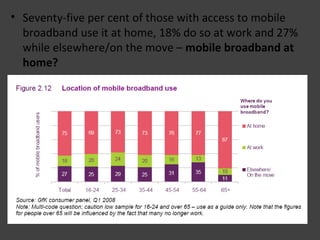
Seventy-five per cent of those with access to mobile broadband use it at home, 18% do so at work and 27% while elsewhere/on the move –  mobile broadband at home?
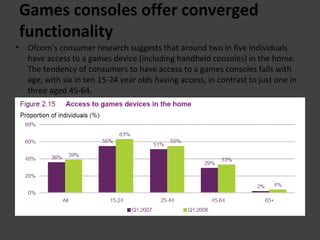
Games consoles offer converged functionality Ofcom’s consumer research suggests that around two in five individuals have access to a games device (including handheld consoles) in the home. The tendency of consumers to have access to a games consoles falls with age, with six in ten 15-24 year olds having access, in contrast to just one in three aged 45-64.
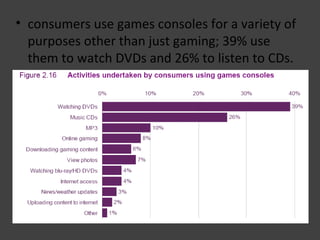
consumers use games consoles for a variety of purposes other than just gaming; 39% use them to watch DVDs and 26% to listen to CDs.
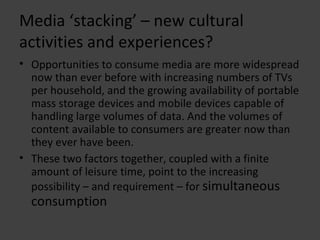
Media ‘stacking’ – new cultural activities and experiences? Opportunities to consume media are more widespread now than ever before with increasing numbers of TVs per household, and the growing availability of portable mass storage devices and mobile devices capable of handling large volumes of data. And the volumes of content available to consumers are greater now than they ever have been. These two factors together, coupled with a finite amount of leisure time, point to the increasing possibility – and requirement – for  simultaneous consumption
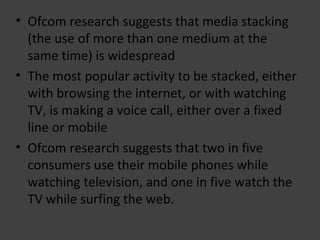
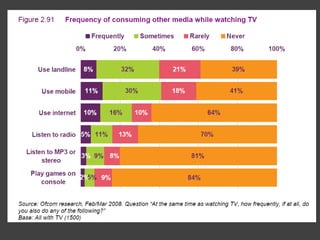
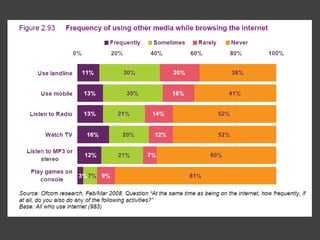
Ofcom  research suggests that media stacking (the use of more than one medium at the same time) is widespread The most popular activity to be stacked, either with browsing the internet, or with watching TV, is making a voice call, either over a fixed line or mobile Ofcom research suggests that two in five consumers use their mobile phones while watching television, and one in five watch the TV while surfing the web.
 
 
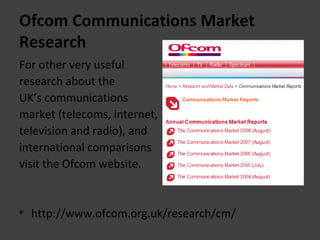
Ofcom Communications Market Research For other very useful  research about the UK’s communications  market (telecoms, internet,  television and radio), and  international comparisons  visit the Ofcom website. http://www.ofcom.org.uk/research/cm/

Ofcom UK Communication Markets Report 2008 - Some Headlines

  • 1.
    Headlines and SomeKey Points from the Ofcom Communication Markets Reports 2008 Converging Communication Markets TECH2002 Week 18 Andrew Clay
  • 2.
    Ofcom tracking ofthe theme of convergence Ofcom has published a number of reports examining the theme of convergence in communications markets The reports look at market trends, industry characteristics and consumers across a range of converged devices and services This is the technical convergence of digital media
  • 3.
    Ofcom’s definition ofconvergence Technical definition (compared to the ‘participation culture’ definition of Henry Jenkins) ‘ Convergence’ is the growing tendency for a range of content types (audio, video, text, pictures) and services to be distributed over different digital networks fixed broadband, mobile infrastructure, satellite, cable, digital terrestrial etc) to a variety of consumer devices (PC, personal digital assistant, TV, mobile) Example: a mobile handset can receive voice calls, data, pictures, audio, video and text, all over a 2G/3G network http://www.ofcom.org.uk/research/cm/cmr08/converge/
  • 4.
    Emerging themes inconverged media Content is increasingly being delivered over a multitude of networks to a range of consumer devices with three developments: Growing interest in content on demand online – professionally produced and user-generated content Growing interest in mobile broadband through laptops and PCs Emerging capabilities of games consoles as converged devices Concurrent use of different types of media (media ‘stacking’)
  • 5.
    Content on demandpeople of all ages in 2008 are more likely to be viewing audio-visual content online
  • 6.
  • 7.
  • 8.
    Mobile broadband PCsand laptops that connect to the internet using a third-generation mobile network are growing in popularity, with over 500k sales of new connections via cards and ‘dongles’ that support this connectivity in the five months from February 2008 As a result, while the base of consumers adopting this means of connectivity is small, it is growing fast
  • 9.
    Seventy-five per centof those with access to mobile broadband use it at home, 18% do so at work and 27% while elsewhere/on the move – mobile broadband at home?
  • 10.
    Games consoles offerconverged functionality Ofcom’s consumer research suggests that around two in five individuals have access to a games device (including handheld consoles) in the home. The tendency of consumers to have access to a games consoles falls with age, with six in ten 15-24 year olds having access, in contrast to just one in three aged 45-64.
  • 11.
    consumers use gamesconsoles for a variety of purposes other than just gaming; 39% use them to watch DVDs and 26% to listen to CDs.
  • 12.
    Media ‘stacking’ –new cultural activities and experiences? Opportunities to consume media are more widespread now than ever before with increasing numbers of TVs per household, and the growing availability of portable mass storage devices and mobile devices capable of handling large volumes of data. And the volumes of content available to consumers are greater now than they ever have been. These two factors together, coupled with a finite amount of leisure time, point to the increasing possibility – and requirement – for simultaneous consumption
  • 13.
    Ofcom researchsuggests that media stacking (the use of more than one medium at the same time) is widespread The most popular activity to be stacked, either with browsing the internet, or with watching TV, is making a voice call, either over a fixed line or mobile Ofcom research suggests that two in five consumers use their mobile phones while watching television, and one in five watch the TV while surfing the web.
  • 14.
  • 15.
  • 16.
    Ofcom Communications MarketResearch For other very useful research about the UK’s communications market (telecoms, internet, television and radio), and international comparisons visit the Ofcom website. http://www.ofcom.org.uk/research/cm/