Introduction to Term 2 TECH2002 Studies in Digital Technology Week 16  Andrew Clay
Introduction Module strands Module tools Coursework Key ideas and themes from term 1 Jun 7, 2009
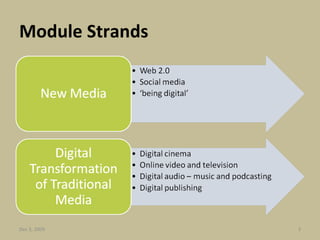
Module Strands Jun 7, 2009
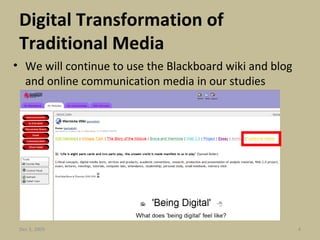
Digital Transformation of Traditional Media We will continue to use the Blackboard wiki and blog and online communication media in our studies Jun 7, 2009
Some New Module Social Media Tools for Collaboration and Sharing Microblog – ‘what are you doing right now?’ Tumblelog – simple multimedia blog Create your own social network Facebook  group Jun 7, 2009
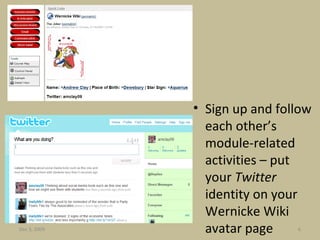
Sign up and follow each other’s module-related activities – put your  Twitter  identity on your Wernicke Wiki avatar page Jun 7, 2009
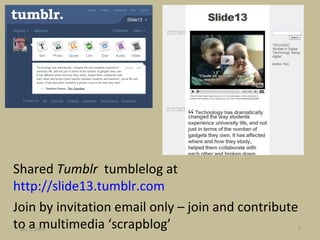
Shared  Tumblr  tumblelog at  http://slide13.tumblr.com Join by invitation email only – join and contribute to a multimedia ‘scrapblog’ Jun 7, 2009
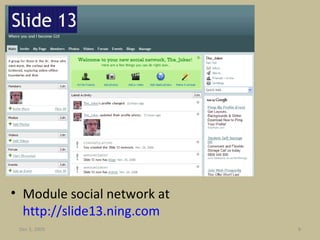
Module social network at  http://slide13.ning.com   Jun 7, 2009
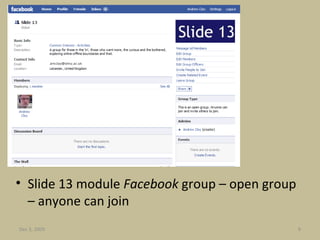
Slide 13 module  Facebook  group – open group – anyone can join Jun 7, 2009
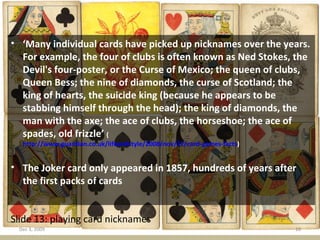
Slide 13: playing card nicknames ‘ Many individual cards have picked up nicknames over the years. For example, the four of clubs is often known as Ned Stokes, the Devil's four-poster, or the Curse of Mexico; the queen of clubs, Queen Bess; the nine of diamonds, the curse of Scotland; the king of hearts, the suicide king (because he appears to be stabbing himself through the head); the king of diamonds, the man with the axe; the ace of clubs, the horseshoe; the ace of spades, old frizzle’  ( http://www.guardian.co.uk/lifeandstyle/2008/nov/22/card-games-facts )  The Joker card only appeared in 1857, hundreds of years after the first packs of cards  Jun 7, 2009
New Media  Digital technology, Web 2.0, social media What kind of shift do you sense is taking place in your life or the lives of others in terms of ‘being digital’ with the introduction of new media technologies? How do people participate in new media cultural practices? This is the subject of the coursework – project and essay Jun 7, 2009
New Media What does new actually mean? What is really new and what is just a reformation of what already exists? Is our use of media shifting and changing the way we relate to it? Jun 7, 2009
Lister (et al.) (2003) Ch. 1 ‘New Media and New Technologies’ (pp.9-44) ‘ new media might be seen as a ‘set of interactions between new technological possibilities and established media forms’ (p.10) Jun 7, 2009
New Media? New textual experiences  (genres, forms, entertainments, pleasures, patterns of consumption) New ways of representing the world  (new representational possibilities and experiences)  New relationships between users/consumers and media technologies  (as part of everyday life and the meanings created with media)  New experiences of the relationship between embodiment, identity and community  (shifts in the personal and social experience of time, space and place)  New conceptions of the body’s relationship to technological media  (human-machine interaction, the real and the virtual)  New patterns of organisation and production  (realignments and integrations between providers and users of media) Jun 7, 2009
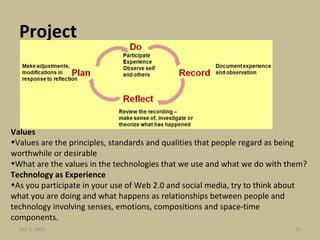
Project   Values Values are the principles, standards and qualities that people regard as being worthwhile or desirable What are the values in the technologies that we use and what we do with them? Technology as Experience As you participate in your use of Web 2.0 and social media, try to think about what you are doing and what happens as relationships between people and technology involving senses, emotions, compositions and space-time components. Jun 7, 2009
Critical Technical Practice CTP  - theoretical insight + hands-on-analysis of the technologies  ‘learning by doing’ get involved, participate, create look at how other people are using the technology the level of engagement, enjoyment of use, integration with everyday experiences, variability of use, or re-appropriation by users might be a typical way of measuring the values inherent in the design and deployment of technology Values – how is something used? Jun 7, 2009
Technology as experience We don’t just use technology; we live with it. Much more deeply than ever before, we are aware that interacting with technology involves us emotionally, intellectually and sensually  .  (McCarthy and Wright, 2004, p.ix) Experience – how does it feel? Jun 7, 2009
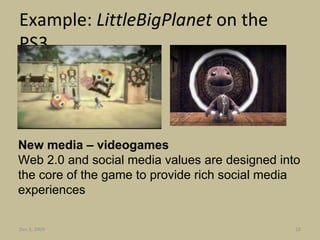
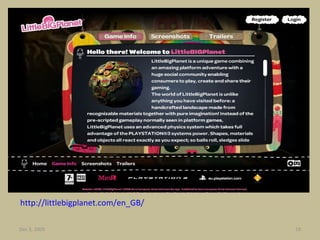
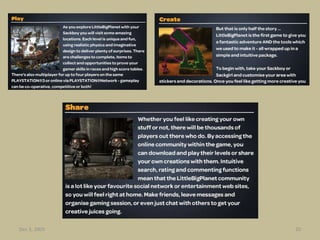
Example:  LittleBigPlanet  on the PS3 New media – videogames Web 2.0 and social media values are designed into the core of the game to provide rich social media experiences Jun 7, 2009
http://littlebigplanet.com/en_GB/   Jun 7, 2009
Jun 7, 2009
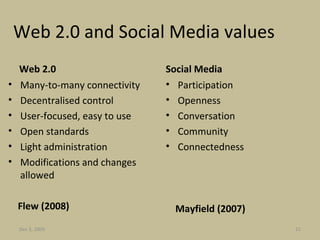
Web 2.0 and Social Media values Web 2.0 Many-to-many connectivity Decentralised control User-focused, easy to use Open standards Light administration Modifications and changes allowed Flew (2008) Social Media Participation Openness Conversation Community  Connectedness Mayfield (2007) Jun 7, 2009
Project Assessment [A] Studentship: Attendance Record (10 marks) [B] Verbal Presentation (15 marks)   [C] Self-Evaluation  (15 marks)   [D] Web 2.0 Portfolio (60 marks) Jun 7, 2009
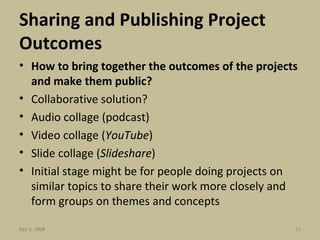
Sharing and Publishing Project Outcomes How to bring together the outcomes of the projects and make them public? Collaborative solution? Audio collage (podcast) Video collage ( YouTube ) Slide collage ( Slideshare ) Initial stage might be for people doing projects on similar topics to share their work more closely and form groups on themes and concepts Jun 7, 2009
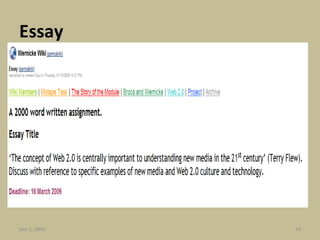
Essay Jun 7, 2009
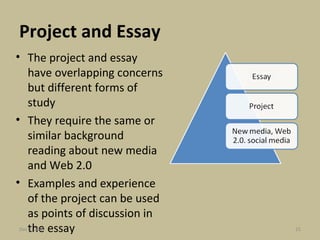
Project and Essay The project and essay have overlapping concerns but different forms of study They require the same or similar background reading about new media and Web 2.0 Examples and experience of the project can be used as points of discussion in the essay Jun 7, 2009
Recap of Term 1 Small Pieces Loosely Joined  (Weinberger, 2002)   [ Smallpieces.com ] ‘ The Web isn’t primarily about replacing atoms with bits...the Web is binding not just pages but us human beings in  new  ways. We are the true “small pieces” of the Web, and we are loosely joining ourselves in ways that we are still inventing’. Jun 7, 2009
ordinariness Settled, familiar, known, taken-for-granted character of daily use of media Television and radio – ‘ordinary’ media Habitual, mundane, underwhelming predictable enjoyment But this has been learned as the technology has been incorporated into everyday life Are we learning to make network media ordinary? What is extraordinary about new media?  Jun 7, 2009
routines Day-to-day, ‘daily life’ Regular round of activities Habitual uses of time and space Possibility of change in routines through new media technologies Time – work, free time, leisure Space – work, domestic, public Jun 7, 2009
Web 2.0 A concept developed by O’Reilly Media for a web industry conference in 2004 Participation environments Distributed, collective intelligence User-generated content User-added value Jun 7, 2009
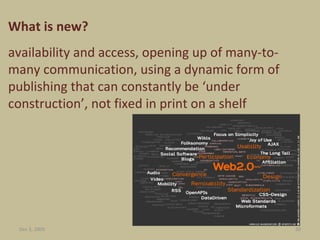
What is new?  availability and access, opening up of many-to-many communication, using a dynamic form of publishing that can constantly be ‘under construction’, not fixed in print on a shelf Jun 7, 2009
Identity - reflexivity Giddens (1991) self-identity, formation of the self Being self-aware is understanding yourself in terms of your biography – a story always in the process of being constructed With the reflexive incorporation of mediated materials (Thompson, 1995) Example – novel or television – we are opened up to new opportunities to see ourselves in relation to issues and social relations beyond the immediate locales of our everyday lives Jun 7, 2009
The web as a media technology of the self The Web seems to be a new technology of production that allows individuals to create their own public image  for  themselves   Instead of imitating others that are presented to us, we create images of ourselves to follow The Web might be seen as a medium of self-publicity rather than self-discovery? a set of techniques that allows us to create public images that come to dominate our identities Do we objectify ourselves as the content of new media? Jun 7, 2009
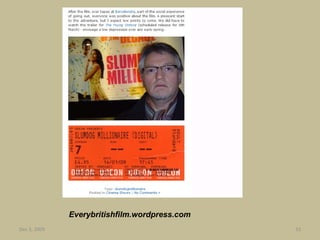
Jun 7, 2009 Everybritishfilm.wordpress.com
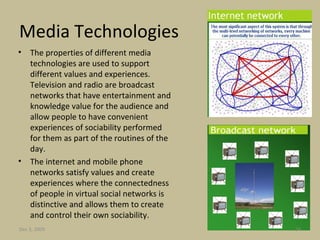
Media Technologies The properties of different media technologies are used to support different values and experiences. Television and radio are broadcast networks that have entertainment and knowledge value for the audience and allow people to have convenient experiences of sociability performed for them as part of the routines of the day.  The internet and mobile phone networks satisfy values and create experiences where the connectedness of people in virtual social networks is distinctive and allows them to create and control their own sociability. Jun 7, 2009
network society ‘ networked individualism’ Individuals build networks offline and online based on their interests, values, affinities, and projects This is enhanced by new technologies Networks become more dominant forms of ‘individualized interaction’ Like virtual communities, social networks are just extensions of offline life – there is not a discrete virtual existence Jun 7, 2009
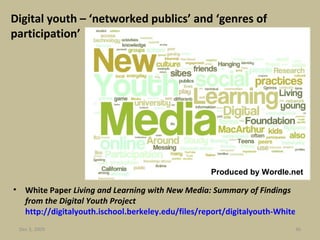
Digital youth – ‘networked publics’ and ‘genres of participation’ White Paper  Living and Learning with New Media: Summary of Findings from the Digital Youth Project  http://digitalyouth.ischool.berkeley.edu/files/report/digitalyouth-WhitePaper.pdf   Jun 7, 2009 Produced by Wordle.net
Networked Publics Participation in Networked Publics 'We use the term “networked publics” to describe participation in public culture that is supported by online networks. The growing availability of digital media-production tools, combined with online networks that traffic in rich media, is creating convergence between mass media and online communication. Rather than conceptualize everyday media engagement as “consumption” by “audiences,” the term “networked publics” places the active participation of a distributed social network in producing and circulating culture and knowledge in the foreground.' (Digital Youth Project, 2008 p.10) Jun 7, 2009
Genres of Participation Online activity is divided into friendship-driven and interest-driven forms of participation. The report identifies three genres of participation to describe different ways that young people engage with new media:   Hanging Out Messing Around Geeking Out Jun 7, 2009
Hanging Out 'Hanging Out' is used to refer to the way that young people maintain a continuous  presence or co-presence in multiple contexts for friendship-driven activities. Often there are forms of 'media socialisation' where media such as television, music, films and videogames are discussed. This is reinforced by the access to technologies for storing,  sharing and consuming files such as video and music.    'Through participation in social network sites such as MySpace, Facebook, and Bebo (among others) as well as instant and text messaging, young people are constructing new social norms and forms of media literacy in networked public culture that reflect the enhanced role of media in their lives' (Digital Youth Project, 2008 p.14) Jun 7, 2009
Messing Around '...messing around with media is embedded in social contexts where friends and a broader peer group share a media-related interest and social focus. For most youth, they find this context in their local friendship-driven networks, grounded in popular practices such as MySpace profile creation, digital photography, and gaming’  (Digital Youth Project, 2008, p.26) Jun 7, 2009
Geeking Out ‘ 'Geeking Out' refers to a more intense commitment  or engagement with media or technology. In this way there is the possibility that the participation goes beyond family, friends and peers to socialization and connections to expert users in interest-driven areas... These activities are associated with creating user-generated content, fandom,  and gaming and allow recognition and reputation to be formed  as well as audiences or appreciative communities’  (Digital Youth Project, 2008 pp.28-29) Jun 7, 2009
Virtual communities ‘ Virtual communities are social aggregations that emerge from the Net when enough people carry on those public discussions long enough, with sufficient human feeling, to form webs of personal relationships in cyberspace’.  (Rheingold, 1993, p.5). Like-minded people form virtual communities regardless of where they are located in the physical world Togetherness beyond face-to-face contact Jun 7, 2009
Virtual communities are ‘ interpersonal social networks, most of them based on weak ties, highly diversified and specialized…They transcend distance…Cyberlinks provide the opportunity of social links for people who, otherwise, will live more limited social lives, because their ties are increasingly spatially dispersed’   (Castells, 2000, p.389) more flexible than real-world communities and don’t rely on physical contact (Gauntlett and Horsley, 2004, p.17) Jun 7, 2009
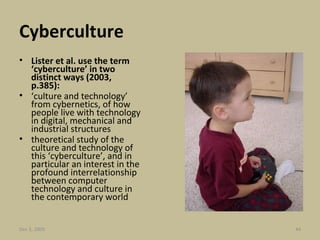
Cyberculture Lister et al. use the term ‘cyberculture’ in two distinct ways (2003, p.385): ‘ culture and technology’ from cybernetics, of how people live with technology in digital, mechanical and industrial structures theoretical study of the culture and technology of this ‘cyberculture’, and in particular an interest in the profound interrelationship between computer technology and culture in the contemporary world  Jun 7, 2009
Immersive VR the experiences of being conscious in one place (a virtual world) while the body is in another (the physical and material world) the capacity of technology to simulate reality and generate fantasy   Virtual spaces of communication networks identity formation away from the physical and everyday world   association and community across space, boundaries and divisions These virtual realities produce cyberspace Jun 7, 2009
virtuality  online social networks user-generated content online games virtual worlds experiencing the world anew? Jun 7, 2009
virtuality Virtuality is a mode of existence experienced through electronically mediated communication Virtual reality and cyberspace are concepts that express our experience of immersive simulation and network communication media  Virtual worlds are the most advanced 3D Web ‘spaces’ Jun 7, 2009
Cyberspace a sense in which we travel, we go, we enter spaces, when we use network communication without leaving our seats Second Life  users are called ‘residents’ as if they are actually living in a real space text-based sites are less-obviously spatial, although individual pages and sites are part of an imagined space that we can explore or ‘surf’. Jun 7, 2009
The cyborg self Mitchell suggests that there is a particular embodiment of technology through machines and computer networks that have extended our bodies as machines so that we have become part-machine or cyborgs: ‘ I construct, and am constructed, in a mutually recursive process that continually engages my fluid, permeable boundaries and my endlessly ramifying networks. I am a spatially extended cyborg’  (Mitchell, 2003, p.39) Jun 7, 2009
Becoming digital? How are we becoming digital? ‘ being digital’ – incorporation of  digital media  into everyday life (culture) Content User-generated content Traditional media content Television, radio, telecoms and internet and mobile device convergence Jun 7, 2009
Bibliography Castells, M. (2000)  The Rise of the Network Society (2nd Edition) , Oxford, Blackwell. Digital Youth Project (2008) White Paper  Living and Learning with New Media: Summary of Findings from the Digital Youth Project  [WWW] http://digitalyouth.ischool.berkeley.edu/files/report/digitalyouth-WhitePaper.pdf (Accessed 15 December 2008). Flew, T. (2008)  New Media: An Introduction (3 rd  Edition) , South Melbourne, Oxford University Press. Gauntlett, D. and Horsley R. (Eds. (2004)  Web.Studies , London, Arnold. Giddens, A. (1991)  Modernity and Self-Identity: Self and Society in the Late Modern Age , Cambridge, Polity Press. Lister, M. (et al.) (2003)  New Media: A Critical Introduction , London and New York, Routledge. McCarthy, J. And Wright, P. (2004)  Technology as Experience , Cambridge, Mass. and London, MIT Press. Mayfield, A. (2007) What is social media? [WWW] Available at  http://www.icrossing.co.uk/fileadmin/uploads/eBooks/What_is_social_media_Nov_2007.pdf (Accessed  24 September 2008). Mitchell, W. J. (2003)  Me++: The Cyborg Self and the Networked City , Cambridge, Mass., MIT Press. Rheingold, H. (1993) The Virtual Community [WWW] Available at http://www.rheingold.com/vc/book  (Accessed 5 January 2008). Thompson, J. (1995)  The Media and Modernity: A Social Theory of the Media , Cambridge, Polity Press. Weinberger, D. (2002) Small Pieces Loosely Joined [WWW] Available at http://www.smallpieces.com (Accessed  21 November 2007). Jun 7, 2009

TECH2002 Studies in Digital Technology Lecture Week 16

  • 1.
    Introduction to Term2 TECH2002 Studies in Digital Technology Week 16 Andrew Clay
  • 2.
    Introduction Module strandsModule tools Coursework Key ideas and themes from term 1 Jun 7, 2009
  • 3.
  • 4.
    Digital Transformation ofTraditional Media We will continue to use the Blackboard wiki and blog and online communication media in our studies Jun 7, 2009
  • 5.
    Some New ModuleSocial Media Tools for Collaboration and Sharing Microblog – ‘what are you doing right now?’ Tumblelog – simple multimedia blog Create your own social network Facebook group Jun 7, 2009
  • 6.
    Sign up andfollow each other’s module-related activities – put your Twitter identity on your Wernicke Wiki avatar page Jun 7, 2009
  • 7.
    Shared Tumblr tumblelog at http://slide13.tumblr.com Join by invitation email only – join and contribute to a multimedia ‘scrapblog’ Jun 7, 2009
  • 8.
    Module social networkat http://slide13.ning.com Jun 7, 2009
  • 9.
    Slide 13 module Facebook group – open group – anyone can join Jun 7, 2009
  • 10.
    Slide 13: playingcard nicknames ‘ Many individual cards have picked up nicknames over the years. For example, the four of clubs is often known as Ned Stokes, the Devil's four-poster, or the Curse of Mexico; the queen of clubs, Queen Bess; the nine of diamonds, the curse of Scotland; the king of hearts, the suicide king (because he appears to be stabbing himself through the head); the king of diamonds, the man with the axe; the ace of clubs, the horseshoe; the ace of spades, old frizzle’ ( http://www.guardian.co.uk/lifeandstyle/2008/nov/22/card-games-facts ) The Joker card only appeared in 1857, hundreds of years after the first packs of cards Jun 7, 2009
  • 11.
    New Media Digital technology, Web 2.0, social media What kind of shift do you sense is taking place in your life or the lives of others in terms of ‘being digital’ with the introduction of new media technologies? How do people participate in new media cultural practices? This is the subject of the coursework – project and essay Jun 7, 2009
  • 12.
    New Media Whatdoes new actually mean? What is really new and what is just a reformation of what already exists? Is our use of media shifting and changing the way we relate to it? Jun 7, 2009
  • 13.
    Lister (et al.)(2003) Ch. 1 ‘New Media and New Technologies’ (pp.9-44) ‘ new media might be seen as a ‘set of interactions between new technological possibilities and established media forms’ (p.10) Jun 7, 2009
  • 14.
    New Media? Newtextual experiences (genres, forms, entertainments, pleasures, patterns of consumption) New ways of representing the world (new representational possibilities and experiences)  New relationships between users/consumers and media technologies (as part of everyday life and the meanings created with media)  New experiences of the relationship between embodiment, identity and community (shifts in the personal and social experience of time, space and place)  New conceptions of the body’s relationship to technological media (human-machine interaction, the real and the virtual)  New patterns of organisation and production (realignments and integrations between providers and users of media) Jun 7, 2009
  • 15.
    Project Values Values are the principles, standards and qualities that people regard as being worthwhile or desirable What are the values in the technologies that we use and what we do with them? Technology as Experience As you participate in your use of Web 2.0 and social media, try to think about what you are doing and what happens as relationships between people and technology involving senses, emotions, compositions and space-time components. Jun 7, 2009
  • 16.
    Critical Technical PracticeCTP - theoretical insight + hands-on-analysis of the technologies ‘learning by doing’ get involved, participate, create look at how other people are using the technology the level of engagement, enjoyment of use, integration with everyday experiences, variability of use, or re-appropriation by users might be a typical way of measuring the values inherent in the design and deployment of technology Values – how is something used? Jun 7, 2009
  • 17.
    Technology as experienceWe don’t just use technology; we live with it. Much more deeply than ever before, we are aware that interacting with technology involves us emotionally, intellectually and sensually . (McCarthy and Wright, 2004, p.ix) Experience – how does it feel? Jun 7, 2009
  • 18.
    Example: LittleBigPlanet on the PS3 New media – videogames Web 2.0 and social media values are designed into the core of the game to provide rich social media experiences Jun 7, 2009
  • 19.
  • 20.
  • 21.
    Web 2.0 andSocial Media values Web 2.0 Many-to-many connectivity Decentralised control User-focused, easy to use Open standards Light administration Modifications and changes allowed Flew (2008) Social Media Participation Openness Conversation Community Connectedness Mayfield (2007) Jun 7, 2009
  • 22.
    Project Assessment [A]Studentship: Attendance Record (10 marks) [B] Verbal Presentation (15 marks)   [C] Self-Evaluation (15 marks)   [D] Web 2.0 Portfolio (60 marks) Jun 7, 2009
  • 23.
    Sharing and PublishingProject Outcomes How to bring together the outcomes of the projects and make them public? Collaborative solution? Audio collage (podcast) Video collage ( YouTube ) Slide collage ( Slideshare ) Initial stage might be for people doing projects on similar topics to share their work more closely and form groups on themes and concepts Jun 7, 2009
  • 24.
  • 25.
    Project and EssayThe project and essay have overlapping concerns but different forms of study They require the same or similar background reading about new media and Web 2.0 Examples and experience of the project can be used as points of discussion in the essay Jun 7, 2009
  • 26.
    Recap of Term1 Small Pieces Loosely Joined (Weinberger, 2002) [ Smallpieces.com ] ‘ The Web isn’t primarily about replacing atoms with bits...the Web is binding not just pages but us human beings in new ways. We are the true “small pieces” of the Web, and we are loosely joining ourselves in ways that we are still inventing’. Jun 7, 2009
  • 27.
    ordinariness Settled, familiar,known, taken-for-granted character of daily use of media Television and radio – ‘ordinary’ media Habitual, mundane, underwhelming predictable enjoyment But this has been learned as the technology has been incorporated into everyday life Are we learning to make network media ordinary? What is extraordinary about new media? Jun 7, 2009
  • 28.
    routines Day-to-day, ‘dailylife’ Regular round of activities Habitual uses of time and space Possibility of change in routines through new media technologies Time – work, free time, leisure Space – work, domestic, public Jun 7, 2009
  • 29.
    Web 2.0 Aconcept developed by O’Reilly Media for a web industry conference in 2004 Participation environments Distributed, collective intelligence User-generated content User-added value Jun 7, 2009
  • 30.
    What is new? availability and access, opening up of many-to-many communication, using a dynamic form of publishing that can constantly be ‘under construction’, not fixed in print on a shelf Jun 7, 2009
  • 31.
    Identity - reflexivityGiddens (1991) self-identity, formation of the self Being self-aware is understanding yourself in terms of your biography – a story always in the process of being constructed With the reflexive incorporation of mediated materials (Thompson, 1995) Example – novel or television – we are opened up to new opportunities to see ourselves in relation to issues and social relations beyond the immediate locales of our everyday lives Jun 7, 2009
  • 32.
    The web asa media technology of the self The Web seems to be a new technology of production that allows individuals to create their own public image for themselves Instead of imitating others that are presented to us, we create images of ourselves to follow The Web might be seen as a medium of self-publicity rather than self-discovery? a set of techniques that allows us to create public images that come to dominate our identities Do we objectify ourselves as the content of new media? Jun 7, 2009
  • 33.
    Jun 7, 2009Everybritishfilm.wordpress.com
  • 34.
    Media Technologies Theproperties of different media technologies are used to support different values and experiences. Television and radio are broadcast networks that have entertainment and knowledge value for the audience and allow people to have convenient experiences of sociability performed for them as part of the routines of the day. The internet and mobile phone networks satisfy values and create experiences where the connectedness of people in virtual social networks is distinctive and allows them to create and control their own sociability. Jun 7, 2009
  • 35.
    network society ‘networked individualism’ Individuals build networks offline and online based on their interests, values, affinities, and projects This is enhanced by new technologies Networks become more dominant forms of ‘individualized interaction’ Like virtual communities, social networks are just extensions of offline life – there is not a discrete virtual existence Jun 7, 2009
  • 36.
    Digital youth –‘networked publics’ and ‘genres of participation’ White Paper Living and Learning with New Media: Summary of Findings from the Digital Youth Project http://digitalyouth.ischool.berkeley.edu/files/report/digitalyouth-WhitePaper.pdf Jun 7, 2009 Produced by Wordle.net
  • 37.
    Networked Publics Participationin Networked Publics 'We use the term “networked publics” to describe participation in public culture that is supported by online networks. The growing availability of digital media-production tools, combined with online networks that traffic in rich media, is creating convergence between mass media and online communication. Rather than conceptualize everyday media engagement as “consumption” by “audiences,” the term “networked publics” places the active participation of a distributed social network in producing and circulating culture and knowledge in the foreground.' (Digital Youth Project, 2008 p.10) Jun 7, 2009
  • 38.
    Genres of ParticipationOnline activity is divided into friendship-driven and interest-driven forms of participation. The report identifies three genres of participation to describe different ways that young people engage with new media:   Hanging Out Messing Around Geeking Out Jun 7, 2009
  • 39.
    Hanging Out 'HangingOut' is used to refer to the way that young people maintain a continuous presence or co-presence in multiple contexts for friendship-driven activities. Often there are forms of 'media socialisation' where media such as television, music, films and videogames are discussed. This is reinforced by the access to technologies for storing, sharing and consuming files such as video and music.   'Through participation in social network sites such as MySpace, Facebook, and Bebo (among others) as well as instant and text messaging, young people are constructing new social norms and forms of media literacy in networked public culture that reflect the enhanced role of media in their lives' (Digital Youth Project, 2008 p.14) Jun 7, 2009
  • 40.
    Messing Around '...messingaround with media is embedded in social contexts where friends and a broader peer group share a media-related interest and social focus. For most youth, they find this context in their local friendship-driven networks, grounded in popular practices such as MySpace profile creation, digital photography, and gaming’ (Digital Youth Project, 2008, p.26) Jun 7, 2009
  • 41.
    Geeking Out ‘'Geeking Out' refers to a more intense commitment or engagement with media or technology. In this way there is the possibility that the participation goes beyond family, friends and peers to socialization and connections to expert users in interest-driven areas... These activities are associated with creating user-generated content, fandom, and gaming and allow recognition and reputation to be formed as well as audiences or appreciative communities’ (Digital Youth Project, 2008 pp.28-29) Jun 7, 2009
  • 42.
    Virtual communities ‘Virtual communities are social aggregations that emerge from the Net when enough people carry on those public discussions long enough, with sufficient human feeling, to form webs of personal relationships in cyberspace’. (Rheingold, 1993, p.5). Like-minded people form virtual communities regardless of where they are located in the physical world Togetherness beyond face-to-face contact Jun 7, 2009
  • 43.
    Virtual communities are‘ interpersonal social networks, most of them based on weak ties, highly diversified and specialized…They transcend distance…Cyberlinks provide the opportunity of social links for people who, otherwise, will live more limited social lives, because their ties are increasingly spatially dispersed’ (Castells, 2000, p.389) more flexible than real-world communities and don’t rely on physical contact (Gauntlett and Horsley, 2004, p.17) Jun 7, 2009
  • 44.
    Cyberculture Lister etal. use the term ‘cyberculture’ in two distinct ways (2003, p.385): ‘ culture and technology’ from cybernetics, of how people live with technology in digital, mechanical and industrial structures theoretical study of the culture and technology of this ‘cyberculture’, and in particular an interest in the profound interrelationship between computer technology and culture in the contemporary world Jun 7, 2009
  • 45.
    Immersive VR theexperiences of being conscious in one place (a virtual world) while the body is in another (the physical and material world) the capacity of technology to simulate reality and generate fantasy   Virtual spaces of communication networks identity formation away from the physical and everyday world association and community across space, boundaries and divisions These virtual realities produce cyberspace Jun 7, 2009
  • 46.
    virtuality onlinesocial networks user-generated content online games virtual worlds experiencing the world anew? Jun 7, 2009
  • 47.
    virtuality Virtuality isa mode of existence experienced through electronically mediated communication Virtual reality and cyberspace are concepts that express our experience of immersive simulation and network communication media Virtual worlds are the most advanced 3D Web ‘spaces’ Jun 7, 2009
  • 48.
    Cyberspace a sensein which we travel, we go, we enter spaces, when we use network communication without leaving our seats Second Life users are called ‘residents’ as if they are actually living in a real space text-based sites are less-obviously spatial, although individual pages and sites are part of an imagined space that we can explore or ‘surf’. Jun 7, 2009
  • 49.
    The cyborg selfMitchell suggests that there is a particular embodiment of technology through machines and computer networks that have extended our bodies as machines so that we have become part-machine or cyborgs: ‘ I construct, and am constructed, in a mutually recursive process that continually engages my fluid, permeable boundaries and my endlessly ramifying networks. I am a spatially extended cyborg’ (Mitchell, 2003, p.39) Jun 7, 2009
  • 50.
    Becoming digital? Howare we becoming digital? ‘ being digital’ – incorporation of digital media into everyday life (culture) Content User-generated content Traditional media content Television, radio, telecoms and internet and mobile device convergence Jun 7, 2009
  • 51.
    Bibliography Castells, M.(2000) The Rise of the Network Society (2nd Edition) , Oxford, Blackwell. Digital Youth Project (2008) White Paper Living and Learning with New Media: Summary of Findings from the Digital Youth Project [WWW] http://digitalyouth.ischool.berkeley.edu/files/report/digitalyouth-WhitePaper.pdf (Accessed 15 December 2008). Flew, T. (2008) New Media: An Introduction (3 rd Edition) , South Melbourne, Oxford University Press. Gauntlett, D. and Horsley R. (Eds. (2004) Web.Studies , London, Arnold. Giddens, A. (1991) Modernity and Self-Identity: Self and Society in the Late Modern Age , Cambridge, Polity Press. Lister, M. (et al.) (2003) New Media: A Critical Introduction , London and New York, Routledge. McCarthy, J. And Wright, P. (2004) Technology as Experience , Cambridge, Mass. and London, MIT Press. Mayfield, A. (2007) What is social media? [WWW] Available at http://www.icrossing.co.uk/fileadmin/uploads/eBooks/What_is_social_media_Nov_2007.pdf (Accessed 24 September 2008). Mitchell, W. J. (2003) Me++: The Cyborg Self and the Networked City , Cambridge, Mass., MIT Press. Rheingold, H. (1993) The Virtual Community [WWW] Available at http://www.rheingold.com/vc/book (Accessed 5 January 2008). Thompson, J. (1995) The Media and Modernity: A Social Theory of the Media , Cambridge, Polity Press. Weinberger, D. (2002) Small Pieces Loosely Joined [WWW] Available at http://www.smallpieces.com (Accessed 21 November 2007). Jun 7, 2009