introduction
 definition

 context

 content

 perspectives
   theoretical
   practical

 user sophistication

 conclusions
definition

The production of content by the general public rather than
   by paid professionals and experts in the field. Also called
    "peer production", and mostly available on the Web via
  blogs and wikis, user-generated content refers to material
       such as the daily news, encyclopedias and other
   references, movie and product reviews as well as articles
 on any subject, all of which have been traditionally written
            by editors, journalists and academics.
                    source: The Free Dictionary (online at
      http://encyclopedia2.thefreedictionary.com/user-generated+content)
context
 “Open-source software, blogs, song-sharing networks,
  free internet telephony – they’re each disrupting
  multibillion-dollar industries and reshaping the landscape
  of business, politics and culture. What’s the common
  threat behind them all? Us.” (Business Week 2005, The
  Power of Us)

 Media fragmentation – radio, newspapers, magazines, TV
context
 Evolution of ‘personal’ technologies & media – CD,
  Walkman, video games, PCs, video cassettes/recorders,
  mobile phone, DVD, QuickTime, internet, email, webcam,
  smartphone, satellite radio, HDTV, apps/iTunes,
  podcasting, blogs, RSS, Flickr, BitTorrent, YouTube,
  Wikipedia, machinima, virtual reality, augmented reality

 Analogue to digital – image, audio, video, information, life
  > convergence of media
context
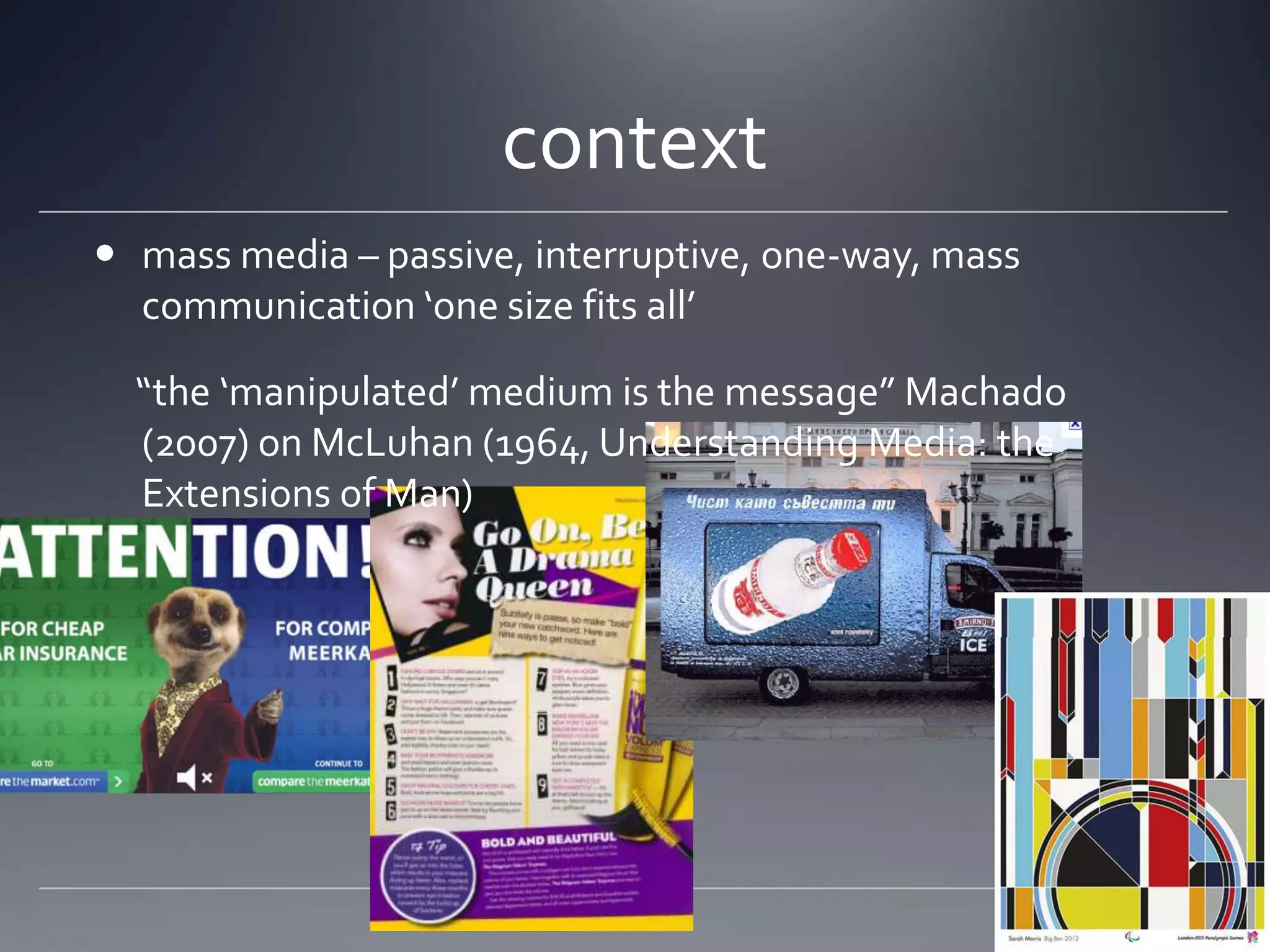
 mass media – passive, interruptive, one-way, mass
  communication ‘one size fits all’

  “the ‘manipulated’ medium is the message” Machado
  (2007) on McLuhan (1964, Understanding Media: the
  Extensions of Man)
context
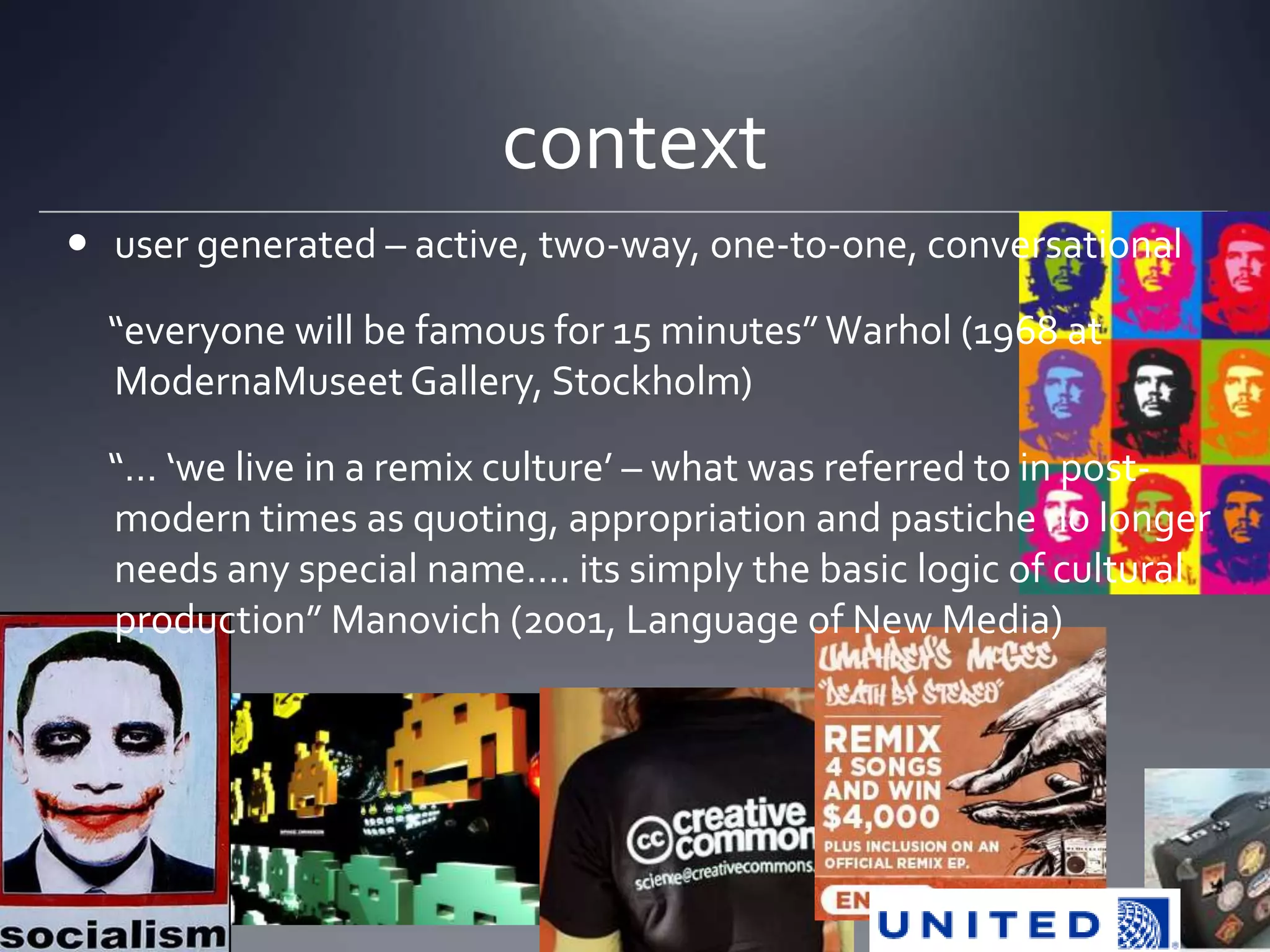
 user generated – active, two-way, one-to-one, conversational

  “everyone will be famous for 15 minutes” Warhol (1968 at
  ModernaMuseet Gallery, Stockholm)

  “… ‘we live in a remix culture’ – what was referred to in post-
  modern times as quoting, appropriation and pastiche no longer
  needs any special name…. its simply the basic logic of cultural
  production” Manovich (2001, Language of New Media)
content
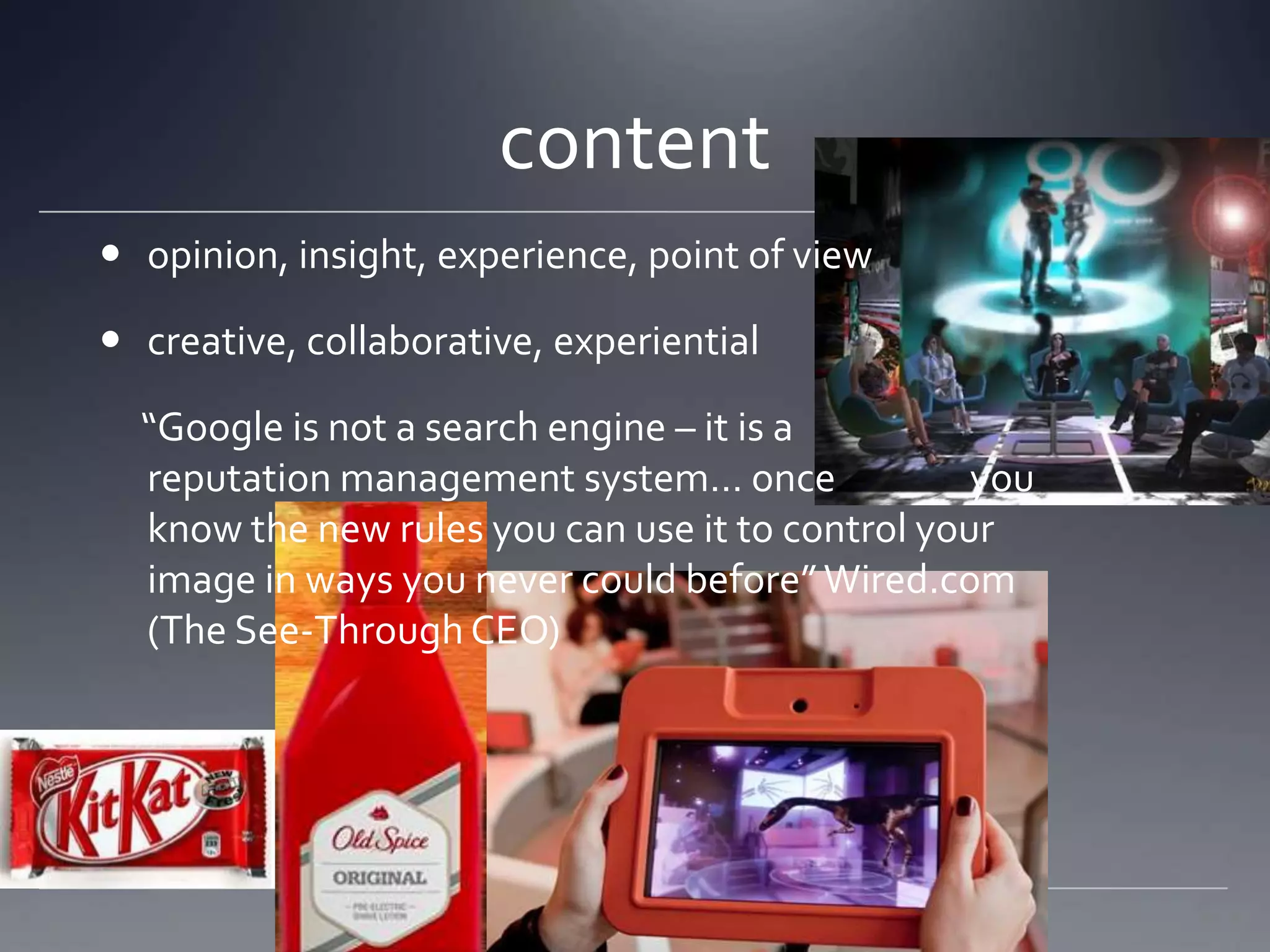
 opinion, insight, experience, point of view

 creative, collaborative, experiential

  “Google is not a search engine – it is a
  reputation management system… once              you
  know the new rules you can use it to control your
  image in ways you never could before” Wired.com
  (The See-Through CEO)
theoretical perspectives
 self identity - gender, ethnicity, perceptions, beliefs, goals and values (Burr,
  1995), roles fulfilled (Stryker and Burke 2000), attachment with objects
  (Hunt and Bashaw 1999)
    online - multiple ‘personae’ unrestricted by real world norms (Rheingold
     1993)

 social identity - individual’s association with group(s) of others reflecting
  different intensity or importance depending on social environment
  (Ashforth and Mael 1989)
    belonging to group(s) promotes ‘community’ (Zillman et al 1989), computer-
     mediated communication free from spatial and geographical boundaries yet
     brought together by common interests (Jones 1995)

 networks and tribes – ‘community of emotion or passion’ (vs interest eg
  brand) (Kozinets 1990, Cova and Cova 2002)
 co-creation and participation – consumers become producers participating
  in a value-creation process – they are PROSUMERS
practical perspectives
 organization – consumer reach (long tail)

 media owner / developer – open source, beta, co-evolved,
  public domain

 third party intermediaries (agencies) – viral marketing
user sophistication
 technical competence

 personal marketing

 network management

 virtual and augmented representation

 growth vs self preservation
Jantol 2011, Dear Fairy, Motion Builder


                    Dear Fairy
Branit 2007, World Builder, Real Life & Second Life
next steps?
 what forms of new media do you use?
   justify the content you post
   how does the medium influence the message/s?

 how do you see media you use and content evolving?
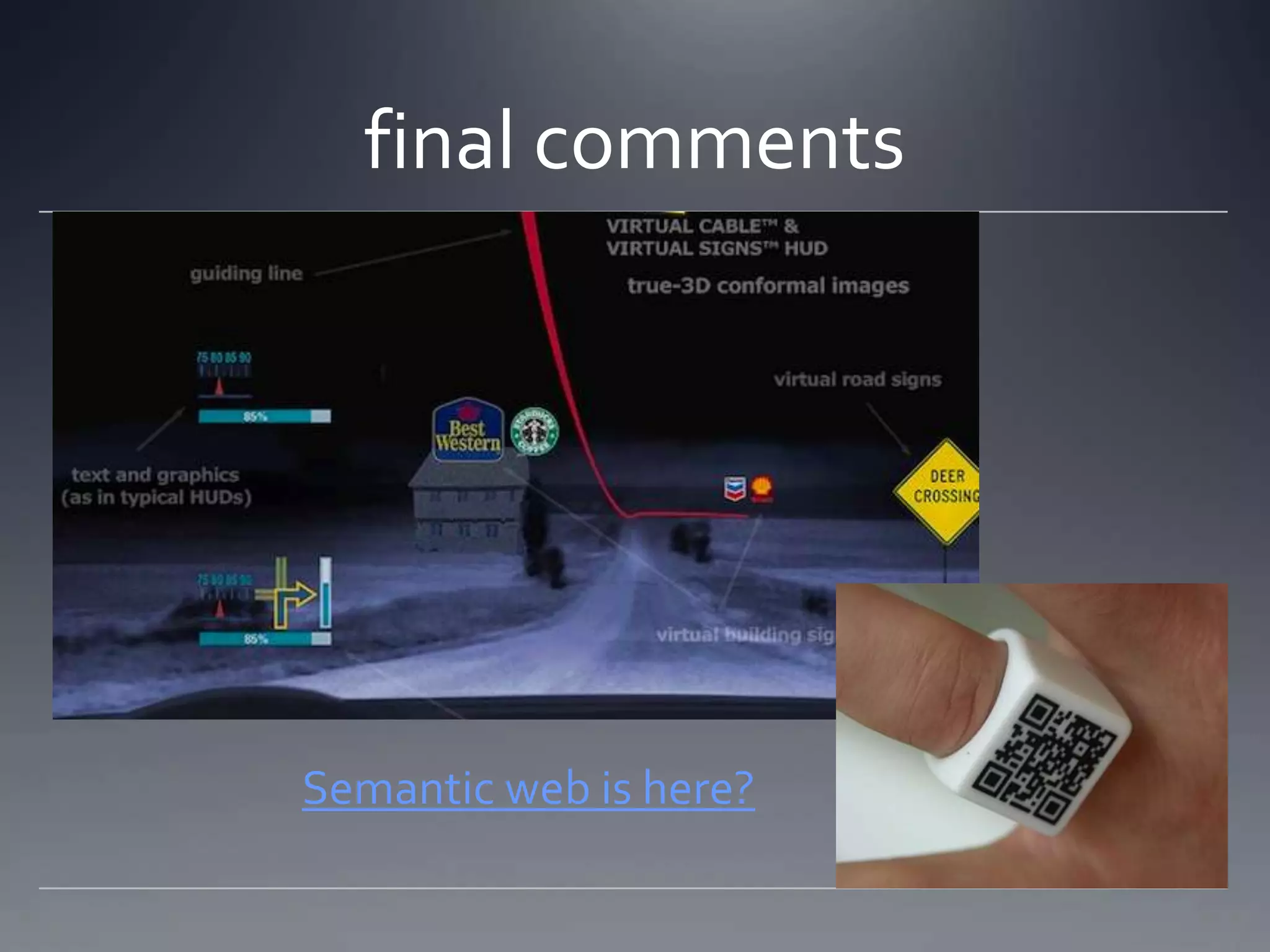
final comments


Semantic web is here?

Digital cultures - user generated content

  • 2.
    introduction  definition  context content  perspectives  theoretical  practical  user sophistication  conclusions
  • 3.
    definition The production ofcontent by the general public rather than by paid professionals and experts in the field. Also called "peer production", and mostly available on the Web via blogs and wikis, user-generated content refers to material such as the daily news, encyclopedias and other references, movie and product reviews as well as articles on any subject, all of which have been traditionally written by editors, journalists and academics. source: The Free Dictionary (online at http://encyclopedia2.thefreedictionary.com/user-generated+content)
  • 4.
    context  “Open-source software,blogs, song-sharing networks, free internet telephony – they’re each disrupting multibillion-dollar industries and reshaping the landscape of business, politics and culture. What’s the common threat behind them all? Us.” (Business Week 2005, The Power of Us)  Media fragmentation – radio, newspapers, magazines, TV
  • 5.
    context  Evolution of‘personal’ technologies & media – CD, Walkman, video games, PCs, video cassettes/recorders, mobile phone, DVD, QuickTime, internet, email, webcam, smartphone, satellite radio, HDTV, apps/iTunes, podcasting, blogs, RSS, Flickr, BitTorrent, YouTube, Wikipedia, machinima, virtual reality, augmented reality  Analogue to digital – image, audio, video, information, life > convergence of media
  • 7.
    context  mass media– passive, interruptive, one-way, mass communication ‘one size fits all’ “the ‘manipulated’ medium is the message” Machado (2007) on McLuhan (1964, Understanding Media: the Extensions of Man)
  • 8.
    context  user generated– active, two-way, one-to-one, conversational “everyone will be famous for 15 minutes” Warhol (1968 at ModernaMuseet Gallery, Stockholm) “… ‘we live in a remix culture’ – what was referred to in post- modern times as quoting, appropriation and pastiche no longer needs any special name…. its simply the basic logic of cultural production” Manovich (2001, Language of New Media)
  • 9.
    content  opinion, insight,experience, point of view  creative, collaborative, experiential “Google is not a search engine – it is a reputation management system… once you know the new rules you can use it to control your image in ways you never could before” Wired.com (The See-Through CEO)
  • 10.
    theoretical perspectives  selfidentity - gender, ethnicity, perceptions, beliefs, goals and values (Burr, 1995), roles fulfilled (Stryker and Burke 2000), attachment with objects (Hunt and Bashaw 1999)  online - multiple ‘personae’ unrestricted by real world norms (Rheingold 1993)  social identity - individual’s association with group(s) of others reflecting different intensity or importance depending on social environment (Ashforth and Mael 1989)  belonging to group(s) promotes ‘community’ (Zillman et al 1989), computer- mediated communication free from spatial and geographical boundaries yet brought together by common interests (Jones 1995)  networks and tribes – ‘community of emotion or passion’ (vs interest eg brand) (Kozinets 1990, Cova and Cova 2002)  co-creation and participation – consumers become producers participating in a value-creation process – they are PROSUMERS
  • 11.
    practical perspectives  organization– consumer reach (long tail)  media owner / developer – open source, beta, co-evolved, public domain  third party intermediaries (agencies) – viral marketing
  • 12.
    user sophistication  technicalcompetence  personal marketing  network management  virtual and augmented representation  growth vs self preservation
  • 13.
    Jantol 2011, DearFairy, Motion Builder Dear Fairy
  • 14.
    Branit 2007, WorldBuilder, Real Life & Second Life
  • 15.
    next steps?  whatforms of new media do you use?  justify the content you post  how does the medium influence the message/s?  how do you see media you use and content evolving?
  • 16.

Editor's Notes

  • #4 Peer production has usurped mass media
  • #5 Disruptive techs > the power to change the way things work – people and industry. UCG has resulted in a fundamental shift in ways mass media industries do business, especially advertising, print news, TV
  • #6 Disruptive techs > the power to change the way things work – people and industry. UCG has resulted in a fundamental shift in ways mass media industries do business, especially advertising, print news, TV
  • #8 From this – mass media…Characteristics of medium influence the content of the messageProfessionally made: crafted, self-promoting
  • #9 To this…Rehashed media – in the style of pop culture > Obama/Joker, games, mixed songs and Warhol‘rich’ media (blogs, wikis, etc) > viral, raw, handmadeMedia is ‘collaborative’ - enables participation through customization & sharingUnited – Dave Carroll complaint 10M+ Youtube views > spin offs as an inspirational speaker!http://www.davecarrollmusic.com/music/ubg-videos/
  • #10 Content of UGC is opinion, insight, experience, pov etc and because it speaks to individuals its potential has been recognised by marketers…..Harnessed by activists and organisations who realise viral is more powerful than mass media1:9:90 rule – 1% primary contributors, 9% contribute a little, 90% audience (lurkers)http://vimeo.com/10236827 – kit katPhaylen’s old spice spoof - http://www.youtube.com/watch?v=qwWesfI_qZM
  • #11 Some theoretical aspects to consider
  • #12 UGC is a way to reach consumers it is not practicable to do within the normal constraints of a business – the long tail is based on the pareto principle: 20% of customers account for 80% of income >>> 80% of customers account for 20% of income (such hard work!), this is a way of extending reach beyond this to a whole UNSERVED segment of the market.Whereas media owners and developers, such as game creators, now increasingly use open source and beta releases as a way of engaging consumers in a process of co-evolution > in a way it’s a form of strategic lock in, as co-creators you become bound to the product you helped to create.And the outgrowth from this activity is a raft of small business who focus on providing specialist expertise in generating slightly more professional UG type content to support industry in viral campaigns …. Attempting to take the uncertainty out of the whole process of ‘going viral’.
  • #13 In contrast to the industry perspectives, however, prosumers are themselves becoming increasingly sophisticated >>>>
  • #14 Eg illustrates technical competence and personal marketingTom Jantol’s award winning machinima – put to Danse Macabrehttp://www.youtube.com/watch?v=ZtmPN_c5auoDO YOU SEE IT AS - A WELL KNOWN PIECE OF MUSIC OR AS AN ORIGINAL ANIMATION?
  • #15 Eg illustrates integration of media, marketing and managementhttp://www.youtube.com/watch?v=VzFpg271sm8&feature=results_main&playnext=1&list=PL2A2FF21FC3ADCDBD
  • #16 In pairs, discuss – in groups share.
  • #17 True3D (HUD=heads up display) – next gen sat nav - tech HUDs (exists as a proof of concept only at the moment)Media embedded objects – QR ringWeb 3 / semantic web – hyperlinked content that can automatically perform tasks for users – Apple Siri is already here